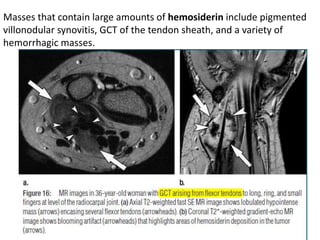
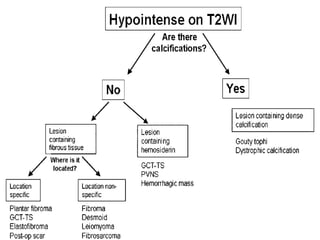
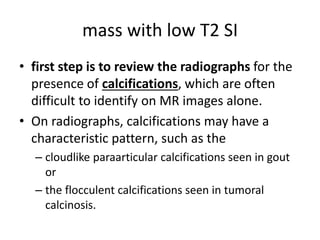
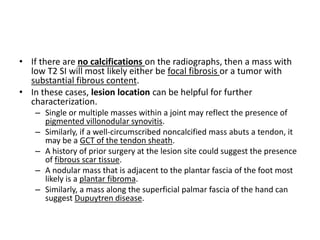
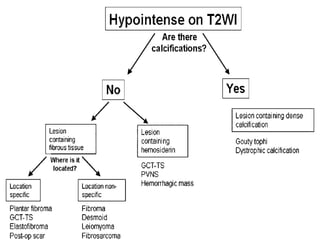
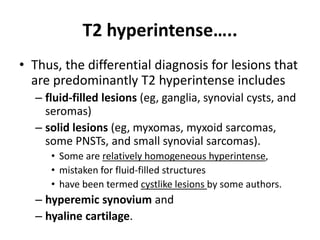
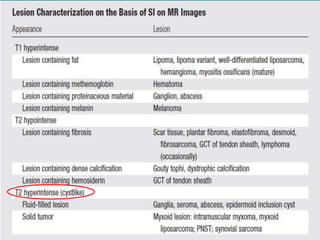
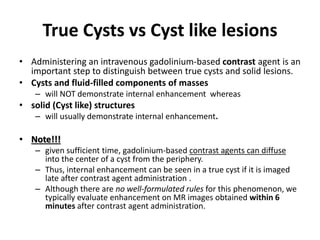
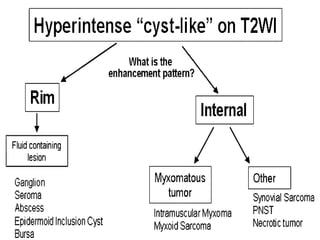
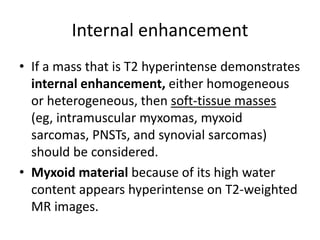
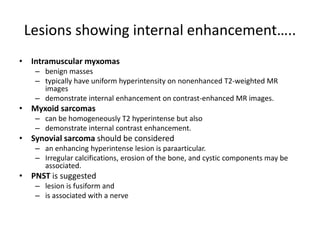
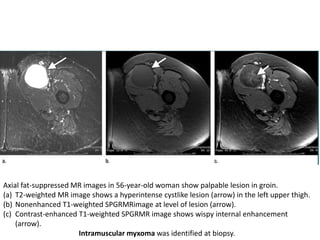
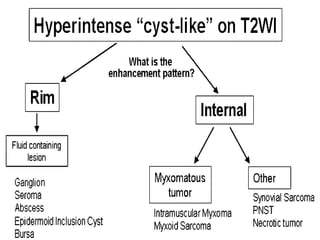
Introduction 
• The imaging evaluation of the soft tissues has 
undergone a rapid evolution with the application 
of computed tomography (CT), magnetic 
resonance imaging (MRI), and recently high 
resolution ultrasound (US). 
• Consideration must be given to the financial costs 
and invasiveness of each technique balanced 
against the diagnostic reward. 
• No examination should be reported in isolation 
without knowledge of relevant clinical details and 
results of previous investigations.
What is Soft Tissue??? 
• Soft tissue 
– derived primarily from mesenchyme and 
– consists of 
• skeletal muscle, 
• fat, 
• fibrous tissue, 
• the vascular structures 
• the peripheral nervous system.
IMAGING TECHNIQUES
Radiography 
• The relative lack of soft tissue contrast 
resolution is a well-recognized limitation of 
radiography.
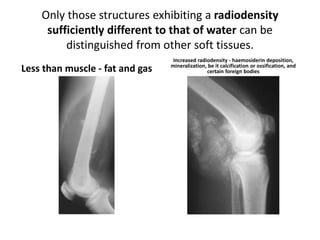
Only those structures exhibiting a radiodensity 
sufficiently different to that of water can be 
distinguished from other soft tissues. 
Less than muscle - fat and gas 
Increased radiodensity - haemosiderin deposition, 
mineralization, be it calcification or ossification, and 
certain foreign bodies
• A low kilovoltage technique will accentuate the 
density differences between fat and muscle. 
• Density differences can also be maximized with 
digital radiography where the broad exposure 
range means that it is difficult to make an 
inadequate exposure. A free choice of data 
processing allows control of the grey scales, 
contrast, etc., which can be optimized to 
highlight soft tissue disease.
Radiograph - Caution!!! 
• When evaluating a radiograph it is important to 
remember that numerous extraneous factors 
may mimic soft tissue abnormalities. These 
include skin folds, clothing, hair artefacts and 
companion shadows. 
• Also, iatrogenic conditions may pose diagnostic 
problems to the unwary such as the sites of old 
bismuth injections in the buttocks and tantalum 
gauze previously used in hernia repairs.
Ultrasound 
• Diagnostic ultrasound has been applied to the musculoskeletal system since B-mode techniques 
became available. There have been rapid developments in ultrasound technology over recent years 
and these, along with the have resulted in a vast expansion in the evaluation of the soft tissues. 
• Advantages of ultrasound include 
– widespread availability of ultrasound and 
– relatively low cost, 
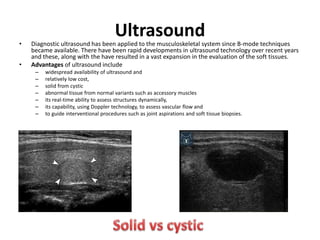
– solid from cystic 
– abnormal tissue from normal variants such as accessory muscles 
– its real-time ability to assess structures dynamically, 
– its capability, using Doppler technology, to assess vascular flow and 
– to guide interventional procedures such as joint aspirations and soft tissue biopsies.
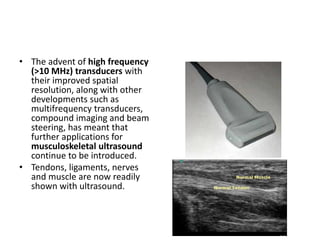
• The advent of high frequency 
(>10 MHz) transducers with 
their improved spatial 
resolution, along with other 
developments such as 
multifrequency transducers, 
compound imaging and beam 
steering, has meant that 
further applications for 
musculoskeletal ultrasound 
continue to be introduced. 
• Tendons, ligaments, nerves 
and muscle are now readily 
shown with ultrasound.
Ultrasound - Trade off!!! 
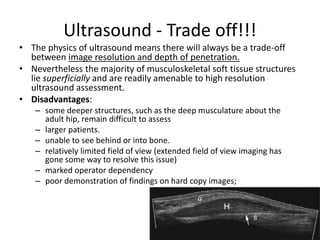
• The physics of ultrasound means there will always be a trade-off 
between image resolution and depth of penetration. 
• Nevertheless the majority of musculoskeletal soft tissue structures 
lie superficially and are readily amenable to high resolution 
ultrasound assessment. 
• Disadvantages: 
– some deeper structures, such as the deep musculature about the 
adult hip, remain difficult to assess 
– larger patients. 
– unable to see behind or into bone. 
– relatively limited field of view (extended field of view imaging has 
gone some way to resolve this issue) 
– marked operator dependency 
– poor demonstration of findings on hard copy images;
Computed tomography 
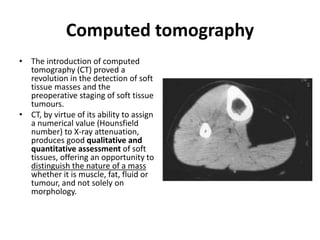
• The introduction of computed 
tomography (CT) proved a 
revolution in the detection of soft 
tissue masses and the 
preoperative staging of soft tissue 
tumours. 
• CT, by virtue of its ability to assign 
a numerical value (Hounsfield 
number) to X-ray attenuation, 
produces good qualitative and 
quantitative assessment of soft 
tissues, offering an opportunity to 
distinguish the nature of a mass 
whether it is muscle, fat, fluid or 
tumour, and not solely on 
morphology.
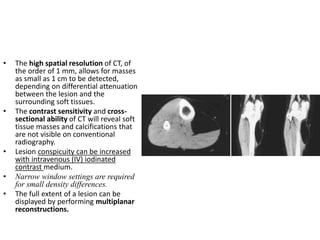
• The high spatial resolution of CT, of 
the order of 1 mm, allows for masses 
as small as 1 cm to be detected, 
depending on differential attenuation 
between the lesion and the 
surrounding soft tissues. 
• The contrast sensitivity and cross-sectional 
ability of CT will reveal soft 
tissue masses and calcifications that 
are not visible on conventional 
radiography. 
• Lesion conspicuity can be increased 
with intravenous (IV) iodinated 
contrast medium. 
• Narrow window settings are required 
for small density differences. 
• The full extent of a lesion can be 
displayed by performing multiplanar 
reconstructions.
Magnetic resonance imaging 
• advantage 
– not using ionizing radiation. 
– superior soft tissue contrast resolution and 
– multiplanar capability 
• Soft tissue lesions can be categorized by MRI 
according to 
– site, 
– morphological changes and 
– signal characteristics – helped by multitude of 
sequences.
• Contrast enhancement following the IV injection of a gadolinium chelate 
will result in a decrease in the T1 relaxation time and show up soft tissue 
lesions due to their different vascularization and perfusion. Enhancement 
can be most clearly identified on fat-suppressed T1-weighted images but 
enhancement is rarely necessary in the detection of soft tissue 
abnormalities where fat-suppressed T2-weighted or STIR sequences will 
suffice without the additional expense of the contrast medium. 
• Similarly, many soft tissue abnormalities can be adequately categorized 
on MRI without contrast medium, e.g. ganglion, lipoma, haemangioma, 
etc. In equivocal cases, contrast agents can be of value in helping to 
distinguish cystic from solid lesions and thereby identifying the most 
appropriate portion of a lesion to biopsy. 
• MRI is the best technique for staging soft tissue tumours and for follow-up. 
With the increasing use of adjuvant chemotherapy for soft tissue 
sarcomas, dynamic contrast-enhanced techniques will be increasingly 
used to assess angiogenesis and response.
Radionuclide imaging 
• Numerous soft tissue lesions concentrate bone-seeking radiopharmaceuticals. Any soft tissue 
abnormality with the propensity to develop mineralization can show ectopic activity on 
skeletal scintigraphy. These include congenital abnormalities such as fibrodysplasia ossificans 
progressiva , collagen vascular disorders such as dermatomyositis, trauma as in myositis 
ossificans and neoplasia as in extraskeletal osteosarcoma and synovial sarcoma. 
• Skeletal scintigraphy may be helpful in assessing the maturity of ectopic ossification as can 
be seen with spinal cord injuries. In this situation surgical resection is best deferred until the 
ossification becomes stable to minimize the risk of recurrence. 
• Scintigraphy is not routinely indicated in the surgical staging of soft tissue sarcomas. Local 
osseous extension is uncommon and is best demonstrated by MRI. Bone metastases from 
soft tissue sarcomas are rare in the absence of disseminated disease elsewhere, notably the 
lungs, but can be seen in alveolar soft part sarcoma and rhabdomyosarcoma. 
• Positron emission tomography (PET) with [F-18] fluorodeoxyglucose has not yet been widely 
studied for soft tissue lesions; it can be used to assess soft tissue tumour metabolism in order 
to grade tumours and to assess relapse. It may also be helpful in assessing malignant 
transformation of peripheral nerve sheath tumours in neurofibromatosis
RADIOGRAPHIC OBSERVATIONS
Calcification And Ossification 
• The deposition of amorphous calcium salts within 
the soft tissues is variously called mineralization 
or calcification. 
• Two forms of calcium salts may be found in the 
soft tissues: calcium pyrophosphate dihydrate 
and calcium hydroxyapatite. 
• If bony trabeculae are discernible within the 
mineralized focus the term ‘ossification’ is used, 
sometimes prefixed with the terms ectopic or 
heterotopic.
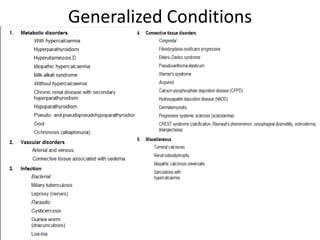
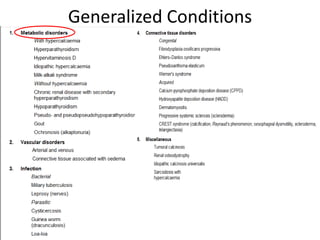
• There is a wide differential diagnosis, which 
can be divided into 
– generalized calcification, 
– localized calcification and 
– ossification
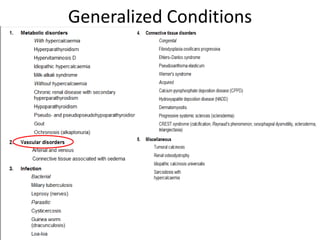
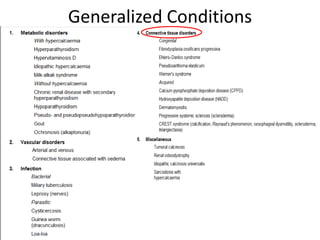
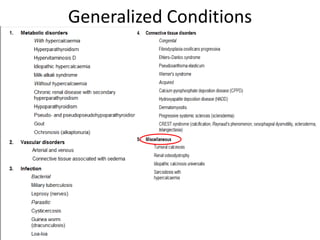
Generalized Conditions
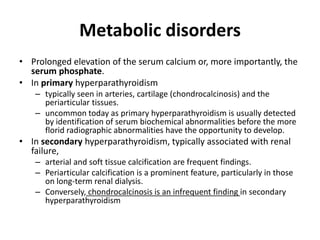
Metabolic disorders 
• Prolonged elevation of the serum calcium or, more importantly, the 
serum phosphate. 
• In primary hyperparathyroidism 
– typically seen in arteries, cartilage (chondrocalcinosis) and the 
periarticular tissues. 
– uncommon today as primary hyperparathyroidism is usually detected 
by identification of serum biochemical abnormalities before the more 
florid radiographic abnormalities have the opportunity to develop. 
• In secondary hyperparathyroidism, typically associated with renal 
failure, 
– arterial and soft tissue calcification are frequent findings. 
– Periarticular calcification is a prominent feature, particularly in those 
on long-term renal dialysis. 
– Conversely, chondrocalcinosis is an infrequent finding in secondary 
hyperparathyroidism
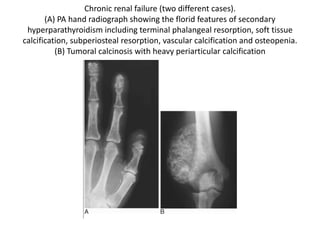
Chronic renal failure (two different cases). 
(A) PA hand radiograph showing the florid features of secondary 
hyperparathyroidism including terminal phalangeal resorption, soft tissue 
calcification, subperiosteal resorption, vascular calcification and osteopenia. 
(B) Tumoral calcinosis with heavy periarticular calcification
• In hypoparathyroidism there is a deficiency in parathormone (PTH), 
usually secondary to excision or surgical trauma but rarely 
idiopathic. Subcutaneous calcification, basal ganglia calcification, 
osteosclerosis and premature closure of epiphyses are typical of the 
primary disease. Occasionally, band-like paraspinal calcification may 
be seen mimicking diffuse idiopathic skeletal hyperostosis. 
• Pseudohypoparathyroidism, a rare inherited X-linked dominant 
disease in which there is end-organ resistance to PTH, exhibits 
similar features to hypoparathyroidism. Features that distinguish it 
from hypoparathyroidism are growth deformities, with broad bones 
and cone epiphyses, brachydactyly with short metacarpals and 
metatarsals, especially the first, fourth and fifth, and small 
exostoses projected at right angles from the bone. 
• In pseudopseudohypoparathyroidism, in which the serum calcium 
and phosphate levels are normal, the radiographic abnormalities 
are identical to those of pseudohypoparathyroidism.
• Hypervitaminosis D usually occurs due to the administration of excessive levels of the vitamin in 
the treatment of rickets and osteomalacia but can also be found in granulomatous diseases, Paget's 
disease and rheumatological conditions such as rheumatoid arthritis and gout. Smooth, lobulated 
amorphous masses of calcium, usually calcium hydroxyapatite, occur in the periarticular regions, 
bursae, tendons sheaths, and both within the capsule and cavity of joints. The bony manifestations 
of vitamin D intoxication depend on the age of the patient, with dense metaphyseal bands and 
cortical thickening with or without generalized osteosclerosis seen in infants and children. Adults 
merely show varying degrees of osteoporosis. 
• A generalized increase in bone density is a feature of idiopathic infantile hypercalcaemia where 
there are associated clinical manifestations of hypotonia and mental and physical retardation. The 
condition is thought to be due to inappropriate sensitivity to vitamin D. 
• Milk-alkali syndrome is reported in patients with chronic peptic ulcer disease and renal impairment 
in whom the excessive ingestion of alkali, usually calcium carbonate, and milk leads to diffuse 
calcifications in the soft tissues, kidneys and eyes. Reversibility depends on the chronicity of the 
disorder. The soft tissue calcifications are typically periarticular, amorphous and vary in size from 
small nodules to large masses. Similar deposits may be seen in renal osteodystrophy, collagen 
vascular disorders, hypervitaminosis D and idiopathic tumoral calcinosis. 
• Deposits of monosodium urate in gout, so-called ‘tophi’, are not radio-opaque. However, 
calcification within the tophi can occur as a secondary phenomenon. The incidence of chronic 
tophaceous gout has decreased considerably with the introduction of effective anti-uricaemic 
drugs.
Generalized Conditions
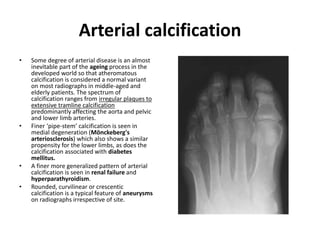
Arterial calcification 
• Some degree of arterial disease is an almost 
inevitable part of the ageing process in the 
developed world so that atheromatous 
calcification is considered a normal variant 
on most radiographs in middle-aged and 
elderly patients. The spectrum of 
calcification ranges from irregular plaques to 
extensive tramline calcification 
predominantly affecting the aorta and pelvic 
and lower limb arteries. 
• Finer ‘pipe-stem’ calcification is seen in 
medial degeneration (Mönckeberg's 
arteriosclerosis) which also shows a similar 
propensity for the lower limbs, as does the 
calcification associated with diabetes 
mellitus. 
• A finer more generalized pattern of arterial 
calcification is seen in renal failure and 
hyperparathyroidism. 
• Rounded, curvilinear or crescentic 
calcification is a typical feature of aneurysms 
on radiographs irrespective of site.
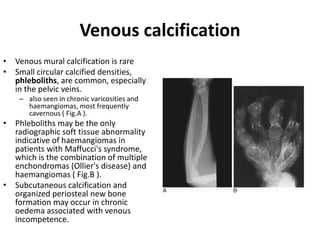
Venous calcification 
• Venous mural calcification is rare 
• Small circular calcified densities, 
phleboliths, are common, especially 
in the pelvic veins. 
– also seen in chronic varicosities and 
haemangiomas, most frequently 
cavernous ( Fig.A ). 
• Phleboliths may be the only 
radiographic soft tissue abnormality 
indicative of haemangiomas in 
patients with Maffucci's syndrome, 
which is the combination of multiple 
enchondromas (Ollier's disease) and 
haemangiomas ( Fig.B ). 
• Subcutaneous calcification and 
organized periosteal new bone 
formation may occur in chronic 
oedema associated with venous 
incompetence.
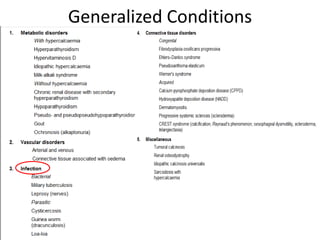
Generalized Conditions
Bacterial 
• Diffuse calcification is 
extremely rare in bacterial 
infection. Dystrophic 
calcification may occur in 
resolving abscesses, 
particularly in tuberculosis of 
the spine. 
• Extensive calcified 
lymphadenitis is highly 
suggestive of an old 
tuberculous infection and, in 
endemic areas, the fungal 
infections histoplasmosis and 
coccidioidomycosis. 
• Leprosy is a rare cause of 
nerve calcification.
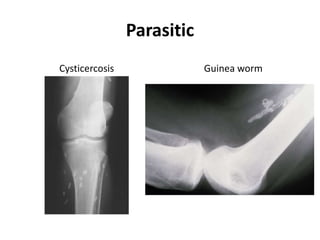
Parasitic 
Cysticercosis Guinea worm
Generalized Conditions
Congenital 
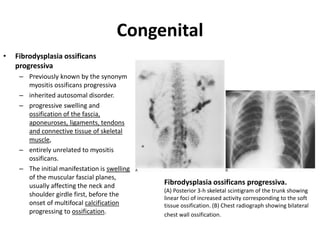
• Fibrodysplasia ossificans 
progressiva 
– Previously known by the synonym 
myositis ossificans progressiva 
– inherited autosomal disorder. 
– progressive swelling and 
ossification of the fascia, 
aponeuroses, ligaments, tendons 
and connective tissue of skeletal 
muscle, 
– entirely unrelated to myositis 
ossificans. 
– The initial manifestation is swelling 
of the muscular fascial planes, 
usually affecting the neck and 
shoulder girdle first, before the 
onset of multifocal calcification 
progressing to ossification. 
Fibrodysplasia ossificans progressiva. 
(A) Posterior 3-h skeletal scintigram of the trunk showing 
linear foci of increased activity corresponding to the soft 
tissue ossification. (B) Chest radiograph showing bilateral 
chest wall ossification.
Congenital 
• Fibrodysplasia ossificans 
progressiva 
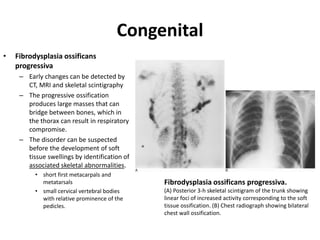
– Early changes can be detected by 
CT, MRI and skeletal scintigraphy 
– The progressive ossification 
produces large masses that can 
bridge between bones, which in 
the thorax can result in respiratory 
compromise. 
– The disorder can be suspected 
before the development of soft 
tissue swellings by identification of 
associated skeletal abnormalities. 
• short first metacarpals and 
metatarsals 
• small cervical vertebral bodies 
with relative prominence of the 
pedicles. 
Fibrodysplasia ossificans progressiva. 
(A) Posterior 3-h skeletal scintigram of the trunk showing 
linear foci of increased activity corresponding to the soft 
tissue ossification. (B) Chest radiograph showing bilateral 
chest wall ossification.
Acquired 
Crystal deposition diseases 
Crystal deposition in a joint will stimulate a synovitis 
due to one of the following crystalline 
arthropathies: 
1. gout 
2. calcium pyrophosphate dihydrate deposition disease 
(CPPD) 
3. calcium hydroxyapatite deposition disease (HADD) 
4. mixed crystal deposition disease.
CPPD 
• CPPD is the general term for the deposition of 
calcium pyrophosphate dihydrate crystals in and 
around joints, and in the annulus of the 
intervertebral disc. 
 The latter is a useful distinguishing feature from ochronosis 
which involves the nucleus pulposus. 
• There are three manifestations of CPPD, 
– acute intermittent synovitis (pseudogout), 
– chronic pyrophosphate arthropathy and 
– chondrocalcinosis
• Pyrophosphate arthropathy has many similar 
radiographic appearances to osteoarthritis. 
• It is for this reason that many cases will pass through 
orthopaedic clinics simply labelled as osteoarthritis. 
• Features suggestive of pyrophosphate arthropathy 
include 
– unusual distribution (e.g. patellofemoral, radiocarpal and 
elbow joints), 
– prominent subchondral cyst formation and 
– relative paucity of osteophytes.
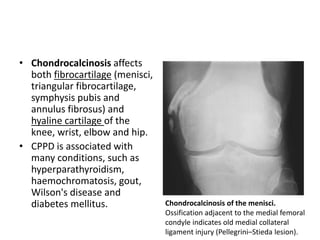
• Chondrocalcinosis affects 
both fibrocartilage (menisci, 
triangular fibrocartilage, 
symphysis pubis and 
annulus fibrosus) and 
hyaline cartilage of the 
knee, wrist, elbow and hip. 
• CPPD is associated with 
many conditions, such as 
hyperparathyroidism, 
haemochromatosis, gout, 
Wilson's disease and 
diabetes mellitus. Chondrocalcinosis of the menisci. 
Ossification adjacent to the medial femoral 
condyle indicates old medial collateral 
ligament injury (Pellegrini–Stieda lesion).
Calcium hydroxyapatite deposition disease 
(HADD) 
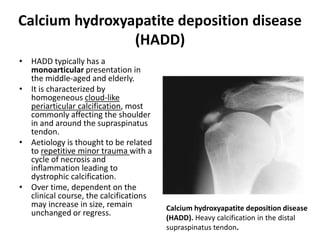
• HADD typically has a 
monoarticular presentation in 
the middle-aged and elderly. 
• It is characterized by 
homogeneous cloud-like 
periarticular calcification, most 
commonly affecting the shoulder 
in and around the supraspinatus 
tendon. 
• Aetiology is thought to be related 
to repetitive minor trauma with a 
cycle of necrosis and 
inflammation leading to 
dystrophic calcification. 
• Over time, dependent on the 
clinical course, the calcifications 
may increase in size, remain 
unchanged or regress. 
Calcium hydroxyapatite deposition disease 
(HADD). Heavy calcification in the distal 
supraspinatus tendon.
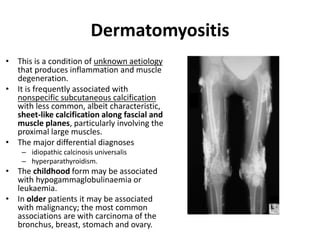
Dermatomyositis 
• This is a condition of unknown aetiology 
that produces inflammation and muscle 
degeneration. 
• It is frequently associated with 
nonspecific subcutaneous calcification 
with less common, albeit characteristic, 
sheet-like calcification along fascial and 
muscle planes, particularly involving the 
proximal large muscles. 
• The major differential diagnoses 
– idiopathic calcinosis universalis 
– hyperparathyroidism. 
• The childhood form may be associated 
with hypogammaglobulinaemia or 
leukaemia. 
• In older patients it may be associated 
with malignancy; the most common 
associations are with carcinoma of the 
bronchus, breast, stomach and ovary.
Progressive systemic sclerosis 
(scleroderma) 
• This condition, with unknown aetiology, causes 
small vessel disease and fibrosis in several 
organs. 
• Scleroderma is the cutaneous manifestation of 
the disease. 
• It often presents with Raynaud's phenomenon 
and skin changes. 
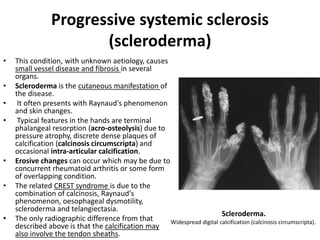
• Typical features in the hands are terminal 
phalangeal resorption (acro-osteolysis) due to 
pressure atrophy, discrete dense plaques of 
calcification (calcinosis circumscripta) and 
occasional intra-articular calcification. 
• Erosive changes can occur which may be due to 
concurrent rheumatoid arthritis or some form 
of overlapping condition. 
• The related CREST syndrome is due to the 
combination of calcinosis, Raynaud's 
phenomenon, oesophageal dysmotility, 
scleroderma and telangiectasia. 
• The only radiographic difference from that 
described above is that the calcification may 
also involve the tendon sheaths. 
Scleroderma. 
Widespread digital calcification (calcinosis circumscripta).
Generalized Conditions
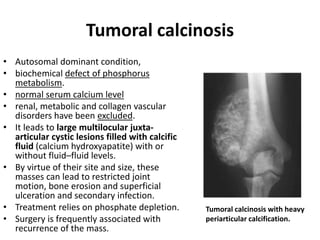
Tumoral calcinosis 
• Autosomal dominant condition, 
• biochemical defect of phosphorus 
metabolism. 
• normal serum calcium level 
• renal, metabolic and collagen vascular 
disorders have been excluded. 
• It leads to large multilocular juxta-articular 
cystic lesions filled with calcific 
fluid (calcium hydroxyapatite) with or 
without fluid–fluid levels. 
• By virtue of their site and size, these 
masses can lead to restricted joint 
motion, bone erosion and superficial 
ulceration and secondary infection. 
• Treatment relies on phosphate depletion. 
• Surgery is frequently associated with 
recurrence of the mass. 
Tumoral calcinosis with heavy 
periarticular calcification.
Localized Conditions
CALCIFICATION—LOCALIZED 
• The first radiographic sign of soft tissue 
mineralization will be faint calcification. 
• In time this may become more extensive and 
therefore more conspicuous. 
• Alternatively, in certain conditions the 
mineralization can develop into woven bone. 
Therefore, localized calcification may be the 
precursor of conditions typically associated 
with ossification.
Trauma 
• Any condition that results in focal soft tissue necrosis may 
predispose to calcification. 
– These include injection sites, radiation damage to the soft 
tissues and thermal injuries, both burns and frost-bite. 
• Blunt trauma may cause fat necrosis within the 
subcutaneous tissues with areas of dystrophic calcification. 
• Calcification of atrophic muscles may be seen 1–2 months 
after severe crush injury (calcific myonecrosis). 
• Any haematoma, particularly if in a subperiosteal location, 
may calcify. 
– This includes the subperiosteal (pericranial) haematoma seen in 
the skull of babies, usually as a result of birth trauma.
Tumours 
• Widespread soft tissue calcification is a rare 
manifestation of disseminated malignancies 
(e.g. metastases, leukaemia and myeloma) 
where there is hypercalcaemia associated with 
extensive bone destruction. 
• Localized intratumoral calcification may occur 
within any soft tissue tumour due to 
haemorrhage and/or necrosis. 
• Benign soft tissue tumours with the propensity 
to mineralize include soft tissue chondromas 
(punctate or ‘ring-and-arc’ calcification), 
lipomas, particularly if in a parosteal location 
(ossification), haemangiomas (phleboliths) and 
soft tissue aneurysmal bone cyst. 
• The typical malignant soft tissue tumours that 
calcify are extraskeletal osteosarcoma, 
extraskeletal chondrosarcoma and synovial 
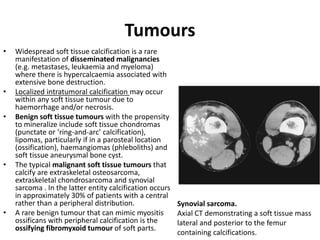
sarcoma . In the latter entity calcification occurs 
in approximately 30% of patients with a central 
rather than a peripheral distribution. 
• A rare benign tumour that can mimic myositis 
ossificans with peripheral calcification is the 
ossifying fibromyxoid tumour of soft parts. 
Synovial sarcoma. 
Axial CT demonstrating a soft tissue mass 
lateral and posterior to the femur 
containing calcifications.
OSSIFICATION 
• Many calcifying lesions may proceed to 
ossification with the production of woven 
bone. 
• The deposits of calcium salts tend to be more 
densely sclerotic than comparable amounts of 
bone. If there is doubt, CT can readily 
distinguish the amorphous quality of calcium 
salts from the trabecular pattern of ossification. 
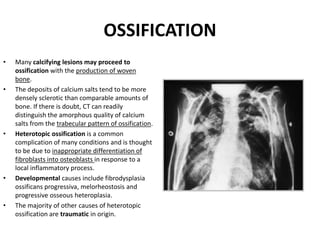
• Heterotopic ossification is a common 
complication of many conditions and is thought 
to be due to inappropriate differentiation of 
fibroblasts into osteoblasts in response to a 
local inflammatory process. 
• Developmental causes include fibrodysplasia 
ossificans progressiva, melorheostosis and 
progressive osseous heteroplasia. 
• The majority of other causes of heterotopic 
ossification are traumatic in origin.
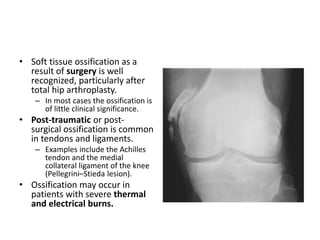
• Soft tissue ossification as a 
result of surgery is well 
recognized, particularly after 
total hip arthroplasty. 
– In most cases the ossification is 
of little clinical significance. 
• Post-traumatic or post-surgical 
ossification is common 
in tendons and ligaments. 
– Examples include the Achilles 
tendon and the medial 
collateral ligament of the knee 
(Pellegrini–Stieda lesion). 
• Ossification may occur in 
patients with severe thermal 
and electrical burns.
• Acute detachment or repeated 
trauma to a tendino-osseous 
junction can lead to soft tissue 
ossification with underlying 
cortical irregularity. 
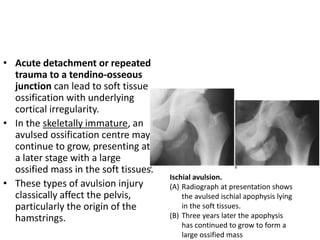
• In the skeletally immature, an 
avulsed ossification centre may 
continue to grow, presenting at 
a later stage with a large 
ossified mass in the soft tissues. 
• These types of avulsion injury 
classically affect the pelvis, 
particularly the origin of the 
hamstrings. 
Ischial avulsion. 
(A) Radiograph at presentation shows 
the avulsed ischial apophysis lying 
in the soft tissues. 
(B) Three years later the apophysis 
has continued to grow to form a 
large ossified mass
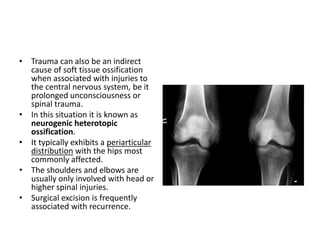
• Trauma can also be an indirect 
cause of soft tissue ossification 
when associated with injuries to 
the central nervous system, be it 
prolonged unconsciousness or 
spinal trauma. 
• In this situation it is known as 
neurogenic heterotopic 
ossification. 
• It typically exhibits a periarticular 
distribution with the hips most 
commonly affected. 
• The shoulders and elbows are 
usually only involved with head or 
higher spinal injuries. 
• Surgical excision is frequently 
associated with recurrence.
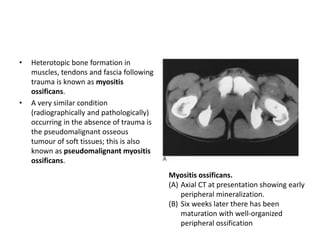
• Heterotopic bone formation in 
muscles, tendons and fascia following 
trauma is known as myositis 
ossificans. 
• A very similar condition 
(radiographically and pathologically) 
occurring in the absence of trauma is 
the pseudomalignant osseous 
tumour of soft tissues; this is also 
known as pseudomalignant myositis 
ossificans. 
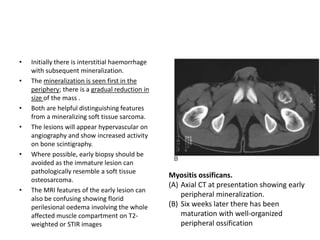
Myositis ossificans. 
(A) Axial CT at presentation showing early 
peripheral mineralization. 
(B) Six weeks later there has been 
maturation with well-organized 
peripheral ossification
• Initially there is interstitial haemorrhage 
with subsequent mineralization. 
• The mineralization is seen first in the 
periphery; there is a gradual reduction in 
size of the mass . 
• Both are helpful distinguishing features 
from a mineralizing soft tissue sarcoma. 
• The lesions will appear hypervascular on 
angiography and show increased activity 
on bone scintigraphy. 
• Where possible, early biopsy should be 
avoided as the immature lesion can 
pathologically resemble a soft tissue 
osteosarcoma. 
• The MRI features of the early lesion can 
also be confusing showing florid 
perilesional oedema involving the whole 
affected muscle compartment on T2- 
weighted or STIR images 
Myositis ossificans. 
(A) Axial CT at presentation showing early 
peripheral mineralization. 
(B) Six weeks later there has been 
maturation with well-organized 
peripheral ossification
GAS IN SOFT TISSUES 
• Gas/air may be introduced into the soft tissues 
from within and without the body. 
• It may also be formed directly within the soft 
tissues. Gas in the soft tissue can be recognized 
radiographically by increased radiolucency 
outlining the soft tissue planes. 
• Care should be taken not to confuse ectopic 
viscera with soft tissue gas. A prime example 
would be bowel gas within an inguinal hernia 
which can overlie the soft tissues of the groin or 
scrotum.
Gas introduced from within 
• Air may enter the soft tissues 
whenever there is a breach in the 
integrity of the lining of either the 
respiratory or gastrointestinal tract. 
• In the chest and retroperitoneum 
this is known as surgical 
emphysema. 
• Common causes in the chest 
include 
– blunt trauma with a fractured rib 
puncturing the lung, 
– penetrating lung trauma and 
– following chest surgery. 
– complication of interventional 
procedures such as the insertion of 
central lines and biopsy and drainage 
procedures.
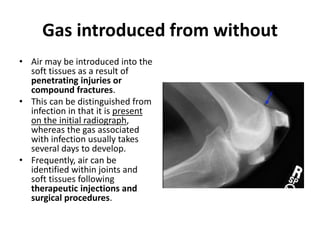
Gas introduced from without 
• Air may be introduced into the 
soft tissues as a result of 
penetrating injuries or 
compound fractures. 
• This can be distinguished from 
infection in that it is present 
on the initial radiograph, 
whereas the gas associated 
with infection usually takes 
several days to develop. 
• Frequently, air can be 
identified within joints and 
soft tissues following 
therapeutic injections and 
surgical procedures.
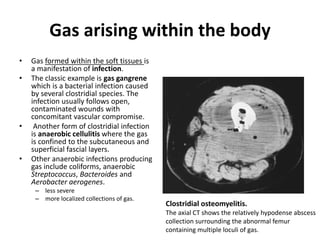
Gas arising within the body 
• Gas formed within the soft tissues is 
a manifestation of infection. 
• The classic example is gas gangrene 
which is a bacterial infection caused 
by several clostridial species. The 
infection usually follows open, 
contaminated wounds with 
concomitant vascular compromise. 
• Another form of clostridial infection 
is anaerobic cellulitis where the gas 
is confined to the subcutaneous and 
superficial fascial layers. 
• Other anaerobic infections producing 
gas include coliforms, anaerobic 
Streptococcus, Bacteroides and 
Aerobacter aerogenes. 
– less severe 
– more localized collections of gas. 
Clostridial osteomyelitis. 
The axial CT shows the relatively hypodense abscess 
collection surrounding the abnormal femur 
containing multiple loculi of gas.
SOFT TISSUE INFECTION 
• Infections in the soft tissues are common and may 
require percutaneous or surgical intervention. 
• Gas may be seen in the soft tissues in association with 
infection 
• The appearance of soft tissue calcification seen with 
parasitic infections, healing abscesses and tuberculosis. 
• With the exception of soft tissue swelling and blurring 
of normal fat planes, most soft tissue infections do not 
give rise to radiographic changes and cross-sectional 
imaging techniques are required.
Abscess 
• Abscesses may develop in the soft tissues 
either from extrinsic sources, for instance 
following a puncture wound, or from an 
intrinsic source either via haematogenous 
spread or direct spread from a nearby 
source such as a bowel fistula or infected 
joint. 
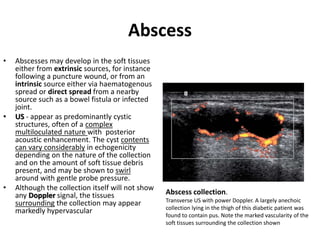
• US - appear as predominantly cystic 
structures, often of a complex 
multiloculated nature with posterior 
acoustic enhancement. The cyst contents 
can vary considerably in echogenicity 
depending on the nature of the collection 
and on the amount of soft tissue debris 
present, and may be shown to swirl 
around with gentle probe pressure. 
• Although the collection itself will not show 
any Doppler signal, the tissues 
surrounding the collection may appear 
markedly hypervascular 
Abscess collection. 
Transverse US with power Doppler. A largely anechoic 
collection lying in the thigh of this diabetic patient was 
found to contain pus. Note the marked vascularity of the 
soft tissues surrounding the collection shown
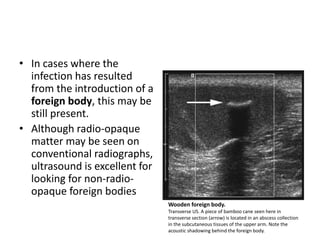
• In cases where the 
infection has resulted 
from the introduction of a 
foreign body, this may be 
still present. 
• Although radio-opaque 
matter may be seen on 
conventional radiographs, 
ultrasound is excellent for 
looking for non-radio-opaque 
foreign bodies 
Wooden foreign body. 
Transverse US. A piece of bamboo cane seen here in 
transverse section (arrow) is located in an abscess collection 
in the subcutaneous tissues of the upper arm. Note the 
acoustic shadowing behind the foreign body.
• MRI and CT will also both show abscess 
collections and may be required for deep-seated 
abscesses such as those in the psoas 
muscle or deep gluteal region. 
• US or CT is ideally suited for guiding aspiration 
and drainage of soft tissue abscess collections.
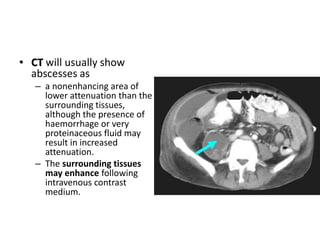
• CT will usually show 
abscesses as 
– a nonenhancing area of 
lower attenuation than the 
surrounding tissues, 
although the presence of 
haemorrhage or very 
proteinaceous fluid may 
result in increased 
attenuation. 
– The surrounding tissues 
may enhance following 
intravenous contrast 
medium.
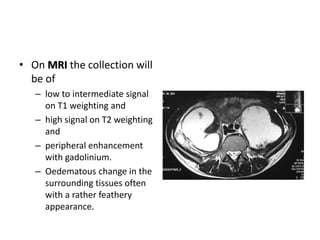
• On MRI the collection will 
be of 
– low to intermediate signal 
on T1 weighting and 
– high signal on T2 weighting 
and 
– peripheral enhancement 
with gadolinium. 
– Oedematous change in the 
surrounding tissues often 
with a rather feathery 
appearance.
Pyomyositis 
• In the western world pyomyositis is most frequently 
seen in immunocompromised individuals. 
• MRI best shows 
– generalized change seen throughout the affected muscle 
– heterogeneous increased signal on T2-weighted imaging, 
• Ultrasound will also show 
– generalized alteration in echogenicity. 
• As the disease progresses, small pockets of fluid form 
within the muscle with similar imaging characteristics 
to abscesses. 
• MRI is the most sensitive investigation in pyomyositis.
Cellulitis 
• Cellulitis represents a superficial infection involving the subcutaneous 
tissues. 
• Clinically the tissues appear erythematous and swollen. 
• Imaging reveals thickening of the skin and subcutaneous tissues. Fluid is 
seen tracking between the lobules of subcutaneous fat. 
• On Ultrasound 
– low reflective septa, 
• On T2-weighted MRI 
– these thickened septa yield increased signal. 
– Increased signal is also seen in the skin itself and underlying fascia. 
• Since these changes are nonspecific and will be seen with noninfective 
causes of soft tissue oedema, clinical correlation is essential. 
• Imaging remains useful to demonstrate any associated abscess 
formation and may be required to exclude involvement of other local 
structures such as bone or joint.
NEUROMUSCULAR DISORDERS 
• A wide-ranging and diverse group of conditions can be considered under 
the broad heading of neuromuscular disorders. These include the 
congenital and acquired myopathies and neuropathies, all of which bring 
about muscle changes as their end point. 
• Conditions include 
– those affecting the nerve supply to muscles, such as the congenital and 
acquired spinal muscle atrophies and peripheral neuropathies, and 
– those affecting the muscles themselves such as the congenital, inflammatory 
and metabolic dystrophies and myopathies. 
• The key changes seen in muscle pathology (seen on imaging) are 

– hypertrophy and atrophy, 
– oedema-like change 
– fat infiltration and 
– calcification. 
 The term ‘oedema-like’ change is preferred to oedematous, as muscles 
showing this change on MRI are not actually oedematous when examined 
histologically.
Conventional radiographs 
• Limited role to play in the diagnosis of these 
conditions. 
– Fat atrophy may be apparent on plain radiography 
– Calcification within skeletal muscle can be seen 
both following trauma (as in myositis ossificans) 
and in inflammatory conditions such as 
dermatomyositis.
Ultrasound 
• Hypertrophy and atrophy may be detected 
– difficult to appreciate when generalized. 
• Fat infiltration is easier to recognize on US 
– normal striated architecture of the muscle is lost and the 
affected muscles show an increase in reflectivity. 
• Advantages: 
– when nerve compression is suspected as many of the 
peripheral nerves can be easily followed and causes of nerve 
entrapment may be identified. 
– role in guiding muscle biopsies. 
• The main disadvantage of US 
– small field of view, which makes it a difficult tool for examining 
generalized muscle conditions.
CT 
• Atrophy, hypertrophy and fat infiltration are easier 
to identify on CT 
• larger areas of muscle can be screened effectively.
MRI 
• Normal muscle shows intermediate signal on both T1- and 
T2-weighted imaging. 
• Indeed, when MRI changes are reported as showing high or 
low signal, this is usually assessed relative to skeletal 
muscle. 
• Fat appears bright on T1-weighted imaging and its signal 
can be suppressed using standard techniques such as 
inversion recovery and spectral fat suppression. 
• Consequently fat infiltration of muscle is easy to recognize 
on MRI. 
• Oedema-like change in muscle will appear as increased 
signal on T2-weighted imaging, and this is most clearly 
shown on fat-suppressed T2 and STIR imaging.
MRI - technique 
• T1 and fat-suppressed T2 (or STIR) sequences are 
fundamental to the diagnosis of neuromuscular 
disorders. 
• coronal and sagittal imaging 
– useful in assessing the longitudinal extent of muscle 
involvement, 
• axial imaging 
– demonstration of the muscle compartments for identifying 
patterns of muscle involvement and the individual muscles 
or muscle groups involved. 
– making comparisons with contralateral side in 
asymmetrical disease.
MRI in neuromuscular pathology 
• The signal changes seen on MRI in neuromuscular 
pathology are nonspecific 
• Generally not helpful in distinguishing between 
different types of disease. 
• The pattern of signal intensity does give some 
useful information about the chronicity of a 
muscle disorder. 
– Fat infiltration represents a long-standing irreversible 
process, 
– while oedema-like signal change represents acute or 
subacute and potentially reversible muscle damage.
Muscle denervation 
• MRI is not very sensitive to early changes in 
muscle following denervation. 
• The earliest reliable changes are seen after 
around 1 month 
– the affected muscle or muscles yielding increased 
signal on T2-weighted and STIR imaging. 
• About a year after denervation 
– fatty infiltration becomes apparent
SOFT TISSUE INJURY 
• The advent of MRI and high resolution US has 
revolutionized our ability to image soft tissue 
injury. 
• Soft tissue injuries can be grouped into acute 
injuries or more chronic injuries which 
generally occur as a result of sustained or 
repetitive trauma. 
• A brief overview of the role of imaging in 
tendon and muscle injury is given here.
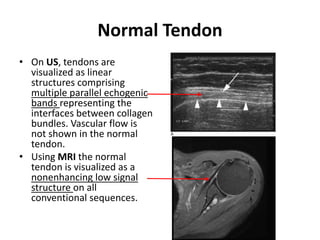
Normal Tendon 
• On US, tendons are 
visualized as linear 
structures comprising 
multiple parallel echogenic 
bands representing the 
interfaces between collagen 
bundles. Vascular flow is 
not shown in the normal 
tendon. 
• Using MRI the normal 
tendon is visualized as a 
nonenhancing low signal 
structure on all 
conventional sequences.
A word of caution!!! 
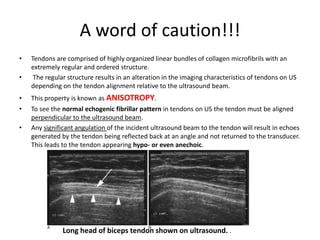
• Tendons are comprised of highly organized linear bundles of collagen microfibrils with an 
extremely regular and ordered structure. 
• The regular structure results in an alteration in the imaging characteristics of tendons on US 
depending on the tendon alignment relative to the ultrasound beam. 
• This property is known as ANISOTROPY. 
• To see the normal echogenic fibrillar pattern in tendons on US the tendon must be aligned 
perpendicular to the ultrasound beam. 
• Any significant angulation of the incident ultrasound beam to the tendon will result in echoes 
generated by the tendon being reflected back at an angle and not returned to the transducer. 
This leads to the tendon appearing hypo- or even anechoic. 
Long head of biceps tendon shown on ultrasound. .
A word of caution!!! 
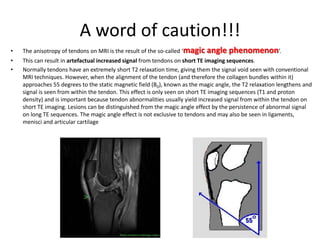
• The anisotropy of tendons on MRI is the result of the so-called ‘magic angle phenomenon’. 
• This can result in artefactual increased signal from tendons on short TE imaging sequences. 
• Normally tendons have an extremely short T2 relaxation time, giving them the signal void seen with conventional 
MRI techniques. However, when the alignment of the tendon (and therefore the collagen bundles within it) 
approaches 55 degrees to the static magnetic field (B0), known as the magic angle, the T2 relaxation lengthens and 
signal is seen from within the tendon. This effect is only seen on short TE imaging sequences (T1 and proton 
density) and is important because tendon abnormalities usually yield increased signal from within the tendon on 
short TE imaging. Lesions can be distinguished from the magic angle effect by the persistence of abnormal signal 
on long TE sequences. The magic angle effect is not exclusive to tendons and may also be seen in ligaments, 
menisci and articular cartilage
Chronic tendon injury 
• Chronic or repetitive trauma to a tendon 
results in degenerative change within the 
tendon which has become known as 
tendinopathy or tendinosis. 
• Changes seen within the tendon include 
degeneration and disorganization of the 
collagen bundles along with vascular 
ingrowth.
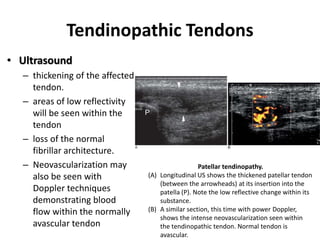
Tendinopathic Tendons 
• Ultrasound 
– thickening of the affected 
tendon. 
– areas of low reflectivity 
will be seen within the 
tendon 
– loss of the normal 
fibrillar architecture. 
– Neovascularization may 
also be seen with 
Doppler techniques 
demonstrating blood 
flow within the normally 
avascular tendon 
Patellar tendinopathy. 
(A) Longitudinal US shows the thickened patellar tendon 
(between the arrowheads) at its insertion into the 
patella (P). Note the low reflective change within its 
substance. 
(B) A similar section, this time with power Doppler, 
shows the intense neovascularization seen within 
the tendinopathic tendon. Normal tendon is 
avascular.
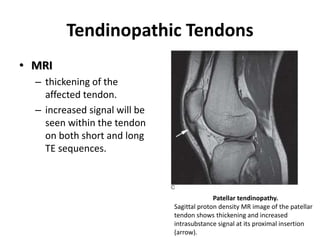
Tendinopathic Tendons 
• MRI 
– thickening of the 
affected tendon. 
– increased signal will be 
seen within the tendon 
on both short and long 
TE sequences. 
Patellar tendinopathy. 
Sagittal proton density MR image of the patellar 
tendon shows thickening and increased 
intrasubstance signal at its proximal insertion 
(arrow).
• Some tendons, such as the extensors and 
flexors of the hand and foot, have a synovial 
tendon sheath; where this becomes involved 
in the process the condition is known as 
tenosynovitis.
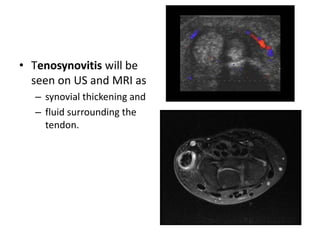
• Tenosynovitis will be 
seen on US and MRI as 
– synovial thickening and 
– fluid surrounding the 
tendon.
• Many tendons do not have a tendon sheath 
(for instance the Achilles and patellar tendons) 
and are instead surrounded by loose 
connective tissue known as the paratenon. 
This may also become involved, a condition 
known as paratenonitis.
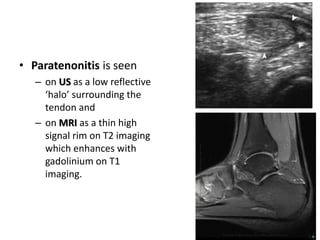
• Paratenonitis is seen 
– on US as a low reflective 
‘halo’ surrounding the 
tendon and 
– on MRI as a thin high 
signal rim on T2 imaging 
which enhances with 
gadolinium on T1 
imaging.
• Calcific deposits may form within the tendon 
– demonstrated on conventional radiographs. 
– shown on US as bright reflective foci. 
– low signal on MRI although there may be increased 
signal in the surrounding tissues due to inflammatory 
response. 
– Tendon calcification can cause susceptibility artefact. 
– In acute calcium deposition the calcific material is 
liquid or semiliquid and may show fluid–fluid levels on 
MRI.
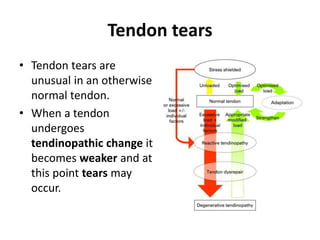
Tendon tears 
• Tendon tears are 
unusual in an otherwise 
normal tendon. 
• When a tendon 
undergoes 
tendinopathic change it 
becomes weaker and at 
this point tears may 
occur.
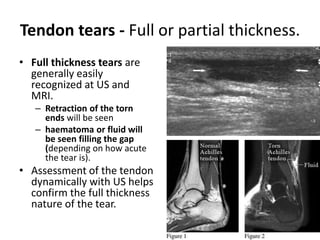
Tendon tears - Full or partial thickness. 
• Full thickness tears are 
generally easily 
recognized at US and 
MRI. 
– Retraction of the torn 
ends will be seen 
– haematoma or fluid will 
be seen filling the gap 
(depending on how acute 
the tear is). 
• Assessment of the tendon 
dynamically with US helps 
confirm the full thickness 
nature of the tear.
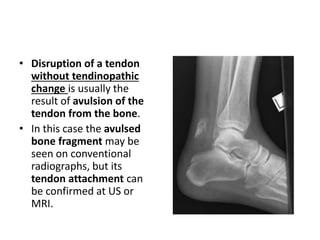
• Disruption of a tendon 
without tendinopathic 
change is usually the 
result of avulsion of the 
tendon from the bone. 
• In this case the avulsed 
bone fragment may be 
seen on conventional 
radiographs, but its 
tendon attachment can 
be confirmed at US or 
MRI.
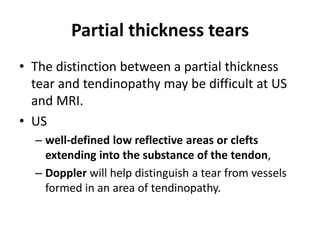
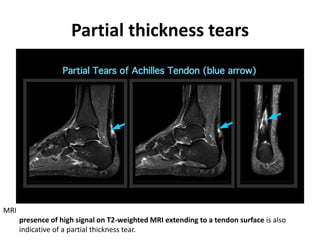
Partial thickness tears 
• The distinction between a partial thickness 
tear and tendinopathy may be difficult at US 
and MRI. 
• US 
– well-defined low reflective areas or clefts 
extending into the substance of the tendon, 
– Doppler will help distinguish a tear from vessels 
formed in an area of tendinopathy.
Partial thickness tears 
MRI 
presence of high signal on T2-weighted MRI extending to a tendon surface is also 
indicative of a partial thickness tear.
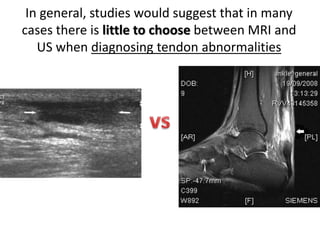
In general, studies would suggest that in many 
cases there is little to choose between MRI and 
US when diagnosing tendon abnormalities
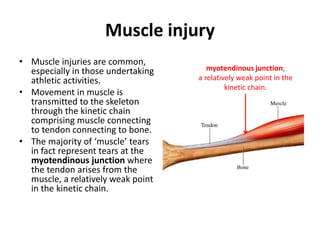
Muscle injury 
• Muscle injuries are common, 
especially in those undertaking 
athletic activities. 
• Movement in muscle is 
transmitted to the skeleton 
through the kinetic chain 
comprising muscle connecting 
to tendon connecting to bone. 
• The majority of ‘muscle’ tears 
in fact represent tears at the 
myotendinous junction where 
the tendon arises from the 
muscle, a relatively weak point 
in the kinetic chain. 
myotendinous junction, 
a relatively weak point in the 
kinetic chain.
Muscle Tears 
• The diagnosis of muscle tears is normally a 
clinical one. 
• Imaging can be helpful 
– indication of the degree of severity of the muscle 
injury 
– Helpful in predicting the likely time before the 
athlete can return to competition.
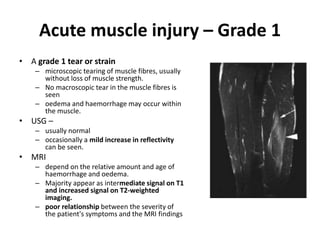
Acute muscle injury – Grade 1 
• A grade 1 tear or strain 
– microscopic tearing of muscle fibres, usually 
without loss of muscle strength. 
– No macroscopic tear in the muscle fibres is 
seen 
– oedema and haemorrhage may occur within 
the muscle. 
• USG – 
– usually normal 
– occasionally a mild increase in reflectivity 
can be seen. 
• MRI 
– depend on the relative amount and age of 
haemorrhage and oedema. 
– Majority appear as intermediate signal on T1 
and increased signal on T2-weighted 
imaging. 
– poor relationship between the severity of 
the patient's symptoms and the MRI findings
Acute muscle injury – Grade 2 
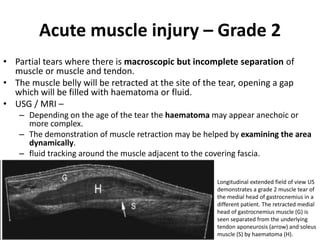
• Partial tears where there is macroscopic but incomplete separation of 
muscle or muscle and tendon. 
• The muscle belly will be retracted at the site of the tear, opening a gap 
which will be filled with haematoma or fluid. 
• USG / MRI – 
– Depending on the age of the tear the haematoma may appear anechoic or 
more complex. 
– The demonstration of muscle retraction may be helped by examining the area 
dynamically. 
– fluid tracking around the muscle adjacent to the covering fascia. 
Longitudinal extended field of view US 
demonstrates a grade 2 muscle tear of 
the medial head of gastrocnemius in a 
different patient. The retracted medial 
head of gastrocnemius muscle (G) is 
seen separated from the underlying 
tendon aponeurosis (arrow) and soleus 
muscle (S) by haematoma (H).
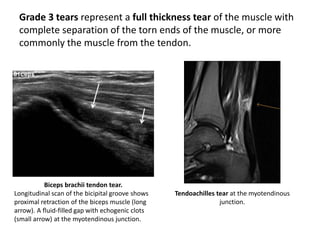
Grade 3 tears represent a full thickness tear of the muscle with 
complete separation of the torn ends of the muscle, or more 
commonly the muscle from the tendon. 
Biceps brachii tendon tear. 
Longitudinal scan of the bicipital groove shows 
proximal retraction of the biceps muscle (long 
arrow). A fluid-filled gap with echogenic clots 
(small arrow) at the myotendinous junction. 
Tendoachilles tear at the myotendinous 
junction.
Blunt trauma to a muscle 
• Haemorrhage into the muscle (often with some 
swelling). 
• Where muscles overlie each other, two or more 
muscles (or even muscle groups) may be 
involved. 
• The diagnosis is normally clear from the history, 
but imaging will show haemorrhage and oedema 
within the muscle. 
• This is often subtle on US and the characteristic 
finding is increased reflectivity and some focal 
swelling of the muscle.
Chronic muscle injuries 
• Disuse atrophy of muscle may be seen from a 
variety of causes including chronic muscle or 
tendon injury and denervation. 
• The loss of muscle bulk may be obvious on 
cross-sectional imaging. In addition the 
muscle undergoes a process of fatty 
infiltration seen as increased signal on T1- 
weighted MRI, as increased echogenicity on 
US, and as areas of fat attenuation on CT.
Delayed onset muscle soreness 
(DOMS) 
• DOMS is a well-recognized phenomenon where 
muscular pain develops hours or days after muscle 
activity. 
• It remains poorly understood but is manifest on MRI as 
oedematous change (increased signal on T2 weighting 
and STIR imaging) in the affected muscles. 
• The appearances are therefore similar to those of a 
muscle strain, but the clinical picture differs in that the 
symptoms come on some time after the exercise. 
• As with muscle strains, the MRI findings take longer to 
resolve than the muscular pain.
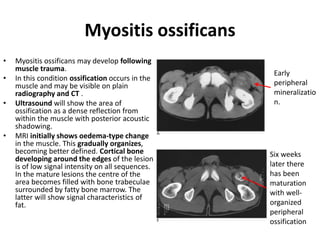
Myositis ossificans 
• Myositis ossificans may develop following 
muscle trauma. 
• In this condition ossification occurs in the 
muscle and may be visible on plain 
radiography and CT . 
• Ultrasound will show the area of 
ossification as a dense reflection from 
within the muscle with posterior acoustic 
shadowing. 
• MRI initially shows oedema-type change 
in the muscle. This gradually organizes, 
becoming better defined. Cortical bone 
developing around the edges of the lesion 
is of low signal intensity on all sequences. 
In the mature lesions the centre of the 
area becomes filled with bone trabeculae 
surrounded by fatty bone marrow. The 
latter will show signal characteristics of 
fat. 
Early 
peripheral 
mineralizatio 
n. 
Six weeks 
later there 
has been 
maturation 
with well-organized 
peripheral 
ossification
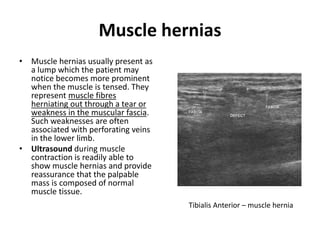
Muscle hernias 
• Muscle hernias usually present as 
a lump which the patient may 
notice becomes more prominent 
when the muscle is tensed. They 
represent muscle fibres 
herniating out through a tear or 
weakness in the muscular fascia. 
Such weaknesses are often 
associated with perforating veins 
in the lower limb. 
• Ultrasound during muscle 
contraction is readily able to 
show muscle hernias and provide 
reassurance that the palpable 
mass is composed of normal 
muscle tissue. 
Tibialis Anterior – muscle hernia
Soft Tissue??? 
• Soft tissue 
– derived primarily from mesenchyme and 
– consists of 
• skeletal muscle, 
• fat, 
• fibrous tissue, 
• the vascular structures 
• the peripheral nervous system.
General Concepts 
• Soft-tissue tumors are classified histologically on the 
basis of the adult tissue they resemble. 
– Eg: liposarcoma does not indicate a lesion arose from fat, 
but rather that it is a malignant mesenchymal tumor that 
has differentiated into tissue that microscopically 
resembles normal adult fat. 
• Many sarcomas are poorly differentiated and, 
consequently, lack the microscopic features required to 
make a specific diagnosis. 
• In such cases, immuno-histochemical stains have aided 
pathologists in identifying their pattern of 
differentiation, allowing accurate classification.
General Concepts 
• Soft-tissue sarcomas 
– relatively uncommon and are estimated to 
represent about 1% of all malignant tumors. 
– two to three times as common as primary 
malignant bone tumors. 
• The annual clinical incidence of benign soft-tissue 
tumors is estimated at 300 per 100,000, 
and these tumors are about 100 times more 
common than malignant soft-tissue tumors.
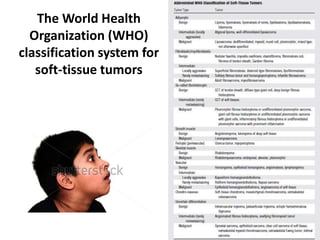
The World Health 
Organization (WHO) 
classification system for 
soft-tissue tumors
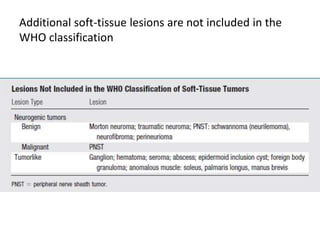
Additional soft-tissue lesions are not included in the 
WHO classification
A SYSTEMATIC APPROACH FOR 
CHARACTERIZATION OF SOFT-TISSUE MASSES
• Given the wide variety of masses and the 
overlap that exists between the imaging 
characteristics of benign and malignant 
masses, it is impossible to arrive at a single 
diagnosis for many of the lesions 
encountered.
Then what is the role of imaging? 
• By applying a systematic approach, one 
– can arrive at a diagnosis for the subset of lesions that have 
characteristic appearances and 
– can narrow the differential diagnosis for lesions that 
demonstrate indeterminate characteristics. 
• In the appropriate clinical setting, excluding a benign 
diagnosis (eg, lipoma or ganglion) can aid in clinical 
decision making. 
• Ultimately, if a lesion cannot be characterized as a 
benign entity, the lesion should be reported as 
indeterminate and the patient should undergo biopsy 
to exclude malignancy.
Clinical History and Physical 
Examination 
• Evaluation of a soft-tissue mass begins with 
the clinical history and physical examination. 
• Clinical history regarding 
– age, 
– recent trauma, 
– fluctuating mass size, 
– history of malignant cancer 
and familial syndromes, 
– single or multiple lesions
Clinical History and Physical 
Examination 
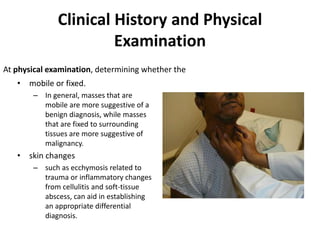
At physical examination, determining whether the 
• mobile or fixed. 
– In general, masses that are 
mobile are more suggestive of a 
benign diagnosis, while masses 
that are fixed to surrounding 
tissues are more suggestive of 
malignancy. 
• skin changes 
– such as ecchymosis related to 
trauma or inflammatory changes 
from cellulitis and soft-tissue 
abscess, can aid in establishing 
an appropriate differential 
diagnosis.
Location 
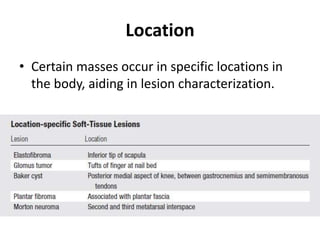
• Certain masses occur in specific locations in 
the body, aiding in lesion characterization.
Origin of the lesion 
• Recognizing that a lesion arises from a specific structure (eg, 
nerves, vessels, or tendons) can help in lesion characterization. 
• Tumors arising from nerves are typically benign PNSTs, which include schwannomas 
and neurofibromas. If there is a history of type 1 neurofibromatosis, a malignant PNST 
should be considered. Occasionally, fat-containing tumors can also arise from nerve. 
This type of lesion, previously known as a fibrolipomatous hamartoma, has been 
designated as lipomatosis of the nerve by the WHO in the 2002 classification. 
• Vascular neoplasms typically have dilated tortuous vessels entering and/or exiting the 
lesion and include hemangiomas, lymphangiomas, and angiosarcomas . 
Hemangiomas are the most common of the vascular lesions and contain serpentine 
vessels, areas of fat, and phleboliths. Besides true vascular tumors, several additional 
vascular lesions should be included in the differential diagnosis of a soft-tissue mass 
arising from vessels. Pseudoaneurysms can occur in the setting of trauma, such as 
femoral vessel injury from cardiac catheterization. In these cases, it is important to 
make the diagnosis prospectively and to avoid biopsy. Another group of masses 
characteristically arise from tendon sheaths. 
• Lesions arising from tendons are most commonly GCTs of the tendon sheath; 
however, ganglia, lipomas, and fibromas are all masses that may arise from a tendon 
sheath.
IMAGING
Radiography 
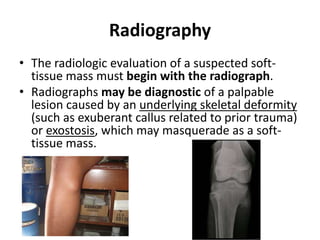
• The radiologic evaluation of a suspected soft-tissue 
mass must begin with the radiograph. 
• Radiographs may be diagnostic of a palpable 
lesion caused by an underlying skeletal deformity 
(such as exuberant callus related to prior trauma) 
or exostosis, which may masquerade as a soft-tissue 
mass.
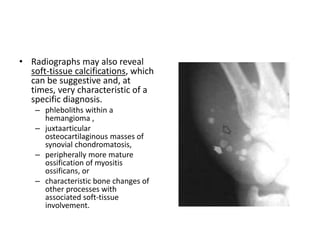
• Radiographs may also reveal 
soft-tissue calcifications, which 
can be suggestive and, at 
times, very characteristic of a 
specific diagnosis. 
– phleboliths within a 
hemangioma , 
– juxtaarticular 
osteocartilaginous masses of 
synovial chondromatosis, 
– peripherally more mature 
ossification of myositis 
ossificans, or 
– characteristic bone changes of 
other processes with 
associated soft-tissue 
involvement.
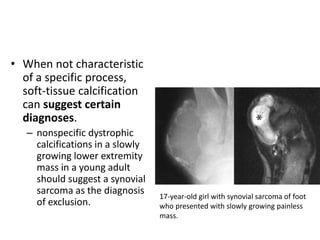
• When not characteristic 
of a specific process, 
soft-tissue calcification 
can suggest certain 
diagnoses. 
– nonspecific dystrophic 
calcifications in a slowly 
growing lower extremity 
mass in a young adult 
should suggest a synovial 
sarcoma as the diagnosis 
of exclusion. 
17-year-old girl with synovial sarcoma of foot 
who presented with slowly growing painless 
mass.
• In addition, radiographs are the best initial method of 
assessing coexistent osseous involvement, such as 
remodeling, periosteal reaction, or overt osseous 
invasion and destruction. 
• However, unlike bone tumors, the biologic activity of a 
soft-tissue mass cannot be reliably assessed by its 
growth rate. A slowly growing soft-tissue mass that 
may remodel adjacent bone (causing a scalloped area 
with well-defined sclerotic margins) may still be highly 
malignant on histologic examination.
• A soft-tissue mass may also be the initial presentation 
of a primary bone tumor or inflammatory process. 
– In such cases, the radiograph may be useful in identifying 
the osseous origin of the lesion. The diagnosis of a 
malignant bone tumor such as Ewing's sarcoma or primary 
lymphoma of the bone should be considered when there is 
a large circumferential soft-tissue mass in association with 
an underlying destructive permeative bone lesion. 
• A subtle radiologic feature, which may help to separate 
inflammatory and neoplastic processes, is that an 
inflammatory process typically obliterates fascial 
planes rather than displaces them.
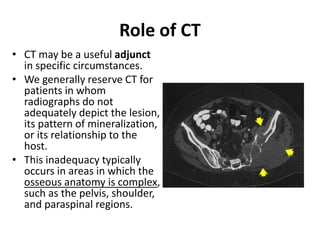
Role of CT 
• CT may be a useful adjunct 
in specific circumstances. 
• We generally reserve CT for 
patients in whom 
radiographs do not 
adequately depict the lesion, 
its pattern of mineralization, 
or its relationship to the 
host. 
• This inadequacy typically 
occurs in areas in which the 
osseous anatomy is complex, 
such as the pelvis, shoulder, 
and paraspinal regions.
MR Imaging 
• MR imaging has emerged as the preferred modality for 
evaluating soft-tissue lesions. 
• It provides 
– superior soft-tissue contrast, 
– allows multiplanar image acquisition, 
– its capability in imaging superficial and deep soft tissues over 
both large and small fields of view 
– obviates iodinated contrast agents and ionizing radiation, and 
– is devoid of streak artifacts commonly encountered with CT. 
• Although initial investigations maintained that CT was 
superior to MR imaging in detecting destruction of cortical 
bone, later studies suggest that these two modalities are 
comparable in this regard.
• Evaluation with MR images allows 
– tumor staging, 
– detection of neurovascular involvement, 
– identification of tumor necrosis, and 
– preoperative planning.
Newer Techniques 
• The use of techniques such as MR 
spectroscopy and diffusion imaging has been 
reported for the evaluation of soft-tissue 
masses and, in particular, for assessing 
response to therapy. 
• These techniques offer intriguing potential for 
interrogation of soft-tissue masses but are not 
yet in routine clinical use.
• The utility of MR imaging in the assessment of 
soft-tissue masses is predicated on the 
generation of diagnostic images of good 
quality. 
• A brief discussion of technical considerations 
as they relate to MR imaging of soft-tissue 
masses is therefore presented.
TECHNICAL CONSIDERATIONS FOR MR 
IMAGING OF SOFT-TISSUE MASSES
General Considerations 
• Given the variety of sizes and locations of soft-tissue 
masses, it is difficult to prescribe a single 
imaging protocol. 
• The lesion should be demarcated prior to 
imaging, but care should be taken not to 
compress or distort the mass, either with the skin 
markers or by imaging the mass dependently 
against the table. 
• Images should be of sufficiently high spatial 
resolution to demonstrate relevant morphologic 
features and local anatomic detail.
Imaging Plane 
• Lesions should be imaged in at least two orthogonal 
planes, using conventional T1-weighted and T2- 
weighted spin-echo MR pulse sequences in at least one 
of these planes. 
• Axial images 
– For demonstrating relevant anatomy and 
– helping to determine whether the mass is confined to a 
single compartment and 
– whether it is invading or encasing surrounding structures. 
• Longitudinal plane—coronal, sagittal, or oblique 
– help demonstrate the extent of the mass and 
– its relationship to anatomic landmarks.
Imaging Strategy 
• Field of view is dictated by the size and location 
of the lesion. 
• large field of view 
– where the goal is to establish the presence of a mass. 
– sacrificing spatial resolution. 
• smaller field of view 
– where detailed assessment of the mass is needed 
– delineate its features and 
– assess its proximity to surrounding structures.
Imaging Sequences 
• Standard spin-echo MR images are most useful in 
establishing a specific diagnosis. 
– the most reproducible technique 
– the most often referenced in the tumor imaging literature. 
– the imaging technique with which we are most familiar for 
tumor evaluation, 
– established as the standard by which other imaging 
techniques must be judged. 
• The main disadvantage of spin-echo MR imaging 
remains 
– the relatively long acquisition times, especially for double-echo 
T2-weighted MR imaging sequences .
• Fast scanning techniques may be useful in the 
evaluation of soft-tissue masses. 
– shorter imaging times, 
– decreased motion artifacts, and 
– increased patient tolerance, as well as patient 
throughput. 
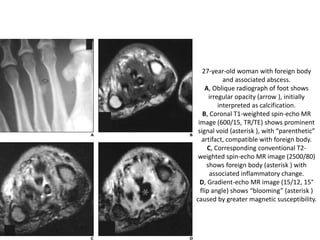
• Gradient-echo imaging may be a 
– useful supplement in revealing hemosiderin because 
of the greater magnetic susceptibility of hemosiderin. 
– showing the lesion—fat interfaces and 
– depicting small surrounding vessels.
27-year-old woman with foreign body 
and associated abscess. 
A, Oblique radiograph of foot shows 
irregular opacity (arrow ), initially 
interpreted as calcification. 
B, Coronal T1-weighted spin-echo MR 
image (600/15, TR/TE) shows prominent 
signal void (asterisk ), with “parenthetic” 
artifact, compatible with foreign body. 
C, Corresponding conventional T2- 
weighted spin-echo MR image (2500/80) 
shows foreign body (asterisk ) with 
associated inflammatory change. 
D, Gradient-echo MR image (15/12, 15° 
flip angle) shows “blooming” (asterisk ) 
caused by greater magnetic susceptibility.
• STIR imaging can be an adjunct in selective cases. 
– produces fat suppression and 
– enhances the identification of abnormal tissue with 
increased water content and, 
– as a result, is useful to confirm subtle areas of soft-tissue 
abnormality 
– increases lesion conspicuity 
• but 
– lower signal-to-noise ratio 
– more susceptible to degradation by motion.
• Fat suppression on T2-weighted MR images 
– increase lesion-to-background signal intensity differences 
for high-signal-intensity lesions within the marrow or fatty 
soft tissue. 
– decreasing or eliminating the MR signal from fat, 
– allowing increased conspicuity of lesions containing 
paramagnetic substances (such as methemoglobin) on T1- 
weighted MR images, and 
– revealing contrast enhancement. 
• However 
– decreases variations in tumor signal intensities, and hence 
not used in place of conventional T2-weighted MR 
imaging.
Describing Masses 
• The SI of masses should be described in 
relation to an internal standard. 
• Most often, a mass is described as being hypo- 
, iso-, or hyperintense to muscle on both T1- 
and T2-weighted images. 
• Some authors describe the SI of a mass on T2- 
weighted images in relation to subcutaneous 
fat; however, the relative SI of fat differs 
between SE and fast SE techniques.
MR Imaging Contrast Enhancement 
• controversial. 
– enhance the signal intensity of many tumors on T1-weighted spin-echo 
MR images, 
– enhancing the demarcation between tumor and muscle and tumor 
and edema 
– providing information on tumor vascularity. 
• In actuality, differentiation between tumor and muscle is usually 
quite well delineated without contrast-enhanced imaging on T2- 
weighted MR images, and 
• the accurate distinction between tumor and edema is probably of 
little practical value. Edema, which is infrequent without 
superimposed trauma or hemorrhage, is considered to be part of 
the reactive zone around the neoplasm and, as a result, is removed 
en bloc with the tumor.
• Disadvantages: 
– increases the length and cost of the examination. 
– not been shown to increase lesion conspicuity or 
to replace conventional T2-weighted MR imaging . 
– contrast reaction (even though small) 
• Consequently, gadolinium-enhanced imaging 
should be reserved for cases in which the 
results would influence patient care.
Contrast: Useful situations 
• evaluation of hematomas. 
– may reveal a small tumor nodule that may have 
been inapparent within the hemorrhage on 
conventional MR imaging. 
Caution is required, however, because the 
fibrovascular tissue in organizing hematomas may 
show enhancement.
Contrast: Useful situations…. 
• differentiate solid from cystic (or necrotic) lesions 
or 
• identify cystic or necrotic areas within solid 
tumors, 
– these necrotic or cystic areas showing no 
enhancement. 
In general, sonography is fast and inexpensive and is 
an ideal method for differentiating solid and cystic 
lesions when the lesion is in an anatomic location 
accessible to sonographic evaluation. 
• guide biopsy
Contrast: Useful situations…. 
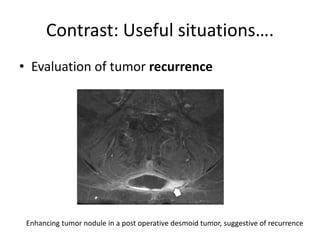
• Evaluation of tumor recurrence 
Enhancing tumor nodule in a post operative desmoid tumor, suggestive of recurrence
Technical considerations in contrast imaging 
• Intravenous gadolinium-based contrast agent is 
generally administered in a nondynamic fashion. 
• Contrast-enhanced images are often obtained with 
fat suppression to suppress fat and highlight the 
presence of the gadolinium-based contrast agent.
Technical considerations….. 
In choosing to use fat-suppressed T1-weighted MR sequences for this 
purpose, several considerations apply: 
1. Images obtained before and after contrast agent administration must be 
obtained with identical imaging parameters to allow adequate 
assessment of enhancement. 
2. For similar reasons, transmit gain cannot be allowed to change between 
nonenhanced and contrast-enhanced images. To maintain the same 
transmit gain, no preliminary imaging should take place between 
nonenhanced and contrast-enhanced imaging. 
3. If, on nonenhanced images, fat suppression proves to be 
inhomogeneous, consideration should be given to acquiring the 
nonenhanced and contrast-enhanced images without fat suppression. 
4. Image subtraction can help to address the problem of inhomogeneous 
fat suppression, but this technique depends on the absence of patient 
motion between the nonenhanced and contrast-enhanced sequences.
LESION CHARACTERIZATION ON THE 
BASIS OF MR IMAGES
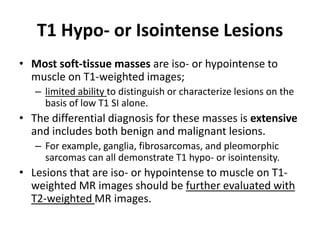
T1 Hypo- or Isointense Lesions 
• Most soft-tissue masses are iso- or hypointense to 
muscle on T1-weighted images; 
– limited ability to distinguish or characterize lesions on the 
basis of low T1 SI alone. 
• The differential diagnosis for these masses is extensive 
and includes both benign and malignant lesions. 
– For example, ganglia, fibrosarcomas, and pleomorphic 
sarcomas can all demonstrate T1 hypo- or isointensity. 
• Lesions that are iso- or hypointense to muscle on T1- 
weighted MR images should be further evaluated with 
T2-weighted MR images.
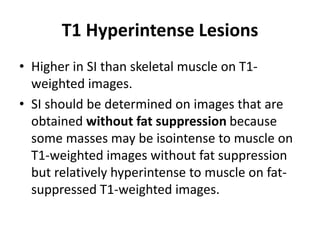
T1 Hyperintense Lesions 
• Higher in SI than skeletal muscle on T1- 
weighted images. 
• SI should be determined on images that are 
obtained without fat suppression because 
some masses may be isointense to muscle on 
T1-weighted images without fat suppression 
but relatively hyperintense to muscle on fat-suppressed 
T1-weighted images.
T1 Hyperintense….. 
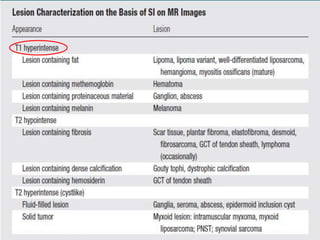
• Substances that are associated with T1 shortening include 
– fat, 
– methemoglobin, 
– proteinaceous fluid, and 
– melanin 
• Fat has intrinsically short T1 relaxation times due to its molecular 
structure. 
• Methemoglobin causes shortening of T1 relaxation times due to a 
paramagnetic effect. 
• Proteinaceous fluid is characterized by relative T1 shortening due to 
accelerated relaxation of water molecules bound to proteins . 
• Although one report of T1 shortening in melanomas ascribed the effect 
directly to paramagnetic radicals associated with melanin itself, a later 
report theorized that it was owing to other sources, such as biological 
paramagnetic metals that become bound by the melanin.
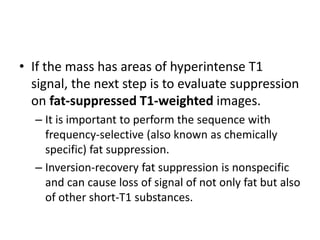
• If the mass has areas of hyperintense T1 
signal, the next step is to evaluate suppression 
on fat-suppressed T1-weighted images. 
– It is important to perform the sequence with 
frequency-selective (also known as chemically 
specific) fat suppression. 
– Inversion-recovery fat suppression is nonspecific 
and can cause loss of signal of not only fat but also 
of other short-T1 substances.
Fat suppression + 
• If the hyperintense area is suppressed, then 
the lesion contains fat, and the most likely 
diagnoses include 
– lipoma, 
– lipoma variant, 
– well-differentiated liposarcoma, 
– hemangioma, and 
– mature ossification.
Fat suppression + 
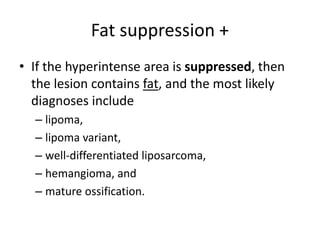
• If the mass is composed 
entirely of fat, with only 
minimal thin septations 
and without nonfatty 
nodular components, 
then a diagnosis of 
lipoma can be made.
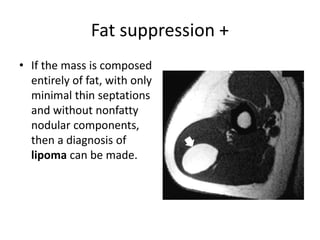
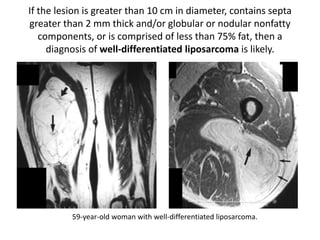
If the lesion is greater than 10 cm in diameter, contains septa 
greater than 2 mm thick and/or globular or nodular nonfatty 
components, or is comprised of less than 75% fat, then a 
diagnosis of well-differentiated liposarcoma is likely. 
59-year-old woman with well-differentiated liposarcoma.
Fat suppression + 
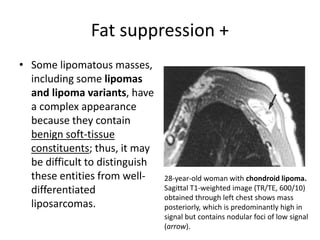
• Some lipomatous masses, 
including some lipomas 
and lipoma variants, have 
a complex appearance 
because they contain 
benign soft-tissue 
constituents; thus, it may 
be difficult to distinguish 
these entities from well-differentiated 
liposarcomas. 
28-year-old woman with chondroid lipoma. 
Sagittal T1-weighted image (TR/TE, 600/10) 
obtained through left chest shows mass 
posteriorly, which is predominantly high in 
signal but contains nodular foci of low signal 
(arrow).
Fat suppression + 
• Hemangiomas with fatty components will have 
suppressed SI on fat-suppressed MR images but 
should have a distinct appearance from lipomas. 
– lobulated 
– have high-SI vascular channels on T2-weighted MR 
images (due to slow intravascular flow), 
– may contain rounded low-SI phleboliths on T1- and 
T2-weighted MR images, (more apparent on 
radiographs) 
– may cause fatty atrophy in surrounding muscles or 
reactive sclerosis in abutting bones.
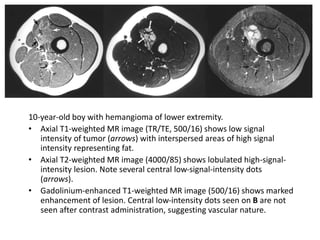
10-year-old boy with hemangioma of lower extremity. 
• Axial T1-weighted MR image (TR/TE, 500/16) shows low signal 
intensity of tumor (arrows) with interspersed areas of high signal 
intensity representing fat. 
• Axial T2-weighted MR image (4000/85) shows lobulated high-signal-intensity 
lesion. Note several central low-signal-intensity dots 
(arrows). 
• Gadolinium-enhanced T1-weighted MR image (500/16) shows marked 
enhancement of lesion. Central low-intensity dots seen on B are not 
seen after contrast administration, suggesting vascular nature.
Fat suppression + 
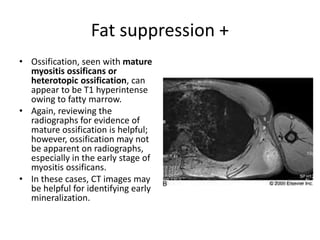
• Ossification, seen with mature 
myositis ossificans or 
heterotopic ossification, can 
appear to be T1 hyperintense 
owing to fatty marrow. 
• Again, reviewing the 
radiographs for evidence of 
mature ossification is helpful; 
however, ossification may not 
be apparent on radiographs, 
especially in the early stage of 
myositis ossificans. 
• In these cases, CT images may 
be helpful for identifying early 
mineralization.
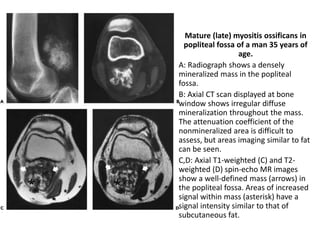
Mature (late) myositis ossificans in 
popliteal fossa of a man 35 years of 
age. 
A: Radiograph shows a densely 
mineralized mass in the popliteal 
fossa. 
B: Axial CT scan displayed at bone 
window shows irregular diffuse 
mineralization throughout the mass. 
The attenuation coefficient of the 
nonmineralized area is difficult to 
assess, but areas imaging similar to fat 
can be seen. 
C,D: Axial T1-weighted (C) and T2- 
weighted (D) spin-echo MR images 
show a well-defined mass (arrows) in 
the popliteal fossa. Areas of increased 
signal within mass (asterisk) have a 
signal intensity similar to that of 
subcutaneous fat.
Fat suppression (-) 
• If the lesion does not lose SI on the fat-suppressed 
T1-weighted MR images, then it is 
composed of another substance that causes 
T1 shortening, such as 
– methemoglobin, 
– proteinaceous fluid, or 
– melanin.
Fat suppression (-) 
• A history of trauma may account for a 
hematoma with methemoglobin. 
• However, a hematoma might also occur 
secondary to bleeding from a tumor. 
• So a hematoma should be followed up with 
imaging to resolution to exclude an underlying 
sarcoma or other malignant lesion as the 
source of the hematoma.
8-year-old woman with subacute 
hematoma adjacent to lipoma. 
T1-weighted axial image shows subacute hematoma (white arrow) 
with relatively increased signal intensity due to extracellular hemoglobin. Compare 
hematoma with higher signal intensity mass (black arrow), which is lipoma. 
T1-weighted fat-suppressed MR image shows 
that signal intensity of subacute hematoma (white arrow) remains 
bright, whereas that of lipoma (black arrow) “drops out.”
Fat suppression (-) 
• Any mass containing sufficient fluid with an 
appropriate concentration of protein can have 
high T1 SI. 
• These masses include ganglia, abscesses, and 
epidermoid inclusion cysts with high protein 
content.
Fat suppression (-) 
• If the patient has a history of melanoma and a 
mass with high T1 SI, the possibility of a 
melanoma metastasis should be considered 
• It should be noted, however, that not all 
melanotic lesions are characterized by 
substantial T1 shortening .
T2 Hypointense Lesions 
• A mass that is lower in SI than skeletal muscle 
on T2-weighted MR images is considered to be 
hypointense . 
• Substances that appear hypointense on T2- 
weighted images include 
– fibrosis, 
– hemosiderin, and 
– calcification (distinct from ossification).
T2 Hypointense…. 
• Lesions with fibrotic components tend to have low T2 SI because of a 
relative lack of mobile protons associated with their hypocellular densely 
collagenous matrix. 
• Hemosiderin, a nonspecific end-product from the breakdown of 
hemorrhage, is T2 hypointense due to magnetic susceptibility. When 
present in sufficient quantities, hemosiderin can appear more prominent 
(blooming) on T2*-weighted MR images than on T2-weighted MR images . 
• Calcifications are typically T2 hypointense because the protons are 
immobilized within a crystalline structure and cannot contribute to the 
signal. 
 Paradoxically, calcifications may appear as higher SI when calcium crystals are 
surrounded by a hydration shell, which provides a source of mobile protons . 
• Substances that have intrinsic low proton density, such as air and some 
foreign bodies, also can appear to be T2 hypointense. 
 Foreign bodies can be deceptive, as small foreign bodies may be surrounded by 
a hyperintense area from reactive fluid or inflammatory tissue, which can 
obscure the underlying foreign body and mimic a neoplasm.
• Masses that are composed of fibrotic material represent 
– broad spectrum of benign and malignant lesions, 
– ranging from fibrotic scars to fibromas and some fibrosarcomas. 
• T2 hypointensity in lesions such as GCT of the tendon 
sheath, amyloid deposits, long-standing rheumatoid 
pannus, soft-tissue callus, leiomyoma, and lymphoma has 
been ascribed to the presence of hypocellular fibrosis. 
 However, not all fibrous masses have low T2 SI; 
hypercellular fibrous masses, such as desmoids and 
leiomyomas, may demonstrate higher T2 SI.
Masses that contain large amounts of hemosiderin include pigmented 
villonodular synovitis, GCT of the tendon sheath, and a variety of 
hemorrhagic masses.
• Masses that are diffusely calcified may also 
appear to have low T2 SI. 
• However, the SI will depend on 
– the extent and distribution of calcification, 
– whether the calcification is hydrated, and 
– whether there is associated edema or 
inflammatory reaction
mass with low T2 SI 
• first step is to review the radiographs for the 
presence of calcifications, which are often 
difficult to identify on MR images alone. 
• On radiographs, calcifications may have a 
characteristic pattern, such as the 
– cloudlike paraarticular calcifications seen in gout 
or 
– the flocculent calcifications seen in tumoral 
calcinosis.
• If there are no calcifications on the radiographs, then a mass with 
low T2 SI will most likely either be focal fibrosis or a tumor with 
substantial fibrous content. 
• In these cases, lesion location can be helpful for further 
characterization. 
– Single or multiple masses within a joint may reflect the presence of 
pigmented villonodular synovitis. 
– Similarly, if a well-circumscribed noncalcified mass abuts a tendon, it 
may be a GCT of the tendon sheath. 
– A history of prior surgery at the lesion site could suggest the presence 
of fibrous scar tissue. 
– A nodular mass that is adjacent to the plantar fascia of the foot most 
likely is a plantar fibroma. 
– Similarly, a mass along the superficial palmar fascia of the hand can 
suggest Dupuytren disease.
T2 Hyperintense (Cystlike) Lesions 
• Many T2 hyperintense lesions are 
heterogeneously hyperintense. 
– difficult to specifically characterize. 
• A subset of lesions that are relatively 
homogeneously hyperintense 
– can be further characterized.
T2 hyperintense….. 
• Thus, the differential diagnosis for lesions that 
are predominantly T2 hyperintense includes 
– fluid-filled lesions (eg, ganglia, synovial cysts, and 
seromas) 
– solid lesions (eg, myxomas, myxoid sarcomas, 
some PNSTs, and small synovial sarcomas). 
• Some are relatively homogeneous hyperintense, 
• mistaken for fluid-filled structures 
• have been termed cystlike lesions by some authors. 
– hyperemic synovium and 
– hyaline cartilage.
True Cysts vs Cyst like lesions 
• Administering an intravenous gadolinium-based contrast agent is an 
important step to distinguish between true cysts and solid lesions. 
• Cysts and fluid-filled components of masses 
– will NOT demonstrate internal enhancement whereas 
• solid (Cyst like) structures 
– will usually demonstrate internal enhancement. 
• Note!!! 
– given sufficient time, gadolinium-based contrast agents can diffuse 
into the center of a cyst from the periphery. 
– Thus, internal enhancement can be seen in a true cyst if it is imaged 
late after contrast agent administration . 
– Although there are no well-formulated rules for this phenomenon, we 
typically evaluate enhancement on MR images obtained within 6 
minutes after contrast agent administration.
Peripheral enhancement 
• If a T2 hyperintense mass has a thin even rim of 
enhancement and no internal enhancement, then it is 
a cyst of some kind. 
– Ganglia are very common and should be considered 
whenever a periarticular hyperintense mass is identified 
on T2-weighted MR images. 
– Postoperative seromas, posttraumatic cysts, epidermoid 
inclusion cysts, lymphoceles, and lymphangiomas are 
other lesions that may demonstrate a thin rim of 
peripheral enhancement . 
• When the peripheral rim of enhancement is thick 
and/or irregular, 
– other diagnoses must be considered, including inflamed or 
infected ganglia, abscesses, hematomas, and necrotic 
tumor masses.
Internal enhancement 
• If a mass that is T2 hyperintense demonstrates 
internal enhancement, either homogeneous 
or heterogeneous, then soft-tissue masses 
(eg, intramuscular myxomas, myxoid 
sarcomas, PNSTs, and synovial sarcomas) 
should be considered. 
• Myxoid material because of its high water 
content appears hyperintense on T2-weighted 
MR images.
Lesions showing internal enhancement….. 
• Intramuscular myxomas 
– benign masses 
– typically have uniform hyperintensity on nonenhanced T2-weighted MR 
images 
– demonstrate internal enhancement on contrast-enhanced MR images. 
• Myxoid sarcomas 
– can be homogeneously T2 hyperintense but also 
– demonstrate internal contrast enhancement. 
• Synovial sarcoma should be considered 
– an enhancing hyperintense lesion is paraarticular. 
– Irregular calcifications, erosion of the bone, and cystic components may be 
associated. 
• PNST is suggested 
– lesion is fusiform and 
– is associated with a nerve
Axial fat-suppressed MR images in 56-year-old woman show palpable lesion in groin. 
(a) T2-weighted MR image shows a hyperintense cystlike lesion (arrow) in the left upper thigh. 
(b) Nonenhanced T1-weighted SPGRMRimage at level of lesion (arrow). 
(c) Contrast-enhanced T1-weighted SPGRMR image shows wispy internal enhancement 
(arrow). 
Intramuscular myxoma was identified at biopsy.
Benign Versus Malignant 
• Diagnostic value of MR imaging 
– general agreement 
• Reliably distinguish benign from malignant??? 
– less clear.
• When not sufficiently characteristic to suggest a specific 
diagnosis, 
– a conservative approach is warranted. 
• Malignancies are generally 
– larger and 
– more likely to outgrow their vascular supply with subsequent 
infarction, necrosis, and heterogeneous signal intensity on T2- 
weighted spin-echo MR imaging. 
• Consequently, the larger a mass is, the greater its 
heterogeneity, the greater is the concern for malignancy. 
– Only 5% of benign soft-tissue tumors exceed 5 cm in diameter. 
– Only about 1% of all benign soft-tissue tumors are deep. 
• Superficial sarcomas have less aggressive biologic behavior 
than do deep lesions.
• As a rule, most malignancies grow as 
– deep space-occupying lesions, 
– enlarging in a centripetal fashion, 
– pushing rather than infiltrating adjacent structures (although 
clearly there are exceptions to this general rule). 
– as sarcomas enlarge, a pseudocapsule of fibrous connective 
tissue is formed around them by compression and layering of 
normal tissue, associated inflammatory reaction, and 
vascularization. 
– generally, they respect fascial borders and 
– remain within anatomic compartments until late in their course. 
• It is this pattern of growth that gives most sarcomas 
relatively well-defined margins, in distinction to the 
general concepts of margins used in the evaluation of 
osseous tumors.
• Metastatic carcinoma to soft tissue 
– appear more infiltrative with ill-defined margins 
– often violating fascial planes and anatomic 
compartments. 
• This pattern of growth is quite different from 
that seen in most primary soft-tissue tumors.
• Increased signal intensity in the skeletal muscle 
surrounding a musculoskeletal mass on T2- 
weighted spin-echo MR images or other fluid-sensitive 
sequences (i.e., STIR) 
– suggested as a reliable indicator of malignancy. 
– quite nonspecific. 
– more commonly suggests an inflammatory process, 
abscess, myositis ossificans, local trauma, 
hemorrhage, biopsy, or the effect of radiation therapy 
rather than a primary soft-tissue neoplasm.
14-year-old boy with myositis ossificans in forearm. 
A, Axial fast spin-echo T2-weighted spin-echo MR image (2600/80, TR/TE) shows poorly defined mass in 
extensor compartment of forearm and adjacent to ulna. Lesion predominantly involves extensor carpi ulnaris, 
although there is abnormal signal in and between adjacent muscles. 
B, Corresponding axial T1-weighted spin-echo MR image (650/20) shows only minimal signal alteration with 
effacement of subcutaneous adipose tissue (arrow )
Benign vs Malignant - Role of Gadolinium 
• Malignant lesions show 
– greater enhancement as well as 
– greater rate of enhancement. 
• Enhancement reflects tissue vascularity and 
tissue perfusion. 
• Considerable overlap – little practical value.
• When a lesion has a nonspecific MR imaging 
appearance, one is ill-advised to suggest a 
lesion is benign or malignant solely on the 
basis of its MR imaging characteristics and 
rate or degree of enhancement.
• DeSchepper et al. performed a multivariate statistical 
analysis of 10 imaging parameters, individually and in 
combination. 
• Highest sensitivity for malignancy 
– high signal intensity on T2-weighted MR images, 
– larger than 33 mm in diameter, 
– heterogeneous signal intensity on T1-weighted MR images. 
• Greatest specificity for malignancy 
– tumor necrosis, 
– bone or neurovascular involvement, and 
– mean diameter of more than 66 mm
15-year-old girl with rhabdomyosarcoma of leg. 
A, Sagittal T1-weighted spin-echo MR image shows large mass with bone invasion. 
B, Corresponding contrast-enhanced MR image shows nonenhancing area compatible 
with necrosis. Bone invasion and necrosis are both specific for malignancy. Note nodal 
involvement (arrows ).
57-year-old woman with liposarcoma of thigh. 
A, Axial fast spin-echo T2-weighted MR image (3200/102, TR/TE) shows large mass 
with mixed intermediate signal intensity. 
B and C, Corresponding coronal unenhanced (B) and contrast-enhanced (C) T1- 
weighted spin-echo MR images (600/16) show adipose tissue within lesion, 
compatible with fat differentiation. Enhancement in portions of tumor is extensive. 
Large size and deep location with adipose differentiation suggest diagnosis of 
liposarcoma.
Staging 
• Purpose of a staging system 
– the state of a malignancy, 
– defining the extent of the local and distant tumor 
– critical for optimum patient care and 
– planning of percutaneous biopsy. 
• Local staging is best accomplished using MR 
imaging, which can accurately depict the 
anatomic spaces (compartments) involved by 
the tumor.
The Indeterminate Lesion 
• Identify the lesion as a benign determinate 
lesion. 
• Provide a succinct differential diagnosis on the 
basis of the available characteristics. 
• However, if the lesion cannot be confidently 
characterized as a benign entity, then it is an 
indeterminate lesion and requires further 
evaluation. 
• This concern should be discussed with the 
ordering clinician, and a biopsy should be strongly 
considered.
The Indeterminate Lesion 
• The WHO recommends that 
• “soft tissue masses that do not demonstrate 
tumor-specific features on MR images should 
be considered indeterminate and biopsy should 
always be obtained to exclude malignancy”. 
• In some instances, especially in patients with 
comorbidities or relative contraindications to 
biopsy, short-term imaging follow-up may be 
an alternative.
Conclusion 
• MR imaging is the preferred modality for the evaluation of a soft-tissue 
mass after radiography. 
• The radiologic appearance of certain soft-tissue tumors or tumorlike 
processes, such as myositis ossificans, fatty tumors, hemangiomas, 
peripheral nerve sheath tumors, pigmented villonodular synovitis, and 
certain hematomas may be sufficiently unique to allow a strong 
presumptive radiologic diagnosis. 
• It must be emphasized that MR imaging cannot reliably distinguish 
between benign and malignant lesions 
• When radiologic evaluation is nonspecific, one is ill-advised to suggest 
that a lesion is benign or malignant solely on its MR imaging appearance. 
• When a specific diagnosis is not possible, knowledge of tumor prevalence 
by location and age, with appropriate clinical history and radiologic 
features, can be used to establish a suitably ordered differential 
diagnosis.
Imaging of Soft tissue pathology

Imaging of Soft tissue pathology

  • 2.
    Introduction • Theimaging evaluation of the soft tissues has undergone a rapid evolution with the application of computed tomography (CT), magnetic resonance imaging (MRI), and recently high resolution ultrasound (US). • Consideration must be given to the financial costs and invasiveness of each technique balanced against the diagnostic reward. • No examination should be reported in isolation without knowledge of relevant clinical details and results of previous investigations.
  • 3.
    What is SoftTissue??? • Soft tissue – derived primarily from mesenchyme and – consists of • skeletal muscle, • fat, • fibrous tissue, • the vascular structures • the peripheral nervous system.
  • 4.
  • 5.
    Radiography • Therelative lack of soft tissue contrast resolution is a well-recognized limitation of radiography.
  • 6.
    Only those structuresexhibiting a radiodensity sufficiently different to that of water can be distinguished from other soft tissues. Less than muscle - fat and gas Increased radiodensity - haemosiderin deposition, mineralization, be it calcification or ossification, and certain foreign bodies
  • 7.
    • A lowkilovoltage technique will accentuate the density differences between fat and muscle. • Density differences can also be maximized with digital radiography where the broad exposure range means that it is difficult to make an inadequate exposure. A free choice of data processing allows control of the grey scales, contrast, etc., which can be optimized to highlight soft tissue disease.
  • 8.
    Radiograph - Caution!!! • When evaluating a radiograph it is important to remember that numerous extraneous factors may mimic soft tissue abnormalities. These include skin folds, clothing, hair artefacts and companion shadows. • Also, iatrogenic conditions may pose diagnostic problems to the unwary such as the sites of old bismuth injections in the buttocks and tantalum gauze previously used in hernia repairs.
  • 9.
    Ultrasound • Diagnosticultrasound has been applied to the musculoskeletal system since B-mode techniques became available. There have been rapid developments in ultrasound technology over recent years and these, along with the have resulted in a vast expansion in the evaluation of the soft tissues. • Advantages of ultrasound include – widespread availability of ultrasound and – relatively low cost, – solid from cystic – abnormal tissue from normal variants such as accessory muscles – its real-time ability to assess structures dynamically, – its capability, using Doppler technology, to assess vascular flow and – to guide interventional procedures such as joint aspirations and soft tissue biopsies.
  • 10.
    • The adventof high frequency (>10 MHz) transducers with their improved spatial resolution, along with other developments such as multifrequency transducers, compound imaging and beam steering, has meant that further applications for musculoskeletal ultrasound continue to be introduced. • Tendons, ligaments, nerves and muscle are now readily shown with ultrasound.
  • 11.
    Ultrasound - Tradeoff!!! • The physics of ultrasound means there will always be a trade-off between image resolution and depth of penetration. • Nevertheless the majority of musculoskeletal soft tissue structures lie superficially and are readily amenable to high resolution ultrasound assessment. • Disadvantages: – some deeper structures, such as the deep musculature about the adult hip, remain difficult to assess – larger patients. – unable to see behind or into bone. – relatively limited field of view (extended field of view imaging has gone some way to resolve this issue) – marked operator dependency – poor demonstration of findings on hard copy images;
  • 12.
    Computed tomography •The introduction of computed tomography (CT) proved a revolution in the detection of soft tissue masses and the preoperative staging of soft tissue tumours. • CT, by virtue of its ability to assign a numerical value (Hounsfield number) to X-ray attenuation, produces good qualitative and quantitative assessment of soft tissues, offering an opportunity to distinguish the nature of a mass whether it is muscle, fat, fluid or tumour, and not solely on morphology.
  • 13.
    • The highspatial resolution of CT, of the order of 1 mm, allows for masses as small as 1 cm to be detected, depending on differential attenuation between the lesion and the surrounding soft tissues. • The contrast sensitivity and cross-sectional ability of CT will reveal soft tissue masses and calcifications that are not visible on conventional radiography. • Lesion conspicuity can be increased with intravenous (IV) iodinated contrast medium. • Narrow window settings are required for small density differences. • The full extent of a lesion can be displayed by performing multiplanar reconstructions.
  • 14.
    Magnetic resonance imaging • advantage – not using ionizing radiation. – superior soft tissue contrast resolution and – multiplanar capability • Soft tissue lesions can be categorized by MRI according to – site, – morphological changes and – signal characteristics – helped by multitude of sequences.
  • 15.
    • Contrast enhancementfollowing the IV injection of a gadolinium chelate will result in a decrease in the T1 relaxation time and show up soft tissue lesions due to their different vascularization and perfusion. Enhancement can be most clearly identified on fat-suppressed T1-weighted images but enhancement is rarely necessary in the detection of soft tissue abnormalities where fat-suppressed T2-weighted or STIR sequences will suffice without the additional expense of the contrast medium. • Similarly, many soft tissue abnormalities can be adequately categorized on MRI without contrast medium, e.g. ganglion, lipoma, haemangioma, etc. In equivocal cases, contrast agents can be of value in helping to distinguish cystic from solid lesions and thereby identifying the most appropriate portion of a lesion to biopsy. • MRI is the best technique for staging soft tissue tumours and for follow-up. With the increasing use of adjuvant chemotherapy for soft tissue sarcomas, dynamic contrast-enhanced techniques will be increasingly used to assess angiogenesis and response.
  • 16.
    Radionuclide imaging •Numerous soft tissue lesions concentrate bone-seeking radiopharmaceuticals. Any soft tissue abnormality with the propensity to develop mineralization can show ectopic activity on skeletal scintigraphy. These include congenital abnormalities such as fibrodysplasia ossificans progressiva , collagen vascular disorders such as dermatomyositis, trauma as in myositis ossificans and neoplasia as in extraskeletal osteosarcoma and synovial sarcoma. • Skeletal scintigraphy may be helpful in assessing the maturity of ectopic ossification as can be seen with spinal cord injuries. In this situation surgical resection is best deferred until the ossification becomes stable to minimize the risk of recurrence. • Scintigraphy is not routinely indicated in the surgical staging of soft tissue sarcomas. Local osseous extension is uncommon and is best demonstrated by MRI. Bone metastases from soft tissue sarcomas are rare in the absence of disseminated disease elsewhere, notably the lungs, but can be seen in alveolar soft part sarcoma and rhabdomyosarcoma. • Positron emission tomography (PET) with [F-18] fluorodeoxyglucose has not yet been widely studied for soft tissue lesions; it can be used to assess soft tissue tumour metabolism in order to grade tumours and to assess relapse. It may also be helpful in assessing malignant transformation of peripheral nerve sheath tumours in neurofibromatosis
  • 17.
  • 18.
    Calcification And Ossification • The deposition of amorphous calcium salts within the soft tissues is variously called mineralization or calcification. • Two forms of calcium salts may be found in the soft tissues: calcium pyrophosphate dihydrate and calcium hydroxyapatite. • If bony trabeculae are discernible within the mineralized focus the term ‘ossification’ is used, sometimes prefixed with the terms ectopic or heterotopic.
  • 19.
    • There isa wide differential diagnosis, which can be divided into – generalized calcification, – localized calcification and – ossification
  • 20.
  • 21.
  • 22.
    Metabolic disorders •Prolonged elevation of the serum calcium or, more importantly, the serum phosphate. • In primary hyperparathyroidism – typically seen in arteries, cartilage (chondrocalcinosis) and the periarticular tissues. – uncommon today as primary hyperparathyroidism is usually detected by identification of serum biochemical abnormalities before the more florid radiographic abnormalities have the opportunity to develop. • In secondary hyperparathyroidism, typically associated with renal failure, – arterial and soft tissue calcification are frequent findings. – Periarticular calcification is a prominent feature, particularly in those on long-term renal dialysis. – Conversely, chondrocalcinosis is an infrequent finding in secondary hyperparathyroidism
  • 23.
    Chronic renal failure(two different cases). (A) PA hand radiograph showing the florid features of secondary hyperparathyroidism including terminal phalangeal resorption, soft tissue calcification, subperiosteal resorption, vascular calcification and osteopenia. (B) Tumoral calcinosis with heavy periarticular calcification
  • 24.
    • In hypoparathyroidismthere is a deficiency in parathormone (PTH), usually secondary to excision or surgical trauma but rarely idiopathic. Subcutaneous calcification, basal ganglia calcification, osteosclerosis and premature closure of epiphyses are typical of the primary disease. Occasionally, band-like paraspinal calcification may be seen mimicking diffuse idiopathic skeletal hyperostosis. • Pseudohypoparathyroidism, a rare inherited X-linked dominant disease in which there is end-organ resistance to PTH, exhibits similar features to hypoparathyroidism. Features that distinguish it from hypoparathyroidism are growth deformities, with broad bones and cone epiphyses, brachydactyly with short metacarpals and metatarsals, especially the first, fourth and fifth, and small exostoses projected at right angles from the bone. • In pseudopseudohypoparathyroidism, in which the serum calcium and phosphate levels are normal, the radiographic abnormalities are identical to those of pseudohypoparathyroidism.
  • 25.
    • Hypervitaminosis Dusually occurs due to the administration of excessive levels of the vitamin in the treatment of rickets and osteomalacia but can also be found in granulomatous diseases, Paget's disease and rheumatological conditions such as rheumatoid arthritis and gout. Smooth, lobulated amorphous masses of calcium, usually calcium hydroxyapatite, occur in the periarticular regions, bursae, tendons sheaths, and both within the capsule and cavity of joints. The bony manifestations of vitamin D intoxication depend on the age of the patient, with dense metaphyseal bands and cortical thickening with or without generalized osteosclerosis seen in infants and children. Adults merely show varying degrees of osteoporosis. • A generalized increase in bone density is a feature of idiopathic infantile hypercalcaemia where there are associated clinical manifestations of hypotonia and mental and physical retardation. The condition is thought to be due to inappropriate sensitivity to vitamin D. • Milk-alkali syndrome is reported in patients with chronic peptic ulcer disease and renal impairment in whom the excessive ingestion of alkali, usually calcium carbonate, and milk leads to diffuse calcifications in the soft tissues, kidneys and eyes. Reversibility depends on the chronicity of the disorder. The soft tissue calcifications are typically periarticular, amorphous and vary in size from small nodules to large masses. Similar deposits may be seen in renal osteodystrophy, collagen vascular disorders, hypervitaminosis D and idiopathic tumoral calcinosis. • Deposits of monosodium urate in gout, so-called ‘tophi’, are not radio-opaque. However, calcification within the tophi can occur as a secondary phenomenon. The incidence of chronic tophaceous gout has decreased considerably with the introduction of effective anti-uricaemic drugs.
  • 26.
  • 27.
    Arterial calcification •Some degree of arterial disease is an almost inevitable part of the ageing process in the developed world so that atheromatous calcification is considered a normal variant on most radiographs in middle-aged and elderly patients. The spectrum of calcification ranges from irregular plaques to extensive tramline calcification predominantly affecting the aorta and pelvic and lower limb arteries. • Finer ‘pipe-stem’ calcification is seen in medial degeneration (Mönckeberg's arteriosclerosis) which also shows a similar propensity for the lower limbs, as does the calcification associated with diabetes mellitus. • A finer more generalized pattern of arterial calcification is seen in renal failure and hyperparathyroidism. • Rounded, curvilinear or crescentic calcification is a typical feature of aneurysms on radiographs irrespective of site.
  • 28.
    Venous calcification •Venous mural calcification is rare • Small circular calcified densities, phleboliths, are common, especially in the pelvic veins. – also seen in chronic varicosities and haemangiomas, most frequently cavernous ( Fig.A ). • Phleboliths may be the only radiographic soft tissue abnormality indicative of haemangiomas in patients with Maffucci's syndrome, which is the combination of multiple enchondromas (Ollier's disease) and haemangiomas ( Fig.B ). • Subcutaneous calcification and organized periosteal new bone formation may occur in chronic oedema associated with venous incompetence.
  • 29.
  • 30.
    Bacterial • Diffusecalcification is extremely rare in bacterial infection. Dystrophic calcification may occur in resolving abscesses, particularly in tuberculosis of the spine. • Extensive calcified lymphadenitis is highly suggestive of an old tuberculous infection and, in endemic areas, the fungal infections histoplasmosis and coccidioidomycosis. • Leprosy is a rare cause of nerve calcification.
  • 31.
  • 32.
  • 33.
    Congenital • Fibrodysplasiaossificans progressiva – Previously known by the synonym myositis ossificans progressiva – inherited autosomal disorder. – progressive swelling and ossification of the fascia, aponeuroses, ligaments, tendons and connective tissue of skeletal muscle, – entirely unrelated to myositis ossificans. – The initial manifestation is swelling of the muscular fascial planes, usually affecting the neck and shoulder girdle first, before the onset of multifocal calcification progressing to ossification. Fibrodysplasia ossificans progressiva. (A) Posterior 3-h skeletal scintigram of the trunk showing linear foci of increased activity corresponding to the soft tissue ossification. (B) Chest radiograph showing bilateral chest wall ossification.
  • 34.
    Congenital • Fibrodysplasiaossificans progressiva – Early changes can be detected by CT, MRI and skeletal scintigraphy – The progressive ossification produces large masses that can bridge between bones, which in the thorax can result in respiratory compromise. – The disorder can be suspected before the development of soft tissue swellings by identification of associated skeletal abnormalities. • short first metacarpals and metatarsals • small cervical vertebral bodies with relative prominence of the pedicles. Fibrodysplasia ossificans progressiva. (A) Posterior 3-h skeletal scintigram of the trunk showing linear foci of increased activity corresponding to the soft tissue ossification. (B) Chest radiograph showing bilateral chest wall ossification.
  • 35.
    Acquired Crystal depositiondiseases Crystal deposition in a joint will stimulate a synovitis due to one of the following crystalline arthropathies: 1. gout 2. calcium pyrophosphate dihydrate deposition disease (CPPD) 3. calcium hydroxyapatite deposition disease (HADD) 4. mixed crystal deposition disease.
  • 36.
    CPPD • CPPDis the general term for the deposition of calcium pyrophosphate dihydrate crystals in and around joints, and in the annulus of the intervertebral disc.  The latter is a useful distinguishing feature from ochronosis which involves the nucleus pulposus. • There are three manifestations of CPPD, – acute intermittent synovitis (pseudogout), – chronic pyrophosphate arthropathy and – chondrocalcinosis
  • 37.
    • Pyrophosphate arthropathyhas many similar radiographic appearances to osteoarthritis. • It is for this reason that many cases will pass through orthopaedic clinics simply labelled as osteoarthritis. • Features suggestive of pyrophosphate arthropathy include – unusual distribution (e.g. patellofemoral, radiocarpal and elbow joints), – prominent subchondral cyst formation and – relative paucity of osteophytes.
  • 38.
    • Chondrocalcinosis affects both fibrocartilage (menisci, triangular fibrocartilage, symphysis pubis and annulus fibrosus) and hyaline cartilage of the knee, wrist, elbow and hip. • CPPD is associated with many conditions, such as hyperparathyroidism, haemochromatosis, gout, Wilson's disease and diabetes mellitus. Chondrocalcinosis of the menisci. Ossification adjacent to the medial femoral condyle indicates old medial collateral ligament injury (Pellegrini–Stieda lesion).
  • 39.
    Calcium hydroxyapatite depositiondisease (HADD) • HADD typically has a monoarticular presentation in the middle-aged and elderly. • It is characterized by homogeneous cloud-like periarticular calcification, most commonly affecting the shoulder in and around the supraspinatus tendon. • Aetiology is thought to be related to repetitive minor trauma with a cycle of necrosis and inflammation leading to dystrophic calcification. • Over time, dependent on the clinical course, the calcifications may increase in size, remain unchanged or regress. Calcium hydroxyapatite deposition disease (HADD). Heavy calcification in the distal supraspinatus tendon.
  • 40.
    Dermatomyositis • Thisis a condition of unknown aetiology that produces inflammation and muscle degeneration. • It is frequently associated with nonspecific subcutaneous calcification with less common, albeit characteristic, sheet-like calcification along fascial and muscle planes, particularly involving the proximal large muscles. • The major differential diagnoses – idiopathic calcinosis universalis – hyperparathyroidism. • The childhood form may be associated with hypogammaglobulinaemia or leukaemia. • In older patients it may be associated with malignancy; the most common associations are with carcinoma of the bronchus, breast, stomach and ovary.
  • 41.
    Progressive systemic sclerosis (scleroderma) • This condition, with unknown aetiology, causes small vessel disease and fibrosis in several organs. • Scleroderma is the cutaneous manifestation of the disease. • It often presents with Raynaud's phenomenon and skin changes. • Typical features in the hands are terminal phalangeal resorption (acro-osteolysis) due to pressure atrophy, discrete dense plaques of calcification (calcinosis circumscripta) and occasional intra-articular calcification. • Erosive changes can occur which may be due to concurrent rheumatoid arthritis or some form of overlapping condition. • The related CREST syndrome is due to the combination of calcinosis, Raynaud's phenomenon, oesophageal dysmotility, scleroderma and telangiectasia. • The only radiographic difference from that described above is that the calcification may also involve the tendon sheaths. Scleroderma. Widespread digital calcification (calcinosis circumscripta).
  • 42.
  • 43.
    Tumoral calcinosis •Autosomal dominant condition, • biochemical defect of phosphorus metabolism. • normal serum calcium level • renal, metabolic and collagen vascular disorders have been excluded. • It leads to large multilocular juxta-articular cystic lesions filled with calcific fluid (calcium hydroxyapatite) with or without fluid–fluid levels. • By virtue of their site and size, these masses can lead to restricted joint motion, bone erosion and superficial ulceration and secondary infection. • Treatment relies on phosphate depletion. • Surgery is frequently associated with recurrence of the mass. Tumoral calcinosis with heavy periarticular calcification.
  • 44.
  • 45.
    CALCIFICATION—LOCALIZED • Thefirst radiographic sign of soft tissue mineralization will be faint calcification. • In time this may become more extensive and therefore more conspicuous. • Alternatively, in certain conditions the mineralization can develop into woven bone. Therefore, localized calcification may be the precursor of conditions typically associated with ossification.
  • 46.
    Trauma • Anycondition that results in focal soft tissue necrosis may predispose to calcification. – These include injection sites, radiation damage to the soft tissues and thermal injuries, both burns and frost-bite. • Blunt trauma may cause fat necrosis within the subcutaneous tissues with areas of dystrophic calcification. • Calcification of atrophic muscles may be seen 1–2 months after severe crush injury (calcific myonecrosis). • Any haematoma, particularly if in a subperiosteal location, may calcify. – This includes the subperiosteal (pericranial) haematoma seen in the skull of babies, usually as a result of birth trauma.
  • 47.
    Tumours • Widespreadsoft tissue calcification is a rare manifestation of disseminated malignancies (e.g. metastases, leukaemia and myeloma) where there is hypercalcaemia associated with extensive bone destruction. • Localized intratumoral calcification may occur within any soft tissue tumour due to haemorrhage and/or necrosis. • Benign soft tissue tumours with the propensity to mineralize include soft tissue chondromas (punctate or ‘ring-and-arc’ calcification), lipomas, particularly if in a parosteal location (ossification), haemangiomas (phleboliths) and soft tissue aneurysmal bone cyst. • The typical malignant soft tissue tumours that calcify are extraskeletal osteosarcoma, extraskeletal chondrosarcoma and synovial sarcoma . In the latter entity calcification occurs in approximately 30% of patients with a central rather than a peripheral distribution. • A rare benign tumour that can mimic myositis ossificans with peripheral calcification is the ossifying fibromyxoid tumour of soft parts. Synovial sarcoma. Axial CT demonstrating a soft tissue mass lateral and posterior to the femur containing calcifications.
  • 48.
    OSSIFICATION • Manycalcifying lesions may proceed to ossification with the production of woven bone. • The deposits of calcium salts tend to be more densely sclerotic than comparable amounts of bone. If there is doubt, CT can readily distinguish the amorphous quality of calcium salts from the trabecular pattern of ossification. • Heterotopic ossification is a common complication of many conditions and is thought to be due to inappropriate differentiation of fibroblasts into osteoblasts in response to a local inflammatory process. • Developmental causes include fibrodysplasia ossificans progressiva, melorheostosis and progressive osseous heteroplasia. • The majority of other causes of heterotopic ossification are traumatic in origin.
  • 49.
    • Soft tissueossification as a result of surgery is well recognized, particularly after total hip arthroplasty. – In most cases the ossification is of little clinical significance. • Post-traumatic or post-surgical ossification is common in tendons and ligaments. – Examples include the Achilles tendon and the medial collateral ligament of the knee (Pellegrini–Stieda lesion). • Ossification may occur in patients with severe thermal and electrical burns.
  • 50.
    • Acute detachmentor repeated trauma to a tendino-osseous junction can lead to soft tissue ossification with underlying cortical irregularity. • In the skeletally immature, an avulsed ossification centre may continue to grow, presenting at a later stage with a large ossified mass in the soft tissues. • These types of avulsion injury classically affect the pelvis, particularly the origin of the hamstrings. Ischial avulsion. (A) Radiograph at presentation shows the avulsed ischial apophysis lying in the soft tissues. (B) Three years later the apophysis has continued to grow to form a large ossified mass
  • 51.
    • Trauma canalso be an indirect cause of soft tissue ossification when associated with injuries to the central nervous system, be it prolonged unconsciousness or spinal trauma. • In this situation it is known as neurogenic heterotopic ossification. • It typically exhibits a periarticular distribution with the hips most commonly affected. • The shoulders and elbows are usually only involved with head or higher spinal injuries. • Surgical excision is frequently associated with recurrence.
  • 52.
    • Heterotopic boneformation in muscles, tendons and fascia following trauma is known as myositis ossificans. • A very similar condition (radiographically and pathologically) occurring in the absence of trauma is the pseudomalignant osseous tumour of soft tissues; this is also known as pseudomalignant myositis ossificans. Myositis ossificans. (A) Axial CT at presentation showing early peripheral mineralization. (B) Six weeks later there has been maturation with well-organized peripheral ossification
  • 53.
    • Initially thereis interstitial haemorrhage with subsequent mineralization. • The mineralization is seen first in the periphery; there is a gradual reduction in size of the mass . • Both are helpful distinguishing features from a mineralizing soft tissue sarcoma. • The lesions will appear hypervascular on angiography and show increased activity on bone scintigraphy. • Where possible, early biopsy should be avoided as the immature lesion can pathologically resemble a soft tissue osteosarcoma. • The MRI features of the early lesion can also be confusing showing florid perilesional oedema involving the whole affected muscle compartment on T2- weighted or STIR images Myositis ossificans. (A) Axial CT at presentation showing early peripheral mineralization. (B) Six weeks later there has been maturation with well-organized peripheral ossification
  • 54.
    GAS IN SOFTTISSUES • Gas/air may be introduced into the soft tissues from within and without the body. • It may also be formed directly within the soft tissues. Gas in the soft tissue can be recognized radiographically by increased radiolucency outlining the soft tissue planes. • Care should be taken not to confuse ectopic viscera with soft tissue gas. A prime example would be bowel gas within an inguinal hernia which can overlie the soft tissues of the groin or scrotum.
  • 55.
    Gas introduced fromwithin • Air may enter the soft tissues whenever there is a breach in the integrity of the lining of either the respiratory or gastrointestinal tract. • In the chest and retroperitoneum this is known as surgical emphysema. • Common causes in the chest include – blunt trauma with a fractured rib puncturing the lung, – penetrating lung trauma and – following chest surgery. – complication of interventional procedures such as the insertion of central lines and biopsy and drainage procedures.
  • 56.
    Gas introduced fromwithout • Air may be introduced into the soft tissues as a result of penetrating injuries or compound fractures. • This can be distinguished from infection in that it is present on the initial radiograph, whereas the gas associated with infection usually takes several days to develop. • Frequently, air can be identified within joints and soft tissues following therapeutic injections and surgical procedures.
  • 57.
    Gas arising withinthe body • Gas formed within the soft tissues is a manifestation of infection. • The classic example is gas gangrene which is a bacterial infection caused by several clostridial species. The infection usually follows open, contaminated wounds with concomitant vascular compromise. • Another form of clostridial infection is anaerobic cellulitis where the gas is confined to the subcutaneous and superficial fascial layers. • Other anaerobic infections producing gas include coliforms, anaerobic Streptococcus, Bacteroides and Aerobacter aerogenes. – less severe – more localized collections of gas. Clostridial osteomyelitis. The axial CT shows the relatively hypodense abscess collection surrounding the abnormal femur containing multiple loculi of gas.
  • 59.
    SOFT TISSUE INFECTION • Infections in the soft tissues are common and may require percutaneous or surgical intervention. • Gas may be seen in the soft tissues in association with infection • The appearance of soft tissue calcification seen with parasitic infections, healing abscesses and tuberculosis. • With the exception of soft tissue swelling and blurring of normal fat planes, most soft tissue infections do not give rise to radiographic changes and cross-sectional imaging techniques are required.
  • 60.
    Abscess • Abscessesmay develop in the soft tissues either from extrinsic sources, for instance following a puncture wound, or from an intrinsic source either via haematogenous spread or direct spread from a nearby source such as a bowel fistula or infected joint. • US - appear as predominantly cystic structures, often of a complex multiloculated nature with posterior acoustic enhancement. The cyst contents can vary considerably in echogenicity depending on the nature of the collection and on the amount of soft tissue debris present, and may be shown to swirl around with gentle probe pressure. • Although the collection itself will not show any Doppler signal, the tissues surrounding the collection may appear markedly hypervascular Abscess collection. Transverse US with power Doppler. A largely anechoic collection lying in the thigh of this diabetic patient was found to contain pus. Note the marked vascularity of the soft tissues surrounding the collection shown
  • 61.
    • In caseswhere the infection has resulted from the introduction of a foreign body, this may be still present. • Although radio-opaque matter may be seen on conventional radiographs, ultrasound is excellent for looking for non-radio-opaque foreign bodies Wooden foreign body. Transverse US. A piece of bamboo cane seen here in transverse section (arrow) is located in an abscess collection in the subcutaneous tissues of the upper arm. Note the acoustic shadowing behind the foreign body.
  • 62.
    • MRI andCT will also both show abscess collections and may be required for deep-seated abscesses such as those in the psoas muscle or deep gluteal region. • US or CT is ideally suited for guiding aspiration and drainage of soft tissue abscess collections.
  • 63.
    • CT willusually show abscesses as – a nonenhancing area of lower attenuation than the surrounding tissues, although the presence of haemorrhage or very proteinaceous fluid may result in increased attenuation. – The surrounding tissues may enhance following intravenous contrast medium.
  • 64.
    • On MRIthe collection will be of – low to intermediate signal on T1 weighting and – high signal on T2 weighting and – peripheral enhancement with gadolinium. – Oedematous change in the surrounding tissues often with a rather feathery appearance.
  • 65.
    Pyomyositis • Inthe western world pyomyositis is most frequently seen in immunocompromised individuals. • MRI best shows – generalized change seen throughout the affected muscle – heterogeneous increased signal on T2-weighted imaging, • Ultrasound will also show – generalized alteration in echogenicity. • As the disease progresses, small pockets of fluid form within the muscle with similar imaging characteristics to abscesses. • MRI is the most sensitive investigation in pyomyositis.
  • 66.
    Cellulitis • Cellulitisrepresents a superficial infection involving the subcutaneous tissues. • Clinically the tissues appear erythematous and swollen. • Imaging reveals thickening of the skin and subcutaneous tissues. Fluid is seen tracking between the lobules of subcutaneous fat. • On Ultrasound – low reflective septa, • On T2-weighted MRI – these thickened septa yield increased signal. – Increased signal is also seen in the skin itself and underlying fascia. • Since these changes are nonspecific and will be seen with noninfective causes of soft tissue oedema, clinical correlation is essential. • Imaging remains useful to demonstrate any associated abscess formation and may be required to exclude involvement of other local structures such as bone or joint.
  • 68.
    NEUROMUSCULAR DISORDERS •A wide-ranging and diverse group of conditions can be considered under the broad heading of neuromuscular disorders. These include the congenital and acquired myopathies and neuropathies, all of which bring about muscle changes as their end point. • Conditions include – those affecting the nerve supply to muscles, such as the congenital and acquired spinal muscle atrophies and peripheral neuropathies, and – those affecting the muscles themselves such as the congenital, inflammatory and metabolic dystrophies and myopathies. • The key changes seen in muscle pathology (seen on imaging) are – hypertrophy and atrophy, – oedema-like change – fat infiltration and – calcification.  The term ‘oedema-like’ change is preferred to oedematous, as muscles showing this change on MRI are not actually oedematous when examined histologically.
  • 69.
    Conventional radiographs •Limited role to play in the diagnosis of these conditions. – Fat atrophy may be apparent on plain radiography – Calcification within skeletal muscle can be seen both following trauma (as in myositis ossificans) and in inflammatory conditions such as dermatomyositis.
  • 70.
    Ultrasound • Hypertrophyand atrophy may be detected – difficult to appreciate when generalized. • Fat infiltration is easier to recognize on US – normal striated architecture of the muscle is lost and the affected muscles show an increase in reflectivity. • Advantages: – when nerve compression is suspected as many of the peripheral nerves can be easily followed and causes of nerve entrapment may be identified. – role in guiding muscle biopsies. • The main disadvantage of US – small field of view, which makes it a difficult tool for examining generalized muscle conditions.
  • 71.
    CT • Atrophy,hypertrophy and fat infiltration are easier to identify on CT • larger areas of muscle can be screened effectively.
  • 72.
    MRI • Normalmuscle shows intermediate signal on both T1- and T2-weighted imaging. • Indeed, when MRI changes are reported as showing high or low signal, this is usually assessed relative to skeletal muscle. • Fat appears bright on T1-weighted imaging and its signal can be suppressed using standard techniques such as inversion recovery and spectral fat suppression. • Consequently fat infiltration of muscle is easy to recognize on MRI. • Oedema-like change in muscle will appear as increased signal on T2-weighted imaging, and this is most clearly shown on fat-suppressed T2 and STIR imaging.
  • 73.
    MRI - technique • T1 and fat-suppressed T2 (or STIR) sequences are fundamental to the diagnosis of neuromuscular disorders. • coronal and sagittal imaging – useful in assessing the longitudinal extent of muscle involvement, • axial imaging – demonstration of the muscle compartments for identifying patterns of muscle involvement and the individual muscles or muscle groups involved. – making comparisons with contralateral side in asymmetrical disease.
  • 74.
    MRI in neuromuscularpathology • The signal changes seen on MRI in neuromuscular pathology are nonspecific • Generally not helpful in distinguishing between different types of disease. • The pattern of signal intensity does give some useful information about the chronicity of a muscle disorder. – Fat infiltration represents a long-standing irreversible process, – while oedema-like signal change represents acute or subacute and potentially reversible muscle damage.
  • 75.
    Muscle denervation •MRI is not very sensitive to early changes in muscle following denervation. • The earliest reliable changes are seen after around 1 month – the affected muscle or muscles yielding increased signal on T2-weighted and STIR imaging. • About a year after denervation – fatty infiltration becomes apparent
  • 77.
    SOFT TISSUE INJURY • The advent of MRI and high resolution US has revolutionized our ability to image soft tissue injury. • Soft tissue injuries can be grouped into acute injuries or more chronic injuries which generally occur as a result of sustained or repetitive trauma. • A brief overview of the role of imaging in tendon and muscle injury is given here.
  • 78.
    Normal Tendon •On US, tendons are visualized as linear structures comprising multiple parallel echogenic bands representing the interfaces between collagen bundles. Vascular flow is not shown in the normal tendon. • Using MRI the normal tendon is visualized as a nonenhancing low signal structure on all conventional sequences.
  • 79.
    A word ofcaution!!! • Tendons are comprised of highly organized linear bundles of collagen microfibrils with an extremely regular and ordered structure. • The regular structure results in an alteration in the imaging characteristics of tendons on US depending on the tendon alignment relative to the ultrasound beam. • This property is known as ANISOTROPY. • To see the normal echogenic fibrillar pattern in tendons on US the tendon must be aligned perpendicular to the ultrasound beam. • Any significant angulation of the incident ultrasound beam to the tendon will result in echoes generated by the tendon being reflected back at an angle and not returned to the transducer. This leads to the tendon appearing hypo- or even anechoic. Long head of biceps tendon shown on ultrasound. .
  • 80.
    A word ofcaution!!! • The anisotropy of tendons on MRI is the result of the so-called ‘magic angle phenomenon’. • This can result in artefactual increased signal from tendons on short TE imaging sequences. • Normally tendons have an extremely short T2 relaxation time, giving them the signal void seen with conventional MRI techniques. However, when the alignment of the tendon (and therefore the collagen bundles within it) approaches 55 degrees to the static magnetic field (B0), known as the magic angle, the T2 relaxation lengthens and signal is seen from within the tendon. This effect is only seen on short TE imaging sequences (T1 and proton density) and is important because tendon abnormalities usually yield increased signal from within the tendon on short TE imaging. Lesions can be distinguished from the magic angle effect by the persistence of abnormal signal on long TE sequences. The magic angle effect is not exclusive to tendons and may also be seen in ligaments, menisci and articular cartilage
  • 81.
    Chronic tendon injury • Chronic or repetitive trauma to a tendon results in degenerative change within the tendon which has become known as tendinopathy or tendinosis. • Changes seen within the tendon include degeneration and disorganization of the collagen bundles along with vascular ingrowth.
  • 82.
    Tendinopathic Tendons •Ultrasound – thickening of the affected tendon. – areas of low reflectivity will be seen within the tendon – loss of the normal fibrillar architecture. – Neovascularization may also be seen with Doppler techniques demonstrating blood flow within the normally avascular tendon Patellar tendinopathy. (A) Longitudinal US shows the thickened patellar tendon (between the arrowheads) at its insertion into the patella (P). Note the low reflective change within its substance. (B) A similar section, this time with power Doppler, shows the intense neovascularization seen within the tendinopathic tendon. Normal tendon is avascular.
  • 83.
    Tendinopathic Tendons •MRI – thickening of the affected tendon. – increased signal will be seen within the tendon on both short and long TE sequences. Patellar tendinopathy. Sagittal proton density MR image of the patellar tendon shows thickening and increased intrasubstance signal at its proximal insertion (arrow).
  • 84.
    • Some tendons,such as the extensors and flexors of the hand and foot, have a synovial tendon sheath; where this becomes involved in the process the condition is known as tenosynovitis.
  • 85.
    • Tenosynovitis willbe seen on US and MRI as – synovial thickening and – fluid surrounding the tendon.
  • 86.
    • Many tendonsdo not have a tendon sheath (for instance the Achilles and patellar tendons) and are instead surrounded by loose connective tissue known as the paratenon. This may also become involved, a condition known as paratenonitis.
  • 87.
    • Paratenonitis isseen – on US as a low reflective ‘halo’ surrounding the tendon and – on MRI as a thin high signal rim on T2 imaging which enhances with gadolinium on T1 imaging.
  • 88.
    • Calcific depositsmay form within the tendon – demonstrated on conventional radiographs. – shown on US as bright reflective foci. – low signal on MRI although there may be increased signal in the surrounding tissues due to inflammatory response. – Tendon calcification can cause susceptibility artefact. – In acute calcium deposition the calcific material is liquid or semiliquid and may show fluid–fluid levels on MRI.
  • 89.
    Tendon tears •Tendon tears are unusual in an otherwise normal tendon. • When a tendon undergoes tendinopathic change it becomes weaker and at this point tears may occur.
  • 90.
    Tendon tears -Full or partial thickness. • Full thickness tears are generally easily recognized at US and MRI. – Retraction of the torn ends will be seen – haematoma or fluid will be seen filling the gap (depending on how acute the tear is). • Assessment of the tendon dynamically with US helps confirm the full thickness nature of the tear.
  • 91.
    • Disruption ofa tendon without tendinopathic change is usually the result of avulsion of the tendon from the bone. • In this case the avulsed bone fragment may be seen on conventional radiographs, but its tendon attachment can be confirmed at US or MRI.
  • 92.
    Partial thickness tears • The distinction between a partial thickness tear and tendinopathy may be difficult at US and MRI. • US – well-defined low reflective areas or clefts extending into the substance of the tendon, – Doppler will help distinguish a tear from vessels formed in an area of tendinopathy.
  • 93.
    Partial thickness tears MRI presence of high signal on T2-weighted MRI extending to a tendon surface is also indicative of a partial thickness tear.
  • 94.
    In general, studieswould suggest that in many cases there is little to choose between MRI and US when diagnosing tendon abnormalities
  • 95.
    Muscle injury •Muscle injuries are common, especially in those undertaking athletic activities. • Movement in muscle is transmitted to the skeleton through the kinetic chain comprising muscle connecting to tendon connecting to bone. • The majority of ‘muscle’ tears in fact represent tears at the myotendinous junction where the tendon arises from the muscle, a relatively weak point in the kinetic chain. myotendinous junction, a relatively weak point in the kinetic chain.
  • 96.
    Muscle Tears •The diagnosis of muscle tears is normally a clinical one. • Imaging can be helpful – indication of the degree of severity of the muscle injury – Helpful in predicting the likely time before the athlete can return to competition.
  • 97.
    Acute muscle injury– Grade 1 • A grade 1 tear or strain – microscopic tearing of muscle fibres, usually without loss of muscle strength. – No macroscopic tear in the muscle fibres is seen – oedema and haemorrhage may occur within the muscle. • USG – – usually normal – occasionally a mild increase in reflectivity can be seen. • MRI – depend on the relative amount and age of haemorrhage and oedema. – Majority appear as intermediate signal on T1 and increased signal on T2-weighted imaging. – poor relationship between the severity of the patient's symptoms and the MRI findings
  • 98.
    Acute muscle injury– Grade 2 • Partial tears where there is macroscopic but incomplete separation of muscle or muscle and tendon. • The muscle belly will be retracted at the site of the tear, opening a gap which will be filled with haematoma or fluid. • USG / MRI – – Depending on the age of the tear the haematoma may appear anechoic or more complex. – The demonstration of muscle retraction may be helped by examining the area dynamically. – fluid tracking around the muscle adjacent to the covering fascia. Longitudinal extended field of view US demonstrates a grade 2 muscle tear of the medial head of gastrocnemius in a different patient. The retracted medial head of gastrocnemius muscle (G) is seen separated from the underlying tendon aponeurosis (arrow) and soleus muscle (S) by haematoma (H).
  • 99.
    Grade 3 tearsrepresent a full thickness tear of the muscle with complete separation of the torn ends of the muscle, or more commonly the muscle from the tendon. Biceps brachii tendon tear. Longitudinal scan of the bicipital groove shows proximal retraction of the biceps muscle (long arrow). A fluid-filled gap with echogenic clots (small arrow) at the myotendinous junction. Tendoachilles tear at the myotendinous junction.
  • 100.
    Blunt trauma toa muscle • Haemorrhage into the muscle (often with some swelling). • Where muscles overlie each other, two or more muscles (or even muscle groups) may be involved. • The diagnosis is normally clear from the history, but imaging will show haemorrhage and oedema within the muscle. • This is often subtle on US and the characteristic finding is increased reflectivity and some focal swelling of the muscle.
  • 101.
    Chronic muscle injuries • Disuse atrophy of muscle may be seen from a variety of causes including chronic muscle or tendon injury and denervation. • The loss of muscle bulk may be obvious on cross-sectional imaging. In addition the muscle undergoes a process of fatty infiltration seen as increased signal on T1- weighted MRI, as increased echogenicity on US, and as areas of fat attenuation on CT.
  • 102.
    Delayed onset musclesoreness (DOMS) • DOMS is a well-recognized phenomenon where muscular pain develops hours or days after muscle activity. • It remains poorly understood but is manifest on MRI as oedematous change (increased signal on T2 weighting and STIR imaging) in the affected muscles. • The appearances are therefore similar to those of a muscle strain, but the clinical picture differs in that the symptoms come on some time after the exercise. • As with muscle strains, the MRI findings take longer to resolve than the muscular pain.
  • 103.
    Myositis ossificans •Myositis ossificans may develop following muscle trauma. • In this condition ossification occurs in the muscle and may be visible on plain radiography and CT . • Ultrasound will show the area of ossification as a dense reflection from within the muscle with posterior acoustic shadowing. • MRI initially shows oedema-type change in the muscle. This gradually organizes, becoming better defined. Cortical bone developing around the edges of the lesion is of low signal intensity on all sequences. In the mature lesions the centre of the area becomes filled with bone trabeculae surrounded by fatty bone marrow. The latter will show signal characteristics of fat. Early peripheral mineralizatio n. Six weeks later there has been maturation with well-organized peripheral ossification
  • 104.
    Muscle hernias •Muscle hernias usually present as a lump which the patient may notice becomes more prominent when the muscle is tensed. They represent muscle fibres herniating out through a tear or weakness in the muscular fascia. Such weaknesses are often associated with perforating veins in the lower limb. • Ultrasound during muscle contraction is readily able to show muscle hernias and provide reassurance that the palpable mass is composed of normal muscle tissue. Tibialis Anterior – muscle hernia
  • 106.
    Soft Tissue??? •Soft tissue – derived primarily from mesenchyme and – consists of • skeletal muscle, • fat, • fibrous tissue, • the vascular structures • the peripheral nervous system.
  • 107.
    General Concepts •Soft-tissue tumors are classified histologically on the basis of the adult tissue they resemble. – Eg: liposarcoma does not indicate a lesion arose from fat, but rather that it is a malignant mesenchymal tumor that has differentiated into tissue that microscopically resembles normal adult fat. • Many sarcomas are poorly differentiated and, consequently, lack the microscopic features required to make a specific diagnosis. • In such cases, immuno-histochemical stains have aided pathologists in identifying their pattern of differentiation, allowing accurate classification.
  • 108.
    General Concepts •Soft-tissue sarcomas – relatively uncommon and are estimated to represent about 1% of all malignant tumors. – two to three times as common as primary malignant bone tumors. • The annual clinical incidence of benign soft-tissue tumors is estimated at 300 per 100,000, and these tumors are about 100 times more common than malignant soft-tissue tumors.
  • 109.
    The World Health Organization (WHO) classification system for soft-tissue tumors
  • 110.
    Additional soft-tissue lesionsare not included in the WHO classification
  • 112.
    A SYSTEMATIC APPROACHFOR CHARACTERIZATION OF SOFT-TISSUE MASSES
  • 113.
    • Given thewide variety of masses and the overlap that exists between the imaging characteristics of benign and malignant masses, it is impossible to arrive at a single diagnosis for many of the lesions encountered.
  • 114.
    Then what isthe role of imaging? • By applying a systematic approach, one – can arrive at a diagnosis for the subset of lesions that have characteristic appearances and – can narrow the differential diagnosis for lesions that demonstrate indeterminate characteristics. • In the appropriate clinical setting, excluding a benign diagnosis (eg, lipoma or ganglion) can aid in clinical decision making. • Ultimately, if a lesion cannot be characterized as a benign entity, the lesion should be reported as indeterminate and the patient should undergo biopsy to exclude malignancy.
  • 115.
    Clinical History andPhysical Examination • Evaluation of a soft-tissue mass begins with the clinical history and physical examination. • Clinical history regarding – age, – recent trauma, – fluctuating mass size, – history of malignant cancer and familial syndromes, – single or multiple lesions
  • 116.
    Clinical History andPhysical Examination At physical examination, determining whether the • mobile or fixed. – In general, masses that are mobile are more suggestive of a benign diagnosis, while masses that are fixed to surrounding tissues are more suggestive of malignancy. • skin changes – such as ecchymosis related to trauma or inflammatory changes from cellulitis and soft-tissue abscess, can aid in establishing an appropriate differential diagnosis.
  • 117.
    Location • Certainmasses occur in specific locations in the body, aiding in lesion characterization.
  • 118.
    Origin of thelesion • Recognizing that a lesion arises from a specific structure (eg, nerves, vessels, or tendons) can help in lesion characterization. • Tumors arising from nerves are typically benign PNSTs, which include schwannomas and neurofibromas. If there is a history of type 1 neurofibromatosis, a malignant PNST should be considered. Occasionally, fat-containing tumors can also arise from nerve. This type of lesion, previously known as a fibrolipomatous hamartoma, has been designated as lipomatosis of the nerve by the WHO in the 2002 classification. • Vascular neoplasms typically have dilated tortuous vessels entering and/or exiting the lesion and include hemangiomas, lymphangiomas, and angiosarcomas . Hemangiomas are the most common of the vascular lesions and contain serpentine vessels, areas of fat, and phleboliths. Besides true vascular tumors, several additional vascular lesions should be included in the differential diagnosis of a soft-tissue mass arising from vessels. Pseudoaneurysms can occur in the setting of trauma, such as femoral vessel injury from cardiac catheterization. In these cases, it is important to make the diagnosis prospectively and to avoid biopsy. Another group of masses characteristically arise from tendon sheaths. • Lesions arising from tendons are most commonly GCTs of the tendon sheath; however, ganglia, lipomas, and fibromas are all masses that may arise from a tendon sheath.
  • 119.
  • 120.
    Radiography • Theradiologic evaluation of a suspected soft-tissue mass must begin with the radiograph. • Radiographs may be diagnostic of a palpable lesion caused by an underlying skeletal deformity (such as exuberant callus related to prior trauma) or exostosis, which may masquerade as a soft-tissue mass.
  • 121.
    • Radiographs mayalso reveal soft-tissue calcifications, which can be suggestive and, at times, very characteristic of a specific diagnosis. – phleboliths within a hemangioma , – juxtaarticular osteocartilaginous masses of synovial chondromatosis, – peripherally more mature ossification of myositis ossificans, or – characteristic bone changes of other processes with associated soft-tissue involvement.
  • 122.
    • When notcharacteristic of a specific process, soft-tissue calcification can suggest certain diagnoses. – nonspecific dystrophic calcifications in a slowly growing lower extremity mass in a young adult should suggest a synovial sarcoma as the diagnosis of exclusion. 17-year-old girl with synovial sarcoma of foot who presented with slowly growing painless mass.
  • 123.
    • In addition,radiographs are the best initial method of assessing coexistent osseous involvement, such as remodeling, periosteal reaction, or overt osseous invasion and destruction. • However, unlike bone tumors, the biologic activity of a soft-tissue mass cannot be reliably assessed by its growth rate. A slowly growing soft-tissue mass that may remodel adjacent bone (causing a scalloped area with well-defined sclerotic margins) may still be highly malignant on histologic examination.
  • 124.
    • A soft-tissuemass may also be the initial presentation of a primary bone tumor or inflammatory process. – In such cases, the radiograph may be useful in identifying the osseous origin of the lesion. The diagnosis of a malignant bone tumor such as Ewing's sarcoma or primary lymphoma of the bone should be considered when there is a large circumferential soft-tissue mass in association with an underlying destructive permeative bone lesion. • A subtle radiologic feature, which may help to separate inflammatory and neoplastic processes, is that an inflammatory process typically obliterates fascial planes rather than displaces them.
  • 125.
    Role of CT • CT may be a useful adjunct in specific circumstances. • We generally reserve CT for patients in whom radiographs do not adequately depict the lesion, its pattern of mineralization, or its relationship to the host. • This inadequacy typically occurs in areas in which the osseous anatomy is complex, such as the pelvis, shoulder, and paraspinal regions.
  • 126.
    MR Imaging •MR imaging has emerged as the preferred modality for evaluating soft-tissue lesions. • It provides – superior soft-tissue contrast, – allows multiplanar image acquisition, – its capability in imaging superficial and deep soft tissues over both large and small fields of view – obviates iodinated contrast agents and ionizing radiation, and – is devoid of streak artifacts commonly encountered with CT. • Although initial investigations maintained that CT was superior to MR imaging in detecting destruction of cortical bone, later studies suggest that these two modalities are comparable in this regard.
  • 127.
    • Evaluation withMR images allows – tumor staging, – detection of neurovascular involvement, – identification of tumor necrosis, and – preoperative planning.
  • 128.
    Newer Techniques •The use of techniques such as MR spectroscopy and diffusion imaging has been reported for the evaluation of soft-tissue masses and, in particular, for assessing response to therapy. • These techniques offer intriguing potential for interrogation of soft-tissue masses but are not yet in routine clinical use.
  • 129.
    • The utilityof MR imaging in the assessment of soft-tissue masses is predicated on the generation of diagnostic images of good quality. • A brief discussion of technical considerations as they relate to MR imaging of soft-tissue masses is therefore presented.
  • 130.
    TECHNICAL CONSIDERATIONS FORMR IMAGING OF SOFT-TISSUE MASSES
  • 131.
    General Considerations •Given the variety of sizes and locations of soft-tissue masses, it is difficult to prescribe a single imaging protocol. • The lesion should be demarcated prior to imaging, but care should be taken not to compress or distort the mass, either with the skin markers or by imaging the mass dependently against the table. • Images should be of sufficiently high spatial resolution to demonstrate relevant morphologic features and local anatomic detail.
  • 132.
    Imaging Plane •Lesions should be imaged in at least two orthogonal planes, using conventional T1-weighted and T2- weighted spin-echo MR pulse sequences in at least one of these planes. • Axial images – For demonstrating relevant anatomy and – helping to determine whether the mass is confined to a single compartment and – whether it is invading or encasing surrounding structures. • Longitudinal plane—coronal, sagittal, or oblique – help demonstrate the extent of the mass and – its relationship to anatomic landmarks.
  • 133.
    Imaging Strategy •Field of view is dictated by the size and location of the lesion. • large field of view – where the goal is to establish the presence of a mass. – sacrificing spatial resolution. • smaller field of view – where detailed assessment of the mass is needed – delineate its features and – assess its proximity to surrounding structures.
  • 134.
    Imaging Sequences •Standard spin-echo MR images are most useful in establishing a specific diagnosis. – the most reproducible technique – the most often referenced in the tumor imaging literature. – the imaging technique with which we are most familiar for tumor evaluation, – established as the standard by which other imaging techniques must be judged. • The main disadvantage of spin-echo MR imaging remains – the relatively long acquisition times, especially for double-echo T2-weighted MR imaging sequences .
  • 135.
    • Fast scanningtechniques may be useful in the evaluation of soft-tissue masses. – shorter imaging times, – decreased motion artifacts, and – increased patient tolerance, as well as patient throughput. • Gradient-echo imaging may be a – useful supplement in revealing hemosiderin because of the greater magnetic susceptibility of hemosiderin. – showing the lesion—fat interfaces and – depicting small surrounding vessels.
  • 136.
    27-year-old woman withforeign body and associated abscess. A, Oblique radiograph of foot shows irregular opacity (arrow ), initially interpreted as calcification. B, Coronal T1-weighted spin-echo MR image (600/15, TR/TE) shows prominent signal void (asterisk ), with “parenthetic” artifact, compatible with foreign body. C, Corresponding conventional T2- weighted spin-echo MR image (2500/80) shows foreign body (asterisk ) with associated inflammatory change. D, Gradient-echo MR image (15/12, 15° flip angle) shows “blooming” (asterisk ) caused by greater magnetic susceptibility.
  • 137.
    • STIR imagingcan be an adjunct in selective cases. – produces fat suppression and – enhances the identification of abnormal tissue with increased water content and, – as a result, is useful to confirm subtle areas of soft-tissue abnormality – increases lesion conspicuity • but – lower signal-to-noise ratio – more susceptible to degradation by motion.
  • 138.
    • Fat suppressionon T2-weighted MR images – increase lesion-to-background signal intensity differences for high-signal-intensity lesions within the marrow or fatty soft tissue. – decreasing or eliminating the MR signal from fat, – allowing increased conspicuity of lesions containing paramagnetic substances (such as methemoglobin) on T1- weighted MR images, and – revealing contrast enhancement. • However – decreases variations in tumor signal intensities, and hence not used in place of conventional T2-weighted MR imaging.
  • 139.
    Describing Masses •The SI of masses should be described in relation to an internal standard. • Most often, a mass is described as being hypo- , iso-, or hyperintense to muscle on both T1- and T2-weighted images. • Some authors describe the SI of a mass on T2- weighted images in relation to subcutaneous fat; however, the relative SI of fat differs between SE and fast SE techniques.
  • 140.
    MR Imaging ContrastEnhancement • controversial. – enhance the signal intensity of many tumors on T1-weighted spin-echo MR images, – enhancing the demarcation between tumor and muscle and tumor and edema – providing information on tumor vascularity. • In actuality, differentiation between tumor and muscle is usually quite well delineated without contrast-enhanced imaging on T2- weighted MR images, and • the accurate distinction between tumor and edema is probably of little practical value. Edema, which is infrequent without superimposed trauma or hemorrhage, is considered to be part of the reactive zone around the neoplasm and, as a result, is removed en bloc with the tumor.
  • 141.
    • Disadvantages: –increases the length and cost of the examination. – not been shown to increase lesion conspicuity or to replace conventional T2-weighted MR imaging . – contrast reaction (even though small) • Consequently, gadolinium-enhanced imaging should be reserved for cases in which the results would influence patient care.
  • 142.
    Contrast: Useful situations • evaluation of hematomas. – may reveal a small tumor nodule that may have been inapparent within the hemorrhage on conventional MR imaging. Caution is required, however, because the fibrovascular tissue in organizing hematomas may show enhancement.
  • 143.
    Contrast: Useful situations…. • differentiate solid from cystic (or necrotic) lesions or • identify cystic or necrotic areas within solid tumors, – these necrotic or cystic areas showing no enhancement. In general, sonography is fast and inexpensive and is an ideal method for differentiating solid and cystic lesions when the lesion is in an anatomic location accessible to sonographic evaluation. • guide biopsy
  • 145.
    Contrast: Useful situations…. • Evaluation of tumor recurrence Enhancing tumor nodule in a post operative desmoid tumor, suggestive of recurrence
  • 146.
    Technical considerations incontrast imaging • Intravenous gadolinium-based contrast agent is generally administered in a nondynamic fashion. • Contrast-enhanced images are often obtained with fat suppression to suppress fat and highlight the presence of the gadolinium-based contrast agent.
  • 147.
    Technical considerations….. Inchoosing to use fat-suppressed T1-weighted MR sequences for this purpose, several considerations apply: 1. Images obtained before and after contrast agent administration must be obtained with identical imaging parameters to allow adequate assessment of enhancement. 2. For similar reasons, transmit gain cannot be allowed to change between nonenhanced and contrast-enhanced images. To maintain the same transmit gain, no preliminary imaging should take place between nonenhanced and contrast-enhanced imaging. 3. If, on nonenhanced images, fat suppression proves to be inhomogeneous, consideration should be given to acquiring the nonenhanced and contrast-enhanced images without fat suppression. 4. Image subtraction can help to address the problem of inhomogeneous fat suppression, but this technique depends on the absence of patient motion between the nonenhanced and contrast-enhanced sequences.
  • 148.
    LESION CHARACTERIZATION ONTHE BASIS OF MR IMAGES
  • 149.
    T1 Hypo- orIsointense Lesions • Most soft-tissue masses are iso- or hypointense to muscle on T1-weighted images; – limited ability to distinguish or characterize lesions on the basis of low T1 SI alone. • The differential diagnosis for these masses is extensive and includes both benign and malignant lesions. – For example, ganglia, fibrosarcomas, and pleomorphic sarcomas can all demonstrate T1 hypo- or isointensity. • Lesions that are iso- or hypointense to muscle on T1- weighted MR images should be further evaluated with T2-weighted MR images.
  • 150.
    T1 Hyperintense Lesions • Higher in SI than skeletal muscle on T1- weighted images. • SI should be determined on images that are obtained without fat suppression because some masses may be isointense to muscle on T1-weighted images without fat suppression but relatively hyperintense to muscle on fat-suppressed T1-weighted images.
  • 151.
    T1 Hyperintense….. •Substances that are associated with T1 shortening include – fat, – methemoglobin, – proteinaceous fluid, and – melanin • Fat has intrinsically short T1 relaxation times due to its molecular structure. • Methemoglobin causes shortening of T1 relaxation times due to a paramagnetic effect. • Proteinaceous fluid is characterized by relative T1 shortening due to accelerated relaxation of water molecules bound to proteins . • Although one report of T1 shortening in melanomas ascribed the effect directly to paramagnetic radicals associated with melanin itself, a later report theorized that it was owing to other sources, such as biological paramagnetic metals that become bound by the melanin.
  • 153.
    • If themass has areas of hyperintense T1 signal, the next step is to evaluate suppression on fat-suppressed T1-weighted images. – It is important to perform the sequence with frequency-selective (also known as chemically specific) fat suppression. – Inversion-recovery fat suppression is nonspecific and can cause loss of signal of not only fat but also of other short-T1 substances.
  • 154.
    Fat suppression + • If the hyperintense area is suppressed, then the lesion contains fat, and the most likely diagnoses include – lipoma, – lipoma variant, – well-differentiated liposarcoma, – hemangioma, and – mature ossification.
  • 155.
    Fat suppression + • If the mass is composed entirely of fat, with only minimal thin septations and without nonfatty nodular components, then a diagnosis of lipoma can be made.
  • 156.
    If the lesionis greater than 10 cm in diameter, contains septa greater than 2 mm thick and/or globular or nodular nonfatty components, or is comprised of less than 75% fat, then a diagnosis of well-differentiated liposarcoma is likely. 59-year-old woman with well-differentiated liposarcoma.
  • 157.
    Fat suppression + • Some lipomatous masses, including some lipomas and lipoma variants, have a complex appearance because they contain benign soft-tissue constituents; thus, it may be difficult to distinguish these entities from well-differentiated liposarcomas. 28-year-old woman with chondroid lipoma. Sagittal T1-weighted image (TR/TE, 600/10) obtained through left chest shows mass posteriorly, which is predominantly high in signal but contains nodular foci of low signal (arrow).
  • 158.
    Fat suppression + • Hemangiomas with fatty components will have suppressed SI on fat-suppressed MR images but should have a distinct appearance from lipomas. – lobulated – have high-SI vascular channels on T2-weighted MR images (due to slow intravascular flow), – may contain rounded low-SI phleboliths on T1- and T2-weighted MR images, (more apparent on radiographs) – may cause fatty atrophy in surrounding muscles or reactive sclerosis in abutting bones.
  • 159.
    10-year-old boy withhemangioma of lower extremity. • Axial T1-weighted MR image (TR/TE, 500/16) shows low signal intensity of tumor (arrows) with interspersed areas of high signal intensity representing fat. • Axial T2-weighted MR image (4000/85) shows lobulated high-signal-intensity lesion. Note several central low-signal-intensity dots (arrows). • Gadolinium-enhanced T1-weighted MR image (500/16) shows marked enhancement of lesion. Central low-intensity dots seen on B are not seen after contrast administration, suggesting vascular nature.
  • 160.
    Fat suppression + • Ossification, seen with mature myositis ossificans or heterotopic ossification, can appear to be T1 hyperintense owing to fatty marrow. • Again, reviewing the radiographs for evidence of mature ossification is helpful; however, ossification may not be apparent on radiographs, especially in the early stage of myositis ossificans. • In these cases, CT images may be helpful for identifying early mineralization.
  • 161.
    Mature (late) myositisossificans in popliteal fossa of a man 35 years of age. A: Radiograph shows a densely mineralized mass in the popliteal fossa. B: Axial CT scan displayed at bone window shows irregular diffuse mineralization throughout the mass. The attenuation coefficient of the nonmineralized area is difficult to assess, but areas imaging similar to fat can be seen. C,D: Axial T1-weighted (C) and T2- weighted (D) spin-echo MR images show a well-defined mass (arrows) in the popliteal fossa. Areas of increased signal within mass (asterisk) have a signal intensity similar to that of subcutaneous fat.
  • 162.
    Fat suppression (-) • If the lesion does not lose SI on the fat-suppressed T1-weighted MR images, then it is composed of another substance that causes T1 shortening, such as – methemoglobin, – proteinaceous fluid, or – melanin.
  • 163.
    Fat suppression (-) • A history of trauma may account for a hematoma with methemoglobin. • However, a hematoma might also occur secondary to bleeding from a tumor. • So a hematoma should be followed up with imaging to resolution to exclude an underlying sarcoma or other malignant lesion as the source of the hematoma.
  • 164.
    8-year-old woman withsubacute hematoma adjacent to lipoma. T1-weighted axial image shows subacute hematoma (white arrow) with relatively increased signal intensity due to extracellular hemoglobin. Compare hematoma with higher signal intensity mass (black arrow), which is lipoma. T1-weighted fat-suppressed MR image shows that signal intensity of subacute hematoma (white arrow) remains bright, whereas that of lipoma (black arrow) “drops out.”
  • 165.
    Fat suppression (-) • Any mass containing sufficient fluid with an appropriate concentration of protein can have high T1 SI. • These masses include ganglia, abscesses, and epidermoid inclusion cysts with high protein content.
  • 166.
    Fat suppression (-) • If the patient has a history of melanoma and a mass with high T1 SI, the possibility of a melanoma metastasis should be considered • It should be noted, however, that not all melanotic lesions are characterized by substantial T1 shortening .
  • 169.
    T2 Hypointense Lesions • A mass that is lower in SI than skeletal muscle on T2-weighted MR images is considered to be hypointense . • Substances that appear hypointense on T2- weighted images include – fibrosis, – hemosiderin, and – calcification (distinct from ossification).
  • 170.
    T2 Hypointense…. •Lesions with fibrotic components tend to have low T2 SI because of a relative lack of mobile protons associated with their hypocellular densely collagenous matrix. • Hemosiderin, a nonspecific end-product from the breakdown of hemorrhage, is T2 hypointense due to magnetic susceptibility. When present in sufficient quantities, hemosiderin can appear more prominent (blooming) on T2*-weighted MR images than on T2-weighted MR images . • Calcifications are typically T2 hypointense because the protons are immobilized within a crystalline structure and cannot contribute to the signal.  Paradoxically, calcifications may appear as higher SI when calcium crystals are surrounded by a hydration shell, which provides a source of mobile protons . • Substances that have intrinsic low proton density, such as air and some foreign bodies, also can appear to be T2 hypointense.  Foreign bodies can be deceptive, as small foreign bodies may be surrounded by a hyperintense area from reactive fluid or inflammatory tissue, which can obscure the underlying foreign body and mimic a neoplasm.
  • 172.
    • Masses thatare composed of fibrotic material represent – broad spectrum of benign and malignant lesions, – ranging from fibrotic scars to fibromas and some fibrosarcomas. • T2 hypointensity in lesions such as GCT of the tendon sheath, amyloid deposits, long-standing rheumatoid pannus, soft-tissue callus, leiomyoma, and lymphoma has been ascribed to the presence of hypocellular fibrosis.  However, not all fibrous masses have low T2 SI; hypercellular fibrous masses, such as desmoids and leiomyomas, may demonstrate higher T2 SI.
  • 174.
    Masses that containlarge amounts of hemosiderin include pigmented villonodular synovitis, GCT of the tendon sheath, and a variety of hemorrhagic masses.
  • 175.
    • Masses thatare diffusely calcified may also appear to have low T2 SI. • However, the SI will depend on – the extent and distribution of calcification, – whether the calcification is hydrated, and – whether there is associated edema or inflammatory reaction
  • 177.
    mass with lowT2 SI • first step is to review the radiographs for the presence of calcifications, which are often difficult to identify on MR images alone. • On radiographs, calcifications may have a characteristic pattern, such as the – cloudlike paraarticular calcifications seen in gout or – the flocculent calcifications seen in tumoral calcinosis.
  • 178.
    • If thereare no calcifications on the radiographs, then a mass with low T2 SI will most likely either be focal fibrosis or a tumor with substantial fibrous content. • In these cases, lesion location can be helpful for further characterization. – Single or multiple masses within a joint may reflect the presence of pigmented villonodular synovitis. – Similarly, if a well-circumscribed noncalcified mass abuts a tendon, it may be a GCT of the tendon sheath. – A history of prior surgery at the lesion site could suggest the presence of fibrous scar tissue. – A nodular mass that is adjacent to the plantar fascia of the foot most likely is a plantar fibroma. – Similarly, a mass along the superficial palmar fascia of the hand can suggest Dupuytren disease.
  • 180.
    T2 Hyperintense (Cystlike)Lesions • Many T2 hyperintense lesions are heterogeneously hyperintense. – difficult to specifically characterize. • A subset of lesions that are relatively homogeneously hyperintense – can be further characterized.
  • 181.
    T2 hyperintense….. •Thus, the differential diagnosis for lesions that are predominantly T2 hyperintense includes – fluid-filled lesions (eg, ganglia, synovial cysts, and seromas) – solid lesions (eg, myxomas, myxoid sarcomas, some PNSTs, and small synovial sarcomas). • Some are relatively homogeneous hyperintense, • mistaken for fluid-filled structures • have been termed cystlike lesions by some authors. – hyperemic synovium and – hyaline cartilage.
  • 183.
    True Cysts vsCyst like lesions • Administering an intravenous gadolinium-based contrast agent is an important step to distinguish between true cysts and solid lesions. • Cysts and fluid-filled components of masses – will NOT demonstrate internal enhancement whereas • solid (Cyst like) structures – will usually demonstrate internal enhancement. • Note!!! – given sufficient time, gadolinium-based contrast agents can diffuse into the center of a cyst from the periphery. – Thus, internal enhancement can be seen in a true cyst if it is imaged late after contrast agent administration . – Although there are no well-formulated rules for this phenomenon, we typically evaluate enhancement on MR images obtained within 6 minutes after contrast agent administration.
  • 185.
    Peripheral enhancement •If a T2 hyperintense mass has a thin even rim of enhancement and no internal enhancement, then it is a cyst of some kind. – Ganglia are very common and should be considered whenever a periarticular hyperintense mass is identified on T2-weighted MR images. – Postoperative seromas, posttraumatic cysts, epidermoid inclusion cysts, lymphoceles, and lymphangiomas are other lesions that may demonstrate a thin rim of peripheral enhancement . • When the peripheral rim of enhancement is thick and/or irregular, – other diagnoses must be considered, including inflamed or infected ganglia, abscesses, hematomas, and necrotic tumor masses.
  • 186.
    Internal enhancement •If a mass that is T2 hyperintense demonstrates internal enhancement, either homogeneous or heterogeneous, then soft-tissue masses (eg, intramuscular myxomas, myxoid sarcomas, PNSTs, and synovial sarcomas) should be considered. • Myxoid material because of its high water content appears hyperintense on T2-weighted MR images.
  • 187.
    Lesions showing internalenhancement….. • Intramuscular myxomas – benign masses – typically have uniform hyperintensity on nonenhanced T2-weighted MR images – demonstrate internal enhancement on contrast-enhanced MR images. • Myxoid sarcomas – can be homogeneously T2 hyperintense but also – demonstrate internal contrast enhancement. • Synovial sarcoma should be considered – an enhancing hyperintense lesion is paraarticular. – Irregular calcifications, erosion of the bone, and cystic components may be associated. • PNST is suggested – lesion is fusiform and – is associated with a nerve
  • 188.
    Axial fat-suppressed MRimages in 56-year-old woman show palpable lesion in groin. (a) T2-weighted MR image shows a hyperintense cystlike lesion (arrow) in the left upper thigh. (b) Nonenhanced T1-weighted SPGRMRimage at level of lesion (arrow). (c) Contrast-enhanced T1-weighted SPGRMR image shows wispy internal enhancement (arrow). Intramuscular myxoma was identified at biopsy.
  • 190.
    Benign Versus Malignant • Diagnostic value of MR imaging – general agreement • Reliably distinguish benign from malignant??? – less clear.
  • 191.
    • When notsufficiently characteristic to suggest a specific diagnosis, – a conservative approach is warranted. • Malignancies are generally – larger and – more likely to outgrow their vascular supply with subsequent infarction, necrosis, and heterogeneous signal intensity on T2- weighted spin-echo MR imaging. • Consequently, the larger a mass is, the greater its heterogeneity, the greater is the concern for malignancy. – Only 5% of benign soft-tissue tumors exceed 5 cm in diameter. – Only about 1% of all benign soft-tissue tumors are deep. • Superficial sarcomas have less aggressive biologic behavior than do deep lesions.
  • 192.
    • As arule, most malignancies grow as – deep space-occupying lesions, – enlarging in a centripetal fashion, – pushing rather than infiltrating adjacent structures (although clearly there are exceptions to this general rule). – as sarcomas enlarge, a pseudocapsule of fibrous connective tissue is formed around them by compression and layering of normal tissue, associated inflammatory reaction, and vascularization. – generally, they respect fascial borders and – remain within anatomic compartments until late in their course. • It is this pattern of growth that gives most sarcomas relatively well-defined margins, in distinction to the general concepts of margins used in the evaluation of osseous tumors.
  • 193.
    • Metastatic carcinomato soft tissue – appear more infiltrative with ill-defined margins – often violating fascial planes and anatomic compartments. • This pattern of growth is quite different from that seen in most primary soft-tissue tumors.
  • 194.
    • Increased signalintensity in the skeletal muscle surrounding a musculoskeletal mass on T2- weighted spin-echo MR images or other fluid-sensitive sequences (i.e., STIR) – suggested as a reliable indicator of malignancy. – quite nonspecific. – more commonly suggests an inflammatory process, abscess, myositis ossificans, local trauma, hemorrhage, biopsy, or the effect of radiation therapy rather than a primary soft-tissue neoplasm.
  • 195.
    14-year-old boy withmyositis ossificans in forearm. A, Axial fast spin-echo T2-weighted spin-echo MR image (2600/80, TR/TE) shows poorly defined mass in extensor compartment of forearm and adjacent to ulna. Lesion predominantly involves extensor carpi ulnaris, although there is abnormal signal in and between adjacent muscles. B, Corresponding axial T1-weighted spin-echo MR image (650/20) shows only minimal signal alteration with effacement of subcutaneous adipose tissue (arrow )
  • 196.
    Benign vs Malignant- Role of Gadolinium • Malignant lesions show – greater enhancement as well as – greater rate of enhancement. • Enhancement reflects tissue vascularity and tissue perfusion. • Considerable overlap – little practical value.
  • 197.
    • When alesion has a nonspecific MR imaging appearance, one is ill-advised to suggest a lesion is benign or malignant solely on the basis of its MR imaging characteristics and rate or degree of enhancement.
  • 198.
    • DeSchepper etal. performed a multivariate statistical analysis of 10 imaging parameters, individually and in combination. • Highest sensitivity for malignancy – high signal intensity on T2-weighted MR images, – larger than 33 mm in diameter, – heterogeneous signal intensity on T1-weighted MR images. • Greatest specificity for malignancy – tumor necrosis, – bone or neurovascular involvement, and – mean diameter of more than 66 mm
  • 199.
    15-year-old girl withrhabdomyosarcoma of leg. A, Sagittal T1-weighted spin-echo MR image shows large mass with bone invasion. B, Corresponding contrast-enhanced MR image shows nonenhancing area compatible with necrosis. Bone invasion and necrosis are both specific for malignancy. Note nodal involvement (arrows ).
  • 200.
    57-year-old woman withliposarcoma of thigh. A, Axial fast spin-echo T2-weighted MR image (3200/102, TR/TE) shows large mass with mixed intermediate signal intensity. B and C, Corresponding coronal unenhanced (B) and contrast-enhanced (C) T1- weighted spin-echo MR images (600/16) show adipose tissue within lesion, compatible with fat differentiation. Enhancement in portions of tumor is extensive. Large size and deep location with adipose differentiation suggest diagnosis of liposarcoma.
  • 201.
    Staging • Purposeof a staging system – the state of a malignancy, – defining the extent of the local and distant tumor – critical for optimum patient care and – planning of percutaneous biopsy. • Local staging is best accomplished using MR imaging, which can accurately depict the anatomic spaces (compartments) involved by the tumor.
  • 202.
    The Indeterminate Lesion • Identify the lesion as a benign determinate lesion. • Provide a succinct differential diagnosis on the basis of the available characteristics. • However, if the lesion cannot be confidently characterized as a benign entity, then it is an indeterminate lesion and requires further evaluation. • This concern should be discussed with the ordering clinician, and a biopsy should be strongly considered.
  • 203.
    The Indeterminate Lesion • The WHO recommends that • “soft tissue masses that do not demonstrate tumor-specific features on MR images should be considered indeterminate and biopsy should always be obtained to exclude malignancy”. • In some instances, especially in patients with comorbidities or relative contraindications to biopsy, short-term imaging follow-up may be an alternative.
  • 204.
    Conclusion • MRimaging is the preferred modality for the evaluation of a soft-tissue mass after radiography. • The radiologic appearance of certain soft-tissue tumors or tumorlike processes, such as myositis ossificans, fatty tumors, hemangiomas, peripheral nerve sheath tumors, pigmented villonodular synovitis, and certain hematomas may be sufficiently unique to allow a strong presumptive radiologic diagnosis. • It must be emphasized that MR imaging cannot reliably distinguish between benign and malignant lesions • When radiologic evaluation is nonspecific, one is ill-advised to suggest that a lesion is benign or malignant solely on its MR imaging appearance. • When a specific diagnosis is not possible, knowledge of tumor prevalence by location and age, with appropriate clinical history and radiologic features, can be used to establish a suitably ordered differential diagnosis.

Editor's Notes

  • #80  Longitudinal US of the normal long head of biceps tendon shows the tendon (arrow) as parallel brightly reflective bands running along the cortical surface of the humerus (arrowheads). Longitudinal US. The probe face has been angled so it no longer lies parallel to the tendon, which now loses some of its echogenicity due to the effect of anisotropy
  • #123 17-year-old girl with synovial sarcoma of foot who presented with slowly growing painless mass. A, Axial conventional T2-weighted spin-echo MR image (1800/80, TR/TE) shows well-defined nonspecific soft-tissue mass (asterisk ). B, Corresponding radiograph shows peripheral and central calcification. This radiographic appearance (calcified soft-tissue mass) in context of slowly growing juxtaarticular mass in young adult strongly suggests appropriate diagnosis of synovial sarcoma.
  • #157 Coronal T1-weighted image (TR/TE, 500/10) obtained through right thigh shows large high-signal mass containing multiple mildly thickened septa (arrows). Corresponding contrast-enhanced axial T1-weighted image (550/8) shows enhancement of these septa (arrows).