SKELETAL SCINTIGRAPHY
Presented by :Dr. Madeeha
Jabeen(MID,UOL)
Skeletal scintigraphy
INTRODUCTION
• A technique used in nuclear medicine in which
bone specific agents (phosphates) are injected
intravenously and followed with the help of
gamma camera to detect their
metabolism(functional imaging) which alters with
the diseased states of bone. Methylene
diphosphonate (MDP) and hydroxymethylene
diphosphonate (HMDP) are the most commonly
used agents; both agents resist in vivo hydrolysis
by alkaline phosphatase.
Bone scan
• A bone scan (skeletal scintigraphy) is a special
type of nuclear medicine procedure that uses
small amounts of radioactive material to
diagnose and assess the severity of ,a variety
of bone diseases and conditions, including
fractures, infection, and cancer.
INDICATIONS
• • Detection of metastases
• • Staging of malignancies
• • Detection of osteomyelitis
• • Detection of radio graphically occult
fractures
• • Determine multiplicity of lesions (e.g.,
fibrous dysplasia, Paget disease)
• • Diagnosis of reflex sympathetic dystrophy
Equipment
• Special gamma camera
• Single-photon emission-computed tomography
(SPECT) imaging techniques.
TECHNIQUE
• 1. Inject 740 MBq 99m Techentium
Methylene Di Phosphonate Intravenously.
• 2. Take image 2 to 4 hours later.
• 3. May have to wait longer before imaging
patients with renal insufficiency to allow for
soft tissue clearance
• 4. Have patient urinate immediately before
imaging to decrease bladder activity.
Two image acquisition formats:
• Whole-body single pass (lower resolution)
• Spot views (longer time of acquisition, better
resolution).
AREAS OF NORMAL UPTAKE
Adults
• Locally increased activity may be a normal
variant:
• Patchy uptake in the skull may be normal.
• Common location for degenerative changes
(usually at both sides of a joint)
• Sternoclavicular joint, manubriosternal joint
• Lower cervical and lumbar spine (usually at
concavity of scoliosis)
• Knees, ankles,wrists,1st carpometacarpal
joint,Tendon insertions Regions of constant
stress Geometric overlap of bones (ribs)
• Normal,secondary uptake of the label:
Nasopharynx , Kidneys, Soft tissues.
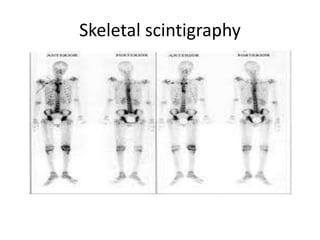
• Anterior (left) and posterior (right) whole-
body bone scintigrams obtained in an adult
Findings Normal symmetric uptake in both
shoulders,sternoclavicular joints, areas of
overlapping of bones such as ribs and iliac
blades, nasopharynx, kidneys and urinary
bladder.
Older patients
• The older the patient, the higher the
proportion of poor quality scans.
Findings that are always abnormal:
• Strikingly asymmetrical changes
• Very hot spots Findings Extensive osseous
metastases from lung carcinoma.
• Anterior (left) and posterior (right) whole-
body bone scintigrams show multiple,
randomly distributed foci of abnormal
radiotracer uptake.
• The foci vary in size and intensity.
Procedure
• A nuclear medicine technologist will perform
the skeletal scintigraphy procedure.
• You will lie on an exam table. If necessary, a
nurse or technologist will insert an intravenous
(IV) catheter into a vein in your hand or arm.
• The technologist will administer the
radiopharmaceutical into a vein in your hand or
arm.
• It takes a few hours, usually two to four hours, for
the radiotracer to circulate through your body and
bind to your bones so that the pictures can be
taken.
• During this time, you'll be asked to drink four to
six glasses of water to remove any unnecessary
radiotracer from your body that does not travel to
the bones.
• You will also be asked to empty your bladder
before the scan begins to prevent any tracer in
the urine from blocking the view of your
pelvic bones during the scan.
• When imaging begins, the camera or scanner
will take a series of images.
What will patient experience during
and after the procedure?
• Patient will feel a slight pin prick when the technologist
inserts the needle into your vein for the intravenous
line. Patient may feel a cold sensation moving up your
arm during the radiotracer injection. Generally, there
are no other side effects.
• The bone scan itself is usually painless and is rarely
associated with significant discomfort or side effects.
No anesthesia is needed for skeletal scintigraphy, and
sedation is rarely necessary. The test may be
uncomfortable if you are having joint or bone pain. Try
to relax by breathing slowly and deeply.
• The small amount of radiotracer in your body will
lose its radioactivity over time through the natural
process of radioactive decay. It may also pass out
of your body through your urine or stool during
the first few hours or days after the test. Drink
plenty of water to help flush the material out of
your body.
• The amount of radiation is so small that it is not a
risk for people to come in contact with you after
the test.
Benefits
• Bone scan helps physicians evaluate the
condition of your bones and detect fractures
and other abnormalities that may be missed in
a Bone Radiography or X-ray exam.
• Bone scan can provide early detection of
primary cancer and cancer that has spread to
the bones from other parts of the body.
• Nuclear medicine exams provide unique
information that is often unattainable using
other imaging procedures. This information
may include details on the function and
anatomy of body structures.
Risks
• Allergic reactions to radiotracers are extremely
rare and usually mild.
• The radiotracer injection may cause slight pain
and redness. This should rapidly resolve.
• The radiotracer can be transmitted to the baby
through breast milk.
Limitations
• Bone scans cannot identify some types of
cancer.
• Nuclear medicine procedures can be time
consuming. It can take several hours to days
for the radiotracer to accumulate in the area of
interest.
• The image resolution of nuclear medicine
images may not be as high as that of CT or
MRI.
bone scan by Dr.Madeeha.pptx

bone scan by Dr.Madeeha.pptx

  • 2.
    SKELETAL SCINTIGRAPHY Presented by:Dr. Madeeha Jabeen(MID,UOL)
  • 3.
  • 4.
    INTRODUCTION • A techniqueused in nuclear medicine in which bone specific agents (phosphates) are injected intravenously and followed with the help of gamma camera to detect their metabolism(functional imaging) which alters with the diseased states of bone. Methylene diphosphonate (MDP) and hydroxymethylene diphosphonate (HMDP) are the most commonly used agents; both agents resist in vivo hydrolysis by alkaline phosphatase.
  • 5.
    Bone scan • Abone scan (skeletal scintigraphy) is a special type of nuclear medicine procedure that uses small amounts of radioactive material to diagnose and assess the severity of ,a variety of bone diseases and conditions, including fractures, infection, and cancer.
  • 6.
    INDICATIONS • • Detectionof metastases • • Staging of malignancies • • Detection of osteomyelitis • • Detection of radio graphically occult fractures • • Determine multiplicity of lesions (e.g., fibrous dysplasia, Paget disease) • • Diagnosis of reflex sympathetic dystrophy
  • 7.
    Equipment • Special gammacamera • Single-photon emission-computed tomography (SPECT) imaging techniques.
  • 8.
    TECHNIQUE • 1. Inject740 MBq 99m Techentium Methylene Di Phosphonate Intravenously. • 2. Take image 2 to 4 hours later. • 3. May have to wait longer before imaging patients with renal insufficiency to allow for soft tissue clearance • 4. Have patient urinate immediately before imaging to decrease bladder activity.
  • 9.
    Two image acquisitionformats: • Whole-body single pass (lower resolution) • Spot views (longer time of acquisition, better resolution).
  • 10.
    AREAS OF NORMALUPTAKE Adults • Locally increased activity may be a normal variant: • Patchy uptake in the skull may be normal. • Common location for degenerative changes (usually at both sides of a joint) • Sternoclavicular joint, manubriosternal joint • Lower cervical and lumbar spine (usually at concavity of scoliosis)
  • 11.
    • Knees, ankles,wrists,1stcarpometacarpal joint,Tendon insertions Regions of constant stress Geometric overlap of bones (ribs) • Normal,secondary uptake of the label: Nasopharynx , Kidneys, Soft tissues.
  • 12.
    • Anterior (left)and posterior (right) whole- body bone scintigrams obtained in an adult Findings Normal symmetric uptake in both shoulders,sternoclavicular joints, areas of overlapping of bones such as ribs and iliac blades, nasopharynx, kidneys and urinary bladder.
  • 13.
    Older patients • Theolder the patient, the higher the proportion of poor quality scans.
  • 14.
    Findings that arealways abnormal: • Strikingly asymmetrical changes • Very hot spots Findings Extensive osseous metastases from lung carcinoma. • Anterior (left) and posterior (right) whole- body bone scintigrams show multiple, randomly distributed foci of abnormal radiotracer uptake. • The foci vary in size and intensity.
  • 15.
    Procedure • A nuclearmedicine technologist will perform the skeletal scintigraphy procedure. • You will lie on an exam table. If necessary, a nurse or technologist will insert an intravenous (IV) catheter into a vein in your hand or arm.
  • 16.
    • The technologistwill administer the radiopharmaceutical into a vein in your hand or arm. • It takes a few hours, usually two to four hours, for the radiotracer to circulate through your body and bind to your bones so that the pictures can be taken. • During this time, you'll be asked to drink four to six glasses of water to remove any unnecessary radiotracer from your body that does not travel to the bones.
  • 17.
    • You willalso be asked to empty your bladder before the scan begins to prevent any tracer in the urine from blocking the view of your pelvic bones during the scan. • When imaging begins, the camera or scanner will take a series of images.
  • 18.
    What will patientexperience during and after the procedure? • Patient will feel a slight pin prick when the technologist inserts the needle into your vein for the intravenous line. Patient may feel a cold sensation moving up your arm during the radiotracer injection. Generally, there are no other side effects. • The bone scan itself is usually painless and is rarely associated with significant discomfort or side effects. No anesthesia is needed for skeletal scintigraphy, and sedation is rarely necessary. The test may be uncomfortable if you are having joint or bone pain. Try to relax by breathing slowly and deeply.
  • 19.
    • The smallamount of radiotracer in your body will lose its radioactivity over time through the natural process of radioactive decay. It may also pass out of your body through your urine or stool during the first few hours or days after the test. Drink plenty of water to help flush the material out of your body. • The amount of radiation is so small that it is not a risk for people to come in contact with you after the test.
  • 21.
    Benefits • Bone scanhelps physicians evaluate the condition of your bones and detect fractures and other abnormalities that may be missed in a Bone Radiography or X-ray exam. • Bone scan can provide early detection of primary cancer and cancer that has spread to the bones from other parts of the body.
  • 22.
    • Nuclear medicineexams provide unique information that is often unattainable using other imaging procedures. This information may include details on the function and anatomy of body structures.
  • 23.
    Risks • Allergic reactionsto radiotracers are extremely rare and usually mild. • The radiotracer injection may cause slight pain and redness. This should rapidly resolve. • The radiotracer can be transmitted to the baby through breast milk.
  • 24.
    Limitations • Bone scanscannot identify some types of cancer. • Nuclear medicine procedures can be time consuming. It can take several hours to days for the radiotracer to accumulate in the area of interest. • The image resolution of nuclear medicine images may not be as high as that of CT or MRI.