X-rays of Pelvic Limb
Submitted to: Sir Awais Sial
Submitted by: Abdul Wahab
Contents:
• Introduction
• Anatomy of pelvic limb
• X-rays of pelvic limb
• Conclusion
• Reference
Introduction:
• X-rays, invented by Wilhelm Conrad Rontgen in
1895, are a very helpful tool in veterinary
investigative work.
• They penetrate tissues and show internal
structures, so vets can quickly diagnose many
conditions that they can't see by just looking at
an animal.
• X-rays can provide pictures of tissues, organs,
bones, and foreign objects like swallowed items
or bladder stones.
Conti…
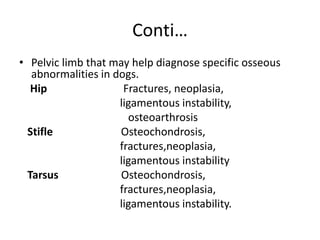
• Pelvic limb that may help diagnose specific osseous
abnormalities in dogs.
Hip Fractures, neoplasia,
ligamentous instability,
osteoarthrosis
Stifle Osteochondrosis,
fractures,neoplasia,
ligamentous instability
Tarsus Osteochondrosis,
fractures,neoplasia,
ligamentous instability.
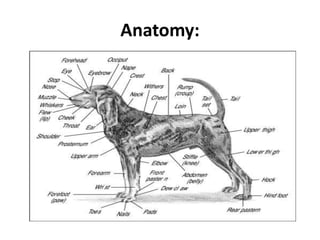
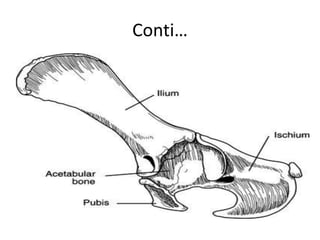
Anatomy:
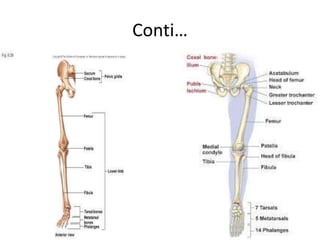
Conti…
Conti…
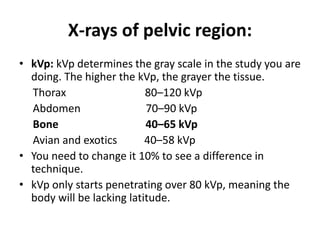
X-rays of pelvic region:
• kVp: kVp determines the gray scale in the study you are
doing. The higher the kVp, the grayer the tissue.
Thorax 80–120 kVp
Abdomen 70–90 kVp
Bone 40–65 kVp
Avian and exotics 40–58 kVp
• You need to change it 10% to see a difference in
technique.
• kVp only starts penetrating over 80 kVp, meaning the
body will be lacking latitude.
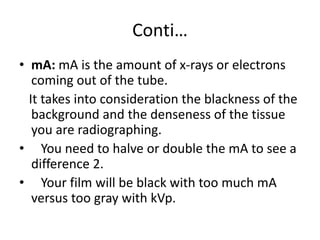
Conti…
• mA: mA is the amount of x-rays or electrons
coming out of the tube.
It takes into consideration the blackness of the
background and the denseness of the tissue
you are radiographing.
• You need to halve or double the mA to see a
difference 2.
• Your film will be black with too much mA
versus too gray with kVp.
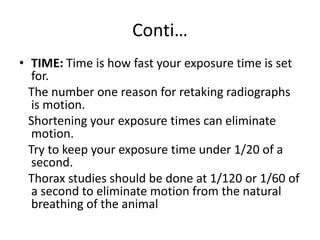
Conti…
• TIME: Time is how fast your exposure time is set
for.
The number one reason for retaking radiographs
is motion.
Shortening your exposure times can eliminate
motion.
Try to keep your exposure time under 1/20 of a
second.
Thorax studies should be done at 1/120 or 1/60 of
a second to eliminate motion from the natural
breathing of the animal
Conti…
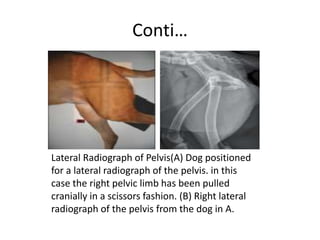
Lateral Radiograph of Pelvis(A) Dog positioned
for a lateral radiograph of the pelvis. in this
case the right pelvic limb has been pulled
cranially in a scissors fashion. (B) Right lateral
radiograph of the pelvis from the dog in A.
Conti…
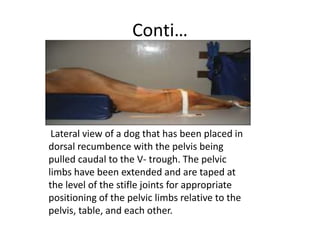
Lateral view of a dog that has been placed in
dorsal recumbence with the pelvis being
pulled caudal to the V- trough. The pelvic
limbs have been extended and are taped at
the level of the stifle joints for appropriate
positioning of the pelvic limbs relative to the
pelvis, table, and each other.
Conti…
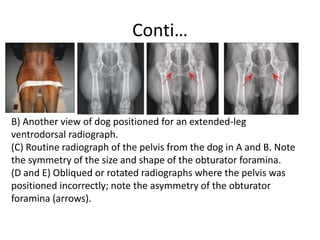
B) Another view of dog positioned for an extended-leg
ventrodorsal radiograph.
(C) Routine radiograph of the pelvis from the dog in A and B. Note
the symmetry of the size and shape of the obturator foramina.
(D and E) Obliqued or rotated radiographs where the pelvis was
positioned incorrectly; note the asymmetry of the obturator
foramina (arrows).
Conti…
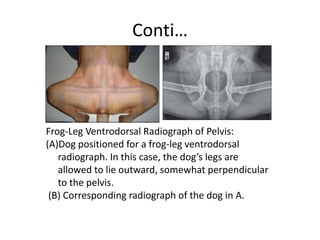
Frog-Leg Ventrodorsal Radiograph of Pelvis:
(A)Dog positioned for a frog-leg ventrodorsal
radiograph. In this case, the dog’s legs are
allowed to lie outward, somewhat perpendicular
to the pelvis.
(B) Corresponding radiograph of the dog in A.
Conti…
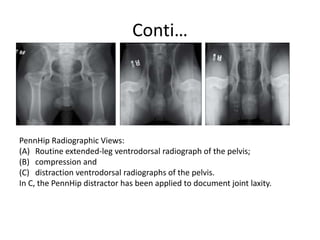
PennHip Radiographic Views:
(A) Routine extended-leg ventrodorsal radiograph of the pelvis;
(B) compression and
(C) distraction ventrodorsal radiographs of the pelvis.
In C, the PennHip distractor has been applied to document joint laxity.
Conti…
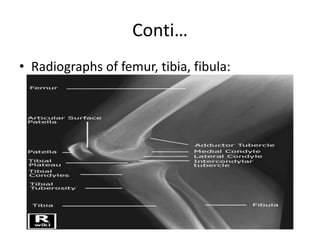
• Radiographs of femur, tibia, fibula:
Conti…
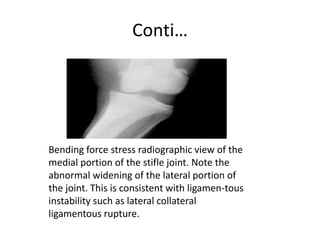
Bending force stress radiographic view of the
medial portion of the stifle joint. Note the
abnormal widening of the lateral portion of
the joint. This is consistent with ligamen-tous
instability such as lateral collateral
ligamentous rupture.
Conti…
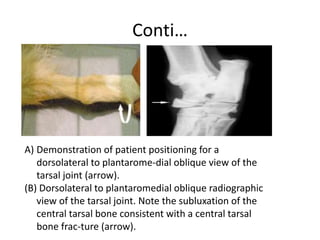
A) Demonstration of patient positioning for a
dorsolateral to plantarome-dial oblique view of the
tarsal joint (arrow).
(B) Dorsolateral to plantaromedial oblique radiographic
view of the tarsal joint. Note the subluxation of the
central tarsal bone consistent with a central tarsal
bone frac-ture (arrow).
Conti…
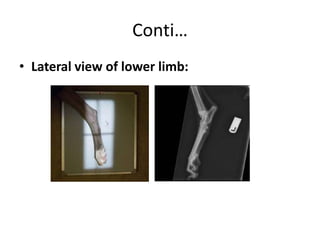
• Lateral view of lower limb:
Conti…
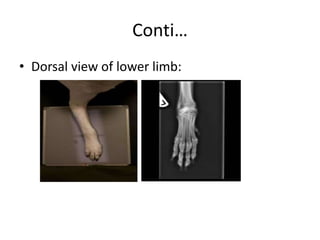
• Dorsal view of lower limb:
Conti…
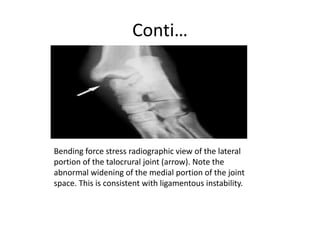
Bending force stress radiographic view of the lateral
portion of the talocrural joint (arrow). Note the
abnormal widening of the medial portion of the joint
space. This is consistent with ligamentous instability.
Conclusion:
• A pelvic X-ray can help find the cause of
symptoms such as pain, swelling, or deformity in
the pelvic, hip, or upper leg regions, and can
detect broken bones after an injury.
• If pelvic surgery is required, an X-ray may be
taken to plan for the surgery and, later, to see the
results of the operation.
• Pelvic X-rays may detect other problems such as
cysts, tumors, and later-stage infections of the
pelvic bones.
Reference:
• www.cabi.org
• vetxray.com
• kidshealth.org
X rays of pelvic limb

X rays of pelvic limb

  • 1.
    X-rays of PelvicLimb Submitted to: Sir Awais Sial Submitted by: Abdul Wahab
  • 2.
    Contents: • Introduction • Anatomyof pelvic limb • X-rays of pelvic limb • Conclusion • Reference
  • 3.
    Introduction: • X-rays, inventedby Wilhelm Conrad Rontgen in 1895, are a very helpful tool in veterinary investigative work. • They penetrate tissues and show internal structures, so vets can quickly diagnose many conditions that they can't see by just looking at an animal. • X-rays can provide pictures of tissues, organs, bones, and foreign objects like swallowed items or bladder stones.
  • 4.
    Conti… • Pelvic limbthat may help diagnose specific osseous abnormalities in dogs. Hip Fractures, neoplasia, ligamentous instability, osteoarthrosis Stifle Osteochondrosis, fractures,neoplasia, ligamentous instability Tarsus Osteochondrosis, fractures,neoplasia, ligamentous instability.
  • 5.
  • 6.
  • 7.
  • 8.
    X-rays of pelvicregion: • kVp: kVp determines the gray scale in the study you are doing. The higher the kVp, the grayer the tissue. Thorax 80–120 kVp Abdomen 70–90 kVp Bone 40–65 kVp Avian and exotics 40–58 kVp • You need to change it 10% to see a difference in technique. • kVp only starts penetrating over 80 kVp, meaning the body will be lacking latitude.
  • 9.
    Conti… • mA: mAis the amount of x-rays or electrons coming out of the tube. It takes into consideration the blackness of the background and the denseness of the tissue you are radiographing. • You need to halve or double the mA to see a difference 2. • Your film will be black with too much mA versus too gray with kVp.
  • 10.
    Conti… • TIME: Timeis how fast your exposure time is set for. The number one reason for retaking radiographs is motion. Shortening your exposure times can eliminate motion. Try to keep your exposure time under 1/20 of a second. Thorax studies should be done at 1/120 or 1/60 of a second to eliminate motion from the natural breathing of the animal
  • 11.
    Conti… Lateral Radiograph ofPelvis(A) Dog positioned for a lateral radiograph of the pelvis. in this case the right pelvic limb has been pulled cranially in a scissors fashion. (B) Right lateral radiograph of the pelvis from the dog in A.
  • 12.
    Conti… Lateral view ofa dog that has been placed in dorsal recumbence with the pelvis being pulled caudal to the V- trough. The pelvic limbs have been extended and are taped at the level of the stifle joints for appropriate positioning of the pelvic limbs relative to the pelvis, table, and each other.
  • 13.
    Conti… B) Another viewof dog positioned for an extended-leg ventrodorsal radiograph. (C) Routine radiograph of the pelvis from the dog in A and B. Note the symmetry of the size and shape of the obturator foramina. (D and E) Obliqued or rotated radiographs where the pelvis was positioned incorrectly; note the asymmetry of the obturator foramina (arrows).
  • 14.
    Conti… Frog-Leg Ventrodorsal Radiographof Pelvis: (A)Dog positioned for a frog-leg ventrodorsal radiograph. In this case, the dog’s legs are allowed to lie outward, somewhat perpendicular to the pelvis. (B) Corresponding radiograph of the dog in A.
  • 15.
    Conti… PennHip Radiographic Views: (A)Routine extended-leg ventrodorsal radiograph of the pelvis; (B) compression and (C) distraction ventrodorsal radiographs of the pelvis. In C, the PennHip distractor has been applied to document joint laxity.
  • 16.
    Conti… • Radiographs offemur, tibia, fibula:
  • 17.
    Conti… Bending force stressradiographic view of the medial portion of the stifle joint. Note the abnormal widening of the lateral portion of the joint. This is consistent with ligamen-tous instability such as lateral collateral ligamentous rupture.
  • 18.
    Conti… A) Demonstration ofpatient positioning for a dorsolateral to plantarome-dial oblique view of the tarsal joint (arrow). (B) Dorsolateral to plantaromedial oblique radiographic view of the tarsal joint. Note the subluxation of the central tarsal bone consistent with a central tarsal bone frac-ture (arrow).
  • 19.
  • 20.
  • 21.
    Conti… Bending force stressradiographic view of the lateral portion of the talocrural joint (arrow). Note the abnormal widening of the medial portion of the joint space. This is consistent with ligamentous instability.
  • 22.
    Conclusion: • A pelvicX-ray can help find the cause of symptoms such as pain, swelling, or deformity in the pelvic, hip, or upper leg regions, and can detect broken bones after an injury. • If pelvic surgery is required, an X-ray may be taken to plan for the surgery and, later, to see the results of the operation. • Pelvic X-rays may detect other problems such as cysts, tumors, and later-stage infections of the pelvic bones.
  • 23.