Unit 1 Lesson 1 What Do Scientists Do? 
Copyright © Houghton Mifflin Harcourt Publishing Company
Unit 1 Lesson 1 What Do Scientists Do? 
The Role of Scientists 
• Science is the study of the natural world. 
• A scientist asks questions about the natural 
world. 
• There are many kinds of scientists and many 
questions to ask. 
• Scientists work alone and in teams. 
Copyright © Houghton Mifflin Harcourt Publishing Company
Unit 1 Lesson 1 What Do Scientists Do? 
The Role of Scientists 
• Earth scientists study things like rocks, weather, 
and the planets. 
• Physical scientists study matter and energy. 
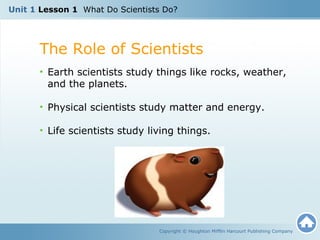
• Life scientists study living things. 
Copyright © Houghton Mifflin Harcourt Publishing Company
Unit 1 Lesson 1 What Do Scientists Do? 
Making Observations and 
Asking Questions 
• Scientists make observations about the world 
around them. 
• An observation is information collected by using 
the five senses. 
• Scientists ask questions about their observations. 
Copyright © Houghton Mifflin Harcourt Publishing Company
Unit 1 Lesson 1 What Do Scientists Do? 
Making Observations and Asking 
Questions 
• Scientists conduct an investigation to answer 
their questions. 
• The steps of an investigation may include asking 
questions, making observations, reading or talking 
to experts, drawing conclusions, and sharing what 
you learn. 
Copyright © Houghton Mifflin Harcourt Publishing Company
Unit 1 Lesson 1 What Do Scientists Do? 
Experiments 
Copyright © Houghton Mifflin Harcourt Publishing Company 
A Fair Test 
• An experiment is a fair test. An experiment can 
show that one thing causes another thing to 
happen. 
• In each experiment, you change only one factor, 
or variable.
Unit 1 Lesson 1 What Do Scientists Do? 
A Fair Test 
• To be fair and accurate, you conduct the 
experiment multiple times. 
• To test something else, you must start a new 
experiment. 
• Being creative and working in teams can help 
scientists conduct experiments. 
Copyright © Houghton Mifflin Harcourt Publishing Company
Unit 1 Lesson 1 What Do Scientists Do? 
Scientific Methods 
• Scientific investigations use scientific methods. 
• Scientific methods may include the following 
activities: make observations, ask a question, 
form a hypothesis, plan and conduct an 
experiment, record and analyze results, draw 
conclusions, communicate results. 
• A hypothesis is an idea or explanation that can 
be tested with an investigation. 
Copyright © Houghton Mifflin Harcourt Publishing Company
Unit 1 Lesson 1 What Do Scientists Do? 
Other Kinds of Investigations 
• Many science questions cannot be answered by 
doing an experiment. 
• Some science questions can be answered by using 
an investigation guide. 
• Other science questions can be answered by using 
models or tools. 
• Some science questions can be answered with 
research. Research includes reading what others 
have written and asking experts. 
Copyright © Houghton Mifflin Harcourt Publishing Company
Unit 1 Lesson 1 What Do Scientists Do? 
Scientists Share Their Results 
as Evidence 
• When scientists explain how things work, they 
must give evidence. 
• Evidence is data gathered during an investigation. 
Evidence might support your hypothesis, or it 
might not. 
• A conclusion is an explanation that is based 
on evidence. 
Copyright © Houghton Mifflin Harcourt Publishing Company

Unit 1 lesson 1 what do scientist do

  • 1.
    Unit 1 Lesson1 What Do Scientists Do? Copyright © Houghton Mifflin Harcourt Publishing Company
  • 2.
    Unit 1 Lesson1 What Do Scientists Do? The Role of Scientists • Science is the study of the natural world. • A scientist asks questions about the natural world. • There are many kinds of scientists and many questions to ask. • Scientists work alone and in teams. Copyright © Houghton Mifflin Harcourt Publishing Company
  • 3.
    Unit 1 Lesson1 What Do Scientists Do? The Role of Scientists • Earth scientists study things like rocks, weather, and the planets. • Physical scientists study matter and energy. • Life scientists study living things. Copyright © Houghton Mifflin Harcourt Publishing Company
  • 4.
    Unit 1 Lesson1 What Do Scientists Do? Making Observations and Asking Questions • Scientists make observations about the world around them. • An observation is information collected by using the five senses. • Scientists ask questions about their observations. Copyright © Houghton Mifflin Harcourt Publishing Company
  • 5.
    Unit 1 Lesson1 What Do Scientists Do? Making Observations and Asking Questions • Scientists conduct an investigation to answer their questions. • The steps of an investigation may include asking questions, making observations, reading or talking to experts, drawing conclusions, and sharing what you learn. Copyright © Houghton Mifflin Harcourt Publishing Company
  • 6.
    Unit 1 Lesson1 What Do Scientists Do? Experiments Copyright © Houghton Mifflin Harcourt Publishing Company A Fair Test • An experiment is a fair test. An experiment can show that one thing causes another thing to happen. • In each experiment, you change only one factor, or variable.
  • 7.
    Unit 1 Lesson1 What Do Scientists Do? A Fair Test • To be fair and accurate, you conduct the experiment multiple times. • To test something else, you must start a new experiment. • Being creative and working in teams can help scientists conduct experiments. Copyright © Houghton Mifflin Harcourt Publishing Company
  • 8.
    Unit 1 Lesson1 What Do Scientists Do? Scientific Methods • Scientific investigations use scientific methods. • Scientific methods may include the following activities: make observations, ask a question, form a hypothesis, plan and conduct an experiment, record and analyze results, draw conclusions, communicate results. • A hypothesis is an idea or explanation that can be tested with an investigation. Copyright © Houghton Mifflin Harcourt Publishing Company
  • 9.
    Unit 1 Lesson1 What Do Scientists Do? Other Kinds of Investigations • Many science questions cannot be answered by doing an experiment. • Some science questions can be answered by using an investigation guide. • Other science questions can be answered by using models or tools. • Some science questions can be answered with research. Research includes reading what others have written and asking experts. Copyright © Houghton Mifflin Harcourt Publishing Company
  • 10.
    Unit 1 Lesson1 What Do Scientists Do? Scientists Share Their Results as Evidence • When scientists explain how things work, they must give evidence. • Evidence is data gathered during an investigation. Evidence might support your hypothesis, or it might not. • A conclusion is an explanation that is based on evidence. Copyright © Houghton Mifflin Harcourt Publishing Company