The ProcessThe Process
SkillsSkills
Logical operations of thinking in
investigations. They are either
basic or
integrated.
Basic Process Skills: Observing, comparing,
classifying, quantifying, inferring,
predicting, communicating and manipulative
skills.
Integrated Process Skills: Embodied in
experimenting which includes
hypothesizing, controlling variables and
1. OBSERVING
most basic and fundamental of the process skills.
One cannot compare, classify or perform the
other process skills without being a good
observer. We observe objects or events through
our five senses: sight, smell, touch, taste and
hearing.
Example: Describing a pencil as yellow
The Process of observing can
be:
• Qualitative – this is identifying and naming
the properties of an object such as its shape,
color, size, texture, smell, and sound.
• Quantitative – This kind of observation
involves measurement.
• Change – it could be the result of crushing,
pounding, burning, cutting, decaying, etc.
2. COMPARING
Comparing is using
observable properties in
discovering similarities of
and differences between
objects and phenomena.
Through comparison, we
are able to identify
relationships among
objects and phenomena
observed.
3. CLASSIFYING
There is an overwhelming number of things
around us – nonliving and living things. Order can
be attained by observing similarities, differences
and interrelationships and by grouping them
accordingly to suit some purpose.
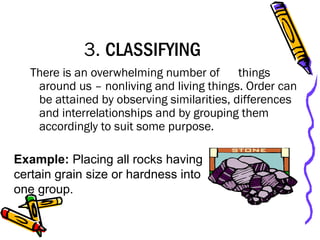
Example: Placing all rocks having
certain grain size or hardness into
one group.
4. INFERRING
While observing is getting information by using one
or more senses, inferring is explaining or
interpreting an observation.
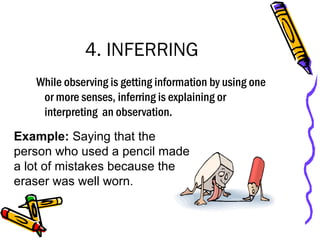
Example: Saying that the
person who used a pencil made
a lot of mistakes because the
eraser was well worn.
5. PREDICTING
Predicting is the process of using past observations or data
along with other kinds of scientific knowledge to forecast
event or relationships. A statement not based on
observation is not a prediction. It is simply a guess.
Interpolation – is predicting new data based on and within a trend/ pattern of
previously observed data.
Extrapolation - is predicting new data outside or beyond the range of previously
observed data.
6. QUANTIFYING
Quantifying is making and manipulating quantitative
observations.
This involves:
1. Using numbers
2. measuring
3. use of time and space
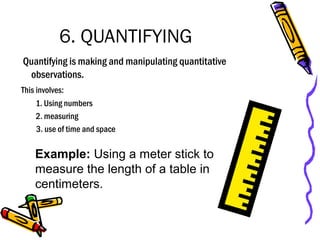
Example: Using a meter stick to
measure the length of a table in
centimeters.
7. COMMUNICATING
Expressing ideas in many forms, such as orally, in writing or
with graphs, diagrams, tables of data or photographs is a
way of communicating.
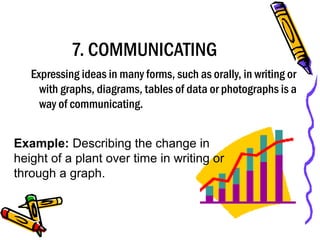
Example: Describing the change in
height of a plant over time in writing or
through a graph.
8. MANIPULATIVE SKILLS
These skills involve using
equipment and materials
properly and accurately,
preparing setups for
investigation, and
handling specimen
carefully.
9. EXPERIMENTING
The ability to design an
investigation to test a
hypothesis, conduct simple
experiments, recognize
limitations of methods and
tools used in experiments,
i.e., experimental
error
and utilize safe procedures
while conducting
investigations.
10. INTERPRETING DATA
• This skill involves one to
organize and state in
his/her own words
information derived from
an investigation.
• This also involves a person
to revise interpretations
of data based on new
information or revised
data.
11. DEFINING OPERATIONALLY
• This refers to one’s
ability to state
definitions of objects
or events in terms of
what the object is
doing or what is
occurring in the event
or to state definitions
of objects or events
based on observable
characteristics
12. FORMULATING MODELS
• The ability to create a
mental, physical, or
mental verbal
representation of an
idea, object or event.
• use models to
describe and explain
interrelationships of
ideas, objects, or
events
Let’s take a look at the
samples!
Jim thinks that the more air pressure in a basketball, the
higher it will bounce. To investigate this hypothesis he
collects several basketballs and an air pump with a
pressure gauge.
How should Jim test his hypothesis?
A) Bounce basketballs with different amounts of force from
the same height.
B) Bounce basketballs having different air pressures from
the same height.
C) Bounce basketballs having the same air pressure at
different angles from the floor.
D) Bounce basketballs having the same amount of air
pressure from different heights.
Luisa wanted to know which of the three types of soil (clay,
sandy and loamy), would be best for growing beans. She
planted bean seedlings in three pots of the same size, but
having different soil types. The pots were placed near a
sunny window after pouring the same amount of water in
them. The bean plants were examined at the end of ten
days. Differences in their growth were recorded.
Which factor do you think made the difference in the growth
rates of the bean seedlings?
a. The amount of sunlight available
b. The type of soil used
c. The temperature of the surroundings
d. The amount of chlorophyll present
Marie wondered if the earth and oceans are heated equally by
sunlight. She decided to conduct an investigation. She filled a
bucket with dirt and another bucket of the same size with water.
She placed them so each bucket received the same amount of
sunlight. The temperature in each was measured every hour
from 8:00 a.m. to 6:00 p.m.
Which hypothesis was being tested?
A) The greater the amount of sunlight, the warmer the soil and
water become.
B) The longer the soil and water are in the sun, the warmer they
become.
C) Different types of materials are warmed differently by the sun.
D) Different amounts of sunlight are received at different times of
the day.
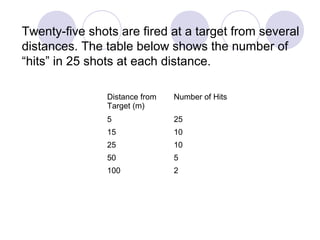
Twenty-five shots are fired at a target from several
distances. The table below shows the number of
“hits” in 25 shots at each distance.
Distance from
Target (m)
Number of Hits
5 25
15 10
25 10
50 5
100 2
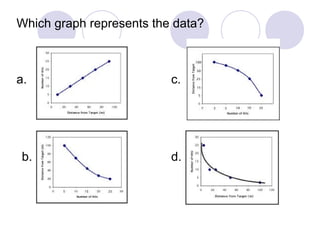
Which graph represents the data?
a.
b.
c.
d.
A farmer wonders how he can increase the
amount of corn he grows. He plans to study
factors that affect the amount of corn produced.
Which of these hypotheses could he test?
A) The greater the amount of fertilizer the larger
the amount of corn produced.
B) The greater the amount of corn, the larger the
profits for the year.
C) As the amount of rainfall increases, the more
effective the fertilizer.
D) As the amount of corn produced increases, the
cost of production increases.
Mark is studying the effect of temperature on the
rate that oil flows. His hypothesis is that as the
temperature of the oil increases it flows faster.
How could he test this hypothesis?
A) Heat oil to different temperatures and weigh it
after it flows out of the can.
B) Observe the speed at which oil at different
temperatures flows down a smooth surface.
C) Let oil flow down smooth surfaces at different
angles and observe its speed.
D) Measure the time it takes for oil at different
thicknesses to pour out of the can.
A gardener notices that his squash plants are being attacked
by aphids. He needs to get rid of the aphids. His brother tells
him that “Aphid-Away” powder is the best insecticide to use.
The county agent says “Squash-Saver” spray works the best.
The gardener selects six squash plants and applies the
powder to three and the spray to three. A week later he
counts the number of live aphids on each of the plants.
How is the effectiveness of the insecticides measured in this
study?
A) Measuring the amount of spray or powder used.
B) Determining the condition of the plants after spraying or
dusting.
C) Weighing the squash each plant produces.
D) Counting the number of aphids remaining on the plants.

Process skills in Science

  • 1.
  • 2.
    Logical operations ofthinking in investigations. They are either basic or integrated. Basic Process Skills: Observing, comparing, classifying, quantifying, inferring, predicting, communicating and manipulative skills. Integrated Process Skills: Embodied in experimenting which includes hypothesizing, controlling variables and
  • 3.
    1. OBSERVING most basicand fundamental of the process skills. One cannot compare, classify or perform the other process skills without being a good observer. We observe objects or events through our five senses: sight, smell, touch, taste and hearing. Example: Describing a pencil as yellow
  • 4.
    The Process ofobserving can be: • Qualitative – this is identifying and naming the properties of an object such as its shape, color, size, texture, smell, and sound. • Quantitative – This kind of observation involves measurement. • Change – it could be the result of crushing, pounding, burning, cutting, decaying, etc.
  • 5.
    2. COMPARING Comparing isusing observable properties in discovering similarities of and differences between objects and phenomena. Through comparison, we are able to identify relationships among objects and phenomena observed.
  • 6.
    3. CLASSIFYING There isan overwhelming number of things around us – nonliving and living things. Order can be attained by observing similarities, differences and interrelationships and by grouping them accordingly to suit some purpose. Example: Placing all rocks having certain grain size or hardness into one group.
  • 7.
    4. INFERRING While observingis getting information by using one or more senses, inferring is explaining or interpreting an observation. Example: Saying that the person who used a pencil made a lot of mistakes because the eraser was well worn.
  • 8.
    5. PREDICTING Predicting isthe process of using past observations or data along with other kinds of scientific knowledge to forecast event or relationships. A statement not based on observation is not a prediction. It is simply a guess. Interpolation – is predicting new data based on and within a trend/ pattern of previously observed data. Extrapolation - is predicting new data outside or beyond the range of previously observed data.
  • 9.
    6. QUANTIFYING Quantifying ismaking and manipulating quantitative observations. This involves: 1. Using numbers 2. measuring 3. use of time and space Example: Using a meter stick to measure the length of a table in centimeters.
  • 10.
    7. COMMUNICATING Expressing ideasin many forms, such as orally, in writing or with graphs, diagrams, tables of data or photographs is a way of communicating. Example: Describing the change in height of a plant over time in writing or through a graph.
  • 11.
    8. MANIPULATIVE SKILLS Theseskills involve using equipment and materials properly and accurately, preparing setups for investigation, and handling specimen carefully.
  • 12.
    9. EXPERIMENTING The abilityto design an investigation to test a hypothesis, conduct simple experiments, recognize limitations of methods and tools used in experiments, i.e., experimental error and utilize safe procedures while conducting investigations.
  • 13.
    10. INTERPRETING DATA •This skill involves one to organize and state in his/her own words information derived from an investigation. • This also involves a person to revise interpretations of data based on new information or revised data.
  • 14.
    11. DEFINING OPERATIONALLY •This refers to one’s ability to state definitions of objects or events in terms of what the object is doing or what is occurring in the event or to state definitions of objects or events based on observable characteristics
  • 15.
    12. FORMULATING MODELS •The ability to create a mental, physical, or mental verbal representation of an idea, object or event. • use models to describe and explain interrelationships of ideas, objects, or events
  • 16.
    Let’s take alook at the samples!
  • 17.
    Jim thinks thatthe more air pressure in a basketball, the higher it will bounce. To investigate this hypothesis he collects several basketballs and an air pump with a pressure gauge. How should Jim test his hypothesis? A) Bounce basketballs with different amounts of force from the same height. B) Bounce basketballs having different air pressures from the same height. C) Bounce basketballs having the same air pressure at different angles from the floor. D) Bounce basketballs having the same amount of air pressure from different heights.
  • 18.
    Luisa wanted toknow which of the three types of soil (clay, sandy and loamy), would be best for growing beans. She planted bean seedlings in three pots of the same size, but having different soil types. The pots were placed near a sunny window after pouring the same amount of water in them. The bean plants were examined at the end of ten days. Differences in their growth were recorded. Which factor do you think made the difference in the growth rates of the bean seedlings? a. The amount of sunlight available b. The type of soil used c. The temperature of the surroundings d. The amount of chlorophyll present
  • 19.
    Marie wondered ifthe earth and oceans are heated equally by sunlight. She decided to conduct an investigation. She filled a bucket with dirt and another bucket of the same size with water. She placed them so each bucket received the same amount of sunlight. The temperature in each was measured every hour from 8:00 a.m. to 6:00 p.m. Which hypothesis was being tested? A) The greater the amount of sunlight, the warmer the soil and water become. B) The longer the soil and water are in the sun, the warmer they become. C) Different types of materials are warmed differently by the sun. D) Different amounts of sunlight are received at different times of the day.
  • 20.
    Twenty-five shots arefired at a target from several distances. The table below shows the number of “hits” in 25 shots at each distance. Distance from Target (m) Number of Hits 5 25 15 10 25 10 50 5 100 2
  • 21.
    Which graph representsthe data? a. b. c. d.
  • 22.
    A farmer wondershow he can increase the amount of corn he grows. He plans to study factors that affect the amount of corn produced. Which of these hypotheses could he test? A) The greater the amount of fertilizer the larger the amount of corn produced. B) The greater the amount of corn, the larger the profits for the year. C) As the amount of rainfall increases, the more effective the fertilizer. D) As the amount of corn produced increases, the cost of production increases.
  • 23.
    Mark is studyingthe effect of temperature on the rate that oil flows. His hypothesis is that as the temperature of the oil increases it flows faster. How could he test this hypothesis? A) Heat oil to different temperatures and weigh it after it flows out of the can. B) Observe the speed at which oil at different temperatures flows down a smooth surface. C) Let oil flow down smooth surfaces at different angles and observe its speed. D) Measure the time it takes for oil at different thicknesses to pour out of the can.
  • 24.
    A gardener noticesthat his squash plants are being attacked by aphids. He needs to get rid of the aphids. His brother tells him that “Aphid-Away” powder is the best insecticide to use. The county agent says “Squash-Saver” spray works the best. The gardener selects six squash plants and applies the powder to three and the spray to three. A week later he counts the number of live aphids on each of the plants. How is the effectiveness of the insecticides measured in this study? A) Measuring the amount of spray or powder used. B) Determining the condition of the plants after spraying or dusting. C) Weighing the squash each plant produces. D) Counting the number of aphids remaining on the plants.