f-Block Elements
28 elements from atomic number 58 to 71 (14 elements) and from atomic number
90 to 103 (14 elements) have been arranged in two horizontal rows below the
periodic table.
These elements are collectively called f- block elements as the last or
differentiating electron in the atoms of these elements is accommodated on one of
the seven f-orbitals of the ante penultimate (next to the penultimate) energy
shell.
These elements have also been called inner transition elements because the
ante-penultimate energy shell, i.e., (n -2) f-orbitals, lie comparatively deep
within the kernel (being inner to the penultimate shell).
f-block consists of two series of elements known as Lanthanides or
Lanthanons and Actinides or Actinons.
The lanthanide series follows lanthanum (At. No. 57), a member of 5d-series.
Similarly, actinide series comes after actinium (At. No. 89), a member of 6d-
series.
The 14 members of lanthanide series have been placed along with lanthanum in
the third group and sixth period and similarly 14 members of the actinide series
have been placed with actinium in the third group and seventh period.
The justification for assigning one place to these elements has been given on the
basis of their similar properties.
The properties are so similar that the fifteen elements from La to Lu can be
considered as equivalent to one element.
The same explanation can be given in the case of actinides.
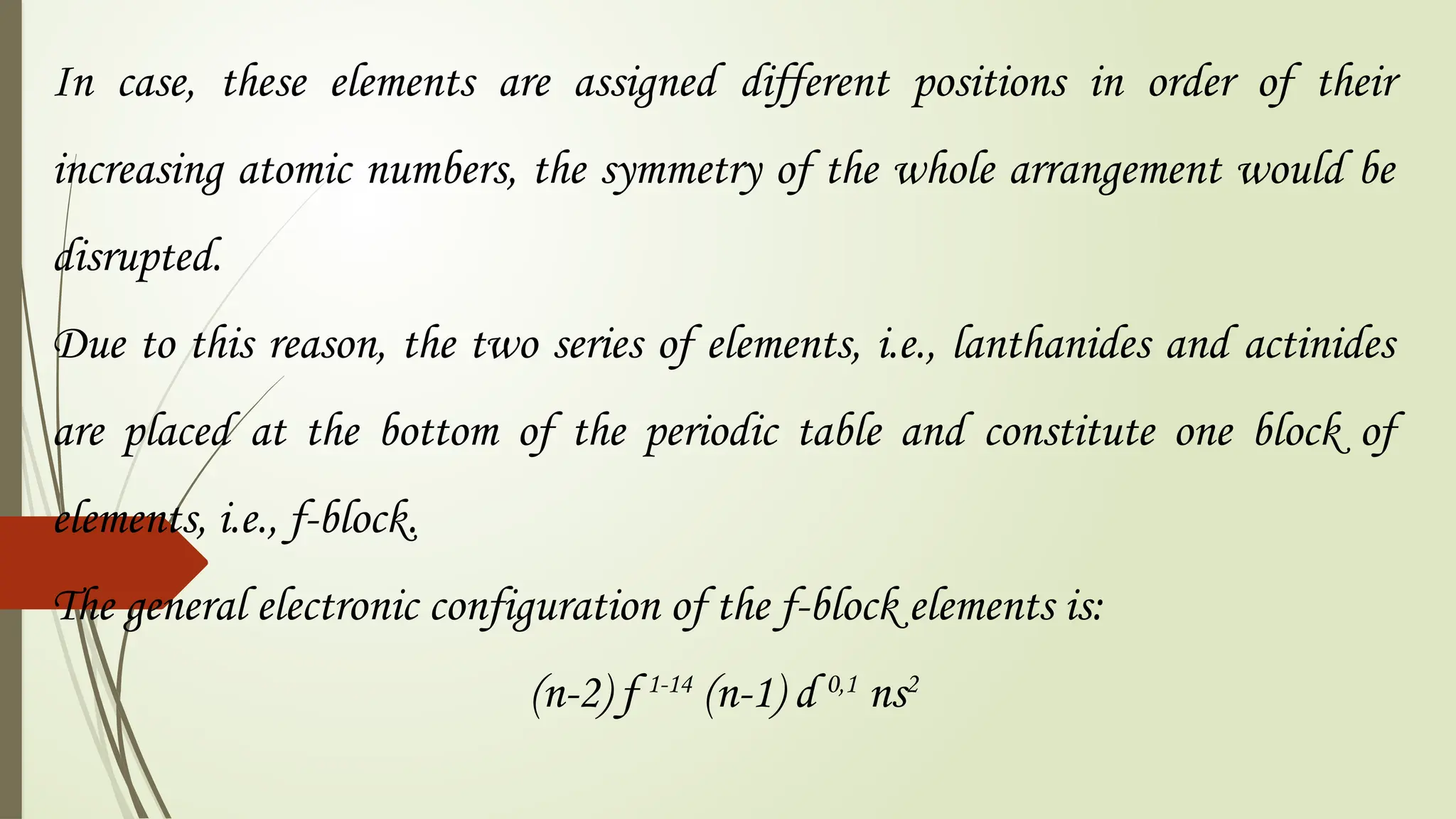
In case, these elements are assigned different positions in order of their
increasing atomic numbers, the symmetry of the whole arrangement would be
disrupted.
Due to this reason, the two series of elements, i.e., lanthanides and actinides
are placed at the bottom of the periodic table and constitute one block of
elements, i.e., f-block.
The general electronic configuration of the f-block elements is:
(n-2) f 1-14
(n-1) d 0,1
ns2
4f series (Lanthanides) :
There are fourteen elements from cerium (At. No. 58) to lutetium (At. No. 71)
in this series.
4f-orbitals are gradually filled up.
In the past, these elements were called rare earths.
This name is not appropriate because many of the elements are not particularly
rare.
Promethium is artificial radioactive element.
GENERAL CHARACTERISTICS OF LANTHANIDES
The general characteristics are similar to transition metals, i.e., d-block elements.
All the lanthanides are metals.
They are soft, malleable and ductile in nature.
They are not good conductors of heat and electricity.
They are highly dense metals and their densities are in the range of 6.77 to 9.74 g
cm-3
They have fairly high melting points. However, no definite trend is observed.
Electronic configuration:
The energies of 5d- and 4f-orbitals are nearly similar and thus their fillings show
certain irregularities.
The electronic configuration of lanthanum is [Xe]5d1
6s2
It is expected that 14 elements from cerium to lutetium would be formed by
adding, 1, 2, 3, ... 14 electrons into the 4f level.
However, it is energetically favourable to move the single electron on 5d into the
4f level in most of the elements but not in the cases of Gd and Lu.
In Gd and Lu besides 5d1
, the 4f-orbitals are half filled or fully filled. This
gives extra stability to the core. The extra stability of half-filled and fully
filled f orbitals is also seen in Eu(4f7
6s2
) and Yb(4f14
6s2
).
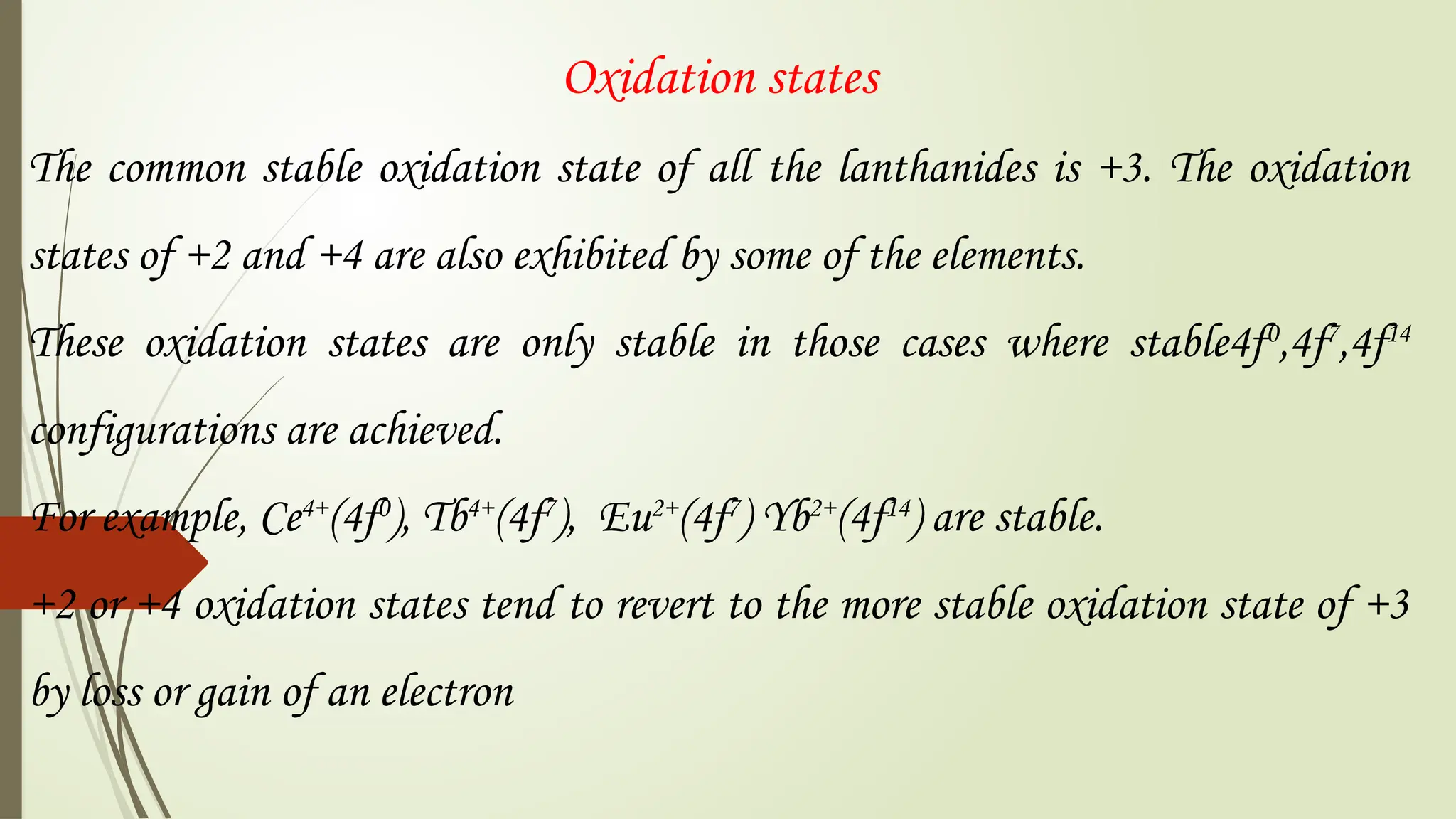
Oxidation states
The common stable oxidation state of all the lanthanides is +3. The oxidation
states of +2 and +4 are also exhibited by some of the elements.
These oxidation states are only stable in those cases where stable4f0
,4f7
,4f14
configurations are achieved.
For example, Ce4+
(4f0
), Tb4+
(4f7
), Eu2+
(4f7
) Yb2+
(4f14
) are stable.
+2 or +4 oxidation states tend to revert to the more stable oxidation state of +3
by loss or gain of an electron
Sm2+
, Eu2+
and Yb2+
ions are thus good reducing agents in solutions while Ce4+
,
Tb4+
ions, etc., are good oxidising agents. The compounds of lanthanides are
mainly ionic in nature.
Atomic and ionic radii (Lanthanoid contraction)
In lanthanide series, there is a regular decrease in the atomic as well as ionic
radii of trivalent ions (M3+
) as the atomic number increases from cerium to
lutetium.
This decrease in size of atoms and ions is known as Lanthanide contraction.
Although the atomic radii do show some irregularities but ionic radii decrease
steadily from La to Lu. However, the decrease is very small.
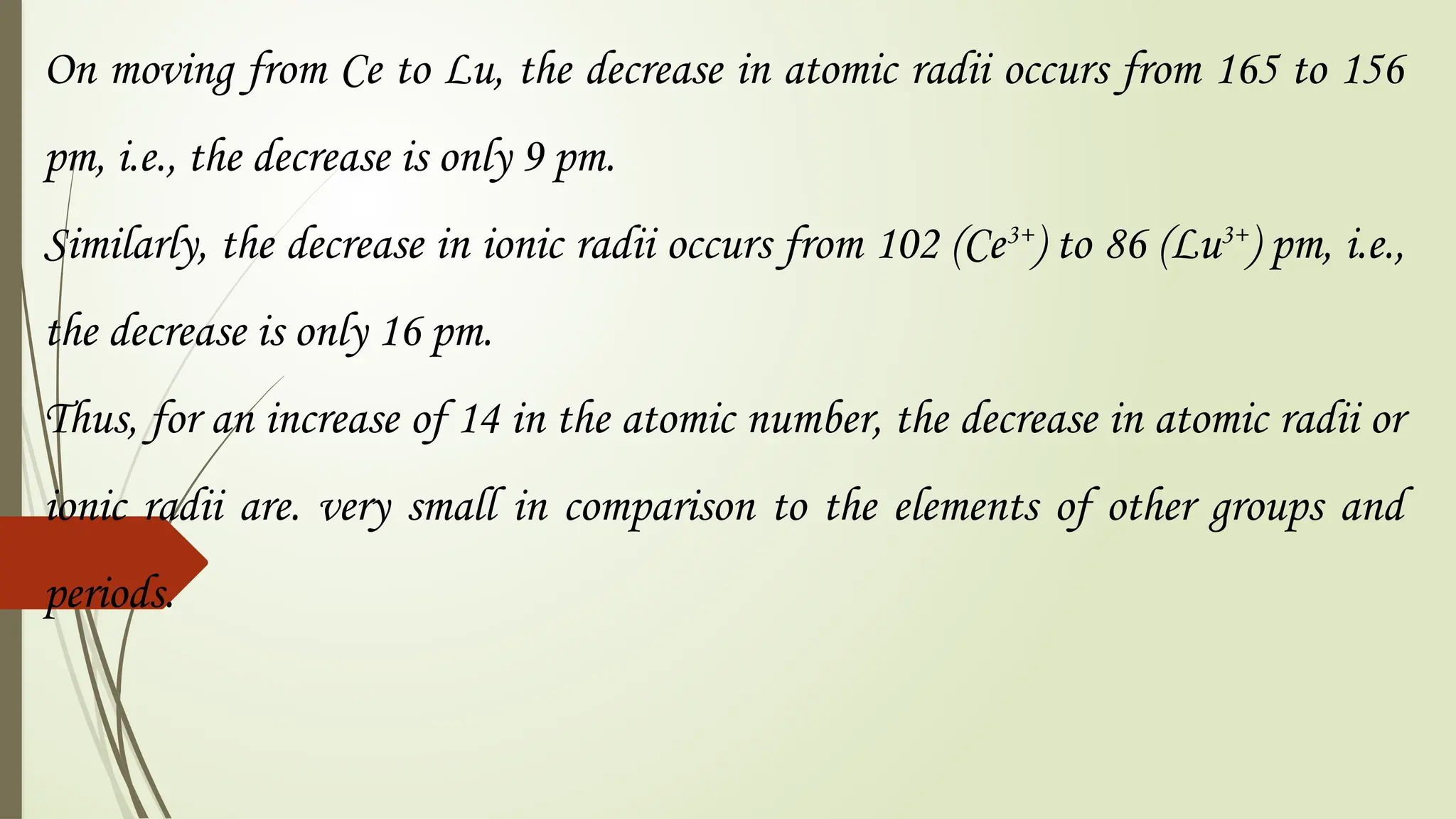
On moving from Ce to Lu, the decrease in atomic radii occurs from 165 to 156
pm, i.e., the decrease is only 9 pm.
Similarly, the decrease in ionic radii occurs from 102 (Ce3+
) to 86 (Lu3+
) pm, i.e.,
the decrease is only 16 pm.
Thus, for an increase of 14 in the atomic number, the decrease in atomic radii or
ionic radii are. very small in comparison to the elements of other groups and
periods.
Cause of lanthanide contraction:
As we proceed from one element to the next element in the lanthanide series, the
nuclear charge, i.e., atomic number increases by one unit and the addition of one
electron occurs at the same time in 4f energy shell.
On account of the very diffused shapes of f orbitals, the 4f electrons shield each
other quite poorly from the nuclear charge.
Thus, the effect of nuclear charge increase is somewhat more than the changed
shielding effect.
This brings the valence shell nearer to the nucleus and hence the size of atom
or ion goes on decreasing as we move in the series. The sum of the successive
reductions is equal to the total lanthanide contraction.
Consequences of lanthanide contraction:
The main consequences of lanthanide contraction are the following:
Similar chemical properties: Since the change in the ionic radii in the lanthanide
series is very small, their chemical properties are similar. Thus it is very difficult
to separate these elements in the pure state;
However, lanthanide contraction brings some differences in properties like
solubility, complex ion formation, hydration, etc.
These differences help in the separation of lanthanide elements by fractional
crystallisation or ion exchange methods.
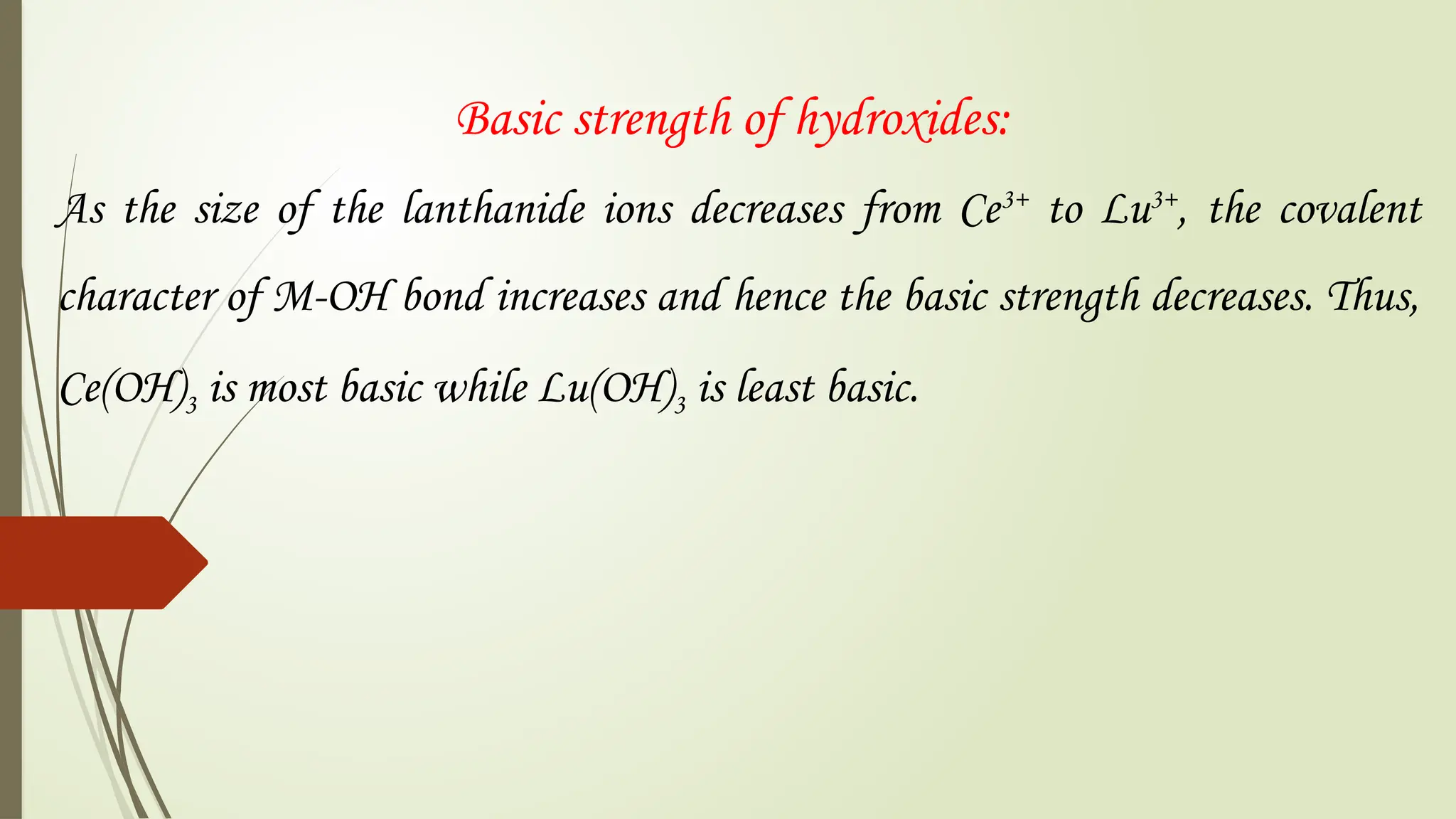
Basic strength of hydroxides:
As the size of the lanthanide ions decreases from Ce3+
to Lu3+
, the covalent
character of M-OH bond increases and hence the basic strength decreases. Thus,
Ce(OH)3 is most basic while Lu(OH)3 is least basic.
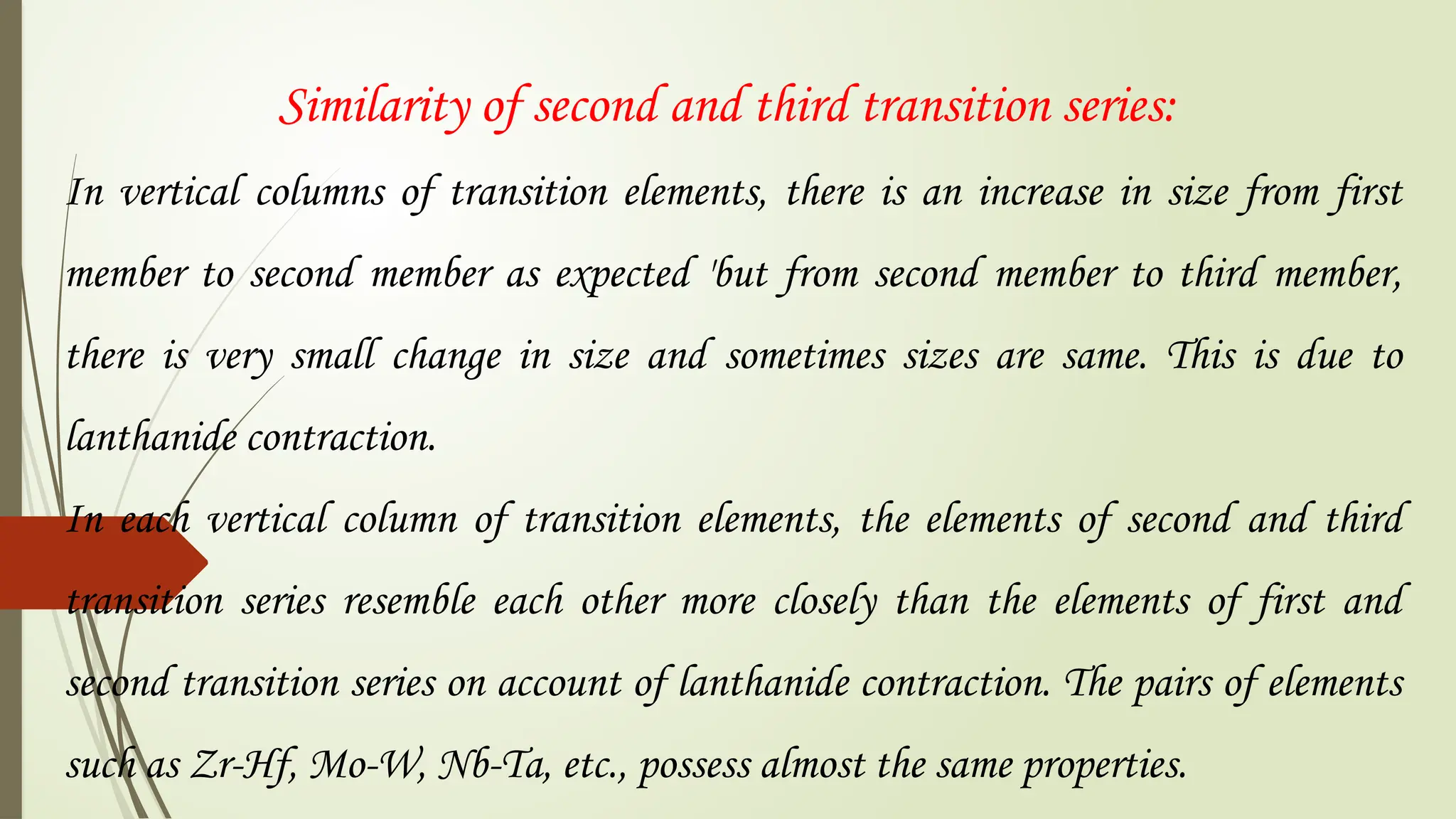
Similarity of second and third transition series:
In vertical columns of transition elements, there is an increase in size from first
member to second member as expected 'but from second member to third member,
there is very small change in size and sometimes sizes are same. This is due to
lanthanide contraction.
In each vertical column of transition elements, the elements of second and third
transition series resemble each other more closely than the elements of first and
second transition series on account of lanthanide contraction. The pairs of elements
such as Zr-Hf, Mo-W, Nb-Ta, etc., possess almost the same properties.
Ionisation energies
Lanthanides have fairly low ionisation energies. IEI and IE2 values are quite
comparable with the values of alkaline earth metals, particularly calcium. The
sum of the first three ionisation energies are low.
Due to low values of ionization energies lanthanides are highly electropositive
in nature.
These elements react with cold water and hot water to liberate hydrogen.
The reactions are slow with cold water but faster with hot water.
The values of standard reduction potential (Eo values) increase from La to
Lu.
EO
values become less negative in the series.
All the lanthanides are, thus, strong reducing agents.
The reducing power decreases from La to Lu.
Coloured ions
Many of the lanthanide ions are coloured in solid state as well as in
solutions. The colour is due to partially filled f orbitals which allow f-f
transitions. M3+
ions having 4f0
, 4f7
, 4f14
configurations are colourless.
Pairs of M3+
ions having the same number of unpaired electrons in 4f-orbitals
have the same colour.
Magnetic properties
Ions having unpaired electrons are paramagnetic while those having all the
orbitals paired are diamagnetic.
The lanthanide ions (M3+
) except La3+
(4f0
) and Lu3+
(4f) are paramagnetic since
they contain 1, 2, ... 7 unpaired electrons.
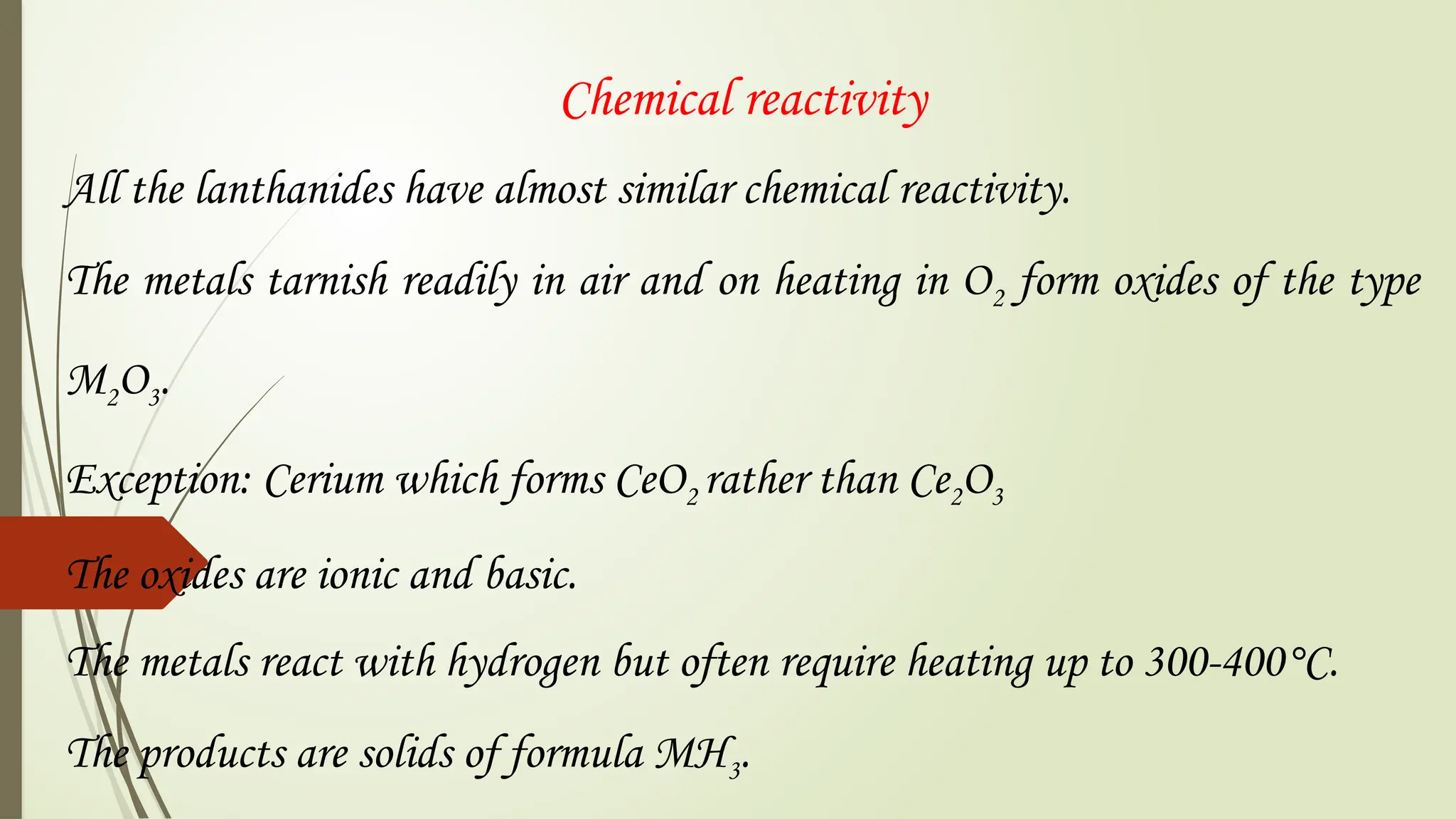
Chemical reactivity
All the lanthanides have almost similar chemical reactivity.
The metals tarnish readily in air and on heating in O2 form oxides of the type
M2O3.
Exception: Cerium which forms CeO2 rather than Ce2O3
The oxides are ionic and basic.
The metals react with hydrogen but often require heating up to 300-400°C.
The products are solids of formula MH3.
The hydrides are decomposed by water and react with O2. The anhydrous
halides, MX3 can be made by heating the metal and halogen or by heating the
metal oxide with the appropriate ammonium halide.
The fluorides are very insoluble. The chlorides are deliquescent and soluble. At
elevated temperatures, lanthanides react with N, C, S, P, As, Sb and Bi. A
wide variety of oxo salts are known.
The carbonates, phosphates, chromates, oxalates, etc., are largely insoluble in
water while nitrates, acetates, sulphates, etc., are soluble. Because of their
similar chemical reactivities, their separation from one another is very difficult.
Complex formation
The lanthanides do not have much tendency to form complexes due to low
charge density because of their large size. However, the tendency to form
complexes and their stability increases with the increase of atomic number.
Uses of Lanthanides
The metals are seldom used in pure state.
As lanthanides do not differ much in their physical and chemical properties,
these are mostly used in the form of alloys.
Neodymium and praseodymium oxides are used for making coloured glasses for
goggles.
CeO2 is used in gas mantles.
Ceric sulphate is a well-known oxidising agent in volumetric analysis.
Many lanthanide oxides are used as phosphorus in colour TV tubes.
Misch metal (an alloy): Misch metal is an alloy consisting lanthanide metals (94-
95%), iron (5%) and traces of sulphur, carbon, silicon, calcium and aluminium.
The main lanthanide metals present are cerium (about 40%), lanthanum and
neodymium (about 44%).
These alloys are used for making ignition devices such as tracer bullets, shells and
flints for lighters.
An alloy of magnesium and about 3%
Misch metal is used in making jet engine parts. Cerium-magnesium alloys are used in
flash light powders.
Cerium salts are used in dyeing cotton, in lead accumulators and as catalyst
Lanthanum oxide is used for polishing glass.
Various compounds of lanthanides are used as catalysts for hydrogenation,
dehydrogenation, oxidation and petroleum cracking.
The compounds of lanthanides are used in making magnetic and, electronic
devices for their paramagnetic and ferromagnetic properties.
Neodymium oxide dissolved in selenium oxy-chloride is used in these days as
powerful liquid laser.
5f-series (Actinides):
There are fourteen elements from thorium (At. No. 90) to lawrencium (At. No.
103) in this series. 5f orbitals are gradually filled up.
The members of actinium are radioactive and majority of them are not found in
nature. The elements from atomic number of 93 onwards are called transuranic
elements and have been discovered by synthetic methods, i.e., these are man
made elements.
GENERAL CHARACTERISTICS OF ACTINIDES
Excepting Ac, Th, Pa and U which occur in nature in uranium minerals, all
the remaining actinides are unstable and synthetic elements.
These have been made by artificial nuclear transmutations.
All the actinides are radioactive. Actinides are analogous to lanthanides and
involve the filling of 5f-orbitals.
Electronic configuration
In lanthanides, after lanthanum 4f-orbitals become appreciably lower in
energy than the 5d-orbitals.
Thus, in lanthanides the electrons fill the 4f-orbitals in a regular way with
minor differences where it is possible to attain a half filled shell.
Similarly, it might have been expected that after actinium the 5f-orbitals
would become lower in energy than the 6d-orbitals.
However, for the first four actinide elements, Th, Pa, U and Np the difference
in energy between 5f and 6d-orbitals is small.
Thus, in these elements (and their ions) electrons may occupy the 5f or the 6d
levels or sometimes both.
Later in the actinide series the 5f-orbitals do become appreciably lower in
energy.
Thus, from Pu onwards the 5f-shell fills in a regular way and the elements
become very similar.
Oxidation states
The actinides exhibit most common oxidation state of +3 like the lanthanides.
However, this state is not always most stable as for the first four elements ( Th,
Pd, U ,Np).
U3+
is readily oxidised in air and in solution.
+3 state is the most stable state for the later elements
The most stable oxidation states for the first four elements are Th (+4), Pa (+5)
and U (+6).
These high oxidation states involve using all the outer electrons including f
electrons for bonding.
Though Np shows +7 oxidation state the most stable state for Np is +5.
Pu shows all the oxidation states from +3 to +7 but the most stable is +4.
Am shows oxidation states from +2 to +6. Am2+
has an f7
configuration.
+4 oxidation state exists for all the elements from Th to Bk.
Cf2+
, Es2+
, Fm2+
, Md2+
and No2+
exists as ions in solution. Their properties are
like alkaline earth metals particularly Ba2+.
The lower oxidation states tend to be ionic and the higher ones are covalent.
Physical properties
The elements are all silvery metals.
The melting points are moderately high but are considerably lower than those
of transition elements.
The size of the ions decreases gradually along the series because the extra
charge on the nucleus is poorly screened by the f electrons.
This results in an 'actinide contraction' similar to the lanthanide contraction.
Actinides have high' densities.
Colour of the ions
Actinide ions are generally coloured.
The colour of the ions depends on the number of electrons present in 5f-
orbitals.
The ions having no electron in 5f-orbitals (i.e:, 5f0
) or seven electrons in 5f-
orbitals (i.e.,5f7
) are colourless. T
he ions having 2 to 6 electrons in Sf-orbitals are coloured both in the
crystalline and in aqueous solution.
The colour is due to f-f transition.
Magnetic behaviour
Majority of the ions of the actinides possess unpaired electrons, thus they are
paramagnetic in nature.
Th3+
(5f1
),Pa4+
(5f1
), U3+
(5f3
) Np5+
(5f2
), Pu4+
(5f4
) Am5+
(5f4
), etc., are
paramagnetic.
Cations of actinides which contain only paired electrons are diamagnetic.
Ac3+
(5f0
), Th4+
(5f0
), U6+
(5f0
) , Lr3+
(5f14
) etc., are diamagnetic in nature.
Formation of complexes
Actinides have somewhat higher tendency to form complex compounds in
comparison to lanthanides.
This is due to their higher charge and smaller size of their ions.
Most of the halides of actinides form complex compounds with alkali metal
halides.
Actinides form chelates with organic compounds such as EDTA.
Chemical Reactivity
On account of low ionisation energies, the actinides are highly electropositive
metals.
They react-with-hot water and tarnish in air forming an oxide coating.
The metals react readily with HCl but reactions with other acids are slower than
expected.
Concentrated HNO3 makes Th, U and Pu passive.
The metals react with oxygen, the halogens and hydrogen.
Actinides act as strong reducing agents.
Inner transistion elements and  properties

Inner transistion elements and properties

  • 1.
    f-Block Elements 28 elementsfrom atomic number 58 to 71 (14 elements) and from atomic number 90 to 103 (14 elements) have been arranged in two horizontal rows below the periodic table. These elements are collectively called f- block elements as the last or differentiating electron in the atoms of these elements is accommodated on one of the seven f-orbitals of the ante penultimate (next to the penultimate) energy shell.
  • 2.
    These elements havealso been called inner transition elements because the ante-penultimate energy shell, i.e., (n -2) f-orbitals, lie comparatively deep within the kernel (being inner to the penultimate shell). f-block consists of two series of elements known as Lanthanides or Lanthanons and Actinides or Actinons. The lanthanide series follows lanthanum (At. No. 57), a member of 5d-series. Similarly, actinide series comes after actinium (At. No. 89), a member of 6d- series.
  • 3.
    The 14 membersof lanthanide series have been placed along with lanthanum in the third group and sixth period and similarly 14 members of the actinide series have been placed with actinium in the third group and seventh period. The justification for assigning one place to these elements has been given on the basis of their similar properties. The properties are so similar that the fifteen elements from La to Lu can be considered as equivalent to one element. The same explanation can be given in the case of actinides.
  • 4.
    In case, theseelements are assigned different positions in order of their increasing atomic numbers, the symmetry of the whole arrangement would be disrupted. Due to this reason, the two series of elements, i.e., lanthanides and actinides are placed at the bottom of the periodic table and constitute one block of elements, i.e., f-block. The general electronic configuration of the f-block elements is: (n-2) f 1-14 (n-1) d 0,1 ns2
  • 5.
    4f series (Lanthanides): There are fourteen elements from cerium (At. No. 58) to lutetium (At. No. 71) in this series. 4f-orbitals are gradually filled up. In the past, these elements were called rare earths. This name is not appropriate because many of the elements are not particularly rare. Promethium is artificial radioactive element.
  • 6.
    GENERAL CHARACTERISTICS OFLANTHANIDES The general characteristics are similar to transition metals, i.e., d-block elements. All the lanthanides are metals. They are soft, malleable and ductile in nature. They are not good conductors of heat and electricity. They are highly dense metals and their densities are in the range of 6.77 to 9.74 g cm-3 They have fairly high melting points. However, no definite trend is observed.
  • 7.
    Electronic configuration: The energiesof 5d- and 4f-orbitals are nearly similar and thus their fillings show certain irregularities. The electronic configuration of lanthanum is [Xe]5d1 6s2 It is expected that 14 elements from cerium to lutetium would be formed by adding, 1, 2, 3, ... 14 electrons into the 4f level. However, it is energetically favourable to move the single electron on 5d into the 4f level in most of the elements but not in the cases of Gd and Lu.
  • 8.
    In Gd andLu besides 5d1 , the 4f-orbitals are half filled or fully filled. This gives extra stability to the core. The extra stability of half-filled and fully filled f orbitals is also seen in Eu(4f7 6s2 ) and Yb(4f14 6s2 ).
  • 9.
    Oxidation states The commonstable oxidation state of all the lanthanides is +3. The oxidation states of +2 and +4 are also exhibited by some of the elements. These oxidation states are only stable in those cases where stable4f0 ,4f7 ,4f14 configurations are achieved. For example, Ce4+ (4f0 ), Tb4+ (4f7 ), Eu2+ (4f7 ) Yb2+ (4f14 ) are stable. +2 or +4 oxidation states tend to revert to the more stable oxidation state of +3 by loss or gain of an electron
  • 10.
    Sm2+ , Eu2+ and Yb2+ ionsare thus good reducing agents in solutions while Ce4+ , Tb4+ ions, etc., are good oxidising agents. The compounds of lanthanides are mainly ionic in nature.
  • 11.
    Atomic and ionicradii (Lanthanoid contraction) In lanthanide series, there is a regular decrease in the atomic as well as ionic radii of trivalent ions (M3+ ) as the atomic number increases from cerium to lutetium. This decrease in size of atoms and ions is known as Lanthanide contraction. Although the atomic radii do show some irregularities but ionic radii decrease steadily from La to Lu. However, the decrease is very small.
  • 12.
    On moving fromCe to Lu, the decrease in atomic radii occurs from 165 to 156 pm, i.e., the decrease is only 9 pm. Similarly, the decrease in ionic radii occurs from 102 (Ce3+ ) to 86 (Lu3+ ) pm, i.e., the decrease is only 16 pm. Thus, for an increase of 14 in the atomic number, the decrease in atomic radii or ionic radii are. very small in comparison to the elements of other groups and periods.
  • 13.
    Cause of lanthanidecontraction: As we proceed from one element to the next element in the lanthanide series, the nuclear charge, i.e., atomic number increases by one unit and the addition of one electron occurs at the same time in 4f energy shell. On account of the very diffused shapes of f orbitals, the 4f electrons shield each other quite poorly from the nuclear charge. Thus, the effect of nuclear charge increase is somewhat more than the changed shielding effect.
  • 14.
    This brings thevalence shell nearer to the nucleus and hence the size of atom or ion goes on decreasing as we move in the series. The sum of the successive reductions is equal to the total lanthanide contraction.
  • 15.
    Consequences of lanthanidecontraction: The main consequences of lanthanide contraction are the following: Similar chemical properties: Since the change in the ionic radii in the lanthanide series is very small, their chemical properties are similar. Thus it is very difficult to separate these elements in the pure state; However, lanthanide contraction brings some differences in properties like solubility, complex ion formation, hydration, etc. These differences help in the separation of lanthanide elements by fractional crystallisation or ion exchange methods.
  • 16.
    Basic strength ofhydroxides: As the size of the lanthanide ions decreases from Ce3+ to Lu3+ , the covalent character of M-OH bond increases and hence the basic strength decreases. Thus, Ce(OH)3 is most basic while Lu(OH)3 is least basic.
  • 17.
    Similarity of secondand third transition series: In vertical columns of transition elements, there is an increase in size from first member to second member as expected 'but from second member to third member, there is very small change in size and sometimes sizes are same. This is due to lanthanide contraction. In each vertical column of transition elements, the elements of second and third transition series resemble each other more closely than the elements of first and second transition series on account of lanthanide contraction. The pairs of elements such as Zr-Hf, Mo-W, Nb-Ta, etc., possess almost the same properties.
  • 18.
    Ionisation energies Lanthanides havefairly low ionisation energies. IEI and IE2 values are quite comparable with the values of alkaline earth metals, particularly calcium. The sum of the first three ionisation energies are low. Due to low values of ionization energies lanthanides are highly electropositive in nature. These elements react with cold water and hot water to liberate hydrogen. The reactions are slow with cold water but faster with hot water.
  • 19.
    The values ofstandard reduction potential (Eo values) increase from La to Lu. EO values become less negative in the series. All the lanthanides are, thus, strong reducing agents. The reducing power decreases from La to Lu.
  • 20.
    Coloured ions Many ofthe lanthanide ions are coloured in solid state as well as in solutions. The colour is due to partially filled f orbitals which allow f-f transitions. M3+ ions having 4f0 , 4f7 , 4f14 configurations are colourless.
  • 21.
    Pairs of M3+ ionshaving the same number of unpaired electrons in 4f-orbitals have the same colour.
  • 22.
    Magnetic properties Ions havingunpaired electrons are paramagnetic while those having all the orbitals paired are diamagnetic. The lanthanide ions (M3+ ) except La3+ (4f0 ) and Lu3+ (4f) are paramagnetic since they contain 1, 2, ... 7 unpaired electrons.
  • 23.
    Chemical reactivity All thelanthanides have almost similar chemical reactivity. The metals tarnish readily in air and on heating in O2 form oxides of the type M2O3. Exception: Cerium which forms CeO2 rather than Ce2O3 The oxides are ionic and basic. The metals react with hydrogen but often require heating up to 300-400°C. The products are solids of formula MH3.
  • 24.
    The hydrides aredecomposed by water and react with O2. The anhydrous halides, MX3 can be made by heating the metal and halogen or by heating the metal oxide with the appropriate ammonium halide.
  • 25.
    The fluorides arevery insoluble. The chlorides are deliquescent and soluble. At elevated temperatures, lanthanides react with N, C, S, P, As, Sb and Bi. A wide variety of oxo salts are known. The carbonates, phosphates, chromates, oxalates, etc., are largely insoluble in water while nitrates, acetates, sulphates, etc., are soluble. Because of their similar chemical reactivities, their separation from one another is very difficult.
  • 26.
    Complex formation The lanthanidesdo not have much tendency to form complexes due to low charge density because of their large size. However, the tendency to form complexes and their stability increases with the increase of atomic number.
  • 27.
    Uses of Lanthanides Themetals are seldom used in pure state. As lanthanides do not differ much in their physical and chemical properties, these are mostly used in the form of alloys. Neodymium and praseodymium oxides are used for making coloured glasses for goggles. CeO2 is used in gas mantles. Ceric sulphate is a well-known oxidising agent in volumetric analysis. Many lanthanide oxides are used as phosphorus in colour TV tubes.
  • 28.
    Misch metal (analloy): Misch metal is an alloy consisting lanthanide metals (94- 95%), iron (5%) and traces of sulphur, carbon, silicon, calcium and aluminium. The main lanthanide metals present are cerium (about 40%), lanthanum and neodymium (about 44%). These alloys are used for making ignition devices such as tracer bullets, shells and flints for lighters. An alloy of magnesium and about 3% Misch metal is used in making jet engine parts. Cerium-magnesium alloys are used in flash light powders.
  • 29.
    Cerium salts areused in dyeing cotton, in lead accumulators and as catalyst Lanthanum oxide is used for polishing glass. Various compounds of lanthanides are used as catalysts for hydrogenation, dehydrogenation, oxidation and petroleum cracking. The compounds of lanthanides are used in making magnetic and, electronic devices for their paramagnetic and ferromagnetic properties. Neodymium oxide dissolved in selenium oxy-chloride is used in these days as powerful liquid laser.
  • 30.
    5f-series (Actinides): There arefourteen elements from thorium (At. No. 90) to lawrencium (At. No. 103) in this series. 5f orbitals are gradually filled up. The members of actinium are radioactive and majority of them are not found in nature. The elements from atomic number of 93 onwards are called transuranic elements and have been discovered by synthetic methods, i.e., these are man made elements.
  • 31.
    GENERAL CHARACTERISTICS OFACTINIDES Excepting Ac, Th, Pa and U which occur in nature in uranium minerals, all the remaining actinides are unstable and synthetic elements. These have been made by artificial nuclear transmutations. All the actinides are radioactive. Actinides are analogous to lanthanides and involve the filling of 5f-orbitals.
  • 32.
    Electronic configuration In lanthanides,after lanthanum 4f-orbitals become appreciably lower in energy than the 5d-orbitals. Thus, in lanthanides the electrons fill the 4f-orbitals in a regular way with minor differences where it is possible to attain a half filled shell. Similarly, it might have been expected that after actinium the 5f-orbitals would become lower in energy than the 6d-orbitals.
  • 33.
    However, for thefirst four actinide elements, Th, Pa, U and Np the difference in energy between 5f and 6d-orbitals is small. Thus, in these elements (and their ions) electrons may occupy the 5f or the 6d levels or sometimes both. Later in the actinide series the 5f-orbitals do become appreciably lower in energy. Thus, from Pu onwards the 5f-shell fills in a regular way and the elements become very similar.
  • 34.
    Oxidation states The actinidesexhibit most common oxidation state of +3 like the lanthanides. However, this state is not always most stable as for the first four elements ( Th, Pd, U ,Np). U3+ is readily oxidised in air and in solution. +3 state is the most stable state for the later elements The most stable oxidation states for the first four elements are Th (+4), Pa (+5) and U (+6).
  • 35.
    These high oxidationstates involve using all the outer electrons including f electrons for bonding. Though Np shows +7 oxidation state the most stable state for Np is +5. Pu shows all the oxidation states from +3 to +7 but the most stable is +4. Am shows oxidation states from +2 to +6. Am2+ has an f7 configuration. +4 oxidation state exists for all the elements from Th to Bk. Cf2+ , Es2+ , Fm2+ , Md2+ and No2+ exists as ions in solution. Their properties are like alkaline earth metals particularly Ba2+. The lower oxidation states tend to be ionic and the higher ones are covalent.
  • 36.
    Physical properties The elementsare all silvery metals. The melting points are moderately high but are considerably lower than those of transition elements. The size of the ions decreases gradually along the series because the extra charge on the nucleus is poorly screened by the f electrons. This results in an 'actinide contraction' similar to the lanthanide contraction. Actinides have high' densities.
  • 37.
    Colour of theions Actinide ions are generally coloured. The colour of the ions depends on the number of electrons present in 5f- orbitals. The ions having no electron in 5f-orbitals (i.e:, 5f0 ) or seven electrons in 5f- orbitals (i.e.,5f7 ) are colourless. T he ions having 2 to 6 electrons in Sf-orbitals are coloured both in the crystalline and in aqueous solution. The colour is due to f-f transition.
  • 38.
    Magnetic behaviour Majority ofthe ions of the actinides possess unpaired electrons, thus they are paramagnetic in nature. Th3+ (5f1 ),Pa4+ (5f1 ), U3+ (5f3 ) Np5+ (5f2 ), Pu4+ (5f4 ) Am5+ (5f4 ), etc., are paramagnetic. Cations of actinides which contain only paired electrons are diamagnetic. Ac3+ (5f0 ), Th4+ (5f0 ), U6+ (5f0 ) , Lr3+ (5f14 ) etc., are diamagnetic in nature.
  • 39.
    Formation of complexes Actinideshave somewhat higher tendency to form complex compounds in comparison to lanthanides. This is due to their higher charge and smaller size of their ions. Most of the halides of actinides form complex compounds with alkali metal halides. Actinides form chelates with organic compounds such as EDTA.
  • 40.
    Chemical Reactivity On accountof low ionisation energies, the actinides are highly electropositive metals. They react-with-hot water and tarnish in air forming an oxide coating. The metals react readily with HCl but reactions with other acids are slower than expected. Concentrated HNO3 makes Th, U and Pu passive. The metals react with oxygen, the halogens and hydrogen. Actinides act as strong reducing agents.