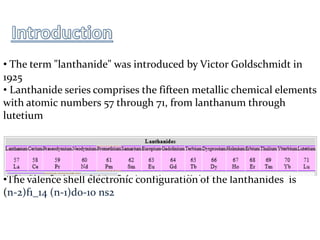
• The term "lanthanide" was introduced by Victor Goldschmidt in
1925
• Lanthanide series comprises the fifteen metallic chemical elements
with atomic numbers 57 through 71, from lanthanum through
lutetium
•The elements in which the additional electrons enter into (n-2)f
Orbitals are called the inner transition elements.
•The valence shell electronic configuration of the lanthanides is
(n-2)f1_14 (n-1)d0-10 ns2
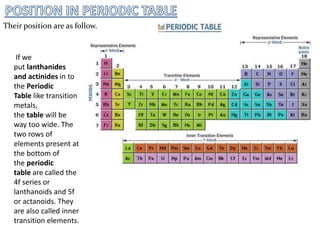
Their position are as follow.
If we
put lanthanides
and actinides in to
the Periodic
Table like transition
metals,
the table will be
way too wide. The
two rows of
elements present at
the bottom of
the periodic
table are called the
4f series or
lanthanoids and 5f
or actanoids. They
are also called inner
transition elements.
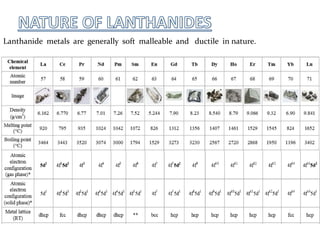
Lanthanide metals are generally soft malleable and ductile in nature.
•In case of Ba 56 ,6s orbital is completely filled and in case of
•La 57 5d orbital is singly filled….
•But after crossing La57 ,
•The nuclear charge increases by one unit and 4f orbital which is
•Much in energy fall than fd is filled first.
•An exception is shown by GADOLINIUM.Its outermost
electronic
•Configuration s [Xe]4f7 5d1 6s2.though there is a huge energy gap
•Between 4f and 5d,Gd tends to remsin in 4f7 confg in order to
•Attain a half filled stability.
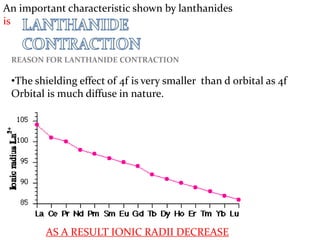
An important characteristic shown by lanthanides
is
REASON FOR LANTHANIDE CONTRACTION
•The shielding effect of 4f is very smaller than d orbital as 4f
Orbital is much diffuse in nature.
AS A RESULT IONIC RADII DECREASE
CONSEQUENCES OF LANTHANIDE CONTRACTION
1. Post lanthanide elements such as Zr and Hf shows similar I
onic radii though they belong to first and second transition
series
2.Lanthanides show similar physical and chemical
properties.so they are hard to seperate
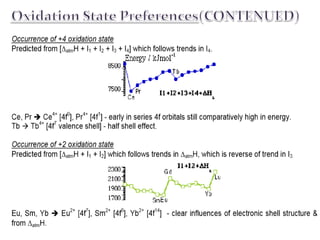
Ionization For any given Lanthanide:
•™As successive electrons are removed from
neutral Ln the stabilizing effect on the
orbitals is related to their principal
quantum number, 4f > 5d > 6s. ā„¢
•For Ln2+ (except for La & Gd) the
configuration is [Xe]4fn
•™For Ln3+ the configuration is always
[Xe]4fn ā„¢The 4f binding energy is so great
that remaining 4f electrons are regarded as
"core-like" (i.e. incapable of modification
by chemical means), except Ce.
Therefore in almost all cases Ln3+
provides the best energetics:
Atomization āˆ†atmH follows the
inverse trend to I3, and therefore also
to (I1 + I2 + I3). Metallic bonding is
correlated with ease of ionization to
Ln3+ state. This trend is modified
slightly due to the different structures
of the Ln metals
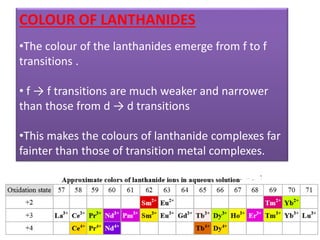
COLOUR OF LANTHANIDES
•The colour of the lanthanides emerge from f to f
transitions .
• f → f transitions are much weaker and narrower
than those from d → d transitions
•This makes the colours of lanthanide complexes far
fainter than those of transition metal complexes.
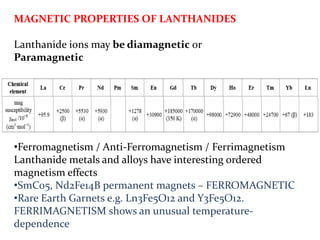
MAGNETIC PROPERTIES OF LANTHANIDES
Lanthanide ions may be diamagnetic or
Paramagnetic
•Ferromagnetism / Anti-Ferromagnetism / Ferrimagnetism
Lanthanide metals and alloys have interesting ordered
magnetism effects
•SmCo5, Nd2Fe14B permanent magnets – FERROMAGNETIC
•Rare Earth Garnets e.g. Ln3Fe5O12 and Y3Fe5O12.
FERRIMAGNETISM shows an unusual temperature-
dependence
•The similarity in ionic radius between adjacent lanthanide
elements makes it difficult to separate them from each other in
naturally occurring ores and other mixtures. thatS why the are
termed ā€œRARE EARTH ELEMENTā€
•2/3 of world production is actually used mixed in the
proportions occurring naturally in the ore
•1. Cerium & Europium may be extracted Chemically
•2. Separation by Fractionation: Small Scale methods used
originally
Current Small Scale Lab Separation: • Ion-Exchange
Displacement Column
•3.Current Large Scale Industrial Separation:
Solvent Extraction
Metals and Alloys
The pure metals of the Lanthanides have little use. However, the alloys of the metals can
be very useful. For example, the alloys of Cerium have been used for metallurgical
applications due to their strong reducing abilities.
Non-nuclear
The Lanthanides can also be used for ceramic purposes. The almost glass-like covering of a
ceramic dish can be created with the lanthanides.
Nuclear
Like the Actinides, the Lanthanides can be used for nuclear purposes. The hydrides can be
used as hydrogen-moderator carriers. The oxides can be used as diluents in nuclear fields.
The metals are good for being used as structural components. The can also be used for
structural-alloy-modifying components of reactors.
Life Science
It is also possible for some elements, such as Tm, to be used as portable x-ray sources.
Other elements, such as Eu, can be used as radiation sources for treatment of cancer.
Lanthanide Chemistry

Lanthanide Chemistry

  • 2.
    • The term"lanthanide" was introduced by Victor Goldschmidt in 1925 • Lanthanide series comprises the fifteen metallic chemical elements with atomic numbers 57 through 71, from lanthanum through lutetium •The elements in which the additional electrons enter into (n-2)f Orbitals are called the inner transition elements. •The valence shell electronic configuration of the lanthanides is (n-2)f1_14 (n-1)d0-10 ns2
  • 3.
    Their position areas follow. If we put lanthanides and actinides in to the Periodic Table like transition metals, the table will be way too wide. The two rows of elements present at the bottom of the periodic table are called the 4f series or lanthanoids and 5f or actanoids. They are also called inner transition elements.
  • 4.
    Lanthanide metals aregenerally soft malleable and ductile in nature.
  • 5.
    •In case ofBa 56 ,6s orbital is completely filled and in case of •La 57 5d orbital is singly filled…. •But after crossing La57 , •The nuclear charge increases by one unit and 4f orbital which is •Much in energy fall than fd is filled first. •An exception is shown by GADOLINIUM.Its outermost electronic •Configuration s [Xe]4f7 5d1 6s2.though there is a huge energy gap •Between 4f and 5d,Gd tends to remsin in 4f7 confg in order to •Attain a half filled stability.
  • 6.
    An important characteristicshown by lanthanides is REASON FOR LANTHANIDE CONTRACTION •The shielding effect of 4f is very smaller than d orbital as 4f Orbital is much diffuse in nature. AS A RESULT IONIC RADII DECREASE
  • 7.
    CONSEQUENCES OF LANTHANIDECONTRACTION 1. Post lanthanide elements such as Zr and Hf shows similar I onic radii though they belong to first and second transition series 2.Lanthanides show similar physical and chemical properties.so they are hard to seperate
  • 8.
    Ionization For anygiven Lanthanide: •™As successive electrons are removed from neutral Ln the stabilizing effect on the orbitals is related to their principal quantum number, 4f > 5d > 6s. ā„¢ •For Ln2+ (except for La & Gd) the configuration is [Xe]4fn •™For Ln3+ the configuration is always [Xe]4fn ā„¢The 4f binding energy is so great that remaining 4f electrons are regarded as "core-like" (i.e. incapable of modification by chemical means), except Ce. Therefore in almost all cases Ln3+ provides the best energetics: Atomization āˆ†atmH follows the inverse trend to I3, and therefore also to (I1 + I2 + I3). Metallic bonding is correlated with ease of ionization to Ln3+ state. This trend is modified slightly due to the different structures of the Ln metals
  • 11.
    COLOUR OF LANTHANIDES •Thecolour of the lanthanides emerge from f to f transitions . • f → f transitions are much weaker and narrower than those from d → d transitions •This makes the colours of lanthanide complexes far fainter than those of transition metal complexes.
  • 12.
    MAGNETIC PROPERTIES OFLANTHANIDES Lanthanide ions may be diamagnetic or Paramagnetic •Ferromagnetism / Anti-Ferromagnetism / Ferrimagnetism Lanthanide metals and alloys have interesting ordered magnetism effects •SmCo5, Nd2Fe14B permanent magnets – FERROMAGNETIC •Rare Earth Garnets e.g. Ln3Fe5O12 and Y3Fe5O12. FERRIMAGNETISM shows an unusual temperature- dependence
  • 13.
    •The similarity inionic radius between adjacent lanthanide elements makes it difficult to separate them from each other in naturally occurring ores and other mixtures. thatS why the are termed ā€œRARE EARTH ELEMENTā€ •2/3 of world production is actually used mixed in the proportions occurring naturally in the ore •1. Cerium & Europium may be extracted Chemically •2. Separation by Fractionation: Small Scale methods used originally Current Small Scale Lab Separation: • Ion-Exchange Displacement Column •3.Current Large Scale Industrial Separation: Solvent Extraction
  • 14.
    Metals and Alloys Thepure metals of the Lanthanides have little use. However, the alloys of the metals can be very useful. For example, the alloys of Cerium have been used for metallurgical applications due to their strong reducing abilities. Non-nuclear The Lanthanides can also be used for ceramic purposes. The almost glass-like covering of a ceramic dish can be created with the lanthanides. Nuclear Like the Actinides, the Lanthanides can be used for nuclear purposes. The hydrides can be used as hydrogen-moderator carriers. The oxides can be used as diluents in nuclear fields. The metals are good for being used as structural components. The can also be used for structural-alloy-modifying components of reactors. Life Science It is also possible for some elements, such as Tm, to be used as portable x-ray sources. Other elements, such as Eu, can be used as radiation sources for treatment of cancer.