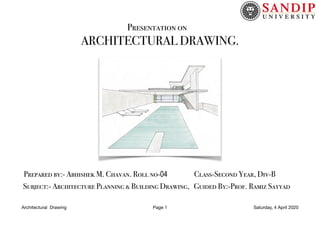
Presentation on
ARCHITECTURAL DRAWING.
Prepared by:- Abhishek M. Chavan. Roll no-04 Class-Second Year, Div-B
Subject:- Architecture Planning & Building Drawing, Guided By:-Prof. Ramiz Sayyad
Architectural Drawing Page 1 Saturday, 4 April 2020
INDEX

————————————————————————————————————————————————————————————
I. INTRODUCTION
————————————————————————————————————————————————————————————
II. STANDARD SCALES FOR ARCHITECTURAL DRAWINGS
————————————————————————————————————————————————————————————
III. TYPES OF STANDARD SCALES FOR ARCHITECTURAL DRAWINGS
•HUMAN SCALE
•MINIATURE SCALE
•MONUMENTAL SCALE
————————————————————————————————————————————————————————————
IV. COMPONENT PARTS
————————————————————————————————————————————————————————————
V. TYPES OF ARCHITECTURAL DRAWINGS
• PRELIMINARY DRAWINGS
• PRESENTATION DRAWING
• MUNICIPAL DRAWING
• WORKING DRAWING
Architectural Drawing Page 2 Saturday, 4 April 2020
————————————————————————————————————————————————————————————
VI. VARIOUS COMPONENT OF WORKING DRAWING
• SITE LAYOUT
• FOUNDATION LAYOUT
• EXCAVATION PLAN
• COLUMN LAYOUT
• BRICKWORK LAYOUT
• ELECTRICAL DRAWING
• ELEVATIONS
• SECTIONS
• STAIRCASE LAYOUT
• FLOOR AND PARAPET LAYOUT
————————————————————————————————————————————————————————————
VII. CONCLUSION
————————————————————————————————————————————————————————————
Architectural Drawing Page 3 Saturday, 4 April 2020
Introduction
Architectural drawing is simply the technical drawing of a house, a building or
any kind of structure. Technical drawings are graphic representations such as
lines and symbols that follow specific conventions of scale and projection.
They are used in architecture, construction, engineering, or mapping. In other
words they are a set of sketches, diagrams, and plans, used to design,
construct, and document buildings. It's a schematic representation of a
building.
Architectural drawing is extremely important in the architecture field as there is
no other ways, for example, to convince clients of the merits of a design other
than a clear architectural drawing. How else can contractor build bridges,
highways, or houses without them? These drawings are frequently used to
Architectural Drawing Page 4 Saturday, 4 April 2020
Standard Scales For Architectural Drawings
Scales is referred to as the ratio of the size of the object to the actual size of the
object. It gives the actual size or dimension of an object or buildings. The term
scale can also to be referred to as the instruments used to measure various
objects or terms. The units of scale are feet (‘), inches (“), metre (m), centimetre
(cm), millimetre (mm), etc. scales in Architecture plays a vital role in the design
process and execution.
I. 1:5000 – Location plan 

II. 1:1000 (1”=80’0”) - Location Plan

III. 1:100 (1/8”=1’0”) – Floor plans, elevations and sections

IV. 1:25 (3/4”=1’0”) - Room plans, interior elevations

V. 1:20 (3/4”=1’0”) - Room plans, interior elevations

VI. 1:5 (3”= 1’0”) – Construction details

VII. 1:2 (Half size) – Construction details

Architectural Drawing Page 5 Saturday, 4 April 2020
Types of Standard Scales
For Architectural Drawing
•Human Scale
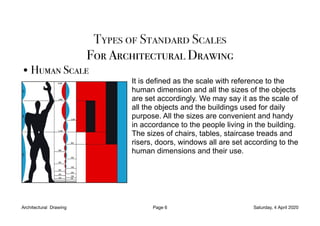
It is defined as the scale with reference to the
human dimension and all the sizes of the objects
are set accordingly. We may say it as the scale of
all the objects and the buildings used for daily
purpose. All the sizes are convenient and handy
in accordance to the people living in the building.
The sizes of chairs, tables, staircase treads and
risers, doors, windows all are set according to the
human dimensions and their use.
Architectural Drawing Page 6 Saturday, 4 April 2020
•Miniature Scale
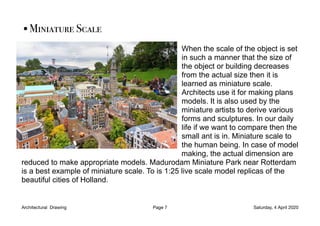
When the scale of the object is set
in such a manner that the size of
the object or building decreases
from the actual size then it is
learned as miniature scale.
Architects use it for making plans
models. It is also used by the
miniature artists to derive various
forms and sculptures. In our daily
life if we want to compare then the
small ant is in. Miniature scale to
the human being. In case of model
making, the actual dimension are
reduced to make appropriate models. Madurodam Miniature Park near Rotterdam
is a best example of miniature scale. To is 1:25 live scale model replicas of the
beautiful cities of Holland.
Architectural Drawing Page 7 Saturday, 4 April 2020
•Monumental Scales
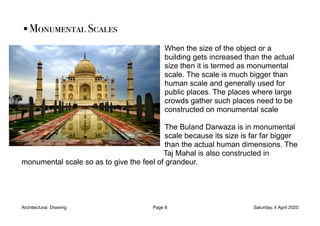
When the size of the object or a
building gets increased than the actual
size then it is termed as monumental
scale. The scale is much bigger than
human scale and generally used for
public places. The places where large
crowds gather such places need to be
constructed on monumental scale
The Buland Darwaza is in monumental
scale because its size is far far bigger
than the actual human dimensions. The
Taj Mahal is also constructed in
monumental scale so as to give the feel of grandeur.
Architectural Drawing Page 8 Saturday, 4 April 2020
Component parts
I. Site Plan

II. Diagram ( shows the inner relationship of spaces)

III. Floor Plans

IV. Elevations

V. Sections

VI. Component details

VII. Perspective view

Architectural Drawing Page 9 Saturday, 4 April 2020
Types of Architectural Drawing
I. Preliminary Drawing

II.Presentation Drawing

III.Municipal Drawing

IV.Working Drawing

V.Detailed Project Report

VI.Record Drawing

Architectural Drawing Page 10 Saturday, 4 April 2020
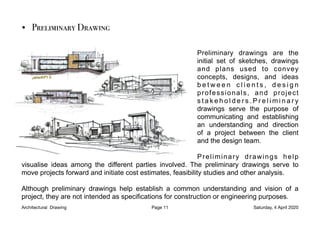
• Preliminary Drawing

Preliminary drawings are the
initial set of sketches, drawings
and plans used to convey
concepts, designs, and ideas
b e t w e e n c l i e n t s , d e s i g n
professionals, and project
s t a k e h o l d e r s . P r e l i m i n a r y
drawings serve the purpose of
communicating and establishing
an understanding and direction
of a project between the client
and the design team.
Preliminary drawings help
visualise ideas among the different parties involved. The preliminary drawings serve to
move projects forward and initiate cost estimates, feasibility studies and other analysis.
Although preliminary drawings help establish a common understanding and vision of a
project, they are not intended as specifications for construction or engineering purposes.
Architectural Drawing Page 11 Saturday, 4 April 2020
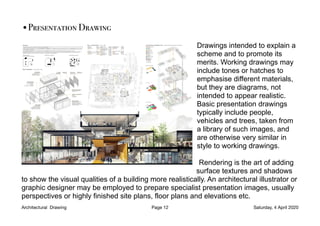
•Presentation Drawing
Drawings intended to explain a
scheme and to promote its
merits. Working drawings may
include tones or hatches to
emphasise different materials,
but they are diagrams, not
intended to appear realistic.
Basic presentation drawings
typically include people,
vehicles and trees, taken from
a library of such images, and
are otherwise very similar in
style to working drawings.
Rendering is the art of adding
surface textures and shadows
to show the visual qualities of a building more realistically. An architectural illustrator or
graphic designer may be employed to prepare specialist presentation images, usually
perspectives or highly finished site plans, floor plans and elevations etc.
Architectural Drawing Page 12 Saturday, 4 April 2020
•Municipal Drawing
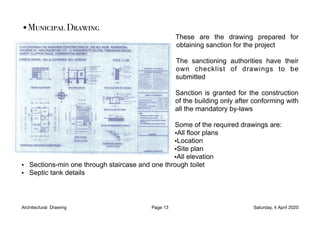
These are the drawing prepared for
obtaining sanction for the project
The sanctioning authorities have their
own checklist of drawings to be
submitted
Sanction is granted for the construction
of the building only after conforming with
all the mandatory by-laws
Some of the required drawings are:
•All floor plans
•Location
•Site plan
•All elevation
• Sections-min one through staircase and one through toilet
• Septic tank details
Architectural Drawing Page 13 Saturday, 4 April 2020
•Working Drawing
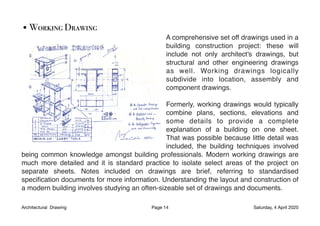
A comprehensive set off drawings used in a
building construction project: these will
include not only architect's drawings, but
structural and other engineering drawings
as well. Working drawings logically
subdivide into location, assembly and
component drawings.
Formerly, working drawings would typically
combine plans, sections, elevations and
some details to provide a complete
explanation of a building on one sheet.
That was possible because little detail was
included, the building techniques involved
being common knowledge amongst building professionals. Modern working drawings are
much more detailed and it is standard practice to isolate select areas of the project on
separate sheets. Notes included on drawings are brief, referring to standardised
specification documents for more information. Understanding the layout and construction of
a modern building involves studying an often-sizeable set of drawings and documents.
Architectural Drawing Page 14 Saturday, 4 April 2020
•Various Component of Working Drawing
I. Site Layout
II. Foundation Layout
III. Excavation Plan
IV. Column Layout
V. Brickwork Layout
VI. Electrical Drawing
VII. PHE Drawing
VIII. HVAC Drawing
Architectural Drawing Page 15 Saturday, 4 April 2020
IX. Generic Details
X. Elevation
XI. Sections
Architectural Drawing Page 16 Saturday, 4 April 2020
•Site Layout
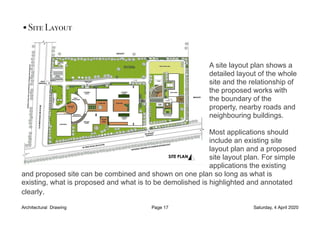
A site layout plan shows a
detailed layout of the whole
site and the relationship of
the proposed works with
the boundary of the
property, nearby roads and
neighbouring buildings.
Most applications should
include an existing site
layout plan and a proposed
site layout plan. For simple
applications the existing
and proposed site can be combined and shown on one plan so long as what is
existing, what is proposed and what is to be demolished is highlighted and annotated
clearly.
Architectural Drawing Page 17 Saturday, 4 April 2020
•Foundation Layout
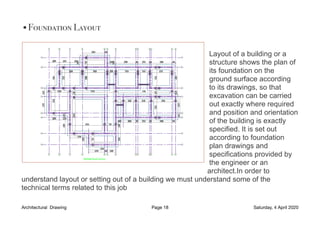
Layout of a building or a
structure shows the plan of
its foundation on the
ground surface according
to its drawings, so that
excavation can be carried
out exactly where required
and position and orientation
of the building is exactly
specified. It is set out
according to foundation
plan drawings and
specifications provided by
the engineer or an
architect.In order to
understand layout or setting out of a building we must understand some of the
technical terms related to this job
Architectural Drawing Page 18 Saturday, 4 April 2020
•Excavation Plan
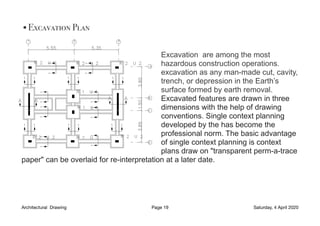
Excavation are among the most
hazardous construction operations.
excavation as any man-made cut, cavity,
trench, or depression in the Earth’s
surface formed by earth removal.
Excavated features are drawn in three
dimensions with the help of drawing
conventions. Single context planning
developed by the has become the
professional norm. The basic advantage
of single context planning is context
plans draw on "transparent perm-a-trace
paper" can be overlaid for re-interpretation at a later date.
Architectural Drawing Page 19 Saturday, 4 April 2020
•Column Layout
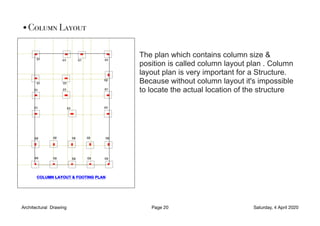
The plan which contains column size &
position is called column layout plan . Column
layout plan is very important for a Structure.
Because without column layout it's impossible
to locate the actual location of the structure
Architectural Drawing Page 20 Saturday, 4 April 2020
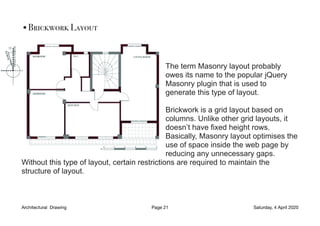
•Brickwork Layout
The term Masonry layout probably
owes its name to the popular jQuery
Masonry plugin that is used to
generate this type of layout.
Brickwork is a grid layout based on
columns. Unlike other grid layouts, it
doesn’t have fixed height rows.
Basically, Masonry layout optimises the
use of space inside the web page by
reducing any unnecessary gaps.
Without this type of layout, certain restrictions are required to maintain the
structure of layout.
Architectural Drawing Page 21 Saturday, 4 April 2020
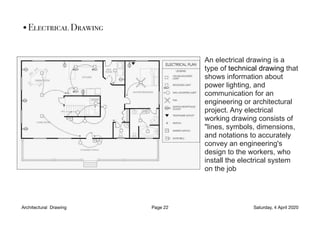
•Electrical Drawing
An electrical drawing is a
type of technical drawing that
shows information about
power lighting, and
communication for an
engineering or architectural
project. Any electrical
working drawing consists of
"lines, symbols, dimensions,
and notations to accurately
convey an engineering's
design to the workers, who
install the electrical system
on the job
Architectural Drawing Page 22 Saturday, 4 April 2020
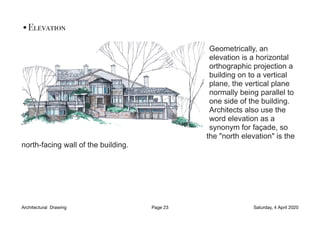
•Elevation
Geometrically, an
elevation is a horizontal
orthographic projection a
building on to a vertical
plane, the vertical plane
normally being parallel to
one side of the building.
Architects also use the
word elevation as a
synonym for façade, so
the "north elevation" is the
north-facing wall of the building.
Architectural Drawing Page 23 Saturday, 4 April 2020
•Sections
Section typically refers to a view of a
structure as though it has been sliced
in half or cut along another imaginary
plane, which is generally, but not
always a vertical plane. This is
represented as a section drawing. This
can be useful when designing or
representing structures such as
buildings as it gives a view that passes
through spaces such as rooms and
also through the building fabric, and
this can reveal relationship between the
parts of the building that might not be
apparent on plans/elevations.
Architectural Drawing Page 24 Saturday, 4 April 2020
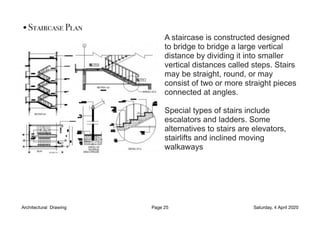
•Staircase Plan
A staircase is constructed designed
to bridge to bridge a large vertical
distance by dividing it into smaller
vertical distances called steps. Stairs
may be straight, round, or may
consist of two or more straight pieces
connected at angles.
Special types of stairs include
escalators and ladders. Some
alternatives to stairs are elevators,
stairlifts and inclined moving
walkaways
Architectural Drawing Page 25 Saturday, 4 April 2020
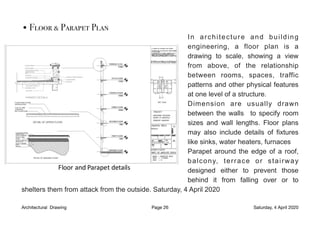
•Floor & Parapet Plan
In architecture and building
engineering, a floor plan is a
drawing to scale, showing a view
from above, of the relationship
between rooms, spaces, traffic
patterns and other physical features
at one level of a structure.
Dimension are usually drawn
between the walls to specify room
sizes and wall lengths. Floor plans
may also include details of fixtures
like sinks, water heaters, furnaces
Parapet around the edge of a roof,
balcony, terrace or stairway
designed either to prevent those
behind it from falling over or to
shelters them from attack from the outside. Saturday, 4 April 2020
Architectural Drawing Page 26 Saturday, 4 April 2020
CONCLUSION
Today’s architectural design process involves many participants, increasingly
complex information and knowledge. Design consists of five important
components: aesthetics, culture, environment, structure and materials, and
economics and social influence. It is also a “participatory” process, encouraging
interdisciplinary knowledge and collaborative community participation. This
research views site analysis as a sub-system within the design process, and the
major factors in the design process also form the essence of site analysis and
selection. In site analysis, several major environmental factors are identified
based on the comparison between fen shui and contemporary environmental
design principles.
Architectural Drawing Page 27 Saturday, 4 April 2020

Architectural drawing pdf

  • 1.
    Presentation on ARCHITECTURAL DRAWING. Preparedby:- Abhishek M. Chavan. Roll no-04 Class-Second Year, Div-B Subject:- Architecture Planning & Building Drawing, Guided By:-Prof. Ramiz Sayyad Architectural Drawing Page 1 Saturday, 4 April 2020
  • 2.
    INDEX ———————————————————————————————————————————————————————————— I. INTRODUCTION ———————————————————————————————————————————————————————————— II. STANDARDSCALES FOR ARCHITECTURAL DRAWINGS ———————————————————————————————————————————————————————————— III. TYPES OF STANDARD SCALES FOR ARCHITECTURAL DRAWINGS •HUMAN SCALE •MINIATURE SCALE •MONUMENTAL SCALE ———————————————————————————————————————————————————————————— IV. COMPONENT PARTS ———————————————————————————————————————————————————————————— V. TYPES OF ARCHITECTURAL DRAWINGS • PRELIMINARY DRAWINGS • PRESENTATION DRAWING • MUNICIPAL DRAWING • WORKING DRAWING Architectural Drawing Page 2 Saturday, 4 April 2020
  • 3.
    ———————————————————————————————————————————————————————————— VI. VARIOUS COMPONENTOF WORKING DRAWING • SITE LAYOUT • FOUNDATION LAYOUT • EXCAVATION PLAN • COLUMN LAYOUT • BRICKWORK LAYOUT • ELECTRICAL DRAWING • ELEVATIONS • SECTIONS • STAIRCASE LAYOUT • FLOOR AND PARAPET LAYOUT ———————————————————————————————————————————————————————————— VII. CONCLUSION ———————————————————————————————————————————————————————————— Architectural Drawing Page 3 Saturday, 4 April 2020
  • 4.
    Introduction Architectural drawing issimply the technical drawing of a house, a building or any kind of structure. Technical drawings are graphic representations such as lines and symbols that follow specific conventions of scale and projection. They are used in architecture, construction, engineering, or mapping. In other words they are a set of sketches, diagrams, and plans, used to design, construct, and document buildings. It's a schematic representation of a building. Architectural drawing is extremely important in the architecture field as there is no other ways, for example, to convince clients of the merits of a design other than a clear architectural drawing. How else can contractor build bridges, highways, or houses without them? These drawings are frequently used to Architectural Drawing Page 4 Saturday, 4 April 2020
  • 5.
    Standard Scales ForArchitectural Drawings Scales is referred to as the ratio of the size of the object to the actual size of the object. It gives the actual size or dimension of an object or buildings. The term scale can also to be referred to as the instruments used to measure various objects or terms. The units of scale are feet (‘), inches (“), metre (m), centimetre (cm), millimetre (mm), etc. scales in Architecture plays a vital role in the design process and execution. I. 1:5000 – Location plan II. 1:1000 (1”=80’0”) - Location Plan III. 1:100 (1/8”=1’0”) – Floor plans, elevations and sections IV. 1:25 (3/4”=1’0”) - Room plans, interior elevations V. 1:20 (3/4”=1’0”) - Room plans, interior elevations VI. 1:5 (3”= 1’0”) – Construction details VII. 1:2 (Half size) – Construction details Architectural Drawing Page 5 Saturday, 4 April 2020
  • 6.
    Types of StandardScales For Architectural Drawing •Human Scale It is defined as the scale with reference to the human dimension and all the sizes of the objects are set accordingly. We may say it as the scale of all the objects and the buildings used for daily purpose. All the sizes are convenient and handy in accordance to the people living in the building. The sizes of chairs, tables, staircase treads and risers, doors, windows all are set according to the human dimensions and their use. Architectural Drawing Page 6 Saturday, 4 April 2020
  • 7.
    •Miniature Scale When thescale of the object is set in such a manner that the size of the object or building decreases from the actual size then it is learned as miniature scale. Architects use it for making plans models. It is also used by the miniature artists to derive various forms and sculptures. In our daily life if we want to compare then the small ant is in. Miniature scale to the human being. In case of model making, the actual dimension are reduced to make appropriate models. Madurodam Miniature Park near Rotterdam is a best example of miniature scale. To is 1:25 live scale model replicas of the beautiful cities of Holland. Architectural Drawing Page 7 Saturday, 4 April 2020
  • 8.
    •Monumental Scales When thesize of the object or a building gets increased than the actual size then it is termed as monumental scale. The scale is much bigger than human scale and generally used for public places. The places where large crowds gather such places need to be constructed on monumental scale The Buland Darwaza is in monumental scale because its size is far far bigger than the actual human dimensions. The Taj Mahal is also constructed in monumental scale so as to give the feel of grandeur. Architectural Drawing Page 8 Saturday, 4 April 2020
  • 9.
    Component parts I. SitePlan II. Diagram ( shows the inner relationship of spaces) III. Floor Plans IV. Elevations V. Sections VI. Component details VII. Perspective view Architectural Drawing Page 9 Saturday, 4 April 2020
  • 10.
    Types of ArchitecturalDrawing I. Preliminary Drawing II.Presentation Drawing III.Municipal Drawing IV.Working Drawing V.Detailed Project Report VI.Record Drawing Architectural Drawing Page 10 Saturday, 4 April 2020
  • 11.
    • Preliminary Drawing Preliminarydrawings are the initial set of sketches, drawings and plans used to convey concepts, designs, and ideas b e t w e e n c l i e n t s , d e s i g n professionals, and project s t a k e h o l d e r s . P r e l i m i n a r y drawings serve the purpose of communicating and establishing an understanding and direction of a project between the client and the design team. Preliminary drawings help visualise ideas among the different parties involved. The preliminary drawings serve to move projects forward and initiate cost estimates, feasibility studies and other analysis. Although preliminary drawings help establish a common understanding and vision of a project, they are not intended as specifications for construction or engineering purposes. Architectural Drawing Page 11 Saturday, 4 April 2020
  • 12.
    •Presentation Drawing Drawings intendedto explain a scheme and to promote its merits. Working drawings may include tones or hatches to emphasise different materials, but they are diagrams, not intended to appear realistic. Basic presentation drawings typically include people, vehicles and trees, taken from a library of such images, and are otherwise very similar in style to working drawings. Rendering is the art of adding surface textures and shadows to show the visual qualities of a building more realistically. An architectural illustrator or graphic designer may be employed to prepare specialist presentation images, usually perspectives or highly finished site plans, floor plans and elevations etc. Architectural Drawing Page 12 Saturday, 4 April 2020
  • 13.
    •Municipal Drawing These arethe drawing prepared for obtaining sanction for the project The sanctioning authorities have their own checklist of drawings to be submitted Sanction is granted for the construction of the building only after conforming with all the mandatory by-laws Some of the required drawings are: •All floor plans •Location •Site plan •All elevation • Sections-min one through staircase and one through toilet • Septic tank details Architectural Drawing Page 13 Saturday, 4 April 2020
  • 14.
    •Working Drawing A comprehensiveset off drawings used in a building construction project: these will include not only architect's drawings, but structural and other engineering drawings as well. Working drawings logically subdivide into location, assembly and component drawings. Formerly, working drawings would typically combine plans, sections, elevations and some details to provide a complete explanation of a building on one sheet. That was possible because little detail was included, the building techniques involved being common knowledge amongst building professionals. Modern working drawings are much more detailed and it is standard practice to isolate select areas of the project on separate sheets. Notes included on drawings are brief, referring to standardised specification documents for more information. Understanding the layout and construction of a modern building involves studying an often-sizeable set of drawings and documents. Architectural Drawing Page 14 Saturday, 4 April 2020
  • 15.
    •Various Component ofWorking Drawing I. Site Layout II. Foundation Layout III. Excavation Plan IV. Column Layout V. Brickwork Layout VI. Electrical Drawing VII. PHE Drawing VIII. HVAC Drawing Architectural Drawing Page 15 Saturday, 4 April 2020
  • 16.
    IX. Generic Details X.Elevation XI. Sections Architectural Drawing Page 16 Saturday, 4 April 2020
  • 17.
    •Site Layout A sitelayout plan shows a detailed layout of the whole site and the relationship of the proposed works with the boundary of the property, nearby roads and neighbouring buildings. Most applications should include an existing site layout plan and a proposed site layout plan. For simple applications the existing and proposed site can be combined and shown on one plan so long as what is existing, what is proposed and what is to be demolished is highlighted and annotated clearly. Architectural Drawing Page 17 Saturday, 4 April 2020
  • 18.
    •Foundation Layout Layout ofa building or a structure shows the plan of its foundation on the ground surface according to its drawings, so that excavation can be carried out exactly where required and position and orientation of the building is exactly specified. It is set out according to foundation plan drawings and specifications provided by the engineer or an architect.In order to understand layout or setting out of a building we must understand some of the technical terms related to this job Architectural Drawing Page 18 Saturday, 4 April 2020
  • 19.
    •Excavation Plan Excavation areamong the most hazardous construction operations. excavation as any man-made cut, cavity, trench, or depression in the Earth’s surface formed by earth removal. Excavated features are drawn in three dimensions with the help of drawing conventions. Single context planning developed by the has become the professional norm. The basic advantage of single context planning is context plans draw on "transparent perm-a-trace paper" can be overlaid for re-interpretation at a later date. Architectural Drawing Page 19 Saturday, 4 April 2020
  • 20.
    •Column Layout The planwhich contains column size & position is called column layout plan . Column layout plan is very important for a Structure. Because without column layout it's impossible to locate the actual location of the structure Architectural Drawing Page 20 Saturday, 4 April 2020
  • 21.
    •Brickwork Layout The termMasonry layout probably owes its name to the popular jQuery Masonry plugin that is used to generate this type of layout. Brickwork is a grid layout based on columns. Unlike other grid layouts, it doesn’t have fixed height rows. Basically, Masonry layout optimises the use of space inside the web page by reducing any unnecessary gaps. Without this type of layout, certain restrictions are required to maintain the structure of layout. Architectural Drawing Page 21 Saturday, 4 April 2020
  • 22.
    •Electrical Drawing An electricaldrawing is a type of technical drawing that shows information about power lighting, and communication for an engineering or architectural project. Any electrical working drawing consists of "lines, symbols, dimensions, and notations to accurately convey an engineering's design to the workers, who install the electrical system on the job Architectural Drawing Page 22 Saturday, 4 April 2020
  • 23.
    •Elevation Geometrically, an elevation isa horizontal orthographic projection a building on to a vertical plane, the vertical plane normally being parallel to one side of the building. Architects also use the word elevation as a synonym for façade, so the "north elevation" is the north-facing wall of the building. Architectural Drawing Page 23 Saturday, 4 April 2020
  • 24.
    •Sections Section typically refersto a view of a structure as though it has been sliced in half or cut along another imaginary plane, which is generally, but not always a vertical plane. This is represented as a section drawing. This can be useful when designing or representing structures such as buildings as it gives a view that passes through spaces such as rooms and also through the building fabric, and this can reveal relationship between the parts of the building that might not be apparent on plans/elevations. Architectural Drawing Page 24 Saturday, 4 April 2020
  • 25.
    •Staircase Plan A staircaseis constructed designed to bridge to bridge a large vertical distance by dividing it into smaller vertical distances called steps. Stairs may be straight, round, or may consist of two or more straight pieces connected at angles. Special types of stairs include escalators and ladders. Some alternatives to stairs are elevators, stairlifts and inclined moving walkaways Architectural Drawing Page 25 Saturday, 4 April 2020
  • 26.
    •Floor & ParapetPlan In architecture and building engineering, a floor plan is a drawing to scale, showing a view from above, of the relationship between rooms, spaces, traffic patterns and other physical features at one level of a structure. Dimension are usually drawn between the walls to specify room sizes and wall lengths. Floor plans may also include details of fixtures like sinks, water heaters, furnaces Parapet around the edge of a roof, balcony, terrace or stairway designed either to prevent those behind it from falling over or to shelters them from attack from the outside. Saturday, 4 April 2020 Architectural Drawing Page 26 Saturday, 4 April 2020
  • 27.
    CONCLUSION Today’s architectural designprocess involves many participants, increasingly complex information and knowledge. Design consists of five important components: aesthetics, culture, environment, structure and materials, and economics and social influence. It is also a “participatory” process, encouraging interdisciplinary knowledge and collaborative community participation. This research views site analysis as a sub-system within the design process, and the major factors in the design process also form the essence of site analysis and selection. In site analysis, several major environmental factors are identified based on the comparison between fen shui and contemporary environmental design principles. Architectural Drawing Page 27 Saturday, 4 April 2020