EMS PRECEPTOR
TRAINING
St. Clair County
Community College
EMS Training Program
EMS Program DIRECTOR: Bryan Richter, EMT-P IC
Paramedic Program Director: Lisa Hill, RN EMT-P IC
clinical Coordinator: Roger McClelland, EMT-P IC
OBJECTIVES
 Identify the roles/responsibilities & legalities of
the preceptor
 Identify the responsibilities of a student in the
appropriate clinical setting
 Identify techniques to facilitate learning
 Identify how the preceptor role integrates and
interacts with the EMS education program
 Discuss feedback, coaching, and benchmark
competencies for the graduate
 Provide objective assessment of student
performance
INTERNSHIP PURPOSE
 Assist EMT/Paramedic student to apply pre-hospital
care concepts
 Experienced EMT/P, physician, RN
 Share special skills & insights
 Reinforce Program goals and objectives
PURPOSE CONTINUED
 Preceptor Shares Special Skills
 Organization
 Prioritizing
 Delivery
 Calmness
 Communication
 Etc.
Student Roles and Responsibilities
 Daily skills tracking
 Complete clinical documentation
 Be present during entire rotation
 Abide by facility and program clinical Rules &
Responsibilities
 Perform at appropriate skill/knowledge level
PRECEPTOR ROLES &
RESPONSIBILITIES
 Knowledge within the preceptors field of
practice
 Knowledge of the student’s scope of
practice
 Knowledge of each student’s goals of
rotation
Preceptor Roles Cont’d
 Be present at ALL times during skill
performance
 Identify learning experiences for students
 Explain clinical techniques as opportunities
arise
 Allow student to assume Paramedic role in
decision making
 Allow student to be accountable for their
own actions and judgments
Preceptor Roles Cont’d
 Actively stimulate critical thinking by use of
questions/answers
 Guide student to assess the whole patient
 Provide pertinent feedback after each
contact
Preceptor Role Cont’d
 Discuss relationship of EMS profession to
medical direction
 Use non-patient care time for skills & demos
 Use effective counseling techniques
 Support program course content
 Maintain an environment free of harassment
and discrimination = Safe
Preceptor Role Cont’d
 Establish standard of care
 Provide safe environment:
 Equipment
 Personnel
 Scene
 Learning environment
Preceptor Role Cont’d
 Coach the student from observer to team
leader
 Provider daily feedback of progress
 Communicate student’s progress with
clinical coordinator
 Promote teamwork
 Orientate the student to site, crew,
equipment
Preceptor Role Cont’d
 Confront issues as they arise
 Promote confidence
 Empower students
 Complete a summative evaluation
 Assist student with documentation
 Evaluate student at end of each shift
Preceptor Role Cont’d
Most important:
Be a Role Model!
Mentor: A wise and trusted counselor or
teacher.
Preceptor Characteristics
 Possess good communication skills
 Establish a climate that is conducive to learning
 Share practical steps in patient care
 Provide positive correctional feedback, when necessary
 Listens to the student
 Knowledgeable in medicine
SCHOOL FACULTY
ROLES & RESPONSIBILITES
 Be available at all times
 Schedule students
 Make scheduling adjustments
 Assist & support preceptor as needed
 Identify appropriate clinical situations/focus
 Consult with preceptor on evaluations
SCHOOL FACULTY
ROLES & RESPONSIBILITES cont.
 Provide agency with Program Syllabus
 Provide copies of Clinical Rules
 Provide copies of Clinical Evaluations
 Provide summative evaluation to students
 Provide students with working knowledge
base
What do I Look For As A Preceptor?
Look for students with the:
 Ability to communicate clearly with patients
 Ability to manage the scene efficiently
 Ability to complete a thorough patient assessment
 Ability to identify a patient’s chief complaint
 Ability to formulate and provide appropriate
treatment strategies at their level of training
 Ability to provide clear direction & leadership for
other emergency responders
Evaluation of the EMT/Paramedic
Student Patient Assessment
During the actual patient assessment:
 Allow the student to complete their assessment
before intervening to ask questions the student
failed to cover
 Do not let the student do harm
 Take mental notes about what they did right and
how they could improve their assessments
Evaluation of the EMT/Paramedic Student
Skills Performance
 Be positive but honest
 Remember that the patient is an audience to the process
 Note weaknesses in skill competencies
 Do not let the student do harm
Equipment & Protocols
 Make sure the student understands what is
expected of him/her
 Tour service area & quarters, if possible
 Review daily routine/responsibilities
 Review equipment check & department or
ambulance layout
Start of Each Shift
 Review with the student how much field and
clinical time they have completed & what
phase they are currently studying.
 Find out the student’s perceptions of their
own strength & weakness
 Find out any issues of concern that student
may have and try to discuss and focus on
these areas
 Relay your expectations of the student
Evaluation of the Paramedic Student
Report Writing
 Make sure that the chief complaint, patient history,
assessment, treatment & outcomes are properly
documented
 Documentation of pertinent positives & negatives is key to
developing critical thinking skills
 Documentation of any variances or unusual aspects of
the patient encounter that will help to enforce learning
COACHING
 What is Coaching?
 Coaching is a method of directing, instructing
and training a person or group of people, with
the aim to achieve some goal or develop
specific skills.
 There are many ways to coach, types of
coaching and methods to coaching.
FEEDBACK
 Steps in the Evaluation:
 Measurement
 Comparison
 Appraisal
 Decision
FEEDBACK Cont’d
 Always start with the positive
 Positive vs. negative
 Try to always provide some positive
 Constructive
 When necessary provide constructive
 Unless in emergencies, avoid giving
negative feedback
FEEDBACK Cont’d
 Elements:
 Describe what was observed: who, what, where,
when, how
 Be as specific as possible
 Avoid judging or criticizing
 Relate how the observed behavior made you feel
 Suggest an alternate behavior
 Problem solve - Why did you use a 16 gauge on an 80 yo for
nausea?
Paramedic Clinical
Report
 Give Credit for Skills Performed
 Medication Administration - The student
demonstrated the ability to safely administer
medications through oral, IV, injection or
inhalation methods. Oxygen does not count.
 Intubation - The student demonstrated the
ability to safely and successfully perform
endotracheal intubation.
Paramedic Clinical
Report cont’d
 IV - The student demonstrated the ability to
safely and successfully gain venous access
in any age group.
 Ventilation - The student demonstrated the
ability to effectively ventilate patients.
Paramedic Clinical
Report cont’d
 Pediatric Assessment - The student
participated in performing a comprehensive
assessment on a pediatric patient. (including
newborns, infants, toddlers, and school age).
 Adult Assessment - The student participated
in performing a comprehensive assessment
on an adult patient.
Paramedic Clinical
Report cont’d
 Geriatric Assessment - The student
participated in performing a comprehensive
assessment on a geriatric patient.
 Obstetric Assessment - The student
participated in performing a comprehensive
assessment on an obstetric patient.
Paramedic Clinical
Report cont’d
 Trauma Assessment - The student
participated in performing a comprehensive
assessment on an trauma patient.
 Psychological Assessment - The student
participated in performing a comprehensive
assessment on an psycological patient.
Paramedic Clinical
Report cont’d
 Chest Pain Patient - The student participated
in performing a comprehensive assessment,
formulating and implementing a treatment
plan for a patient with chest pain.
 Adult Dyspnea - The student participated in
performing a comprehensive assessment,
formulating and implementing a treatment
plan for an adult patient with difficulty
breathing.
Paramedic Clinical
Report cont’d
 Pediatric Dyspnea - The student participated
in performing a comprehensive assessment,
formulating and implementing a treatment
plan for a pediatric patient with difficulty
breathing.
 Syncope or near syncope - The student
participated in performing a comprehensive
assessment, formulating and implementing a
treatment plan for a patient with a chief
complaint of syncope or near syncope.
Paramedic Clinical
Report cont’d
 Abdominal Complaints - The student
participated in performing a comprehensive
assessment, formulating and implementing a
treatment plan for a patient with abdominal
complaints.
 Altered Mental Status - The student
participated in performing a comprehensive
assessment, formulating and implementing a
treatment plan for a patient with an altered
mental status of any etiology.
Paramedic Clinical
Report Internship
 Team Leader - The student lead the
comprehensive assessment, formulation and
implementation of a treatment plan for a
patient of any etiology.
 Internship – Please fill out the student
evaluation on the back of the clinical record.
TIPS FOR PRECEPTORS
 Remember how you felt the first day of
clinical
 New students may be nervous
 New students may forget an easy concept
or panic easily
 Think out loud (when/where appropriate)
 Tell your students to think out loud
 Voice or verbalize and why, why, why
TIPS FOR PRECEPTORS
 Use the practicum objectives
 Help students set daily goals
 Use humor & compassion
 Guide “patient care”, not just performance
of skills
TIPS
 Catch problems early
 Evaluate/identify problems
 Problem, perception, goals
 Entry level vs. graduate
 Share, discuss, coach
TIPS
 If student is not ready for next level:
 Define (skills/competency)
 Be Objective vs. subjective
 Criteria
TIPS
 Common Problems:
 He said, she said
 Lack of communication/interpretation
 Determine root:
 Skill – Lack of physical ability to complete the
task
 Cognitive – Lack of knowledge
 Affective – Lack of professional behavior
 Scene control
 Remove distracters
TIPS
 Corrections
 Journaling, recording, simulations
 Communicate with SC4 College Staff
 Clarify, document, meetings, plan of action
 Date of follow-up
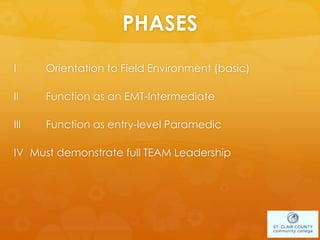
PHASES
I Orientation to Field Environment (basic)
II Function as an EMT-Intermediate
III Function as entry-level Paramedic
IV Must demonstrate full TEAM Leadership
TIPS
 Initial meeting
 Intro, expectations, forms, house rules, manuals
 Encourage preceptor hands off (if appropriate)
 Communicate, Communicate, Communicate!
PRECEPTOR BILL OF
RIGHTS
1. Clear definition of their role;
2. A clearly stated set of expectations for their
performance;
3. A clear delineation of their responsibilities in
relation to others who are involved in the
program;
4. A clear enumeration of all expected
outcomes;
PRECEPTOR BILL OF
RIGHTS
5. A clear delineation of their responsibilities
to the student;
6. Valid and reliable evaluation tools to
appraise student performance;
7. The resources necessary to fulfill their
responsibilities;
8. Continuing and responsive support system
for fulfillment of their roles;
PRECEPTOR BILL OF
RIGHTS
9. Adequate preparation for integration of
the preceptor role;
10. Adequate training in the knowledge, skills,
and attitudes necessary to fulfill their role
responsibilities.
PROBLEM STUDENTS
 Apathetic
 Know it all
 Non-participant
 Over Enthusiastic
SENDING A STUDENT
HOME
 If student is not prepared for shift
 Late, Out of Uniform, No Photo ID, Poor
Hygiene Appear intoxicated, Or otherwise
unprepared
 Poor attitude, Not engaged in Patient care
 If Unable to resolve with student, ask student
to go home and come back when they are
prepared
 CALL CLINICAL COODNIATOR PRIOR
SENDING STUDENT HOME
PRECEPTOR EVALUATION
 ROLE MODELING
 ORGANIZATION
 FEEDBACK
 See evaluation form
THANK YOU!
 It is dedicated preceptors like yourself that
allow us to educate and train quality pre-
hospital medical providers.
 Policies and procedures for clinical
education can be obtained by referring to
the St. Clair County Community College EMS
Training Program Clinical Preceptor Manual.
You can access it at your workplace.
Contact Information
 Please feel free to contact us with any
questions or concerns
 Clinical Coordinator : Roger McClelland
 Cell (810) 824-0521
 E-mail RTMcClelland@SC4.EDU
 Paramedic Program Director: Lisa Hill
 Cell (810)434-7550
 E-mail Lhill@SC4.EDU
 EMS Program Director: Bryan Richter
 Cell (586)709-1475

Sc4 preceptor training ppt

  • 1.
    EMS PRECEPTOR TRAINING St. ClairCounty Community College EMS Training Program EMS Program DIRECTOR: Bryan Richter, EMT-P IC Paramedic Program Director: Lisa Hill, RN EMT-P IC clinical Coordinator: Roger McClelland, EMT-P IC
  • 2.
    OBJECTIVES  Identify theroles/responsibilities & legalities of the preceptor  Identify the responsibilities of a student in the appropriate clinical setting  Identify techniques to facilitate learning  Identify how the preceptor role integrates and interacts with the EMS education program  Discuss feedback, coaching, and benchmark competencies for the graduate  Provide objective assessment of student performance
  • 3.
    INTERNSHIP PURPOSE  AssistEMT/Paramedic student to apply pre-hospital care concepts  Experienced EMT/P, physician, RN  Share special skills & insights  Reinforce Program goals and objectives
  • 4.
    PURPOSE CONTINUED  PreceptorShares Special Skills  Organization  Prioritizing  Delivery  Calmness  Communication  Etc.
  • 5.
    Student Roles andResponsibilities  Daily skills tracking  Complete clinical documentation  Be present during entire rotation  Abide by facility and program clinical Rules & Responsibilities  Perform at appropriate skill/knowledge level
  • 6.
    PRECEPTOR ROLES & RESPONSIBILITIES Knowledge within the preceptors field of practice  Knowledge of the student’s scope of practice  Knowledge of each student’s goals of rotation
  • 7.
    Preceptor Roles Cont’d Be present at ALL times during skill performance  Identify learning experiences for students  Explain clinical techniques as opportunities arise  Allow student to assume Paramedic role in decision making  Allow student to be accountable for their own actions and judgments
  • 8.
    Preceptor Roles Cont’d Actively stimulate critical thinking by use of questions/answers  Guide student to assess the whole patient  Provide pertinent feedback after each contact
  • 9.
    Preceptor Role Cont’d Discuss relationship of EMS profession to medical direction  Use non-patient care time for skills & demos  Use effective counseling techniques  Support program course content  Maintain an environment free of harassment and discrimination = Safe
  • 10.
    Preceptor Role Cont’d Establish standard of care  Provide safe environment:  Equipment  Personnel  Scene  Learning environment
  • 11.
    Preceptor Role Cont’d Coach the student from observer to team leader  Provider daily feedback of progress  Communicate student’s progress with clinical coordinator  Promote teamwork  Orientate the student to site, crew, equipment
  • 12.
    Preceptor Role Cont’d Confront issues as they arise  Promote confidence  Empower students  Complete a summative evaluation  Assist student with documentation  Evaluate student at end of each shift
  • 13.
    Preceptor Role Cont’d Mostimportant: Be a Role Model! Mentor: A wise and trusted counselor or teacher.
  • 14.
    Preceptor Characteristics  Possessgood communication skills  Establish a climate that is conducive to learning  Share practical steps in patient care  Provide positive correctional feedback, when necessary  Listens to the student  Knowledgeable in medicine
  • 15.
    SCHOOL FACULTY ROLES &RESPONSIBILITES  Be available at all times  Schedule students  Make scheduling adjustments  Assist & support preceptor as needed  Identify appropriate clinical situations/focus  Consult with preceptor on evaluations
  • 16.
    SCHOOL FACULTY ROLES &RESPONSIBILITES cont.  Provide agency with Program Syllabus  Provide copies of Clinical Rules  Provide copies of Clinical Evaluations  Provide summative evaluation to students  Provide students with working knowledge base
  • 17.
    What do ILook For As A Preceptor? Look for students with the:  Ability to communicate clearly with patients  Ability to manage the scene efficiently  Ability to complete a thorough patient assessment  Ability to identify a patient’s chief complaint  Ability to formulate and provide appropriate treatment strategies at their level of training  Ability to provide clear direction & leadership for other emergency responders
  • 18.
    Evaluation of theEMT/Paramedic Student Patient Assessment During the actual patient assessment:  Allow the student to complete their assessment before intervening to ask questions the student failed to cover  Do not let the student do harm  Take mental notes about what they did right and how they could improve their assessments
  • 19.
    Evaluation of theEMT/Paramedic Student Skills Performance  Be positive but honest  Remember that the patient is an audience to the process  Note weaknesses in skill competencies  Do not let the student do harm
  • 20.
    Equipment & Protocols Make sure the student understands what is expected of him/her  Tour service area & quarters, if possible  Review daily routine/responsibilities  Review equipment check & department or ambulance layout
  • 21.
    Start of EachShift  Review with the student how much field and clinical time they have completed & what phase they are currently studying.  Find out the student’s perceptions of their own strength & weakness  Find out any issues of concern that student may have and try to discuss and focus on these areas  Relay your expectations of the student
  • 22.
    Evaluation of theParamedic Student Report Writing  Make sure that the chief complaint, patient history, assessment, treatment & outcomes are properly documented  Documentation of pertinent positives & negatives is key to developing critical thinking skills  Documentation of any variances or unusual aspects of the patient encounter that will help to enforce learning
  • 23.
    COACHING  What isCoaching?  Coaching is a method of directing, instructing and training a person or group of people, with the aim to achieve some goal or develop specific skills.  There are many ways to coach, types of coaching and methods to coaching.
  • 24.
    FEEDBACK  Steps inthe Evaluation:  Measurement  Comparison  Appraisal  Decision
  • 25.
    FEEDBACK Cont’d  Alwaysstart with the positive  Positive vs. negative  Try to always provide some positive  Constructive  When necessary provide constructive  Unless in emergencies, avoid giving negative feedback
  • 26.
    FEEDBACK Cont’d  Elements: Describe what was observed: who, what, where, when, how  Be as specific as possible  Avoid judging or criticizing  Relate how the observed behavior made you feel  Suggest an alternate behavior  Problem solve - Why did you use a 16 gauge on an 80 yo for nausea?
  • 27.
    Paramedic Clinical Report  GiveCredit for Skills Performed  Medication Administration - The student demonstrated the ability to safely administer medications through oral, IV, injection or inhalation methods. Oxygen does not count.  Intubation - The student demonstrated the ability to safely and successfully perform endotracheal intubation.
  • 28.
    Paramedic Clinical Report cont’d IV - The student demonstrated the ability to safely and successfully gain venous access in any age group.  Ventilation - The student demonstrated the ability to effectively ventilate patients.
  • 29.
    Paramedic Clinical Report cont’d Pediatric Assessment - The student participated in performing a comprehensive assessment on a pediatric patient. (including newborns, infants, toddlers, and school age).  Adult Assessment - The student participated in performing a comprehensive assessment on an adult patient.
  • 30.
    Paramedic Clinical Report cont’d Geriatric Assessment - The student participated in performing a comprehensive assessment on a geriatric patient.  Obstetric Assessment - The student participated in performing a comprehensive assessment on an obstetric patient.
  • 31.
    Paramedic Clinical Report cont’d Trauma Assessment - The student participated in performing a comprehensive assessment on an trauma patient.  Psychological Assessment - The student participated in performing a comprehensive assessment on an psycological patient.
  • 32.
    Paramedic Clinical Report cont’d Chest Pain Patient - The student participated in performing a comprehensive assessment, formulating and implementing a treatment plan for a patient with chest pain.  Adult Dyspnea - The student participated in performing a comprehensive assessment, formulating and implementing a treatment plan for an adult patient with difficulty breathing.
  • 33.
    Paramedic Clinical Report cont’d Pediatric Dyspnea - The student participated in performing a comprehensive assessment, formulating and implementing a treatment plan for a pediatric patient with difficulty breathing.  Syncope or near syncope - The student participated in performing a comprehensive assessment, formulating and implementing a treatment plan for a patient with a chief complaint of syncope or near syncope.
  • 34.
    Paramedic Clinical Report cont’d Abdominal Complaints - The student participated in performing a comprehensive assessment, formulating and implementing a treatment plan for a patient with abdominal complaints.  Altered Mental Status - The student participated in performing a comprehensive assessment, formulating and implementing a treatment plan for a patient with an altered mental status of any etiology.
  • 35.
    Paramedic Clinical Report Internship Team Leader - The student lead the comprehensive assessment, formulation and implementation of a treatment plan for a patient of any etiology.  Internship – Please fill out the student evaluation on the back of the clinical record.
  • 36.
    TIPS FOR PRECEPTORS Remember how you felt the first day of clinical  New students may be nervous  New students may forget an easy concept or panic easily  Think out loud (when/where appropriate)  Tell your students to think out loud  Voice or verbalize and why, why, why
  • 37.
    TIPS FOR PRECEPTORS Use the practicum objectives  Help students set daily goals  Use humor & compassion  Guide “patient care”, not just performance of skills
  • 38.
    TIPS  Catch problemsearly  Evaluate/identify problems  Problem, perception, goals  Entry level vs. graduate  Share, discuss, coach
  • 39.
    TIPS  If studentis not ready for next level:  Define (skills/competency)  Be Objective vs. subjective  Criteria
  • 40.
    TIPS  Common Problems: He said, she said  Lack of communication/interpretation  Determine root:  Skill – Lack of physical ability to complete the task  Cognitive – Lack of knowledge  Affective – Lack of professional behavior  Scene control  Remove distracters
  • 41.
    TIPS  Corrections  Journaling,recording, simulations  Communicate with SC4 College Staff  Clarify, document, meetings, plan of action  Date of follow-up
  • 42.
    PHASES I Orientation toField Environment (basic) II Function as an EMT-Intermediate III Function as entry-level Paramedic IV Must demonstrate full TEAM Leadership
  • 43.
    TIPS  Initial meeting Intro, expectations, forms, house rules, manuals  Encourage preceptor hands off (if appropriate)  Communicate, Communicate, Communicate!
  • 44.
    PRECEPTOR BILL OF RIGHTS 1.Clear definition of their role; 2. A clearly stated set of expectations for their performance; 3. A clear delineation of their responsibilities in relation to others who are involved in the program; 4. A clear enumeration of all expected outcomes;
  • 45.
    PRECEPTOR BILL OF RIGHTS 5.A clear delineation of their responsibilities to the student; 6. Valid and reliable evaluation tools to appraise student performance; 7. The resources necessary to fulfill their responsibilities; 8. Continuing and responsive support system for fulfillment of their roles;
  • 46.
    PRECEPTOR BILL OF RIGHTS 9.Adequate preparation for integration of the preceptor role; 10. Adequate training in the knowledge, skills, and attitudes necessary to fulfill their role responsibilities.
  • 47.
    PROBLEM STUDENTS  Apathetic Know it all  Non-participant  Over Enthusiastic
  • 48.
    SENDING A STUDENT HOME If student is not prepared for shift  Late, Out of Uniform, No Photo ID, Poor Hygiene Appear intoxicated, Or otherwise unprepared  Poor attitude, Not engaged in Patient care  If Unable to resolve with student, ask student to go home and come back when they are prepared  CALL CLINICAL COODNIATOR PRIOR SENDING STUDENT HOME
  • 49.
    PRECEPTOR EVALUATION  ROLEMODELING  ORGANIZATION  FEEDBACK  See evaluation form
  • 50.
    THANK YOU!  Itis dedicated preceptors like yourself that allow us to educate and train quality pre- hospital medical providers.  Policies and procedures for clinical education can be obtained by referring to the St. Clair County Community College EMS Training Program Clinical Preceptor Manual. You can access it at your workplace.
  • 51.
    Contact Information  Pleasefeel free to contact us with any questions or concerns  Clinical Coordinator : Roger McClelland  Cell (810) 824-0521  E-mail RTMcClelland@SC4.EDU  Paramedic Program Director: Lisa Hill  Cell (810)434-7550  E-mail Lhill@SC4.EDU  EMS Program Director: Bryan Richter  Cell (586)709-1475