Preceptor Training
Eastern Gateway
Community College
EMS Program
Program Accreditation
• Ohio Department of Public Safety, Division of
EMS Program #316
• Committee on Accreditation of Educational
Programs for the EMS Professions (CoAEMSP)
LOR Status Program #600635
Training Objectives
• Define what a preceptor is
• Define preceptor role and responsibilities
• Define the purpose of field training
• Define the field training requirements
• Understand the evaluation tools and their
application
Training Objectives
• Understand the learning domains
• Understand the difference between formative
and summative learning and evaluation
– Understand the difference between regular field
clinical and summative field evaluation
• Understand techniques of giving feedback
• Recall contact information for the program
What is a preceptor?
• A mentor
• A teacher, instructor
• An identified experienced practitioner who
provides transitional role support and learning
experiences
What is the Preceptor’s Role
and Responsibilities?
• Safety
– Patient
– Student
• Role Model
• Educator/Information resource
• Evaluator
• Coach
• Field liaison to the program
What is the Purpose of Field Training?
• A structured field learning experience that
assists students in reaching the program
terminal goal:
“To prepare competent entry-level Emergency
Medical Technician-Paramedics in the cognitive
(knowledge), psychomotor (skills), and affective
(behavior) learning domains”
What is the Purpose of Field Training?
• Field Training should stimulate growth.
• Should prepare student toward program
terminal goal.
• Must evaluate all three learning domains:
– Cognitive – Knowledge
– Psychomotor – Skills
– Affective – Attitude
What are the field clinical
requirements?
• First Semester - “regular clinical”
– Minimum 85 hours
– Minimum 15 ALS patient contacts
• Second Semester - “regular clinical”
– Minimum 85 hours
– Minimum 15 ALS patient contacts
What are the field clinical
requirements?
• Third Semester
• “Regular Field Clinical”
– Students must first complete 66 hours regular field
clinical.
– Upon completion will be eligible to enter field
summative.
• “Field Summative Evaluation”
– Minimum 40 hours
– Minimum 20 ALS team leads
– Cannot start until majority of patient care learning
done in classroom.
What are the field clinical
requirements?
• Third Semester – “Summative Field Evaluation”
– Preceptor needs to let students lead as much as
possible
• Student must earn positive team leader evaluations
• Doesn’t require student to do every skill during call
– Must positively impact overall management of the call
• Be sure to mark clinical form check box “field summative”
• Be sure to evaluate team leader ability and document
• Student will need minimum two affective evaluations during
period
– Students should demonstrate “entry level paramedic
skills”
Evaluation Tools
• Field Clinical Worksheet
• Affective Evaluation Form
• FISDAP
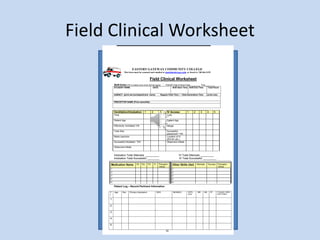
Field Clinical Worksheet
EASTERN GATEWAY COMMUNITY COLLEGE
This form must be scanned and emailed to emsclinical@egcc.edu, or faxed to 740.266.3195
Field Clinical Worksheet
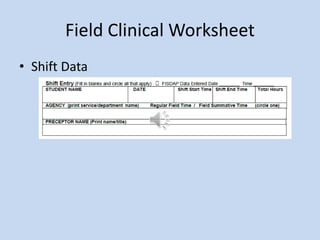
Shift Entry (Fill in blanks and circle all that apply)  FISDAP Data Entered Date ________ Time ________
STUDENT NAME DATE Shift Start Time Shift End Time Total Hours
AGENCY (print service/department name) Regular Field Time / Field Summative Time (circle one)
PRECEPTOR NAME (Print name/title)
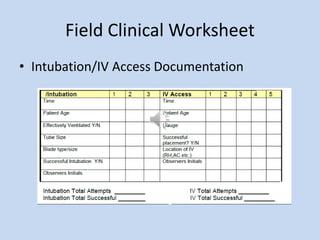
Ventilation/Intubation 1 2 3 IV Access 1 2 3 4 5
Time Time
Patient Age Patient Age
Effectively Ventilated Y/N Gauge
Tube Size Successful
placement? Y/N
Blade type/size Location of IV
(RH,AC etc.)
Successful Intubation Y/N Observers Initials
Observers Initials
Intubation Total Attempts _________ IV Total Attempts _________
Intubation Total Successful ________ IV Total Successful _________
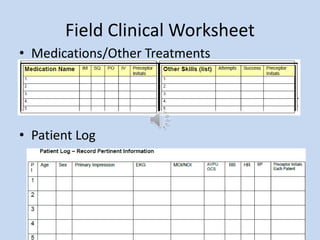
Patient Log – Record Pertinent Information
29
P
t
Age Sex Primary Impression EKG MOI/NOI AVPU
GCS
RR HR BP Preceptor Initials
Each Patient
1
2
3
4
5
Medication Name IM SQ PO IV Preceptor
Initials
1.
2.
3.
4.
5.
Other Skills (list) Attempts Success Preceptor
Initials
1.
2.
3.
4.
5.
Field Clinical Worksheet
• Shift Data
Field Clinical Worksheet
• Intubation/IV Access Documentation
Field Clinical Worksheet
• Medications/Other Treatments
• Patient Log
Field Clinical Worksheet
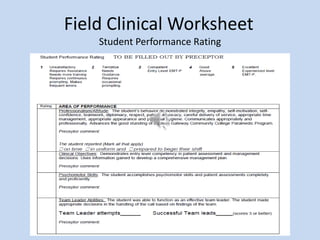
Student Performance Rating
Field Clinical Worksheet
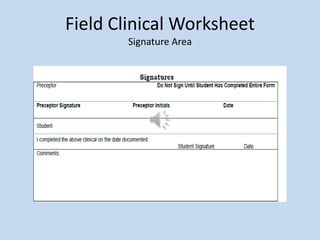
Signature Area
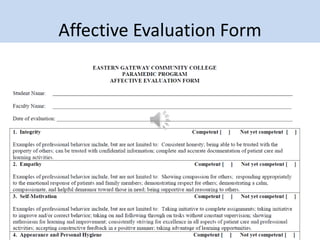
Affective Evaluation Form
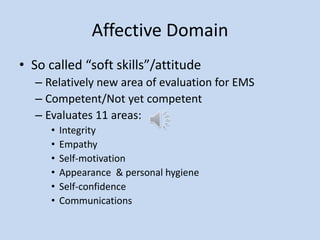
Affective Domain
• So called “soft skills”/attitude
– Relatively new area of evaluation for EMS
– Competent/Not yet competent
– Evaluates 11 areas:
• Integrity
• Empathy
• Self-motivation
• Appearance & personal hygiene
• Self-confidence
• Communications
Affective Domain
• So called “soft skills”/attitude
– Evaluates 11 areas:
• Teamwork
• Time management
• Respect
• Patient Advocacy
• Careful delivery of services
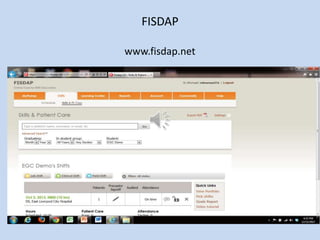
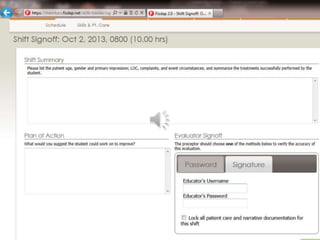
FISDAP
www.fisdap.net
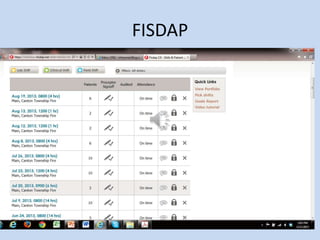
FISDAP
FISDAP
• Internet based clinical management tool.
– Documents clinical experience
• Student completes narrative, documentation of patient and
skills performed.
• Student completes a preceptor evaluation
– Provides check sheets for preceptor completion
• Not currently using
– Provides an area for preceptor to evaluate and
provide comments and suggestions.
– Upon student completion, preceptor can review/verify
and electronically sign off student.
• Long term goal of eliminating paperwork
Giving Feedback
• Immediate
– Errors should be corrected immediately every
time they occur
– Clear/Accurate
– Respectful
– Constructive vs Corrective
Feedback Strategy
• Constructive (Behavioral)
– Positive or Negative
• Describe – don’t label
• Don’t exaggerate
• Use “I” statements
• Avoid “need to” or “should” statements
• State consequences
Feedback Strategy
• Corrective (Procedural)
– Response for incorrect procedure or answer
• Analyze performance
• Identify correct and incorrect components
• Provide specific information to correct
• Positive feedback should be used when improvement
noted
Feedback Strategy
• Feedback should not be a surprise
– If a student exhibits multiple weak areas focus on
the most important area
• Goal being to shape behavior, not making the whole
experience very negative.
• Develop a student specific plan for improvement,
document on paperwork or FISDAP.
• Try and discover several things the student does good
for one thing they do not.
• Contact the program if concerns are serious in nature.
EMS Program Contact Information
• Mike Freeman – EMS Program Director
– (740)266-9757
– mfreeman@egcc.edu
• Marty Thorn – Clinical Coordinator
– mthorn2@egcc.edu
Preceptor training original -show

Preceptor training original -show

  • 1.
  • 2.
    Program Accreditation • OhioDepartment of Public Safety, Division of EMS Program #316 • Committee on Accreditation of Educational Programs for the EMS Professions (CoAEMSP) LOR Status Program #600635
  • 3.
    Training Objectives • Definewhat a preceptor is • Define preceptor role and responsibilities • Define the purpose of field training • Define the field training requirements • Understand the evaluation tools and their application
  • 4.
    Training Objectives • Understandthe learning domains • Understand the difference between formative and summative learning and evaluation – Understand the difference between regular field clinical and summative field evaluation • Understand techniques of giving feedback • Recall contact information for the program
  • 5.
    What is apreceptor? • A mentor • A teacher, instructor • An identified experienced practitioner who provides transitional role support and learning experiences
  • 6.
    What is thePreceptor’s Role and Responsibilities? • Safety – Patient – Student • Role Model • Educator/Information resource • Evaluator • Coach • Field liaison to the program
  • 7.
    What is thePurpose of Field Training? • A structured field learning experience that assists students in reaching the program terminal goal: “To prepare competent entry-level Emergency Medical Technician-Paramedics in the cognitive (knowledge), psychomotor (skills), and affective (behavior) learning domains”
  • 8.
    What is thePurpose of Field Training? • Field Training should stimulate growth. • Should prepare student toward program terminal goal. • Must evaluate all three learning domains: – Cognitive – Knowledge – Psychomotor – Skills – Affective – Attitude
  • 9.
    What are thefield clinical requirements? • First Semester - “regular clinical” – Minimum 85 hours – Minimum 15 ALS patient contacts • Second Semester - “regular clinical” – Minimum 85 hours – Minimum 15 ALS patient contacts
  • 10.
    What are thefield clinical requirements? • Third Semester • “Regular Field Clinical” – Students must first complete 66 hours regular field clinical. – Upon completion will be eligible to enter field summative. • “Field Summative Evaluation” – Minimum 40 hours – Minimum 20 ALS team leads – Cannot start until majority of patient care learning done in classroom.
  • 11.
    What are thefield clinical requirements? • Third Semester – “Summative Field Evaluation” – Preceptor needs to let students lead as much as possible • Student must earn positive team leader evaluations • Doesn’t require student to do every skill during call – Must positively impact overall management of the call • Be sure to mark clinical form check box “field summative” • Be sure to evaluate team leader ability and document • Student will need minimum two affective evaluations during period – Students should demonstrate “entry level paramedic skills”
  • 12.
    Evaluation Tools • FieldClinical Worksheet • Affective Evaluation Form • FISDAP
  • 13.
    Field Clinical Worksheet EASTERNGATEWAY COMMUNITY COLLEGE This form must be scanned and emailed to emsclinical@egcc.edu, or faxed to 740.266.3195 Field Clinical Worksheet Shift Entry (Fill in blanks and circle all that apply)  FISDAP Data Entered Date ________ Time ________ STUDENT NAME DATE Shift Start Time Shift End Time Total Hours AGENCY (print service/department name) Regular Field Time / Field Summative Time (circle one) PRECEPTOR NAME (Print name/title) Ventilation/Intubation 1 2 3 IV Access 1 2 3 4 5 Time Time Patient Age Patient Age Effectively Ventilated Y/N Gauge Tube Size Successful placement? Y/N Blade type/size Location of IV (RH,AC etc.) Successful Intubation Y/N Observers Initials Observers Initials Intubation Total Attempts _________ IV Total Attempts _________ Intubation Total Successful ________ IV Total Successful _________ Patient Log – Record Pertinent Information 29 P t Age Sex Primary Impression EKG MOI/NOI AVPU GCS RR HR BP Preceptor Initials Each Patient 1 2 3 4 5 Medication Name IM SQ PO IV Preceptor Initials 1. 2. 3. 4. 5. Other Skills (list) Attempts Success Preceptor Initials 1. 2. 3. 4. 5.
  • 14.
  • 15.
    Field Clinical Worksheet •Intubation/IV Access Documentation
  • 16.
    Field Clinical Worksheet •Medications/Other Treatments • Patient Log
  • 17.
  • 18.
  • 19.
  • 20.
    Affective Domain • Socalled “soft skills”/attitude – Relatively new area of evaluation for EMS – Competent/Not yet competent – Evaluates 11 areas: • Integrity • Empathy • Self-motivation • Appearance & personal hygiene • Self-confidence • Communications
  • 21.
    Affective Domain • Socalled “soft skills”/attitude – Evaluates 11 areas: • Teamwork • Time management • Respect • Patient Advocacy • Careful delivery of services
  • 22.
  • 23.
  • 24.
    FISDAP • Internet basedclinical management tool. – Documents clinical experience • Student completes narrative, documentation of patient and skills performed. • Student completes a preceptor evaluation – Provides check sheets for preceptor completion • Not currently using – Provides an area for preceptor to evaluate and provide comments and suggestions. – Upon student completion, preceptor can review/verify and electronically sign off student. • Long term goal of eliminating paperwork
  • 26.
    Giving Feedback • Immediate –Errors should be corrected immediately every time they occur – Clear/Accurate – Respectful – Constructive vs Corrective
  • 27.
    Feedback Strategy • Constructive(Behavioral) – Positive or Negative • Describe – don’t label • Don’t exaggerate • Use “I” statements • Avoid “need to” or “should” statements • State consequences
  • 28.
    Feedback Strategy • Corrective(Procedural) – Response for incorrect procedure or answer • Analyze performance • Identify correct and incorrect components • Provide specific information to correct • Positive feedback should be used when improvement noted
  • 29.
    Feedback Strategy • Feedbackshould not be a surprise – If a student exhibits multiple weak areas focus on the most important area • Goal being to shape behavior, not making the whole experience very negative. • Develop a student specific plan for improvement, document on paperwork or FISDAP. • Try and discover several things the student does good for one thing they do not. • Contact the program if concerns are serious in nature.
  • 30.
    EMS Program ContactInformation • Mike Freeman – EMS Program Director – (740)266-9757 – mfreeman@egcc.edu • Marty Thorn – Clinical Coordinator – mthorn2@egcc.edu