PRECEPTOR TRAINING
1
PURPOSE & GOAL
To reveal the importance of the
preceptor/EMS student relationship & to
positively influence the learning process.
To help create successful, productive and
reflective preceptors.
To facilitate an expanded role of the
precepting healthcare professional.
To familiarize the preceptor with Dorsey
Emergency Medical Academy’s policies for
clinical & internship students.
2
OBJECTIVES
Identify the expectations, roles and
responsibilities of the EMS preceptor.
Identify the responsibilities of the EMS
student in the clinical setting.
Identify techniques to facilitate learning.
Identify ways to help the EMS student feel
valued.
Identify ways to facilitate sound clinical
reasoning and effective evaluation.
3
OBJECTIVES
 Identify factors which can facilitate the success of
precepting.
 Identify & appreciate potential roadblocks to the
success of precepting.
 Identify how the preceptor role integrates and
interacts with the EMS education program.
 Discuss feedback, coaching, and benchmark
competencies for the EMS student.
 Provide objective assessment of the EMS student’s
performance.
4
WHAT IS HEALTHCARE
PRECEPTING?
Precepting:
A prescribed, time-limited relationship
between an experienced healthcare
professional and a healthcare student for
the purpose and facilitation of learning.
The successful precepting relationship
has been found to promote success as
the healthcare student transitions into
the graduate/professional role.
5
PURPOSE OF PRECEPTORSHIP
To reveal the gap between the realities
of practicing healthcare and the
academic experience.
To fulfill the need for EMS students to
be exposed to the expanded role of the
practicing healthcare professional.
To facilitate the transition of EMS
students to become more autonomous.
6
CHARACTERISTICS OF A GOOD
PRECEPTOR
They are proficient and/or considered
experts in their respective fields.
They exhibit a positive attitude (they still
have a passion for healthcare).
They are enthusiastic about the role of the
preceptor.
They are often regarded as a role model by
other healthcare professionals.
They possess solid communication skills
and have a willingness to give honest
feedback. 7
CHARACTERISTICS OF A GOOD
PRECEPTOR
They advocate for patients and their
families as well as for the students.
They share knowledge, resources and
innovative ways of critical thinking.
They enjoy teaching.
They manage conflict well (not easily
ruffled).
They share formal & informal rules.
They are models of exemplary healthcare
practice.
8
WHY THE NEED FOR A
PRECEPTOR?
EMS students need help managing anxiety.
They need to develop a professional
identification.
They need to understand that there are a
variety of strategies that are effective –
“there’s more than one way to skin a cat”.
They need to develop their own “style”.
9
ADULT LEARNING STRATEGIES
Focus is Novice to Expert: Begin by:
Learning policies, procedures &
etiquette.
Learning effective skills of teamwork.
Gradually increasing workload and
responsibilities of a competent
healthcare professional (following
guide). 10
REMEMBER WHEN?
Many EMS students look at successful
healthcare practitioners & think they were
always that way.
Most healthcare professionals have had
great mentors.
We developed over time, through much
trial & error.
We received correction along the way.
11
YOU ARE NOW THE MENTOR
You are now the preceptor and thus a
mentor.
Many times, you are the first medical
professional that students will see “in action”.
Your attitudes and actions have an impact on
the kind of healthcare professional the
student will wish to become.
The mentoring a student receives is just as
important (maybe more so) as the training
he/she receives in the classroom. It should
solidify/validate what they have learned
didactically.
12
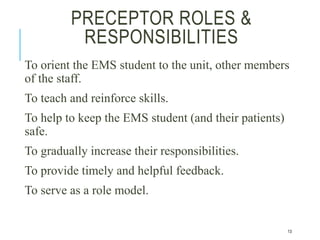
PRECEPTOR ROLES &
RESPONSIBILITIES
To orient the EMS student to the unit, other members
of the staff.
To teach and reinforce skills.
To help to keep the EMS student (and their patients)
safe.
To gradually increase their responsibilities.
To provide timely and helpful feedback.
To serve as a role model.
13
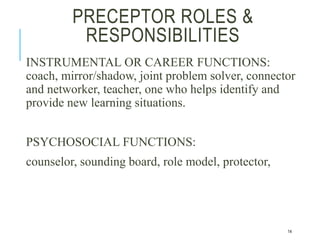
PRECEPTOR ROLES &
RESPONSIBILITIES
INSTRUMENTAL OR CAREER FUNCTIONS:
coach, mirror/shadow, joint problem solver, connector
and networker, teacher, one who helps identify and
provide new learning situations.
PSYCHOSOCIAL FUNCTIONS:
counselor, sounding board, role model, protector,
14
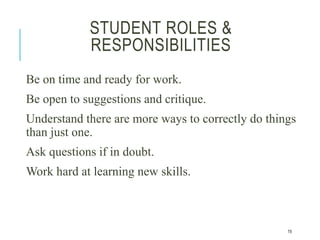
STUDENT ROLES &
RESPONSIBILITIES
Be on time and ready for work.
Be open to suggestions and critique.
Understand there are more ways to correctly do things
than just one.
Ask questions if in doubt.
Work hard at learning new skills.
15
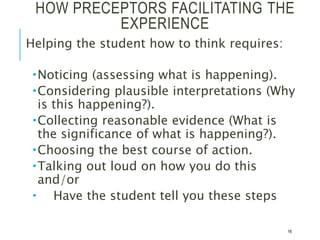
HOW PRECEPTORS FACILITATING THE
EXPERIENCE
Helping the student how to think requires:
Noticing (assessing what is happening).
Considering plausible interpretations (Why
is this happening?).
Collecting reasonable evidence (What is
the significance of what is happening?).
Choosing the best course of action.
Talking out loud on how you do this
and/or
 Have the student tell you these steps
16
TEACHING STRATEGIES FOR
PRECEPTORS:
Coaching.
Simulations.
Role-modeling.
Post event review.
Sharing thoughts: (Two way street).
17
POTENTIAL PITFALLS FOR
PRECEPTOR
Passive aggressive communication style.
Talks about student behind his/her back.
Indirect criticism.
Critical and over demanding.
Not allowing student to problem solve and
gain increasing independence.
Does not advocate for student with peers and
other health care providers.
Poor role model (makes up own rules).
Doesn’t like precepting!
18
THE FIRST MEETING
Get to know each other
What is your basic personality?
How do you handle criticism?
How do you handle stress?
What is your learning style?
Are there any potential hurdles?
 language, culture, socialization skills
19
TEACH GOOD COMMUNICATION
With Nurses, Physicians, Peers,
Patients, Families…
Walk/talk them through this: What the
essential ingredients are. Help them to
define the goal of the communication
(Practice).
Conflict management, customer
relations, team building, phone skills
(Practice).
Always be respectful and caring.
20
WAYS TO HELP YOUR STUDENT
Help the Student to Understand and Interpret
Conflict
 With patients, hospital staff and team members
Be very clear what your expectations are.
Understand that most EMS students have had
limited communication with physicians and
others in authority.
Expect that they will not know all of the
forms .
Model communication and then have them
do the next one (such as a physician’s order).
21
HOW TO CRITICIZE
EFFECTIVELY
Target the behavior that needs to be changed, not
the person.
Choose a private, comfortable time.
Explain the facts. Don’t get into WHY.
Explain the impact of their behavior or action.
Ask the EMS student to share their perspective.
Ask the EMS student what is needed to fix the
problem
22
SAMPLE:
Problem - Student has been late
consistently.
How to handle the problem-
You have been late for your shift three days
this week. That gets the day started late and
irritates the practitioners trying to get out
on time. Can you help me understand why
this is a problem?
What do you need to do to make sure that
you are here on time? (Be supportive, but
make it clear that the responsibility for
change lies with the EMS student).
23
STRETCH THE STUDENT!
Expose them to new situations.
Give them strategies or clues to
handling situation effectively.
Take over only when safety is an issue!
Afterwards, help the student review
what went well and what didn’t. What
would they do differently if they had the
chance?
24
FIELD EXPERIENCE VS
INTERNSHIP
Field/Clinical Experience-
Field experience is during the course, the student is
learning and practicing new skills.
Internship-
The student is at the end of the program. The student is
now ready to be the team lead.
25
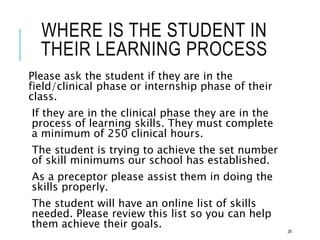
WHERE IS THE STUDENT IN
THEIR LEARNING PROCESS
Please ask the student if they are in the
field/clinical phase or internship phase of their
class.
If they are in the clinical phase they are in the
process of learning skills. They must complete
a minimum of 250 clinical hours.
The student is trying to achieve the set number
of skill minimums our school has established.
As a preceptor please assist them in doing the
skills properly.
The student will have an online list of skills
needed. Please review this list so you can help
them achieve their goals.
26
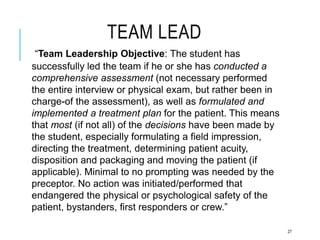
TEAM LEAD
“Team Leadership Objective: The student has
successfully led the team if he or she has conducted a
comprehensive assessment (not necessary performed
the entire interview or physical exam, but rather been in
charge-of the assessment), as well as formulated and
implemented a treatment plan for the patient. This means
that most (if not all) of the decisions have been made by
the student, especially formulating a field impression,
directing the treatment, determining patient acuity,
disposition and packaging and moving the patient (if
applicable). Minimal to no prompting was needed by the
preceptor. No action was initiated/performed that
endangered the physical or psychological safety of the
patient, bystanders, first responders or crew.”
27
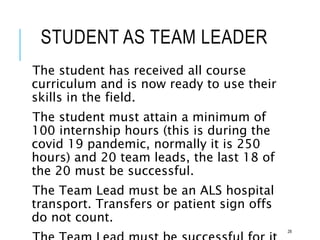
STUDENT AS TEAM LEADER
The student has received all course
curriculum and is now ready to use their
skills in the field.
The student must attain a minimum of
100 internship hours (this is during the
covid 19 pandemic, normally it is 250
hours) and 20 team leads, the last 18 of
the 20 must be successful.
The Team Lead must be an ALS hospital
transport. Transfers or patient sign offs
do not count.
28
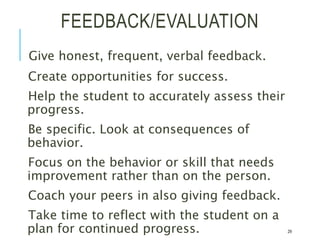
FEEDBACK/EVALUATION
Give honest, frequent, verbal feedback.
Create opportunities for success.
Help the student to accurately assess their
progress.
Be specific. Look at consequences of
behavior.
Focus on the behavior or skill that needs
improvement rather than on the person.
Coach your peers in also giving feedback.
Take time to reflect with the student on a
plan for continued progress. 29
EVALUATION PROCESS
Daily
Set daily goals, then evaluate whether they were
achieved verbally throughout shift. Debrief at
the end of each shift
This helps keep everyone on target
Weekly
Summarize daily goals.
Discuss long-term and weekly goals and your
progress toward them.
Hints: There should be no surprises!
Should be affirming and constructive.
Ask how you can improve as a preceptor.30
FINAL EVALUATION:
Summary of what has and has not been
accomplished (Again no surprises!)
Brings closure to the precepting
relationship.
EMS student completes their own self-
evaluation.
Schedule a meeting with instructor, EMS
student, and preceptor; to discuss
experience and final evaluations.
31
WHAT ABOUT THE STUDENT?
Keep the Program Director informed
of progress (or lack there of). This
should be done on the Field
Internship evaluation the student
must ask you to fill out. These
evaluations must be done after every
shift.
If there are personality conflicts-
Identify them early. It’s OK to make
a change!
Let the Program Director know what
you think of the precepting
experience.
Remember: This is an investment in 32
REVIEW OF DEMA CLINICAL
POLICIES & PROCEDURES
Please review patient care reports and the
clinical time before signing off on Platinum
Planner.
Platinum Planner is our clinical scheduler
and skills tracker.
The student will be asking you to fill out a
student field internship evaluation, please
give honest feedback. Once you hit submit
and close the student can not review the
evaluation.
The student will be asking for your signature33
Thanks!
Without your participation our students
and the EMS profession do not
succeed.
Please contact Ken Hamilton the
Program Director at
khamilton@Dorsey.edu if you have any
concerns or questions.
34

1 dema preceptor educational training

  • 1.
  • 2.
    PURPOSE & GOAL Toreveal the importance of the preceptor/EMS student relationship & to positively influence the learning process. To help create successful, productive and reflective preceptors. To facilitate an expanded role of the precepting healthcare professional. To familiarize the preceptor with Dorsey Emergency Medical Academy’s policies for clinical & internship students. 2
  • 3.
    OBJECTIVES Identify the expectations,roles and responsibilities of the EMS preceptor. Identify the responsibilities of the EMS student in the clinical setting. Identify techniques to facilitate learning. Identify ways to help the EMS student feel valued. Identify ways to facilitate sound clinical reasoning and effective evaluation. 3
  • 4.
    OBJECTIVES  Identify factorswhich can facilitate the success of precepting.  Identify & appreciate potential roadblocks to the success of precepting.  Identify how the preceptor role integrates and interacts with the EMS education program.  Discuss feedback, coaching, and benchmark competencies for the EMS student.  Provide objective assessment of the EMS student’s performance. 4
  • 5.
    WHAT IS HEALTHCARE PRECEPTING? Precepting: Aprescribed, time-limited relationship between an experienced healthcare professional and a healthcare student for the purpose and facilitation of learning. The successful precepting relationship has been found to promote success as the healthcare student transitions into the graduate/professional role. 5
  • 6.
    PURPOSE OF PRECEPTORSHIP Toreveal the gap between the realities of practicing healthcare and the academic experience. To fulfill the need for EMS students to be exposed to the expanded role of the practicing healthcare professional. To facilitate the transition of EMS students to become more autonomous. 6
  • 7.
    CHARACTERISTICS OF AGOOD PRECEPTOR They are proficient and/or considered experts in their respective fields. They exhibit a positive attitude (they still have a passion for healthcare). They are enthusiastic about the role of the preceptor. They are often regarded as a role model by other healthcare professionals. They possess solid communication skills and have a willingness to give honest feedback. 7
  • 8.
    CHARACTERISTICS OF AGOOD PRECEPTOR They advocate for patients and their families as well as for the students. They share knowledge, resources and innovative ways of critical thinking. They enjoy teaching. They manage conflict well (not easily ruffled). They share formal & informal rules. They are models of exemplary healthcare practice. 8
  • 9.
    WHY THE NEEDFOR A PRECEPTOR? EMS students need help managing anxiety. They need to develop a professional identification. They need to understand that there are a variety of strategies that are effective – “there’s more than one way to skin a cat”. They need to develop their own “style”. 9
  • 10.
    ADULT LEARNING STRATEGIES Focusis Novice to Expert: Begin by: Learning policies, procedures & etiquette. Learning effective skills of teamwork. Gradually increasing workload and responsibilities of a competent healthcare professional (following guide). 10
  • 11.
    REMEMBER WHEN? Many EMSstudents look at successful healthcare practitioners & think they were always that way. Most healthcare professionals have had great mentors. We developed over time, through much trial & error. We received correction along the way. 11
  • 12.
    YOU ARE NOWTHE MENTOR You are now the preceptor and thus a mentor. Many times, you are the first medical professional that students will see “in action”. Your attitudes and actions have an impact on the kind of healthcare professional the student will wish to become. The mentoring a student receives is just as important (maybe more so) as the training he/she receives in the classroom. It should solidify/validate what they have learned didactically. 12
  • 13.
    PRECEPTOR ROLES & RESPONSIBILITIES Toorient the EMS student to the unit, other members of the staff. To teach and reinforce skills. To help to keep the EMS student (and their patients) safe. To gradually increase their responsibilities. To provide timely and helpful feedback. To serve as a role model. 13
  • 14.
    PRECEPTOR ROLES & RESPONSIBILITIES INSTRUMENTALOR CAREER FUNCTIONS: coach, mirror/shadow, joint problem solver, connector and networker, teacher, one who helps identify and provide new learning situations. PSYCHOSOCIAL FUNCTIONS: counselor, sounding board, role model, protector, 14
  • 15.
    STUDENT ROLES & RESPONSIBILITIES Beon time and ready for work. Be open to suggestions and critique. Understand there are more ways to correctly do things than just one. Ask questions if in doubt. Work hard at learning new skills. 15
  • 16.
    HOW PRECEPTORS FACILITATINGTHE EXPERIENCE Helping the student how to think requires: Noticing (assessing what is happening). Considering plausible interpretations (Why is this happening?). Collecting reasonable evidence (What is the significance of what is happening?). Choosing the best course of action. Talking out loud on how you do this and/or  Have the student tell you these steps 16
  • 17.
    TEACHING STRATEGIES FOR PRECEPTORS: Coaching. Simulations. Role-modeling. Postevent review. Sharing thoughts: (Two way street). 17
  • 18.
    POTENTIAL PITFALLS FOR PRECEPTOR Passiveaggressive communication style. Talks about student behind his/her back. Indirect criticism. Critical and over demanding. Not allowing student to problem solve and gain increasing independence. Does not advocate for student with peers and other health care providers. Poor role model (makes up own rules). Doesn’t like precepting! 18
  • 19.
    THE FIRST MEETING Getto know each other What is your basic personality? How do you handle criticism? How do you handle stress? What is your learning style? Are there any potential hurdles?  language, culture, socialization skills 19
  • 20.
    TEACH GOOD COMMUNICATION WithNurses, Physicians, Peers, Patients, Families… Walk/talk them through this: What the essential ingredients are. Help them to define the goal of the communication (Practice). Conflict management, customer relations, team building, phone skills (Practice). Always be respectful and caring. 20
  • 21.
    WAYS TO HELPYOUR STUDENT Help the Student to Understand and Interpret Conflict  With patients, hospital staff and team members Be very clear what your expectations are. Understand that most EMS students have had limited communication with physicians and others in authority. Expect that they will not know all of the forms . Model communication and then have them do the next one (such as a physician’s order). 21
  • 22.
    HOW TO CRITICIZE EFFECTIVELY Targetthe behavior that needs to be changed, not the person. Choose a private, comfortable time. Explain the facts. Don’t get into WHY. Explain the impact of their behavior or action. Ask the EMS student to share their perspective. Ask the EMS student what is needed to fix the problem 22
  • 23.
    SAMPLE: Problem - Studenthas been late consistently. How to handle the problem- You have been late for your shift three days this week. That gets the day started late and irritates the practitioners trying to get out on time. Can you help me understand why this is a problem? What do you need to do to make sure that you are here on time? (Be supportive, but make it clear that the responsibility for change lies with the EMS student). 23
  • 24.
    STRETCH THE STUDENT! Exposethem to new situations. Give them strategies or clues to handling situation effectively. Take over only when safety is an issue! Afterwards, help the student review what went well and what didn’t. What would they do differently if they had the chance? 24
  • 25.
    FIELD EXPERIENCE VS INTERNSHIP Field/ClinicalExperience- Field experience is during the course, the student is learning and practicing new skills. Internship- The student is at the end of the program. The student is now ready to be the team lead. 25
  • 26.
    WHERE IS THESTUDENT IN THEIR LEARNING PROCESS Please ask the student if they are in the field/clinical phase or internship phase of their class. If they are in the clinical phase they are in the process of learning skills. They must complete a minimum of 250 clinical hours. The student is trying to achieve the set number of skill minimums our school has established. As a preceptor please assist them in doing the skills properly. The student will have an online list of skills needed. Please review this list so you can help them achieve their goals. 26
  • 27.
    TEAM LEAD “Team LeadershipObjective: The student has successfully led the team if he or she has conducted a comprehensive assessment (not necessary performed the entire interview or physical exam, but rather been in charge-of the assessment), as well as formulated and implemented a treatment plan for the patient. This means that most (if not all) of the decisions have been made by the student, especially formulating a field impression, directing the treatment, determining patient acuity, disposition and packaging and moving the patient (if applicable). Minimal to no prompting was needed by the preceptor. No action was initiated/performed that endangered the physical or psychological safety of the patient, bystanders, first responders or crew.” 27
  • 28.
    STUDENT AS TEAMLEADER The student has received all course curriculum and is now ready to use their skills in the field. The student must attain a minimum of 100 internship hours (this is during the covid 19 pandemic, normally it is 250 hours) and 20 team leads, the last 18 of the 20 must be successful. The Team Lead must be an ALS hospital transport. Transfers or patient sign offs do not count. 28
  • 29.
    FEEDBACK/EVALUATION Give honest, frequent,verbal feedback. Create opportunities for success. Help the student to accurately assess their progress. Be specific. Look at consequences of behavior. Focus on the behavior or skill that needs improvement rather than on the person. Coach your peers in also giving feedback. Take time to reflect with the student on a plan for continued progress. 29
  • 30.
    EVALUATION PROCESS Daily Set dailygoals, then evaluate whether they were achieved verbally throughout shift. Debrief at the end of each shift This helps keep everyone on target Weekly Summarize daily goals. Discuss long-term and weekly goals and your progress toward them. Hints: There should be no surprises! Should be affirming and constructive. Ask how you can improve as a preceptor.30
  • 31.
    FINAL EVALUATION: Summary ofwhat has and has not been accomplished (Again no surprises!) Brings closure to the precepting relationship. EMS student completes their own self- evaluation. Schedule a meeting with instructor, EMS student, and preceptor; to discuss experience and final evaluations. 31
  • 32.
    WHAT ABOUT THESTUDENT? Keep the Program Director informed of progress (or lack there of). This should be done on the Field Internship evaluation the student must ask you to fill out. These evaluations must be done after every shift. If there are personality conflicts- Identify them early. It’s OK to make a change! Let the Program Director know what you think of the precepting experience. Remember: This is an investment in 32
  • 33.
    REVIEW OF DEMACLINICAL POLICIES & PROCEDURES Please review patient care reports and the clinical time before signing off on Platinum Planner. Platinum Planner is our clinical scheduler and skills tracker. The student will be asking you to fill out a student field internship evaluation, please give honest feedback. Once you hit submit and close the student can not review the evaluation. The student will be asking for your signature33
  • 34.
    Thanks! Without your participationour students and the EMS profession do not succeed. Please contact Ken Hamilton the Program Director at khamilton@Dorsey.edu if you have any concerns or questions. 34

Editor's Notes

  • #3 The purpose of this training is to help create successful, productive and reflective preceptors who will Assist the EMS student to understand prioritization and organization as it relates to the healthcare profession.
  • #4 The objectives for todays training are to Identify the expectations, roles and responsibilities of the EMS preceptor and the responsibilities of the EMS student in the clinical setting.
  • #5 Identify factors which can facilitate the success of precepting. Identify & appreciate potential roadblocks to the success of precepting. Identify how the preceptor role integrates and interacts with the EMS education program. Discuss feedback, coaching, and benchmark competencies for the EMS student. Provide objective assessment of the EMS student’s performance.
  • #6 What is Healthcare Precepting? It is you the experienced paramedic work with and facilitating the learning process. Helping the student use the tools we give them in the classroom.
  • #7 What is the Purpose of Preceptorship- It is so you can help expose the student to the role of being a autonomous healthcare professional.
  • #8 Characteristics of a Good Preceptor- They are considered experts in their respective fields. They have a positive attitude & are enthusiastic about the role of the preceptor. They have good communication skills and have a will give the student honest feedback.
  • #9 At first you will lead by example & when/ if you feel confident in the students abilities you give them more responsibility.
  • #10 Why the Need for a Preceptor You are there as a security blanket, to help them relax so they can preform. To let them see a different way of doing things To help them develop a good style- take good things from all coaches.
  • #11 You will have students who are on their first field clinical & students who are on their capstone internship. When they are new they need to know policies & procedures.
  • #12 Remember you had to go to medic school also, how did you want to be treated.
  • #13 Your interaction with our students will have a major impact on how they perceive the people in this field and how they should act.
  • #14 To orient the EMS student to the unit, other members of the staff. Your Roles To teach and reinforce skills. To help to keep the EMS student (and their patients) safe. To gradually increase their responsibilities. To provide timely and helpful feedback. To serve as a role model.
  • #15 You are instrumental to the learning journey- you are the coach, teacher who helps identify and provide new learning situations Sometimes a counselor, sounding board, role model & protector
  • #16 Our students are expected to- Be on time and ready for work. Be open to suggestions and critique. Understand there are more ways to correctly do things than just one. Ask questions if in doubt. Work hard at learning new skills.
  • #17 Facilitating the Experience assess what is happening, Why is this happening, What is the significance of what is happening, what's the best course of action and then discuss it with the student (if time allows)
  • #18 Being a strong role model will go a long way in creating competent students
  • #19 Pitfalls Passive aggressive communication style- making comments that aren’t productive. Talks about student behind his/her back- say what you need to say to the student Indirect criticism- tell them what they did wrong & right Critical and over demanding- remember they are still students Not allowing student to problem solve and gain increasing independence- they need to get some autonomy. Does not advocate for student with peers and other health care providers- have their back, this will establish trust. Poor role model (makes up own rules)- there are no street medics Doesn’t like precepting- If this is the case let us know so you wont have to.
  • #20 Try to get to know the student, Ask them some questions
  • #21 Be a good role model, Walk/talk them through the process.
  • #22 Help the Student to Understand and Interpret Conflict- They may be young and new to stress, may not understand Power/territory issues. As you know honestly, some people like conflict and chaos and seek to generate it, help the student work through this.
  • #23 How to Criticize Effectively- Target the behavior that needs to be changed, not the person. Choose a private, comfortable time- never criticize in public Explain the facts. Don’t get into WHY. Explain the impact of their behavior or action. Ask the EMS student to share their perspective. Ask the EMS student what is needed to fix the problem
  • #24 Problem - Student has been late consistently. How to handle the problem- You have been late for your shift three days this week. That gets the day started late and irritates the practitioners trying to get out on time. Can you help me understand why this is a problem? What do you need to do to make sure that you are here on time? (Be supportive, but make it clear that the responsibility for change lies with the EMS student).
  • #25 Expose them to new situations At the same time, remember that you must always keep your patients safe!)
  • #30 Give honest, frequent, verbal feedback. Be specific. Look at consequences of behavior. Take time to reflect with the student on a plan for continued progress.
  • #31 Set daily goals and Discuss long-term and weekly goals and your progress toward them.
  • #32 Summary of what has and has not been accomplished