NaloxoneNaloxone
Training ProgramTraining Program
EMR/EMTEMR/EMT
May 27, 2014May 27, 2014
State of Connecticut
Department of Public Health/OEMS
1
GoalGoal
To reduce mortality and morbidity from
opioid overdose by instructing EMS
Responders (EMT and EMR) in the
administration of naloxone.
2
ObjectivesObjectives
By the end of this course the EMT/EMR will:
•Recognize the signs and symptoms of an opiate overdose
•Identify the indications and contraindications of naloxone
•Explain the possible adverse reactions of naloxone
•Describe how to manage adverse reactions
•Prepare and administer naloxone via approved route
•Describe the on-going patient management after the
administration of naloxone
•Appreciate the place of naloxone in the management of
opioid overdose
3
HistoryHistory
• In 2010, approximately 38, 329 drug overdose
deaths occurred in the United States, one death
every 7 minutes.
• About 75% of these deaths involved prescription
opioid analgesics.
• In 2009 alone, there were 257 million opioid
prescriptions written.
4
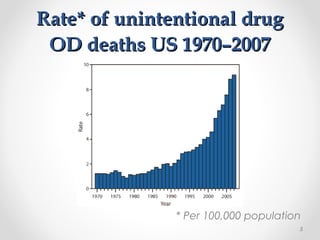
Rate* of unintentional drugRate* of unintentional drug
OD deaths US 1970–2007OD deaths US 1970–2007
* Per 100,000 population
5
Treatment HistoryTreatment History
• Opiates kill because they cause people to stop
breathing
• EMTs and EMRs have been limited to providing
ventilatory support as a means to reverse hypoxia
• Reversal of the cause of hypoventilation allows for
return of spontaneous respiration and limits the
continued need for ventilatory support
• Prolonged hypoventilation complications include
hypercarbia, hypoxia, aspiration, respiratory arrest
and death
6
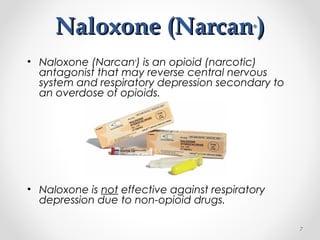
Naloxone (NarcanNaloxone (Narcan®®
))
• Naloxone (Narcan®
) is an opioid (narcotic)
antagonist that may reverse central nervous
system and respiratory depression secondary to
an overdose of opioids.
• Naloxone is not effective against respiratory
depression due to non-opioid drugs.
7
CAUTION!!CAUTION!!
• Naloxone works for a shorter period of time than
most opioids
• Without additional treatment, patients may
experience a relapse of respiratory arrest that may
lead to death
8
OpioidsOpioids
Synthetic or semi-synthetic alkaloids act on the
Central Nervous System as a depressant to:
•decrease the perception of pain
•decrease the reaction to pain
•increase pain tolerance
May be prescribed for acute pain, debilitating pain, or
chronic pain as part of palliative care (e.g., cancer)
May be abused to induce euphoria or “high”
9
Opioids, continuedOpioids, continued
• Tolerance and/or addiction may occur, requiring
increasing doses for the same effect
• Common side effects include:
-respiratory depression
-drowsiness
-itching
-nausea and vomiting
-dry mouth
-miosis (constricted pupils)
-constipation
10
OpioidsOpioids
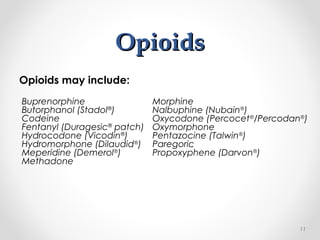
Opioids may include:
Buprenorphine
Butorphanol (Stadol®
)
Codeine
Fentanyl (Duragesic®
patch)
Hydrocodone (Vicodin®
)
Hydromorphone (Dilaudid®
)
Meperidine (Demerol®
)
Methadone
Morphine
Nalbuphine (Nubain®
)
Oxycodone (Percocet®
/Percodan®
)
Oxymorphone
Pentazocine (Talwin®
)
Paregoric
Propoxyphene (Darvon®
)
11
OpioidsOpioids
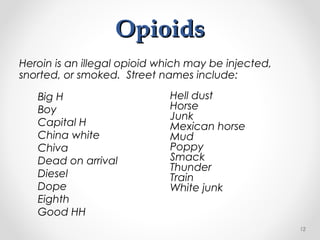
Heroin is an illegal opioid which may be injected,
snorted, or smoked. Street names include:
Big H
Boy
Capital H
China white
Chiva
Dead on arrival
Diesel
Dope
Eighth
Good HH
Hell dust
Horse
Junk
Mexican horse
Mud
Poppy
Smack
Thunder
Train
White junk
12
Opioid AddictionOpioid Addiction
Treatment DrugsTreatment Drugs
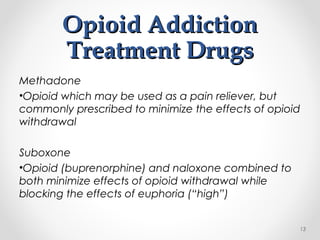
Methadone
•Opioid which may be used as a pain reliever, but
commonly prescribed to minimize the effects of opioid
withdrawal
Suboxone
•Opioid (buprenorphine) and naloxone combined to
both minimize effects of opioid withdrawal while
blocking the effects of euphoria (“high”)
13
Target PopulationTarget Population
The target population for naloxone is persons
who may have overdosed on opioids and
whose respiratory drive is at a depressed life-
threatening level.
14
On SceneOn Scene
• You may know you’re responding to a suspected
overdose, or you may be told upon arrival
• Scene Safety/BSI is a top priority
• Do you have appropriate resources present or
responding?
• Remain non-judgmental and non-confrontational
• Ask bystander(s) what and when the patient
injected, ingested, or inhaled (or if a transdermal
patch has been used)
• Was more than one substance used?
15
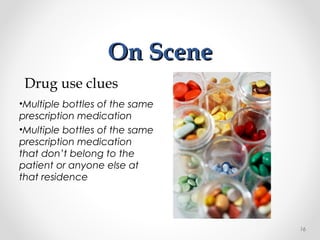
On SceneOn Scene
•Multiple bottles of the same
prescription medication
•Multiple bottles of the same
prescription medication
that don’t belong to the
patient or anyone else at
that residence
Drug use clues
16
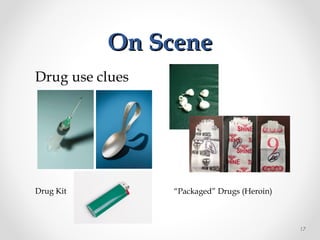
On SceneOn Scene
Drug Kit “Packaged” Drugs (Heroin)
Drug use clues
17
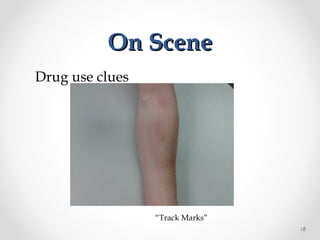
On SceneOn Scene
Drug use clues
“Track Marks”
18
Signs and Symptoms ofSigns and Symptoms of
Opioid/Toxidrome:Opioid/Toxidrome:
• Unresponsive or minimally responsive, with a pulse
• Depressed respiratory rate
• Agonal respirations
• Respiratory arrest
• Cyanosis
• Miosis (constricted pupils)
19
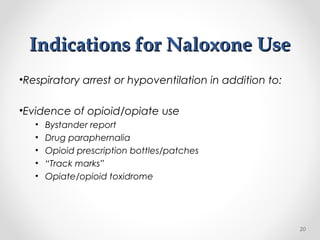
Indications for Naloxone UseIndications for Naloxone Use
•Respiratory arrest or hypoventilation in addition to:
•Evidence of opioid/opiate use
• Bystander report
• Drug paraphernalia
• Opioid prescription bottles/patches
• “Track marks”
• Opiate/opioid toxidrome
20
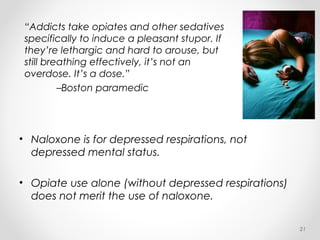
“Addicts take opiates and other sedatives
specifically to induce a pleasant stupor. If
they’re lethargic and hard to arouse, but
still breathing effectively, it’s not an
overdose. It’s a dose.”
–Boston paramedic
21
• Naloxone is for depressed respirations, not
depressed mental status.
• Opiate use alone (without depressed respirations)
does not merit the use of naloxone.
ContraindicationsContraindications
Known hypersensitivity (rare)
22
Naloxone DosageNaloxone Dosage
• Naloxone dosage will be specified by the agency’s
EMS sponsor hospital
• Common intramuscular (IM) dosage:
o 0.4 mg autoinjector
• Common intranasal (IN) dosage:
o Adults and children: 2 mg (2 mL) divided as 1mg (1 mL) per nostril
o Infant and toddler: naloxone 1 (1 mL) mg divided as 0.5 mg (0.5 mL) per
nostril
• Physician oversight may direct different dosing to
improve therapy or decrease adverse effects
23
Naloxone UseNaloxone Use
• Ensure scene safety!
• Maintain appropriate Body Substance Isolation (BSI)
• Assess level of consciousness and vital signs
• Maintain open airway and provide tactile
stimulation
• Assist ventilations
• Ensure appropriate resources are responding
• Administer naloxone when indicated
• Initiate transport as soon as possible (don’t wait on
scene for paramedic)
24
Naloxone Use,Naloxone Use, continuedcontinued
The “Eight Rights” for Medication Administration:
•Right Patient
•Right Reason
•Right Time
•Right Dose
•Right Route
•Right Drug
•Right Response
•Right Documentation
25
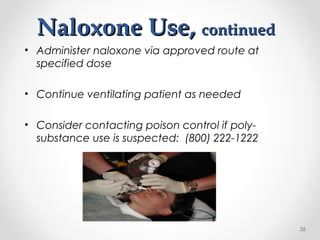
• Administer naloxone via approved route at
specified dose
• Continue ventilating patient as needed
• Consider contacting poison control if poly-
substance use is suspected: (800) 222-1222
26
Naloxone Use,Naloxone Use, continuedcontinued
• The effects of naloxone may not last as long as the
effects of the opioid; be prepared for a return of
overdose signs & symptoms!
• Every effort should be made to encourage patient
be transported to definitive care.
• Physician or police speaking with the patient may
assist in eliciting transport.
27
Methods of AdministrationMethods of Administration
• The following slides address the preparation and
administration of both intranasal and intramuscular
(via autoinjector) administration of naloxone.
• Providers may only administer naloxone via the
route(s) authorized by their EMS sponsor hospital.
28
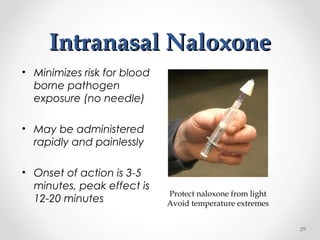
Intranasal NaloxoneIntranasal Naloxone
• Minimizes risk for blood
borne pathogen
exposure (no needle)
• May be administered
rapidly and painlessly
• Onset of action is 3-5
minutes, peak effect is
12-20 minutes
Protect naloxone from light
Avoid temperature extremes
29
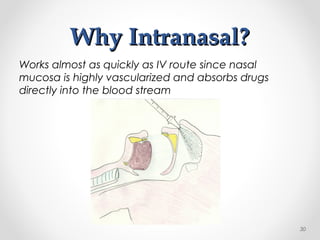
Why Intranasal?Why Intranasal?
Works almost as quickly as IV route since nasal
mucosa is highly vascularized and absorbs drugs
directly into the blood stream
30
Why an Atomizer?Why an Atomizer?
Briskly compressing the
syringe converts the liquid
drug to a fine atomized
mist.
This results in broader
mucosal coverage and
better chance of
absorption
into the blood stream than
drops that can run straight
back into the throat.
31
Intranasal NaloxoneIntranasal Naloxone
Preparation Step 1Preparation Step 1
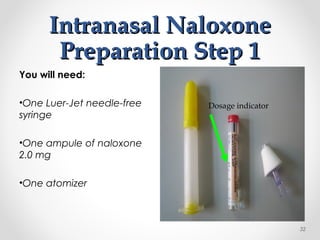
You will need:
•One Luer-Jet needle-free
syringe
•One ampule of naloxone
2.0 mg
•One atomizer
Dosage indicator
32
Intranasal NaloxoneIntranasal Naloxone
Preparation Step 2Preparation Step 2
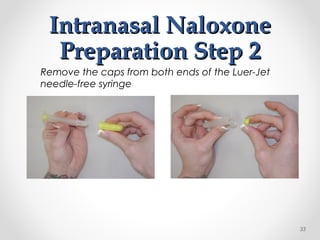
Remove the caps from both ends of the Luer-Jet
needle-free syringe
33
Intranasal NaloxoneIntranasal Naloxone
Preparation Step 3Preparation Step 3
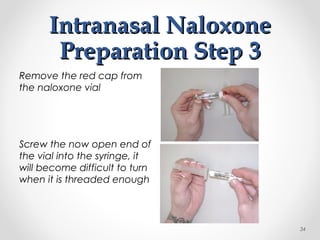
Remove the red cap from
the naloxone vial
Screw the now open end of
the vial into the syringe, it
will become difficult to turn
when it is threaded enough
34
Intranasal NaloxoneIntranasal Naloxone
Preparation Step 4Preparation Step 4
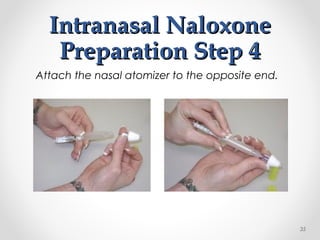
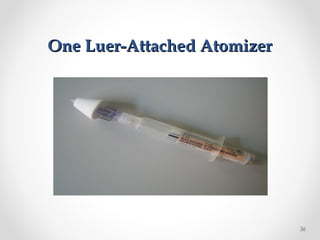
Attach the nasal atomizer to the opposite end.
35
One Luer-Attached AtomizerOne Luer-Attached Atomizer
36
Intranasal NaloxoneIntranasal Naloxone
AdministrationAdministration
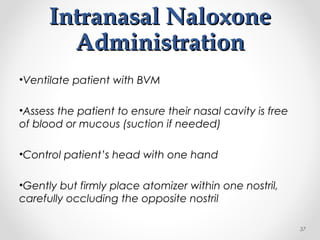
•Ventilate patient with BVM
•Assess the patient to ensure their nasal cavity is free
of blood or mucous (suction if needed)
•Control patient’s head with one hand
•Gently but firmly place atomizer within one nostril,
carefully occluding the opposite nostril
37
Intranasal NaloxoneIntranasal Naloxone
Administration,Administration, continuedcontinued
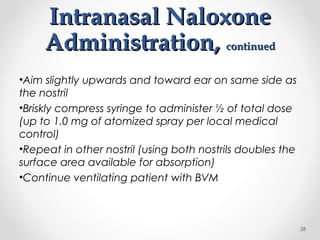
•Aim slightly upwards and toward ear on same side as
the nostril
•Briskly compress syringe to administer ½ of total dose
(up to 1.0 mg of atomized spray per local medical
control)
•Repeat in other nostril (using both nostrils doubles the
surface area available for absorption)
•Continue ventilating patient with BVM
38
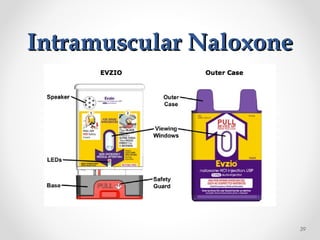
Intramuscular NaloxoneIntramuscular Naloxone
39
Why Intramuscular?Why Intramuscular?
• Consistent delivery of medication
• Simple and fast acting
• Similar to other auto-injectors used by EMS
40
Intramuscular NaloxoneIntramuscular Naloxone
AdministrationAdministration
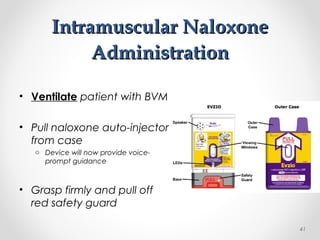
• Ventilate patient with BVM
• Pull naloxone auto-injector
from case
o Device will now provide voice-
prompt guidance
• Grasp firmly and pull off
red safety guard
41
Intramuscular Naloxone AdministrationIntramuscular Naloxone Administration, continued, continued
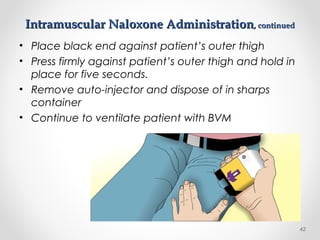
• Place black end against patient’s outer thigh
• Press firmly against patient’s outer thigh and hold in
place for five seconds.
• Remove auto-injector and dispose of in sharps
container
• Continue to ventilate patient with BVM
42
Critical ReminderCritical Reminder
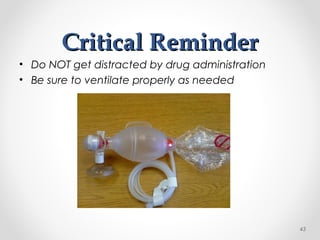
• Do NOT get distracted by drug administration
• Be sure to ventilate properly as needed
43
Avoid “Tunnel Vision”Avoid “Tunnel Vision”
• If respirations do not improve after five minutes,
consider what else could be going on?
44
Other PossibilitiesOther Possibilities
•The patient has taken an amount of opioids that is
more than the naloxone is able to counter
•Maybe it’s not an overdose!
•What other conditions may have similar signs &
symptoms?
45
Adverse ReactionsAdverse Reactions
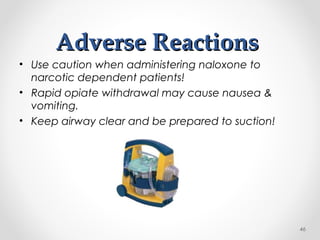
• Use caution when administering naloxone to
narcotic dependent patients!
• Rapid opiate withdrawal may cause nausea &
vomiting.
• Keep airway clear and be prepared to suction!
46
Adverse Reactions,Adverse Reactions, continuedcontinued
Rapid opiate withdrawal may also cause:
•Runny nose
•Diaphoresis (excessive sweating)
•Tachycardia
•Tremulousness
•Hypertension (high blood pressure)
•Hypotension
•Cardiac disturbances, including cardiac arrest
•Epistaxis
47
Adverse Reactions,Adverse Reactions, continuedcontinued
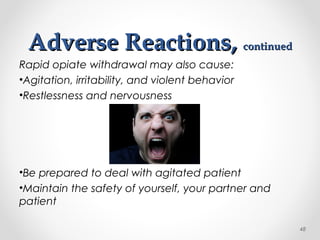
Rapid opiate withdrawal may also cause:
•Agitation, irritability, and violent behavior
•Restlessness and nervousness
•Be prepared to deal with agitated patient
•Maintain the safety of yourself, your partner and
patient
48
Paramedic RoleParamedic Role
• Call for Paramedic if available
• Paramedic may titrate naloxone dosing to reverse
respiratory depression without full return to
consciousness
• Patient may require care for:
o Other medications/drugs they have received (polypharmacia)
o Additional care if no response to BLS care or if patient relapses
o Other conditions (head Injury, stroke, hypoxia, etc.)
• Do not delay transport
49
DocumentationDocumentation
As always, carefully document, including:
•Patient presentation (neuro, respiratory, cardiac)
•Signs and symptoms (before & after treatment)
•Vital signs (before & after treatment)
•naloxone administration prior to EMS arrival
•Clinical response
•Any use of physical restraint
•Record time drug was administrated, amount, and route,
for example:
“19:21, naloxone 2.0 mg intranasal”
“02:32, naloxone 2.0 mg intramuscular (IM), right thigh”
50
Patient RefusalsPatient Refusals
• Do not “treat & release”
• A refusal must be signed by a patient who can
reasonably be determined to be competent to
make an informed decision to refuse further care
• Having a physician speak with the patient may
assist in encouraging transport.
• Request police assistance if needed
51
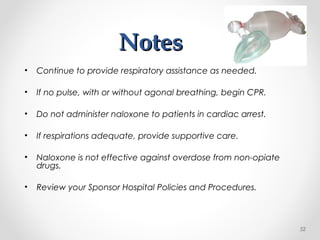
NotesNotes
• Continue to provide respiratory assistance as needed.
• If no pulse, with or without agonal breathing, begin CPR.
• Do not administer naloxone to patients in cardiac arrest.
• If respirations adequate, provide supportive care.
• Naloxone is not effective against overdose from non-opiate
drugs.
• Review your Sponsor Hospital Policies and Procedures.
52
ReviewReview
What have we learned:
•Why naloxone was added as an option for BLS.
•What an opioid overdose presents like.
•What the signs and symptoms of an opioid overdose
are.
•The indications for administering naloxone.
•The contraindications to administering naloxone.
•The possible adverse reactions of naloxone.
•How to manage adverse reactions.
•How to prepare a naloxone atomizer or to administer
naloxone via autoinjector.
53
Thank youThank you
Special thanks to those who have shared their training
materials with us to help develop this program:
• To Central Massachusetts EMS for use of much of
their BLS naloxone program and slides
•Peter Canning RN, Paramedic, EMS Coordinator at
John Dempsey Hospital
•State of CT EMS Advisory Board, Education and
Training Committee
54
ReferencesReferences
• Centers for Disease Control
• Drugs.com
• Federal Drug Administration
• CT DPH Bureau of Substance Abuse Services
• N.O.M.A.D. (Not One More Anonymous Death
Overdose Prevention Project)
55
Skills Practice &Skills Practice &
AssessmentAssessment
Given a scenario by your instructor:
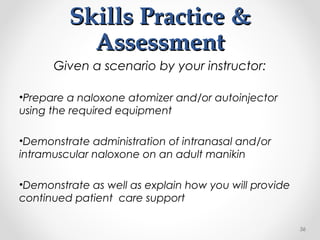
•Prepare a naloxone atomizer and/or autoinjector
using the required equipment
•Demonstrate administration of intranasal and/or
intramuscular naloxone on an adult manikin
•Demonstrate as well as explain how you will provide
continued patient care support
56
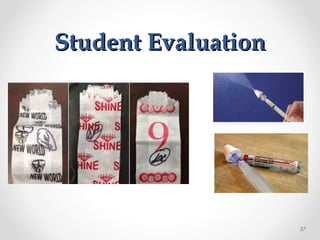
Student EvaluationStudent Evaluation
57

Ct ems naloxone_bls_training_27may2014 PPT

  • 1.
    NaloxoneNaloxone Training ProgramTraining Program EMR/EMTEMR/EMT May27, 2014May 27, 2014 State of Connecticut Department of Public Health/OEMS 1
  • 2.
    GoalGoal To reduce mortalityand morbidity from opioid overdose by instructing EMS Responders (EMT and EMR) in the administration of naloxone. 2
  • 3.
    ObjectivesObjectives By the endof this course the EMT/EMR will: •Recognize the signs and symptoms of an opiate overdose •Identify the indications and contraindications of naloxone •Explain the possible adverse reactions of naloxone •Describe how to manage adverse reactions •Prepare and administer naloxone via approved route •Describe the on-going patient management after the administration of naloxone •Appreciate the place of naloxone in the management of opioid overdose 3
  • 4.
    HistoryHistory • In 2010,approximately 38, 329 drug overdose deaths occurred in the United States, one death every 7 minutes. • About 75% of these deaths involved prescription opioid analgesics. • In 2009 alone, there were 257 million opioid prescriptions written. 4
  • 5.
    Rate* of unintentionaldrugRate* of unintentional drug OD deaths US 1970–2007OD deaths US 1970–2007 * Per 100,000 population 5
  • 6.
    Treatment HistoryTreatment History •Opiates kill because they cause people to stop breathing • EMTs and EMRs have been limited to providing ventilatory support as a means to reverse hypoxia • Reversal of the cause of hypoventilation allows for return of spontaneous respiration and limits the continued need for ventilatory support • Prolonged hypoventilation complications include hypercarbia, hypoxia, aspiration, respiratory arrest and death 6
  • 7.
    Naloxone (NarcanNaloxone (Narcan®® )) •Naloxone (Narcan® ) is an opioid (narcotic) antagonist that may reverse central nervous system and respiratory depression secondary to an overdose of opioids. • Naloxone is not effective against respiratory depression due to non-opioid drugs. 7
  • 8.
    CAUTION!!CAUTION!! • Naloxone worksfor a shorter period of time than most opioids • Without additional treatment, patients may experience a relapse of respiratory arrest that may lead to death 8
  • 9.
    OpioidsOpioids Synthetic or semi-syntheticalkaloids act on the Central Nervous System as a depressant to: •decrease the perception of pain •decrease the reaction to pain •increase pain tolerance May be prescribed for acute pain, debilitating pain, or chronic pain as part of palliative care (e.g., cancer) May be abused to induce euphoria or “high” 9
  • 10.
    Opioids, continuedOpioids, continued •Tolerance and/or addiction may occur, requiring increasing doses for the same effect • Common side effects include: -respiratory depression -drowsiness -itching -nausea and vomiting -dry mouth -miosis (constricted pupils) -constipation 10
  • 11.
    OpioidsOpioids Opioids may include: Buprenorphine Butorphanol(Stadol® ) Codeine Fentanyl (Duragesic® patch) Hydrocodone (Vicodin® ) Hydromorphone (Dilaudid® ) Meperidine (Demerol® ) Methadone Morphine Nalbuphine (Nubain® ) Oxycodone (Percocet® /Percodan® ) Oxymorphone Pentazocine (Talwin® ) Paregoric Propoxyphene (Darvon® ) 11
  • 12.
    OpioidsOpioids Heroin is anillegal opioid which may be injected, snorted, or smoked. Street names include: Big H Boy Capital H China white Chiva Dead on arrival Diesel Dope Eighth Good HH Hell dust Horse Junk Mexican horse Mud Poppy Smack Thunder Train White junk 12
  • 13.
    Opioid AddictionOpioid Addiction TreatmentDrugsTreatment Drugs Methadone •Opioid which may be used as a pain reliever, but commonly prescribed to minimize the effects of opioid withdrawal Suboxone •Opioid (buprenorphine) and naloxone combined to both minimize effects of opioid withdrawal while blocking the effects of euphoria (“high”) 13
  • 14.
    Target PopulationTarget Population Thetarget population for naloxone is persons who may have overdosed on opioids and whose respiratory drive is at a depressed life- threatening level. 14
  • 15.
    On SceneOn Scene •You may know you’re responding to a suspected overdose, or you may be told upon arrival • Scene Safety/BSI is a top priority • Do you have appropriate resources present or responding? • Remain non-judgmental and non-confrontational • Ask bystander(s) what and when the patient injected, ingested, or inhaled (or if a transdermal patch has been used) • Was more than one substance used? 15
  • 16.
    On SceneOn Scene •Multiplebottles of the same prescription medication •Multiple bottles of the same prescription medication that don’t belong to the patient or anyone else at that residence Drug use clues 16
  • 17.
    On SceneOn Scene DrugKit “Packaged” Drugs (Heroin) Drug use clues 17
  • 18.
    On SceneOn Scene Druguse clues “Track Marks” 18
  • 19.
    Signs and SymptomsofSigns and Symptoms of Opioid/Toxidrome:Opioid/Toxidrome: • Unresponsive or minimally responsive, with a pulse • Depressed respiratory rate • Agonal respirations • Respiratory arrest • Cyanosis • Miosis (constricted pupils) 19
  • 20.
    Indications for NaloxoneUseIndications for Naloxone Use •Respiratory arrest or hypoventilation in addition to: •Evidence of opioid/opiate use • Bystander report • Drug paraphernalia • Opioid prescription bottles/patches • “Track marks” • Opiate/opioid toxidrome 20
  • 21.
    “Addicts take opiatesand other sedatives specifically to induce a pleasant stupor. If they’re lethargic and hard to arouse, but still breathing effectively, it’s not an overdose. It’s a dose.” –Boston paramedic 21 • Naloxone is for depressed respirations, not depressed mental status. • Opiate use alone (without depressed respirations) does not merit the use of naloxone.
  • 22.
  • 23.
    Naloxone DosageNaloxone Dosage •Naloxone dosage will be specified by the agency’s EMS sponsor hospital • Common intramuscular (IM) dosage: o 0.4 mg autoinjector • Common intranasal (IN) dosage: o Adults and children: 2 mg (2 mL) divided as 1mg (1 mL) per nostril o Infant and toddler: naloxone 1 (1 mL) mg divided as 0.5 mg (0.5 mL) per nostril • Physician oversight may direct different dosing to improve therapy or decrease adverse effects 23
  • 24.
    Naloxone UseNaloxone Use •Ensure scene safety! • Maintain appropriate Body Substance Isolation (BSI) • Assess level of consciousness and vital signs • Maintain open airway and provide tactile stimulation • Assist ventilations • Ensure appropriate resources are responding • Administer naloxone when indicated • Initiate transport as soon as possible (don’t wait on scene for paramedic) 24
  • 25.
    Naloxone Use,Naloxone Use,continuedcontinued The “Eight Rights” for Medication Administration: •Right Patient •Right Reason •Right Time •Right Dose •Right Route •Right Drug •Right Response •Right Documentation 25
  • 26.
    • Administer naloxonevia approved route at specified dose • Continue ventilating patient as needed • Consider contacting poison control if poly- substance use is suspected: (800) 222-1222 26 Naloxone Use,Naloxone Use, continuedcontinued
  • 27.
    Naloxone Use,Naloxone Use,continuedcontinued • The effects of naloxone may not last as long as the effects of the opioid; be prepared for a return of overdose signs & symptoms! • Every effort should be made to encourage patient be transported to definitive care. • Physician or police speaking with the patient may assist in eliciting transport. 27
  • 28.
    Methods of AdministrationMethodsof Administration • The following slides address the preparation and administration of both intranasal and intramuscular (via autoinjector) administration of naloxone. • Providers may only administer naloxone via the route(s) authorized by their EMS sponsor hospital. 28
  • 29.
    Intranasal NaloxoneIntranasal Naloxone •Minimizes risk for blood borne pathogen exposure (no needle) • May be administered rapidly and painlessly • Onset of action is 3-5 minutes, peak effect is 12-20 minutes Protect naloxone from light Avoid temperature extremes 29
  • 30.
    Why Intranasal?Why Intranasal? Worksalmost as quickly as IV route since nasal mucosa is highly vascularized and absorbs drugs directly into the blood stream 30
  • 31.
    Why an Atomizer?Whyan Atomizer? Briskly compressing the syringe converts the liquid drug to a fine atomized mist. This results in broader mucosal coverage and better chance of absorption into the blood stream than drops that can run straight back into the throat. 31
  • 32.
    Intranasal NaloxoneIntranasal Naloxone PreparationStep 1Preparation Step 1 You will need: •One Luer-Jet needle-free syringe •One ampule of naloxone 2.0 mg •One atomizer Dosage indicator 32
  • 33.
    Intranasal NaloxoneIntranasal Naloxone PreparationStep 2Preparation Step 2 Remove the caps from both ends of the Luer-Jet needle-free syringe 33
  • 34.
    Intranasal NaloxoneIntranasal Naloxone PreparationStep 3Preparation Step 3 Remove the red cap from the naloxone vial Screw the now open end of the vial into the syringe, it will become difficult to turn when it is threaded enough 34
  • 35.
    Intranasal NaloxoneIntranasal Naloxone PreparationStep 4Preparation Step 4 Attach the nasal atomizer to the opposite end. 35
  • 36.
    One Luer-Attached AtomizerOneLuer-Attached Atomizer 36
  • 37.
    Intranasal NaloxoneIntranasal Naloxone AdministrationAdministration •Ventilatepatient with BVM •Assess the patient to ensure their nasal cavity is free of blood or mucous (suction if needed) •Control patient’s head with one hand •Gently but firmly place atomizer within one nostril, carefully occluding the opposite nostril 37
  • 38.
    Intranasal NaloxoneIntranasal Naloxone Administration,Administration,continuedcontinued •Aim slightly upwards and toward ear on same side as the nostril •Briskly compress syringe to administer ½ of total dose (up to 1.0 mg of atomized spray per local medical control) •Repeat in other nostril (using both nostrils doubles the surface area available for absorption) •Continue ventilating patient with BVM 38
  • 39.
  • 40.
    Why Intramuscular?Why Intramuscular? •Consistent delivery of medication • Simple and fast acting • Similar to other auto-injectors used by EMS 40
  • 41.
    Intramuscular NaloxoneIntramuscular Naloxone AdministrationAdministration •Ventilate patient with BVM • Pull naloxone auto-injector from case o Device will now provide voice- prompt guidance • Grasp firmly and pull off red safety guard 41
  • 42.
    Intramuscular Naloxone AdministrationIntramuscularNaloxone Administration, continued, continued • Place black end against patient’s outer thigh • Press firmly against patient’s outer thigh and hold in place for five seconds. • Remove auto-injector and dispose of in sharps container • Continue to ventilate patient with BVM 42
  • 43.
    Critical ReminderCritical Reminder •Do NOT get distracted by drug administration • Be sure to ventilate properly as needed 43
  • 44.
    Avoid “Tunnel Vision”Avoid“Tunnel Vision” • If respirations do not improve after five minutes, consider what else could be going on? 44
  • 45.
    Other PossibilitiesOther Possibilities •Thepatient has taken an amount of opioids that is more than the naloxone is able to counter •Maybe it’s not an overdose! •What other conditions may have similar signs & symptoms? 45
  • 46.
    Adverse ReactionsAdverse Reactions •Use caution when administering naloxone to narcotic dependent patients! • Rapid opiate withdrawal may cause nausea & vomiting. • Keep airway clear and be prepared to suction! 46
  • 47.
    Adverse Reactions,Adverse Reactions,continuedcontinued Rapid opiate withdrawal may also cause: •Runny nose •Diaphoresis (excessive sweating) •Tachycardia •Tremulousness •Hypertension (high blood pressure) •Hypotension •Cardiac disturbances, including cardiac arrest •Epistaxis 47
  • 48.
    Adverse Reactions,Adverse Reactions,continuedcontinued Rapid opiate withdrawal may also cause: •Agitation, irritability, and violent behavior •Restlessness and nervousness •Be prepared to deal with agitated patient •Maintain the safety of yourself, your partner and patient 48
  • 49.
    Paramedic RoleParamedic Role •Call for Paramedic if available • Paramedic may titrate naloxone dosing to reverse respiratory depression without full return to consciousness • Patient may require care for: o Other medications/drugs they have received (polypharmacia) o Additional care if no response to BLS care or if patient relapses o Other conditions (head Injury, stroke, hypoxia, etc.) • Do not delay transport 49
  • 50.
    DocumentationDocumentation As always, carefullydocument, including: •Patient presentation (neuro, respiratory, cardiac) •Signs and symptoms (before & after treatment) •Vital signs (before & after treatment) •naloxone administration prior to EMS arrival •Clinical response •Any use of physical restraint •Record time drug was administrated, amount, and route, for example: “19:21, naloxone 2.0 mg intranasal” “02:32, naloxone 2.0 mg intramuscular (IM), right thigh” 50
  • 51.
    Patient RefusalsPatient Refusals •Do not “treat & release” • A refusal must be signed by a patient who can reasonably be determined to be competent to make an informed decision to refuse further care • Having a physician speak with the patient may assist in encouraging transport. • Request police assistance if needed 51
  • 52.
    NotesNotes • Continue toprovide respiratory assistance as needed. • If no pulse, with or without agonal breathing, begin CPR. • Do not administer naloxone to patients in cardiac arrest. • If respirations adequate, provide supportive care. • Naloxone is not effective against overdose from non-opiate drugs. • Review your Sponsor Hospital Policies and Procedures. 52
  • 53.
    ReviewReview What have welearned: •Why naloxone was added as an option for BLS. •What an opioid overdose presents like. •What the signs and symptoms of an opioid overdose are. •The indications for administering naloxone. •The contraindications to administering naloxone. •The possible adverse reactions of naloxone. •How to manage adverse reactions. •How to prepare a naloxone atomizer or to administer naloxone via autoinjector. 53
  • 54.
    Thank youThank you Specialthanks to those who have shared their training materials with us to help develop this program: • To Central Massachusetts EMS for use of much of their BLS naloxone program and slides •Peter Canning RN, Paramedic, EMS Coordinator at John Dempsey Hospital •State of CT EMS Advisory Board, Education and Training Committee 54
  • 55.
    ReferencesReferences • Centers forDisease Control • Drugs.com • Federal Drug Administration • CT DPH Bureau of Substance Abuse Services • N.O.M.A.D. (Not One More Anonymous Death Overdose Prevention Project) 55
  • 56.
    Skills Practice &SkillsPractice & AssessmentAssessment Given a scenario by your instructor: •Prepare a naloxone atomizer and/or autoinjector using the required equipment •Demonstrate administration of intranasal and/or intramuscular naloxone on an adult manikin •Demonstrate as well as explain how you will provide continued patient care support 56
  • 57.

Editor's Notes

  • #3 Naloxone may be administered intranasal or by autoinjector as per local medical control
  • #5 Source: Federal Drug Administration Most Common Drugs involved in Overdoses In 2010, of the 38,329 drug overdose deaths in the United States, 22,134 (60%) were related to pharmaceuticals.6 Of the 22,134 deaths relating to prescription drug overdose in 2010, 16,651 (75%) involved opioid analgesics (also called opioid pain relievers or prescription painkillers), and 6,497 (30%) involved benzodiazepines.6 In 2011, about 1.4 million ED visits involved the nonmedical use of pharmaceuticals. Among those ED visits, 501,207 visits were related to anti-anxiety and insomnia medications, and 420,040 visits were related to opioid analgesics.2 Benzodiazepines are frequently found among people treated in EDs for misusing or abusing drugs.2  People who died of drug overdoses often had a combination of benzodiazepines and opioid analgesics in their bodies.6
  • #6 Source: National Vital Statistics System. Available at http://www.cdc.gov/nchs/nvss.htm IN CT, rural areas have experienced an especially high OD rate per capita. Connecticut Heroin Deaths 2013 - 257 2012 – 174
  • #7 Hypercarbia: abnormally high levels of carbon dioxide concentrations in the blood.
  • #8 Photo Source: MDPH Opioid Overdose Prevention & Reversal Information Sheet (1/25/12) What is naloxone (Narcan®)? A. It is a prescription medicine that reverses an opioid overdose. It cannot be used to get high and is not addictive. Naloxone is safe and effective; emergency medical professionals have used it for decades. For more information, see: http://www.drugs.com/pro/naloxone.html.
  • #9 The half- life of naloxone is 1 hour and the duration of action ranges from 30 minutes to four hours. From MicroMedex: Absorption ■Tmax, subQ or IM: 15 minutes (Evzio(R) auto-injector); 20 minutes (standard syringe) [6]Distribution ■Protein binding, Albumin: relatively weak [6][12]Metabolism ■Liver: extensive [6][12]■Naloxone-3-glucoronide (major): inactive [6][12]Excretion ■Renal: 25% to 40% as metabolites (within 6 hours), about 50% (in 24 hours), 60% to 70% (in 72 hours) [6][12]Elimination Half Life ■Adults: 1.28 hours (Evzio(R) auto-injector); 30 min to 81 min (standard injection) [6][12] ■Neonates: 3.1 hours +/- 0.5 hours [6][12]
  • #10 Trivia: Opiates are an alkaloid derived from the opium poppy plant (non-synthetic) Reversal by naloxone of opioids in patients with pain may result in acute return of pain. Emphasize use of tactile stimulation and respiratory support in this population.
  • #12 For a more complete list, see NIDA's page on commonly abused prescription drugs: http://www.drugabuse.gov/drugs-abuse/commonly-abused-drugs/commonly-abused-prescription-drugs-chart For pictures of opioids and other commonly abused drugs, see: www.webmd.com/a-to-z-guides/ss/slideshow-commonly-abused-drugs
  • #15 Is naloxone just a "safety net" that allows users to use even more? A. Research studies have investigated this common concern and found that making naloxone available does NOT encourage people to use opiates more.  The goal of distributing naloxone and educating people about how to prevent, recognize and intervene in overdoses is to prevent deaths.  Other goals, such as decreasing drug use, can only be accomplished if the user is alive.  High Risk Populations for opioid overdose: Individuals demonstrating drug-seeking behavior (e.g., frequent ED visits, or accessing care from multiple doctors) High dose users Prescription pain-killer users (often not own prescription) IV drug users Over-medicated elderly patients Patients with pain relieving patches Children with access to prescription pain-killers
  • #16 Police necessary as patient may become agitated, uncooperative and/or violent after naloxone. Advanced life support should be activated.
  • #17 Discuss other situations such as child overdoses, medically frail patients, etc.
  • #18 Photo Source “Packaged” Drugs (Heroin): Central MA EMS Corp; Holden, MA
  • #19 Photo Source “Track Marks”: Central MA EMS Corp; Holden, MA
  • #23 Abnormal breath sounds may indicate opiate induced noncardiogenic pulmonary edema or aspiration. Cautions: Abnormal breath sounds on auscultation (wheezing, unequal breath sounds, rale or rhonchi) Recent seizure (by report or signs) Head/Facial trauma Nasal trauma (obstruction and/or epistaxis)
  • #25 Suction as needed Paramedics should be dispatched Police should be dispatched
  • #27 Photo Source Denver Paramedics Administering naloxone: www.intranasal.net If NPA in place, remove prior to administration and then reinsert. Local medical control will determine appropriate dose. This will commonly be 2mg (1mg per nostril) Auto injector contains 0.4mg for IM use
  • #30 Photo Source: MDPH Opioid Overdose Prevention & Reversal Information Sheet (1/25/12) How does naloxone help? Naloxone is an antidote to opioid drugs. Opioids can slow or stop a person's breathing, which causes death. Naloxone helps the person wake up and keeps them breathing.  An overdose death may happen hours after taking drugs. If EMS acts when they first notice a person's breathing has slowed, or when they can't awaken a user, start rescue breathing (if needed) and give naloxone. Can naloxone harm someone? A. No. If you suspect an opioid overdose, it is safe to give naloxone.  People who used opioids will then wake up and go into withdrawal. Withdrawal is miserable but better than dying. Naloxone does not prevent deaths caused by other drugs such as benzodiazepines (e.g. Xanax®, Klonopin® and Valium®), bath salts, cocaine, methamphetamine or alcohol. Participants should be directed to store medication in compliance with labeled storage requirements.
  • #31 IM administration may be more reliable (less variable) Mechanism of Action Competitive opioid antagonist; synthetic congener of oxymorphone Absorption Onset: 2 min (IV); 2-5 min (IM/SC) Duration: Depends on route of administration; generally 1-2 hr Elimination Half-life: 30-90 min (adults); 3-4 hr (neonates) Excretion: Urine
  • #32 Wolfe-Tory Mucosal Atomizer Device MAD available at: http://store.airwaycam.com
  • #33 Photo Source: www.intranasal.net
  • #34 Source: https://sites.google.com/site/nomadoverdoseproject/naloxone
  • #35 Source: https://sites.google.com/site/nomadoverdoseproject/naloxone
  • #36 Source: https://sites.google.com/site/nomadoverdoseproject/naloxone
  • #37 Photo Source: www.intranasal.net
  • #41 Mechanism of Action Competitive opioid antagonist; synthetic congener of oxymorphone Absorption Onset: 2 min (IV); 2-5 min (IM/SC) Duration: Depends on route of administration; generally 1-2 hr Elimination Half-life: 30-90 min (adults); 3-4 hr (neonates) Excretion: Urine
  • #42 Instructions are specific to EVZIO naloxone autoinjector. Minor variations may be required for other devices (such as time held against thigh or location of safety guard) If battery fails or voice prompts are not delivered, auto-injector should still function. After injection is complete and autoinjector removed from patient, device should shield needle.
  • #44 Photo Source Bag-Valve-Mask: Central MA EMS Corp; Holden, MA
  • #46 Discuss how each changes the treatment plan.
  • #47 Portable Suction Unit available at: www.alibaba.com Patients receiving opioids for pain control may have an acute return of pain
  • #48 Adverse reactions may be the result of a co-ingestant (stimulant, cocaine, etc.)
  • #49 May need to consider physical restraint
  • #50 Polypharmacia is the co-ingestion/administration of multiple drugs or medications. These may have additive or opposing effects.
  • #57 In addition to intranasal and/ or autoinjector naloxone supplies, the instructor should also have related equipment (e.g., nasal airway, BVM) for students to demonstrate treatment.