PREPARED BY :- DR. M. RAMZY
ER RESIDENT-QUALITY COORDINATOR-MGH
1
Patient Safety Definition
The working to avoid, manage and treat
unsafe acts within the health-care
system, through the use of best
practices lead to optimal patient
outcomes.
The GOAL
 Hospitals should provide an
environment that ensures safety of all
individuals
 By promoting a proactive and non-
punitive Culture to facilitate reporting
of hazards, errors, near-misses,
concerns and otherwise unsafe
conditions within the Hospital.
What Should Be Reported?
 Unanticipated death or permanent loss of
function
 Healthcare acquired infection
 Unanticipated patient outcome
 Any adverse event involving patient care
&/or pt. environment.
 Any near miss
 Any safety concerns
FIRST DO NO HARM
NOW DO IT SAFE
5
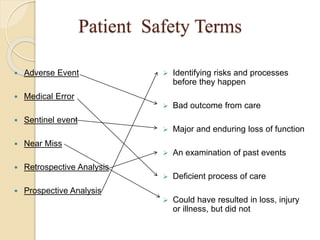
Patient Safety Terms
 Adverse Event
 Medical Error
 Sentinel event
 Near Miss
 Retrospective Analysis
 Prospective Analysis
 Identifying risks and processes
before they happen
 Bad outcome from care
 Major and enduring loss of function
 An examination of past events
 Deficient process of care
 Could have resulted in loss, injury
or illness, but did not
7
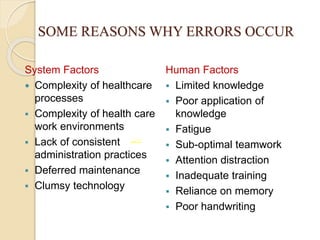
SOME REASONS WHY ERRORS OCCUR
System Factors
 Complexity of healthcare
processes
 Complexity of health care
work environments
 Lack of consistent
administration practices
 Deferred maintenance
 Clumsy technology
Human Factors
 Limited knowledge
 Poor application of
knowledge
 Fatigue
 Sub-optimal teamwork
 Attention distraction
 Inadequate training
 Reliance on memory
 Poor handwriting
‫تناغم‬
What is a culture of safety?
Components of a safety culture include:
 Commitment to safety as the primary priority
 Availability of the necessary resources
 Incentives, and rewards for safety
 Openness about errors and problems
 Commitment to organizational learning
 Unity, loyalty, and teamwork among staff
 Non Punitive Environment (culture of safe reporting)
leads to increase number of reported errors
9
Just culture
 3 basics:
1. It doesn’t reduce the personal accountability and
discipline. It emphasizes the learning from the errors
and near misses to reduce errors in the future.
2. The greatest error not to report a mistake.
Thereby prevent learning.
3. All in the organization to serve as safety
advocates. Both providers and consumers will feel
safe and supported when they report medical
errors, near misses and voice concerns about
patient safety.
IT HAS ZERO TOLERANCE FOR RECKLESS BEHAVIOR.
BEHAVIORS
 Human error – inadvertent action: doing other than what
should have been done. ‫غفلة‬-‫مقصود‬ ‫غير‬
Manage through change in processes, procedures and
training.
 At risk behavior: behavioral choice that increase risk , where
risk is not recognized or is believed to be justified.
Manage through increase awareness, and providing
incentives for healthy behaviors and disincentives for risky
behaviors.
 Reckless behavior: consciously disregard substantial and
unjustifiable risk.
Manage through Remedial and punitive action.
12
‫قلعة‬‫قايتباى‬
‫ية‬‫ر‬‫ـكند‬‫ـ‬‫ـ‬‫ـ‬‫ـ‬‫ـ‬‫ـ‬‫ـ‬‫ـ‬‫ـ‬‫س‬‫اال‬
The most common cause of medical
errors is miscommunications
13
MISCOMMUNICATION
 Breakdowns in communication can result
in the wrong treatment, a lack of
treatment, or incorrect self-care by the
patient.
4
6 1
3
25
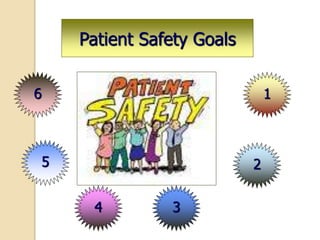
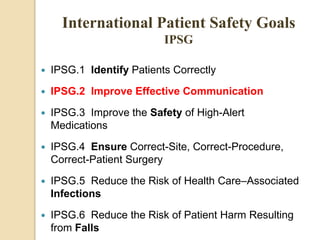
Patient Safety Goals
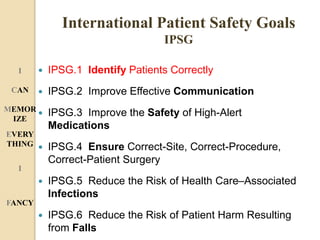
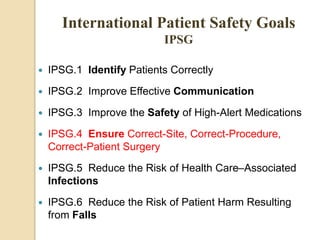
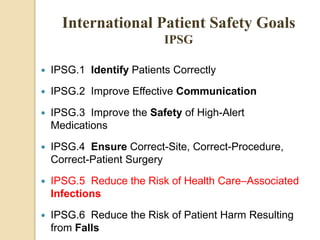
 IPSG.1 Identify Patients Correctly
 IPSG.2 Improve Effective Communication
 IPSG.3 Improve the Safety of High-Alert
Medications
 IPSG.4 Ensure Correct-Site, Correct-Procedure,
Correct-Patient Surgery
 IPSG.5 Reduce the Risk of Health Care–Associated
Infections
 IPSG.6 Reduce the Risk of Patient Harm Resulting
from Falls
International Patient Safety Goals
IPSG
I
CAN
MEMOR
IZE
EVERY
THING
I
FANCY
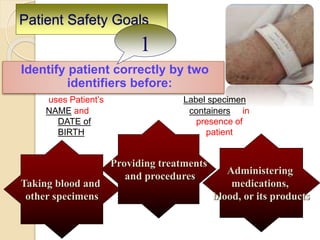
Patient Safety Goals
Identify patient correctly by two
identifiers before:
1
Providing treatments
and procedures
Administering
medications,
blood, or its products
Taking blood and
other specimens
uses Patient’s
NAME and
DATE of
BIRTH
Label specimen
containers in
presence of
patient
18
 IPSG.1 Identify Patients Correctly
 IPSG.2 Improve Effective Communication
 IPSG.3 Improve the Safety of High-Alert
Medications
 IPSG.4 Ensure Correct-Site, Correct-Procedure,
Correct-Patient Surgery
 IPSG.5 Reduce the Risk of Health Care–Associated
Infections
 IPSG.6 Reduce the Risk of Patient Harm Resulting
from Falls
International Patient Safety Goals
IPSG
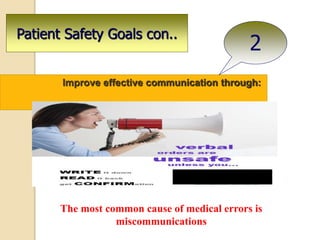
Improve effective communication through:
2
Patient Safety Goals con..
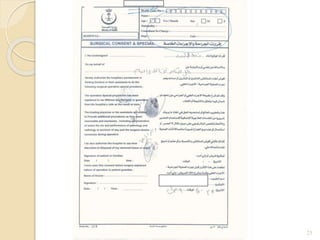
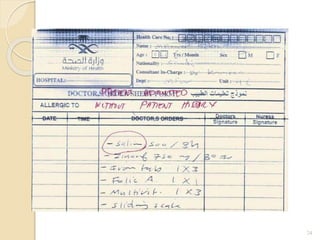
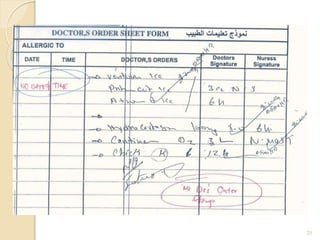
The most common cause of medical errors is
miscommunications
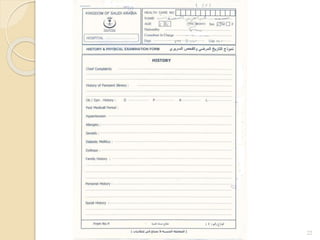
Documentation
a major form of
Communication.
21
22
23
24
25
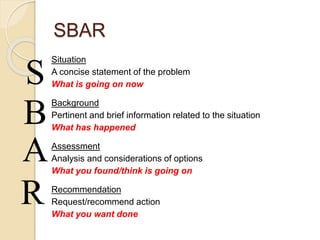
SBAR
 A structured communication technique
designed to convey a great deal of
information in an organized & brief
manner.
 This is important as we all have
different styles of communicating,
varying by profession, culture, and
gender.
SBAR
Situation
A concise statement of the problem
What is going on now
Background
Pertinent and brief information related to the situation
What has happened
Assessment
Analysis and considerations of options
What you found/think is going on
Recommendation
Request/recommend action
What you want done
S
B
A
R
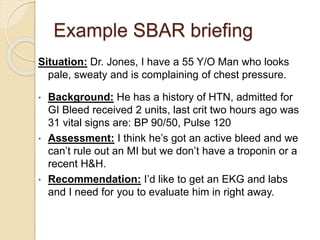
Example SBAR briefing
Situation: Dr. Jones, I have a 55 Y/O Man who looks
pale, sweaty and is complaining of chest pressure.
• Background: He has a history of HTN, admitted for
GI Bleed received 2 units, last crit two hours ago was
31 vital signs are: BP 90/50, Pulse 120
• Assessment: I think he’s got an active bleed and we
can’t rule out an MI but we don’t have a troponin or a
recent H&H.
• Recommendation: I’d like to get an EKG and labs
and I need for you to evaluate him in right away.
29
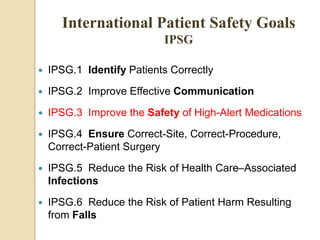
 IPSG.1 Identify Patients Correctly
 IPSG.2 Improve Effective Communication
 IPSG.3 Improve the Safety of High-Alert Medications
 IPSG.4 Ensure Correct-Site, Correct-Procedure,
Correct-Patient Surgery
 IPSG.5 Reduce the Risk of Health Care–Associated
Infections
 IPSG.6 Reduce the Risk of Patient Harm Resulting
from Falls
International Patient Safety Goals
IPSG
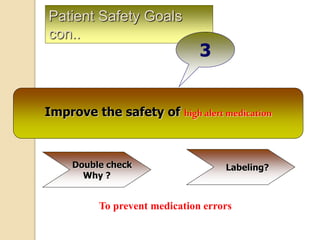
Patient Safety Goals
con..
Improve the safety of high alert medication
3
Double check
Why ?
Labeling?
To prevent medication errors
32
 Medication reconciliation: document meds
on admission
 Medication brought in by family members
 Herbals, supplements, OTC drugs
 Develop a process for communicating
patient medications to all providers
 Provide list of medications to patient upon
discharge from facility.
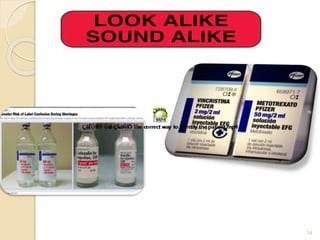
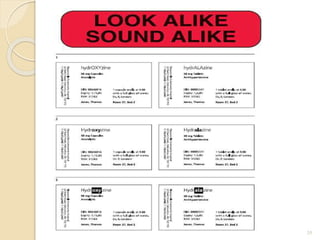
 Standardizing drug concentrations
 Reducing potential for error related to
look-alike and sound alike meds.
– Insulin – all types
– Chemotherapy
– Ambulatory medications
 Label all medications and med
containers or other solutions on or off
the sterile field in operative and
procedural areas.
33
34
35
 IPSG.1 Identify Patients Correctly
 IPSG.2 Improve Effective Communication
 IPSG.3 Improve the Safety of High-Alert Medications
 IPSG.4 Ensure Correct-Site, Correct-Procedure,
Correct-Patient Surgery
 IPSG.5 Reduce the Risk of Health Care–Associated
Infections
 IPSG.6 Reduce the Risk of Patient Harm Resulting
from Falls
International Patient Safety Goals
IPSG
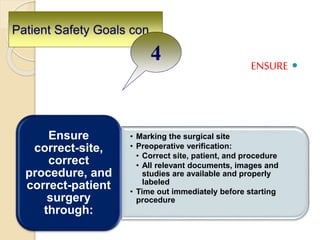
Patient Safety Goals con..
ENSURE
• Marking the surgical site
• Preoperative verification:
• Correct site, patient, and procedure
• All relevant documents, images and
studies are available and properly
labeled
• Time out immediately before starting
procedure
Ensure
correct-site,
correct
procedure, and
correct-patient
surgery
through:
4
 IPSG.1 Identify Patients Correctly
 IPSG.2 Improve Effective Communication
 IPSG.3 Improve the Safety of High-Alert
Medications
 IPSG.4 Ensure Correct-Site, Correct-Procedure,
Correct-Patient Surgery
 IPSG.5 Reduce the Risk of Health Care–Associated
Infections
 IPSG.6 Reduce the Risk of Patient Harm Resulting
from Falls
International Patient Safety Goals
IPSG
Patient Safety Goals
con..
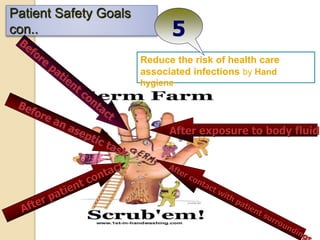
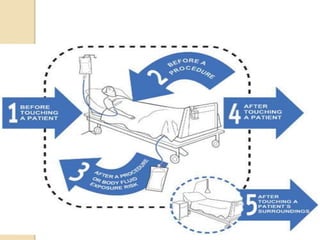
Reduce the risk of health care
associated infections by Hand
hygiene
5
After exposure to body fluid
40
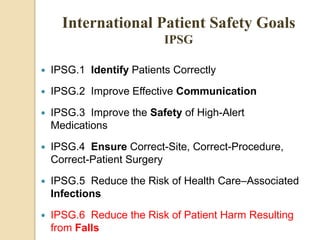
 IPSG.1 Identify Patients Correctly
 IPSG.2 Improve Effective Communication
 IPSG.3 Improve the Safety of High-Alert
Medications
 IPSG.4 Ensure Correct-Site, Correct-Procedure,
Correct-Patient Surgery
 IPSG.5 Reduce the Risk of Health Care–Associated
Infections
 IPSG.6 Reduce the Risk of Patient Harm Resulting
from Falls
International Patient Safety Goals
IPSG
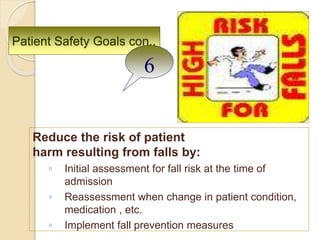
Patient Safety Goals con..
Reduce the risk of patient
harm resulting from falls by:
◦ Initial assessment for fall risk at the time of
admission
◦ Reassessment when change in patient condition,
medication , etc.
◦ Implement fall prevention measures
6
43
Thank you
44

Patient safety

  • 1.
    PREPARED BY :-DR. M. RAMZY ER RESIDENT-QUALITY COORDINATOR-MGH 1
  • 2.
    Patient Safety Definition Theworking to avoid, manage and treat unsafe acts within the health-care system, through the use of best practices lead to optimal patient outcomes.
  • 3.
    The GOAL  Hospitalsshould provide an environment that ensures safety of all individuals  By promoting a proactive and non- punitive Culture to facilitate reporting of hazards, errors, near-misses, concerns and otherwise unsafe conditions within the Hospital.
  • 4.
    What Should BeReported?  Unanticipated death or permanent loss of function  Healthcare acquired infection  Unanticipated patient outcome  Any adverse event involving patient care &/or pt. environment.  Any near miss  Any safety concerns
  • 5.
    FIRST DO NOHARM NOW DO IT SAFE 5
  • 6.
    Patient Safety Terms Adverse Event  Medical Error  Sentinel event  Near Miss  Retrospective Analysis  Prospective Analysis  Identifying risks and processes before they happen  Bad outcome from care  Major and enduring loss of function  An examination of past events  Deficient process of care  Could have resulted in loss, injury or illness, but did not
  • 7.
  • 8.
    SOME REASONS WHYERRORS OCCUR System Factors  Complexity of healthcare processes  Complexity of health care work environments  Lack of consistent administration practices  Deferred maintenance  Clumsy technology Human Factors  Limited knowledge  Poor application of knowledge  Fatigue  Sub-optimal teamwork  Attention distraction  Inadequate training  Reliance on memory  Poor handwriting ‫تناغم‬
  • 9.
    What is aculture of safety? Components of a safety culture include:  Commitment to safety as the primary priority  Availability of the necessary resources  Incentives, and rewards for safety  Openness about errors and problems  Commitment to organizational learning  Unity, loyalty, and teamwork among staff  Non Punitive Environment (culture of safe reporting) leads to increase number of reported errors 9
  • 10.
    Just culture  3basics: 1. It doesn’t reduce the personal accountability and discipline. It emphasizes the learning from the errors and near misses to reduce errors in the future. 2. The greatest error not to report a mistake. Thereby prevent learning. 3. All in the organization to serve as safety advocates. Both providers and consumers will feel safe and supported when they report medical errors, near misses and voice concerns about patient safety. IT HAS ZERO TOLERANCE FOR RECKLESS BEHAVIOR.
  • 11.
    BEHAVIORS  Human error– inadvertent action: doing other than what should have been done. ‫غفلة‬-‫مقصود‬ ‫غير‬ Manage through change in processes, procedures and training.  At risk behavior: behavioral choice that increase risk , where risk is not recognized or is believed to be justified. Manage through increase awareness, and providing incentives for healthy behaviors and disincentives for risky behaviors.  Reckless behavior: consciously disregard substantial and unjustifiable risk. Manage through Remedial and punitive action.
  • 12.
  • 13.
    The most commoncause of medical errors is miscommunications 13
  • 14.
    MISCOMMUNICATION  Breakdowns incommunication can result in the wrong treatment, a lack of treatment, or incorrect self-care by the patient.
  • 15.
  • 16.
     IPSG.1 IdentifyPatients Correctly  IPSG.2 Improve Effective Communication  IPSG.3 Improve the Safety of High-Alert Medications  IPSG.4 Ensure Correct-Site, Correct-Procedure, Correct-Patient Surgery  IPSG.5 Reduce the Risk of Health Care–Associated Infections  IPSG.6 Reduce the Risk of Patient Harm Resulting from Falls International Patient Safety Goals IPSG I CAN MEMOR IZE EVERY THING I FANCY
  • 17.
    Patient Safety Goals Identifypatient correctly by two identifiers before: 1 Providing treatments and procedures Administering medications, blood, or its products Taking blood and other specimens uses Patient’s NAME and DATE of BIRTH Label specimen containers in presence of patient
  • 18.
  • 19.
     IPSG.1 IdentifyPatients Correctly  IPSG.2 Improve Effective Communication  IPSG.3 Improve the Safety of High-Alert Medications  IPSG.4 Ensure Correct-Site, Correct-Procedure, Correct-Patient Surgery  IPSG.5 Reduce the Risk of Health Care–Associated Infections  IPSG.6 Reduce the Risk of Patient Harm Resulting from Falls International Patient Safety Goals IPSG
  • 20.
    Improve effective communicationthrough: 2 Patient Safety Goals con.. The most common cause of medical errors is miscommunications
  • 21.
    Documentation a major formof Communication. 21
  • 22.
  • 23.
  • 24.
  • 25.
  • 26.
    SBAR  A structuredcommunication technique designed to convey a great deal of information in an organized & brief manner.  This is important as we all have different styles of communicating, varying by profession, culture, and gender.
  • 27.
    SBAR Situation A concise statementof the problem What is going on now Background Pertinent and brief information related to the situation What has happened Assessment Analysis and considerations of options What you found/think is going on Recommendation Request/recommend action What you want done S B A R
  • 28.
    Example SBAR briefing Situation:Dr. Jones, I have a 55 Y/O Man who looks pale, sweaty and is complaining of chest pressure. • Background: He has a history of HTN, admitted for GI Bleed received 2 units, last crit two hours ago was 31 vital signs are: BP 90/50, Pulse 120 • Assessment: I think he’s got an active bleed and we can’t rule out an MI but we don’t have a troponin or a recent H&H. • Recommendation: I’d like to get an EKG and labs and I need for you to evaluate him in right away.
  • 29.
  • 30.
     IPSG.1 IdentifyPatients Correctly  IPSG.2 Improve Effective Communication  IPSG.3 Improve the Safety of High-Alert Medications  IPSG.4 Ensure Correct-Site, Correct-Procedure, Correct-Patient Surgery  IPSG.5 Reduce the Risk of Health Care–Associated Infections  IPSG.6 Reduce the Risk of Patient Harm Resulting from Falls International Patient Safety Goals IPSG
  • 31.
    Patient Safety Goals con.. Improvethe safety of high alert medication 3 Double check Why ? Labeling? To prevent medication errors
  • 32.
    32  Medication reconciliation:document meds on admission  Medication brought in by family members  Herbals, supplements, OTC drugs  Develop a process for communicating patient medications to all providers  Provide list of medications to patient upon discharge from facility.
  • 33.
     Standardizing drugconcentrations  Reducing potential for error related to look-alike and sound alike meds. – Insulin – all types – Chemotherapy – Ambulatory medications  Label all medications and med containers or other solutions on or off the sterile field in operative and procedural areas. 33
  • 34.
  • 35.
  • 36.
     IPSG.1 IdentifyPatients Correctly  IPSG.2 Improve Effective Communication  IPSG.3 Improve the Safety of High-Alert Medications  IPSG.4 Ensure Correct-Site, Correct-Procedure, Correct-Patient Surgery  IPSG.5 Reduce the Risk of Health Care–Associated Infections  IPSG.6 Reduce the Risk of Patient Harm Resulting from Falls International Patient Safety Goals IPSG
  • 37.
    Patient Safety Goalscon.. ENSURE • Marking the surgical site • Preoperative verification: • Correct site, patient, and procedure • All relevant documents, images and studies are available and properly labeled • Time out immediately before starting procedure Ensure correct-site, correct procedure, and correct-patient surgery through: 4
  • 38.
     IPSG.1 IdentifyPatients Correctly  IPSG.2 Improve Effective Communication  IPSG.3 Improve the Safety of High-Alert Medications  IPSG.4 Ensure Correct-Site, Correct-Procedure, Correct-Patient Surgery  IPSG.5 Reduce the Risk of Health Care–Associated Infections  IPSG.6 Reduce the Risk of Patient Harm Resulting from Falls International Patient Safety Goals IPSG
  • 39.
    Patient Safety Goals con.. Reducethe risk of health care associated infections by Hand hygiene 5 After exposure to body fluid
  • 40.
  • 41.
     IPSG.1 IdentifyPatients Correctly  IPSG.2 Improve Effective Communication  IPSG.3 Improve the Safety of High-Alert Medications  IPSG.4 Ensure Correct-Site, Correct-Procedure, Correct-Patient Surgery  IPSG.5 Reduce the Risk of Health Care–Associated Infections  IPSG.6 Reduce the Risk of Patient Harm Resulting from Falls International Patient Safety Goals IPSG
  • 42.
    Patient Safety Goalscon.. Reduce the risk of patient harm resulting from falls by: ◦ Initial assessment for fall risk at the time of admission ◦ Reassessment when change in patient condition, medication , etc. ◦ Implement fall prevention measures 6
  • 43.
  • 44.