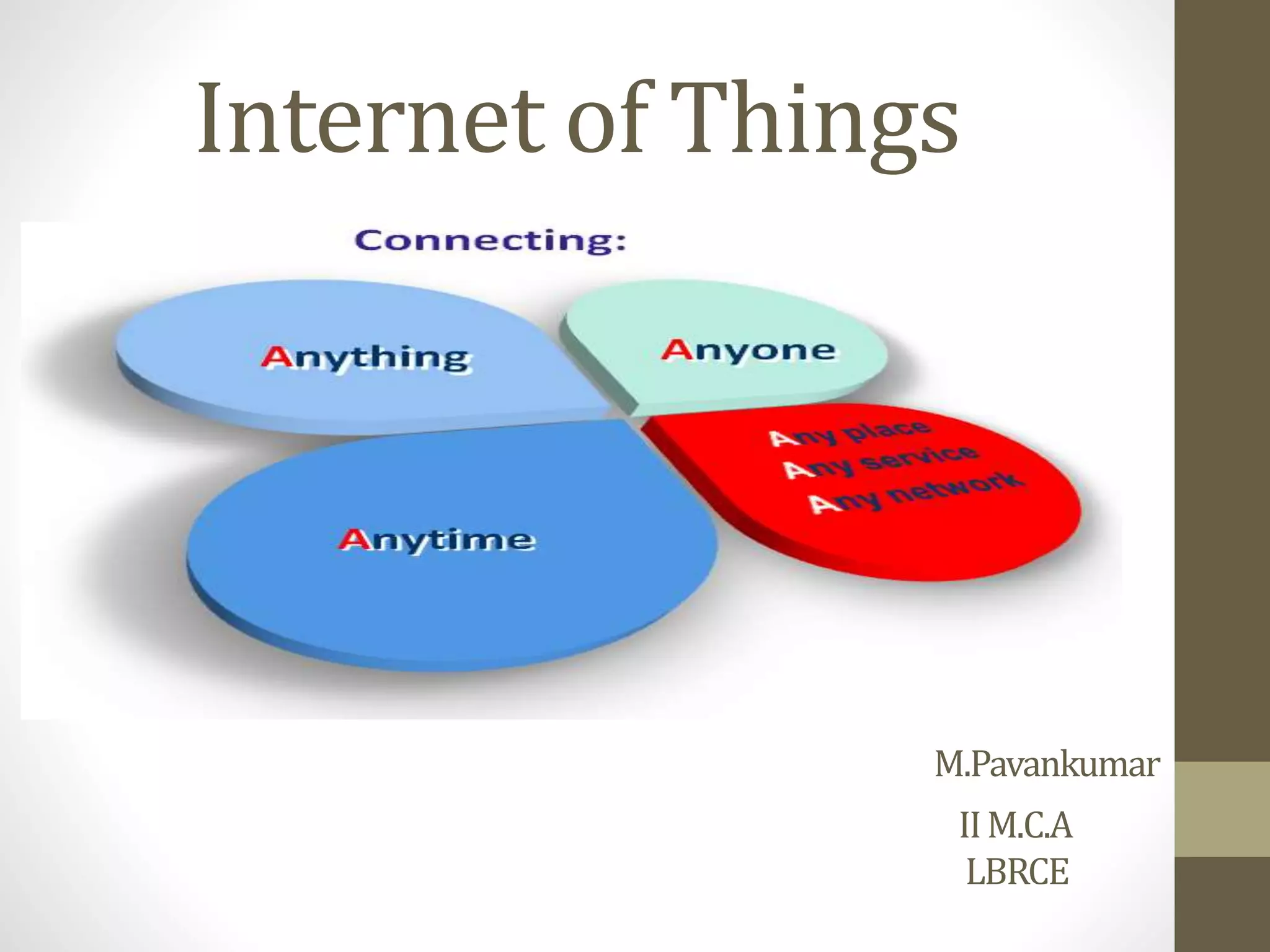
Internet of Things
M.Pavankumar
IIM.C.A
LBRCE
contents
• Abstract
• Introduction
• Basic technologies
• Applications
• Conclusion
Abstract:
• The Internet of Things (IoT) is generally thought of as connecting things to
the Internet and using that connection to provide some kind of useful
remote monitoring or control of those things.
• The IoT creates an intelligent, invisible network fabric that can be sensed,
controlled and programmed.
• IoT enabled products employ embedded technology that allows them to
communicate, directly or indirectly, with each other or the Internet.
• This paper discusses the social and governance issues that are likely to arise
as the vision of the Internet of Things becomes a reality.
Introduction:
• As of 2014 the vision of the Internet of Things has evolved due to a
convergence of multiple technologies, ranging from wireless
communication to the Internet and from embedded
systems. (e.g embedded systems, wireless sensor networks, control
systems ,automation)
• The Internet of Things (IoT) is the interconnection of uniquely
identifiable embedded computing devices within the
existing Internet infrastructure.
• IoT is expected to offer advanced connectivity of devices, systems,
and services that goes beyond machine-to-machine communications
(M2M) and covers a variety of protocols, domains, and applications.
Basic Technologies
• Communication and cooperation: Objects have the ability to
network with Internet resources or even with each other
• Addressability: Within an Internet of Things, objects can be
located and addressed
• Identification: Objects are uniquely identifiable.
E.g: RFID, NFC (Near Field Communication)
• Sensing: Objects collect information about their surroundings
with sensors.
• Localization: Smart things are aware of their physical
location, or can be located.
• User interfaces: Smart objects can communicate with people
in an appropriate manner (for example via a smartphone).
APPLICATIONS:
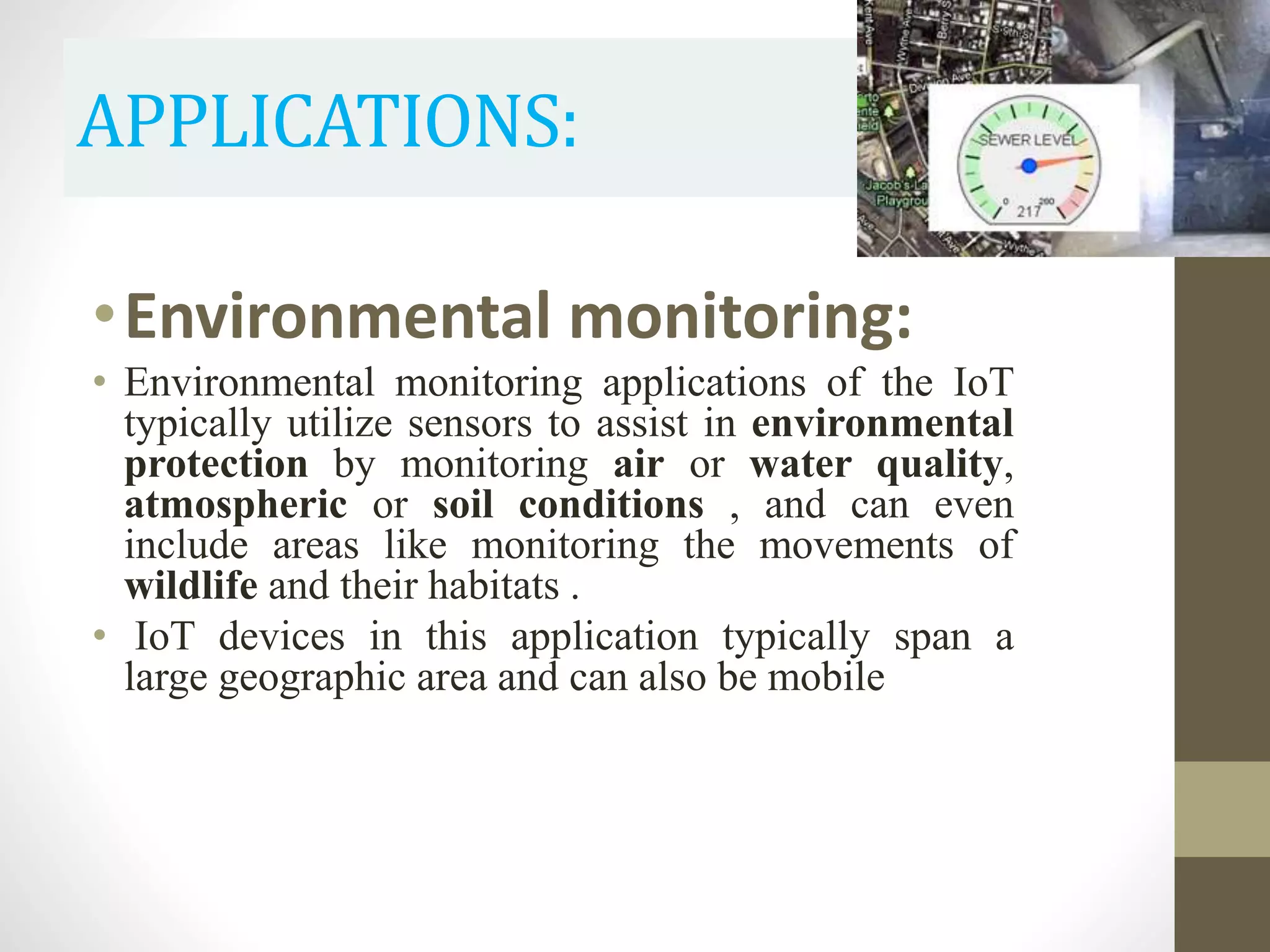
•Environmental monitoring:
• Environmental monitoring applications of the IoT
typically utilize sensors to assist in environmental
protection by monitoring air or water quality,
atmospheric or soil conditions , and can even
include areas like monitoring the movements of
wildlife and their habitats .
• IoT devices in this application typically span a
large geographic area and can also be mobile
Transportation:
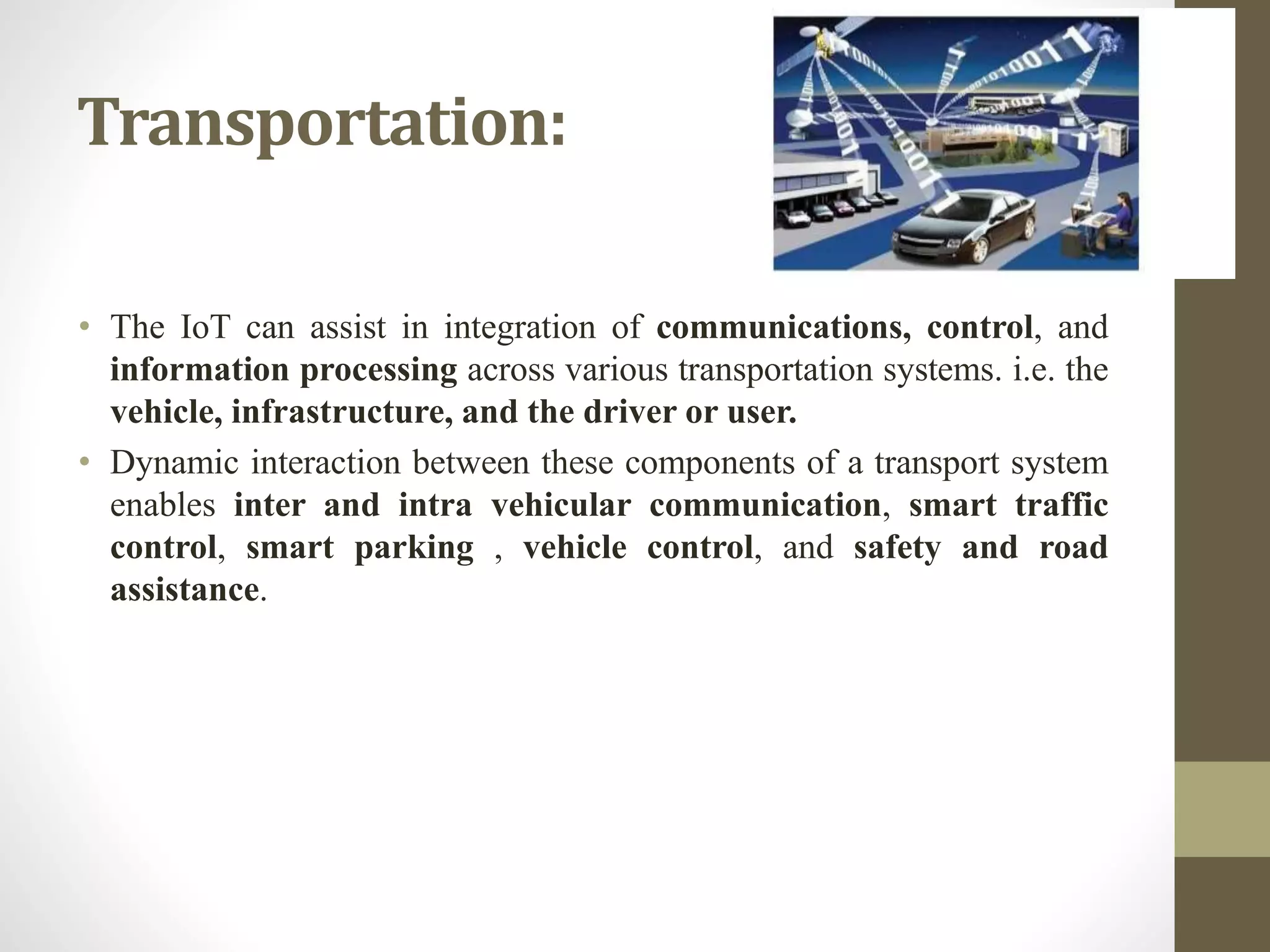
• The IoT can assist in integration of communications, control, and
information processing across various transportation systems. i.e. the
vehicle, infrastructure, and the driver or user.
• Dynamic interaction between these components of a transport system
enables inter and intra vehicular communication, smart traffic
control, smart parking , vehicle control, and safety and road
assistance.
Medical and healthcare
systems:
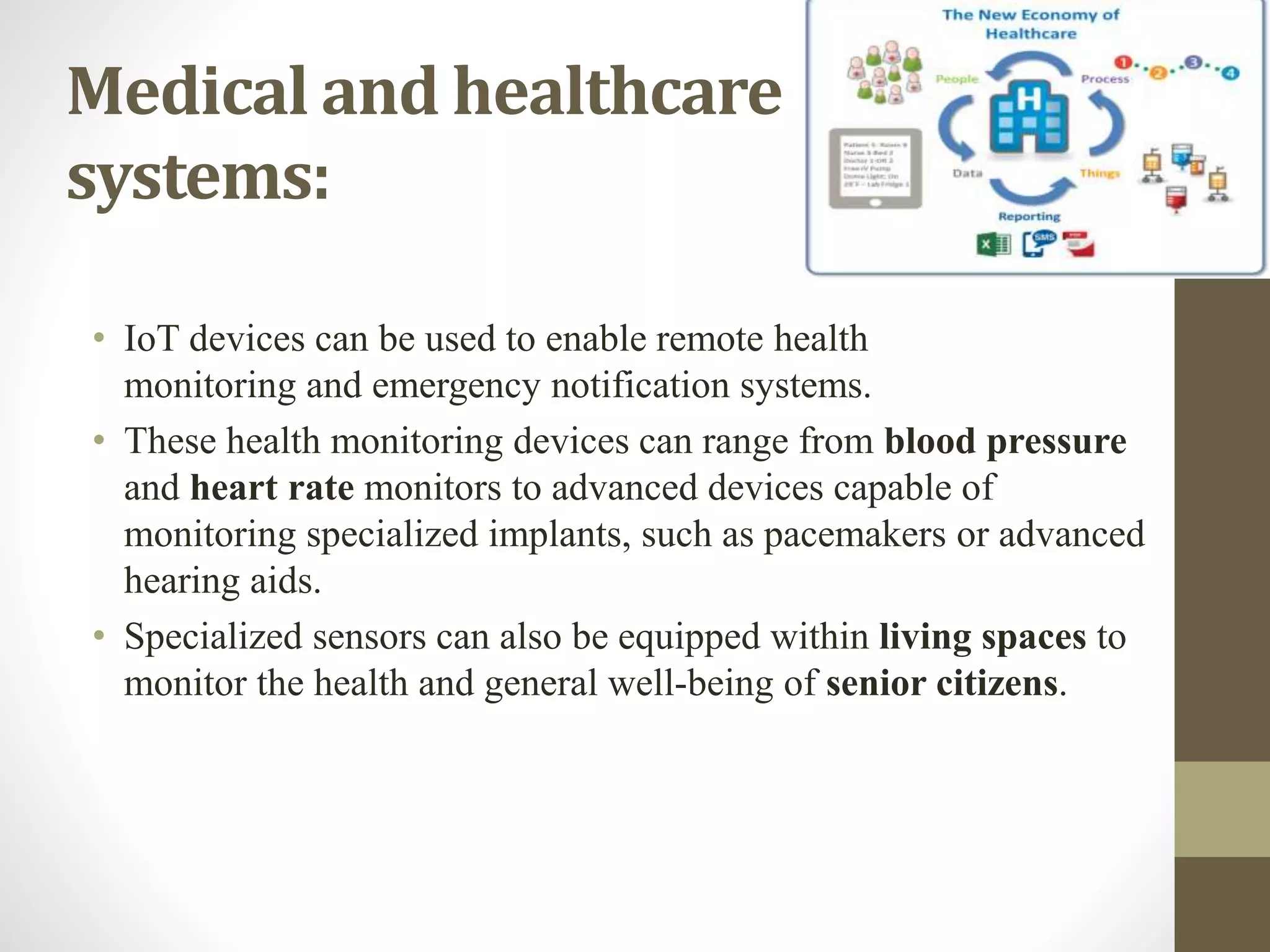
• IoT devices can be used to enable remote health
monitoring and emergency notification systems.
• These health monitoring devices can range from blood pressure
and heart rate monitors to advanced devices capable of
monitoring specialized implants, such as pacemakers or advanced
hearing aids.
• Specialized sensors can also be equipped within living spaces to
monitor the health and general well-being of senior citizens.
Manufacturing:
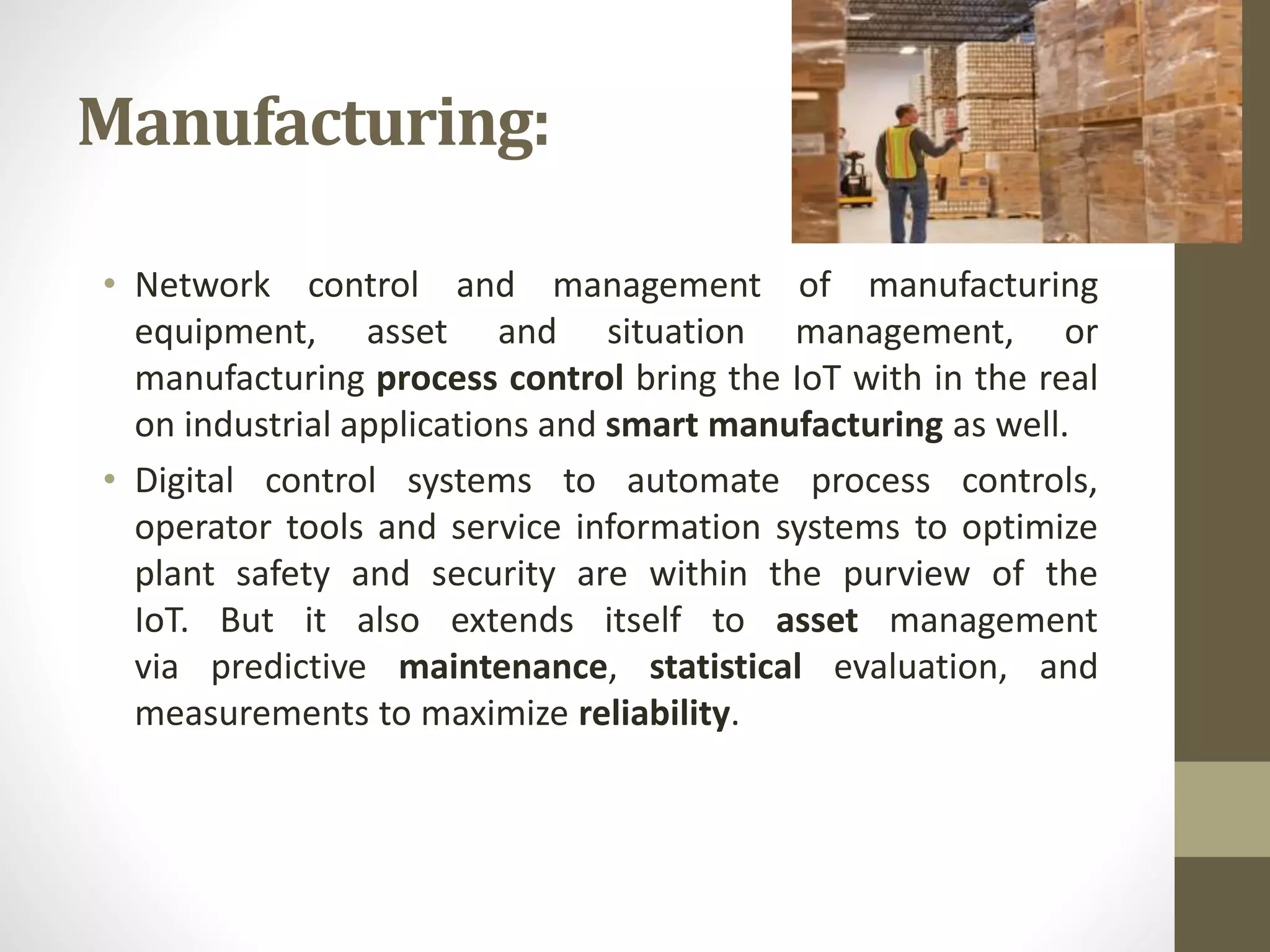
• Network control and management of manufacturing
equipment, asset and situation management, or
manufacturing process control bring the IoT with in the real
on industrial applications and smart manufacturing as well.
• Digital control systems to automate process controls,
operator tools and service information systems to optimize
plant safety and security are within the purview of the
IoT. But it also extends itself to asset management
via predictive maintenance, statistical evaluation, and
measurements to maximize reliability.
Building and home
automation:
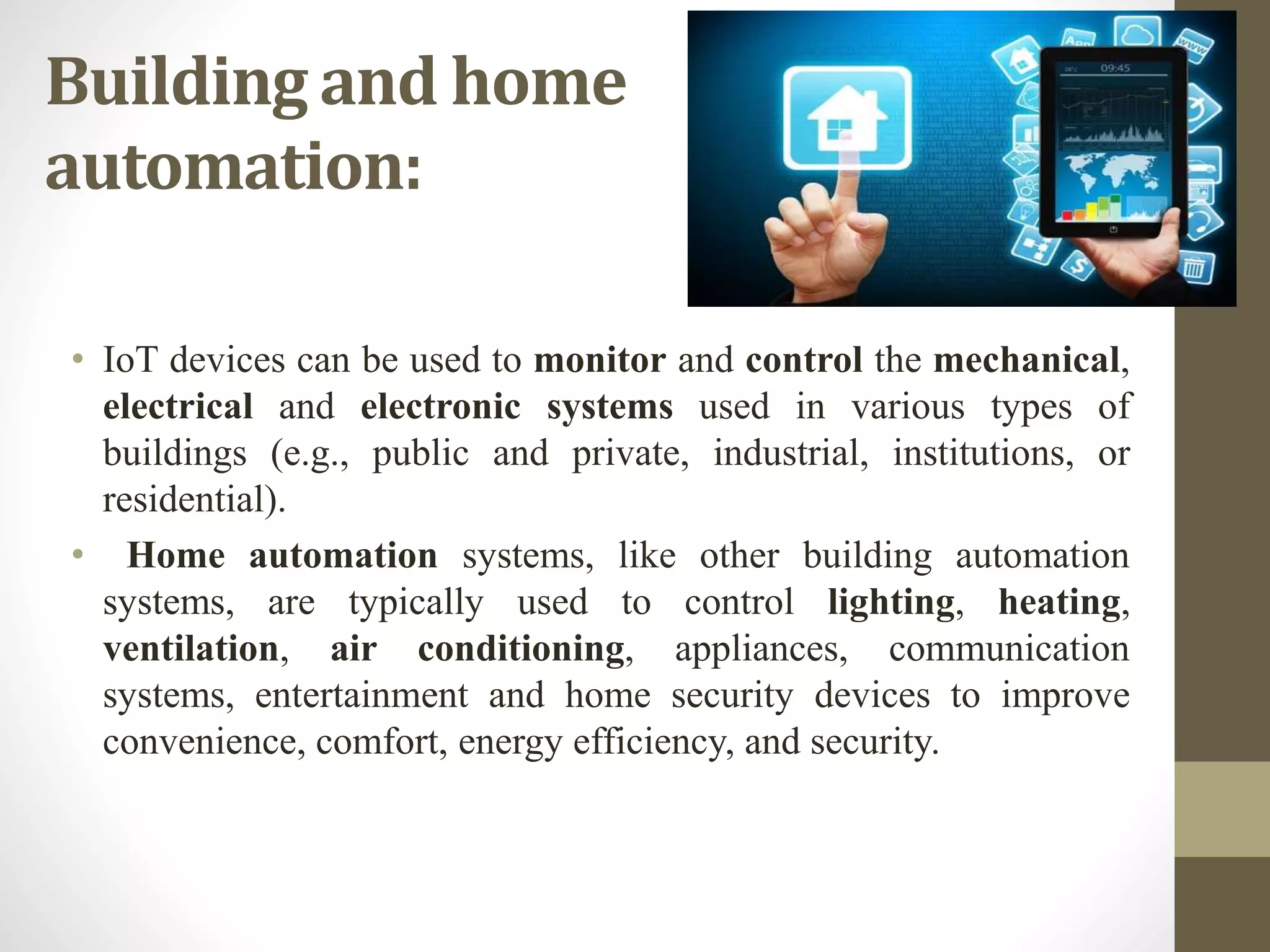
• IoT devices can be used to monitor and control the mechanical,
electrical and electronic systems used in various types of
buildings (e.g., public and private, industrial, institutions, or
residential).
• Home automation systems, like other building automation
systems, are typically used to control lighting, heating,
ventilation, air conditioning, appliances, communication
systems, entertainment and home security devices to improve
convenience, comfort, energy efficiency, and security.
Conclusion
• IoT is at a stage where disparate networks and a multitude of sensors
must come together and interoperate under a common set of standards.
This effort will require businesses, governments, standards
organizations, and academia to work together toward a common goal.
IoT represents the next evolution of the Internet. IoT has the potential to
change the world as we know it today for the better. How quickly we get
there is up to us.
“Creativity is thinking up new things.
Innovation is doing new
things.”

IOT ppt

  • 1.
  • 2.
    contents • Abstract • Introduction •Basic technologies • Applications • Conclusion
  • 3.
    Abstract: • The Internetof Things (IoT) is generally thought of as connecting things to the Internet and using that connection to provide some kind of useful remote monitoring or control of those things. • The IoT creates an intelligent, invisible network fabric that can be sensed, controlled and programmed. • IoT enabled products employ embedded technology that allows them to communicate, directly or indirectly, with each other or the Internet. • This paper discusses the social and governance issues that are likely to arise as the vision of the Internet of Things becomes a reality.
  • 4.
    Introduction: • As of2014 the vision of the Internet of Things has evolved due to a convergence of multiple technologies, ranging from wireless communication to the Internet and from embedded systems. (e.g embedded systems, wireless sensor networks, control systems ,automation) • The Internet of Things (IoT) is the interconnection of uniquely identifiable embedded computing devices within the existing Internet infrastructure. • IoT is expected to offer advanced connectivity of devices, systems, and services that goes beyond machine-to-machine communications (M2M) and covers a variety of protocols, domains, and applications.
  • 5.
    Basic Technologies • Communicationand cooperation: Objects have the ability to network with Internet resources or even with each other • Addressability: Within an Internet of Things, objects can be located and addressed • Identification: Objects are uniquely identifiable. E.g: RFID, NFC (Near Field Communication) • Sensing: Objects collect information about their surroundings with sensors. • Localization: Smart things are aware of their physical location, or can be located. • User interfaces: Smart objects can communicate with people in an appropriate manner (for example via a smartphone).
  • 6.
    APPLICATIONS: •Environmental monitoring: • Environmentalmonitoring applications of the IoT typically utilize sensors to assist in environmental protection by monitoring air or water quality, atmospheric or soil conditions , and can even include areas like monitoring the movements of wildlife and their habitats . • IoT devices in this application typically span a large geographic area and can also be mobile
  • 7.
    Transportation: • The IoTcan assist in integration of communications, control, and information processing across various transportation systems. i.e. the vehicle, infrastructure, and the driver or user. • Dynamic interaction between these components of a transport system enables inter and intra vehicular communication, smart traffic control, smart parking , vehicle control, and safety and road assistance.
  • 8.
    Medical and healthcare systems: •IoT devices can be used to enable remote health monitoring and emergency notification systems. • These health monitoring devices can range from blood pressure and heart rate monitors to advanced devices capable of monitoring specialized implants, such as pacemakers or advanced hearing aids. • Specialized sensors can also be equipped within living spaces to monitor the health and general well-being of senior citizens.
  • 9.
    Manufacturing: • Network controland management of manufacturing equipment, asset and situation management, or manufacturing process control bring the IoT with in the real on industrial applications and smart manufacturing as well. • Digital control systems to automate process controls, operator tools and service information systems to optimize plant safety and security are within the purview of the IoT. But it also extends itself to asset management via predictive maintenance, statistical evaluation, and measurements to maximize reliability.
  • 10.
    Building and home automation: •IoT devices can be used to monitor and control the mechanical, electrical and electronic systems used in various types of buildings (e.g., public and private, industrial, institutions, or residential). • Home automation systems, like other building automation systems, are typically used to control lighting, heating, ventilation, air conditioning, appliances, communication systems, entertainment and home security devices to improve convenience, comfort, energy efficiency, and security.
  • 11.
    Conclusion • IoT isat a stage where disparate networks and a multitude of sensors must come together and interoperate under a common set of standards. This effort will require businesses, governments, standards organizations, and academia to work together toward a common goal. IoT represents the next evolution of the Internet. IoT has the potential to change the world as we know it today for the better. How quickly we get there is up to us.
  • 12.
    “Creativity is thinkingup new things. Innovation is doing new things.”