DEVELOPING A RESEARCH
PROPOSAL
PRESENTED TO: SIR IQBAL BUTT
PRESENTED BY: MUQADDAS ZAKA
. PROGRAM: M.PHIL
SEMESTER: ONE
NCBA&E
OVERVIEW:
 INTRODUCTION
 DEFINE RESEARCH
 DEFINE RESEARCH PROPOSAL
 GOALS FOR WRITING RESEARCH PROPOSAL
 ELEMENTS OF RESAERCH PROPOSAL
 APA FORMAT
 SOME FLAWS
INTRODUCTION:
 RESEARCH PROPOSAL is very important step in the research process.
 It is like a blueprint of the building before the construction starts.
 It is very important for the researchers to write an effective research proposal, writing a
good research proposal is both science and art .an effective research proposal is based
on the scientific facts and on the art of clear communication. A researcher should start
writing the research proposal by the time one has decided the topic for the study.
DEFINE RESEARCH:
 “The systematic study of material and resources in order to establish facts and reach
new conclusions.”
(Oxford English Dictionary ,2002)
“A systematic process of collecting and analyzing information for some purpose.”
(McMillan and Schumacher,1997)
DEFINE RESEARCH PROPOSAL:
 “A research proposal is a document proposing a research
project, generally in the sciences or academia, and
generally constitutes a request for sponsorship of that
research. Proposals are evaluated on the cost and
potential impact of the proposed research, and on the
soundness of the proposed plan for carrying it out.”
(wikipedia.org/wiki/Research_proposal)
GOALS :
the main purpose of research proposal is to ensure :
 significance
 feasibility
 suitability
of your research problem
Steps for writing research proposal:
 While there are no hard and fast rules governing the structure of a proposal, a typical
one would include the following elements:
 The title
 The abstract
 Aims and objectives
 Background
 Methodology
 Schedule n timing
 Ethnic approval
Steps for writing research proposal:
 Resources
 budget
The title:
 Naming your research is very important task as it will tell the
reader about your research .
 It is the title of your research that will help the reader in
deciding whether he/she will read it or not.
Good title
A good title has the following qualities:
 Short
 Sharp
 Relevant
 Condenses the paper s contents in a few words
 Captures reader’s attention
 Differentiate from other papers of the same area
The title:
 Note :
A good title for a research paper is typically around
10 to 12 words long. A lengthy title may seem unfocused
and take the readers’ attention away from an important
point.
APA and title page:
 For your research proposal, your title page should include
your paper’s title, your name and your university’s name.
 Other information that may appear on the title page includes
submission date, budget period, total funds requested or
advisor’s name, depending on your proposal’s audience.
 APA style recommends that your title is no more than 12
words in length.
The abstract:
 “An abstract is a concise summary of a larger project (a thesis, research report,
performance, service project, etc.) that concisely describes the content and scope of the
project and identifies the project's objective, its methodology and its findings,
conclusions, or intended results.”
 The abstract is a 200-250 words summary of the proposed research, including the key
points: what, why, how and when.
Qualities of a good abstract:
Following are the qualities of a good abstract:
Coherent
Concise
Readable
TYPES OF ABSTRACT:
 Informative abstract/complete abstract (for sciences).
 Descriptive abstract/limited abstract (for social sciences).
 Structured abstract (for medical literature).
 Note: It is recommended to write the abstract last, after the rest of the research
proposal has been written and thought out. If the abstract is written before the rest of
the research proposal , there are the chances of missing many important points .So it
would be wise to wait and write the abstract last.
APA format and abstract:
 In APA format, your abstract is the second page of
your paper. Despite appearing at the beginning of
your paper, plan to write your research proposal last.
This is a brief summary of your entire paper. In a
150- to 250-word paragraph, state your problem,
and propose a solution for it
Aims and objectives:
 This section answers the question why this research is
being done. Outline the aims and objectives of
the research, and/or the research questions. Define any
specialized terms you may use and indicate why the aims
and objectives are appropriate.
Aims vs Objectives
 Aims are what you hope to achieve by the end of your
dissertation. They should be clear and concise statements, but
expressed in general terms.
 Objectives are how you intend to achieve those aims. They will
include the specific means of answering the research question that
you have posed and details of the key issues involved.
How to develop objectives:
Use these S.M.A.R.T. guidelines to try and develop your objectives:
 Specific
 Measurable
 Achievable
 Realistic
 Time constrained
Background:
 There are two aspects to this æ one is how the project came about, and the other is itS
relationship to other research in the field.
 1: Who is undertaking this research and for whom (where applicable)? Why choose this
topic? Who is going to gain from this research?
 2: Write a brief history of the research question, indicating other work in
the field and a summary of previous conclusions. Include a brief literature review
indicating where you gained your information and any personal references such as
discussions with people, conference papers, policy documents, memos, etc. This section
sets your proposal within the wider context.
Methodology:
 “ The methodology generally refers to the theory to be used to justify
the use of particular research method that you are choosing to use.”
 The “Methodology” section is the most important section in the entire
proposal, as it explains each step the experimenter will take in order to
conduct his or her research. This section discusses what measures the
researcher will take in order to test the study’s hypothesis. In this
section, it is vital to include the following subheadings while expanding
on them in as much detail as possible
Note:
 You may use more than one methodology
to inform your method of research.
Schedule n timing:
 Many projects fail because they could not be carried
out within the set time limit. Hence, working out a
time schedule is essential. In most cases, you can use
a table for the time schedule as in the example table
(Table 1). Your table may contain more or fewer
points. Plan backwards form the date your paper is
due and allow for enough time
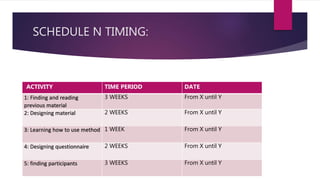
SCHEDULE N TIMING:
ACTIVITY TIME PERIOD DATE
1: Finding and reading
previous material
3 WEEKS From X until Y
2: Designing material 2 WEEKS From X until Y
3: Learning how to use method 1 WEEK From X until Y
4: Designing questionnaire 2 WEEKS From X until Y
5: finding participants 3 WEEKS From X until Y
Ethnic approval:
 Some institutions require that any research involving interaction with human
participants get approval from ethical advisory committees or boards. This ethical
approval is sought to ensure that the researcher conducts research in a manner that is
respectful to the participants and other human beings that may be influenced by the
research process. It is important that you seek out what ethical approval is required
within your area of research. You may need to seek approval from more than one
advisory committee depending on the institutional, financial and disciplinary context.
Applications for ethical approval are obtained directly from the ethical committees
themselves.
Resources:
 This section demonstrates to the reader that you are both suitable and capable of
carrying out the proposed research. You will need to discuss what resources you have at
your disposal that makes it possible for you to carry out this research. For example,
physical resources (such as research instruments), personal resources (such as
knowledge of the discipline, area or community under study), as well as any other
resources that you have as a researcher (or research team) that will enable you to carry
out the research from beginning through to completion.
Budget:
 Not all research proposal require a budget (such as thesis proposals for academic
institutions), however if you intend to apply for funding for research it is important that
you are able to show how much money you require, and justify the amount asked for.
The way to justify the amount you are asking for is to provide a detailed budget outlining
what expenses you predict you will incur in conducting the research. Exactly where and
how money will be spent will differ from project to project, and the size of the budget
should reflect the size of the research project. Some of the main expenses that may be
included in any budget could be researcher’s time, human resources (such as other
research assistants, transcribers, advisory board members), technical equipment
(Dictaphones, transcribers, computer hardware and software etc), stationary, koha and
others.
APA format and research proposal:
 APA format recommends that you type your proposal with a highly legible 12-point
font, such as Times New Roman.
 It needs to be double-spaced.
 When you write a new paragraph, indent fives spaces or use the Tab key.
 Your paper should have a 1-inch margin on all sides.
 At the top of each page, insert a running head in the header.
 To format this correctly, write the title of your proposal in the upper left hand side and
the page number in the upper right hand side.
 Your running head is limited to 50 characters, including spaces. If you must shorten
your title, select the keywords.
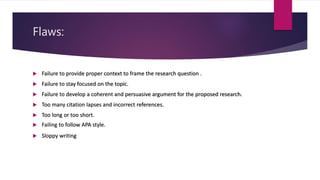
Flaws:
 Failure to provide proper context to frame the research question .
 Failure to stay focused on the topic.
 Failure to develop a coherent and persuasive argument for the proposed research.
 Too many citation lapses and incorrect references.
 Too long or too short.
 Failing to follow APA style.
 Sloppy writing
Thank you

Developing a research proposal

  • 1.
    DEVELOPING A RESEARCH PROPOSAL PRESENTEDTO: SIR IQBAL BUTT PRESENTED BY: MUQADDAS ZAKA . PROGRAM: M.PHIL SEMESTER: ONE NCBA&E
  • 2.
    OVERVIEW:  INTRODUCTION  DEFINERESEARCH  DEFINE RESEARCH PROPOSAL  GOALS FOR WRITING RESEARCH PROPOSAL  ELEMENTS OF RESAERCH PROPOSAL  APA FORMAT  SOME FLAWS
  • 3.
    INTRODUCTION:  RESEARCH PROPOSALis very important step in the research process.  It is like a blueprint of the building before the construction starts.  It is very important for the researchers to write an effective research proposal, writing a good research proposal is both science and art .an effective research proposal is based on the scientific facts and on the art of clear communication. A researcher should start writing the research proposal by the time one has decided the topic for the study.
  • 4.
    DEFINE RESEARCH:  “Thesystematic study of material and resources in order to establish facts and reach new conclusions.” (Oxford English Dictionary ,2002) “A systematic process of collecting and analyzing information for some purpose.” (McMillan and Schumacher,1997)
  • 5.
    DEFINE RESEARCH PROPOSAL: “A research proposal is a document proposing a research project, generally in the sciences or academia, and generally constitutes a request for sponsorship of that research. Proposals are evaluated on the cost and potential impact of the proposed research, and on the soundness of the proposed plan for carrying it out.” (wikipedia.org/wiki/Research_proposal)
  • 6.
    GOALS : the mainpurpose of research proposal is to ensure :  significance  feasibility  suitability of your research problem
  • 7.
    Steps for writingresearch proposal:  While there are no hard and fast rules governing the structure of a proposal, a typical one would include the following elements:  The title  The abstract  Aims and objectives  Background  Methodology  Schedule n timing  Ethnic approval
  • 8.
    Steps for writingresearch proposal:  Resources  budget
  • 9.
    The title:  Namingyour research is very important task as it will tell the reader about your research .  It is the title of your research that will help the reader in deciding whether he/she will read it or not.
  • 10.
    Good title A goodtitle has the following qualities:  Short  Sharp  Relevant  Condenses the paper s contents in a few words  Captures reader’s attention  Differentiate from other papers of the same area
  • 11.
    The title:  Note: A good title for a research paper is typically around 10 to 12 words long. A lengthy title may seem unfocused and take the readers’ attention away from an important point.
  • 12.
    APA and titlepage:  For your research proposal, your title page should include your paper’s title, your name and your university’s name.  Other information that may appear on the title page includes submission date, budget period, total funds requested or advisor’s name, depending on your proposal’s audience.  APA style recommends that your title is no more than 12 words in length.
  • 13.
    The abstract:  “Anabstract is a concise summary of a larger project (a thesis, research report, performance, service project, etc.) that concisely describes the content and scope of the project and identifies the project's objective, its methodology and its findings, conclusions, or intended results.”  The abstract is a 200-250 words summary of the proposed research, including the key points: what, why, how and when.
  • 14.
    Qualities of agood abstract: Following are the qualities of a good abstract: Coherent Concise Readable
  • 15.
    TYPES OF ABSTRACT: Informative abstract/complete abstract (for sciences).  Descriptive abstract/limited abstract (for social sciences).  Structured abstract (for medical literature).  Note: It is recommended to write the abstract last, after the rest of the research proposal has been written and thought out. If the abstract is written before the rest of the research proposal , there are the chances of missing many important points .So it would be wise to wait and write the abstract last.
  • 16.
    APA format andabstract:  In APA format, your abstract is the second page of your paper. Despite appearing at the beginning of your paper, plan to write your research proposal last. This is a brief summary of your entire paper. In a 150- to 250-word paragraph, state your problem, and propose a solution for it
  • 17.
    Aims and objectives: This section answers the question why this research is being done. Outline the aims and objectives of the research, and/or the research questions. Define any specialized terms you may use and indicate why the aims and objectives are appropriate.
  • 18.
    Aims vs Objectives Aims are what you hope to achieve by the end of your dissertation. They should be clear and concise statements, but expressed in general terms.  Objectives are how you intend to achieve those aims. They will include the specific means of answering the research question that you have posed and details of the key issues involved.
  • 19.
    How to developobjectives: Use these S.M.A.R.T. guidelines to try and develop your objectives:  Specific  Measurable  Achievable  Realistic  Time constrained
  • 20.
    Background:  There aretwo aspects to this æ one is how the project came about, and the other is itS relationship to other research in the field.  1: Who is undertaking this research and for whom (where applicable)? Why choose this topic? Who is going to gain from this research?  2: Write a brief history of the research question, indicating other work in the field and a summary of previous conclusions. Include a brief literature review indicating where you gained your information and any personal references such as discussions with people, conference papers, policy documents, memos, etc. This section sets your proposal within the wider context.
  • 21.
    Methodology:  “ Themethodology generally refers to the theory to be used to justify the use of particular research method that you are choosing to use.”  The “Methodology” section is the most important section in the entire proposal, as it explains each step the experimenter will take in order to conduct his or her research. This section discusses what measures the researcher will take in order to test the study’s hypothesis. In this section, it is vital to include the following subheadings while expanding on them in as much detail as possible
  • 22.
    Note:  You mayuse more than one methodology to inform your method of research.
  • 23.
    Schedule n timing: Many projects fail because they could not be carried out within the set time limit. Hence, working out a time schedule is essential. In most cases, you can use a table for the time schedule as in the example table (Table 1). Your table may contain more or fewer points. Plan backwards form the date your paper is due and allow for enough time
  • 24.
    SCHEDULE N TIMING: ACTIVITYTIME PERIOD DATE 1: Finding and reading previous material 3 WEEKS From X until Y 2: Designing material 2 WEEKS From X until Y 3: Learning how to use method 1 WEEK From X until Y 4: Designing questionnaire 2 WEEKS From X until Y 5: finding participants 3 WEEKS From X until Y
  • 25.
    Ethnic approval:  Someinstitutions require that any research involving interaction with human participants get approval from ethical advisory committees or boards. This ethical approval is sought to ensure that the researcher conducts research in a manner that is respectful to the participants and other human beings that may be influenced by the research process. It is important that you seek out what ethical approval is required within your area of research. You may need to seek approval from more than one advisory committee depending on the institutional, financial and disciplinary context. Applications for ethical approval are obtained directly from the ethical committees themselves.
  • 26.
    Resources:  This sectiondemonstrates to the reader that you are both suitable and capable of carrying out the proposed research. You will need to discuss what resources you have at your disposal that makes it possible for you to carry out this research. For example, physical resources (such as research instruments), personal resources (such as knowledge of the discipline, area or community under study), as well as any other resources that you have as a researcher (or research team) that will enable you to carry out the research from beginning through to completion.
  • 27.
    Budget:  Not allresearch proposal require a budget (such as thesis proposals for academic institutions), however if you intend to apply for funding for research it is important that you are able to show how much money you require, and justify the amount asked for. The way to justify the amount you are asking for is to provide a detailed budget outlining what expenses you predict you will incur in conducting the research. Exactly where and how money will be spent will differ from project to project, and the size of the budget should reflect the size of the research project. Some of the main expenses that may be included in any budget could be researcher’s time, human resources (such as other research assistants, transcribers, advisory board members), technical equipment (Dictaphones, transcribers, computer hardware and software etc), stationary, koha and others.
  • 28.
    APA format andresearch proposal:  APA format recommends that you type your proposal with a highly legible 12-point font, such as Times New Roman.  It needs to be double-spaced.  When you write a new paragraph, indent fives spaces or use the Tab key.  Your paper should have a 1-inch margin on all sides.  At the top of each page, insert a running head in the header.  To format this correctly, write the title of your proposal in the upper left hand side and the page number in the upper right hand side.  Your running head is limited to 50 characters, including spaces. If you must shorten your title, select the keywords.
  • 29.
    Flaws:  Failure toprovide proper context to frame the research question .  Failure to stay focused on the topic.  Failure to develop a coherent and persuasive argument for the proposed research.  Too many citation lapses and incorrect references.  Too long or too short.  Failing to follow APA style.  Sloppy writing
  • 30.