6/19/2013 1BRM-Types Of Research (
6/19/2013 2BRM-Types Of Research (
•Research is defined as a scientific and systematic search
for relevant information on a specific topic involving a
systematized effort to gain new knowledge.
•Research comprises defining and redefining problems,
formulating hypothesis or suggested solutions;
collecting, organizing and evaluating data; making
deductions and reaching conclusions; and at last
carefully testing the conclusions to determine whether
they fit the formulating hypothesis.
6/19/2013 3BRM-Types Of Research (
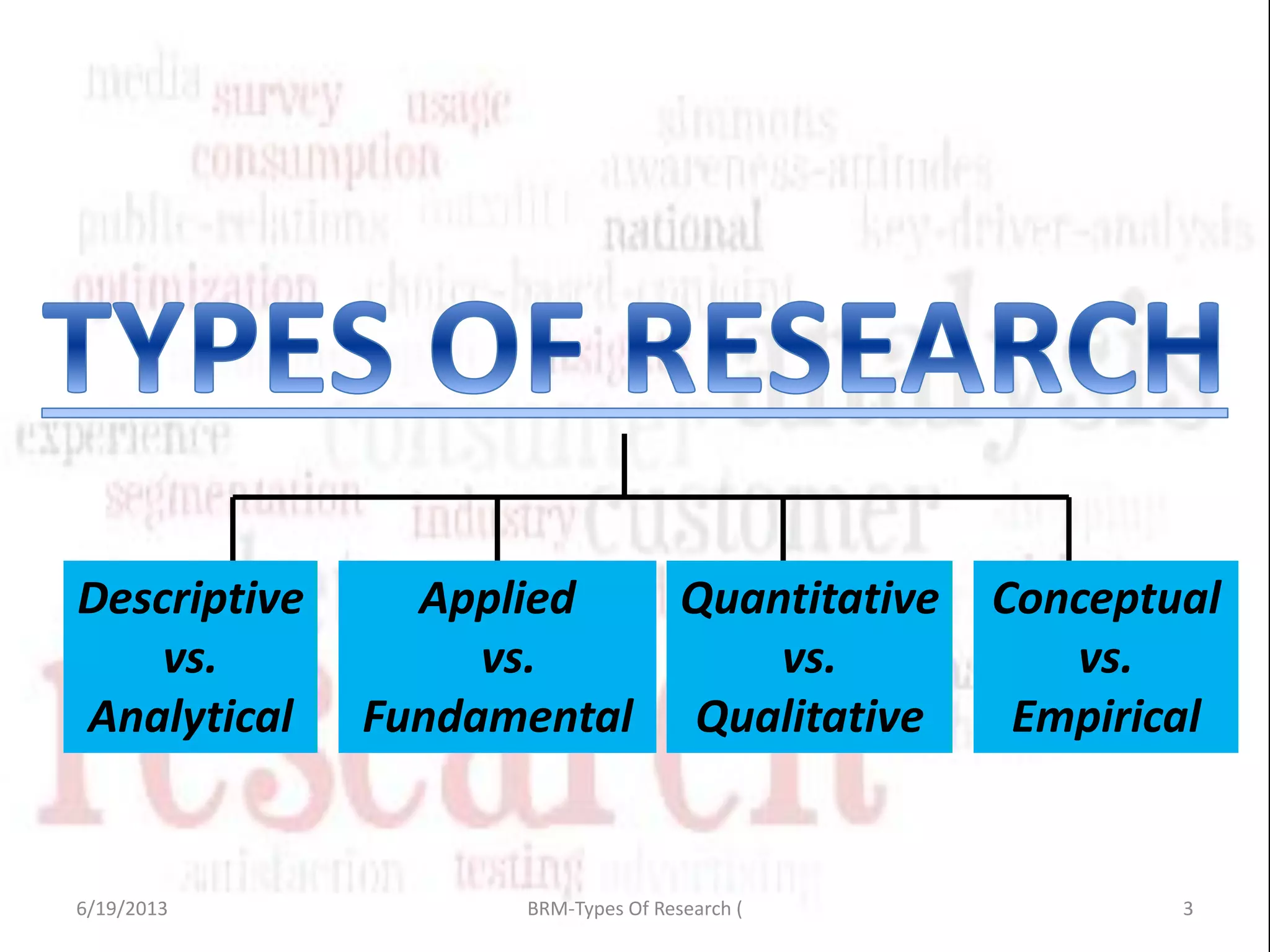
Descriptive
vs.
Analytical
Applied
vs.
Fundamental
Quantitative
vs.
Qualitative
Conceptual
vs.
Empirical
DESCRIPTIVE ANALYTICAL
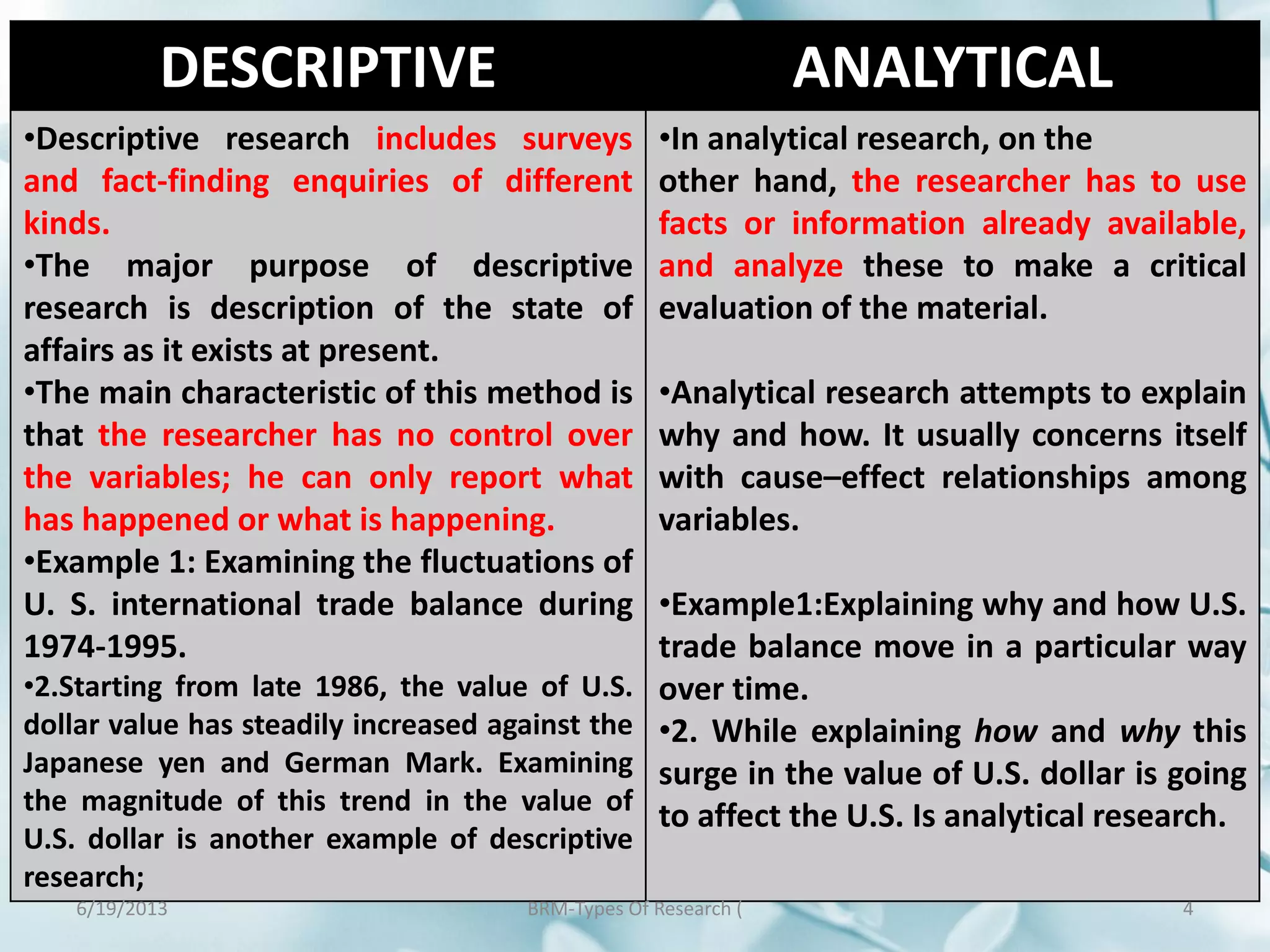
•Descriptive research includes surveys
and fact-finding enquiries of different
kinds.
•The major purpose of descriptive
research is description of the state of
affairs as it exists at present.
•The main characteristic of this method is
that the researcher has no control over
the variables; he can only report what
has happened or what is happening.
•Example 1: Examining the fluctuations of
U. S. international trade balance during
1974-1995.
•2.Starting from late 1986, the value of U.S.
dollar value has steadily increased against the
Japanese yen and German Mark. Examining
the magnitude of this trend in the value of
U.S. dollar is another example of descriptive
research;
•In analytical research, on the
other hand, the researcher has to use
facts or information already available,
and analyze these to make a critical
evaluation of the material.
•Analytical research attempts to explain
why and how. It usually concerns itself
with cause–effect relationships among
variables.
•Example1:Explaining why and how U.S.
trade balance move in a particular way
over time.
•2. While explaining how and why this
surge in the value of U.S. dollar is going
to affect the U.S. Is analytical research.
6/19/2013 4BRM-Types Of Research (
APPLIED FUNDAMENTAL
•Applied research aims at finding a
solution for an immediate problem
facing a society or an
industrial/business organisation.
•The central aim of applied research is
to discover a solution for some
pressing practical problem.
•Examples: Research aimed at certain
conclusions (say, a solution) facing a
concrete social or business. Research
to identify social, economic or political
trends that may affect a particular
institution or marketing research or
evaluation research are examples of
applied research.
•Fundamental research is mainly
concerned with. generalisations and
with the formulation of a theory
•Basic research is directed towards
finding information that has a broad
base of applications and thus, adds to
the already existing organized body of
scientific knowledge.
•Examples: Research concerning
some natural phenomenon, human
behaviour carried on with a view to
make generalisations about human
behaviour
6/19/2013 5BRM-Types Of Research (
QUALITATIVE RESEARCH QUANTITATIVE RESEARCH
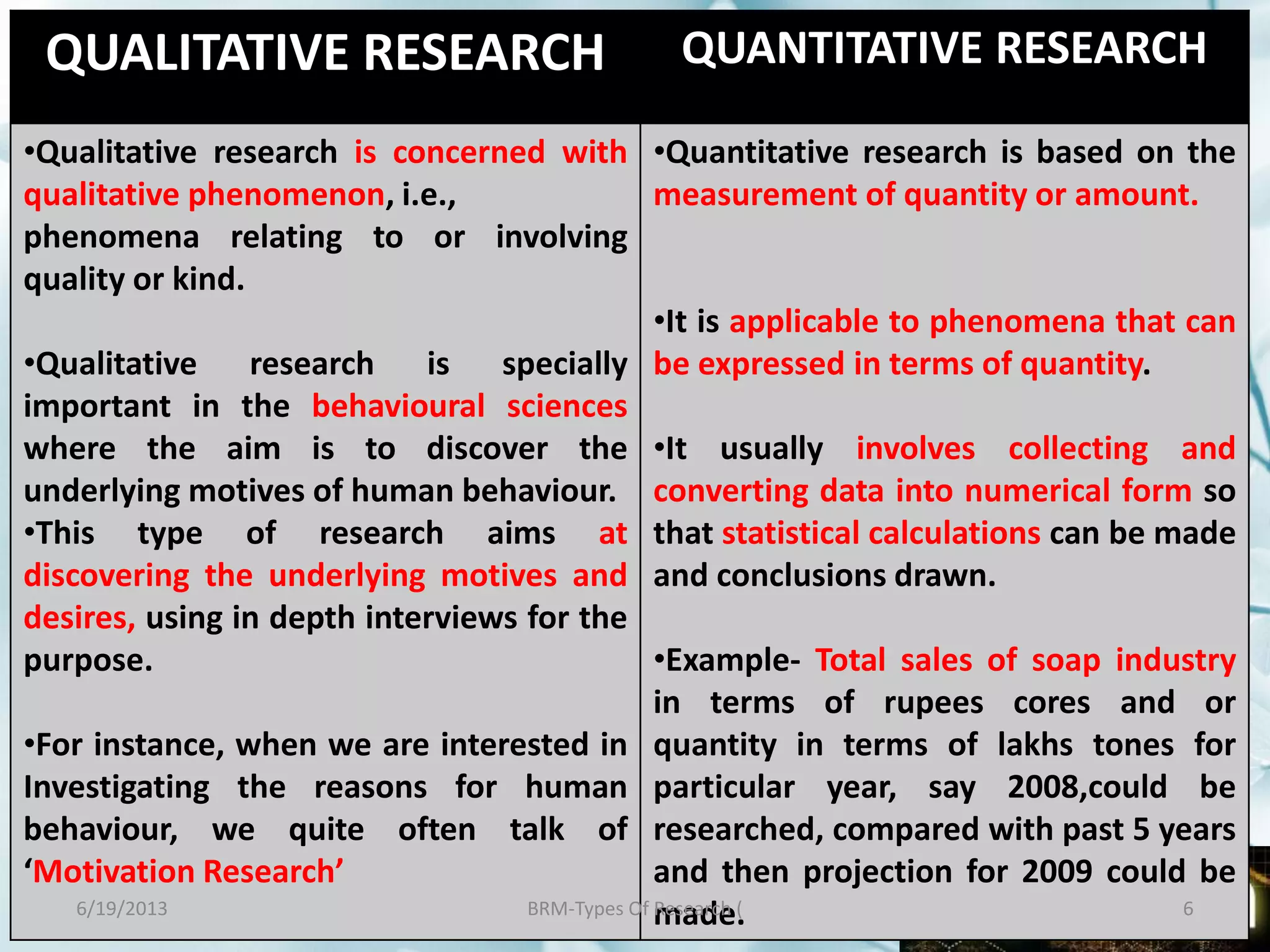
•Qualitative research is concerned with
qualitative phenomenon, i.e.,
phenomena relating to or involving
quality or kind.
•Qualitative research is specially
important in the behavioural sciences
where the aim is to discover the
underlying motives of human behaviour.
•This type of research aims at
discovering the underlying motives and
desires, using in depth interviews for the
purpose.
•For instance, when we are interested in
Investigating the reasons for human
behaviour, we quite often talk of
‘Motivation Research’
•Quantitative research is based on the
measurement of quantity or amount.
•It is applicable to phenomena that can
be expressed in terms of quantity.
•It usually involves collecting and
converting data into numerical form so
that statistical calculations can be made
and conclusions drawn.
•Example- Total sales of soap industry
in terms of rupees cores and or
quantity in terms of lakhs tones for
particular year, say 2008,could be
researched, compared with past 5 years
and then projection for 2009 could be
made.6/19/2013 6BRM-Types Of Research (
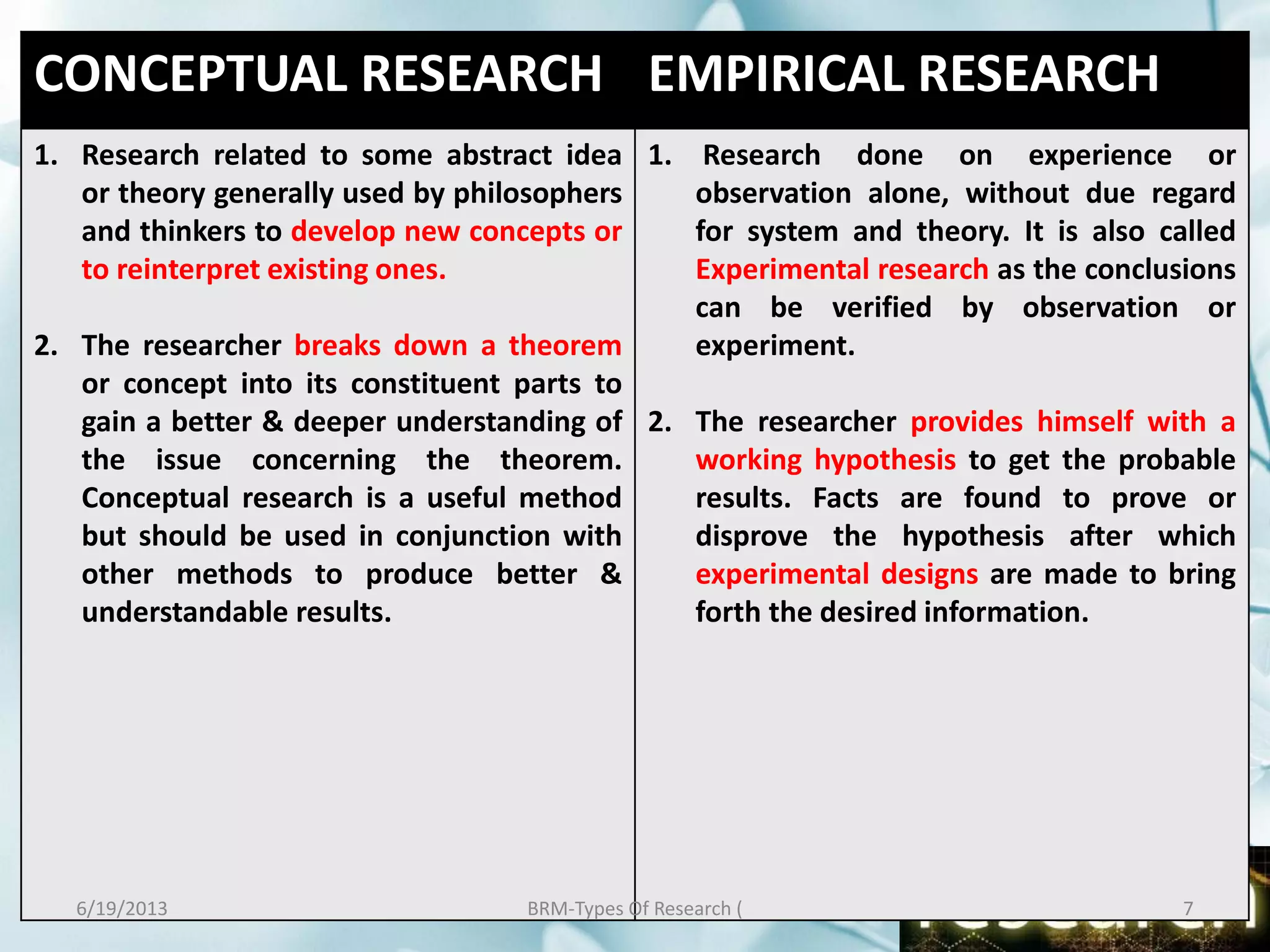
CONCEPTUAL RESEARCH EMPIRICAL RESEARCH
1. Research related to some abstract idea
or theory generally used by philosophers
and thinkers to develop new concepts or
to reinterpret existing ones.
2. The researcher breaks down a theorem
or concept into its constituent parts to
gain a better & deeper understanding of
the issue concerning the theorem.
Conceptual research is a useful method
but should be used in conjunction with
other methods to produce better &
understandable results.
1. Research done on experience or
observation alone, without due regard
for system and theory. It is also called
Experimental research as the conclusions
can be verified by observation or
experiment.
2. The researcher provides himself with a
working hypothesis to get the probable
results. Facts are found to prove or
disprove the hypothesis after which
experimental designs are made to bring
forth the desired information.
6/19/2013 7BRM-Types Of Research (
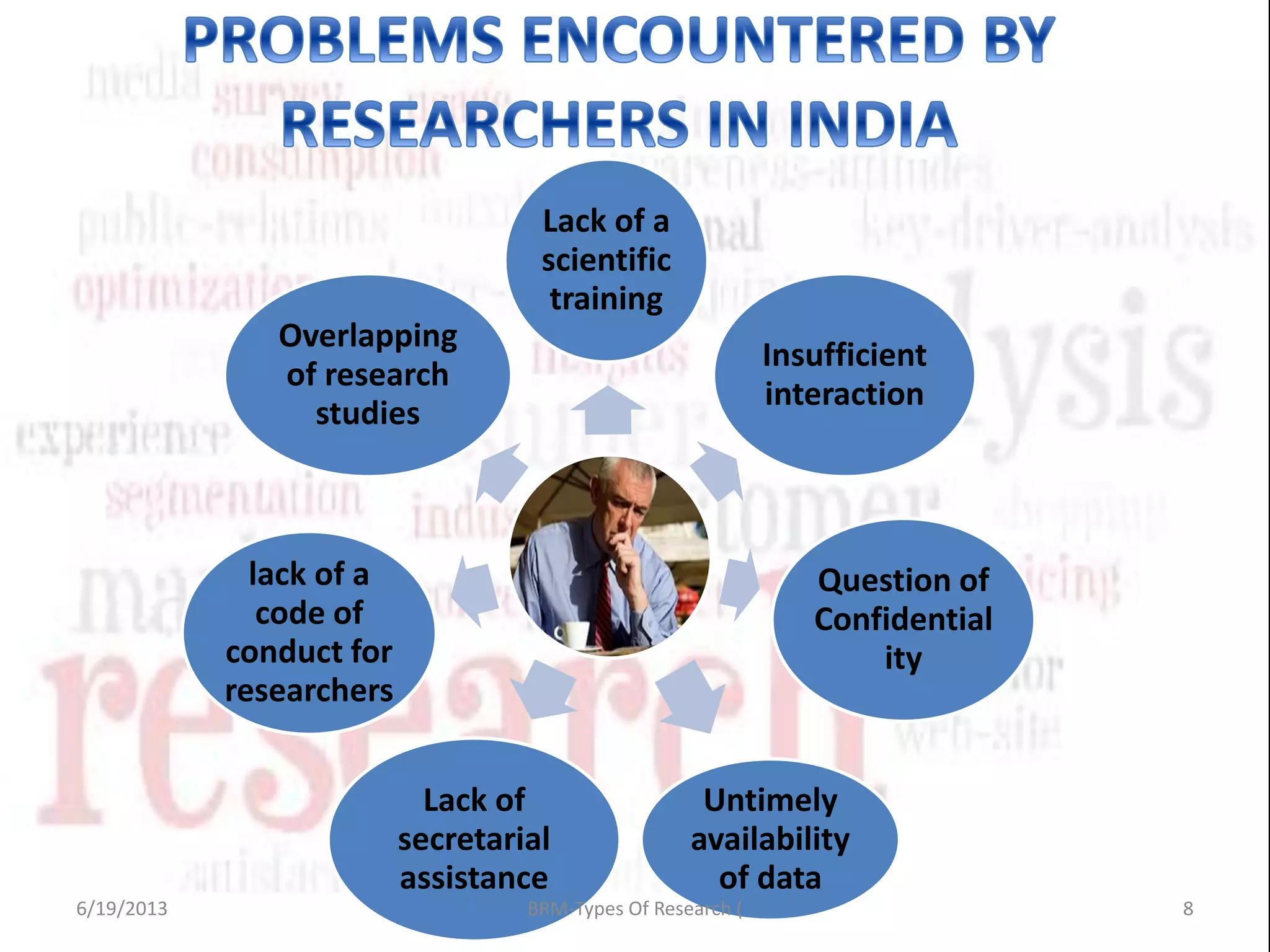
Lack of a
scientific
training
Insufficient
interaction
Question of
Confidential
ity
Untimely
availability
of data
Lack of
secretarial
assistance
lack of a
code of
conduct for
researchers
Overlapping
of research
studies
6/19/2013 8BRM-Types Of Research (
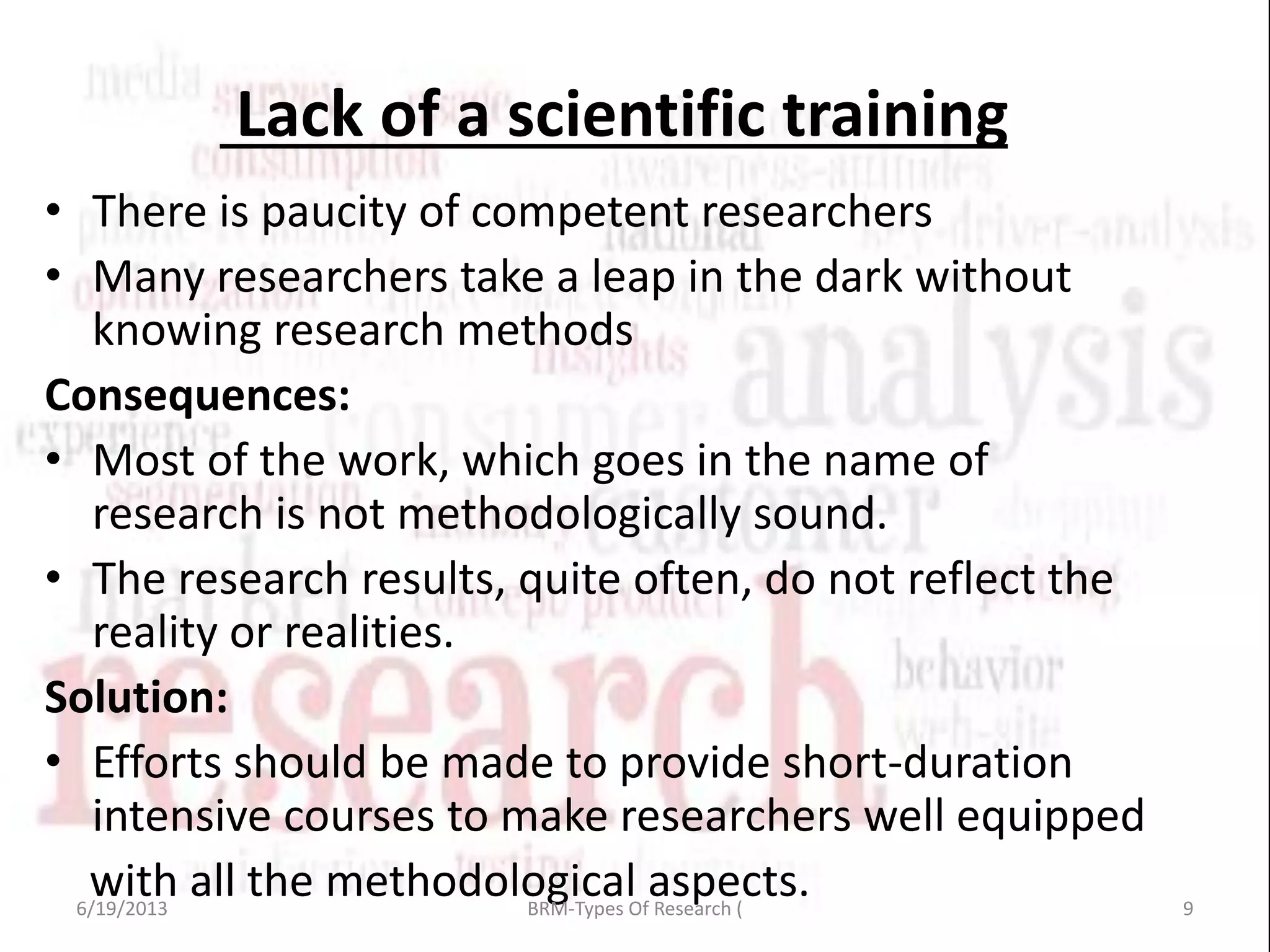
Lack of a scientific training
• There is paucity of competent researchers
• Many researchers take a leap in the dark without
knowing research methods
Consequences:
• Most of the work, which goes in the name of
research is not methodologically sound.
• The research results, quite often, do not reflect the
reality or realities.
Solution:
• Efforts should be made to provide short-duration
intensive courses to make researchers well equipped
with all the methodological aspects.6/19/2013 9BRM-Types Of Research (
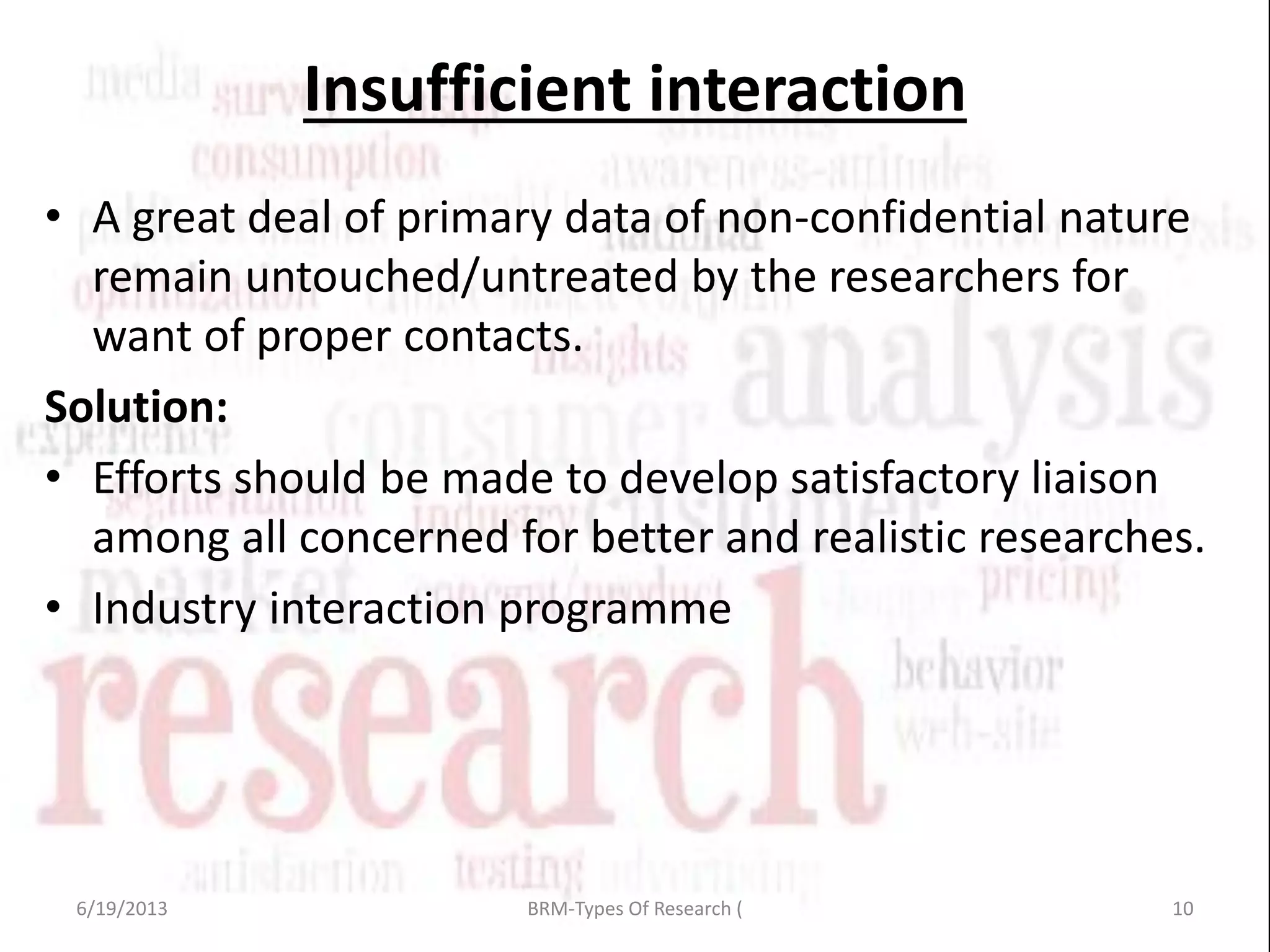
Insufficient interaction
• A great deal of primary data of non-confidential nature
remain untouched/untreated by the researchers for
want of proper contacts.
Solution:
• Efforts should be made to develop satisfactory liaison
among all concerned for better and realistic researches.
• Industry interaction programme
6/19/2013 10BRM-Types Of Research (
Question of Confidentiality
• Most of the business units in our country do not
have the confidence that the material supplied by
them to researchers will not be misused.
Consequences:
• Reluctance in supplying the needed information to
researchers.
Solution:
• Generate the confidence that the Information will be
confidential.
6/19/2013 11BRM-Types Of Research (
Overlapping of research studies
• Research studies overlapping one another are
undertaken quite often for want of adequate
information.
Consequences:
• Duplication
Solution:
• Proper compilation and revision, at regular intervals
6/19/2013 12BRM-Types Of Research (
Lack of a code of conduct for researchers
• There does not exist a code of conduct for
researchers and inter-university and inter-
departmental rivalries are also quite common.
Solution:
• Develop a code of conduct for researchers
6/19/2013 13BRM-Types Of Research (
Lack of secretarial assistance
• Many researchers in our country also face the
difficulty of adequate and timely secretarial
assistance , including computerized assistance.
Consequences:
• Delay in the completion of research studies.
Solution:
• University Grants Commission must play a dynamic
role in providing secretarial assistance.
6/19/2013 14BRM-Types Of Research (
• There is also the difficulty of timely availability of published
data from various government and other agencies.
• published data vary quite significantly because of differences
in coverage by the concerning agencies.
Consequences:
• The time and energy of researchers are spent in tracing out
the books, journals, reports, etc.,
Solution:
• Efforts should be made for the regular and speedy supply of
all governmental publications to reach our libraries.
Untimely available of data
6/19/2013 15BRM-Types Of Research (
PRESENTED BY
GROUP NO: 7
Utkarsh Garg - 121
Sangam Lalsivaraju- 138
Sugandha Arora 140
Dhruv Mahajan -141
Nitish Dubey -177
6/19/2013 16BRM-Types Of Research (

Types of business research methods

  • 1.
  • 2.
    6/19/2013 2BRM-Types OfResearch ( •Research is defined as a scientific and systematic search for relevant information on a specific topic involving a systematized effort to gain new knowledge. •Research comprises defining and redefining problems, formulating hypothesis or suggested solutions; collecting, organizing and evaluating data; making deductions and reaching conclusions; and at last carefully testing the conclusions to determine whether they fit the formulating hypothesis.
  • 3.
    6/19/2013 3BRM-Types OfResearch ( Descriptive vs. Analytical Applied vs. Fundamental Quantitative vs. Qualitative Conceptual vs. Empirical
  • 4.
    DESCRIPTIVE ANALYTICAL •Descriptive researchincludes surveys and fact-finding enquiries of different kinds. •The major purpose of descriptive research is description of the state of affairs as it exists at present. •The main characteristic of this method is that the researcher has no control over the variables; he can only report what has happened or what is happening. •Example 1: Examining the fluctuations of U. S. international trade balance during 1974-1995. •2.Starting from late 1986, the value of U.S. dollar value has steadily increased against the Japanese yen and German Mark. Examining the magnitude of this trend in the value of U.S. dollar is another example of descriptive research; •In analytical research, on the other hand, the researcher has to use facts or information already available, and analyze these to make a critical evaluation of the material. •Analytical research attempts to explain why and how. It usually concerns itself with cause–effect relationships among variables. •Example1:Explaining why and how U.S. trade balance move in a particular way over time. •2. While explaining how and why this surge in the value of U.S. dollar is going to affect the U.S. Is analytical research. 6/19/2013 4BRM-Types Of Research (
  • 5.
    APPLIED FUNDAMENTAL •Applied researchaims at finding a solution for an immediate problem facing a society or an industrial/business organisation. •The central aim of applied research is to discover a solution for some pressing practical problem. •Examples: Research aimed at certain conclusions (say, a solution) facing a concrete social or business. Research to identify social, economic or political trends that may affect a particular institution or marketing research or evaluation research are examples of applied research. •Fundamental research is mainly concerned with. generalisations and with the formulation of a theory •Basic research is directed towards finding information that has a broad base of applications and thus, adds to the already existing organized body of scientific knowledge. •Examples: Research concerning some natural phenomenon, human behaviour carried on with a view to make generalisations about human behaviour 6/19/2013 5BRM-Types Of Research (
  • 6.
    QUALITATIVE RESEARCH QUANTITATIVERESEARCH •Qualitative research is concerned with qualitative phenomenon, i.e., phenomena relating to or involving quality or kind. •Qualitative research is specially important in the behavioural sciences where the aim is to discover the underlying motives of human behaviour. •This type of research aims at discovering the underlying motives and desires, using in depth interviews for the purpose. •For instance, when we are interested in Investigating the reasons for human behaviour, we quite often talk of ‘Motivation Research’ •Quantitative research is based on the measurement of quantity or amount. •It is applicable to phenomena that can be expressed in terms of quantity. •It usually involves collecting and converting data into numerical form so that statistical calculations can be made and conclusions drawn. •Example- Total sales of soap industry in terms of rupees cores and or quantity in terms of lakhs tones for particular year, say 2008,could be researched, compared with past 5 years and then projection for 2009 could be made.6/19/2013 6BRM-Types Of Research (
  • 7.
    CONCEPTUAL RESEARCH EMPIRICALRESEARCH 1. Research related to some abstract idea or theory generally used by philosophers and thinkers to develop new concepts or to reinterpret existing ones. 2. The researcher breaks down a theorem or concept into its constituent parts to gain a better & deeper understanding of the issue concerning the theorem. Conceptual research is a useful method but should be used in conjunction with other methods to produce better & understandable results. 1. Research done on experience or observation alone, without due regard for system and theory. It is also called Experimental research as the conclusions can be verified by observation or experiment. 2. The researcher provides himself with a working hypothesis to get the probable results. Facts are found to prove or disprove the hypothesis after which experimental designs are made to bring forth the desired information. 6/19/2013 7BRM-Types Of Research (
  • 8.
    Lack of a scientific training Insufficient interaction Questionof Confidential ity Untimely availability of data Lack of secretarial assistance lack of a code of conduct for researchers Overlapping of research studies 6/19/2013 8BRM-Types Of Research (
  • 9.
    Lack of ascientific training • There is paucity of competent researchers • Many researchers take a leap in the dark without knowing research methods Consequences: • Most of the work, which goes in the name of research is not methodologically sound. • The research results, quite often, do not reflect the reality or realities. Solution: • Efforts should be made to provide short-duration intensive courses to make researchers well equipped with all the methodological aspects.6/19/2013 9BRM-Types Of Research (
  • 10.
    Insufficient interaction • Agreat deal of primary data of non-confidential nature remain untouched/untreated by the researchers for want of proper contacts. Solution: • Efforts should be made to develop satisfactory liaison among all concerned for better and realistic researches. • Industry interaction programme 6/19/2013 10BRM-Types Of Research (
  • 11.
    Question of Confidentiality •Most of the business units in our country do not have the confidence that the material supplied by them to researchers will not be misused. Consequences: • Reluctance in supplying the needed information to researchers. Solution: • Generate the confidence that the Information will be confidential. 6/19/2013 11BRM-Types Of Research (
  • 12.
    Overlapping of researchstudies • Research studies overlapping one another are undertaken quite often for want of adequate information. Consequences: • Duplication Solution: • Proper compilation and revision, at regular intervals 6/19/2013 12BRM-Types Of Research (
  • 13.
    Lack of acode of conduct for researchers • There does not exist a code of conduct for researchers and inter-university and inter- departmental rivalries are also quite common. Solution: • Develop a code of conduct for researchers 6/19/2013 13BRM-Types Of Research (
  • 14.
    Lack of secretarialassistance • Many researchers in our country also face the difficulty of adequate and timely secretarial assistance , including computerized assistance. Consequences: • Delay in the completion of research studies. Solution: • University Grants Commission must play a dynamic role in providing secretarial assistance. 6/19/2013 14BRM-Types Of Research (
  • 15.
    • There isalso the difficulty of timely availability of published data from various government and other agencies. • published data vary quite significantly because of differences in coverage by the concerning agencies. Consequences: • The time and energy of researchers are spent in tracing out the books, journals, reports, etc., Solution: • Efforts should be made for the regular and speedy supply of all governmental publications to reach our libraries. Untimely available of data 6/19/2013 15BRM-Types Of Research (
  • 16.
    PRESENTED BY GROUP NO:7 Utkarsh Garg - 121 Sangam Lalsivaraju- 138 Sugandha Arora 140 Dhruv Mahajan -141 Nitish Dubey -177 6/19/2013 16BRM-Types Of Research (