SAMPLE SIZE
and
SAMPLING TECHNIQUES
WHAT IS SAMPLE SIZE?
 This is a sub-population to be studied in order to
make an inference to a reference population.
 In census, the sample size is equal to the
population size. However, in research, because of
time constraint and budget, a representative
sample are normally used.
 The larger the sample size the more accurate the
findings from a study.
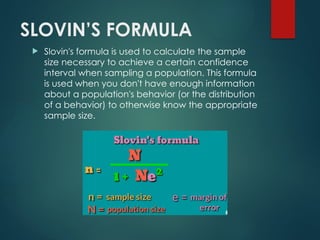
SLOVIN’S FORMULA
 Slovin's formula is used to calculate the sample
size necessary to achieve a certain confidence
interval when sampling a population. This formula
is used when you don't have enough information
about a population's behavior (or the distribution
of a behavior) to otherwise know the appropriate
sample size.
TRY THIS!
SAMPLING
 If the data you collect really are the
same as you would get from the
rest, then you can draw conclusions
from those answers which you can
relate to the whole group.
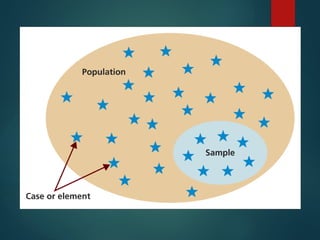
 This process of selecting just a small
group of cases from out of a large
group is called sampling.
The need to sample
Sampling- a valid alternative to a census when;
 A survey of the entire population is impracticable
 Budget constraints restrict data collection
 Time constraints restrict data collection
 Results from data collection are needed quickly
When doing a survey, the question inevitably
arises:
 how representative is the sample of the
whole population, in other words;
 how similar are characteristics of the small
group of cases that are chosen for the
survey to those of all of the cases in the
whole group?
Population in Research
 It does not necessarily mean a number
of people, it is a collective term used
to describe the total quantity of things
(or cases) of the type which are the
subject of your study.
 So a population can consist of certain
types of objects, organizations, people
or even events.
Sampling Frame
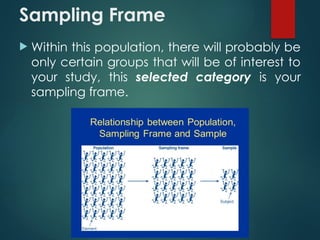
 Within this population, there will probably be
only certain groups that will be of interest to
your study, this selected category is your
sampling frame.
Populations can have the following characteristics:
Characteristics Explains Examples
homogeneous all cases are similar bottles of beer on a production line
stratified contain strata or
layers
people with different levels of income:
low, medium, high
proportional
stratified
contains strata of
known proportions
percentages of different nationalities
of students in a university
grouped by
type
contains
distinctive groups
of apartment buildings – towers, slabs,
villas, tenement blocks
grouped by
location
different groups
according to
where they are
animals in different habitats – desert,
equatorial forest, savannah, tundra
SAMPLING TECHNIQUES
Sampling techniques
 Probability sampling techniques give the most
reliable representation of the whole
population.
 Non-probability techniques, relying on the
judgment of the researcher or on accident,
cannot generally be used to make
generalizations about the whole population.
Probability Sampling
 It is a sampling technique in which sample from a
larger population are chosen using a method based
on the theory of probability.
 For a participant to be considered as a probability
sample, he/she must be selected using a random
selection.
 The most important requirement of probability
sampling is that everyone in your population has a
known and an equal chance of getting selected.
 Probability sampling uses statistical theory to select
randomly, a small group of people (sample) from
an existing large population and then predict that
all their responses together will match the overall
population.
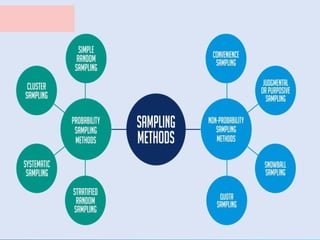
Types of Probability Sampling
 Simple random
 Stratified random
 Cluster
 Systematic
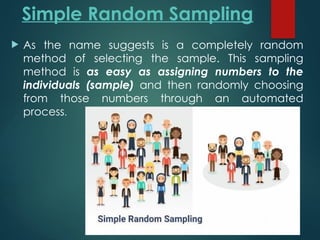
Simple Random Sampling
 As the name suggests is a completely random
method of selecting the sample. This sampling
method is as easy as assigning numbers to the
individuals (sample) and then randomly choosing
from those numbers through an automated
process.
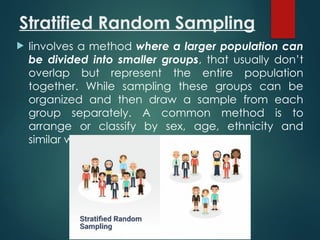
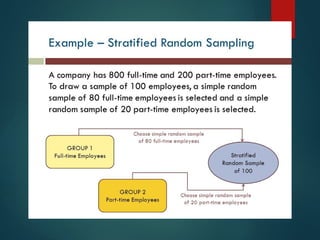
Stratified Random Sampling
 Iinvolves a method where a larger population can
be divided into smaller groups, that usually don’t
overlap but represent the entire population
together. While sampling these groups can be
organized and then draw a sample from each
group separately. A common method is to
arrange or classify by sex, age, ethnicity and
similar ways.
Cluster Random Sampling
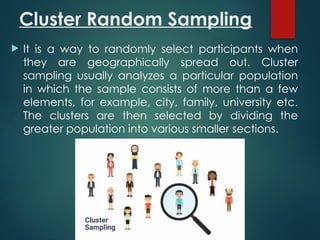
 It is a way to randomly select participants when
they are geographically spread out. Cluster
sampling usually analyzes a particular population
in which the sample consists of more than a few
elements, for example, city, family, university etc.
The clusters are then selected by dividing the
greater population into various smaller sections.
Systematic Sampling
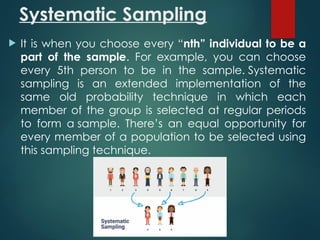
 It is when you choose every “nth” individual to be a
part of the sample. For example, you can choose
every 5th person to be in the sample. Systematic
sampling is an extended implementation of the
same old probability technique in which each
member of the group is selected at regular periods
to form a sample. There’s an equal opportunity for
every member of a population to be selected using
this sampling technique.
Types of Non-probability Sampling
 Convenience
 Judgemental
 Snowball
 Quota
Convenience Sampling
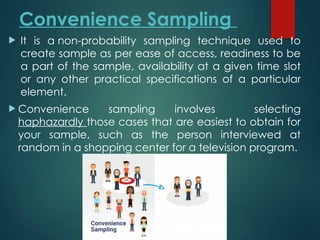
 It is a non-probability sampling technique used to
create sample as per ease of access, readiness to be
a part of the sample, availability at a given time slot
or any other practical specifications of a particular
element.
 Convenience sampling involves selecting
haphazardly those cases that are easiest to obtain for
your sample, such as the person interviewed at
random in a shopping center for a television program.
Judgmental Sampling
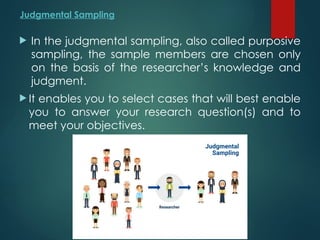
 In the judgmental sampling, also called purposive
sampling, the sample members are chosen only
on the basis of the researcher’s knowledge and
judgment.
 It enables you to select cases that will best enable
you to answer your research question(s) and to
meet your objectives.
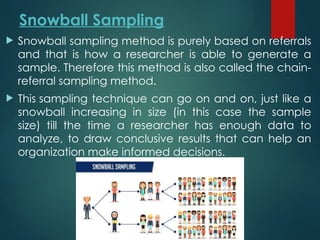
Snowball Sampling
 Snowball sampling method is purely based on referrals
and that is how a researcher is able to generate a
sample. Therefore this method is also called the chain-
referral sampling method.
 This sampling technique can go on and on, just like a
snowball increasing in size (in this case the sample
size) till the time a researcher has enough data to
analyze, to draw conclusive results that can help an
organization make informed decisions.
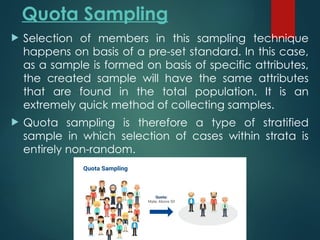
Quota Sampling
 Selection of members in this sampling technique
happens on basis of a pre-set standard. In this case,
as a sample is formed on basis of specific attributes,
the created sample will have the same attributes
that are found in the total population. It is an
extremely quick method of collecting samples.
 Quota sampling is therefore a type of stratified
sample in which selection of cases within strata is
entirely non-random.
Sample-Size-and-Sampling-Techniques 2.pptx

  • 1.
  • 2.
    WHAT IS SAMPLESIZE?  This is a sub-population to be studied in order to make an inference to a reference population.  In census, the sample size is equal to the population size. However, in research, because of time constraint and budget, a representative sample are normally used.  The larger the sample size the more accurate the findings from a study.
  • 3.
    SLOVIN’S FORMULA  Slovin'sformula is used to calculate the sample size necessary to achieve a certain confidence interval when sampling a population. This formula is used when you don't have enough information about a population's behavior (or the distribution of a behavior) to otherwise know the appropriate sample size.
  • 4.
  • 5.
    SAMPLING  If thedata you collect really are the same as you would get from the rest, then you can draw conclusions from those answers which you can relate to the whole group.  This process of selecting just a small group of cases from out of a large group is called sampling.
  • 7.
    The need tosample Sampling- a valid alternative to a census when;  A survey of the entire population is impracticable  Budget constraints restrict data collection  Time constraints restrict data collection  Results from data collection are needed quickly
  • 8.
    When doing asurvey, the question inevitably arises:  how representative is the sample of the whole population, in other words;  how similar are characteristics of the small group of cases that are chosen for the survey to those of all of the cases in the whole group?
  • 9.
    Population in Research It does not necessarily mean a number of people, it is a collective term used to describe the total quantity of things (or cases) of the type which are the subject of your study.  So a population can consist of certain types of objects, organizations, people or even events.
  • 10.
    Sampling Frame  Withinthis population, there will probably be only certain groups that will be of interest to your study, this selected category is your sampling frame.
  • 11.
    Populations can havethe following characteristics: Characteristics Explains Examples homogeneous all cases are similar bottles of beer on a production line stratified contain strata or layers people with different levels of income: low, medium, high proportional stratified contains strata of known proportions percentages of different nationalities of students in a university grouped by type contains distinctive groups of apartment buildings – towers, slabs, villas, tenement blocks grouped by location different groups according to where they are animals in different habitats – desert, equatorial forest, savannah, tundra
  • 12.
  • 13.
  • 14.
     Probability samplingtechniques give the most reliable representation of the whole population.  Non-probability techniques, relying on the judgment of the researcher or on accident, cannot generally be used to make generalizations about the whole population.
  • 15.
    Probability Sampling  Itis a sampling technique in which sample from a larger population are chosen using a method based on the theory of probability.  For a participant to be considered as a probability sample, he/she must be selected using a random selection.  The most important requirement of probability sampling is that everyone in your population has a known and an equal chance of getting selected.  Probability sampling uses statistical theory to select randomly, a small group of people (sample) from an existing large population and then predict that all their responses together will match the overall population.
  • 16.
    Types of ProbabilitySampling  Simple random  Stratified random  Cluster  Systematic
  • 17.
    Simple Random Sampling As the name suggests is a completely random method of selecting the sample. This sampling method is as easy as assigning numbers to the individuals (sample) and then randomly choosing from those numbers through an automated process.
  • 18.
    Stratified Random Sampling Iinvolves a method where a larger population can be divided into smaller groups, that usually don’t overlap but represent the entire population together. While sampling these groups can be organized and then draw a sample from each group separately. A common method is to arrange or classify by sex, age, ethnicity and similar ways.
  • 20.
    Cluster Random Sampling It is a way to randomly select participants when they are geographically spread out. Cluster sampling usually analyzes a particular population in which the sample consists of more than a few elements, for example, city, family, university etc. The clusters are then selected by dividing the greater population into various smaller sections.
  • 22.
    Systematic Sampling  Itis when you choose every “nth” individual to be a part of the sample. For example, you can choose every 5th person to be in the sample. Systematic sampling is an extended implementation of the same old probability technique in which each member of the group is selected at regular periods to form a sample. There’s an equal opportunity for every member of a population to be selected using this sampling technique.
  • 23.
    Types of Non-probabilitySampling  Convenience  Judgemental  Snowball  Quota
  • 24.
    Convenience Sampling  Itis a non-probability sampling technique used to create sample as per ease of access, readiness to be a part of the sample, availability at a given time slot or any other practical specifications of a particular element.  Convenience sampling involves selecting haphazardly those cases that are easiest to obtain for your sample, such as the person interviewed at random in a shopping center for a television program.
  • 25.
    Judgmental Sampling  Inthe judgmental sampling, also called purposive sampling, the sample members are chosen only on the basis of the researcher’s knowledge and judgment.  It enables you to select cases that will best enable you to answer your research question(s) and to meet your objectives.
  • 26.
    Snowball Sampling  Snowballsampling method is purely based on referrals and that is how a researcher is able to generate a sample. Therefore this method is also called the chain- referral sampling method.  This sampling technique can go on and on, just like a snowball increasing in size (in this case the sample size) till the time a researcher has enough data to analyze, to draw conclusive results that can help an organization make informed decisions.
  • 27.
    Quota Sampling  Selectionof members in this sampling technique happens on basis of a pre-set standard. In this case, as a sample is formed on basis of specific attributes, the created sample will have the same attributes that are found in the total population. It is an extremely quick method of collecting samples.  Quota sampling is therefore a type of stratified sample in which selection of cases within strata is entirely non-random.