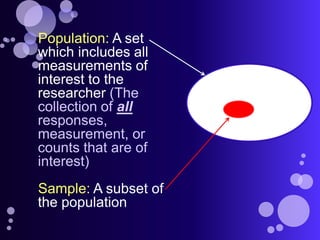
Population: A set
which includes all
measurements of
interest to the
researcher (The
collection of all
responses,
measurement, or
counts that are of
interest)
Sample: A subset of
the population
Target Population: The
population to be studied/ to
which the investigator wants to
generalize his results
Sampling Unit: Smallest unit
from which sample can be
selected
Sampling Frame: List of all the
sampling units from which
sample is drawn
Sampling Scheme: Method of
selecting sampling units from
sampling frame
Section 1

Section 2

Section 3

Section 5

Section 4
Sample size
Quantitative
n

2σ 2
Z
D2

2
(σ1  σ 2 )xF
2
n
2
D

Qualitative
Z2 π(1  π)
n
D2

2 P (1 - P) F
n
D2
Sampling theory

Sampling theory

  • 2.
    Population: A set whichincludes all measurements of interest to the researcher (The collection of all responses, measurement, or counts that are of interest) Sample: A subset of the population
  • 4.
    Target Population: The populationto be studied/ to which the investigator wants to generalize his results Sampling Unit: Smallest unit from which sample can be selected Sampling Frame: List of all the sampling units from which sample is drawn Sampling Scheme: Method of selecting sampling units from sampling frame
  • 13.
    Section 1 Section 2 Section3 Section 5 Section 4
  • 14.
    Sample size Quantitative n 2σ 2 Z D2 2 (σ1 σ 2 )xF 2 n 2 D Qualitative Z2 π(1  π) n D2 2 P (1 - P) F n D2