A process of selecting units from a population A process of selecting a sample to determine certain characteristics of a population A sample is a subset of a larger population of objects individuals,  households, businesses, organizations and so forth. Concept of sampling
Sampling enables researchers to make estimates of some unknown characteristics of the population in question A finite group is called population whereas a non-finite (infinite) group is called universe A census is a investigation of all the individual elements of a population
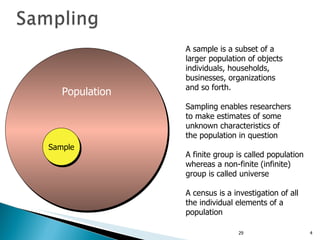
29 Population Sample A sample is a subset of a larger population of objects individuals, households, businesses, organizations and so forth. Sampling enables researchers to make estimates of some  unknown characteristics of  the population in question A finite group is called population whereas a non-finite (infinite)  group is called universe A census is a investigation of all the individual elements of a  population
Get information about large populations Less costs Less field time More accuracy i.e.  Can Do A Better Job of Data Collection When it’s impossible to study the whole population Why sampling
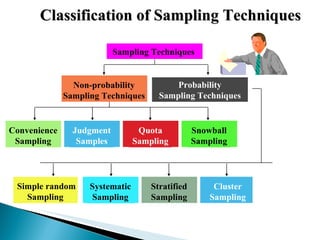
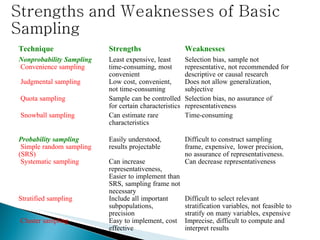
Classification of Sampling Techniques Probability Sampling Techniques Stratified Sampling Cluster Sampling Simple random Sampling Sampling Techniques  Non-probability Sampling Techniques Convenience Sampling Judgment Samples Quota Sampling Snowball Sampling Systematic Sampling
Probability Sampling:  utilizes some form of  random selection.  A probability sample is a sample in which every element of the population has a known and equal probability of being selected into the sample.  Non-probability sampling : does not involve random selection
Simple random Stratified random Systematic random Cluster/area random Multi-stage random
Non-probability Sampling are of following types Convenience Sampling    Judgment Sampling  Quota Sampling    Snow ball Sampling
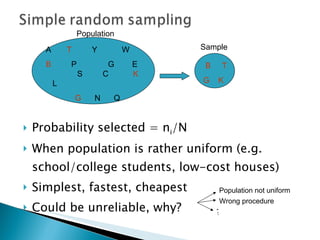
Probability selected = n i /N When population is rather uniform (e.g. school/college students, low-cost houses) Simplest, fastest, cheapest Could be unreliable, why? A  T   Y  W B   P  G  E  S  C  K   L  G   N  Q B   T G   K Population Sample Population not uniform Wrong procedure ?
Pick any “element”  Use random table
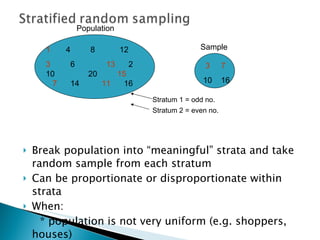
Break population into “meaningful” strata and take random sample from each stratum Can be proportionate or disproportionate within strata When: * population is not very uniform (e.g. shoppers, houses) * key sub-groups need to be represented -> more  precision * variability within group affects research results 1   4  8  12 3   6  13   2  10  20  15   7   14  11   16  3   7 10  16 Population Sample Stratum 2 = even no. Stratum 1 = odd no.
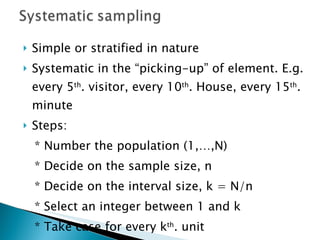
Simple or stratified in nature Systematic in the “picking-up” of element. E.g. every 5 th . visitor, every 10 th . House, every 15 th . minute Steps: * Number the population (1,…,N) * Decide on the sample size, n * Decide on the interval size, k = N/n * Select an integer between 1 and k * Take case for every k th . unit
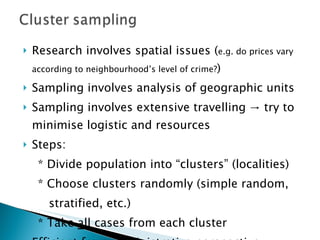
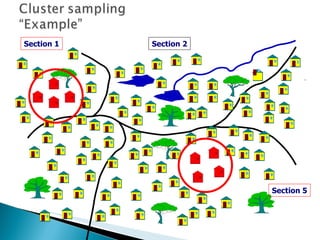
Research involves spatial issues ( e.g. do prices vary according to neighbourhood’s level of crime? ) Sampling involves analysis of geographic units  Sampling involves extensive travelling -> try to minimise logistic and resources Steps: * Divide population into “clusters” (localities) * Choose clusters randomly (simple random,  stratified, etc.) * Take  all  cases from each cluster Efficient from administrative perspective
Section 5 Section 2 Section 1
Convenience Samples Non-probability samples used primarily because they are easy to collect. Judgment Samples Non-probability samples in which the selection criteria are based on personal judgment that the element is representative of the population under study.
Quota Samples Non-probability samples in which population subgroups are classified on the basis of researcher judgment. Snowball Samples Non-probability samples in which selection of additional respondents is based on referrals from the initial respondents.
 
Thank you!

050 sampling theory

  • 1.
  • 2.
    A process ofselecting units from a population A process of selecting a sample to determine certain characteristics of a population A sample is a subset of a larger population of objects individuals, households, businesses, organizations and so forth. Concept of sampling
  • 3.
    Sampling enables researchersto make estimates of some unknown characteristics of the population in question A finite group is called population whereas a non-finite (infinite) group is called universe A census is a investigation of all the individual elements of a population
  • 4.
    29 Population SampleA sample is a subset of a larger population of objects individuals, households, businesses, organizations and so forth. Sampling enables researchers to make estimates of some unknown characteristics of the population in question A finite group is called population whereas a non-finite (infinite) group is called universe A census is a investigation of all the individual elements of a population
  • 5.
    Get information aboutlarge populations Less costs Less field time More accuracy i.e. Can Do A Better Job of Data Collection When it’s impossible to study the whole population Why sampling
  • 6.
    Classification of SamplingTechniques Probability Sampling Techniques Stratified Sampling Cluster Sampling Simple random Sampling Sampling Techniques Non-probability Sampling Techniques Convenience Sampling Judgment Samples Quota Sampling Snowball Sampling Systematic Sampling
  • 7.
    Probability Sampling: utilizes some form of random selection. A probability sample is a sample in which every element of the population has a known and equal probability of being selected into the sample. Non-probability sampling : does not involve random selection
  • 8.
    Simple random Stratifiedrandom Systematic random Cluster/area random Multi-stage random
  • 9.
    Non-probability Sampling areof following types Convenience Sampling Judgment Sampling Quota Sampling Snow ball Sampling
  • 10.
    Probability selected =n i /N When population is rather uniform (e.g. school/college students, low-cost houses) Simplest, fastest, cheapest Could be unreliable, why? A T Y W B P G E S C K L G N Q B T G K Population Sample Population not uniform Wrong procedure ?
  • 11.
    Pick any “element” Use random table
  • 12.
    Break population into“meaningful” strata and take random sample from each stratum Can be proportionate or disproportionate within strata When: * population is not very uniform (e.g. shoppers, houses) * key sub-groups need to be represented -> more precision * variability within group affects research results 1 4 8 12 3 6 13 2 10 20 15 7 14 11 16 3 7 10 16 Population Sample Stratum 2 = even no. Stratum 1 = odd no.
  • 13.
    Simple or stratifiedin nature Systematic in the “picking-up” of element. E.g. every 5 th . visitor, every 10 th . House, every 15 th . minute Steps: * Number the population (1,…,N) * Decide on the sample size, n * Decide on the interval size, k = N/n * Select an integer between 1 and k * Take case for every k th . unit
  • 14.
    Research involves spatialissues ( e.g. do prices vary according to neighbourhood’s level of crime? ) Sampling involves analysis of geographic units Sampling involves extensive travelling -> try to minimise logistic and resources Steps: * Divide population into “clusters” (localities) * Choose clusters randomly (simple random, stratified, etc.) * Take all cases from each cluster Efficient from administrative perspective
  • 15.
    Section 5 Section2 Section 1
  • 16.
    Convenience Samples Non-probabilitysamples used primarily because they are easy to collect. Judgment Samples Non-probability samples in which the selection criteria are based on personal judgment that the element is representative of the population under study.
  • 17.
    Quota Samples Non-probabilitysamples in which population subgroups are classified on the basis of researcher judgment. Snowball Samples Non-probability samples in which selection of additional respondents is based on referrals from the initial respondents.
  • 18.
  • 19.