Non Probability Sampling

Presented By
Prashant Benki
Non Probability Sampling
• Unequal chance of being included in the
sample (non-random)
• Non random or non - probability sampling
refers to the sampling process in which, the
samples are selected for a specific purpose
with a pre-determined basis of selection.
Types of Non Probability Sampling
•
•
•
•

Convenience sampling
Judgment sampling
Quota sampling
Snowball sampling
Convenience sampling
This method of sampling involves
selecting the sample elements using some
convenient method without going through the
rigour (extrmenes) of sampling method. The
researcher may make use of any convenient base
to select the required number of samples.
A type of non probability sampling
which involves the sample being drawn from that
part of the population which is close to hand.
That is, readily available and convenient.
Convenience sampling….
• For example, suppose 100 car owners are to
be selected. Then we may collect from the
RTO's office the list of car owners and then
make a selection of 100 from that to form the
sample.
Judgemental Sampling
• In this method, the sample selection is purely
based on the judgement of the investigator or
the researcher. This is because, the researcher
may lack information regarding the population
from which he has to collect the sample.
Population characteristics or qualities may not
be known, but sample has to be selected.
Judgemental Sampling…
• For example, suppose 100 boys are to be selected
from a college with 1000 boys. If nothing is
known about the students in this college, then
the investigator may visit the college and choose
the first 100 boys he meets. Or he may select
100 boys all belonging to III Year. Or he might
select 25 boys from Commerce course, 25 from
Science courses, 25 boys from Arts courses and
25 from Fine arts courses. Hence, when only the
sample size is known, the investigator uses his
discretion and select the sample.
Quota Sampling
• In this method, the sample size is determined
first and then quota is fixed for various categories
of population, which is followed while selecting
the sample.
• In this method the quota has to be determined in
advance and intimated to the investigator. The
quota for each segment of the population may be
fixed at random or with a specific basis. Normally
such a sampling method does not ensure
representativeness of the population.
Quota Sampling…
• Example: Suppose we want to select 100
students, then we might say that the sample
should be according to the quota given below
: Boys 50%, Girls 50% Then among the boys,
20% college students, 40% plus two students,
30% high school students and 10% elementary
school students. A different or the same
quota may be fixed for the girls.
Snowball Sampling
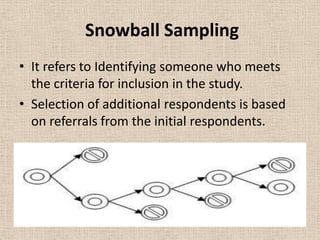
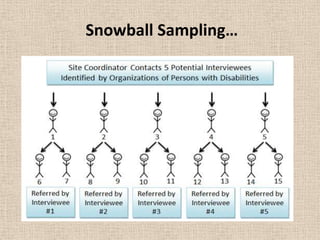
• It refers to Identifying someone who meets
the criteria for inclusion in the study.
• Selection of additional respondents is based
on referrals from the initial respondents.
Snowball Sampling…
Non probability sampling methods

Non probability sampling methods

  • 2.
  • 3.
    Non Probability Sampling •Unequal chance of being included in the sample (non-random) • Non random or non - probability sampling refers to the sampling process in which, the samples are selected for a specific purpose with a pre-determined basis of selection.
  • 4.
    Types of NonProbability Sampling • • • • Convenience sampling Judgment sampling Quota sampling Snowball sampling
  • 5.
    Convenience sampling This methodof sampling involves selecting the sample elements using some convenient method without going through the rigour (extrmenes) of sampling method. The researcher may make use of any convenient base to select the required number of samples. A type of non probability sampling which involves the sample being drawn from that part of the population which is close to hand. That is, readily available and convenient.
  • 6.
    Convenience sampling…. • Forexample, suppose 100 car owners are to be selected. Then we may collect from the RTO's office the list of car owners and then make a selection of 100 from that to form the sample.
  • 7.
    Judgemental Sampling • Inthis method, the sample selection is purely based on the judgement of the investigator or the researcher. This is because, the researcher may lack information regarding the population from which he has to collect the sample. Population characteristics or qualities may not be known, but sample has to be selected.
  • 8.
    Judgemental Sampling… • Forexample, suppose 100 boys are to be selected from a college with 1000 boys. If nothing is known about the students in this college, then the investigator may visit the college and choose the first 100 boys he meets. Or he may select 100 boys all belonging to III Year. Or he might select 25 boys from Commerce course, 25 from Science courses, 25 boys from Arts courses and 25 from Fine arts courses. Hence, when only the sample size is known, the investigator uses his discretion and select the sample.
  • 9.
    Quota Sampling • Inthis method, the sample size is determined first and then quota is fixed for various categories of population, which is followed while selecting the sample. • In this method the quota has to be determined in advance and intimated to the investigator. The quota for each segment of the population may be fixed at random or with a specific basis. Normally such a sampling method does not ensure representativeness of the population.
  • 10.
    Quota Sampling… • Example:Suppose we want to select 100 students, then we might say that the sample should be according to the quota given below : Boys 50%, Girls 50% Then among the boys, 20% college students, 40% plus two students, 30% high school students and 10% elementary school students. A different or the same quota may be fixed for the girls.
  • 11.
    Snowball Sampling • Itrefers to Identifying someone who meets the criteria for inclusion in the study. • Selection of additional respondents is based on referrals from the initial respondents.
  • 12.