-ALEN PHILIP-
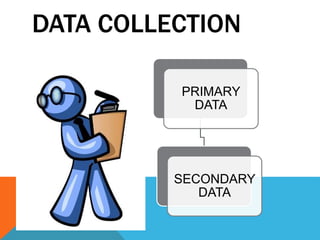
DATA COLLECTION
PRIMARY
DATA
SECONDARY
DATA
PRIMARY DATA
Primary data is the
data collected directly
from the respondent
by the researcher
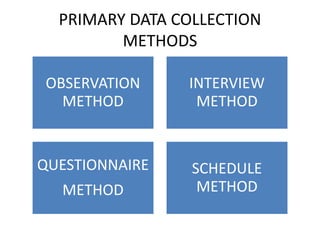
PRIMARY DATA COLLECTION
METHODS
OBSERVATION
METHOD
INTERVIEW
METHOD
QUESTIONNAIRE
METHOD
SCHEDULE
METHOD
1.OBSERVATION METHOD
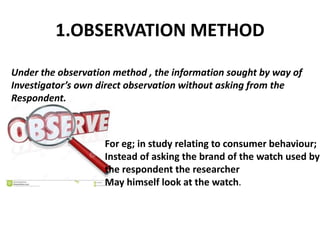
Under the observation method , the information sought by way of
Investigator’s own direct observation without asking from the
Respondent.
For eg; in study relating to consumer behaviour;
Instead of asking the brand of the watch used by
the respondent the researcher
May himself look at the watch.
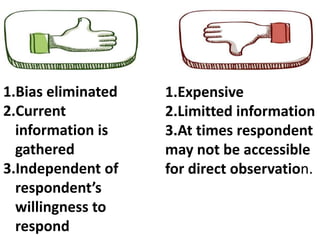
1.Bias eliminated
2.Current
information is
gathered
3.Independent of
respondent’s
willingness to
respond
1.Expensive
2.Limitted information
3.At times respondent
may not be accessible
for direct observation.
INTERVIEW METHOD
This method of collecting
Data involves oral – verbal
Communications where
Interviewer ask questions and
Respondent give answers.
there are 2 types of interviews;
1. Personal interview
2. Telephonic interview
1.Personal interview
 Personal interview is a face to face interaction
between the interviewer and respondent
2.Telephonic interview
 interviewing a person by means of a telephone
QUESTIONNAIRE METHOD
• A questionnaire is a research instrument
consisting of a series of questions and other
prompts for the purpose of
gathering information from respondents.
 Practical
 Large amounts of information can be collected from a large
number of people in a short period of time and in a
relatively cost effective way
 Can be carried out by the researcher or by any number of
people with limited affect to its validity and reliability
 The results of the questionnaires can usually be quickly
and easily quantified by either a researcher or through the
use of a software package
 Can be analysed more 'scientifically' and objectively than
other forms of research
 When data has been quantified, it can be used to compare
and contrast other research and may be used to measure
change
 Positivists believe that quantitative data can be used to
create new theories and / or test existing hypotheses
•
Is argued to be inadequate to understand some
forms
of information - i.e. changes of emotions, behaviour,
feelings etc.
•Phenomenologists state that quantitative research is
simply an artificial creation by the researcher, as it is
asking only a limited amount of information without
explanation
•Lacks validity
•There is no way to tell how truthful a respondent is
being
•There is no way of telling how much thought a
respondent has put in
SCHEDULE METHOD
 Schedule is the tool or instrument used
to collect data from the respondents
while interview is conducted. Schedule
contains questions, statements (on
which opinions are elicited) and blank
spaces/tables for filling up the
respondents.
 The schedule is presented by the
interviewer. The questions are asked
and the answers are noted down by
him. The list of questions is a more
formal document, it need not be
attractive.
 Questionnaire: It is a set of questions
typed or printed and sent to the
respondents through mail are post
which should be returned back after
answering.

Schedule: It is a set of questions which
has to be filled by enumerators by
asking questions to the respondents.
QUESTIONNAIRE V/S SCHEDULE
THANKS

data collection primary secondary methods

  • 1.
  • 2.
  • 3.
    PRIMARY DATA Primary datais the data collected directly from the respondent by the researcher
  • 4.
  • 5.
    1.OBSERVATION METHOD Under theobservation method , the information sought by way of Investigator’s own direct observation without asking from the Respondent. For eg; in study relating to consumer behaviour; Instead of asking the brand of the watch used by the respondent the researcher May himself look at the watch.
  • 6.
    1.Bias eliminated 2.Current information is gathered 3.Independentof respondent’s willingness to respond 1.Expensive 2.Limitted information 3.At times respondent may not be accessible for direct observation.
  • 7.
    INTERVIEW METHOD This methodof collecting Data involves oral – verbal Communications where Interviewer ask questions and Respondent give answers. there are 2 types of interviews; 1. Personal interview 2. Telephonic interview
  • 8.
    1.Personal interview  Personalinterview is a face to face interaction between the interviewer and respondent 2.Telephonic interview  interviewing a person by means of a telephone
  • 9.
    QUESTIONNAIRE METHOD • Aquestionnaire is a research instrument consisting of a series of questions and other prompts for the purpose of gathering information from respondents.
  • 10.
     Practical  Largeamounts of information can be collected from a large number of people in a short period of time and in a relatively cost effective way  Can be carried out by the researcher or by any number of people with limited affect to its validity and reliability  The results of the questionnaires can usually be quickly and easily quantified by either a researcher or through the use of a software package  Can be analysed more 'scientifically' and objectively than other forms of research  When data has been quantified, it can be used to compare and contrast other research and may be used to measure change  Positivists believe that quantitative data can be used to create new theories and / or test existing hypotheses
  • 11.
    • Is argued tobe inadequate to understand some forms of information - i.e. changes of emotions, behaviour, feelings etc. •Phenomenologists state that quantitative research is simply an artificial creation by the researcher, as it is asking only a limited amount of information without explanation •Lacks validity •There is no way to tell how truthful a respondent is being •There is no way of telling how much thought a respondent has put in
  • 12.
    SCHEDULE METHOD  Scheduleis the tool or instrument used to collect data from the respondents while interview is conducted. Schedule contains questions, statements (on which opinions are elicited) and blank spaces/tables for filling up the respondents.  The schedule is presented by the interviewer. The questions are asked and the answers are noted down by him. The list of questions is a more formal document, it need not be attractive.
  • 13.
     Questionnaire: Itis a set of questions typed or printed and sent to the respondents through mail are post which should be returned back after answering.  Schedule: It is a set of questions which has to be filled by enumerators by asking questions to the respondents. QUESTIONNAIRE V/S SCHEDULE
  • 14.