Sampling
Made by: Naiya Virani
4th yr BDS
introduction
 Sampling is procedure of making decisions by studying a
few items regarding characteristics of items in a
universe.
larger population
Small area
SAMPLING UNIT:
is single member of sample
SAMPLE FRAME:
is a list or map of population identifying each sampling unit by a number
Sample size:
is dependent on the statistical characteristics of data to be collected.
Ideal requirements
 Efficiency: it is ability of sample to yield desired information.
 Representativeness : a sample should be representative of parent
population.
 Measurability: design of sample should be such as that valid
estimate of its variability can be made.
 Size: a sample should be large enough to minimize sample variability
to allow estimates of population characteristic to be made with
measurable precision.
 Coverage: adequate coverage is essential if sample has to remain
representative.
 Goal orientation: sample selection should be oriented towards study
objectives and research design.
 Feasibility: design should be sample enough to be carried out in
practice.
 Economy and cost-efficiency: sample should be such that it should
yield desired information with appreciable savings in time & cost.
Actual sample
selection can be
accomplished in
two basic ways
Purposive selection: purposively
select individuals who seem to represent
population under study.
Random selection: this possible by
selecting units of sample at random. A sample
in which each can get equal chance to
participate.
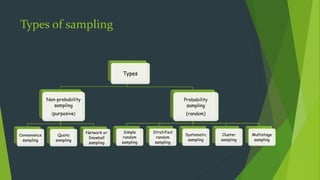
Types of sampling
Types
Non-probability
sampling
(purposive)
Convenience
sampling
Quota
sampling
Network or
Snowball
sampling
Probability
sampling
(random)
Simple
random
sampling
Stratified
random
sampling
Systematic
sampling
Cluster
sampling
Multistage
sampling
Non - probability sample
convenience sampling
 It is done for administrative convenience with the ease of access
being the sole concern.
 It is also known as accidental accessibility ,incidental or haphazard
sampling.
 Inexpensive, less time consuming & accessible.
 Result from the sample are rarely representative because they are
generally biased
 It lacks “representativeness” .
quota sampling
 It is combination of convenience & purposive sampling.
convenience – biased
purposive – certain criteria
 In this type , statistical design may be used to determine the
numbers needed in each of quota.
 Each investigator is allotted a quota of person to be interviewed.
quota with some specified characteristics.
 All persons in a population do not have an equal chance of being
selected.
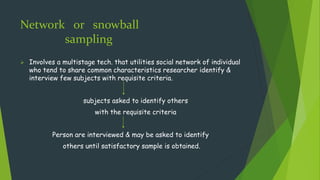
Network or snowball
sampling
 Involves a multistage tech. that utilities social network of individual
who tend to share common characteristics researcher identify &
interview few subjects with requisite criteria.
subjects asked to identify others
with the requisite criteria
Person are interviewed & may be asked to identify
others until satisfactory sample is obtained.
Probability sampling
Simple random sampling
 In this method, every member of population has an equal chance of
being selected in sample.
 It applicable when population is very small,
homogenous & readily available.
 The randomness of sample is achieved by use of
lottery method or table of random numbers.
 Advantages: personal bias of investigator will not harm the
selection – because it depends upon chance.
 Disadvantage: selection of sample can become costly & time
consuming.
• It may fail to depict true characteristics in a large
heterogenous population.
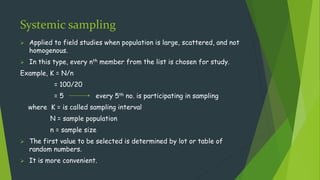
Systemic sampling
 Applied to field studies when population is large, scattered, and not
homogenous.
 In this type, every nth member from the list is chosen for study.
Example, K = N/n
= 100/20
= 5 every 5th no. is participating in sampling
where K = is called sampling interval
N = sample population
n = sample size
 The first value to be selected is determined by lot or table of
random numbers.
 It is more convenient.
 Advantages:
• More representative than other sampling.
• Time & labour in collection of sample is relatively small.
• Give accurate results when population is large.
 Disadvantage:
• Process might skip significant portion of the population that is grouped
together on the list.
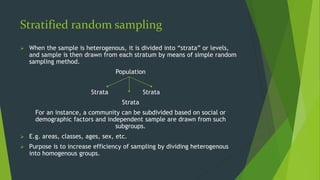
Stratified random sampling
 When the sample is heterogenous, it is divided into “strata” or levels,
and sample is then drawn from each stratum by means of simple random
sampling method.
Population
Strata Strata
Strata
For an instance, a community can be subdivided based on social or
demographic factors and independent sample are drawn from such
subgroups.
 E.g. areas, classes, ages, sex, etc.
 Purpose is to increase efficiency of sampling by dividing heterogenous
into homogenous groups.
Cluster sampling
 Any method of sampling wherein group is taken as a sampling unit is
known as cluster sampling.
 This method is used when population forms natural groups or
cluster such as villages, wards, blocks or school.
 It is more convenient for administrative & economic reasons.
Multistage sampling
 In this type, there are progressively higher levels of subsampling.
 This method refers to sampling procedures carried out in several
stages using random sampling tech.
 The process of drawing sample from selected cluster.
 The simple random sampling method is used to draw sample.
Example, Country
1 stage
states
2 stage
districts
3 stage
taluks
4 stage
village
5 stage
school
Thank you

Sampling in public health dentistry

  • 1.
    Sampling Made by: NaiyaVirani 4th yr BDS
  • 2.
    introduction  Sampling isprocedure of making decisions by studying a few items regarding characteristics of items in a universe. larger population Small area
  • 3.
    SAMPLING UNIT: is singlemember of sample SAMPLE FRAME: is a list or map of population identifying each sampling unit by a number Sample size: is dependent on the statistical characteristics of data to be collected.
  • 4.
    Ideal requirements  Efficiency:it is ability of sample to yield desired information.  Representativeness : a sample should be representative of parent population.  Measurability: design of sample should be such as that valid estimate of its variability can be made.  Size: a sample should be large enough to minimize sample variability to allow estimates of population characteristic to be made with measurable precision.  Coverage: adequate coverage is essential if sample has to remain representative.
  • 5.
     Goal orientation:sample selection should be oriented towards study objectives and research design.  Feasibility: design should be sample enough to be carried out in practice.  Economy and cost-efficiency: sample should be such that it should yield desired information with appreciable savings in time & cost.
  • 6.
    Actual sample selection canbe accomplished in two basic ways Purposive selection: purposively select individuals who seem to represent population under study. Random selection: this possible by selecting units of sample at random. A sample in which each can get equal chance to participate.
  • 7.
    Types of sampling Types Non-probability sampling (purposive) Convenience sampling Quota sampling Networkor Snowball sampling Probability sampling (random) Simple random sampling Stratified random sampling Systematic sampling Cluster sampling Multistage sampling
  • 8.
    Non - probabilitysample convenience sampling  It is done for administrative convenience with the ease of access being the sole concern.  It is also known as accidental accessibility ,incidental or haphazard sampling.  Inexpensive, less time consuming & accessible.  Result from the sample are rarely representative because they are generally biased  It lacks “representativeness” .
  • 9.
    quota sampling  Itis combination of convenience & purposive sampling. convenience – biased purposive – certain criteria  In this type , statistical design may be used to determine the numbers needed in each of quota.  Each investigator is allotted a quota of person to be interviewed. quota with some specified characteristics.  All persons in a population do not have an equal chance of being selected.
  • 10.
    Network or snowball sampling Involves a multistage tech. that utilities social network of individual who tend to share common characteristics researcher identify & interview few subjects with requisite criteria. subjects asked to identify others with the requisite criteria Person are interviewed & may be asked to identify others until satisfactory sample is obtained.
  • 11.
    Probability sampling Simple randomsampling  In this method, every member of population has an equal chance of being selected in sample.  It applicable when population is very small, homogenous & readily available.  The randomness of sample is achieved by use of lottery method or table of random numbers.
  • 12.
     Advantages: personalbias of investigator will not harm the selection – because it depends upon chance.  Disadvantage: selection of sample can become costly & time consuming. • It may fail to depict true characteristics in a large heterogenous population.
  • 13.
    Systemic sampling  Appliedto field studies when population is large, scattered, and not homogenous.  In this type, every nth member from the list is chosen for study. Example, K = N/n = 100/20 = 5 every 5th no. is participating in sampling where K = is called sampling interval N = sample population n = sample size  The first value to be selected is determined by lot or table of random numbers.  It is more convenient.
  • 14.
     Advantages: • Morerepresentative than other sampling. • Time & labour in collection of sample is relatively small. • Give accurate results when population is large.  Disadvantage: • Process might skip significant portion of the population that is grouped together on the list.
  • 15.
    Stratified random sampling When the sample is heterogenous, it is divided into “strata” or levels, and sample is then drawn from each stratum by means of simple random sampling method. Population Strata Strata Strata For an instance, a community can be subdivided based on social or demographic factors and independent sample are drawn from such subgroups.  E.g. areas, classes, ages, sex, etc.  Purpose is to increase efficiency of sampling by dividing heterogenous into homogenous groups.
  • 16.
    Cluster sampling  Anymethod of sampling wherein group is taken as a sampling unit is known as cluster sampling.  This method is used when population forms natural groups or cluster such as villages, wards, blocks or school.  It is more convenient for administrative & economic reasons.
  • 17.
    Multistage sampling  Inthis type, there are progressively higher levels of subsampling.  This method refers to sampling procedures carried out in several stages using random sampling tech.  The process of drawing sample from selected cluster.  The simple random sampling method is used to draw sample.
  • 18.
    Example, Country 1 stage states 2stage districts 3 stage taluks 4 stage village 5 stage school
  • 19.