CHARACTERISTICS OF GOOD SAMPLEING , And PROCESS:-
CONTENTS:-
• INTRODUCTION
• MEANING
• DEFINATION
• CHARACTERISTICS
• IMPORTANCE
• PROCESS
INTRODUCTION
Sampling is a process of selecting representative units from an entire population of
a study. Sample in not always possible to study an entire population therefore, the
researcher draws a representative part of a population through sampling process.
In research, sampling is a crucial technique that involves selecting a subset of
individuals from a larger population to participate in a study. This approach is often
necessary because it's impractical, and sometimes impossible, to study an entire
population directly due to time, cost, or logistical constraints.
Meaning Of sampling :-
• A sample is a subset of individuals from a larger population. Sampling means
selecting the group that you will actually collect data from in your research .
• For ex:- If you are researching the opinions of students in your university, you could
survey a sample of 100 students.
• In statistics, sampling allows you to test a hypothesis about the characteristics of a
population.
Definition:-
Sampling is the process of selecting a small number of elements from a
larger defined target group of elements such that the information gathered from the
small group will allow judgements to be made about the larger groups.
Characteristics of Good Sampling:-
Goal orientation
Measurability
Practicality
Economy
Independence
Homogeneity
Adequate
Characteristics of Good Sampling:-
Goal orientation in sampling refers to the strategic approach taken in selecting
samples for research or data collection based on the specific objectives or goals of the
study. This orientation ensures that the sampling method aligns with the desired
outcomes, providing relevant, reliable, and valid data. Here's how goal orientation can
influence sampling.
.
1.Goal orientation:-
2. Measurability:-
Measurability is a crucial characteristic in the context of good sampling and
research. It refers to the ability to quantitatively or qualitatively assess and analyse the
data collected from the sampling.
3.Practicality:-
Characteristics of Good Sampling:-
Practicality in sampling refers to the feasibility and efficiency of the sampling
process. It ensures that the sampling method chosen is not only theoretically sound but
also practically implementable within the constraints of time, resources, and accessibility.
4.Economy:-
Economy in sampling refers to the cost-effectiveness and efficiency of the sampling
process. It emphasizes achieving reliable and accurate results without incurring
unnecessary expenses or wasting resources.
Characteristics of Good Sampling:-
5.Independence:-
Independence in sampling refers to the principle that each sample unit should be
selected independently of the others. This means that the selection of one unit should
not influence the selection of another. Independence is crucial to ensure the validity and
reliability of statistical inferences.
6.Homogeneity:-
When using stratified sampling, ensure that individuals within each stratum are as
similar as possible regarding the characteristics being studied. This increases the
efficiency and accuracy of the results.
7.Adequate:-
Characteristics of Good Sampling:-
Adequacy in sampling refers to ensuring that the sample size is sufficient to
provide reliable and valid results. An adequate sample size enables researchers to draw
accurate conclusions about the population and increases the statistical power of the
study.
Importance of sampling:-
 Cost and time efficiency
 Feasibility
 Accuracy and precision
 Generalizability
 Ethical considerations
 Data quality
1.Cost and time efficiency:-
IMPORTANCE OF SAMPLING
Sampling significantly enhances cost and time efficiency in research. By focusing on
a subset of a larger population, researchers can gather and analyze data more rapidly
than if they attempted to study the entire group. This approach reduces the time needed
for data collection and processing, leading to quicker insights and decision-making.
2. Feasibility:-
Sampling enhances the feasibility of research by making it practical to study large
populations. For many research projects, it is often impractical or impossible to collect
data from every individual in the target population due to constraints such as time, cost,
and accessibility. By selecting a representative sample, researchers can conduct their
studies efficiently and effectively.
3. Accuracy and precision:-
IMPORTANCE OF SAMPLING
Sampling plays a crucial role in achieving accuracy and precision in research. Accuracy
refers to how close the sample's results are to the true values of the entire population.
while precision indicates the consistency and reliability of these results. A well-designed
sampling strategy ensures that the sample is representative of the population, thereby providing
accurate estimates of population parameters.
4. Generalizability:-
Generalizability is a fundamental aspect of sampling that allows researchers to
extend their findings from a sample to the broader population. By ensuring that the
sample accurately represents the larger group, researchers can make valid and reliable
inferences about the entire population.
IMPORTANCE OF SAMPLING
5.Ethical considerations:-
Ethical considerations in sampling refer to the principles and guidelines that
researchers follow to ensure that their sampling practices are fair, respectful, and
responsible. Sampling is the process of selecting a subset of individuals or units from a
larger population to represent that population in research or surveys.
6. Data quality:-
The quantity of data in sampling, specifically the size of the sample selected to
represent a larger population, is crucial in research methodology. Sample size directly
impacts the reliability and generalizability of study findings. A larger sample size
generally leads to more precise estimates of population parameters, and its smaller
well managed samples often allow for higher quality data collecting and more in depth
analysis then would be possible with a full population study.
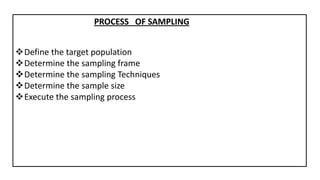
PROCESS OF SAMPLING
Define the target population
Determine the sampling frame
Determine the sampling Techniques
Determine the sample size
Execute the sampling process
1.Define the target population:-
PROCESS OF SAMPLING
Target population refers to the entire group of individuals or elements that a
researcher is interested in studying and to which they aim to generalize their findings. This
population is defined based on specific criteria relevant to the research objectives.
2. Determine the sampling frame:-
A sampling frame is a comprehensive list or device used to define the population of
interest for a study, from which a sample can be drawn. To determine an appropriate
sampling frame, one must first clearly define the target population, specifying relevant
characteristics such as geography, age, or occupation. Next, identify potential sources that
can provide a comprehensive list of the population, such as databases, public records,
directories, or online sources.
PROCESS OF SAMPLING
3.Select the sampling techniques:-
To select the appropriate sampling techniques for your study, consider the nature
of your research, the population, and available resources. Common sampling techniques
include simple random sampling, where every population member has an equal chance
of being selected, ideal for small populations with an available list. Systematic sampling
involves selecting every nth member from a list, useful for homogeneous populations.
4.Determine the sample size:-
Determining the sample size for a study is a crucial step that involves several
considerations to ensure the sample is representative of the population. The appropriate
sample size depends on the desired level of precision, confidence level, population size,
and the expected variability in the data.
5.Execute the sampling process:-
PROCESS OF SAMPLING
Executing the sampling process involves several practical steps to select the
sample from the defined population using the chosen sampling technique. First, develop
a detailed plan outlining the steps and methods, including how to access the sampling
frame, the sampling technique, and procedures for contacting selected individuals. Next,
obtain or compile the list of all members in your population.
CONCLUSION:-
The process of sampling is a critical step in research that ensures the study's findings
are reliable and generalizable to the broader population. It involves several key stages,
including defining the target population, selecting an appropriate sampling frame,
choosing a suitable sampling technique, determining the sample size, and executing the
sampling process effectively. By carefully planning and implementing each step,
researchers can obtain a representative sample that accurately reflects the population's
characteristics. This meticulous approach minimizes bias, enhances the validity of the
results, and ultimately contributes to the overall credibility and success of the research
study.

Characteristics of good Sampling and process

  • 1.
    CHARACTERISTICS OF GOODSAMPLEING , And PROCESS:- CONTENTS:- • INTRODUCTION • MEANING • DEFINATION • CHARACTERISTICS • IMPORTANCE • PROCESS
  • 2.
    INTRODUCTION Sampling is aprocess of selecting representative units from an entire population of a study. Sample in not always possible to study an entire population therefore, the researcher draws a representative part of a population through sampling process. In research, sampling is a crucial technique that involves selecting a subset of individuals from a larger population to participate in a study. This approach is often necessary because it's impractical, and sometimes impossible, to study an entire population directly due to time, cost, or logistical constraints.
  • 3.
    Meaning Of sampling:- • A sample is a subset of individuals from a larger population. Sampling means selecting the group that you will actually collect data from in your research . • For ex:- If you are researching the opinions of students in your university, you could survey a sample of 100 students. • In statistics, sampling allows you to test a hypothesis about the characteristics of a population.
  • 4.
    Definition:- Sampling is theprocess of selecting a small number of elements from a larger defined target group of elements such that the information gathered from the small group will allow judgements to be made about the larger groups.
  • 5.
    Characteristics of GoodSampling:- Goal orientation Measurability Practicality Economy Independence Homogeneity Adequate
  • 6.
    Characteristics of GoodSampling:- Goal orientation in sampling refers to the strategic approach taken in selecting samples for research or data collection based on the specific objectives or goals of the study. This orientation ensures that the sampling method aligns with the desired outcomes, providing relevant, reliable, and valid data. Here's how goal orientation can influence sampling. . 1.Goal orientation:- 2. Measurability:- Measurability is a crucial characteristic in the context of good sampling and research. It refers to the ability to quantitatively or qualitatively assess and analyse the data collected from the sampling.
  • 7.
    3.Practicality:- Characteristics of GoodSampling:- Practicality in sampling refers to the feasibility and efficiency of the sampling process. It ensures that the sampling method chosen is not only theoretically sound but also practically implementable within the constraints of time, resources, and accessibility. 4.Economy:- Economy in sampling refers to the cost-effectiveness and efficiency of the sampling process. It emphasizes achieving reliable and accurate results without incurring unnecessary expenses or wasting resources.
  • 8.
    Characteristics of GoodSampling:- 5.Independence:- Independence in sampling refers to the principle that each sample unit should be selected independently of the others. This means that the selection of one unit should not influence the selection of another. Independence is crucial to ensure the validity and reliability of statistical inferences. 6.Homogeneity:- When using stratified sampling, ensure that individuals within each stratum are as similar as possible regarding the characteristics being studied. This increases the efficiency and accuracy of the results.
  • 9.
    7.Adequate:- Characteristics of GoodSampling:- Adequacy in sampling refers to ensuring that the sample size is sufficient to provide reliable and valid results. An adequate sample size enables researchers to draw accurate conclusions about the population and increases the statistical power of the study.
  • 10.
    Importance of sampling:- Cost and time efficiency  Feasibility  Accuracy and precision  Generalizability  Ethical considerations  Data quality
  • 11.
    1.Cost and timeefficiency:- IMPORTANCE OF SAMPLING Sampling significantly enhances cost and time efficiency in research. By focusing on a subset of a larger population, researchers can gather and analyze data more rapidly than if they attempted to study the entire group. This approach reduces the time needed for data collection and processing, leading to quicker insights and decision-making. 2. Feasibility:- Sampling enhances the feasibility of research by making it practical to study large populations. For many research projects, it is often impractical or impossible to collect data from every individual in the target population due to constraints such as time, cost, and accessibility. By selecting a representative sample, researchers can conduct their studies efficiently and effectively.
  • 12.
    3. Accuracy andprecision:- IMPORTANCE OF SAMPLING Sampling plays a crucial role in achieving accuracy and precision in research. Accuracy refers to how close the sample's results are to the true values of the entire population. while precision indicates the consistency and reliability of these results. A well-designed sampling strategy ensures that the sample is representative of the population, thereby providing accurate estimates of population parameters. 4. Generalizability:- Generalizability is a fundamental aspect of sampling that allows researchers to extend their findings from a sample to the broader population. By ensuring that the sample accurately represents the larger group, researchers can make valid and reliable inferences about the entire population.
  • 13.
    IMPORTANCE OF SAMPLING 5.Ethicalconsiderations:- Ethical considerations in sampling refer to the principles and guidelines that researchers follow to ensure that their sampling practices are fair, respectful, and responsible. Sampling is the process of selecting a subset of individuals or units from a larger population to represent that population in research or surveys. 6. Data quality:- The quantity of data in sampling, specifically the size of the sample selected to represent a larger population, is crucial in research methodology. Sample size directly impacts the reliability and generalizability of study findings. A larger sample size generally leads to more precise estimates of population parameters, and its smaller well managed samples often allow for higher quality data collecting and more in depth analysis then would be possible with a full population study.
  • 14.
    PROCESS OF SAMPLING Definethe target population Determine the sampling frame Determine the sampling Techniques Determine the sample size Execute the sampling process
  • 15.
    1.Define the targetpopulation:- PROCESS OF SAMPLING Target population refers to the entire group of individuals or elements that a researcher is interested in studying and to which they aim to generalize their findings. This population is defined based on specific criteria relevant to the research objectives. 2. Determine the sampling frame:- A sampling frame is a comprehensive list or device used to define the population of interest for a study, from which a sample can be drawn. To determine an appropriate sampling frame, one must first clearly define the target population, specifying relevant characteristics such as geography, age, or occupation. Next, identify potential sources that can provide a comprehensive list of the population, such as databases, public records, directories, or online sources.
  • 16.
    PROCESS OF SAMPLING 3.Selectthe sampling techniques:- To select the appropriate sampling techniques for your study, consider the nature of your research, the population, and available resources. Common sampling techniques include simple random sampling, where every population member has an equal chance of being selected, ideal for small populations with an available list. Systematic sampling involves selecting every nth member from a list, useful for homogeneous populations. 4.Determine the sample size:- Determining the sample size for a study is a crucial step that involves several considerations to ensure the sample is representative of the population. The appropriate sample size depends on the desired level of precision, confidence level, population size, and the expected variability in the data.
  • 17.
    5.Execute the samplingprocess:- PROCESS OF SAMPLING Executing the sampling process involves several practical steps to select the sample from the defined population using the chosen sampling technique. First, develop a detailed plan outlining the steps and methods, including how to access the sampling frame, the sampling technique, and procedures for contacting selected individuals. Next, obtain or compile the list of all members in your population.
  • 18.
    CONCLUSION:- The process ofsampling is a critical step in research that ensures the study's findings are reliable and generalizable to the broader population. It involves several key stages, including defining the target population, selecting an appropriate sampling frame, choosing a suitable sampling technique, determining the sample size, and executing the sampling process effectively. By carefully planning and implementing each step, researchers can obtain a representative sample that accurately reflects the population's characteristics. This meticulous approach minimizes bias, enhances the validity of the results, and ultimately contributes to the overall credibility and success of the research study.