SAMPLING
Mr. Pradeep Abothu, M.Sc (N), PhD Scholar
Associate Professor
Dept. of Child Health Nursing
ASRAM College of Nursing
 INTRODUCTION
 TERMINOLOGY
 PURPOSES OF SAMPLING
 CRITERIA FOR SELECTING SAMPLE
 CHARECTERISTICS OF A GOOD SAMPLE
 SAMPLING PROCESS
 TYPES OF SAMPLING TECHNIQUES
 SAMPLE SIZE DETERMINATION
 SAMPLING ERRORS
CONTENTS
INTRODUCTION
In research, sampling and data collection are essential
for obtaining accurate and reliable insights into a specific
population. Sampling involves selecting a subset (sample) from
a larger group (population) to represent it, enabling researchers
to generalize findings without studying every individual. This
process is vital in qualitative and quantitative research. Data
collection, using methods like surveys and interviews, directly
influences the study's validity and applicability by ensuring the
reliability and accuracy of the findings.
TERMINOLOGY
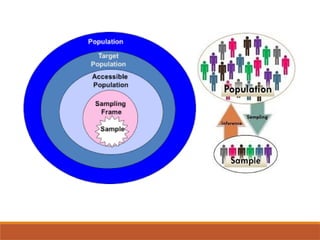
Population: A population is the entire group of individuals, events,
or objects that share common characteristics and includes all the
elements that a researcher aims to study and draw conclusions from.
Example: If a study aims to understand the dietary habits of college
students in Andhra Pradesh, the population would be all college
students across Andhra Pradesh.
Target Population: The target population is the specific
group of individuals or elements that the researcher aims to
study and make generalizations about.
Example: For a study focused on dietary habits, the target
population might be all undergraduate students enrolled in
colleges in Andhra Pradesh.
Accessible Population: The accessible population is the
portion of the target population that is available and feasible
for the researcher to reach and study. It may be limited by
geographical, temporal, or logistical constraints.
Example: For a study conducted in a specific city within
Andhra Pradesh, the accessible population might be
undergraduate students enrolled in colleges in
Visakhapatnam.
Sample: A sample is a subset of individuals or observations
selected from a larger population and is used in research to
represent the entire population.
Example: If the study includes 300 students selected from
the accessible population of 3,000 students in Visakhapatnam,
those 300 students would constitute the sample.
Sampling: Sampling is the process of selecting a sample from
the population of research study.
Example: In the dietary habits study, researchers might use
stratified sampling to ensure representation by selecting
proportionate students from different colleges in
Visakhapatnam.
Sampling Frame: A sampling frame is a comprehensive list
or database of all individuals or units
PURPOSES OF SAMPLING
• Representing a Population: Sampling allows researchers to
study a subset of a population to make inferences about the
entire group.
• Saving Time and Resources: Sampling is more efficient than
conducting a census, allowing researchers to gather data quickly
and with fewer resources.
• Enhancing Data Accuracy: Carefully chosen samples reduce
the likelihood of errors and biases that might occur in larger,
more complex data sets.
• Facilitating In-Depth Analysis: Sampling allows researchers
to focus on a specific subset, enabling more detailed and
focused analysis.
CRITERIA FOR SELECTING SAMPLE
The criteria for selecting sample are as follows:
Research Objectives:
• Align sample selection with study goals and hypotheses.
• Determine the specific population characteristics needed.
Population Characteristics:
• Define inclusion criteria (e.g., age, gender, diagnosis).
• Identify exclusion criteria (e.g., comorbidities, medication
use).
Sampling Method:
• Choose between probability (random) and non-probability
(non-random) sampling.
• Select method based on research design and resources.
Sample Size:
• Ensure sample size is adequate for statistical analysis.
• Balance between feasibility and the need for accuracy.
Resources and Time:
• Consider budget, personnel, and time constraints.
• Opt for a sampling method that fits logistical capabilities.
Ethical Considerations:
• Ensure informed consent and participant protection.
• Address ethical issues related to vulnerable populations.
Variability:
• Consider diversity within the population for
representativeness.
• Stratify sampling to capture significant subgroups.
CHARACTERISTICS OFA GOOD SAMPLING
• Representativeness: A good sample accurately reflects the
population's diversity, ensuring that all relevant characteristics and
subgroups are included. This allows the findings to be generalized
to the entire population.
• Adequate Size: The sample size must be sufficient to provide
statistically significant results. An adequately sized sample reduces
errors and enhances the reliability of the study’s conclusions.
• Randomness: Random selection minimizes bias and ensures that
every individual in the population has an equal chance of being
chosen. This randomness increases the sample's validity.
• Homogeneity and Consistency: The sample should be consistent
in its selection criteria and methods, reducing variability and
ensuring that the findings are consistent across different subsets.
SAMPLING PROCESS
Define
Population
Determine
the Sample
Size
Choose a
Sampling
Method
Develop a
Sampling
Frame
Select the
Sample
Collect and
analyze data
Step 1- Define the Population: This step involves determining the
specific characteristics, scope, and size of the population that the
research aims to study. For instance if researching job satisfaction
among nurses, define the population as all registered nurses in a
particular city or hospital.
Step 2- Determine the Sample Size: Deciding on an appropriate
sample size is critical for obtaining meaningful data. Use statistical
methods to calculate the needed sample size based on confidence levels
and population variance.
Step 3- Choose a Sampling Method: This step involves deciding on
the sampling method that best suits the research objectives.
Step 4- Develop a Sampling Frame: The sampling frame is a
comprehensive list of all individuals or units within the defined
population. This list serves as the basis for selecting the sample.
5. Select the Sample: Once the sampling frame is established, the
actual selection of the sample takes place. This involves applying the
chosen sampling method to pick the sample from the population.
6. Collect and Analyze Data: In the final step, data collection methods
such as surveys, interviews, or observations are used to gather
information from the chosen sample.
FACTORS INFLUENCING SAMPLING PROCESS
• Population Size: The total number of individuals in the
target population affects the sample size and method chosen.
• Research Objectives: Specific goals of the study determine
the sampling approach and criteria for participant selection.
• Available Resources: Budget, time, and manpower
limitations can impact the size and method of the sample.
• Time Constraints: Tight deadlines may necessitate quicker
sampling methods, possibly affecting representativeness.
• Variability in Population: High diversity within the
population may require stratified sampling to ensure all
subgroups are represented.
• Desired Precision: Higher accuracy demands larger samples
and more robust sampling techniques to ensure reliable
results.
• Ethical Considerations: Ethical guidelines may limit certain
sampling methods, especially when dealing with vulnerable
populations.
TYPES OF SAMPLING TECHNIQUES
Sampling techniques are methods used in research to
select a sample of a population for study. These techniques
ensure efficient data collection and accurate results, balancing
precision and practicality. Sampling techniques are broadly
classified as two types.
I. Probability Sampling
II. Non-Probability Sampling
I. Probability Sampling
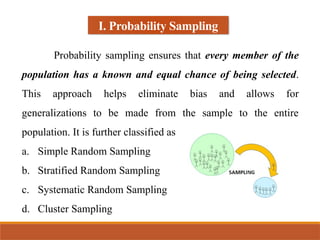
Probability sampling ensures that every member of the
population has a known and equal chance of being selected.
This approach helps eliminate bias and allows for
generalizations to be made from the sample to the entire
population. It is further classified as
a. Simple Random Sampling
b. Stratified Random Sampling
c. Systematic Random Sampling
d. Cluster Sampling
a. Simple Random Sampling
Simple random sampling is the most basic form of
probability sampling. It involves selecting a sample from a larger
population in such a way that every possible sample of the
desired size has the same chance of being chosen.
Methods:
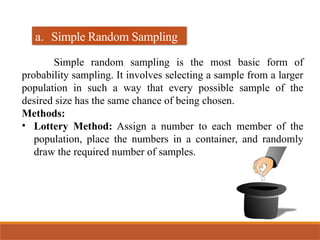
• Lottery Method: Assign a number to each member of the
population, place the numbers in a container, and randomly
draw the required number of samples.
• Random Number Table: Use a table of random numbers to
select sample units.
• Computer Software: Use software to randomly select
samples, which is especially useful for large populations.
Merits:
• Easy to implement and understand.
• Eliminates bias as each member has an equal chance of being
selected.
• Provides a representative sample of the population.
Demerits:
• Requires a complete list of the population, which may not be
available.
• May be difficult to manage with large populations.
• Can be time-consuming if the population is large.
b. Stratified Random Sampling
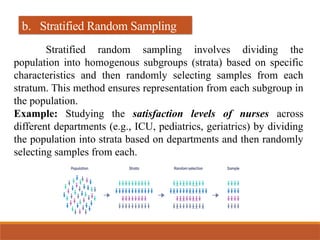
Stratified random sampling involves dividing the
population into homogenous subgroups (strata) based on specific
characteristics and then randomly selecting samples from each
stratum. This method ensures representation from each subgroup in
the population.
Example: Studying the satisfaction levels of nurses across
different departments (e.g., ICU, pediatrics, geriatrics) by dividing
the population into strata based on departments and then randomly
selecting samples from each.
Methods:
• Proportional Stratified Sampling: Sample size from each stratum is
proportional to the stratum's size relative to the population. For instance,
if 40% of the population are females and 60% are males, then 40% of the
sample will consist of females and 60% of males.
• Equal Stratified Sampling: Equal numbers of samples are drawn from
each stratum, regardless of its size.
Merits:
• Ensures representation from each subgroup, providing a more
comprehensive view.
• Increases precision and reliability of results compared to simple random
sampling.
• Effective for populations with diverse characteristics.
Demerits:
• Requires detailed knowledge of population characteristics for effective
stratification.
• More complex and time-consuming than simple random sampling.
• Possibility of incorrect stratification if characteristics are not well-defined.
c. Systematic Random Sampling
Systematic random sampling involves selecting every Kth
member from a list after a random start point is determined. It’s
akin to an arithmetic progression and is useful for ordered lists.
Methods:
• Determining Kth Interval: Calculate K=N/n, where N is the
population size and n is the sample size.
• Random Start Point: Randomly choose a start point between 1
and K, then select every Kth member.
Example: Selecting every 10th nurse from a list of nurses registered for a
continuing education program to evaluate their learning outcomes.
Merits:
• Simple and easy to implement.
• Ensures a systematic spread of the sample across the population.
• Useful when a complete list of the population is available.
Demerits:
• May introduce bias if there's a hidden pattern in the list.
• Not suitable for populations with periodic patterns.
d. Cluster sampling
Cluster sampling is used when populations are
geographically dispersed or when a complete list of the
population is unavailable. It involves dividing the population into
clusters and randomly selecting clusters for the study, rather than
individual units.
Example: Conducting a study on community health practices by
selecting certain cities (clusters) and then randomly sampling
nurses within those cities.
Methods:
• Single-Stage Cluster Sampling: Randomly select entire clusters
and use all members within those clusters.
• Two-Stage (or Multistage) Cluster Sampling: Randomly select
clusters, then randomly select samples within those clusters.
Merits:
• Cost-effective and time-efficient for large and dispersed
populations.
• Reduces the need for a complete population list.
• Simplifies logistics in field research.
Demerits:
• May result in higher sampling error compared to other probability
sampling techniques.
• Less representative if clusters are not homogenous.
• Requires careful selection of clusters to avoid bias.
II. NON-PROBABILITY SAMPLING
Non-probability sampling does not provide every
individual in the population with a known or equal chance of
being selected. It often relies on the researcher's judgment and is
used when probability sampling is impractical. It is further
classifies as:
a. Convenience Sampling
b. Purposive Sampling
c. Quota Sampling
d. Snowball Sampling
e. Consecutive Sampling
a. Convenience Sampling
Convenience sampling involves selecting samples that are
easiest to access and available to the researcher. It is often used for
exploratory research where time and resources are limited.
Example: Surveying nursing students present in the library to gather
quick feedback on a new curriculum change.
Merits:
• Quick, easy, and inexpensive to conduct.
• Requires minimal planning and effort.
• Suitable for preliminary research and pilot studies.
Demerits:
• High risk of sampling bias and non-representativeness.
• Results cannot be generalized to the entire population.
• May lead to inaccurate conclusions.
b. Purposive Sampling
Purposive sampling, also known as judgmental sampling,
involves selecting individuals based on specific characteristics or
qualities relevant to the research. The researcher uses their judgment to
choose subjects that best fit the study’s purpose.
Example: Selecting experienced nurses to evaluate the effectiveness
of a new patient care protocol, focusing on those with specific
expertise.
Merits:
• Allows for the selection of subjects with specific expertise or
characteristics.
• Useful for qualitative research where depth is more important
than breadth.
• Provides insights into specific phenomena.
Demerits:
• Highly subjective, as it relies on the researcher’s judgment.
• Potential for bias, as the sample may not represent the broader
population.
• Limited generalizability of results.
c. Quota sampling
Quota sampling involves dividing the population into
subgroups and ensuring that each subgroup is represented in the
sample according to a specified quota. It combines elements of
both stratified and convenience sampling.
Example: Ensuring equal representation of male and female
nursing students in a study about attitudes towards nursing
education by setting quotas for each gender.
Merits:
• Ensures representation of different subgroups, addressing
diversity.
• Faster and less expensive than probability sampling.
• Useful when population proportions are known.
Demerits:
• Can introduce bias, as selection within subgroups is not
random.
• Not as statistically robust as probability sampling.
• Potential for overrepresentation of certain traits.
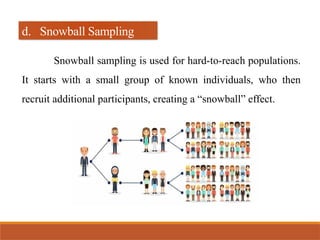
d. Snowball Sampling
Snowball sampling is used for hard-to-reach populations.
It starts with a small group of known individuals, who then
recruit additional participants, creating a “snowball” effect.
Merits:
• Effective for reaching hidden or hard-to-locate populations.
• Cost-effective and requires minimal initial planning.
• Builds trust through personal referrals.
Demerits:
• High potential for sampling bias, as the sample depends on
initial contacts.
• Results may not be representative of the entire population.
• Difficult to determine the sample size in advance.
e. Consecutive Sampling
Consecutive sampling involves selecting every available
subject that meets specific criteria until the desired sample size
is achieved. It is similar to convenience sampling but aims to
include all eligible subjects over a period.
Example: Studying recovery patterns by including every post-
surgical patient admitted to a hospital ward over a month.
Merits:
• Provides a more comprehensive sample compared to
convenience sampling.
• Easy to implement with a clearly defined population.
• Suitable for small populations with specific inclusion criteria.
Demerits:
• May still introduce bias if not all eligible subjects are
available.
• Less representative if the population changes over time.
• Results may not be generalizable beyond the study period.
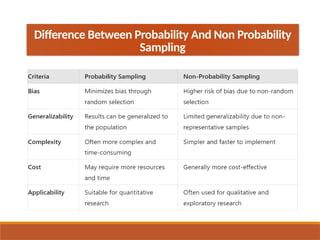
Difference Between Probability And Non Probability
Sampling
SAMPLE SIZE DETERMINATION
Determining the sample size is a crucial step in research
design. It ensures that the sample accurately reflects the
population, allowing researchers to draw meaningful
conclusions. The right sample size balances precision and
practicality, ensuring that results are statistically significant
without wasting resources.
Methods for Determining Sample Size
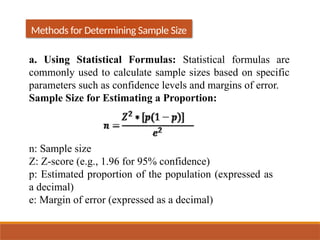
a. Using Statistical Formulas: Statistical formulas are
commonly used to calculate sample sizes based on specific
parameters such as confidence levels and margins of error.
Sample Size for Estimating a Proportion:
n: Sample size
Z: Z-score (e.g., 1.96 for 95% confidence)
p: Estimated proportion of the population (expressed as
a decimal)
e: Margin of error (expressed as a decimal)
b. Using Online Calculators and Software: Various online
calculators and statistical software can automate sample size
determination, allowing for adjustments in parameters and
providing detailed insights into the calculations. Examples
include:
• Raosoft Sample Size Calculator
• G*Power
• Qualtrics
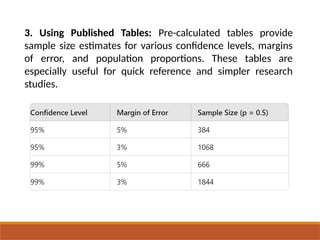
3. Using Published Tables: Pre-calculated tables provide
sample size estimates for various confidence levels, margins
of error, and population proportions. These tables are
especially useful for quick reference and simpler research
studies.
Factors Influencing Sample Size
• Population Size: Larger populations often require larger
samples, but not linearly.
• Variability: High variability within the population requires
a larger sample to capture diversity accurately.
• Confidence Level: Higher confidence levels necessitate
larger samples. Common confidence levels are 90%, 95%,
and 99%.
• Margin of Error (Precision): Smaller margins of error
require larger samples for more precise results.
• Sampling Technique: Different techniques (e.g., stratified,
cluster) may influence the required sample size.
• Study Design: Complex study designs with multiple
variables may need larger samples.
SAMPLING ERRORS
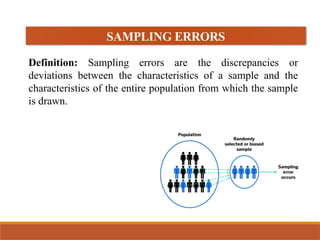
Definition: Sampling errors are the discrepancies or
deviations between the characteristics of a sample and the
characteristics of the entire population from which the sample
is drawn.
Causes of Sampling Error
• Sampling Bias: Sampling errors often occur when the sample is
not representative of the population due to flawed sampling
methods, leading to systematic deviations. A sample must be free
from bias and truly representative of the entire population. Any
deviation from this can lead to sampling error.
• Chance Error: Even when using randomization and probability
sampling, there is always a possibility that the sample drawn is not
fully representative of the population. This inherent randomness
can lead to sampling error.
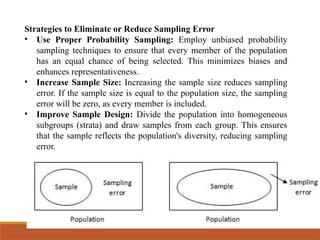
Strategies to Eliminate or Reduce Sampling Error
• Use Proper Probability Sampling: Employ unbiased probability
sampling techniques to ensure that every member of the population
has an equal chance of being selected. This minimizes biases and
enhances representativeness.
• Increase Sample Size: Increasing the sample size reduces sampling
error. If the sample size is equal to the population size, the sampling
error will be zero, as every member is included.
• Improve Sample Design: Divide the population into homogeneous
subgroups (strata) and draw samples from each group. This ensures
that the sample reflects the population's diversity, reducing sampling
error.
SAMPLING: DEFINITION,PROCESS,TYPES,SAMPLE SIZE, SAMPLING ERROR.pptx

SAMPLING: DEFINITION,PROCESS,TYPES,SAMPLE SIZE, SAMPLING ERROR.pptx

  • 1.
    SAMPLING Mr. Pradeep Abothu,M.Sc (N), PhD Scholar Associate Professor Dept. of Child Health Nursing ASRAM College of Nursing
  • 2.
     INTRODUCTION  TERMINOLOGY PURPOSES OF SAMPLING  CRITERIA FOR SELECTING SAMPLE  CHARECTERISTICS OF A GOOD SAMPLE  SAMPLING PROCESS  TYPES OF SAMPLING TECHNIQUES  SAMPLE SIZE DETERMINATION  SAMPLING ERRORS CONTENTS
  • 3.
    INTRODUCTION In research, samplingand data collection are essential for obtaining accurate and reliable insights into a specific population. Sampling involves selecting a subset (sample) from a larger group (population) to represent it, enabling researchers to generalize findings without studying every individual. This process is vital in qualitative and quantitative research. Data collection, using methods like surveys and interviews, directly influences the study's validity and applicability by ensuring the reliability and accuracy of the findings.
  • 4.
    TERMINOLOGY Population: A populationis the entire group of individuals, events, or objects that share common characteristics and includes all the elements that a researcher aims to study and draw conclusions from. Example: If a study aims to understand the dietary habits of college students in Andhra Pradesh, the population would be all college students across Andhra Pradesh.
  • 5.
    Target Population: Thetarget population is the specific group of individuals or elements that the researcher aims to study and make generalizations about. Example: For a study focused on dietary habits, the target population might be all undergraduate students enrolled in colleges in Andhra Pradesh.
  • 6.
    Accessible Population: Theaccessible population is the portion of the target population that is available and feasible for the researcher to reach and study. It may be limited by geographical, temporal, or logistical constraints. Example: For a study conducted in a specific city within Andhra Pradesh, the accessible population might be undergraduate students enrolled in colleges in Visakhapatnam.
  • 7.
    Sample: A sampleis a subset of individuals or observations selected from a larger population and is used in research to represent the entire population. Example: If the study includes 300 students selected from the accessible population of 3,000 students in Visakhapatnam, those 300 students would constitute the sample.
  • 8.
    Sampling: Sampling isthe process of selecting a sample from the population of research study. Example: In the dietary habits study, researchers might use stratified sampling to ensure representation by selecting proportionate students from different colleges in Visakhapatnam. Sampling Frame: A sampling frame is a comprehensive list or database of all individuals or units
  • 10.
    PURPOSES OF SAMPLING •Representing a Population: Sampling allows researchers to study a subset of a population to make inferences about the entire group. • Saving Time and Resources: Sampling is more efficient than conducting a census, allowing researchers to gather data quickly and with fewer resources. • Enhancing Data Accuracy: Carefully chosen samples reduce the likelihood of errors and biases that might occur in larger, more complex data sets. • Facilitating In-Depth Analysis: Sampling allows researchers to focus on a specific subset, enabling more detailed and focused analysis.
  • 11.
    CRITERIA FOR SELECTINGSAMPLE The criteria for selecting sample are as follows: Research Objectives: • Align sample selection with study goals and hypotheses. • Determine the specific population characteristics needed. Population Characteristics: • Define inclusion criteria (e.g., age, gender, diagnosis). • Identify exclusion criteria (e.g., comorbidities, medication use).
  • 12.
    Sampling Method: • Choosebetween probability (random) and non-probability (non-random) sampling. • Select method based on research design and resources. Sample Size: • Ensure sample size is adequate for statistical analysis. • Balance between feasibility and the need for accuracy. Resources and Time: • Consider budget, personnel, and time constraints. • Opt for a sampling method that fits logistical capabilities.
  • 13.
    Ethical Considerations: • Ensureinformed consent and participant protection. • Address ethical issues related to vulnerable populations. Variability: • Consider diversity within the population for representativeness. • Stratify sampling to capture significant subgroups.
  • 14.
    CHARACTERISTICS OFA GOODSAMPLING • Representativeness: A good sample accurately reflects the population's diversity, ensuring that all relevant characteristics and subgroups are included. This allows the findings to be generalized to the entire population. • Adequate Size: The sample size must be sufficient to provide statistically significant results. An adequately sized sample reduces errors and enhances the reliability of the study’s conclusions. • Randomness: Random selection minimizes bias and ensures that every individual in the population has an equal chance of being chosen. This randomness increases the sample's validity. • Homogeneity and Consistency: The sample should be consistent in its selection criteria and methods, reducing variability and ensuring that the findings are consistent across different subsets.
  • 15.
    SAMPLING PROCESS Define Population Determine the Sample Size Choosea Sampling Method Develop a Sampling Frame Select the Sample Collect and analyze data
  • 16.
    Step 1- Definethe Population: This step involves determining the specific characteristics, scope, and size of the population that the research aims to study. For instance if researching job satisfaction among nurses, define the population as all registered nurses in a particular city or hospital. Step 2- Determine the Sample Size: Deciding on an appropriate sample size is critical for obtaining meaningful data. Use statistical methods to calculate the needed sample size based on confidence levels and population variance.
  • 17.
    Step 3- Choosea Sampling Method: This step involves deciding on the sampling method that best suits the research objectives. Step 4- Develop a Sampling Frame: The sampling frame is a comprehensive list of all individuals or units within the defined population. This list serves as the basis for selecting the sample. 5. Select the Sample: Once the sampling frame is established, the actual selection of the sample takes place. This involves applying the chosen sampling method to pick the sample from the population. 6. Collect and Analyze Data: In the final step, data collection methods such as surveys, interviews, or observations are used to gather information from the chosen sample.
  • 18.
    FACTORS INFLUENCING SAMPLINGPROCESS • Population Size: The total number of individuals in the target population affects the sample size and method chosen. • Research Objectives: Specific goals of the study determine the sampling approach and criteria for participant selection. • Available Resources: Budget, time, and manpower limitations can impact the size and method of the sample. • Time Constraints: Tight deadlines may necessitate quicker sampling methods, possibly affecting representativeness.
  • 19.
    • Variability inPopulation: High diversity within the population may require stratified sampling to ensure all subgroups are represented. • Desired Precision: Higher accuracy demands larger samples and more robust sampling techniques to ensure reliable results. • Ethical Considerations: Ethical guidelines may limit certain sampling methods, especially when dealing with vulnerable populations.
  • 20.
    TYPES OF SAMPLINGTECHNIQUES Sampling techniques are methods used in research to select a sample of a population for study. These techniques ensure efficient data collection and accurate results, balancing precision and practicality. Sampling techniques are broadly classified as two types. I. Probability Sampling II. Non-Probability Sampling
  • 22.
    I. Probability Sampling Probabilitysampling ensures that every member of the population has a known and equal chance of being selected. This approach helps eliminate bias and allows for generalizations to be made from the sample to the entire population. It is further classified as a. Simple Random Sampling b. Stratified Random Sampling c. Systematic Random Sampling d. Cluster Sampling
  • 23.
    a. Simple RandomSampling Simple random sampling is the most basic form of probability sampling. It involves selecting a sample from a larger population in such a way that every possible sample of the desired size has the same chance of being chosen. Methods: • Lottery Method: Assign a number to each member of the population, place the numbers in a container, and randomly draw the required number of samples.
  • 24.
    • Random NumberTable: Use a table of random numbers to select sample units. • Computer Software: Use software to randomly select samples, which is especially useful for large populations. Merits: • Easy to implement and understand. • Eliminates bias as each member has an equal chance of being selected. • Provides a representative sample of the population. Demerits: • Requires a complete list of the population, which may not be available. • May be difficult to manage with large populations. • Can be time-consuming if the population is large.
  • 25.
    b. Stratified RandomSampling Stratified random sampling involves dividing the population into homogenous subgroups (strata) based on specific characteristics and then randomly selecting samples from each stratum. This method ensures representation from each subgroup in the population. Example: Studying the satisfaction levels of nurses across different departments (e.g., ICU, pediatrics, geriatrics) by dividing the population into strata based on departments and then randomly selecting samples from each.
  • 26.
    Methods: • Proportional StratifiedSampling: Sample size from each stratum is proportional to the stratum's size relative to the population. For instance, if 40% of the population are females and 60% are males, then 40% of the sample will consist of females and 60% of males. • Equal Stratified Sampling: Equal numbers of samples are drawn from each stratum, regardless of its size. Merits: • Ensures representation from each subgroup, providing a more comprehensive view. • Increases precision and reliability of results compared to simple random sampling. • Effective for populations with diverse characteristics. Demerits: • Requires detailed knowledge of population characteristics for effective stratification. • More complex and time-consuming than simple random sampling. • Possibility of incorrect stratification if characteristics are not well-defined.
  • 27.
    c. Systematic RandomSampling Systematic random sampling involves selecting every Kth member from a list after a random start point is determined. It’s akin to an arithmetic progression and is useful for ordered lists. Methods: • Determining Kth Interval: Calculate K=N/n, where N is the population size and n is the sample size. • Random Start Point: Randomly choose a start point between 1 and K, then select every Kth member.
  • 28.
    Example: Selecting every10th nurse from a list of nurses registered for a continuing education program to evaluate their learning outcomes. Merits: • Simple and easy to implement. • Ensures a systematic spread of the sample across the population. • Useful when a complete list of the population is available. Demerits: • May introduce bias if there's a hidden pattern in the list. • Not suitable for populations with periodic patterns.
  • 29.
    d. Cluster sampling Clustersampling is used when populations are geographically dispersed or when a complete list of the population is unavailable. It involves dividing the population into clusters and randomly selecting clusters for the study, rather than individual units. Example: Conducting a study on community health practices by selecting certain cities (clusters) and then randomly sampling nurses within those cities.
  • 30.
    Methods: • Single-Stage ClusterSampling: Randomly select entire clusters and use all members within those clusters. • Two-Stage (or Multistage) Cluster Sampling: Randomly select clusters, then randomly select samples within those clusters. Merits: • Cost-effective and time-efficient for large and dispersed populations. • Reduces the need for a complete population list. • Simplifies logistics in field research. Demerits: • May result in higher sampling error compared to other probability sampling techniques. • Less representative if clusters are not homogenous. • Requires careful selection of clusters to avoid bias.
  • 31.
    II. NON-PROBABILITY SAMPLING Non-probabilitysampling does not provide every individual in the population with a known or equal chance of being selected. It often relies on the researcher's judgment and is used when probability sampling is impractical. It is further classifies as: a. Convenience Sampling b. Purposive Sampling c. Quota Sampling d. Snowball Sampling e. Consecutive Sampling
  • 32.
    a. Convenience Sampling Conveniencesampling involves selecting samples that are easiest to access and available to the researcher. It is often used for exploratory research where time and resources are limited. Example: Surveying nursing students present in the library to gather quick feedback on a new curriculum change. Merits: • Quick, easy, and inexpensive to conduct. • Requires minimal planning and effort. • Suitable for preliminary research and pilot studies. Demerits: • High risk of sampling bias and non-representativeness. • Results cannot be generalized to the entire population. • May lead to inaccurate conclusions.
  • 33.
    b. Purposive Sampling Purposivesampling, also known as judgmental sampling, involves selecting individuals based on specific characteristics or qualities relevant to the research. The researcher uses their judgment to choose subjects that best fit the study’s purpose. Example: Selecting experienced nurses to evaluate the effectiveness of a new patient care protocol, focusing on those with specific expertise.
  • 34.
    Merits: • Allows forthe selection of subjects with specific expertise or characteristics. • Useful for qualitative research where depth is more important than breadth. • Provides insights into specific phenomena. Demerits: • Highly subjective, as it relies on the researcher’s judgment. • Potential for bias, as the sample may not represent the broader population. • Limited generalizability of results.
  • 35.
    c. Quota sampling Quotasampling involves dividing the population into subgroups and ensuring that each subgroup is represented in the sample according to a specified quota. It combines elements of both stratified and convenience sampling. Example: Ensuring equal representation of male and female nursing students in a study about attitudes towards nursing education by setting quotas for each gender.
  • 36.
    Merits: • Ensures representationof different subgroups, addressing diversity. • Faster and less expensive than probability sampling. • Useful when population proportions are known. Demerits: • Can introduce bias, as selection within subgroups is not random. • Not as statistically robust as probability sampling. • Potential for overrepresentation of certain traits.
  • 37.
    d. Snowball Sampling Snowballsampling is used for hard-to-reach populations. It starts with a small group of known individuals, who then recruit additional participants, creating a “snowball” effect.
  • 38.
    Merits: • Effective forreaching hidden or hard-to-locate populations. • Cost-effective and requires minimal initial planning. • Builds trust through personal referrals. Demerits: • High potential for sampling bias, as the sample depends on initial contacts. • Results may not be representative of the entire population. • Difficult to determine the sample size in advance.
  • 39.
    e. Consecutive Sampling Consecutivesampling involves selecting every available subject that meets specific criteria until the desired sample size is achieved. It is similar to convenience sampling but aims to include all eligible subjects over a period. Example: Studying recovery patterns by including every post- surgical patient admitted to a hospital ward over a month.
  • 40.
    Merits: • Provides amore comprehensive sample compared to convenience sampling. • Easy to implement with a clearly defined population. • Suitable for small populations with specific inclusion criteria. Demerits: • May still introduce bias if not all eligible subjects are available. • Less representative if the population changes over time. • Results may not be generalizable beyond the study period.
  • 41.
    Difference Between ProbabilityAnd Non Probability Sampling
  • 42.
    SAMPLE SIZE DETERMINATION Determiningthe sample size is a crucial step in research design. It ensures that the sample accurately reflects the population, allowing researchers to draw meaningful conclusions. The right sample size balances precision and practicality, ensuring that results are statistically significant without wasting resources.
  • 43.
    Methods for DeterminingSample Size a. Using Statistical Formulas: Statistical formulas are commonly used to calculate sample sizes based on specific parameters such as confidence levels and margins of error. Sample Size for Estimating a Proportion: n: Sample size Z: Z-score (e.g., 1.96 for 95% confidence) p: Estimated proportion of the population (expressed as a decimal) e: Margin of error (expressed as a decimal)
  • 44.
    b. Using OnlineCalculators and Software: Various online calculators and statistical software can automate sample size determination, allowing for adjustments in parameters and providing detailed insights into the calculations. Examples include: • Raosoft Sample Size Calculator • G*Power • Qualtrics
  • 45.
    3. Using PublishedTables: Pre-calculated tables provide sample size estimates for various confidence levels, margins of error, and population proportions. These tables are especially useful for quick reference and simpler research studies.
  • 46.
    Factors Influencing SampleSize • Population Size: Larger populations often require larger samples, but not linearly. • Variability: High variability within the population requires a larger sample to capture diversity accurately. • Confidence Level: Higher confidence levels necessitate larger samples. Common confidence levels are 90%, 95%, and 99%. • Margin of Error (Precision): Smaller margins of error require larger samples for more precise results. • Sampling Technique: Different techniques (e.g., stratified, cluster) may influence the required sample size. • Study Design: Complex study designs with multiple variables may need larger samples.
  • 47.
    SAMPLING ERRORS Definition: Samplingerrors are the discrepancies or deviations between the characteristics of a sample and the characteristics of the entire population from which the sample is drawn.
  • 49.
    Causes of SamplingError • Sampling Bias: Sampling errors often occur when the sample is not representative of the population due to flawed sampling methods, leading to systematic deviations. A sample must be free from bias and truly representative of the entire population. Any deviation from this can lead to sampling error. • Chance Error: Even when using randomization and probability sampling, there is always a possibility that the sample drawn is not fully representative of the population. This inherent randomness can lead to sampling error.
  • 50.
    Strategies to Eliminateor Reduce Sampling Error • Use Proper Probability Sampling: Employ unbiased probability sampling techniques to ensure that every member of the population has an equal chance of being selected. This minimizes biases and enhances representativeness. • Increase Sample Size: Increasing the sample size reduces sampling error. If the sample size is equal to the population size, the sampling error will be zero, as every member is included. • Improve Sample Design: Divide the population into homogeneous subgroups (strata) and draw samples from each group. This ensures that the sample reflects the population's diversity, reducing sampling error.