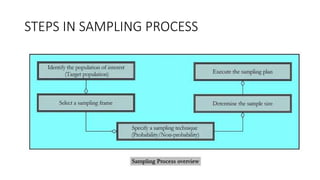
STEPS IN SAMPLING PROCESS
1. Identify the Target population
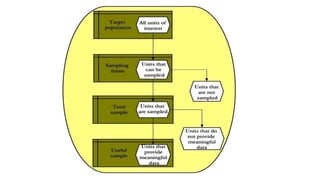
• Target population refers to the group of individuals or objects to which
researchers are interested in generalizing their findings.
• The target population is the group of individuals or objects, from which the
sample might be taken.
• A well - defined population reduces the probability of including the participants
who all are not suitable for the research objective.
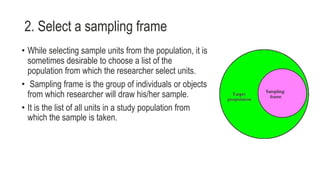
2. Select a sampling frame
• While selecting sample units from the population, it is
sometimes desirable to choose a list of the
population from which the researcher select units.
• Sampling frame is the group of individuals or objects
from which researcher will draw his/her sample.
• It is the list of all units in a study population from
which the sample is taken.
3. Specify the sampling technique
• Sampling can be done through probability (random selection) or non-
probability (non-random) technique.
• Now, if the sampling frame is approximately the same as the target
population, random selection may be used to select sample.
• On the other hand, if the sampling frame does not really represent the target
population, the researcher may choose non-random selection which can give
at least an idea about the population in his nearby area.
4. Determine the sample size
• The sample size is simply the number of units in the sample.
• Sample size determination depends on many factors such as time, cost,
facility. In general, larger samples are better, but they also require more
resources.
• larger sample sizes reduce sampling error but at a decreasing rate. Several
statistical formulas are available for determining sample size.
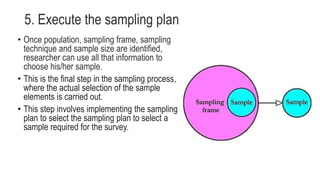
5. Execute the sampling plan
• Once population, sampling frame, sampling
technique and sample size are identified,
researcher can use all that information to
choose his/her sample.
• This is the final step in the sampling process,
where the actual selection of the sample
elements is carried out.
• This step involves implementing the sampling
plan to select the sampling plan to select a
sample required for the survey.
STEPS IN SAMPLING PROCESS 5 stepmodel.pptx

STEPS IN SAMPLING PROCESS 5 stepmodel.pptx

  • 1.
  • 2.
    1. Identify theTarget population • Target population refers to the group of individuals or objects to which researchers are interested in generalizing their findings. • The target population is the group of individuals or objects, from which the sample might be taken. • A well - defined population reduces the probability of including the participants who all are not suitable for the research objective.
  • 3.
    2. Select asampling frame • While selecting sample units from the population, it is sometimes desirable to choose a list of the population from which the researcher select units. • Sampling frame is the group of individuals or objects from which researcher will draw his/her sample. • It is the list of all units in a study population from which the sample is taken.
  • 4.
    3. Specify thesampling technique • Sampling can be done through probability (random selection) or non- probability (non-random) technique. • Now, if the sampling frame is approximately the same as the target population, random selection may be used to select sample. • On the other hand, if the sampling frame does not really represent the target population, the researcher may choose non-random selection which can give at least an idea about the population in his nearby area.
  • 5.
    4. Determine thesample size • The sample size is simply the number of units in the sample. • Sample size determination depends on many factors such as time, cost, facility. In general, larger samples are better, but they also require more resources. • larger sample sizes reduce sampling error but at a decreasing rate. Several statistical formulas are available for determining sample size.
  • 6.
    5. Execute thesampling plan • Once population, sampling frame, sampling technique and sample size are identified, researcher can use all that information to choose his/her sample. • This is the final step in the sampling process, where the actual selection of the sample elements is carried out. • This step involves implementing the sampling plan to select the sampling plan to select a sample required for the survey.