1
Study Smart
www.studysmart.page.tl
STUDYSMART
CHEMISTRY FORM 4
CHAPTER 8 : SALTS
8.1 Synthesising Salts
8.2 Synthesising qualitative analysis of salts
8.3 Practising to be systematic and meticulous when carrying
out activities
8.1 SYNTHESISING SALTS
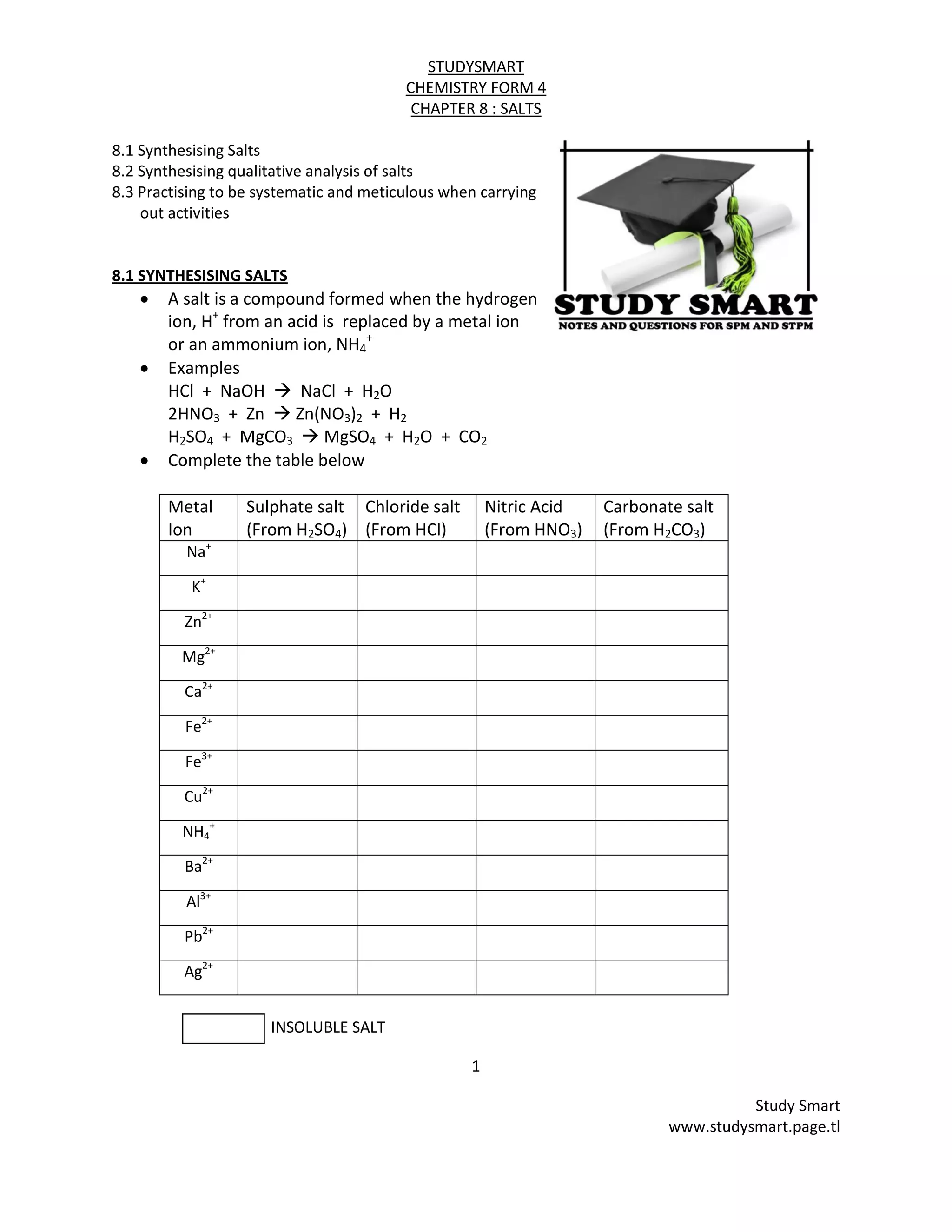
A salt is a compound formed when the hydrogen
ion, H+
from an acid is replaced by a metal ion
or an ammonium ion, NH4
+
Examples
HCl + NaOH  NaCl + H2O
2HNO3 + Zn  Zn(NO3)2 + H2
H2SO4 + MgCO3  MgSO4 + H2O + CO2
Complete the table below
Metal
Ion
Sulphate salt
(From H2SO4)
Chloride salt
(From HCl)
Nitric Acid
(From HNO3)
Carbonate salt
(From H2CO3)
Na+
K+
Zn2+
Mg2+
Ca2+
Fe2+
Fe3+
Cu2+
NH4
+
Ba2+
Al3+
Pb2+
Ag2+
INSOLUBLE SALT
2
Study Smart
www.studysmart.page.tl
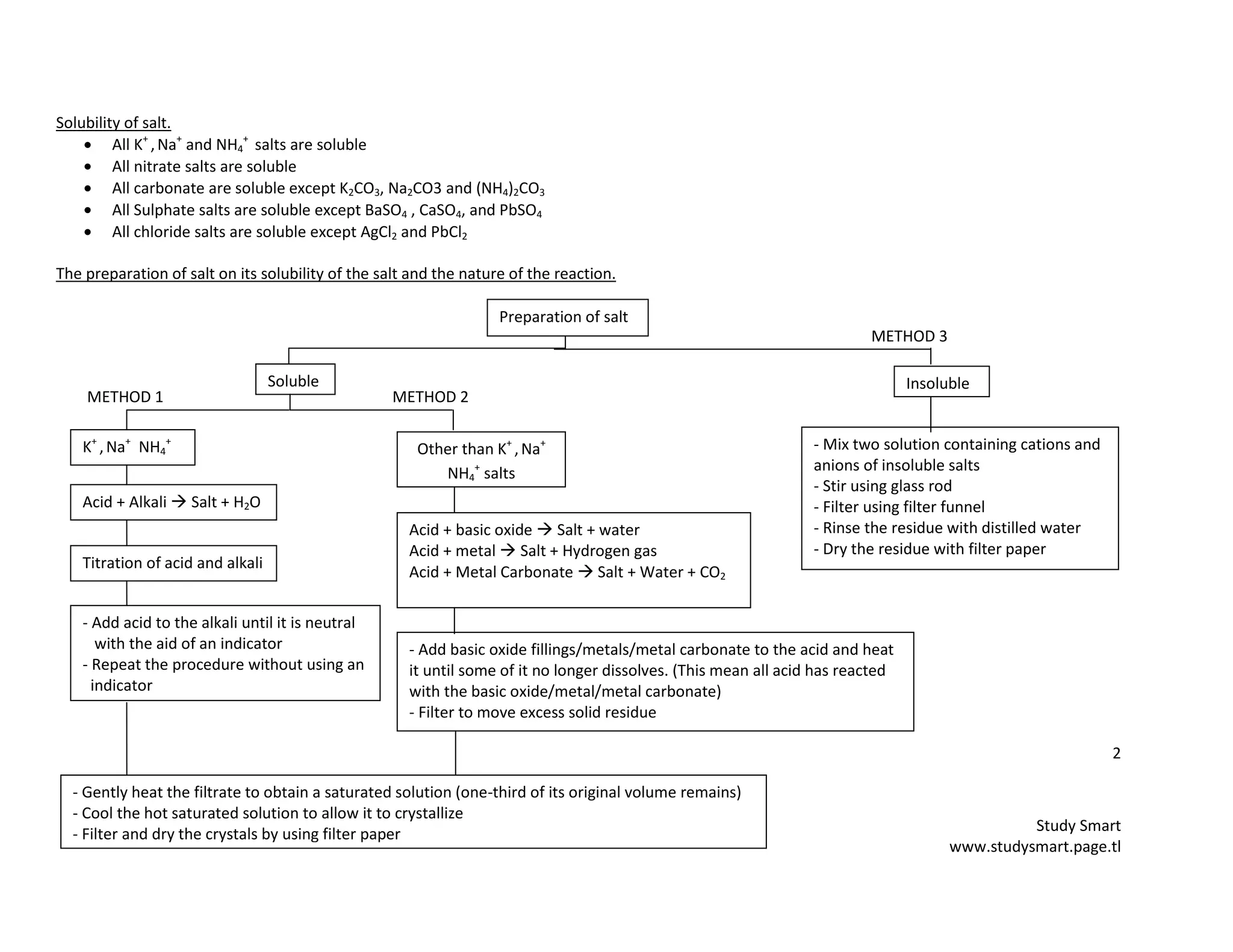
Solubility of salt.
All K+
,Na+
and NH4
+
salts are soluble
All nitrate salts are soluble
All carbonate are soluble except K2CO3, Na2CO3 and (NH4)2CO3
All Sulphate salts are soluble except BaSO4 , CaSO4, and PbSO4
All chloride salts are soluble except AgCl2 and PbCl2
The preparation of salt on its solubility of the salt and the nature of the reaction.
METHOD 3
METHOD 1 METHOD 2
2
Preparation of salt
Soluble Insoluble
K+
,Na+
NH4
+
Acid + Alkali  Salt + H2O
Titration of acid and alkali
- Add acid to the alkali until it is neutral
with the aid of an indicator
- Repeat the procedure without using an
indicator
- Gently heat the filtrate to obtain a saturated solution (one-third of its original volume remains)
- Cool the hot saturated solution to allow it to crystallize
- Filter and dry the crystals by using filter paper
Other than K+
,Na+
NH4
+
salts
Acid + basic oxide  Salt + water
Acid + metal  Salt + Hydrogen gas
Acid + Metal Carbonate  Salt + Water + CO2
- Add basic oxide fillings/metals/metal carbonate to the acid and heat
it until some of it no longer dissolves. (This mean all acid has reacted
with the basic oxide/metal/metal carbonate)
- Filter to move excess solid residue
- Mix two solution containing cations and
anions of insoluble salts
- Stir using glass rod
- Filter using filter funnel
- Rinse the residue with distilled water
- Dry the residue with filter paper
3
Study Smart
www.studysmart.page.tl
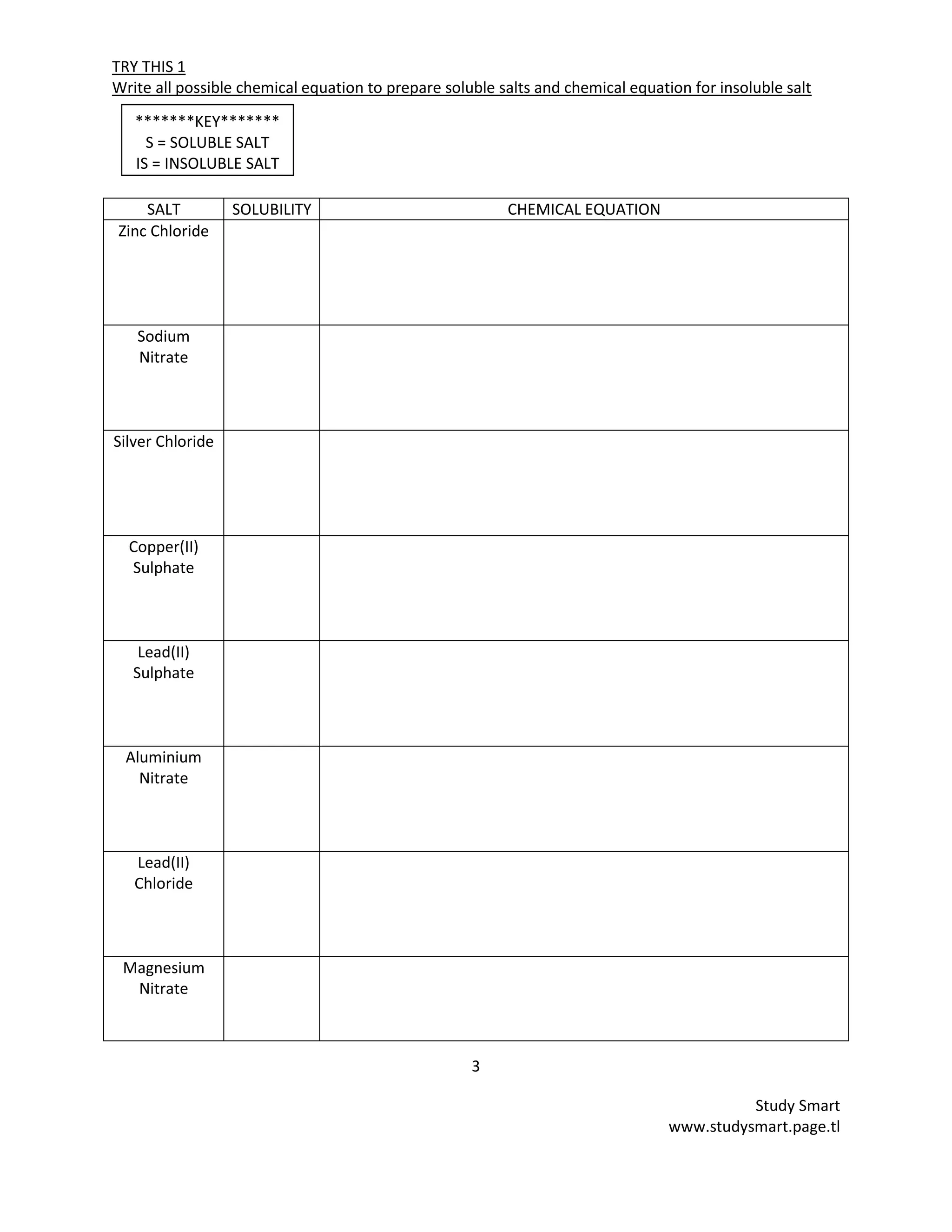
TRY THIS 1
Write all possible chemical equation to prepare soluble salts and chemical equation for insoluble salt
SALT SOLUBILITY CHEMICAL EQUATION
Zinc Chloride
Sodium
Nitrate
Silver Chloride
Copper(II)
Sulphate
Lead(II)
Sulphate
Aluminium
Nitrate
Lead(II)
Chloride
Magnesium
Nitrate
*******KEY*******
S = SOLUBLE SALT
IS = INSOLUBLE SALT
4
Study Smart
www.studysmart.page.tl
Potassium
Chloride
Lead(II)
Nitrate
Barium
Sulphate
Ammonium
Sulphate
Numerical problem involving stoichiometry reactions in the preparation of salts
A student prepare copper(II) nitrate, Cu(NO3)2 by reacting copper(II) oxide, CuO with 100 cm3 of 1.5
mol dm-3
nitric acid, HNO3. Calculate the mass of copper(II) oxide, CuO needed to react
completely with the acid. [RAM : Cu,64 ; O,16]
5
Study Smart
www.studysmart.page.tl
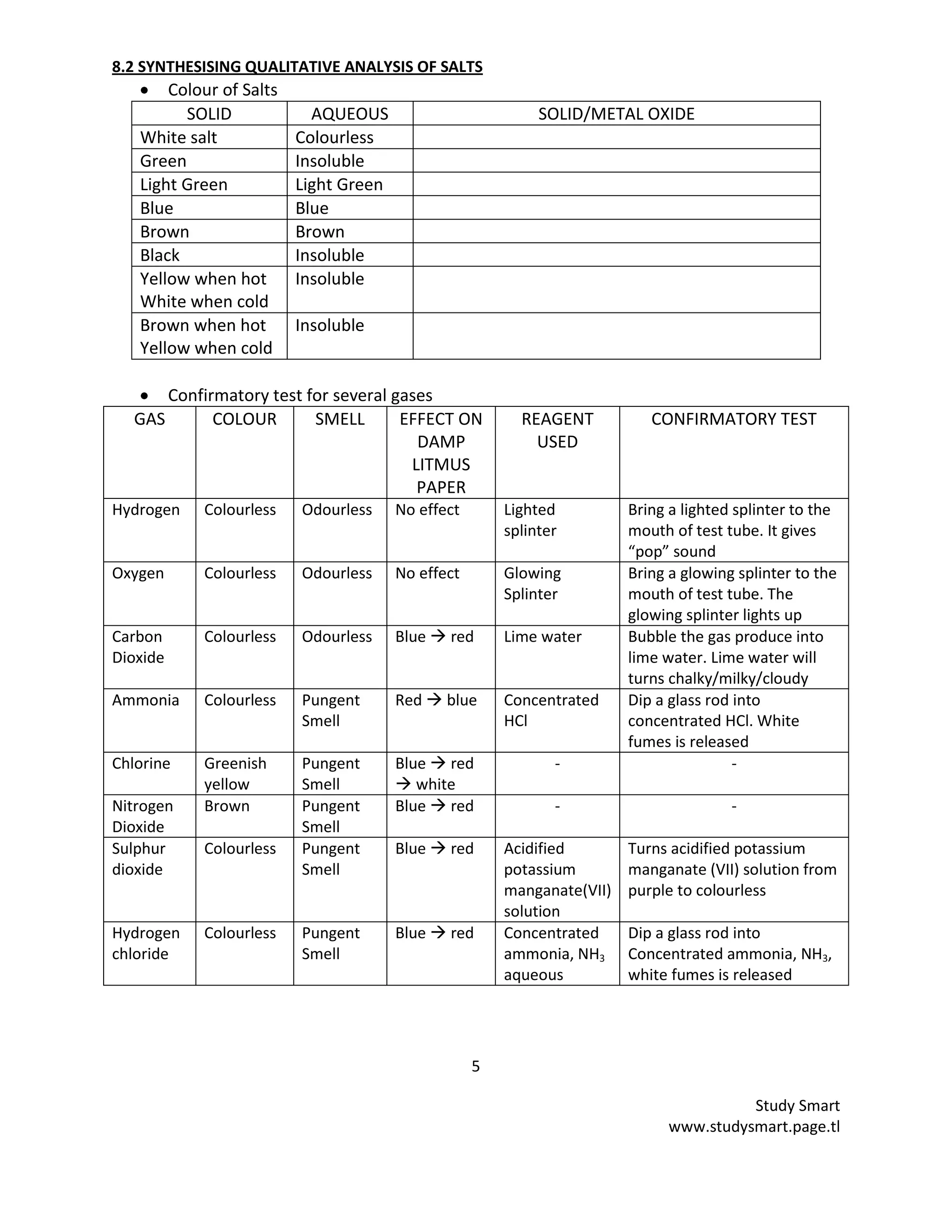
8.2 SYNTHESISING QUALITATIVE ANALYSIS OF SALTS
Colour of Salts
Confirmatory test for several gases
GAS COLOUR SMELL EFFECT ON
DAMP
LITMUS
PAPER
REAGENT
USED
CONFIRMATORY TEST
Hydrogen Colourless Odourless No effect Lighted
splinter
Bring a lighted splinter to the
mouth of test tube. It gives
“pop” sound
Oxygen Colourless Odourless No effect Glowing
Splinter
Bring a glowing splinter to the
mouth of test tube. The
glowing splinter lights up
Carbon
Dioxide
Colourless Odourless Blue  red Lime water Bubble the gas produce into
lime water. Lime water will
turns chalky/milky/cloudy
Ammonia Colourless Pungent
Smell
Red  blue Concentrated
HCl
Dip a glass rod into
concentrated HCl. White
fumes is released
Chlorine Greenish
yellow
Pungent
Smell
Blue  red
 white
- -
Nitrogen
Dioxide
Brown Pungent
Smell
Blue  red - -
Sulphur
dioxide
Colourless Pungent
Smell
Blue  red Acidified
potassium
manganate(VII)
solution
Turns acidified potassium
manganate (VII) solution from
purple to colourless
Hydrogen
chloride
Colourless Pungent
Smell
Blue  red Concentrated
ammonia, NH3
aqueous
Dip a glass rod into
Concentrated ammonia, NH3,
white fumes is released
SOLID AQUEOUS SOLID/METAL OXIDE
White salt Colourless
Green Insoluble
Light Green Light Green
Blue Blue
Brown Brown
Black Insoluble
Yellow when hot
White when cold
Insoluble
Brown when hot
Yellow when cold
Insoluble
6
Study Smart
www.studysmart.page.tl
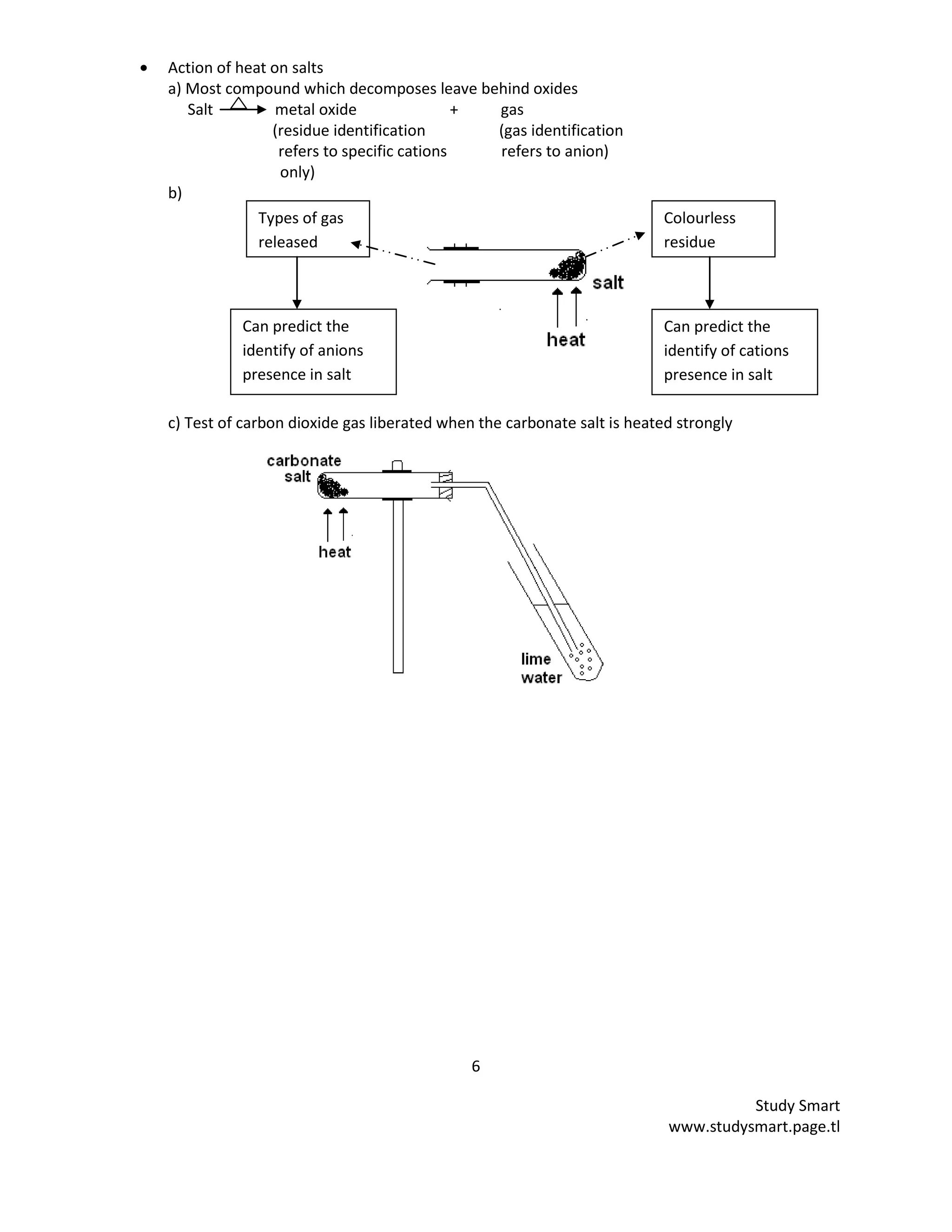
Action of heat on salts
a) Most compound which decomposes leave behind oxides
Salt metal oxide + gas
(residue identification (gas identification
refers to specific cations refers to anion)
only)
b)
c) Test of carbon dioxide gas liberated when the carbonate salt is heated strongly
Types of gas
released
Can predict the
identify of anions
presence in salt
Colourless
residue
Can predict the
identify of cations
presence in salt
7
Study Smart
www.studysmart.page.tl
d) Write down the chemical equation for the reactions that occur.
Ion Carbonate Salt Nitrate Salt
Is not decomposed by heat Decompose into O2 gas and metal nitrate
K+
Na+
Ca2+
Decompose into metallic oxide and CO2 Decompose into metal oxide, NO2 and O2
Mg2+
Al3+
Zn2+
Fe2+
Fe3+
Pb2+
Cu2+
Sulphate salts usually do not decompose
Chloride salts do not decompose except NH4Cl
NH4Cl (s) NH3 (g) + HCl (g) [sublimation]
Confirmatory test for anions
+ H2SO4 dilute
+ dilute +HNO3 + HNO3 + FeSO4
acid + AgNO3 + Ba(NO3)2 + H2SO4 conc
Confirmatory test for cations
a) The presence of cation can be detected by using two common bench alkalis namely
i) _____________________________ solution
ii) _____________________________ solution
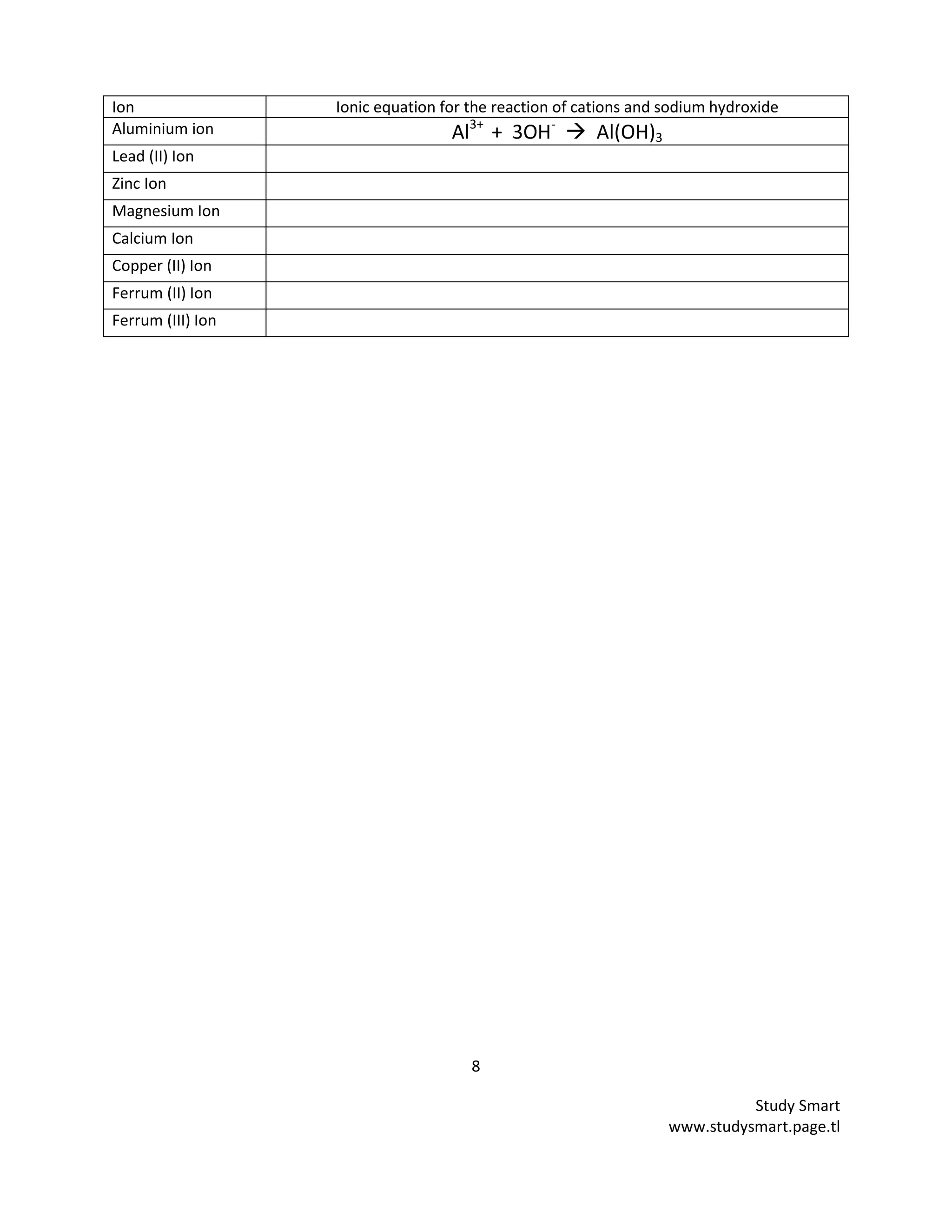
b) Write the ionic equation for the reaction of cations and sodium hydroxide
Unknown Salt Solution
Gas turns
limewater
__________
__________
Precipitate
formed
__________
precipitate
formed
________
________
__
The function of the alkalis is to produce a precipitate that is
Metal hydroxide
METAL + HYDROXIDE ION  METAL HYDROXIDE
8
Study Smart
www.studysmart.page.tl
Ion Ionic equation for the reaction of cations and sodium hydroxide
Aluminium ion Al3+
+ 3OH-
 Al(OH)3
Lead (II) Ion
Zinc Ion
Magnesium Ion
Calcium Ion
Copper (II) Ion
Ferrum (II) Ion
Ferrum (III) Ion
9
Study Smart
www.studysmart.page.tl
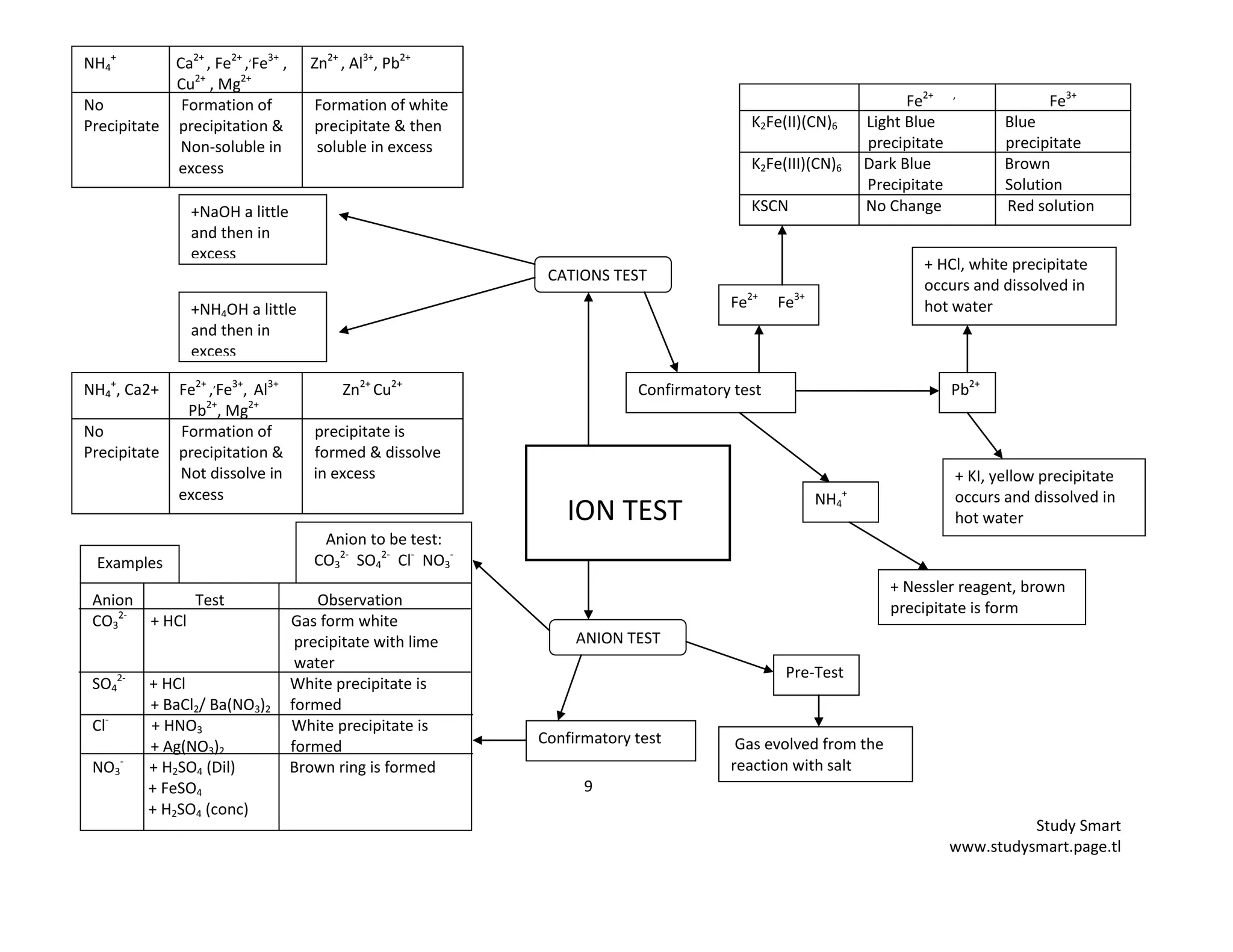
NH4
+
Ca2+
, Fe2+
,,
Fe3+
, Zn2+
, Al3+
, Pb2+
Cu2+
, Mg2+
No Formation of Formation of white
Precipitate precipitation & precipitate & then
Non-soluble in soluble in excess
excess
Fe2+ ,
Fe3+
K2Fe(II)(CN)6 Light Blue Blue
precipitate precipitate
K2Fe(III)(CN)6 Dark Blue Brown
Precipitate Solution
KSCN No Change Red solution+NaOH a little
and then in
excess
+NH4OH a little
and then in
excess
NH4
+
, Ca2+ Fe2+
,,
Fe3+
, Al3+
Zn2+
Cu2+
Pb2+
, Mg2+
No Formation of precipitate is
Precipitate precipitation & formed & dissolve
Not dissolve in in excess
excess
Examples
Anion Test Observation
CO3
2-
+ HCl Gas form white
precipitate with lime
water
SO4
2-
+ HCl White precipitate is
+ BaCl2/ Ba(NO3)2 formed
Cl-
+ HNO3 White precipitate is
+ Ag(NO3)2 formed
NO3
-
+ H2SO4 (Dil) Brown ring is formed
+ FeSO4
+ H2SO4 (conc)
Anion to be test:
CO3
2-
SO4
2-
Cl-
NO3
-
CATIONS TEST
Pre-Test
Confirmatory test
ION TEST
Gas evolved from the
reaction with salt
NH4
+
+ Nessler reagent, brown
precipitate is form
+ KI, yellow precipitate
occurs and dissolved in
hot water
Pb2+
,
+ HCl, white precipitate
occurs and dissolved in
hot waterFe2+
Fe3+
ANION TEST
Confirmatory test
10
Study Smart
www.studysmart.page.tl
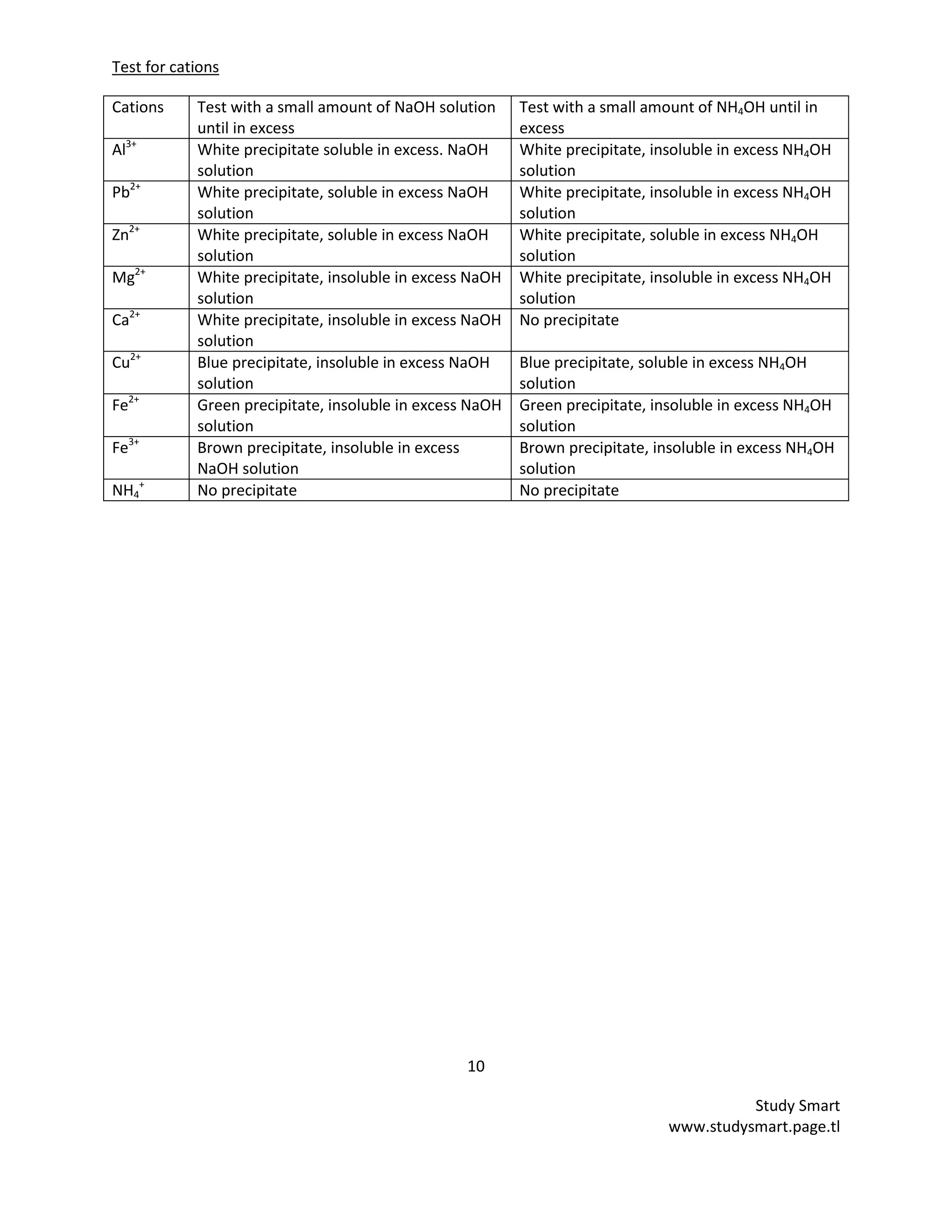
Test for cations
Cations Test with a small amount of NaOH solution
until in excess
Test with a small amount of NH4OH until in
excess
Al3+
White precipitate soluble in excess. NaOH
solution
White precipitate, insoluble in excess NH4OH
solution
Pb2+
White precipitate, soluble in excess NaOH
solution
White precipitate, insoluble in excess NH4OH
solution
Zn2+
White precipitate, soluble in excess NaOH
solution
White precipitate, soluble in excess NH4OH
solution
Mg2+
White precipitate, insoluble in excess NaOH
solution
White precipitate, insoluble in excess NH4OH
solution
Ca2+
White precipitate, insoluble in excess NaOH
solution
No precipitate
Cu2+
Blue precipitate, insoluble in excess NaOH
solution
Blue precipitate, soluble in excess NH4OH
solution
Fe2+
Green precipitate, insoluble in excess NaOH
solution
Green precipitate, insoluble in excess NH4OH
solution
Fe3+
Brown precipitate, insoluble in excess
NaOH solution
Brown precipitate, insoluble in excess NH4OH
solution
NH4
+
No precipitate No precipitate

Studysmartchapter8 121211185514-phpapp02

  • 1.
    1 Study Smart www.studysmart.page.tl STUDYSMART CHEMISTRY FORM4 CHAPTER 8 : SALTS 8.1 Synthesising Salts 8.2 Synthesising qualitative analysis of salts 8.3 Practising to be systematic and meticulous when carrying out activities 8.1 SYNTHESISING SALTS A salt is a compound formed when the hydrogen ion, H+ from an acid is replaced by a metal ion or an ammonium ion, NH4 + Examples HCl + NaOH  NaCl + H2O 2HNO3 + Zn  Zn(NO3)2 + H2 H2SO4 + MgCO3  MgSO4 + H2O + CO2 Complete the table below Metal Ion Sulphate salt (From H2SO4) Chloride salt (From HCl) Nitric Acid (From HNO3) Carbonate salt (From H2CO3) Na+ K+ Zn2+ Mg2+ Ca2+ Fe2+ Fe3+ Cu2+ NH4 + Ba2+ Al3+ Pb2+ Ag2+ INSOLUBLE SALT
  • 2.
    2 Study Smart www.studysmart.page.tl Solubility ofsalt. All K+ ,Na+ and NH4 + salts are soluble All nitrate salts are soluble All carbonate are soluble except K2CO3, Na2CO3 and (NH4)2CO3 All Sulphate salts are soluble except BaSO4 , CaSO4, and PbSO4 All chloride salts are soluble except AgCl2 and PbCl2 The preparation of salt on its solubility of the salt and the nature of the reaction. METHOD 3 METHOD 1 METHOD 2 2 Preparation of salt Soluble Insoluble K+ ,Na+ NH4 + Acid + Alkali  Salt + H2O Titration of acid and alkali - Add acid to the alkali until it is neutral with the aid of an indicator - Repeat the procedure without using an indicator - Gently heat the filtrate to obtain a saturated solution (one-third of its original volume remains) - Cool the hot saturated solution to allow it to crystallize - Filter and dry the crystals by using filter paper Other than K+ ,Na+ NH4 + salts Acid + basic oxide  Salt + water Acid + metal  Salt + Hydrogen gas Acid + Metal Carbonate  Salt + Water + CO2 - Add basic oxide fillings/metals/metal carbonate to the acid and heat it until some of it no longer dissolves. (This mean all acid has reacted with the basic oxide/metal/metal carbonate) - Filter to move excess solid residue - Mix two solution containing cations and anions of insoluble salts - Stir using glass rod - Filter using filter funnel - Rinse the residue with distilled water - Dry the residue with filter paper
  • 3.
    3 Study Smart www.studysmart.page.tl TRY THIS1 Write all possible chemical equation to prepare soluble salts and chemical equation for insoluble salt SALT SOLUBILITY CHEMICAL EQUATION Zinc Chloride Sodium Nitrate Silver Chloride Copper(II) Sulphate Lead(II) Sulphate Aluminium Nitrate Lead(II) Chloride Magnesium Nitrate *******KEY******* S = SOLUBLE SALT IS = INSOLUBLE SALT
  • 4.
    4 Study Smart www.studysmart.page.tl Potassium Chloride Lead(II) Nitrate Barium Sulphate Ammonium Sulphate Numerical probleminvolving stoichiometry reactions in the preparation of salts A student prepare copper(II) nitrate, Cu(NO3)2 by reacting copper(II) oxide, CuO with 100 cm3 of 1.5 mol dm-3 nitric acid, HNO3. Calculate the mass of copper(II) oxide, CuO needed to react completely with the acid. [RAM : Cu,64 ; O,16]
  • 5.
    5 Study Smart www.studysmart.page.tl 8.2 SYNTHESISINGQUALITATIVE ANALYSIS OF SALTS Colour of Salts Confirmatory test for several gases GAS COLOUR SMELL EFFECT ON DAMP LITMUS PAPER REAGENT USED CONFIRMATORY TEST Hydrogen Colourless Odourless No effect Lighted splinter Bring a lighted splinter to the mouth of test tube. It gives “pop” sound Oxygen Colourless Odourless No effect Glowing Splinter Bring a glowing splinter to the mouth of test tube. The glowing splinter lights up Carbon Dioxide Colourless Odourless Blue  red Lime water Bubble the gas produce into lime water. Lime water will turns chalky/milky/cloudy Ammonia Colourless Pungent Smell Red  blue Concentrated HCl Dip a glass rod into concentrated HCl. White fumes is released Chlorine Greenish yellow Pungent Smell Blue  red  white - - Nitrogen Dioxide Brown Pungent Smell Blue  red - - Sulphur dioxide Colourless Pungent Smell Blue  red Acidified potassium manganate(VII) solution Turns acidified potassium manganate (VII) solution from purple to colourless Hydrogen chloride Colourless Pungent Smell Blue  red Concentrated ammonia, NH3 aqueous Dip a glass rod into Concentrated ammonia, NH3, white fumes is released SOLID AQUEOUS SOLID/METAL OXIDE White salt Colourless Green Insoluble Light Green Light Green Blue Blue Brown Brown Black Insoluble Yellow when hot White when cold Insoluble Brown when hot Yellow when cold Insoluble
  • 6.
    6 Study Smart www.studysmart.page.tl Action ofheat on salts a) Most compound which decomposes leave behind oxides Salt metal oxide + gas (residue identification (gas identification refers to specific cations refers to anion) only) b) c) Test of carbon dioxide gas liberated when the carbonate salt is heated strongly Types of gas released Can predict the identify of anions presence in salt Colourless residue Can predict the identify of cations presence in salt
  • 7.
    7 Study Smart www.studysmart.page.tl d) Writedown the chemical equation for the reactions that occur. Ion Carbonate Salt Nitrate Salt Is not decomposed by heat Decompose into O2 gas and metal nitrate K+ Na+ Ca2+ Decompose into metallic oxide and CO2 Decompose into metal oxide, NO2 and O2 Mg2+ Al3+ Zn2+ Fe2+ Fe3+ Pb2+ Cu2+ Sulphate salts usually do not decompose Chloride salts do not decompose except NH4Cl NH4Cl (s) NH3 (g) + HCl (g) [sublimation] Confirmatory test for anions + H2SO4 dilute + dilute +HNO3 + HNO3 + FeSO4 acid + AgNO3 + Ba(NO3)2 + H2SO4 conc Confirmatory test for cations a) The presence of cation can be detected by using two common bench alkalis namely i) _____________________________ solution ii) _____________________________ solution b) Write the ionic equation for the reaction of cations and sodium hydroxide Unknown Salt Solution Gas turns limewater __________ __________ Precipitate formed __________ precipitate formed ________ ________ __ The function of the alkalis is to produce a precipitate that is Metal hydroxide METAL + HYDROXIDE ION  METAL HYDROXIDE
  • 8.
    8 Study Smart www.studysmart.page.tl Ion Ionicequation for the reaction of cations and sodium hydroxide Aluminium ion Al3+ + 3OH-  Al(OH)3 Lead (II) Ion Zinc Ion Magnesium Ion Calcium Ion Copper (II) Ion Ferrum (II) Ion Ferrum (III) Ion
  • 9.
    9 Study Smart www.studysmart.page.tl NH4 + Ca2+ , Fe2+ ,, Fe3+ ,Zn2+ , Al3+ , Pb2+ Cu2+ , Mg2+ No Formation of Formation of white Precipitate precipitation & precipitate & then Non-soluble in soluble in excess excess Fe2+ , Fe3+ K2Fe(II)(CN)6 Light Blue Blue precipitate precipitate K2Fe(III)(CN)6 Dark Blue Brown Precipitate Solution KSCN No Change Red solution+NaOH a little and then in excess +NH4OH a little and then in excess NH4 + , Ca2+ Fe2+ ,, Fe3+ , Al3+ Zn2+ Cu2+ Pb2+ , Mg2+ No Formation of precipitate is Precipitate precipitation & formed & dissolve Not dissolve in in excess excess Examples Anion Test Observation CO3 2- + HCl Gas form white precipitate with lime water SO4 2- + HCl White precipitate is + BaCl2/ Ba(NO3)2 formed Cl- + HNO3 White precipitate is + Ag(NO3)2 formed NO3 - + H2SO4 (Dil) Brown ring is formed + FeSO4 + H2SO4 (conc) Anion to be test: CO3 2- SO4 2- Cl- NO3 - CATIONS TEST Pre-Test Confirmatory test ION TEST Gas evolved from the reaction with salt NH4 + + Nessler reagent, brown precipitate is form + KI, yellow precipitate occurs and dissolved in hot water Pb2+ , + HCl, white precipitate occurs and dissolved in hot waterFe2+ Fe3+ ANION TEST Confirmatory test
  • 10.
    10 Study Smart www.studysmart.page.tl Test forcations Cations Test with a small amount of NaOH solution until in excess Test with a small amount of NH4OH until in excess Al3+ White precipitate soluble in excess. NaOH solution White precipitate, insoluble in excess NH4OH solution Pb2+ White precipitate, soluble in excess NaOH solution White precipitate, insoluble in excess NH4OH solution Zn2+ White precipitate, soluble in excess NaOH solution White precipitate, soluble in excess NH4OH solution Mg2+ White precipitate, insoluble in excess NaOH solution White precipitate, insoluble in excess NH4OH solution Ca2+ White precipitate, insoluble in excess NaOH solution No precipitate Cu2+ Blue precipitate, insoluble in excess NaOH solution Blue precipitate, soluble in excess NH4OH solution Fe2+ Green precipitate, insoluble in excess NaOH solution Green precipitate, insoluble in excess NH4OH solution Fe3+ Brown precipitate, insoluble in excess NaOH solution Brown precipitate, insoluble in excess NH4OH solution NH4 + No precipitate No precipitate