Dept of Pharmaceutical Analysis
Sree Dattha Institute Of Pharmacy
Sheriguda, Ibrahimpatnam.
Presented by
Salma
16U21R0001
Under the guidance of
Asst.Professor Mrs. Sadhana
SREE DATTHA INSTITUTE OF PHARMACY 1
Flourimetry
 Introduction
 Principle
 Factors influencing flourescence intensity
 Quenching of flourescence and types
 Instrumentation
 Applications
SREE DATTHA INSTITUTE OF PHARMACY 2
 FLOUESCENCE
It is a phenomenon of emission of radiation when the molecules are exited
by radiation at certain wavelength.
 FLOURIMETRY
It is measurement of fluorescence intensity at a particular wavelength with
the help of a filter fluorimeter or a spectrofluorimeter.
SREE DATTHA INSTITUTE OF PHARMACY 3
 FLOURESCENCE
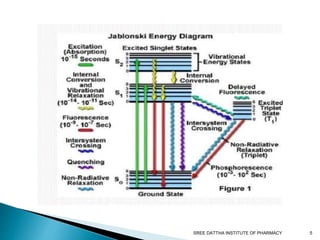
• Excited singlet state is highly unstable. Relaxation of electrons from
excited singlet to singlet ground state with emission of light .
 PHOSPHORESCENCE
• At favourable conditions like absence of oxygen and low temperature
there is transition from excited singlet state to triplet state which is called
as intersystem crossing. The emission of radiation when electrons
undergo transition from triplet state to singlet ground state is called as
phosphorescence.
SREE DATTHA INSTITUTE OF PHARMACY 4
SREE DATTHA INSTITUTE OF PHARMACY 5
• Based upon the wavelength of emitted radiation when compared to
absorbed radiation
• A.Stoke`s flourescence: The wavelength of emitted radiation is
longer than the absorbed radiation
• B. Anti-stoke`s flourescence: The wavelength of emitted radiation
is shorter than the absorbed radiation.
• C.Resonance florescence: When the wavelength of the emitted
radiation is equal to the absorbed radiation.
SREE DATTHA INSTITUTE OF PHARMACY 6
 Conjugation
A molecule must have unsaturation so that uv/vis radiation can be
absorbed. If there is no absorption of radiation, there will not be
flourescence
 Nature of substituent groups
Electron donating groups like amino, hydroxyl groups enhance
flourescence intensity.
electron withdrawing groups like nitro carboxylic group reduce flourescene
intensity.
SREE DATTHA INSTITUTE OF PHARMACY 7
SREE DATTHA INSTITUTE OF PHARMACY 8
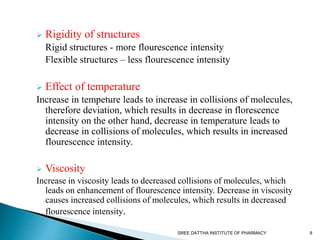
 Rigidity of structures
Rigid structures - more flourescence intensity
Flexible structures – less flourescence intensity
 Effect of temperature
Increase in tempeture leads to increase in collisions of molecules,
therefore deviation, which results in decrease in florescence
intensity on the other hand, decrease in temperature leads to
decrease in collisions of molecules, which results in increased
flourescence intensity.
 Viscosity
Increase in viscosity leads to decreased collisions of molecules, which
leads on enhancement of flourescence intensity. Decrease in viscosity
causes increased collisions of molecules, which results in decreased
flourescence intensity.
 SELF QUENCHING
At Low Concentration Linearity Is Observed, At High Concentration Of
The Same Substance Increase In Fluorescent Intensity Is Observed. This
phenomena is called self quenching.
 COLLISONAL QUENCHING
Collisions between the fluorescent substance and halide ions leads to
reduction in fluorescence intensity.
 STATIC QUENCHING
This occurs because of complex formation between the fluorescent
molecule and other molecules.
 Ex: caffeine reduces fluorescence of riboflavin.
SREE DATTHA INSTITUTE OF PHARMACY
9
QUENCHING OF FLOURESCENCE AND TYPES
SREE DATTHA INSTITUTE OF PHARMACY
10
SREE DATTHA INSTITUTE OF PHARMACY 11
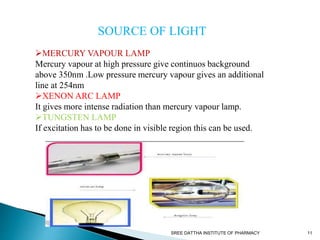
SOURCE OF LIGHT
MERCURY VAPOUR LAMP
Mercury vapour at high pressure give continuos background
above 350nm .Low pressure mercury vapour gives an additional
line at 254nm
XENON ARC LAMP
It gives more intense radiation than mercury vapour lamp.
TUNGSTEN LAMP
If excitation has to be done in visible region this can be used.
 FILTERS
• Filters works on the principle of absorption of unwanted light and
transmitting the required wavelength of light.
 PRIMARY FILTER
• Absorbs visible radiation and transmit uv radiation.
 SECONDARY FILTER
• Absorbs uv radiation and transmit visible radiation.
SREE DATTHA INSTITUTE OF PHARMACY 12
• They convert polychromatic light into monochromatic light.
• They isolate a specific range of wavelength or a particular wavelenth of
radiation from a source.
 EXCITATION MONOCHROMATORS
• Provides suitable radiation for excitation of molecule.
 EMISSION MONOCHROMATORS
• Isolate only the radiation emitted by the flourescent molecules.
SREE DATTHA INSTITUTE OF PHARMACY 13
 These are meant for holding liquid samples.These are made up of quartz
and can have various shapes like cylindrical or rectangular etc.
 DETECTORS
• The most commonly used detectors are
• 1.Barrier layer cell
• 2.Photo tubes
• 3.Photo multiplier tubes
SREE DATTHA INSTITUTE OF PHARMACY 14
SREE DATTHA INSTITUTE OF PHARMACY 15
PHOTO MULTIPLIER TUBE
The principle employed in this detector is that multiplication of photo
electrons by secondary emission of electrons.
This is achieved by using a photo cathode and a series of anodes
[dyanodes].upto 10 dyanodes are used.
SREE DATTHA INSTITUTE OF PHARMACY 16
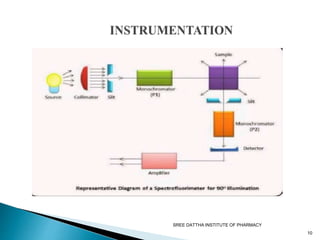
INSTRUMENTS
 The most common types are
 Single beam fluorimeter
 Double beam fluorimeter
 Spectrofluorimeter
 Tungsten lamp as sorce of light.
 The primary filter absorbs visible radiation and transmits uv radiation.
 Emitted radiation measured at 90 by secondary filter.
 Secondary filter absorbs uv radiation and transmits visible radiation.
SREE DATTHA INSTITUTE OF PHARMACY 17
 Similar to single beam instrument.
 Two incident beams from light source pass through primary filters
separately and fall on either sample or reference solution.
 The emitted radiation from sample or reference pass separately through
secondary filter.
SREE DATTHA INSTITUTE OF PHARMACY 18
 In this primary filter in double beam flourimeter is replaced by excitation
monochromator and the secondary filter is replaced by emission
monochromator.
 Incident beam is split into sample and reference beam by using beam
splitter.
SREE DATTHA INSTITUTE OF PHARMACY 19
SREE DATTHA INSTITUTE OF PHARMACY
20
APPLICATIONS
1.Determination Of Thiamine Hcl
2.Determination of phenytoin.
3.Determination of indoles,phenols and phenothiazines.
4.Determination Of Ruthenium Ions In Presence Of Other Platinum
Metals
5.Determination of napthols,proteins,plant pigments and steroids.
6.Respiratory tract infections.
SREE DATTHA INSTITUTE OF PHARMACY 21

Salma

  • 1.
    Dept of PharmaceuticalAnalysis Sree Dattha Institute Of Pharmacy Sheriguda, Ibrahimpatnam. Presented by Salma 16U21R0001 Under the guidance of Asst.Professor Mrs. Sadhana SREE DATTHA INSTITUTE OF PHARMACY 1 Flourimetry
  • 2.
     Introduction  Principle Factors influencing flourescence intensity  Quenching of flourescence and types  Instrumentation  Applications SREE DATTHA INSTITUTE OF PHARMACY 2
  • 3.
     FLOUESCENCE It isa phenomenon of emission of radiation when the molecules are exited by radiation at certain wavelength.  FLOURIMETRY It is measurement of fluorescence intensity at a particular wavelength with the help of a filter fluorimeter or a spectrofluorimeter. SREE DATTHA INSTITUTE OF PHARMACY 3
  • 4.
     FLOURESCENCE • Excitedsinglet state is highly unstable. Relaxation of electrons from excited singlet to singlet ground state with emission of light .  PHOSPHORESCENCE • At favourable conditions like absence of oxygen and low temperature there is transition from excited singlet state to triplet state which is called as intersystem crossing. The emission of radiation when electrons undergo transition from triplet state to singlet ground state is called as phosphorescence. SREE DATTHA INSTITUTE OF PHARMACY 4
  • 5.
    SREE DATTHA INSTITUTEOF PHARMACY 5
  • 6.
    • Based uponthe wavelength of emitted radiation when compared to absorbed radiation • A.Stoke`s flourescence: The wavelength of emitted radiation is longer than the absorbed radiation • B. Anti-stoke`s flourescence: The wavelength of emitted radiation is shorter than the absorbed radiation. • C.Resonance florescence: When the wavelength of the emitted radiation is equal to the absorbed radiation. SREE DATTHA INSTITUTE OF PHARMACY 6
  • 7.
     Conjugation A moleculemust have unsaturation so that uv/vis radiation can be absorbed. If there is no absorption of radiation, there will not be flourescence  Nature of substituent groups Electron donating groups like amino, hydroxyl groups enhance flourescence intensity. electron withdrawing groups like nitro carboxylic group reduce flourescene intensity. SREE DATTHA INSTITUTE OF PHARMACY 7
  • 8.
    SREE DATTHA INSTITUTEOF PHARMACY 8  Rigidity of structures Rigid structures - more flourescence intensity Flexible structures – less flourescence intensity  Effect of temperature Increase in tempeture leads to increase in collisions of molecules, therefore deviation, which results in decrease in florescence intensity on the other hand, decrease in temperature leads to decrease in collisions of molecules, which results in increased flourescence intensity.  Viscosity Increase in viscosity leads to decreased collisions of molecules, which leads on enhancement of flourescence intensity. Decrease in viscosity causes increased collisions of molecules, which results in decreased flourescence intensity.
  • 9.
     SELF QUENCHING AtLow Concentration Linearity Is Observed, At High Concentration Of The Same Substance Increase In Fluorescent Intensity Is Observed. This phenomena is called self quenching.  COLLISONAL QUENCHING Collisions between the fluorescent substance and halide ions leads to reduction in fluorescence intensity.  STATIC QUENCHING This occurs because of complex formation between the fluorescent molecule and other molecules.  Ex: caffeine reduces fluorescence of riboflavin. SREE DATTHA INSTITUTE OF PHARMACY 9 QUENCHING OF FLOURESCENCE AND TYPES
  • 10.
    SREE DATTHA INSTITUTEOF PHARMACY 10
  • 11.
    SREE DATTHA INSTITUTEOF PHARMACY 11 SOURCE OF LIGHT MERCURY VAPOUR LAMP Mercury vapour at high pressure give continuos background above 350nm .Low pressure mercury vapour gives an additional line at 254nm XENON ARC LAMP It gives more intense radiation than mercury vapour lamp. TUNGSTEN LAMP If excitation has to be done in visible region this can be used.
  • 12.
     FILTERS • Filtersworks on the principle of absorption of unwanted light and transmitting the required wavelength of light.  PRIMARY FILTER • Absorbs visible radiation and transmit uv radiation.  SECONDARY FILTER • Absorbs uv radiation and transmit visible radiation. SREE DATTHA INSTITUTE OF PHARMACY 12
  • 13.
    • They convertpolychromatic light into monochromatic light. • They isolate a specific range of wavelength or a particular wavelenth of radiation from a source.  EXCITATION MONOCHROMATORS • Provides suitable radiation for excitation of molecule.  EMISSION MONOCHROMATORS • Isolate only the radiation emitted by the flourescent molecules. SREE DATTHA INSTITUTE OF PHARMACY 13
  • 14.
     These aremeant for holding liquid samples.These are made up of quartz and can have various shapes like cylindrical or rectangular etc.  DETECTORS • The most commonly used detectors are • 1.Barrier layer cell • 2.Photo tubes • 3.Photo multiplier tubes SREE DATTHA INSTITUTE OF PHARMACY 14
  • 15.
    SREE DATTHA INSTITUTEOF PHARMACY 15 PHOTO MULTIPLIER TUBE The principle employed in this detector is that multiplication of photo electrons by secondary emission of electrons. This is achieved by using a photo cathode and a series of anodes [dyanodes].upto 10 dyanodes are used.
  • 16.
    SREE DATTHA INSTITUTEOF PHARMACY 16 INSTRUMENTS  The most common types are  Single beam fluorimeter  Double beam fluorimeter  Spectrofluorimeter
  • 17.
     Tungsten lampas sorce of light.  The primary filter absorbs visible radiation and transmits uv radiation.  Emitted radiation measured at 90 by secondary filter.  Secondary filter absorbs uv radiation and transmits visible radiation. SREE DATTHA INSTITUTE OF PHARMACY 17
  • 18.
     Similar tosingle beam instrument.  Two incident beams from light source pass through primary filters separately and fall on either sample or reference solution.  The emitted radiation from sample or reference pass separately through secondary filter. SREE DATTHA INSTITUTE OF PHARMACY 18
  • 19.
     In thisprimary filter in double beam flourimeter is replaced by excitation monochromator and the secondary filter is replaced by emission monochromator.  Incident beam is split into sample and reference beam by using beam splitter. SREE DATTHA INSTITUTE OF PHARMACY 19
  • 20.
    SREE DATTHA INSTITUTEOF PHARMACY 20 APPLICATIONS 1.Determination Of Thiamine Hcl 2.Determination of phenytoin. 3.Determination of indoles,phenols and phenothiazines. 4.Determination Of Ruthenium Ions In Presence Of Other Platinum Metals 5.Determination of napthols,proteins,plant pigments and steroids. 6.Respiratory tract infections.
  • 21.
    SREE DATTHA INSTITUTEOF PHARMACY 21