ANTIFUNGAL AGENTS
Submitted by:
Ch.Peethi (16U21R0056)
SREE DATTHA INSTITUTE OF PHARMACY
Sheriguda, Ibrahimpatnam Telangana 5010510
Under the guidance of:
Miss.Nikitha
Dept. Of Chemistry
SREE DATTHA INSTITUTE OF PHARMACY
CONTENTS:
• INTRODUCTION
• CLASSIFICATION
• STRUCTURE
• MECHANISM OF ACTION
• SYNTHESIS
• ADVERSE AFFECTS
• USES
SREE DATTHA INSTITUTE OF PHARMACY
INTRODUCTION:
• Fungi are small filamentous organisms which live either as
saprophytes or parasites in plants and in human beings.
• Fungi are harmful to human beings as they are responsible for
causing several infectious diseases.
• Fungal infections are very rare when compared to bacterial and viral
infections.
SREE DATTHA INSTITUTE OF PHARMACY
• Fungal infections are classified as:
• Superficial infections: These are associated with skin, hair, nails
mucous membrane.
• Systemic infections: These are associated with the entire body and
are capable of infecting tissues and organs.
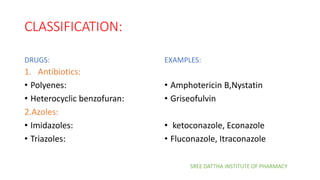
CLASSIFICATION:
DRUGS:
1. Antibiotics:
• Polyenes:
• Heterocyclic benzofuran:
2.Azoles:
• Imidazoles:
• Triazoles:
EXAMPLES:
• Amphotericin B,Nystatin
• Griseofulvin
• ketoconazole, Econazole
• Fluconazole, Itraconazole
SREE DATTHA INSTITUTE OF PHARMACY
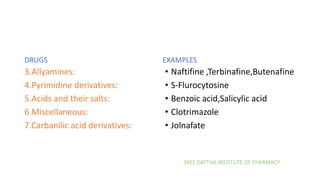
DRUGS
3.Allyamines:
4.Pyrimidine derivatives:
5.Acids and their salts:
6.Miscellaneous:
7.Carbanilic acid derivatives:
EXAMPLES
• Naftifine ,Terbinafine,Butenafine
• S-Flurocytosine
• Benzoic acid,Salicylic acid
• Clotrimazole
• Jolnafate
AZOLES:
• These are synthetic antifungal agents they are both fungicidal and
fungistatic in action depending upon the concentration level of drug.
• Azoles are five membered ring structures with nitrogen groups based
on the number of nitrogen atoms present in the drug , azoles are
grouped as imidazoles (2 nitrogens) ,triazoles (3nitrogens). Both
imidazoles and triazoles have similar antifungal spectrum.
SREE DATTHA INSTITUTE OF PHARMACY
• Mechanism of action:
• Azoles control the fungal infections by different mechanisms .The
most suitable mechanism of action is inhibition of ergosterol
synthesis.
• Ergosterol is a sterol component of fungal cell membrane responsible
for its rigidity.
• The azoles bind to cytochrome P-450 class enzyme.
SREE DATTHA INSTITUTE OF PHARMACY
• Lanosterol on demethylation produces ergosterol which occurs in the
presence of 14-alpha demethylase . Azoles inhibit 14-alpha
demthylase action by binding to free electron pairs present on the
azole ring.
• Due to this binding the enzymes such as ATPases and those involved
electron transfer chain are rendered function less. Additionally
conversion of lanosterol into ergosterol is not formed.
SREE DATTHA INSTITUTE OF PHARMACY
• Structure Activity Relationship:
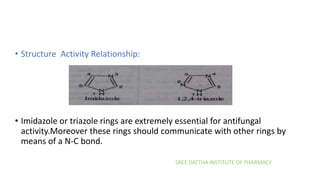
• Imidazole or triazole rings are extremely essential for antifungal
activity.Moreover these rings should communicate with other rings by
means of a N-C bond.
SREE DATTHA INSTITUTE OF PHARMACY
• The nitrogen atom present at third position in imidazole and fourth
position in triazole is termed as abidine nitrogen.Basic structure of
drug should posses at least 2or3 hetetocyclic rings.
• At least one of the above mentioned hetrtocyclic ring should be
substituted with halogen atoms.
• The substitution can occur either at only second or at both second
and fourth position resulting in potent antifungal drugs.
FLUCONAZOLE:
• Fluconazole is a broad spectrum antifungal agent, effective against
numerous fungi. Chemically, fluconazole is fluorinated bis-triazole
that exhibit exceptional water solubility which enables its
administration by both oral and I.V route.
• Molecular Weight: 306.271g/mole.
SREE DATTHA INSTITUTE OF PHARMACY
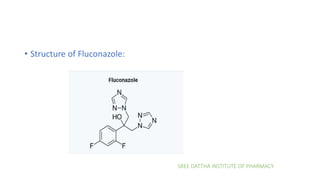
• Structure of Fluconazole:
SREE DATTHA INSTITUTE OF PHARMACY
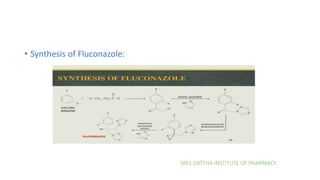
• Synthesis of Fluconazole:
SREE DATTHA INSTITUTE OF PHARMACY
• Adverse Effects:
1. Nausea, vomiting, headache, abdominal pain, alopecia and skin
rashes.
2. Immunocompromised patients who consume the drug for
prolonged period experience increased levels of serum
transaminase.
3. Stevens-johnson syndrome is seen in aids patients who are on
multiple drug therapy.
SREE DATTHA INSTITUTE OF PHARMACY
• Therapeutic Uses:
1. It is the drug of choice to treat cryptococcal meningitis and
coccidiodal meningitis.
2. It can effectively treat infections like cutaneous candidiasis, oral
candidiasis, vaginal candidiasis.
3. Fungal keratitis is treated by using eye drops.
REFERENCE
MEDICINAL CHEMISTRY
SREE DATTHA INSTITUTE OF PHARMACY
THANK YOU
SREE DATTHA INSTITUTE OF PHARMACY

Preethi

  • 1.
    ANTIFUNGAL AGENTS Submitted by: Ch.Peethi(16U21R0056) SREE DATTHA INSTITUTE OF PHARMACY Sheriguda, Ibrahimpatnam Telangana 5010510 Under the guidance of: Miss.Nikitha Dept. Of Chemistry SREE DATTHA INSTITUTE OF PHARMACY
  • 2.
    CONTENTS: • INTRODUCTION • CLASSIFICATION •STRUCTURE • MECHANISM OF ACTION • SYNTHESIS • ADVERSE AFFECTS • USES SREE DATTHA INSTITUTE OF PHARMACY
  • 3.
    INTRODUCTION: • Fungi aresmall filamentous organisms which live either as saprophytes or parasites in plants and in human beings. • Fungi are harmful to human beings as they are responsible for causing several infectious diseases. • Fungal infections are very rare when compared to bacterial and viral infections. SREE DATTHA INSTITUTE OF PHARMACY
  • 4.
    SREE DATTHA INSTITUTEOF PHARMACY • Fungal infections are classified as: • Superficial infections: These are associated with skin, hair, nails mucous membrane. • Systemic infections: These are associated with the entire body and are capable of infecting tissues and organs.
  • 5.
    CLASSIFICATION: DRUGS: 1. Antibiotics: • Polyenes: •Heterocyclic benzofuran: 2.Azoles: • Imidazoles: • Triazoles: EXAMPLES: • Amphotericin B,Nystatin • Griseofulvin • ketoconazole, Econazole • Fluconazole, Itraconazole SREE DATTHA INSTITUTE OF PHARMACY
  • 6.
    SREE DATTHA INSTITUTEOF PHARMACY DRUGS 3.Allyamines: 4.Pyrimidine derivatives: 5.Acids and their salts: 6.Miscellaneous: 7.Carbanilic acid derivatives: EXAMPLES • Naftifine ,Terbinafine,Butenafine • S-Flurocytosine • Benzoic acid,Salicylic acid • Clotrimazole • Jolnafate
  • 7.
    AZOLES: • These aresynthetic antifungal agents they are both fungicidal and fungistatic in action depending upon the concentration level of drug. • Azoles are five membered ring structures with nitrogen groups based on the number of nitrogen atoms present in the drug , azoles are grouped as imidazoles (2 nitrogens) ,triazoles (3nitrogens). Both imidazoles and triazoles have similar antifungal spectrum. SREE DATTHA INSTITUTE OF PHARMACY
  • 8.
    SREE DATTHA INSTITUTEOF PHARMACY • Mechanism of action: • Azoles control the fungal infections by different mechanisms .The most suitable mechanism of action is inhibition of ergosterol synthesis. • Ergosterol is a sterol component of fungal cell membrane responsible for its rigidity. • The azoles bind to cytochrome P-450 class enzyme.
  • 9.
    SREE DATTHA INSTITUTEOF PHARMACY • Lanosterol on demethylation produces ergosterol which occurs in the presence of 14-alpha demethylase . Azoles inhibit 14-alpha demthylase action by binding to free electron pairs present on the azole ring. • Due to this binding the enzymes such as ATPases and those involved electron transfer chain are rendered function less. Additionally conversion of lanosterol into ergosterol is not formed.
  • 10.
    SREE DATTHA INSTITUTEOF PHARMACY • Structure Activity Relationship: • Imidazole or triazole rings are extremely essential for antifungal activity.Moreover these rings should communicate with other rings by means of a N-C bond.
  • 11.
    SREE DATTHA INSTITUTEOF PHARMACY • The nitrogen atom present at third position in imidazole and fourth position in triazole is termed as abidine nitrogen.Basic structure of drug should posses at least 2or3 hetetocyclic rings. • At least one of the above mentioned hetrtocyclic ring should be substituted with halogen atoms. • The substitution can occur either at only second or at both second and fourth position resulting in potent antifungal drugs.
  • 12.
    FLUCONAZOLE: • Fluconazole isa broad spectrum antifungal agent, effective against numerous fungi. Chemically, fluconazole is fluorinated bis-triazole that exhibit exceptional water solubility which enables its administration by both oral and I.V route. • Molecular Weight: 306.271g/mole. SREE DATTHA INSTITUTE OF PHARMACY
  • 13.
    SREE DATTHA INSTITUTEOF PHARMACY • Structure of Fluconazole:
  • 14.
    SREE DATTHA INSTITUTEOF PHARMACY • Synthesis of Fluconazole:
  • 15.
    SREE DATTHA INSTITUTEOF PHARMACY • Adverse Effects: 1. Nausea, vomiting, headache, abdominal pain, alopecia and skin rashes. 2. Immunocompromised patients who consume the drug for prolonged period experience increased levels of serum transaminase. 3. Stevens-johnson syndrome is seen in aids patients who are on multiple drug therapy.
  • 16.
    SREE DATTHA INSTITUTEOF PHARMACY • Therapeutic Uses: 1. It is the drug of choice to treat cryptococcal meningitis and coccidiodal meningitis. 2. It can effectively treat infections like cutaneous candidiasis, oral candidiasis, vaginal candidiasis. 3. Fungal keratitis is treated by using eye drops.
  • 17.
  • 18.
    THANK YOU SREE DATTHAINSTITUTE OF PHARMACY