Downloaded 67 times


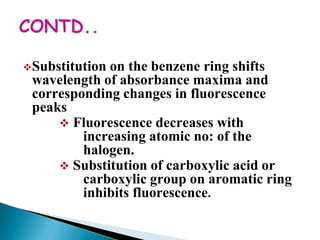
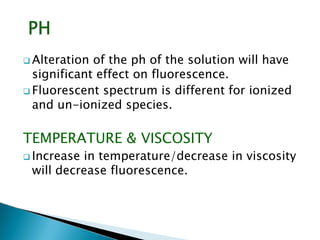
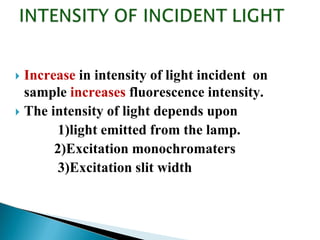
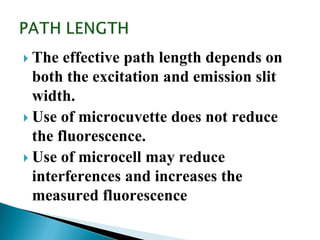
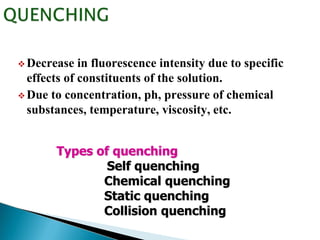
![ Monochromatic light is essential for the
excitation of fluorescence because the
intensity will vary with wavelength.
OXYGEN
The presence of oxygen may interfere in 2
ways.
1] by direct oxidation of the fluorescent
substances to non fluorescent.
2] by quenching of fluorescence.](https://image.slidesharecdn.com/flourimetry-140618015916-phpapp01-copy-170218141111/85/Flourimetry-140618015916-phpapp01-copy-27-320.jpg)

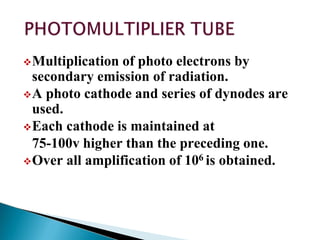
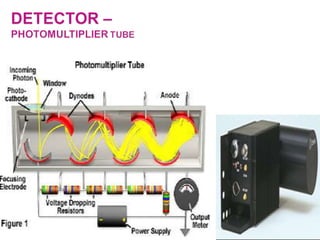
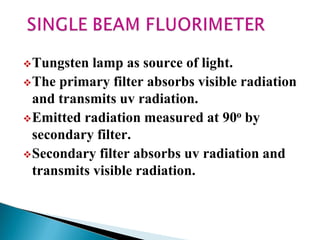
![1] Determination of inorganic substances
Determination of ruthenium ions in presence of
other platinum metals.
Determination of aluminum (III) in alloys.
Determination of boron in steel by complex formed
with benzoin.
Estimation of cadmium with
2-(2 hydroxyphenyl) benzoxazole in presence of
tartarate.](https://image.slidesharecdn.com/flourimetry-140618015916-phpapp01-copy-170218141111/85/Flourimetry-140618015916-phpapp01-copy-54-320.jpg)
![ Field determination of uranium salts.
3]fluorescent indicators
Mainly used in acid-base titration.
e.g.:
eosin- colorless-green.
Fluorescein:colourless-green.
Quinine sulphate: blue-violet.
Acridine: green-violet](https://image.slidesharecdn.com/flourimetry-140618015916-phpapp01-copy-170218141111/85/Flourimetry-140618015916-phpapp01-copy-55-320.jpg)
![Reagent Ion Fluorescence
wavelength
Sensitivity
Alizarin
garnet B
Al3+ 500 0.007
Flavanol
8-Hydroxy
quinoline
Sn4+
Li2+
470
580
0.1
0.2
4] Fluorometric reagent
Aromatic structure with two or more donor
functional groups](https://image.slidesharecdn.com/flourimetry-140618015916-phpapp01-copy-170218141111/85/Flourimetry-140618015916-phpapp01-copy-56-320.jpg)
![compound reagent excitation
wavelength
fluorescence
hydrocortisone 75%v/v
H2SO4 in
ethanol
460 520
nicotinamide cyanogen
chloride
250 430
5] organic analysis
Qualitative and quantitative analysis of organic
aromatic compounds present in cigarette smoke, air
pollutants, automobile exhausts etc.
6] pharmaceutical analysis](https://image.slidesharecdn.com/flourimetry-140618015916-phpapp01-copy-170218141111/85/Flourimetry-140618015916-phpapp01-copy-57-320.jpg)
![7] Liquid chromatography
Fluorescence is an imp method of
determining compounds as they
appear at the end of chromatogram or
capillary electrophoresis column.
8]determination of vitamin B1 &B2.](https://image.slidesharecdn.com/flourimetry-140618015916-phpapp01-copy-170218141111/85/Flourimetry-140618015916-phpapp01-copy-58-320.jpg)


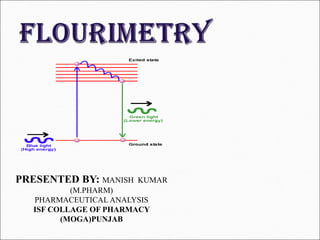
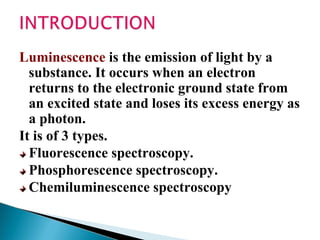
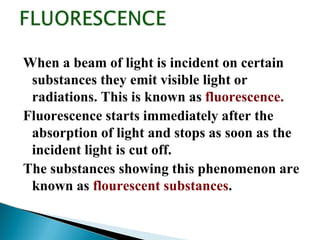
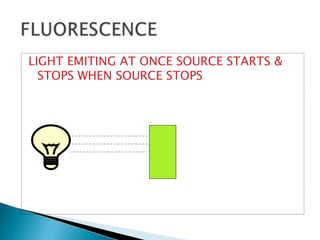
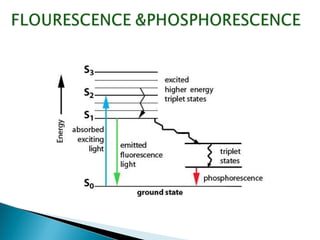
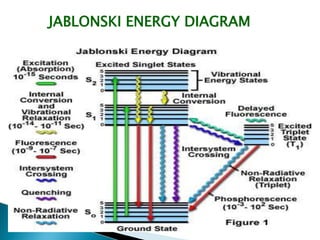
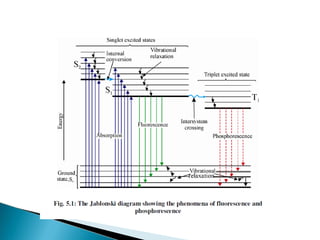
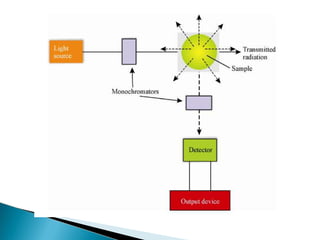
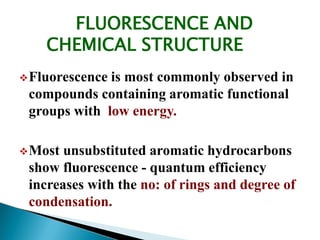
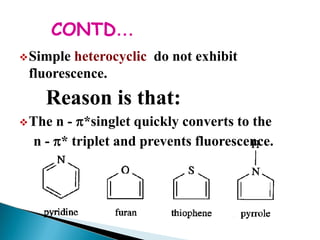
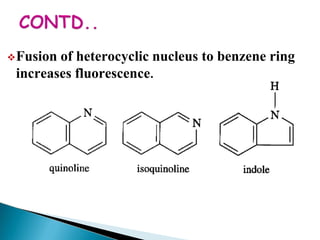
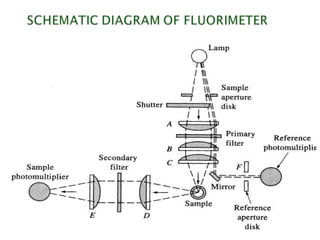
This document discusses fluorescence spectroscopy and its applications in pharmacy. It begins with definitions of fluorescence, phosphorescence, and chemiluminescence. It describes how fluorescent substances emit light when exposed to radiation and discusses factors that affect fluorescence like molecular structure, substituents, concentration, oxygen, pH, and temperature. The principles of fluorescence are explained using Jablonski diagrams. Instrumentation for fluorescence spectroscopy including light sources, filters, sample cells, and detectors are outlined. Finally, applications of fluorescence spectroscopy in inorganic analysis, organic analysis, liquid chromatography, and determination of vitamins and drugs are described.


