1
THEORY OF FLUORIMETRY
PRESENTED BY-
AMEENA MEHABOOB
1ST YR MPHARM 2
Luminescence is the emission of light by a substance. It occurs when an
electron returns to the electronic ground state from an excited state and
loses its excess energy as a photon. It is of 3 types-
• Fluorescence
• Phosphorescence
• Chemiluminescence
INTRODUCTION
3
FLUORESCENCE
•When a beam of light is incident on certain substances they emit
visible light or radiations. This is called flourescence.
•It starts immediately after absorption of light and stops as soon as
the incident light is cut off.
•Substances showing this phenomenon are flourescent substances.
FLUORESCENCE
4
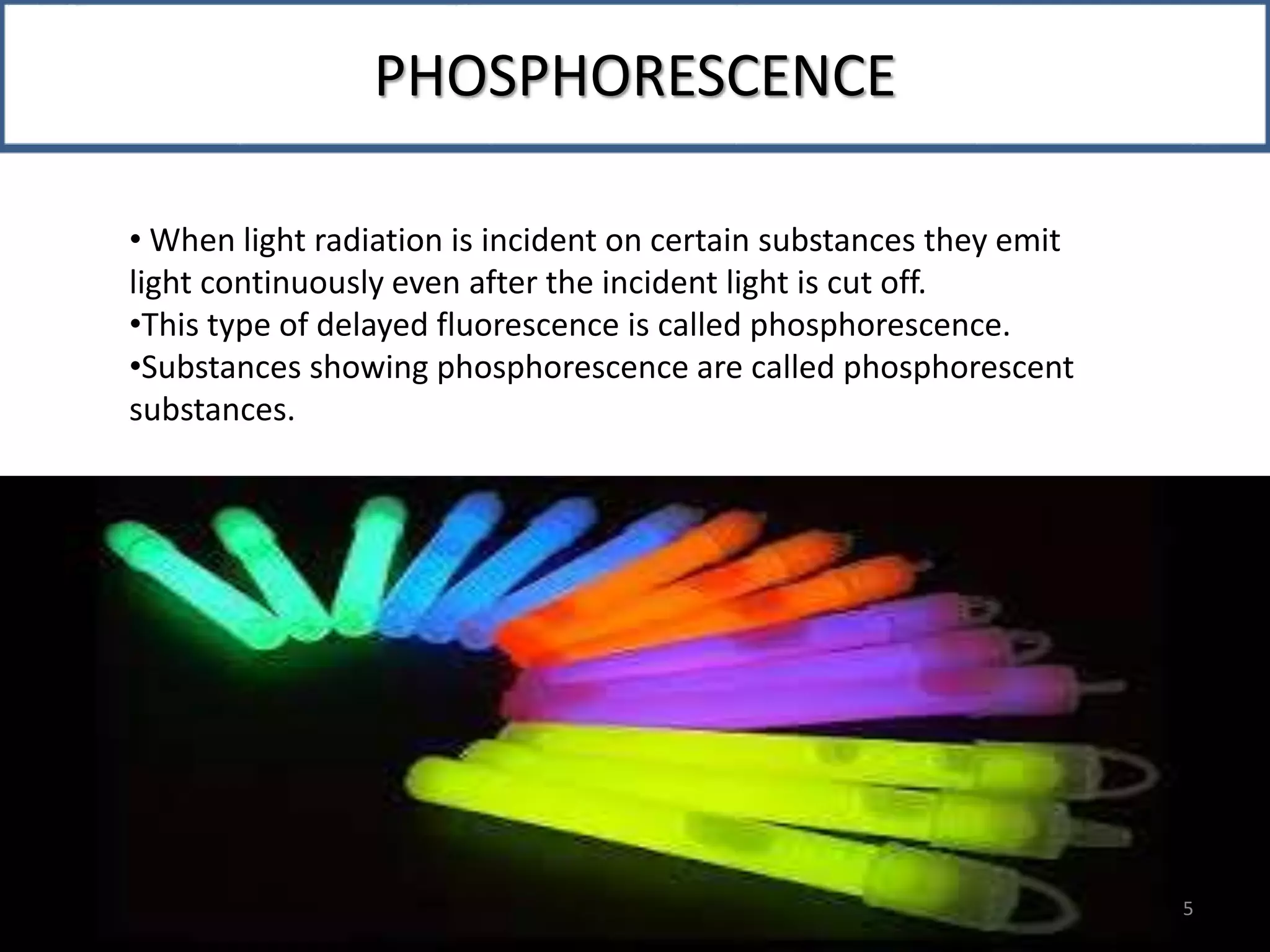
PHOSPHORESCENCE
• When light radiation is incident on certain substances they emit
light continuously even after the incident light is cut off.
•This type of delayed fluorescence is called phosphorescence.
•Substances showing phosphorescence are called phosphorescent
substances.
PHOSPHORESCENCE
5
FLOURIMETRY
• Fluorescence is the molecular absorption of light energy at one
wavelength and its nearly instantaneous re-emission at another, usually
longer, wavelength.
• Fluorescent compounds have two characteristic spectra: an excitation
spectrum (the wavelength and amount of light absorbed) and an emission
spectrum (the wavelength and amount of light emitted). Fluorimetry is the
measurement of fluorescence.
FLUORIMETRY
6
•A molecular electronic state in which all the electrons are paired are called singlet
state.
•At this state all molecules are diamagnetic
•Most of the molecules in their ground state are paired
•When a molecule absorbs UV/ visible radiation, one or more of the paired
electron is raised to an excited singlet state/ excited triplet state
Ground
singlet
state
Excited singlet state
Spin paired
No net mag. field
Triplet state
Spins unpaired
Net mag. field
THEORY OF FLUORIMETRY
7
SINGLET/TRIPLET STATES
Ground
state
Excited
singlet
state
Excited
Triplet
state
PAULI EXCLUSION PRINCIPLE-
No 2 electrons in an atom can have the same set of 4 quantum numbers.
In other words, 2 electrons in the same orbital must have opposite spins
(paired, no net magnetic field- diamagnetic), molecule with unpaired
electrons (triplet state) possess magnetic moment, and are attracted by
magnetic field, are called paramagnetic.
Excited triplet state is of less energy than excited singlet state.
Singlet to triplet transitions are far less probable than
singlet/singlet transitions.
8
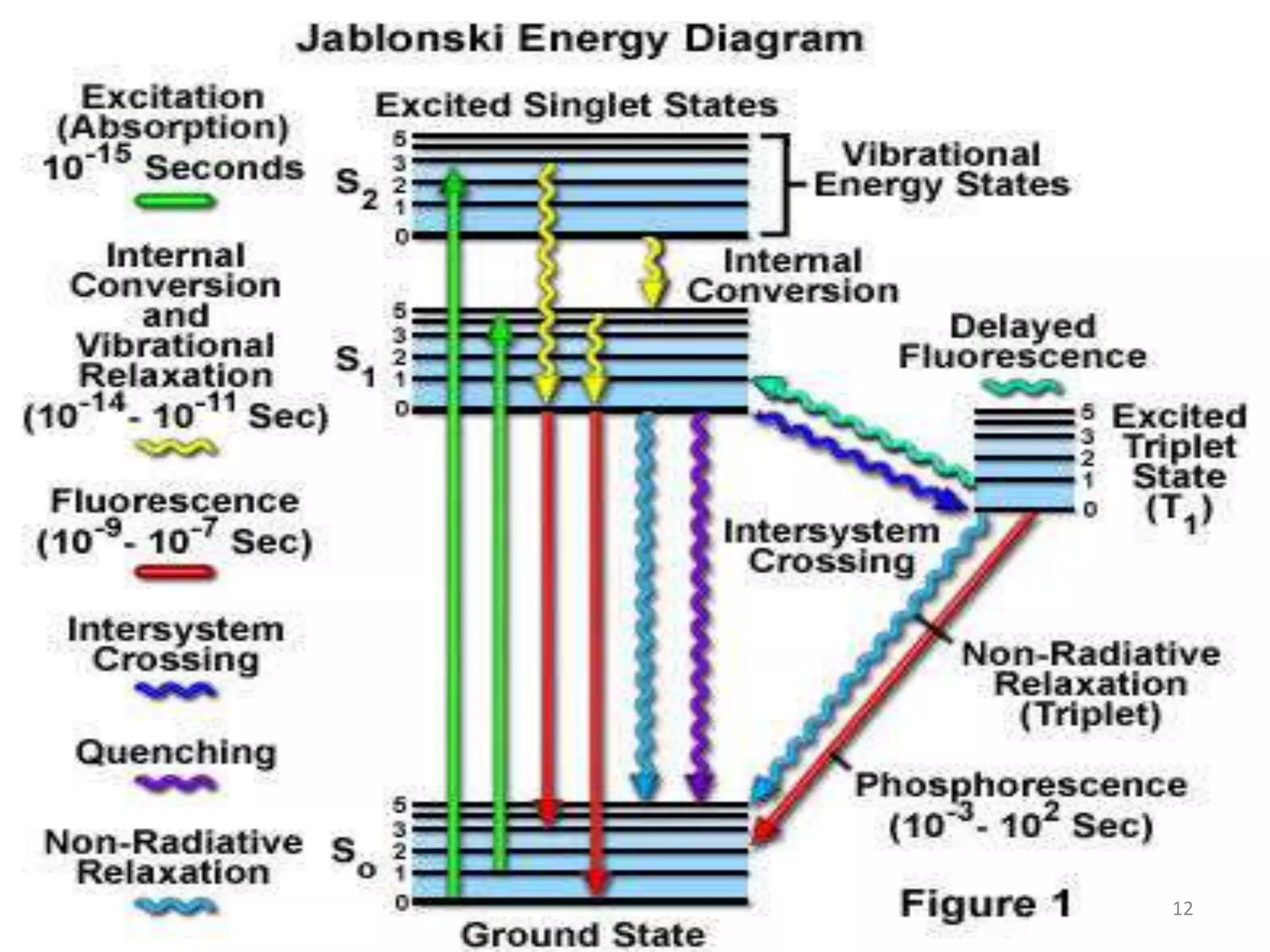
ELECTRONIC AND VIBRATIONAL LEVELS
•S0: ground state of a molecule at ambient temperature
•S1 and S2: excited singlet states
•T1: lowest energy triplet state, usually of less energy than lowest energetic
excited singlet state S1
Because singlet/triplet transitions are less probable than singlet/singlet transition
(spin conversion is necessary), thus average lifetime of an excited triplet state is 10-4
sec and more, while excited singlet state lifetime is 10-8 to 10-5 sec.
9
• The absorption of a photon of suitable energy causes the
molecule to get excited from the ground state to one of
the excited states. This process is called as excitation or
activation and is governed by Frank‐Codon principle.
• According to this principle, the electronic transition takes
place so fast (~10‐15s) that the molecule does not get an
opportunity to execute a vibration, i.e., when the
electrons are excited the inter nuclear distance does not
change.
• The basis for the principle is that the nuclei are very
massive as compared to the electrons and therefore move
very slowly.
ABSORPTION AND DEACTIVATION
10
ELECTRONIC TRANSITIONS
11
12
• The Stokes shift is the gap between the maximum of
the first absorption band and the maximum of the
fluorescence spectrum
STOKES SHIFT
heat
loss of vibrational energy in the excited
state as heat by collision with solvent
13
14
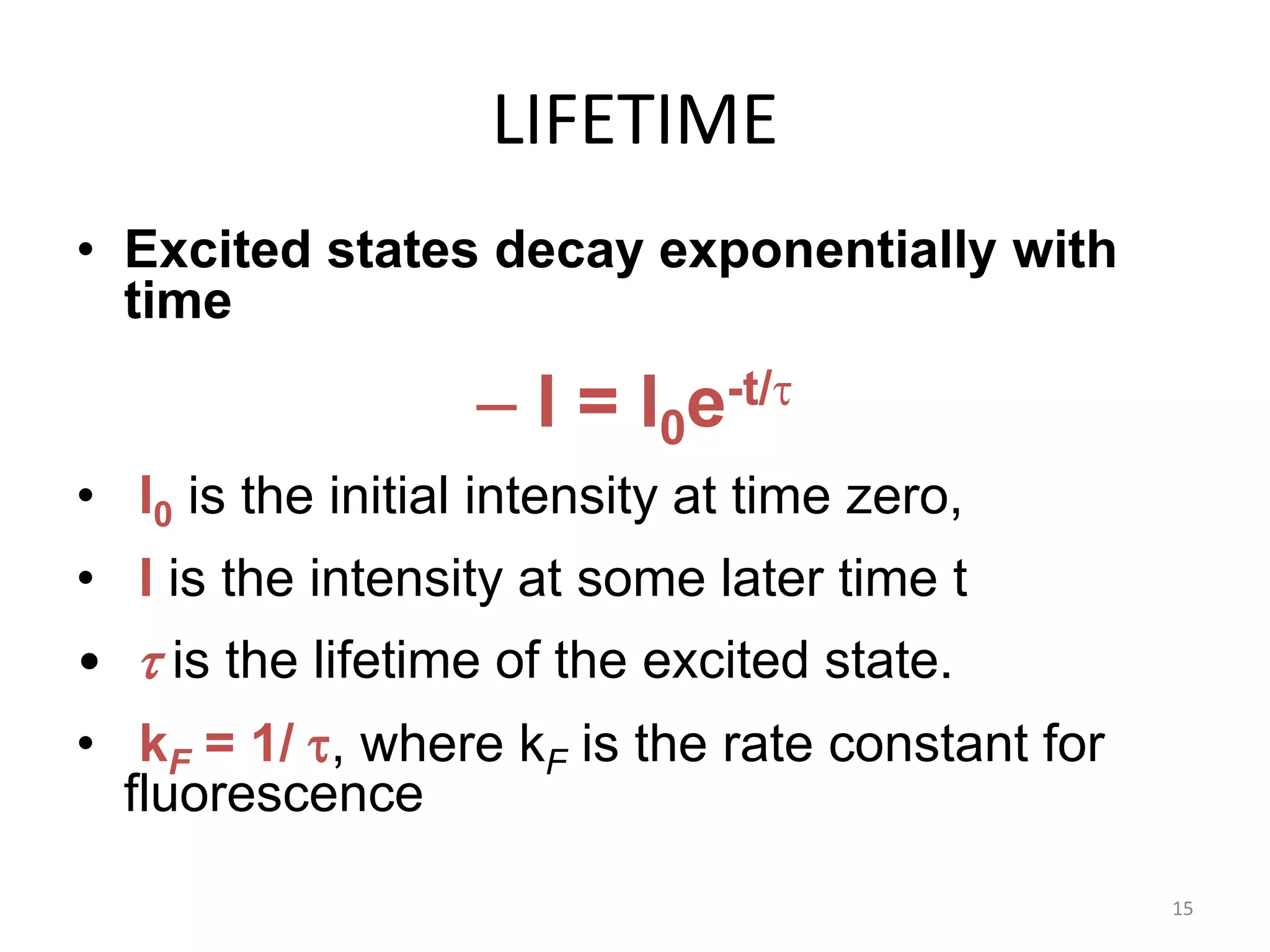
LIFETIME
• Excited states decay exponentially with
time
– I = I0e-t/t
• I0 is the initial intensity at time zero,
• I is the intensity at some later time t
• t is the lifetime of the excited state.
• kF = 1/ t, where kF is the rate constant for
fluorescence
15
QUANTUM YIELD
• Quantum Yield = FF
• FF = ratio of photons emitted to photons
absorbed
• Quantum yield is the ratio of photons
emitted to photons absorbed by the
system:
16
• Lakowicz, J.R. 1983. Principles of Fluorescence
Spectroscopy, Plenum Press, New York.
• 2 Guilbault, G.G. 1990. Practical Fluorescence,
Second Edition, Marcel Dekker, Inc., New York.
• Instrumental methods of chemical analysis,
3rd Edition, Ewing, G.W., McGraw-Hill Book
Co. (1969).
REFERENCES
17
18

Flourimetry

  • 1.
  • 2.
    THEORY OF FLUORIMETRY PRESENTEDBY- AMEENA MEHABOOB 1ST YR MPHARM 2
  • 3.
    Luminescence is theemission of light by a substance. It occurs when an electron returns to the electronic ground state from an excited state and loses its excess energy as a photon. It is of 3 types- • Fluorescence • Phosphorescence • Chemiluminescence INTRODUCTION 3
  • 4.
    FLUORESCENCE •When a beamof light is incident on certain substances they emit visible light or radiations. This is called flourescence. •It starts immediately after absorption of light and stops as soon as the incident light is cut off. •Substances showing this phenomenon are flourescent substances. FLUORESCENCE 4
  • 5.
    PHOSPHORESCENCE • When lightradiation is incident on certain substances they emit light continuously even after the incident light is cut off. •This type of delayed fluorescence is called phosphorescence. •Substances showing phosphorescence are called phosphorescent substances. PHOSPHORESCENCE 5
  • 6.
    FLOURIMETRY • Fluorescence isthe molecular absorption of light energy at one wavelength and its nearly instantaneous re-emission at another, usually longer, wavelength. • Fluorescent compounds have two characteristic spectra: an excitation spectrum (the wavelength and amount of light absorbed) and an emission spectrum (the wavelength and amount of light emitted). Fluorimetry is the measurement of fluorescence. FLUORIMETRY 6
  • 7.
    •A molecular electronicstate in which all the electrons are paired are called singlet state. •At this state all molecules are diamagnetic •Most of the molecules in their ground state are paired •When a molecule absorbs UV/ visible radiation, one or more of the paired electron is raised to an excited singlet state/ excited triplet state Ground singlet state Excited singlet state Spin paired No net mag. field Triplet state Spins unpaired Net mag. field THEORY OF FLUORIMETRY 7
  • 8.
    SINGLET/TRIPLET STATES Ground state Excited singlet state Excited Triplet state PAULI EXCLUSIONPRINCIPLE- No 2 electrons in an atom can have the same set of 4 quantum numbers. In other words, 2 electrons in the same orbital must have opposite spins (paired, no net magnetic field- diamagnetic), molecule with unpaired electrons (triplet state) possess magnetic moment, and are attracted by magnetic field, are called paramagnetic. Excited triplet state is of less energy than excited singlet state. Singlet to triplet transitions are far less probable than singlet/singlet transitions. 8
  • 9.
    ELECTRONIC AND VIBRATIONALLEVELS •S0: ground state of a molecule at ambient temperature •S1 and S2: excited singlet states •T1: lowest energy triplet state, usually of less energy than lowest energetic excited singlet state S1 Because singlet/triplet transitions are less probable than singlet/singlet transition (spin conversion is necessary), thus average lifetime of an excited triplet state is 10-4 sec and more, while excited singlet state lifetime is 10-8 to 10-5 sec. 9
  • 10.
    • The absorptionof a photon of suitable energy causes the molecule to get excited from the ground state to one of the excited states. This process is called as excitation or activation and is governed by Frank‐Codon principle. • According to this principle, the electronic transition takes place so fast (~10‐15s) that the molecule does not get an opportunity to execute a vibration, i.e., when the electrons are excited the inter nuclear distance does not change. • The basis for the principle is that the nuclei are very massive as compared to the electrons and therefore move very slowly. ABSORPTION AND DEACTIVATION 10
  • 11.
  • 12.
  • 13.
    • The Stokesshift is the gap between the maximum of the first absorption band and the maximum of the fluorescence spectrum STOKES SHIFT heat loss of vibrational energy in the excited state as heat by collision with solvent 13
  • 14.
  • 15.
    LIFETIME • Excited statesdecay exponentially with time – I = I0e-t/t • I0 is the initial intensity at time zero, • I is the intensity at some later time t • t is the lifetime of the excited state. • kF = 1/ t, where kF is the rate constant for fluorescence 15
  • 16.
    QUANTUM YIELD • QuantumYield = FF • FF = ratio of photons emitted to photons absorbed • Quantum yield is the ratio of photons emitted to photons absorbed by the system: 16
  • 17.
    • Lakowicz, J.R.1983. Principles of Fluorescence Spectroscopy, Plenum Press, New York. • 2 Guilbault, G.G. 1990. Practical Fluorescence, Second Edition, Marcel Dekker, Inc., New York. • Instrumental methods of chemical analysis, 3rd Edition, Ewing, G.W., McGraw-Hill Book Co. (1969). REFERENCES 17
  • 18.