R Deepthi,
Asst. Professor,
Vignan Institute of Pharmaceutical Technology
Visakhapatnam
NEPHLOMETRY AND TURBIDIMETRY
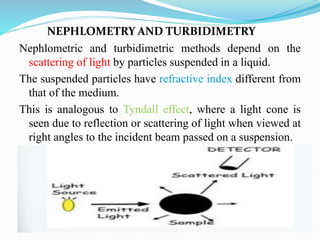
Nephlometric and turbidimetric methods depend on the
scattering of light by particles suspended in a liquid.
The suspended particles have refractive index different from
that of the medium.
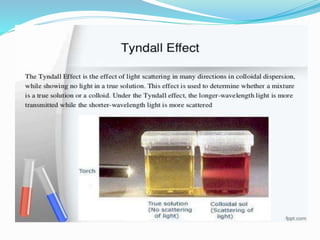
This is analogous to Tyndall effect, where a light cone is
seen due to reflection or scattering of light when viewed at
right angles to the incident beam passed on a suspension.
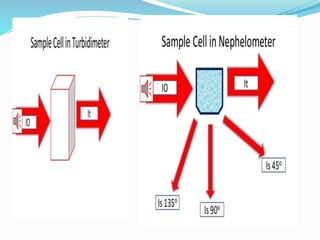
ļ‚— Nephlometry is the measurement of scattered light as
a function of concentration of suspended particles
(less than, approximately 100mg/litre).
ļ‚— Turbidimetry is the measurement of transmitted light
as a function of concentration of suspended particles
(more than 100mg/litre, high concentrations).
Principle:
ļ‚— Nephlometry: At low concentrations of a suspension, there is
uniform scattering. Hence the intensity of scattered light is
normally measured at 900 (like in Flourimetry). It can also be
measured at any convenient angle like 450, 600, 1350, etc
ļ‚— Turbidimetry: At high concentrations of a suspension,
scattering is not uniform and light is scattered in all directions.
Hence it becomes difficult to measure the intensity of scattered
radiation at all angles. Hence the intensity of transmitted light
(unscattered radiation) is measured at 1800 (like in UV/Visible
spectroscopy). The intensity of transmitted light (It) is a
function of concentration i.e. when concentration is more, It is
less and when concentration is more, It is less and when
concentration is less, It is more. This is the principle in
turbidimetry.
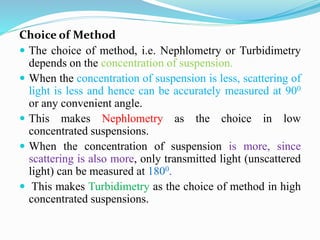
Choice of Method
ļ‚— The choice of method, i.e. Nephlometry or Turbidimetry
depends on the concentration of suspension.
ļ‚— When the concentration of suspension is less, scattering of
light is less and hence can be accurately measured at 900
or any convenient angle.
ļ‚— This makes Nephlometry as the choice in low
concentrated suspensions.
ļ‚— When the concentration of suspension is more, since
scattering is also more, only transmitted light (unscattered
light) can be measured at 1800.
ļ‚— This makes Turbidimetry as the choice of method in high
concentrated suspensions.
Factors responsible for producing uniform Turbidity
ļ‚— For Nephlometric or turbidimetric measurements, it is
important to have uniform turbidity of suspension, otherwise
accuracy may not be obtained. Hence to produce uniform
turbidity, the following factors must be considered.
ļ‚— The manner, order and rate of mixing of substances.
ļ‚— Agitation of Suspension.
ļ‚— Temperature: As temperature affects solubility of substance and
viscosity of medium.
ļ‚— Presence or absence of inert electrolytes, protective colloids
like gelatine, acacia, dextrin etc which affects flocculation and
deflocculation.
ļ‚— Concentrations of solutions mixed, to get a suspension.
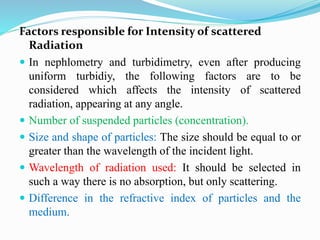
Factors responsible for Intensity of scattered
Radiation
ļ‚— In nephlometry and turbidimetry, even after producing
uniform turbidiy, the following factors are to be
considered which affects the intensity of scattered
radiation, appearing at any angle.
ļ‚— Number of suspended particles (concentration).
ļ‚— Size and shape of particles: The size should be equal to or
greater than the wavelength of the incident light.
ļ‚— Wavelength of radiation used: It should be selected in
such a way there is no absorption, but only scattering.
ļ‚— Difference in the refractive index of particles and the
medium.
Effect of concentration and wavelength on scattering
Concentration
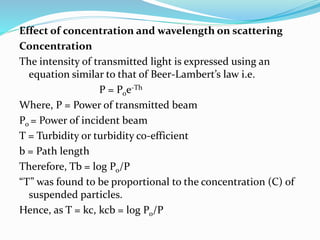
The intensity of transmitted light is expressed using an
equation similar to that of Beer-Lambert’s law i.e.
P = Poe-Th
Where, P = Power of transmitted beam
Po = Power of incident beam
T = Turbidity or turbidity co-efficient
b = Path length
Therefore, Tb = log Po/P
ā€œTā€ was found to be proportional to the concentration (C) of
suspended particles.
Hence, as T = kc, kcb = log Po/P
Wavelength
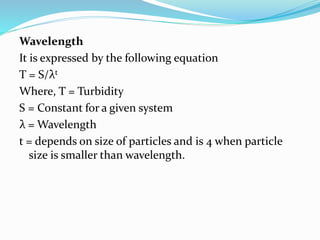
It is expressed by the following equation
T = S/λt
Where, T = Turbidity
S = Constant for a given system
Ī» = Wavelength
t = depends on size of particles and is 4 when particle
size is smaller than wavelength.
INSTRUMENTATION
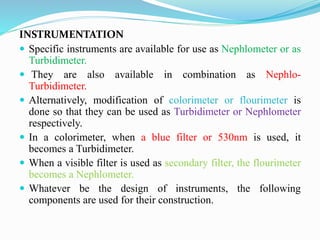
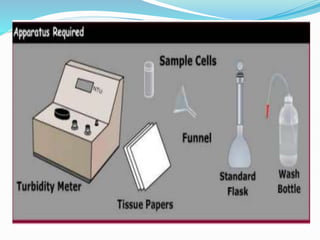
ļ‚— Specific instruments are available for use as Nephlometer or as
Turbidimeter.
ļ‚— They are also available in combination as Nephlo-
Turbidimeter.
ļ‚— Alternatively, modification of colorimeter or flourimeter is
done so that they can be used as Turbidimeter or Nephlometer
respectively.
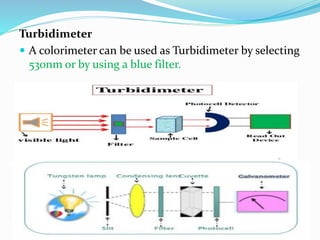
ļ‚— In a colorimeter, when a blue filter or 530nm is used, it
becomes a Turbidimeter.
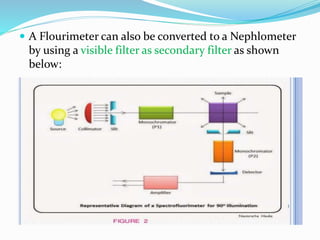
ļ‚— When a visible filter is used as secondary filter, the flourimeter
becomes a Nephlometer.
ļ‚— Whatever be the design of instruments, the following
components are used for their construction.
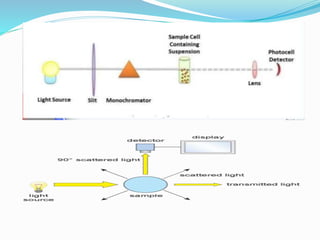
Source of Light:
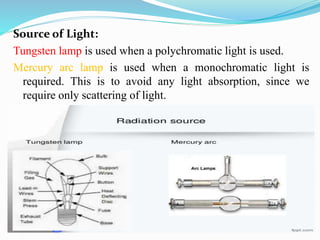
Tungsten lamp is used when a polychromatic light is used.
Mercury arc lamp is used when a monochromatic light is
required. This is to avoid any light absorption, since we
require only scattering of light.
Filters and Monochromators:
ļ‚— When a white light or polychromatic light is used, filters
and monochromators are not required.
ļ‚— But when monochromatic light is required, a filter or
monochromator is used.
ļ‚— In a turbidimeter, blue filter or 530 nm is used.
ļ‚— In a nephlometer, visible filter is used as secondary filter.
(The description of various types of filters and
monochromators is given in UV chapter).
Sample cells:
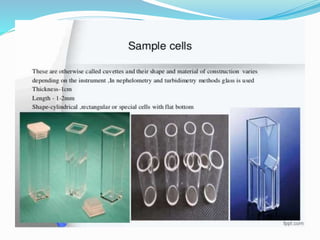
ļ‚— Various shapes of sample cells are used in Nephlometry
and Turbidimetry.
ļ‚— They may be cylindrical (like ordinary small test tubes)
with 1cm path length.
ļ‚— Rectangular cells are also used, but the cell walls may be
coated with black to avoid any reflection that may affect
detector response.
ļ‚— Special cells are also used to measure scattered light at
different angles like 450, 900, 1350, and 1800. The cells are
made up of glass.
Detectors:
ļ‚— Photometric detectors like Photovoltaic cells, photo tubes
or Photomultiplier tubes are used.
ļ‚— In Turbidimeters, Photo voltaic cell or Phototubes are
used.
ļ‚— In Nephlometers, as the scattered radiation is weak,
Photomultiplier tubes are used.
Instruments
Nephlometer
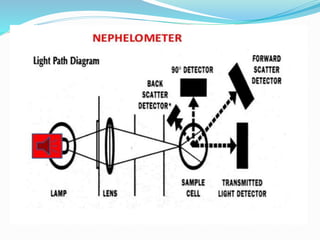
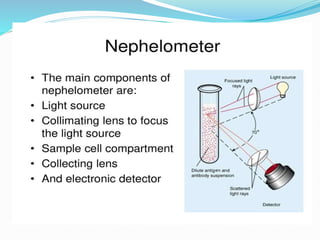
ļ‚— The Nephlometer consists of a tungsten lamp as source of
light and the sample cell (flat bottom) is placed on top of
source.
ļ‚— Light passing through filter falls on suspended particles.
These particles scatter the light.
ļ‚— The light scattered by the particles are collected by curved
mirror and reflected to the Photovoltaic cell, kept at the
bottom of the instrument.
ļ‚— This model is simple, inexpensive and easy to operate. It
has reasonable precision and accuracy.
ļ‚— A Flourimeter can also be converted to a Nephlometer
by using a visible filter as secondary filter as shown
below:
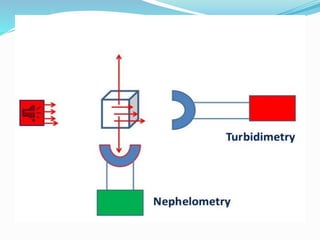
Turbidimeter
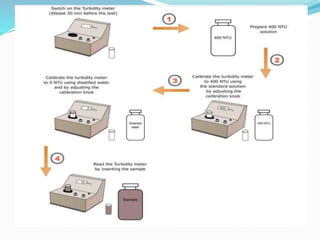
ļ‚— A colorimeter can be used as Turbidimeter by selecting
530nm or by using a blue filter.
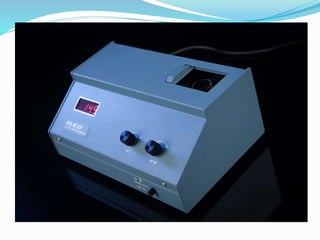
Nephloturbidimeter
ļ‚— If a suspension has to be analysed, it is important to know
whether it can be analysed by nephlometry and
turbidimetry.
ļ‚— But in practice, it is not essential to know this, because
recent instruments are a combination of the above two i.e.
Nephlo-turbidimeter.
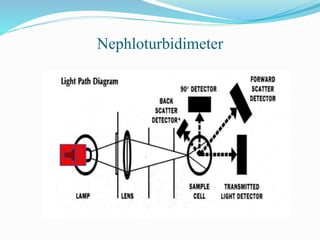
ļ‚— These Nephlo-turbidimeters have the design, as shown
below.
ļ‚— They have two detectors, one for measuring scattered light
at 900 and the other at 1800 for measuring the transmitted
light.
ļ‚— The ratio of the response of the two detectors is
displayed as Nephlo-Turbidimetric units (NTU), which is
proportional to the turbidity of the suspension.
Nephloturbidimeter
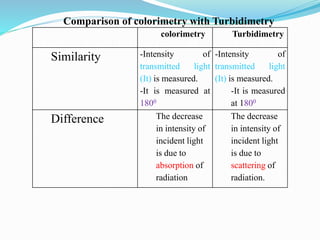
Comparison of colorimetry with Turbidimetry
colorimetry Turbidimetry
Similarity -Intensity of
transmitted light
(It) is measured.
-It is measured at
1800
-Intensity of
transmitted light
(It) is measured.
-It is measured
at 1800
Difference The decrease
in intensity of
incident light
is due to
absorption of
radiation
The decrease
in intensity of
incident light
is due to
scattering of
radiation.
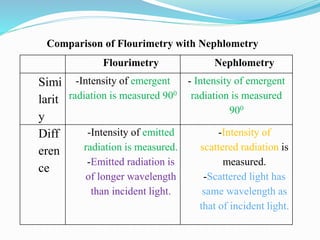
Comparison of Flourimetry with Nephlometry
Flourimetry Nephlometry
Simi
larit
y
-Intensity of emergent
radiation is measured 900
- Intensity of emergent
radiation is measured
900
Diff
eren
ce
-Intensity of emitted
radiation is measured.
-Emitted radiation is
of longer wavelength
than incident light.
-Intensity of
scattered radiation is
measured.
-Scattered light has
same wavelength as
that of incident light.
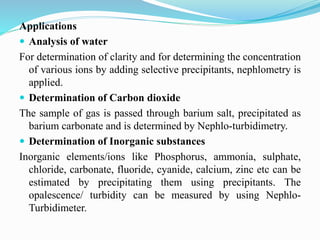
Applications
ļ‚— Analysis of water
For determination of clarity and for determining the concentration
of various ions by adding selective precipitants, nephlometry is
applied.
ļ‚— Determination of Carbon dioxide
The sample of gas is passed through barium salt, precipitated as
barium carbonate and is determined by Nephlo-turbidimetry.
ļ‚— Determination of Inorganic substances
Inorganic elements/ions like Phosphorus, ammonia, sulphate,
chloride, carbonate, fluoride, cyanide, calcium, zinc etc can be
estimated by precipitating them using precipitants. The
opalescence/ turbidity can be measured by using Nephlo-
Turbidimeter.
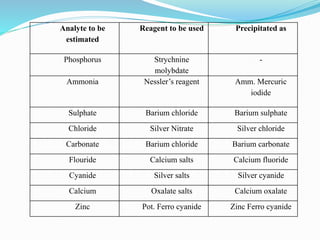
Analyte to be
estimated
Reagent to be used Precipitated as
Phosphorus Strychnine
molybdate
-
Ammonia Nessler’s reagent Amm. Mercuric
iodide
Sulphate Barium chloride Barium sulphate
Chloride Silver Nitrate Silver chloride
Carbonate Barium chloride Barium carbonate
Flouride Calcium salts Calcium fluoride
Cyanide Silver salts Silver cyanide
Calcium Oxalate salts Calcium oxalate
Zinc Pot. Ferro cyanide Zinc Ferro cyanide
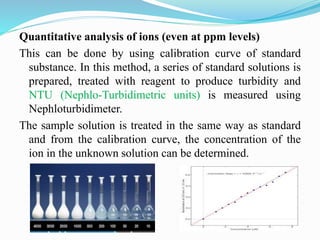
Quantitative analysis of ions (even at ppm levels)
This can be done by using calibration curve of standard
substance. In this method, a series of standard solutions is
prepared, treated with reagent to produce turbidity and
NTU (Nephlo-Turbidimetric units) is measured using
Nephloturbidimeter.
The sample solution is treated in the same way as standard
and from the calibration curve, the concentration of the
ion in the unknown solution can be determined.
ļ‚— Miscellaneous
Nephloturbidimetry is applied in water treatment plants,
sewage work, power and steam generating plants,
breweries, bottling industry, petroleum refineries, pulp and
paper industry, analysis of turbidimetry in sugar products,
clarity of citrus juices. Etc.
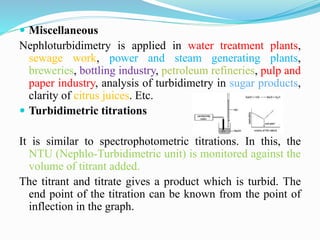
ļ‚— Turbidimetric titrations
It is similar to spectrophotometric titrations. In this, the
NTU (Nephlo-Turbidimetric unit) is monitored against the
volume of titrant added.
The titrant and titrate gives a product which is turbid. The
end point of the titration can be known from the point of
inflection in the graph.
To watch The analysis of turbid samples copy and paste the below
link in Google search engine
https://youtu.be/PCsWGxsZWoQ
Thank u...

Nephlometry & Turbidometry

  • 1.
    R Deepthi, Asst. Professor, VignanInstitute of Pharmaceutical Technology Visakhapatnam
  • 2.
    NEPHLOMETRY AND TURBIDIMETRY Nephlometricand turbidimetric methods depend on the scattering of light by particles suspended in a liquid. The suspended particles have refractive index different from that of the medium. This is analogous to Tyndall effect, where a light cone is seen due to reflection or scattering of light when viewed at right angles to the incident beam passed on a suspension.
  • 4.
    ļ‚— Nephlometry isthe measurement of scattered light as a function of concentration of suspended particles (less than, approximately 100mg/litre). ļ‚— Turbidimetry is the measurement of transmitted light as a function of concentration of suspended particles (more than 100mg/litre, high concentrations).
  • 5.
    Principle: ļ‚— Nephlometry: Atlow concentrations of a suspension, there is uniform scattering. Hence the intensity of scattered light is normally measured at 900 (like in Flourimetry). It can also be measured at any convenient angle like 450, 600, 1350, etc ļ‚— Turbidimetry: At high concentrations of a suspension, scattering is not uniform and light is scattered in all directions. Hence it becomes difficult to measure the intensity of scattered radiation at all angles. Hence the intensity of transmitted light (unscattered radiation) is measured at 1800 (like in UV/Visible spectroscopy). The intensity of transmitted light (It) is a function of concentration i.e. when concentration is more, It is less and when concentration is more, It is less and when concentration is less, It is more. This is the principle in turbidimetry.
  • 7.
    Choice of Method ļ‚—The choice of method, i.e. Nephlometry or Turbidimetry depends on the concentration of suspension. ļ‚— When the concentration of suspension is less, scattering of light is less and hence can be accurately measured at 900 or any convenient angle. ļ‚— This makes Nephlometry as the choice in low concentrated suspensions. ļ‚— When the concentration of suspension is more, since scattering is also more, only transmitted light (unscattered light) can be measured at 1800. ļ‚— This makes Turbidimetry as the choice of method in high concentrated suspensions.
  • 9.
    Factors responsible forproducing uniform Turbidity ļ‚— For Nephlometric or turbidimetric measurements, it is important to have uniform turbidity of suspension, otherwise accuracy may not be obtained. Hence to produce uniform turbidity, the following factors must be considered. ļ‚— The manner, order and rate of mixing of substances. ļ‚— Agitation of Suspension. ļ‚— Temperature: As temperature affects solubility of substance and viscosity of medium. ļ‚— Presence or absence of inert electrolytes, protective colloids like gelatine, acacia, dextrin etc which affects flocculation and deflocculation. ļ‚— Concentrations of solutions mixed, to get a suspension.
  • 10.
    Factors responsible forIntensity of scattered Radiation ļ‚— In nephlometry and turbidimetry, even after producing uniform turbidiy, the following factors are to be considered which affects the intensity of scattered radiation, appearing at any angle. ļ‚— Number of suspended particles (concentration). ļ‚— Size and shape of particles: The size should be equal to or greater than the wavelength of the incident light. ļ‚— Wavelength of radiation used: It should be selected in such a way there is no absorption, but only scattering. ļ‚— Difference in the refractive index of particles and the medium.
  • 11.
    Effect of concentrationand wavelength on scattering Concentration The intensity of transmitted light is expressed using an equation similar to that of Beer-Lambert’s law i.e. P = Poe-Th Where, P = Power of transmitted beam Po = Power of incident beam T = Turbidity or turbidity co-efficient b = Path length Therefore, Tb = log Po/P ā€œTā€ was found to be proportional to the concentration (C) of suspended particles. Hence, as T = kc, kcb = log Po/P
  • 12.
    Wavelength It is expressedby the following equation T = S/λt Where, T = Turbidity S = Constant for a given system λ = Wavelength t = depends on size of particles and is 4 when particle size is smaller than wavelength.
  • 13.
    INSTRUMENTATION ļ‚— Specific instrumentsare available for use as Nephlometer or as Turbidimeter. ļ‚— They are also available in combination as Nephlo- Turbidimeter. ļ‚— Alternatively, modification of colorimeter or flourimeter is done so that they can be used as Turbidimeter or Nephlometer respectively. ļ‚— In a colorimeter, when a blue filter or 530nm is used, it becomes a Turbidimeter. ļ‚— When a visible filter is used as secondary filter, the flourimeter becomes a Nephlometer. ļ‚— Whatever be the design of instruments, the following components are used for their construction.
  • 15.
    Source of Light: Tungstenlamp is used when a polychromatic light is used. Mercury arc lamp is used when a monochromatic light is required. This is to avoid any light absorption, since we require only scattering of light.
  • 16.
    Filters and Monochromators: ļ‚—When a white light or polychromatic light is used, filters and monochromators are not required. ļ‚— But when monochromatic light is required, a filter or monochromator is used. ļ‚— In a turbidimeter, blue filter or 530 nm is used. ļ‚— In a nephlometer, visible filter is used as secondary filter. (The description of various types of filters and monochromators is given in UV chapter).
  • 17.
    Sample cells: ļ‚— Variousshapes of sample cells are used in Nephlometry and Turbidimetry. ļ‚— They may be cylindrical (like ordinary small test tubes) with 1cm path length. ļ‚— Rectangular cells are also used, but the cell walls may be coated with black to avoid any reflection that may affect detector response. ļ‚— Special cells are also used to measure scattered light at different angles like 450, 900, 1350, and 1800. The cells are made up of glass.
  • 20.
    Detectors: ļ‚— Photometric detectorslike Photovoltaic cells, photo tubes or Photomultiplier tubes are used. ļ‚— In Turbidimeters, Photo voltaic cell or Phototubes are used. ļ‚— In Nephlometers, as the scattered radiation is weak, Photomultiplier tubes are used.
  • 21.
    Instruments Nephlometer ļ‚— The Nephlometerconsists of a tungsten lamp as source of light and the sample cell (flat bottom) is placed on top of source. ļ‚— Light passing through filter falls on suspended particles. These particles scatter the light. ļ‚— The light scattered by the particles are collected by curved mirror and reflected to the Photovoltaic cell, kept at the bottom of the instrument. ļ‚— This model is simple, inexpensive and easy to operate. It has reasonable precision and accuracy.
  • 23.
    ļ‚— A Flourimetercan also be converted to a Nephlometer by using a visible filter as secondary filter as shown below:
  • 24.
    Turbidimeter ļ‚— A colorimetercan be used as Turbidimeter by selecting 530nm or by using a blue filter.
  • 25.
    Nephloturbidimeter ļ‚— If asuspension has to be analysed, it is important to know whether it can be analysed by nephlometry and turbidimetry. ļ‚— But in practice, it is not essential to know this, because recent instruments are a combination of the above two i.e. Nephlo-turbidimeter. ļ‚— These Nephlo-turbidimeters have the design, as shown below. ļ‚— They have two detectors, one for measuring scattered light at 900 and the other at 1800 for measuring the transmitted light. ļ‚— The ratio of the response of the two detectors is displayed as Nephlo-Turbidimetric units (NTU), which is proportional to the turbidity of the suspension.
  • 26.
  • 27.
    Comparison of colorimetrywith Turbidimetry colorimetry Turbidimetry Similarity -Intensity of transmitted light (It) is measured. -It is measured at 1800 -Intensity of transmitted light (It) is measured. -It is measured at 1800 Difference The decrease in intensity of incident light is due to absorption of radiation The decrease in intensity of incident light is due to scattering of radiation.
  • 28.
    Comparison of Flourimetrywith Nephlometry Flourimetry Nephlometry Simi larit y -Intensity of emergent radiation is measured 900 - Intensity of emergent radiation is measured 900 Diff eren ce -Intensity of emitted radiation is measured. -Emitted radiation is of longer wavelength than incident light. -Intensity of scattered radiation is measured. -Scattered light has same wavelength as that of incident light.
  • 29.
    Applications ļ‚— Analysis ofwater For determination of clarity and for determining the concentration of various ions by adding selective precipitants, nephlometry is applied. ļ‚— Determination of Carbon dioxide The sample of gas is passed through barium salt, precipitated as barium carbonate and is determined by Nephlo-turbidimetry. ļ‚— Determination of Inorganic substances Inorganic elements/ions like Phosphorus, ammonia, sulphate, chloride, carbonate, fluoride, cyanide, calcium, zinc etc can be estimated by precipitating them using precipitants. The opalescence/ turbidity can be measured by using Nephlo- Turbidimeter.
  • 30.
    Analyte to be estimated Reagentto be used Precipitated as Phosphorus Strychnine molybdate - Ammonia Nessler’s reagent Amm. Mercuric iodide Sulphate Barium chloride Barium sulphate Chloride Silver Nitrate Silver chloride Carbonate Barium chloride Barium carbonate Flouride Calcium salts Calcium fluoride Cyanide Silver salts Silver cyanide Calcium Oxalate salts Calcium oxalate Zinc Pot. Ferro cyanide Zinc Ferro cyanide
  • 31.
    Quantitative analysis ofions (even at ppm levels) This can be done by using calibration curve of standard substance. In this method, a series of standard solutions is prepared, treated with reagent to produce turbidity and NTU (Nephlo-Turbidimetric units) is measured using Nephloturbidimeter. The sample solution is treated in the same way as standard and from the calibration curve, the concentration of the ion in the unknown solution can be determined.
  • 32.
    ļ‚— Miscellaneous Nephloturbidimetry isapplied in water treatment plants, sewage work, power and steam generating plants, breweries, bottling industry, petroleum refineries, pulp and paper industry, analysis of turbidimetry in sugar products, clarity of citrus juices. Etc. ļ‚— Turbidimetric titrations It is similar to spectrophotometric titrations. In this, the NTU (Nephlo-Turbidimetric unit) is monitored against the volume of titrant added. The titrant and titrate gives a product which is turbid. The end point of the titration can be known from the point of inflection in the graph.
  • 36.
    To watch Theanalysis of turbid samples copy and paste the below link in Google search engine https://youtu.be/PCsWGxsZWoQ Thank u...