SALES
MANAGEMENT
UNIT - 1
PRESENTED BY
K.BALASRI PRASAD
B.Sc(KU), M.B.A(OU), NET(UGC), (Ph.D)(MGU)
ASSISTANT PROFESSOR IN MANAGEMENT
VISHWA VISHWANI GROUP OF INSTITUTIONS
Unit-1
Sales Management
Definition and meaning, Objectives, Sales
Research, Sales Forecasting, Sales
Forecasting methods, Sales planning and
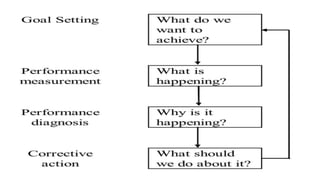
control: Goal setting, performance
measurement, diagnosis and corrective
actions.
Sales Management
 Sales management is a business discipline which is focused on the
practical application of sales techniques and the management of
a firm's sales operations.
 It is an important business function as net sales, through the sale
of products and services and resulting profit, drive most
commercial business.
 Sales management is how sales managers organize, motivate, and
lead their sales reps while tracking — and improving — team
performance.
 This includes hiring top talent, training sales staff, coordinating
operations across the sales department, and implementing a
cohesive sales strategy that drives business revenues.
Objectives of Sales Management:
1. Growing revenue :
 Sales teams are responsible for supporting businesses by executing effective sales methods and increasing the
organization's revenue.
 Prioritize customers based on background checks and past involvements with similar products.
 Track the generated revenue and identify ways to upgrade their sales strategy.
 Tracking such data allows analysts to examine critical information and suggest better sales tactics.
2. Setting the desired sales volume:
 Quantity of sold units contributes to the overall revenue, sales team can be motivated by setting the desired sales
volume.
 Employees can set daily, weekly or monthly sales targets based on the sales volume goals.
3. Improving production and distribution:
 Reducing the production duration and improving product's distribution chains can help deliver the product to
customers quicker.
 This improves sales volume and positively affect the overall revenue.
4. Maintaining profits despite expenditures:
 Goals focused on regulating the efficiency of all sales operations and resources may sustain company profits despite
poor decisions leading to unnecessary spending.
 Allocating a sales process analyst tasks related to checking company spendings and revenue margins might
positively affect your company's yearly revenue.
 Sales managers can define monetary limits, which can be a threshold value for the sales team's accessibility to
funds, whether for marketing or allowances.
5. Encouraging the sales team:
 Determining sales team's performance and motivation towards achieving the
company's short- and long-term sales goals.
 Offering free training materials with interactive learning experiences through
seminars or workshops can maintain their interest in selling the product.
 Sales managers can provide incentives for teammates who achieve their targets in
advance.
 Creating a reward system and offering vacations or promotions when your team
performs better than expected helps build motivation.
6. Performing regular analytics:
 Regular analytics to check for the scope of improvements in the sales process.
 Generate reports on various target markets and the customer's response to a
product's performance.
 Accessing analytical documents can help develop strategies to retain loyal
customers and increase engagement rates without relying on trial-and-error
methods.
7. Closing deals faster:
Maintain an attitude of urgency and make your team competitive.
Shortening the sales cycle can grow the business more quickly by encouraging
instant purchasing decisions from customers.
For sales of B2B products, identifying the decision maker and directly
contacting them with appropriate pitch might complete deals more efficiently
and in less time.
Sales Research
Companies depends heavily on Sales Control Research (Sales Research) for
formulating marketing policies, planning and controlling marketing operation.
Sales Control Research is the identification and measurement of all those variables
which individually and in combination have an effect on sales.
Sales Control Research comprises substantial proportion of research work conducted
by various companies’ marketing research departments.
This encompasses the marketing studies pertaining to sales forecasting, market
potentials, market share analysis, and determination of market characteristics and sales
analysis.
These are the four most common sales control research activities undertaken by a
marketing research department of a company.
Sales Control Research heavily relies on secondary data and expert opinion.
Techniques such as multiple regression analysis, multiple discriminant analysis, factor
analysis and cluster analysis are widely used in such studies.
Marketing intelligence is responsible for examining published information
maintaining full records of sales, customer activity by the maintenance of
company records, by means of field research, information supplied by
salesmen and advertising agencies provides a balanced information flow to
formulate suitable and effective marketing strategies.
Market analysis is undertaken to reveal a set of geographical sales
potential the maximum possible sales opportunities, for all sellers of
product or service in a specific area.
Market potentials refer to total sales possibilities and sales forecast refers
to possible units of sale of a product by a seller.
Sales potential is to firm what market potential is to an industry or product
class: both represent maximum demand response and are boundary
conditions.
Depending upon the sales potential existing in each sales territory, we can
design the trade channels keeping in view the sales potential figures.
Actual analysis of sales-results according to the product, customer, order
size and territory.
The objective of sales analysis is to find out the areas of strengths and
weaknesses.
The maximum and lowest volume of sales in accordance with the product,
territory customers and order size can be revealed by sales analysis.
Sales analysis provides information about areas where sales performance
has been good or bad.
Sales Forecasting
The process of estimating future revenue by predicting the amount of product or
services a sales unit (which can be an individual salesperson, a sales team, or a
company) will sell in the next week, month, quarter, or year.
Sales forecasting enables businesses to plan and make informed decisions about
future operations, marketing, and resource allocation.
Accurate sales forecasting can help businesses anticipate future demand, identify
potential problems or opportunities, and adjust their strategies accordingly.
Sales managers or analysts typically do the sales analysis.
Once the data has been analyzed, it is time to make predictions about future
Sales.
Sales leaders use their knowledge of the market and the data to develop Sales
targets for the upcoming period.
Sales forecasts are usually based on historical data, industry trends, and the
status of the current sales pipeline.
Sales Forecasting methods
A sales forecast is not just a sales predicting. It is the act of matching opportunities with the marketing
efforts.
Sales forecasting is the determination of a firm’s share in the market under a specified future. Thus
sales forecasting shows the probable volume of sales.
A. Qualitative Methods of Forecasting
1.Expert’s Opinion Method
2.The Delphi Method
3.Sales Force Composite Method
4.Survey of Buyer’s Expectations
5.Historical Analogy Method
6.Jury of Executive Opinions
7.Leading Indicators Method.
B. Quantitative Methods of Forecasting.
1.Test Marketing
2.Time Series Analysis
3.Moving Average Method
4.Exponential Smoothing Method
5.Regression Analysis
6.Econometric Models.
Qualitative Methods of Forecasting
1. Expert’s Opinion Method
Used by commercial organizations for forecasting the future demand of their
products.
The services of experts in that area such as marketing professionals, important
members of the distribution channel such as distributors/dealers, and professional
bodies such as industry associations and marketing consultants may be asked for.
Forecasting on the basis of expert’s opinion is done in two ways- (i) by one
seasoned individual (usually in a small company) or (ii) by a group of
individuals, sometimes called a ‘jury of executive opinion’.
The group approach, in turn, uses two methods- (i) key executives submit the
independent estimates without discussion, and these are averaged into one
forecast by the chief executive, and (ii) the group meets, each person presents
separate estimates, differences are resolved, and a consensus is reached.
2. The Delphi Method:
 This is an improvement over the executive opinion method.
 Determine the forecasts on the likely time period of occurrence of
certain future events and the probability of their occurrence.
 A group of experts and a Delphi coordinator will be selected.
 The experts give their written opinions/forecasts individually to the
coordinator.
The coordinator processes, compiles, and refers them back to the
panel members for revision, if any.
This to-and-fro process continues for several rounds (usually three).
the coordinator will carry out statistical analysis of the responses
deriving average answers, variability, prediction intervals, etc.
3. Sales Force Composite Method:
 The organization asks its sales personnel to come up with their
forecasts.
 It is assumed that such persons who are in direct contact with the
customers and other members of the distribution channel will be
better informed about the trends in demand for the product.
 The individual forecasts are then combined to get an overall demand
forecast for the organization.
 This method is often used to generate forecasts in the industrial
equipment industry.
 Many companies use the accuracy of the field sales manager’s
forecasts as a major part of their performance evaluation.
 The more accurate the manager’s forecast is, the higher will be the
compensation received by the manager.
4. Survey of Buyer’s Expectations:
Survey of buying intentions and market tests.
The survey of buying intentions involves the selection of a sample of potential buyers
and then getting information from them on their likely purchase of the product in
future.
This information is then extrapolated to get the total demand forecast.
There may be variations between the stated intentions and the actual purchases.
Many companies often poll their actual or potential customers, ranging from individual
households to intermediaries, to forecast market demand.
Some companies employ consumer panels that are given products and asked to supply
information on the product’s quality, features, price, and whether they would buy it.
In many instances, consumers have difficulty in predicting their future buying habits.
Original equipment manufacturers (OEMs) often survey the end consumers to know
the level of end consumer demand, which helps them predict the sales and forecast
based on the survey of buyer’s intention.
This method is also called the build to order method, in which the original equipment
manufacturers build their forecasts depending on the demand patterns of their business-
to-business (B2B) buyers.
B. Quantitative Methods of Forecasting
1. Test Marketing:
Popular method for measuring consumer acceptance of new products.
The results from a test market are extrapolated to make predictions about future
sales. Companies select a limited number of cities with populations which are
representative of the target customers in terms of demographic factors that
include age, income, lifestyle and shopping behaviour.
A product is made available at the retail outlets and the features are highlighted
either through in-store promotion or through a small advertising campaign.
Then the performance of the product is tracked through consumer research and
modifications if any are made before taking it for a national launch.
By a complex test marketing procedure, one can measure the effectiveness of the
core product in inviting trial, making people loyal, effectiveness of the
promotional campaign, and in-store promotions.
2. Time Series Analysis:
It is important to collect relevant past data for future projects.
Time series analysis is a series of techniques that make forecasts based on past patterns of
data.
These data are collected, observed, and recorded at regular intervals of time.
These methods are useful when the market forces are somehow stable and the market shows
least erratic behaviour.
Time series methods use chronologically ordered raw data.
Historical data are used to project future events. For example, past sales are used to project
future sales.
However, future events are often different from past events, which make the accuracy of such
methods far less than 100 per cent.
By studying the historical correlation of sales levels over time, a sales manager can identify a
trend and find a general indication of the possible continuation of the time series.
A trend can move up or down depending on the product development efforts, consumer tastes,
changes in technology, broad economic trends, and other fundamental issues in the market for
the product.
Seasonality is the extent to which the time series varies consistency within a period of one
year. For example, sales of fans and refrigerators in India are very seasonal with a sales peak
happening in summer and a slump in winter.
3. Moving Average Method:
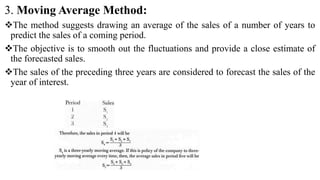
The method suggests drawing an average of the sales of a number of years to
predict the sales of a coming period.
The objective is to smooth out the fluctuations and provide a close estimate of
the forecasted sales.
The sales of the preceding three years are considered to forecast the sales of the
year of interest.
4. Exponential Smoothing Method:
It is similar to the moving average method.
In moving average, the sales of previous years are given equal importance but in exponential
smoothing, the recent past sales are given more weight than the earlier pasts.
The objective is to smooth out fluctuations in the time series for accurate estimation of sales
forecast.
The general equation of exponential smoothing is as follows:
Next year’s sales = a (this year’s sales) + (1-a) (this year’s forecasts)
Where,
a is a constant, and is called the smoothing constant or weight
where a = weight for the current year’s sales (1 -a) = Weight for the immediate
preceding year.
If a =1, then, the forecasted sales is equal to sales of the current year.
If a = 0, then current year’s forecast is equal to next year’s forecast. No adjustment is needed.
The range of the value of ‘a’ is from 0 to 1.
For practical reasons, the value of a is chosen between 0.1 to 0.4. Similarly, the observations
for the preceding second year, third year, etc. may be considered.
Sales planning and control
 A document that lays out a company’s plan for improving sales results in
a specified period of time
 The sales plan establishes the company’s sales objectives and develops
the necessary strategies to achieve them.
 A sales plan is a strategy that sets out sales targets and tactics for your
business, and identifies the steps you will take to meet your targets.
 A sales plan will help you: define a set of sales targets for your business.
Choose sales strategies that are suited to your target market.
 A plan containing an assessment of current sales for a product in a given
region or market, a statement of sales objectives, strategies for achieving
the stated sales objectives, and resources available for achieving this
goal.
Step 1: Setting the Goals
 Setting goals can help in 2 main things: triggering new behaviors and
guiding one’s focus.
 It is suggested to use the SMART goal setting strategy. SMART is an
acronym that stands for
Specific, Measurable, Achievable, Relevant and Time-based.
Step 2: Analyzing the Current Situation
 This step is about the current company situation, the company’s situation
using a SWOT analysis which is a methodology that identifies four factors
for any company: Strengths, Weaknesses, Opportunities, and Threats.
 This step will make it easy for me as a sales leader to understand which
strategy to use and when, and what strategies or ideas to eliminate.
Step 3: Preparing an Action Plan
The third step that in sales plan is outlining a plan of action,
which is basically charting out how the sales team will reach
targeted customers and market segments.
This plan can include: Existing business growth strategies,
New business acquisition tactics, the resources to be used,
etc…
An action plan can be divided into 2 parts: a team action plan
and an individual action plan.
This is usually done by assigning tasks, activities, and
responsibilities to different teams and individuals.
Step 4: Setting and Monitoring Performance Metrics
The laying out performance metrics and monitoring them.
Performance metrics are defined as figures and data representative
of an organization’s actions, abilities, and overall quality.
There are many different forms of performance metrics, including
sales, profit margins, ROI, customer satisfaction, market share, etc.,.
A sales leader should be able to define the right metrics for the
industry, organization and team.
Many Sales managers tend to measure the wrong performance
metrics, which wind up having a negative effect on the overall sales
performance of the organization.
Important Questions
1. Define Sales Management. Discuss Objectives of Sales Management.
2. What is Sales Forecasting. Enumerate Sales Forecasting methods in detail.
3. State the meaning of Sales planning. Explain the process of Sales planning and
control.
Sales Management - Unit-1.pptx

Sales Management - Unit-1.pptx

  • 1.
    SALES MANAGEMENT UNIT - 1 PRESENTEDBY K.BALASRI PRASAD B.Sc(KU), M.B.A(OU), NET(UGC), (Ph.D)(MGU) ASSISTANT PROFESSOR IN MANAGEMENT VISHWA VISHWANI GROUP OF INSTITUTIONS
  • 2.
    Unit-1 Sales Management Definition andmeaning, Objectives, Sales Research, Sales Forecasting, Sales Forecasting methods, Sales planning and control: Goal setting, performance measurement, diagnosis and corrective actions.
  • 3.
    Sales Management  Salesmanagement is a business discipline which is focused on the practical application of sales techniques and the management of a firm's sales operations.  It is an important business function as net sales, through the sale of products and services and resulting profit, drive most commercial business.  Sales management is how sales managers organize, motivate, and lead their sales reps while tracking — and improving — team performance.  This includes hiring top talent, training sales staff, coordinating operations across the sales department, and implementing a cohesive sales strategy that drives business revenues.
  • 4.
    Objectives of SalesManagement: 1. Growing revenue :  Sales teams are responsible for supporting businesses by executing effective sales methods and increasing the organization's revenue.  Prioritize customers based on background checks and past involvements with similar products.  Track the generated revenue and identify ways to upgrade their sales strategy.  Tracking such data allows analysts to examine critical information and suggest better sales tactics. 2. Setting the desired sales volume:  Quantity of sold units contributes to the overall revenue, sales team can be motivated by setting the desired sales volume.  Employees can set daily, weekly or monthly sales targets based on the sales volume goals. 3. Improving production and distribution:  Reducing the production duration and improving product's distribution chains can help deliver the product to customers quicker.  This improves sales volume and positively affect the overall revenue. 4. Maintaining profits despite expenditures:  Goals focused on regulating the efficiency of all sales operations and resources may sustain company profits despite poor decisions leading to unnecessary spending.  Allocating a sales process analyst tasks related to checking company spendings and revenue margins might positively affect your company's yearly revenue.  Sales managers can define monetary limits, which can be a threshold value for the sales team's accessibility to funds, whether for marketing or allowances.
  • 5.
    5. Encouraging thesales team:  Determining sales team's performance and motivation towards achieving the company's short- and long-term sales goals.  Offering free training materials with interactive learning experiences through seminars or workshops can maintain their interest in selling the product.  Sales managers can provide incentives for teammates who achieve their targets in advance.  Creating a reward system and offering vacations or promotions when your team performs better than expected helps build motivation. 6. Performing regular analytics:  Regular analytics to check for the scope of improvements in the sales process.  Generate reports on various target markets and the customer's response to a product's performance.  Accessing analytical documents can help develop strategies to retain loyal customers and increase engagement rates without relying on trial-and-error methods.
  • 6.
    7. Closing dealsfaster: Maintain an attitude of urgency and make your team competitive. Shortening the sales cycle can grow the business more quickly by encouraging instant purchasing decisions from customers. For sales of B2B products, identifying the decision maker and directly contacting them with appropriate pitch might complete deals more efficiently and in less time.
  • 7.
    Sales Research Companies dependsheavily on Sales Control Research (Sales Research) for formulating marketing policies, planning and controlling marketing operation. Sales Control Research is the identification and measurement of all those variables which individually and in combination have an effect on sales. Sales Control Research comprises substantial proportion of research work conducted by various companies’ marketing research departments. This encompasses the marketing studies pertaining to sales forecasting, market potentials, market share analysis, and determination of market characteristics and sales analysis. These are the four most common sales control research activities undertaken by a marketing research department of a company. Sales Control Research heavily relies on secondary data and expert opinion. Techniques such as multiple regression analysis, multiple discriminant analysis, factor analysis and cluster analysis are widely used in such studies.
  • 8.
    Marketing intelligence isresponsible for examining published information maintaining full records of sales, customer activity by the maintenance of company records, by means of field research, information supplied by salesmen and advertising agencies provides a balanced information flow to formulate suitable and effective marketing strategies. Market analysis is undertaken to reveal a set of geographical sales potential the maximum possible sales opportunities, for all sellers of product or service in a specific area. Market potentials refer to total sales possibilities and sales forecast refers to possible units of sale of a product by a seller. Sales potential is to firm what market potential is to an industry or product class: both represent maximum demand response and are boundary conditions. Depending upon the sales potential existing in each sales territory, we can design the trade channels keeping in view the sales potential figures.
  • 9.
    Actual analysis ofsales-results according to the product, customer, order size and territory. The objective of sales analysis is to find out the areas of strengths and weaknesses. The maximum and lowest volume of sales in accordance with the product, territory customers and order size can be revealed by sales analysis. Sales analysis provides information about areas where sales performance has been good or bad.
  • 10.
    Sales Forecasting The processof estimating future revenue by predicting the amount of product or services a sales unit (which can be an individual salesperson, a sales team, or a company) will sell in the next week, month, quarter, or year. Sales forecasting enables businesses to plan and make informed decisions about future operations, marketing, and resource allocation. Accurate sales forecasting can help businesses anticipate future demand, identify potential problems or opportunities, and adjust their strategies accordingly. Sales managers or analysts typically do the sales analysis. Once the data has been analyzed, it is time to make predictions about future Sales. Sales leaders use their knowledge of the market and the data to develop Sales targets for the upcoming period. Sales forecasts are usually based on historical data, industry trends, and the status of the current sales pipeline.
  • 11.
    Sales Forecasting methods Asales forecast is not just a sales predicting. It is the act of matching opportunities with the marketing efforts. Sales forecasting is the determination of a firm’s share in the market under a specified future. Thus sales forecasting shows the probable volume of sales. A. Qualitative Methods of Forecasting 1.Expert’s Opinion Method 2.The Delphi Method 3.Sales Force Composite Method 4.Survey of Buyer’s Expectations 5.Historical Analogy Method 6.Jury of Executive Opinions 7.Leading Indicators Method. B. Quantitative Methods of Forecasting. 1.Test Marketing 2.Time Series Analysis 3.Moving Average Method 4.Exponential Smoothing Method 5.Regression Analysis 6.Econometric Models.
  • 12.
    Qualitative Methods ofForecasting 1. Expert’s Opinion Method Used by commercial organizations for forecasting the future demand of their products. The services of experts in that area such as marketing professionals, important members of the distribution channel such as distributors/dealers, and professional bodies such as industry associations and marketing consultants may be asked for. Forecasting on the basis of expert’s opinion is done in two ways- (i) by one seasoned individual (usually in a small company) or (ii) by a group of individuals, sometimes called a ‘jury of executive opinion’. The group approach, in turn, uses two methods- (i) key executives submit the independent estimates without discussion, and these are averaged into one forecast by the chief executive, and (ii) the group meets, each person presents separate estimates, differences are resolved, and a consensus is reached.
  • 13.
    2. The DelphiMethod:  This is an improvement over the executive opinion method.  Determine the forecasts on the likely time period of occurrence of certain future events and the probability of their occurrence.  A group of experts and a Delphi coordinator will be selected.  The experts give their written opinions/forecasts individually to the coordinator. The coordinator processes, compiles, and refers them back to the panel members for revision, if any. This to-and-fro process continues for several rounds (usually three). the coordinator will carry out statistical analysis of the responses deriving average answers, variability, prediction intervals, etc.
  • 14.
    3. Sales ForceComposite Method:  The organization asks its sales personnel to come up with their forecasts.  It is assumed that such persons who are in direct contact with the customers and other members of the distribution channel will be better informed about the trends in demand for the product.  The individual forecasts are then combined to get an overall demand forecast for the organization.  This method is often used to generate forecasts in the industrial equipment industry.  Many companies use the accuracy of the field sales manager’s forecasts as a major part of their performance evaluation.  The more accurate the manager’s forecast is, the higher will be the compensation received by the manager.
  • 15.
    4. Survey ofBuyer’s Expectations: Survey of buying intentions and market tests. The survey of buying intentions involves the selection of a sample of potential buyers and then getting information from them on their likely purchase of the product in future. This information is then extrapolated to get the total demand forecast. There may be variations between the stated intentions and the actual purchases. Many companies often poll their actual or potential customers, ranging from individual households to intermediaries, to forecast market demand. Some companies employ consumer panels that are given products and asked to supply information on the product’s quality, features, price, and whether they would buy it. In many instances, consumers have difficulty in predicting their future buying habits. Original equipment manufacturers (OEMs) often survey the end consumers to know the level of end consumer demand, which helps them predict the sales and forecast based on the survey of buyer’s intention. This method is also called the build to order method, in which the original equipment manufacturers build their forecasts depending on the demand patterns of their business- to-business (B2B) buyers.
  • 16.
    B. Quantitative Methodsof Forecasting 1. Test Marketing: Popular method for measuring consumer acceptance of new products. The results from a test market are extrapolated to make predictions about future sales. Companies select a limited number of cities with populations which are representative of the target customers in terms of demographic factors that include age, income, lifestyle and shopping behaviour. A product is made available at the retail outlets and the features are highlighted either through in-store promotion or through a small advertising campaign. Then the performance of the product is tracked through consumer research and modifications if any are made before taking it for a national launch. By a complex test marketing procedure, one can measure the effectiveness of the core product in inviting trial, making people loyal, effectiveness of the promotional campaign, and in-store promotions.
  • 17.
    2. Time SeriesAnalysis: It is important to collect relevant past data for future projects. Time series analysis is a series of techniques that make forecasts based on past patterns of data. These data are collected, observed, and recorded at regular intervals of time. These methods are useful when the market forces are somehow stable and the market shows least erratic behaviour. Time series methods use chronologically ordered raw data. Historical data are used to project future events. For example, past sales are used to project future sales. However, future events are often different from past events, which make the accuracy of such methods far less than 100 per cent. By studying the historical correlation of sales levels over time, a sales manager can identify a trend and find a general indication of the possible continuation of the time series. A trend can move up or down depending on the product development efforts, consumer tastes, changes in technology, broad economic trends, and other fundamental issues in the market for the product. Seasonality is the extent to which the time series varies consistency within a period of one year. For example, sales of fans and refrigerators in India are very seasonal with a sales peak happening in summer and a slump in winter.
  • 18.
    3. Moving AverageMethod: The method suggests drawing an average of the sales of a number of years to predict the sales of a coming period. The objective is to smooth out the fluctuations and provide a close estimate of the forecasted sales. The sales of the preceding three years are considered to forecast the sales of the year of interest.
  • 19.
    4. Exponential SmoothingMethod: It is similar to the moving average method. In moving average, the sales of previous years are given equal importance but in exponential smoothing, the recent past sales are given more weight than the earlier pasts. The objective is to smooth out fluctuations in the time series for accurate estimation of sales forecast. The general equation of exponential smoothing is as follows: Next year’s sales = a (this year’s sales) + (1-a) (this year’s forecasts) Where, a is a constant, and is called the smoothing constant or weight where a = weight for the current year’s sales (1 -a) = Weight for the immediate preceding year. If a =1, then, the forecasted sales is equal to sales of the current year. If a = 0, then current year’s forecast is equal to next year’s forecast. No adjustment is needed. The range of the value of ‘a’ is from 0 to 1. For practical reasons, the value of a is chosen between 0.1 to 0.4. Similarly, the observations for the preceding second year, third year, etc. may be considered.
  • 20.
    Sales planning andcontrol  A document that lays out a company’s plan for improving sales results in a specified period of time  The sales plan establishes the company’s sales objectives and develops the necessary strategies to achieve them.  A sales plan is a strategy that sets out sales targets and tactics for your business, and identifies the steps you will take to meet your targets.  A sales plan will help you: define a set of sales targets for your business. Choose sales strategies that are suited to your target market.  A plan containing an assessment of current sales for a product in a given region or market, a statement of sales objectives, strategies for achieving the stated sales objectives, and resources available for achieving this goal.
  • 21.
    Step 1: Settingthe Goals  Setting goals can help in 2 main things: triggering new behaviors and guiding one’s focus.  It is suggested to use the SMART goal setting strategy. SMART is an acronym that stands for Specific, Measurable, Achievable, Relevant and Time-based. Step 2: Analyzing the Current Situation  This step is about the current company situation, the company’s situation using a SWOT analysis which is a methodology that identifies four factors for any company: Strengths, Weaknesses, Opportunities, and Threats.  This step will make it easy for me as a sales leader to understand which strategy to use and when, and what strategies or ideas to eliminate.
  • 22.
    Step 3: Preparingan Action Plan The third step that in sales plan is outlining a plan of action, which is basically charting out how the sales team will reach targeted customers and market segments. This plan can include: Existing business growth strategies, New business acquisition tactics, the resources to be used, etc… An action plan can be divided into 2 parts: a team action plan and an individual action plan. This is usually done by assigning tasks, activities, and responsibilities to different teams and individuals.
  • 23.
    Step 4: Settingand Monitoring Performance Metrics The laying out performance metrics and monitoring them. Performance metrics are defined as figures and data representative of an organization’s actions, abilities, and overall quality. There are many different forms of performance metrics, including sales, profit margins, ROI, customer satisfaction, market share, etc.,. A sales leader should be able to define the right metrics for the industry, organization and team. Many Sales managers tend to measure the wrong performance metrics, which wind up having a negative effect on the overall sales performance of the organization.
  • 25.
    Important Questions 1. DefineSales Management. Discuss Objectives of Sales Management. 2. What is Sales Forecasting. Enumerate Sales Forecasting methods in detail. 3. State the meaning of Sales planning. Explain the process of Sales planning and control.