Sales Forecasts
A salesforecast is a prediction of what a firm’s sales will be during a
specific future time period.
Sales forecasts can be short-term, intermediate, or long-term in
nature.
Business managers and owners use sales forecasts frequently
when making plans for their businesses. Sales forecasts help them to
determine:
o How much to buy
o What new items to offer
o How many workers are needed o What prices to charge
o Whether promotion is needed
3.
Approaches to Forecasting
Beforechoosing a method for forecasting sales, businesses must
decide which forecasting approach to take. These approaches are
referred to as the:
Top-down approach: In this approach, also known as the breakdown
approach, the sales forecast is prepared for the company as a
whole. Then, the forecast is broken down into forecasts for specific
products, salespersons, territories, product lines, departments, etc.
Bottom-up approach: In this approach, also know as the build-up
approach, the sales forecast is prepared by starting with separate
forecasts for specific products, salespersons, territories, etc. Then,
these individual forecasts are combined into a forecast for the entire
company. For example, a shoe company might gather forecasts for
each line of shoes or for each salesperson’s territory and combine
the data to forecast sales for the whole company.
4.
Categories of ForecastingMethods
Quantitative Forecasting:
Quantitative methods of forecasting sales are based on the results
of gathering and analyzing all kinds of numerical market data.
Numerical data may come from internal sources such as:
o Sales records
o Past product/market research
o Customer surveys that the company has on hand
Numerical data such as economic trends, population changes,
consumer spending, and industry forecasts come from external
sources such as government reports, business publications, and
trade associations.
5.
Categories of ForecastingMethods
Qualitative Forecasting:
Qualitative, or judgmental, forecasting methods are based on
expert opinion and personal experience.
The company prepares its sales forecasts by asking knowledgeable
people such as experts in the field, sales personnel, customers,
and company executives.
These individuals base their predictions on what they have seen
happen in the past as well as no current observations of the
economy or of the industry.
This method is especially common when sufficient historical data
isn't available, i.e., for a new business or a less-established market
environment.
6.
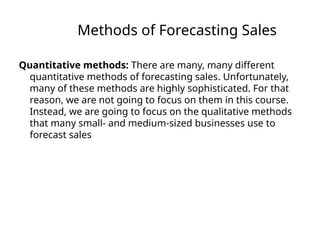
Methods of ForecastingSales
Quantitative methods: There are many, many different
quantitative methods of forecasting sales. Unfortunately,
many of these methods are highly sophisticated. For that
reason, we are not going to focus on them in this course.
Instead, we are going to focus on the qualitative methods
that many small- and medium-sized businesses use to
forecast sales
7.
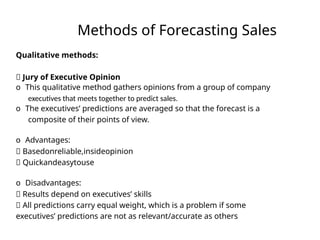
Methods of ForecastingSales
Qualitative methods:
Jury of Executive Opinion
o This qualitative method gathers opinions from a group of company
executives that meets together to predict sales.
o The executives’ predictions are averaged so that the forecast is a
composite of their points of view.
o Advantages:
Basedonreliable,insideopinion
Quickandeasytouse
o Disadvantages:
Results depend on executives’ skills
All predictions carry equal weight, which is a problem if some
executives’ predictions are not as relevant/accurate as others
8.
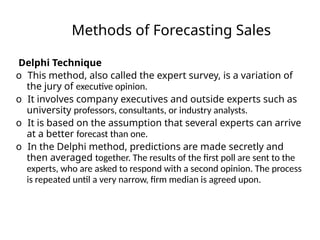
Methods of ForecastingSales
Delphi Technique
o This method, also called the expert survey, is a variation of
the jury of executive opinion.
o It involves company executives and outside experts such as
university professors, consultants, or industry analysts.
o It is based on the assumption that several experts can arrive
at a better forecast than one.
o In the Delphi method, predictions are made secretly and
then averaged together. The results of the first poll are sent to the
experts, who are asked to respond with a second opinion. The process
is repeated until a very narrow, firm median is agreed upon.
9.
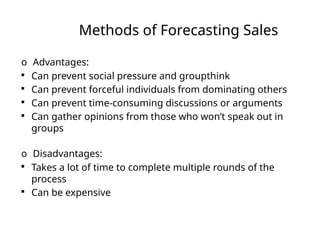
Methods of ForecastingSales
o Advantages:
Can prevent social pressure and groupthink
Can prevent forceful individuals from dominating others
Can prevent time-consuming discussions or arguments
Can gather opinions from those who won’t speak out in
groups
o Disadvantages:
Takes a lot of time to complete multiple rounds of the
process
Can be expensive
10.
Methods of ForecastingSales
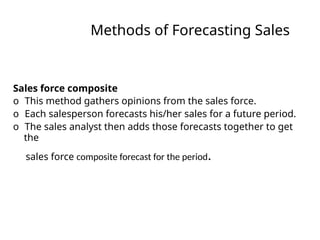
Sales force composite
o This method gathers opinions from the sales force.
o Each salesperson forecasts his/her sales for a future period.
o The sales analyst then adds those forecasts together to get
the
sales force composite forecast for the period.
11.
Methods of ForecastingSales
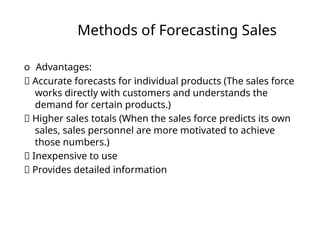
o Advantages:
Accurate forecasts for individual products (The sales force
works directly with customers and understands the
demand for certain products.)
Higher sales totals (When the sales force predicts its own
sales, sales personnel are more motivated to achieve
those numbers.)
Inexpensive to use
Provides detailed information
12.
Methods of ForecastingSales
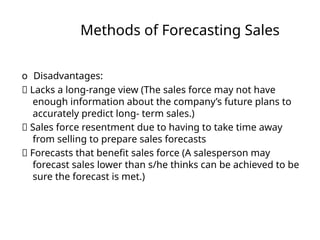
o Disadvantages:
Lacks a long-range view (The sales force may not have
enough information about the company’s future plans to
accurately predict long- term sales.)
Sales force resentment due to having to take time away
from selling to prepare sales forecasts
Forecasts that benefit sales force (A salesperson may
forecast sales lower than s/he thinks can be achieved to be
sure the forecast is met.)
13.
Methods of ForecastingSales
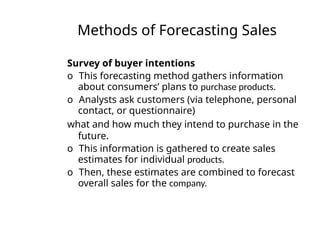
Survey of buyer intentions
o This forecasting method gathers information
about consumers’ plans to purchase products.
o Analysts ask customers (via telephone, personal
contact, or questionnaire)
what and how much they intend to purchase in the
future.
o This information is gathered to create sales
estimates for individual products.
o Then, these estimates are combined to forecast
overall sales for the company.
14.
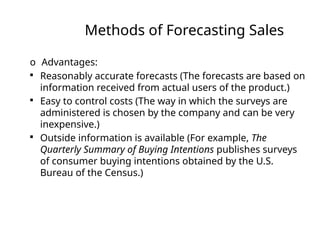
Methods of ForecastingSales
o Advantages:
Reasonably accurate forecasts (The forecasts are based on
information received from actual users of the product.)
Easy to control costs (The way in which the surveys are
administered is chosen by the company and can be very
inexpensive.)
Outside information is available (For example, The
Quarterly Summary of Buying Intentions publishes surveys
of consumer buying intentions obtained by the U.S.
Bureau of the Census.)
15.
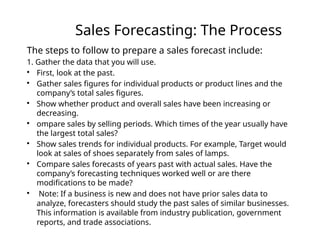
Sales Forecasting: TheProcess
The steps to follow to prepare a sales forecast include:
1. Gather the data that you will use.
First, look at the past.
Gather sales figures for individual products or product lines and the
company’s total sales figures.
Show whether product and overall sales have been increasing or
decreasing.
ompare sales by selling periods. Which times of the year usually have
the largest total sales?
Show sales trends for individual products. For example, Target would
look at sales of shoes separately from sales of lamps.
Compare sales forecasts of years past with actual sales. Have the
company’s forecasting techniques worked well or are there
modifications to be made?
Note: If a business is new and does not have prior sales data to
analyze, forecasters should study the past sales of similar businesses.
This information is available from industry publication, government
reports, and trade associations.
16.
Sales Forecasting: TheProcess
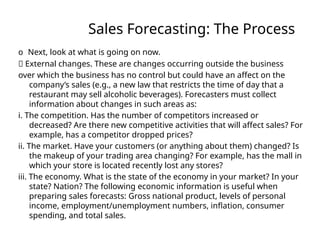
o Next, look at what is going on now.
External changes. These are changes occurring outside the business
over which the business has no control but could have an affect on the
company’s sales (e.g., a new law that restricts the time of day that a
restaurant may sell alcoholic beverages). Forecasters must collect
information about changes in such areas as:
i. The competition. Has the number of competitors increased or
decreased? Are there new competitive activities that will affect sales? For
example, has a competitor dropped prices?
ii. The market. Have your customers (or anything about them) changed? Is
the makeup of your trading area changing? For example, has the mall in
which your store is located recently lost any stores?
iii. The economy. What is the state of the economy in your market? In your
state? Nation? The following economic information is useful when
preparing sales forecasts: Gross national product, levels of personal
income, employment/unemployment numbers, inflation, consumer
spending, and total sales.
17.
Sales Forecasting: TheProcess
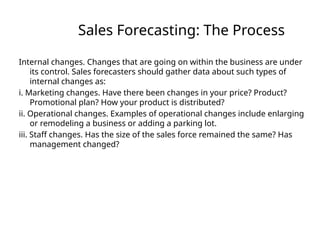
Internal changes. Changes that are going on within the business are under
its control. Sales forecasters should gather data about such types of
internal changes as:
i. Marketing changes. Have there been changes in your price? Product?
Promotional plan? How your product is distributed?
ii. Operational changes. Examples of operational changes include enlarging
or remodeling a business or adding a parking lot.
iii. Staff changes. Has the size of the sales force remained the same? Has
management changed?
18.
Sales Forecasting: TheProcess
2. Determine the amount by which your sales increased or
decreased last year.
o Use the data that you collected to determine your sales for the
prior two years.
o Next, determine the difference between the two years’ sales (i.e.,
subtract the first year’s sales from last year’s sales; if your answer
is positive, your sales increased; if your answer is negative, your
sales decreased).
3. Determine the percent of increase or decrease.
o To determine the percent of increase or decrease, divide the
amount of sales increase/decrease by the sales for the first year.
19.
Sales Forecasting: TheProcess
4. Add outside predictions of increases in sales for your trading
area from positive economic forecasts, population growth,
reduced competition, etc.
o For example, if experts are forecasting that the economy and/or
population will grow, add the percent of predicted growth to the
company’s percent of increase/decrease in sales.
5. Subtract outside predictions of decreases in sales from
negative economic forecasts, reductions in population,
increased competition, etc.
o For example, if you learn that a new competitor is expected to
reduce your sales, subtract the percent of reduction in sales from
your company’s percent of increase/decrease in sales.
20.
Sales Forecasting: TheProcess
6. Convert your final forecast percentage into a dollar figure.
o Multiply the percent of increase/decrease by last year’s sales.
o If you expect sales to increase, add your answer to last year’s
sales. If you expect sales to decrease, subtract your answer from last
year’s sales.
Note:
Keep in mind that estimating your sales will be an inexact science.
Don’t rely too heavily on your projections. If you’re going to err,
err on the conservative side. It’s better to be pleasantly surprised
by higher than projected sales versus being caught off-guard by
lower than predicted sales.