By
Sagar Trivedi
 Gastrointestinal transit is the time it takes for food or drug to leave
stomach and travel through intestines.
 The transit time for the mouth to anus varies person to person and
also depending upon object ingested and physiological condition of
the tract.
 A study shows transit time for an indigestible object vary from 8-62
Hrs.
 Many factors can affect transit time, including your diet,
medications, prior surgeries, gender, level of physical activity and
stress level, as well as any chronic or acute illnesses that affect your
gastrointestinal tract.
 It takes varying amounts of time for food to pass through the
different areas of your intestinal tract, which includes the stomach,
small intestine and large intestine.
 Anatomy of GI tract
 Dynamics of GI tract
 GI transit
 Ileocecal junction
 Colon and Gut flora
 GI Mucus
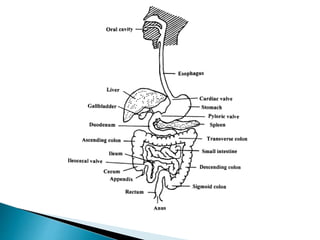
 GI tract is a group of organs joined in a long tube which is divided
into several sections, each of that fulfills a specific function.
 The tract begins with oral cavity, follows pharynx, esophagus,
stomach, small intestine and large intestine ending with rectum to
anus part.
 GI with muscular walls comprising four different layers:
1. inner mucosa,
2. submucosa
3. muscularis externa
4. serosa.
 Stomach serves the most primarily mixing area and a reservoir that
secretes pepsinogen, gastric lipase, hydrochloric acid, and the
intrinsic factor.
 This section of the GI tract is normally impermeable for absorption
of most materials into the blood except water, ions, alcohol, and
certain drugs such as aspirin.
 It follows small intestine, the major digestive and absorptive site of
the GI tract, providing an extended surface area by the circular folds
of about 10 mm height through the microvilli on the absorptive cells
of the mucosa.
 The last part of the GI tract is the large intestine extending from the
ileum to the anus with 1.5 m long and 6.35 cm in diameter serving
mainly the fecal storage and water absorptive roles.
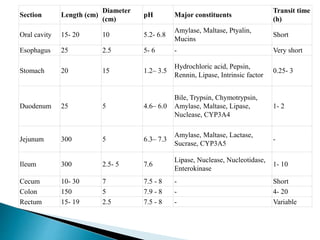
Section Length (cm)
Diameter
(cm)
pH Major constituents
Transit time
(h)
Oral cavity 15- 20 10 5.2- 6.8
Amylase, Maltase, Ptyalin,
Mucins
Short
Esophagus 25 2.5 5- 6 - Very short
Stomach 20 15 1.2– 3.5
Hydrochloric acid, Pepsin,
Rennin, Lipase, Intrinsic factor
0.25- 3
Duodenum 25 5 4.6– 6.0
Bile, Trypsin, Chymotrypsin,
Amylase, Maltase, Lipase,
Nuclease, CYP3A4
1- 2
Jejunum 300 5 6.3– 7.3
Amylase, Maltase, Lactase,
Sucrase, CYP3A5
-
Ileum 300 2.5- 5 7.6
Lipase, Nuclease, Nucleotidase,
Enterokinase
1- 10
Cecum 10- 30 7 7.5 - 8 - Short
Colon 150 5 7.9 - 8 - 4- 20
Rectum 15- 19 2.5 7.5 - 8 - Variable
 GI tract is always in a state of continous motility mainly there are 2
types of motlity patterns
1. Digestive mode
2. Interdigestive mode
 This mode consist of four distinct phases
I. Period of no contraction
II. Period of intermittent contractions
III. Period of regular contractions at maximal frequency
IV. Period of transition between phase 3 and phase 1
 Average duration of these 4 phases is 90-120 min, this can be
influenced under diseases states.
 Phase 3 serves a role of clearing all indigestible materials from
stomach and intestine.
 Controlled –release GIDDS are intended to prolong GI retention so
the system must be designed as such that it must be capable of
resisting PHASE 3
 Bioadhesive properties able the system to adhere mucosal
membrane strongly to withstand shear produced during this stages.
 The secretions of stomach, pancreas , liver , large & Small intestine
provide mechanical and chemical means required for PHASE3 in
fasting conditions.
 GI transit is most limiting factor in development of controlled
release GIDDS and GI transit depend upon whether the person is
fasted or fed state.
 The physical state of DDS , either a solid or liquid also influences
GI transit.
A. Fasted State :
 The gastric emptying of liquids in fasted state is function of
volume administered , for small volume (<100ml) liq emptied on
onset of PHASE 2 and for larger volume (>150ml) their empting
is irrespective of phase activity.
 The fasted state emptying of liq. Is independent of presence of any
indigestible solid in stomach and is suggested DDS should be
asdminstered with small volume of liq for prolongation GI
empyting time.
 Empyting of solid is function of their size small size(<1mm) can be
emptied with liq solids of 2mm or more done not empty untill arival
of phase 3.
 During phase 1 contractions are minimum no or little movement of
liq or solid in phase 2 and 3 movement become progressively faster,
segregation of liq and solid also seen , liq migrates during phase 2
and 3.
 During fasted state relative motion between the dosage form in
small intestine and luminal fluid content is observed , continue shear
forces and constat fluid movement around dosage form may lead ti
difference between in in-vivo and in-vitro bioavaibility of drug
release
 Feeding the fundus of stomach expand to accommodate food
without an appreciable increase in intragastric pressure .
 Solids emptied at a faster rate than solids are their emptying
controlled by feedback mechanism from duodenum and ileum.
 Solids are not emptied in feed state untill they ground to 2mm or
less in size, since grinding & mixing take place in antral area dosage
form tend to reside in this area if large
 Gastric secretions also start following ingestion of food dependind
upon nature and volume of ingested food , the volume emptied is
replaced by gastric secertions and thus gastric volume remains
constant for 1st four hrs of gastric empyting.
 In small intestine contents move faster in fed state , the intestinal
transit time regradless of nature is around 3-4 hrs.
 Non disintegrating tablets and capsule stay for 2-6hr and
disintegrating re emptied with the food.
 This serves mainly to ensure the unidirectional
flow of luminal contents from small to large
intestine.
 Ileocecal junction is point along the course of
the gastrointestinal tract where the small
intestine (ileum) ends as it opens into the cecal
portion of the large intestine
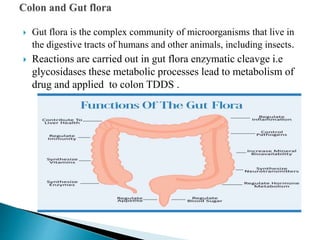
 Gut flora is the complex community of microorganisms that live in
the digestive tracts of humans and other animals, including insects.
 Reactions are carried out in gut flora enzymatic cleavge i.e
glycosidases these metabolic processes lead to metabolism of
drug and applied to colon TDDS .
 Mucus is continuously secreted by goblet cells located throughout
GIT.
 Fresh mucous is very thick and becomes diluted and less thick near
lumen , thickness varies upon various region in GIT.
 Main function is to protect surface Mucosal cell from gastric acid as
well as barrier to antigens bacteria and virues.
 Chemical composition is network of glycoproteins .
 Presence of mucus in GIT presented opportunity to prolong transit
time by application of bio(muco)adhesive polymers.
Modulation of GI transit time

Modulation of GI transit time

  • 1.
  • 2.
     Gastrointestinal transitis the time it takes for food or drug to leave stomach and travel through intestines.  The transit time for the mouth to anus varies person to person and also depending upon object ingested and physiological condition of the tract.  A study shows transit time for an indigestible object vary from 8-62 Hrs.  Many factors can affect transit time, including your diet, medications, prior surgeries, gender, level of physical activity and stress level, as well as any chronic or acute illnesses that affect your gastrointestinal tract.  It takes varying amounts of time for food to pass through the different areas of your intestinal tract, which includes the stomach, small intestine and large intestine.
  • 3.
     Anatomy ofGI tract  Dynamics of GI tract  GI transit  Ileocecal junction  Colon and Gut flora  GI Mucus
  • 4.
     GI tractis a group of organs joined in a long tube which is divided into several sections, each of that fulfills a specific function.  The tract begins with oral cavity, follows pharynx, esophagus, stomach, small intestine and large intestine ending with rectum to anus part.  GI with muscular walls comprising four different layers: 1. inner mucosa, 2. submucosa 3. muscularis externa 4. serosa.  Stomach serves the most primarily mixing area and a reservoir that secretes pepsinogen, gastric lipase, hydrochloric acid, and the intrinsic factor.
  • 5.
     This sectionof the GI tract is normally impermeable for absorption of most materials into the blood except water, ions, alcohol, and certain drugs such as aspirin.  It follows small intestine, the major digestive and absorptive site of the GI tract, providing an extended surface area by the circular folds of about 10 mm height through the microvilli on the absorptive cells of the mucosa.  The last part of the GI tract is the large intestine extending from the ileum to the anus with 1.5 m long and 6.35 cm in diameter serving mainly the fecal storage and water absorptive roles.
  • 7.
    Section Length (cm) Diameter (cm) pHMajor constituents Transit time (h) Oral cavity 15- 20 10 5.2- 6.8 Amylase, Maltase, Ptyalin, Mucins Short Esophagus 25 2.5 5- 6 - Very short Stomach 20 15 1.2– 3.5 Hydrochloric acid, Pepsin, Rennin, Lipase, Intrinsic factor 0.25- 3 Duodenum 25 5 4.6– 6.0 Bile, Trypsin, Chymotrypsin, Amylase, Maltase, Lipase, Nuclease, CYP3A4 1- 2 Jejunum 300 5 6.3– 7.3 Amylase, Maltase, Lactase, Sucrase, CYP3A5 - Ileum 300 2.5- 5 7.6 Lipase, Nuclease, Nucleotidase, Enterokinase 1- 10 Cecum 10- 30 7 7.5 - 8 - Short Colon 150 5 7.9 - 8 - 4- 20 Rectum 15- 19 2.5 7.5 - 8 - Variable
  • 8.
     GI tractis always in a state of continous motility mainly there are 2 types of motlity patterns 1. Digestive mode 2. Interdigestive mode  This mode consist of four distinct phases I. Period of no contraction II. Period of intermittent contractions III. Period of regular contractions at maximal frequency IV. Period of transition between phase 3 and phase 1  Average duration of these 4 phases is 90-120 min, this can be influenced under diseases states.  Phase 3 serves a role of clearing all indigestible materials from stomach and intestine.
  • 9.
     Controlled –releaseGIDDS are intended to prolong GI retention so the system must be designed as such that it must be capable of resisting PHASE 3  Bioadhesive properties able the system to adhere mucosal membrane strongly to withstand shear produced during this stages.  The secretions of stomach, pancreas , liver , large & Small intestine provide mechanical and chemical means required for PHASE3 in fasting conditions.
  • 10.
     GI transitis most limiting factor in development of controlled release GIDDS and GI transit depend upon whether the person is fasted or fed state.  The physical state of DDS , either a solid or liquid also influences GI transit. A. Fasted State :  The gastric emptying of liquids in fasted state is function of volume administered , for small volume (<100ml) liq emptied on onset of PHASE 2 and for larger volume (>150ml) their empting is irrespective of phase activity.  The fasted state emptying of liq. Is independent of presence of any indigestible solid in stomach and is suggested DDS should be asdminstered with small volume of liq for prolongation GI empyting time.
  • 11.
     Empyting ofsolid is function of their size small size(<1mm) can be emptied with liq solids of 2mm or more done not empty untill arival of phase 3.  During phase 1 contractions are minimum no or little movement of liq or solid in phase 2 and 3 movement become progressively faster, segregation of liq and solid also seen , liq migrates during phase 2 and 3.  During fasted state relative motion between the dosage form in small intestine and luminal fluid content is observed , continue shear forces and constat fluid movement around dosage form may lead ti difference between in in-vivo and in-vitro bioavaibility of drug release
  • 12.
     Feeding thefundus of stomach expand to accommodate food without an appreciable increase in intragastric pressure .  Solids emptied at a faster rate than solids are their emptying controlled by feedback mechanism from duodenum and ileum.  Solids are not emptied in feed state untill they ground to 2mm or less in size, since grinding & mixing take place in antral area dosage form tend to reside in this area if large  Gastric secretions also start following ingestion of food dependind upon nature and volume of ingested food , the volume emptied is replaced by gastric secertions and thus gastric volume remains constant for 1st four hrs of gastric empyting.  In small intestine contents move faster in fed state , the intestinal transit time regradless of nature is around 3-4 hrs.  Non disintegrating tablets and capsule stay for 2-6hr and disintegrating re emptied with the food.
  • 13.
     This servesmainly to ensure the unidirectional flow of luminal contents from small to large intestine.  Ileocecal junction is point along the course of the gastrointestinal tract where the small intestine (ileum) ends as it opens into the cecal portion of the large intestine
  • 14.
     Gut florais the complex community of microorganisms that live in the digestive tracts of humans and other animals, including insects.  Reactions are carried out in gut flora enzymatic cleavge i.e glycosidases these metabolic processes lead to metabolism of drug and applied to colon TDDS .
  • 15.
     Mucus iscontinuously secreted by goblet cells located throughout GIT.  Fresh mucous is very thick and becomes diluted and less thick near lumen , thickness varies upon various region in GIT.  Main function is to protect surface Mucosal cell from gastric acid as well as barrier to antigens bacteria and virues.  Chemical composition is network of glycoproteins .  Presence of mucus in GIT presented opportunity to prolong transit time by application of bio(muco)adhesive polymers.