SAFETY PRECAUTION
FOR WELDING AND
CUTTING
ARCRAFT PLASMA EQUIPMENTS (INDIA) PVT.LTD.
SAFETYPRECAUTIONFORWELDINGANDCUTTING
1
SAFETY PRECAUTION
FOR WELDING AND
CUTTING
INTRODUCTION
 To prevent injury to personnel, extreme caution should be exercised
when using any types of welding equipment. Injury can result from
fire, explosions, electric shock, or harmful agents. Both the general
and specific safety precautions listed below must be strictly
observed by workers who weld or cut metals.
 The electric arc is a very powerful source of light, including visible,
ultraviolet, and infrared. Protective clothing and equipment must be
worn during all welding operations. During all oxyacetylene
welding and cutting process, operators must use safety goggles to
protect the eyes from heat, glare, and flying fragments of hot metals.
During all electric welding processes, operators must use safety
goggles and a hand shield or helmet equipped with a suitable filter
SAFETYPRECAUTIONFORWELDINGANDCUTTING
2
glass to protect against the intense ultraviolet and infrared rays.
When others are in the vicinity of the electric welding processes, the
area must be screened so the arc cannot be seen either directly or by
reflection from glass or metal.
 Where there is exposure to sharp or heavy falling objects or a hazard
of bumping in confined spaces, hard hats or head protectors must be
used
 For welding and cladding overhead or in confined spaces, steel-toed
boots and ear protection must also be used.
 When welding in any area, the operation should be adequately
screened to protect nearby workers or passers-by from the glare of
welding. The screens should be arranged so that no serious
restriction of ventilation exists. The screens should be mounted so
that they are about 2.0ft above the floor unless the work is performed
at such a low level that the screen must be extended closer to the
floor to protect adjacent workers. The height of the screen is
normally 6.0ft (1.8 m) but may be higher depending upon the
situation. Screen and surrounding areas must be painted with special
paints which absorb ultraviolet radiation yet do not create high
contrast between the bright and dark areas. Light pastel colors of a
zinc or titanium dioxide base paint are recommended. Black paint
should not be used
SAFETYPRECAUTIONFORWELDINGANDCUTTING
3
ELECTRIC SHOCK
Arc welding equipment’s operates at a voltage which is safe under normal
working conditions. But the shock hazard should not be ignored. It
increases in warm & damp conditions, because an electric arc welder has
to work with electric current which may pass through his body. The human
body resistance to current passage is not constant. The highest resistance
is offered by the skin. Wet skin conducts electric current better than dry
skin under normal condition.
Safety precautions:
 Check that equipment is correctly
earthed when installed & when in use.
 Make sure welding cables and
machines are capable of handling
maximum voltage & current as rated for the equipment & for the
desired applications.
 Check for damage to insulation on cables,
holders, guns and connectors. Please do not
operate the equipment without properly
insulating them.
 Ensure ARC welding machines are designed
as per applicable standards.
 Please operate equipment’s strictly as per printed instructions and
rules specified by respective original equipment manufacturers.
SAFETYPRECAUTIONFORWELDINGANDCUTTING
4
 Make sure all earthing connections are mechanically strong.
 Ensure all welding equipment’s are inspected once a week.
 Do not carry holder and earthing together when welding machine is
ON.
 Always wear rubber soled safety shoes.
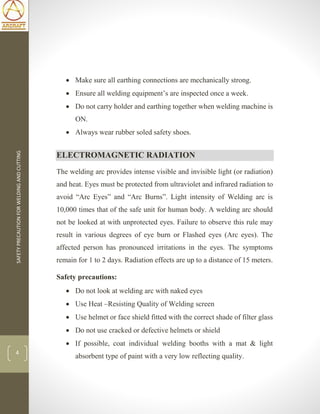
ELECTROMAGNETIC RADIATION
The welding arc provides intense visible and invisible light (or radiation)
and heat. Eyes must be protected from ultraviolet and infrared radiation to
avoid “Arc Eyes” and “Arc Burns”. Light intensity of Welding arc is
10,000 times that of the safe unit for human body. A welding arc should
not be looked at with unprotected eyes. Failure to observe this rule may
result in various degrees of eye burn or Flashed eyes (Arc eyes). The
affected person has pronounced irritations in the eyes. The symptoms
remain for 1 to 2 days. Radiation effects are up to a distance of 15 meters.
Safety precautions:
 Do not look at welding arc with naked eyes
 Use Heat –Resisting Quality of Welding screen
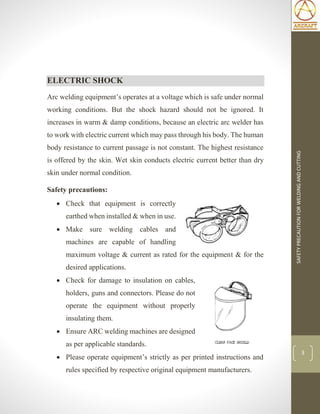
 Use helmet or face shield fitted with the correct shade of filter glass
 Do not use cracked or defective helmets or shield
 If possible, coat individual welding booths with a mat & light
absorbent type of paint with a very low reflecting quality.
SAFETYPRECAUTIONFORWELDINGANDCUTTING
5
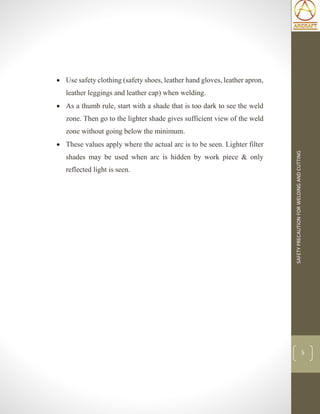
 Use safety clothing (safety shoes, leather hand gloves, leather apron,
leather leggings and leather cap) when welding.
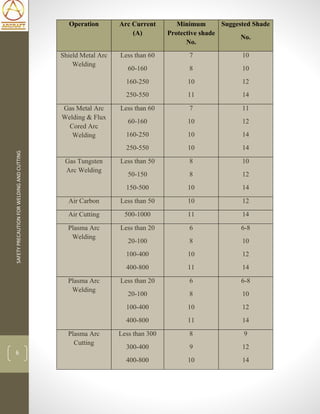
 As a thumb rule, start with a shade that is too dark to see the weld
zone. Then go to the lighter shade gives sufficient view of the weld
zone without going below the minimum.
 These values apply where the actual arc is to be seen. Lighter filter
shades may be used when arc is hidden by work piece & only
reflected light is seen.
SAFETYPRECAUTIONFORWELDINGANDCUTTING
6
Operation Arc Current
(A)
Minimum
Protective shade
No.
Suggested Shade
No.
Shield Metal Arc
Welding
Less than 60
60-160
160-250
250-550
7
8
10
11
10
10
12
14
Gas Metal Arc
Welding & Flux
Cored Arc
Welding
Less than 60
60-160
160-250
250-550
7
10
10
10
11
12
14
14
Gas Tungsten
Arc Welding
Less than 50
50-150
150-500
8
8
10
10
12
14
Air Carbon Less than 50 10 12
Air Cutting 500-1000 11 14
Plasma Arc
Welding
Less than 20
20-100
100-400
400-800
6
8
10
11
6-8
10
12
14
Plasma Arc
Welding
Less than 20
20-100
100-400
400-800
6
8
10
11
6-8
10
12
14
Plasma Arc
Cutting
Less than 300
300-400
400-800
8
9
10
9
12
14
SAFETYPRECAUTIONFORWELDINGANDCUTTING
7
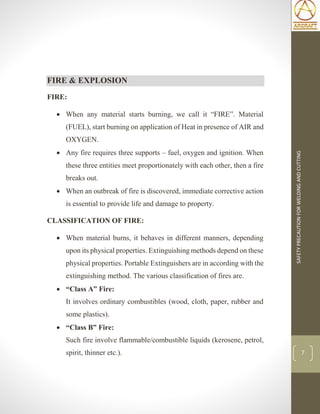
FIRE & EXPLOSION
FIRE:
 When any material starts burning, we call it “FIRE”. Material
(FUEL), start burning on application of Heat in presence of AIR and
OXYGEN.
 Any fire requires three supports – fuel, oxygen and ignition. When
these three entities meet proportionately with each other, then a fire
breaks out.
 When an outbreak of fire is discovered, immediate corrective action
is essential to provide life and damage to property.
CLASSIFICATION OF FIRE:
 When material burns, it behaves in different manners, depending
upon its physical properties. Extinguishing methods depend on these
physical properties. Portable Extinguishers are in according with the
extinguishing method. The various classification of fires are.
 “Class A” Fire:
It involves ordinary combustibles (wood, cloth, paper, rubber and
some plastics).
 “Class B” Fire:
Such fire involve flammable/combustible liquids (kerosene, petrol,
spirit, thinner etc.).
SAFETYPRECAUTIONFORWELDINGANDCUTTING
8
 “Class C” Fire:
Involves substances in gaseous from like LPG, Acetylene, Halogen,
Hydrogen etc.
 “Class D” Fire:
Those involving combustible metals such as magnesium, sodium,
potassium etc.
EXPLOSION:
 It is very rapid process of combustion, accompanied by rapid
liberation of heat and formation of a very large volume of gaseous
products fire can be controlled by reducing Fuel or Heat or Air
Before extinguishing any fire, it is essential to know the
classification of fire.
SAFETY PRECAUTIONS:
 While repairing tanks, vessels, drums or pipes by welding or gas
cutting, remove all traces of earlier stored material, to avoid
possibility of explosion.
 Remove all flammable materials from working areas.
 Avoid excessive release of fuel gas into the atmosphere.
 Ensure that appropriate firefighting equipment is available at hand
and that all concerned know how to use it.
 Have a bucket of water at the work station for cooling overheated
blow pipes.
SAFETYPRECAUTIONFORWELDINGANDCUTTING
9
 Where a “permitted to work” system is in operation, ensure that all
instruction are fully complied with.
 Do not use adaptors for hose connections.
 Check emergency escape route.
 Gas welding, brazing and cutting are familiar processes today in
every industry and as such, the equipment is designed and
manufactured, to be as safe as possible. However, there are a number
of aspects to safety and design and manufacture is only the first step.
SAFETY DEVICES FOR MINIMIZING RISK:
 Flash back arrestor
 Non return value
 Cut off value
 Relief value
PRECAUTIONS IN CASE OF FIRE:
Do’s
 Raise alarm ‘FIRE’ at peak of your voice, if you notice a fire within
your vicinity
 Approach the scene in quickest possible time
 Try to attract other’s attention on your way to the scene of fire
SAFETYPRECAUTIONFORWELDINGANDCUTTING
10
 Make sure no life is trapped
 Tell others the type of fire and which extinguisher to use
 Put off the supply in case of electrical fires
 Dial 101 & give exact location as needed
 Open all doors and windows after the fire is completely
extinguished, to avoid inhalation of fumes
Don’ts
 Don’t run in panic.
 Don’t take undue risk
 Don’t tamper with any machinery during firefighting. Leave it for
authorized handling
 Don’t argue on the scene of fire
 Don’t throw sand on machinery parts. Use CO2 or dry powder
instead
 Don’t flood the affected area with water
 Don’t crowd the scene of fire
 Don’t close the valve of a inflammable gas cylinder on fire
SAFETYPRECAUTIONFORWELDINGANDCUTTING
11
FUMES & GASES
Proper ventilation is must to maintain good health. It is true that when a
welder gets clean air to breathe, he can see better, work better, work longer,
quality of his work improves & productivity of people working nearby
increase in an improved environment. Most common toxic fumes are from
materials such as Zinc Oxide, Carbon Monoxide, Mercury, and Lead &
Cadmium.
SAFETY PRECAUTIONS:
 Carry out all welding operations in safe, clean and dry location
 Under normal workshop conditions, use a local fume extractor
wherever possible and maintain its position close to the weld as
work progresses
 Check for possible toxic hazards from parent metal (Specially if
surface is painted, plated or chemically treated), or from welding
consumables
 Check for adequate ventilation and / or breathing apparatus when
welding in an enclose space
 Use a face respirator when toxic fumes are present
SAFETYPRECAUTIONFORWELDINGANDCUTTING
12
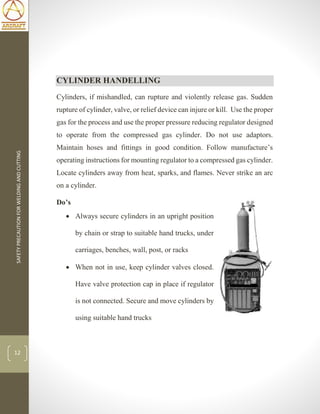
CYLINDER HANDELLING
Cylinders, if mishandled, can rupture and violently release gas. Sudden
rupture of cylinder, valve, or relief device can injure or kill. Use the proper
gas for the process and use the proper pressure reducing regulator designed
to operate from the compressed gas cylinder. Do not use adaptors.
Maintain hoses and fittings in good condition. Follow manufacture’s
operating instructions for mounting regulator to a compressed gas cylinder.
Locate cylinders away from heat, sparks, and flames. Never strike an arc
on a cylinder.
Do’s
 Always secure cylinders in an upright position
by chain or strap to suitable hand trucks, under
carriages, benches, wall, post, or racks
 When not in use, keep cylinder valves closed.
Have valve protection cap in place if regulator
is not connected. Secure and move cylinders by
using suitable hand trucks
SAFETYPRECAUTIONFORWELDINGANDCUTTING
13
Don’ts
 Never secure cylinders to work tables or fixtures where they may
become part of an electrical circuit
 Avoid rough handling of cylinder
 Do not keep cylinders close to heat, sparks and flames. Never an arc
on a cylinder
EQUIPMENT MAINTENANCE
Faulty or improperly maintained equipment can cause injury or
death. Therefore the Safety Precautions are:
 Always have qualified personnel perform the installation,
troubleshooting, and maintenance work. Do not perform any
electrical work unless you are qualified to perform such work
 Before performing any maintenance work inside a power source,
disconnect the power source from the incoming electrical power
 Maintain cables, grounding wire, connections, power cord, and
power supply in safe working order. Do not operate any equipment
in faulty condition.
SAFETYPRECAUTIONFORWELDINGANDCUTTING
14
 Do not abuse any equipment or accessories. Keep equipment away
from heat sources such as furnaces, wet conditions such as water
puddles, oil or grease, corrosive atmospheres and inclement
weather.
HEAT
 Heat & Spatter are expelled during cutting and welding. The work
pieces will remain hot for some time after welding
SAFETY PRECAUTIONS:
 Wear correct protective clothing in good condition, free from grease
and oil
 Treat all metal connected with welding and cutting as HOT
 Mark work HOT when so (remove notice when cool)
“Wishing Safe & Healthy Welding & Cutting!”
SAFETYPRECAUTIONFORWELDINGANDCUTTING
15
Arcraft Plasma Equipments (I) Pvt Ltd.,
124, Diamond Industrial Estate,
Ketkipada, Dahisar (East),
Mumbai- 400068.
INDIA.
Visit us : arcraftplasma.com
Email us : arcraftplama@gmail.com
Contact us:
Ph -: 00-91-22-28965890, 28965745, 28963247
Fax-: 00-91-22-28966418

Safety precaution for welding and cutting

  • 1.
    SAFETY PRECAUTION FOR WELDINGAND CUTTING ARCRAFT PLASMA EQUIPMENTS (INDIA) PVT.LTD.
  • 2.
    SAFETYPRECAUTIONFORWELDINGANDCUTTING 1 SAFETY PRECAUTION FOR WELDINGAND CUTTING INTRODUCTION  To prevent injury to personnel, extreme caution should be exercised when using any types of welding equipment. Injury can result from fire, explosions, electric shock, or harmful agents. Both the general and specific safety precautions listed below must be strictly observed by workers who weld or cut metals.  The electric arc is a very powerful source of light, including visible, ultraviolet, and infrared. Protective clothing and equipment must be worn during all welding operations. During all oxyacetylene welding and cutting process, operators must use safety goggles to protect the eyes from heat, glare, and flying fragments of hot metals. During all electric welding processes, operators must use safety goggles and a hand shield or helmet equipped with a suitable filter
  • 3.
    SAFETYPRECAUTIONFORWELDINGANDCUTTING 2 glass to protectagainst the intense ultraviolet and infrared rays. When others are in the vicinity of the electric welding processes, the area must be screened so the arc cannot be seen either directly or by reflection from glass or metal.  Where there is exposure to sharp or heavy falling objects or a hazard of bumping in confined spaces, hard hats or head protectors must be used  For welding and cladding overhead or in confined spaces, steel-toed boots and ear protection must also be used.  When welding in any area, the operation should be adequately screened to protect nearby workers or passers-by from the glare of welding. The screens should be arranged so that no serious restriction of ventilation exists. The screens should be mounted so that they are about 2.0ft above the floor unless the work is performed at such a low level that the screen must be extended closer to the floor to protect adjacent workers. The height of the screen is normally 6.0ft (1.8 m) but may be higher depending upon the situation. Screen and surrounding areas must be painted with special paints which absorb ultraviolet radiation yet do not create high contrast between the bright and dark areas. Light pastel colors of a zinc or titanium dioxide base paint are recommended. Black paint should not be used
  • 4.
    SAFETYPRECAUTIONFORWELDINGANDCUTTING 3 ELECTRIC SHOCK Arc weldingequipment’s operates at a voltage which is safe under normal working conditions. But the shock hazard should not be ignored. It increases in warm & damp conditions, because an electric arc welder has to work with electric current which may pass through his body. The human body resistance to current passage is not constant. The highest resistance is offered by the skin. Wet skin conducts electric current better than dry skin under normal condition. Safety precautions:  Check that equipment is correctly earthed when installed & when in use.  Make sure welding cables and machines are capable of handling maximum voltage & current as rated for the equipment & for the desired applications.  Check for damage to insulation on cables, holders, guns and connectors. Please do not operate the equipment without properly insulating them.  Ensure ARC welding machines are designed as per applicable standards.  Please operate equipment’s strictly as per printed instructions and rules specified by respective original equipment manufacturers.
  • 5.
    SAFETYPRECAUTIONFORWELDINGANDCUTTING 4  Make sureall earthing connections are mechanically strong.  Ensure all welding equipment’s are inspected once a week.  Do not carry holder and earthing together when welding machine is ON.  Always wear rubber soled safety shoes. ELECTROMAGNETIC RADIATION The welding arc provides intense visible and invisible light (or radiation) and heat. Eyes must be protected from ultraviolet and infrared radiation to avoid “Arc Eyes” and “Arc Burns”. Light intensity of Welding arc is 10,000 times that of the safe unit for human body. A welding arc should not be looked at with unprotected eyes. Failure to observe this rule may result in various degrees of eye burn or Flashed eyes (Arc eyes). The affected person has pronounced irritations in the eyes. The symptoms remain for 1 to 2 days. Radiation effects are up to a distance of 15 meters. Safety precautions:  Do not look at welding arc with naked eyes  Use Heat –Resisting Quality of Welding screen  Use helmet or face shield fitted with the correct shade of filter glass  Do not use cracked or defective helmets or shield  If possible, coat individual welding booths with a mat & light absorbent type of paint with a very low reflecting quality.
  • 6.
    SAFETYPRECAUTIONFORWELDINGANDCUTTING 5  Use safetyclothing (safety shoes, leather hand gloves, leather apron, leather leggings and leather cap) when welding.  As a thumb rule, start with a shade that is too dark to see the weld zone. Then go to the lighter shade gives sufficient view of the weld zone without going below the minimum.  These values apply where the actual arc is to be seen. Lighter filter shades may be used when arc is hidden by work piece & only reflected light is seen.
  • 7.
    SAFETYPRECAUTIONFORWELDINGANDCUTTING 6 Operation Arc Current (A) Minimum Protectiveshade No. Suggested Shade No. Shield Metal Arc Welding Less than 60 60-160 160-250 250-550 7 8 10 11 10 10 12 14 Gas Metal Arc Welding & Flux Cored Arc Welding Less than 60 60-160 160-250 250-550 7 10 10 10 11 12 14 14 Gas Tungsten Arc Welding Less than 50 50-150 150-500 8 8 10 10 12 14 Air Carbon Less than 50 10 12 Air Cutting 500-1000 11 14 Plasma Arc Welding Less than 20 20-100 100-400 400-800 6 8 10 11 6-8 10 12 14 Plasma Arc Welding Less than 20 20-100 100-400 400-800 6 8 10 11 6-8 10 12 14 Plasma Arc Cutting Less than 300 300-400 400-800 8 9 10 9 12 14
  • 8.
    SAFETYPRECAUTIONFORWELDINGANDCUTTING 7 FIRE & EXPLOSION FIRE: When any material starts burning, we call it “FIRE”. Material (FUEL), start burning on application of Heat in presence of AIR and OXYGEN.  Any fire requires three supports – fuel, oxygen and ignition. When these three entities meet proportionately with each other, then a fire breaks out.  When an outbreak of fire is discovered, immediate corrective action is essential to provide life and damage to property. CLASSIFICATION OF FIRE:  When material burns, it behaves in different manners, depending upon its physical properties. Extinguishing methods depend on these physical properties. Portable Extinguishers are in according with the extinguishing method. The various classification of fires are.  “Class A” Fire: It involves ordinary combustibles (wood, cloth, paper, rubber and some plastics).  “Class B” Fire: Such fire involve flammable/combustible liquids (kerosene, petrol, spirit, thinner etc.).
  • 9.
    SAFETYPRECAUTIONFORWELDINGANDCUTTING 8  “Class C”Fire: Involves substances in gaseous from like LPG, Acetylene, Halogen, Hydrogen etc.  “Class D” Fire: Those involving combustible metals such as magnesium, sodium, potassium etc. EXPLOSION:  It is very rapid process of combustion, accompanied by rapid liberation of heat and formation of a very large volume of gaseous products fire can be controlled by reducing Fuel or Heat or Air Before extinguishing any fire, it is essential to know the classification of fire. SAFETY PRECAUTIONS:  While repairing tanks, vessels, drums or pipes by welding or gas cutting, remove all traces of earlier stored material, to avoid possibility of explosion.  Remove all flammable materials from working areas.  Avoid excessive release of fuel gas into the atmosphere.  Ensure that appropriate firefighting equipment is available at hand and that all concerned know how to use it.  Have a bucket of water at the work station for cooling overheated blow pipes.
  • 10.
    SAFETYPRECAUTIONFORWELDINGANDCUTTING 9  Where a“permitted to work” system is in operation, ensure that all instruction are fully complied with.  Do not use adaptors for hose connections.  Check emergency escape route.  Gas welding, brazing and cutting are familiar processes today in every industry and as such, the equipment is designed and manufactured, to be as safe as possible. However, there are a number of aspects to safety and design and manufacture is only the first step. SAFETY DEVICES FOR MINIMIZING RISK:  Flash back arrestor  Non return value  Cut off value  Relief value PRECAUTIONS IN CASE OF FIRE: Do’s  Raise alarm ‘FIRE’ at peak of your voice, if you notice a fire within your vicinity  Approach the scene in quickest possible time  Try to attract other’s attention on your way to the scene of fire
  • 11.
    SAFETYPRECAUTIONFORWELDINGANDCUTTING 10  Make sureno life is trapped  Tell others the type of fire and which extinguisher to use  Put off the supply in case of electrical fires  Dial 101 & give exact location as needed  Open all doors and windows after the fire is completely extinguished, to avoid inhalation of fumes Don’ts  Don’t run in panic.  Don’t take undue risk  Don’t tamper with any machinery during firefighting. Leave it for authorized handling  Don’t argue on the scene of fire  Don’t throw sand on machinery parts. Use CO2 or dry powder instead  Don’t flood the affected area with water  Don’t crowd the scene of fire  Don’t close the valve of a inflammable gas cylinder on fire
  • 12.
    SAFETYPRECAUTIONFORWELDINGANDCUTTING 11 FUMES & GASES Properventilation is must to maintain good health. It is true that when a welder gets clean air to breathe, he can see better, work better, work longer, quality of his work improves & productivity of people working nearby increase in an improved environment. Most common toxic fumes are from materials such as Zinc Oxide, Carbon Monoxide, Mercury, and Lead & Cadmium. SAFETY PRECAUTIONS:  Carry out all welding operations in safe, clean and dry location  Under normal workshop conditions, use a local fume extractor wherever possible and maintain its position close to the weld as work progresses  Check for possible toxic hazards from parent metal (Specially if surface is painted, plated or chemically treated), or from welding consumables  Check for adequate ventilation and / or breathing apparatus when welding in an enclose space  Use a face respirator when toxic fumes are present
  • 13.
    SAFETYPRECAUTIONFORWELDINGANDCUTTING 12 CYLINDER HANDELLING Cylinders, ifmishandled, can rupture and violently release gas. Sudden rupture of cylinder, valve, or relief device can injure or kill. Use the proper gas for the process and use the proper pressure reducing regulator designed to operate from the compressed gas cylinder. Do not use adaptors. Maintain hoses and fittings in good condition. Follow manufacture’s operating instructions for mounting regulator to a compressed gas cylinder. Locate cylinders away from heat, sparks, and flames. Never strike an arc on a cylinder. Do’s  Always secure cylinders in an upright position by chain or strap to suitable hand trucks, under carriages, benches, wall, post, or racks  When not in use, keep cylinder valves closed. Have valve protection cap in place if regulator is not connected. Secure and move cylinders by using suitable hand trucks
  • 14.
    SAFETYPRECAUTIONFORWELDINGANDCUTTING 13 Don’ts  Never securecylinders to work tables or fixtures where they may become part of an electrical circuit  Avoid rough handling of cylinder  Do not keep cylinders close to heat, sparks and flames. Never an arc on a cylinder EQUIPMENT MAINTENANCE Faulty or improperly maintained equipment can cause injury or death. Therefore the Safety Precautions are:  Always have qualified personnel perform the installation, troubleshooting, and maintenance work. Do not perform any electrical work unless you are qualified to perform such work  Before performing any maintenance work inside a power source, disconnect the power source from the incoming electrical power  Maintain cables, grounding wire, connections, power cord, and power supply in safe working order. Do not operate any equipment in faulty condition.
  • 15.
    SAFETYPRECAUTIONFORWELDINGANDCUTTING 14  Do notabuse any equipment or accessories. Keep equipment away from heat sources such as furnaces, wet conditions such as water puddles, oil or grease, corrosive atmospheres and inclement weather. HEAT  Heat & Spatter are expelled during cutting and welding. The work pieces will remain hot for some time after welding SAFETY PRECAUTIONS:  Wear correct protective clothing in good condition, free from grease and oil  Treat all metal connected with welding and cutting as HOT  Mark work HOT when so (remove notice when cool) “Wishing Safe & Healthy Welding & Cutting!”
  • 16.
    SAFETYPRECAUTIONFORWELDINGANDCUTTING 15 Arcraft Plasma Equipments(I) Pvt Ltd., 124, Diamond Industrial Estate, Ketkipada, Dahisar (East), Mumbai- 400068. INDIA. Visit us : arcraftplasma.com Email us : arcraftplama@gmail.com Contact us: Ph -: 00-91-22-28965890, 28965745, 28963247 Fax-: 00-91-22-28966418