Lockout/Tagout
• Who needs training?
• What is hazardous energy?
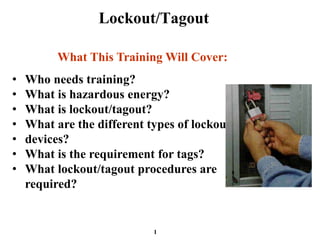
• What is lockout/tagout?
• What are the different types of lockout
• devices?
• What is the requirement for tags?
• What lockout/tagout procedures are
required?
What This Training Will Cover:
1
Who Needs Training?
• Authorized employees –people who lock or
tag out machines or equipment to perform
servicing.
• Affected employees –people who use machines
or equipment on which servicing is performed
under lockout/tagout.
• Other employees –people who work in the
area of locked out machinery or equipment
2
What is Hazardous Energy?
Hazardous energy is any of the following:
Electricity – live or stored
Moving machinery parts
Stored mechanical
movement in machinery
3
What is Hazardous Energy?
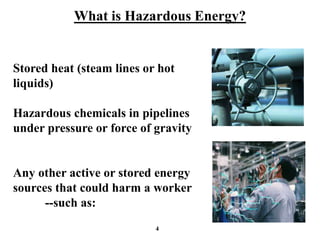
Stored heat (steam lines or hot
liquids)
Hazardous chemicals in pipelines
under pressure or force of gravity
Any other active or stored energy
sources that could harm a worker
--such as:
4
Hazardous Energy Source Examples
• Live electrical lines
• Electrical capacitors
• Lasers
• Engines that move machinery
parts
• Hydraulic lifts
• Pneumatic (air pressure) lines
• Pressurized water lines
• Springs
5
Lockout/Tagout and Confined Spaces
• Lockout/Tagout is important in
confined spaces since it is easy
to get trapped and hard to
escape.
• Pipelines leading into tanks
must be blanked off before
entering the space.
• All electrical and mechanical
hazardous energy must be
addressed and locked out or
tagged as needed.
6
Electrical Lockout Devices
Locked out electrical panel
Locked out circuit breaker
Locked out electrical plug
14
Fluid & Gas Lockout Devices
15
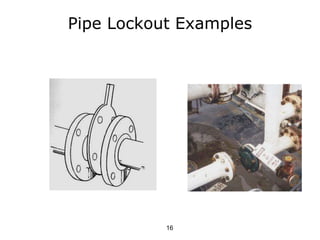
Pipe Lockout Examples
16
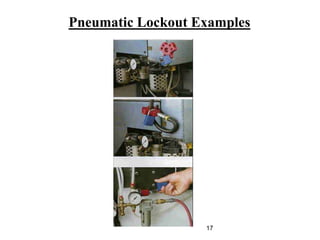
Pneumatic Lockout Examples
17
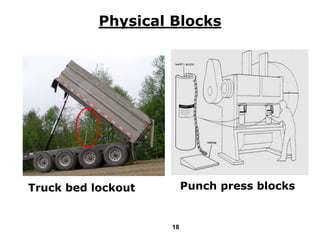
Physical Blocks
Truck bed lockout Punch press blocks
18
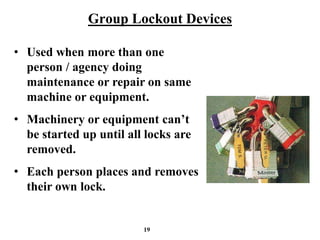
Group Lockout Devices
• Used when more than one
person / agency doing
maintenance or repair on same
machine or equipment.
• Machinery or equipment can’t
be started up until all locks are
removed.
• Each person places and removes
their own lock.
19
What is Tag-out?
Tags are warning devices only
• They don’t provide the same level of protection as
lockout devices. We only use for information, along
with a locked device.
• They can only be removed by an authorized person.
• They must be legible, securely attached.
22
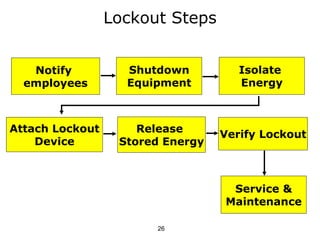
Lockout Procedures
Six Steps to Follow:
1. Notify affected employees (anybody in the
area) that the machine or equipment will be
shut down and locked out
2. Shut down the machinery or equipment using
normal procedure
3. Isolate energy sources with energy-isolating
devices
24
Lockout Procedures
4. Lock out energy-isolating devices with assigned
locks.
5. Release or restrain stored or residual energy
(capacitors, pressure, vacuum, blades, etc.)
6. Test machinery to make sure it can’t start up
(use the normal start procedure)
25
Lockout Steps
Notify
employees
Shutdown
Equipment
Isolate
Energy
Attach Lockout
Device
Release
Stored Energy
Verify Lockout
Service &
Maintenance
26
Examples of Release of Stored Energy
• “Slowly open the receiver tank port and bleed off
any internal pressure.”
• “Loosen both line valves to relieve all pressure in
the cooling circuit.”
• “Ground out capacitor…”
27

LOTO Training.ppt

  • 1.
    Lockout/Tagout • Who needstraining? • What is hazardous energy? • What is lockout/tagout? • What are the different types of lockout • devices? • What is the requirement for tags? • What lockout/tagout procedures are required? What This Training Will Cover: 1
  • 2.
    Who Needs Training? •Authorized employees –people who lock or tag out machines or equipment to perform servicing. • Affected employees –people who use machines or equipment on which servicing is performed under lockout/tagout. • Other employees –people who work in the area of locked out machinery or equipment 2
  • 3.
    What is HazardousEnergy? Hazardous energy is any of the following: Electricity – live or stored Moving machinery parts Stored mechanical movement in machinery 3
  • 4.
    What is HazardousEnergy? Stored heat (steam lines or hot liquids) Hazardous chemicals in pipelines under pressure or force of gravity Any other active or stored energy sources that could harm a worker --such as: 4
  • 5.
    Hazardous Energy SourceExamples • Live electrical lines • Electrical capacitors • Lasers • Engines that move machinery parts • Hydraulic lifts • Pneumatic (air pressure) lines • Pressurized water lines • Springs 5
  • 6.
    Lockout/Tagout and ConfinedSpaces • Lockout/Tagout is important in confined spaces since it is easy to get trapped and hard to escape. • Pipelines leading into tanks must be blanked off before entering the space. • All electrical and mechanical hazardous energy must be addressed and locked out or tagged as needed. 6
  • 7.
    Electrical Lockout Devices Lockedout electrical panel Locked out circuit breaker Locked out electrical plug 14
  • 8.
    Fluid & GasLockout Devices 15
  • 9.
  • 10.
  • 11.
    Physical Blocks Truck bedlockout Punch press blocks 18
  • 12.
    Group Lockout Devices •Used when more than one person / agency doing maintenance or repair on same machine or equipment. • Machinery or equipment can’t be started up until all locks are removed. • Each person places and removes their own lock. 19
  • 13.
    What is Tag-out? Tagsare warning devices only • They don’t provide the same level of protection as lockout devices. We only use for information, along with a locked device. • They can only be removed by an authorized person. • They must be legible, securely attached. 22
  • 14.
    Lockout Procedures Six Stepsto Follow: 1. Notify affected employees (anybody in the area) that the machine or equipment will be shut down and locked out 2. Shut down the machinery or equipment using normal procedure 3. Isolate energy sources with energy-isolating devices 24
  • 15.
    Lockout Procedures 4. Lockout energy-isolating devices with assigned locks. 5. Release or restrain stored or residual energy (capacitors, pressure, vacuum, blades, etc.) 6. Test machinery to make sure it can’t start up (use the normal start procedure) 25
  • 16.
  • 17.
    Examples of Releaseof Stored Energy • “Slowly open the receiver tank port and bleed off any internal pressure.” • “Loosen both line valves to relieve all pressure in the cooling circuit.” • “Ground out capacitor…” 27