Welding, Cutting and
Welding,Cutting and
Brazing Safety
Brazing Safety
Understanding the Safety Requirements for
Welding, Cutting and Brazing
29 CFR 1910.251-255 Welding, Cutting and Brazing
Prohibited Areas forWelding and
Prohibited Areas for Welding and
Cutting
Cutting
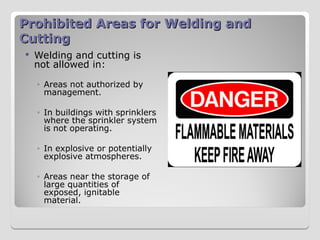
Welding and cutting is
not allowed in:
◦ Areas not authorized by
management.
◦ In buildings with sprinklers
where the sprinkler system
is not operating.
◦ In explosive or potentially
explosive atmospheres.
◦ Areas near the storage of
large quantities of
exposed, ignitable
material.
Guarding Fire Hazards
GuardingFire Hazards
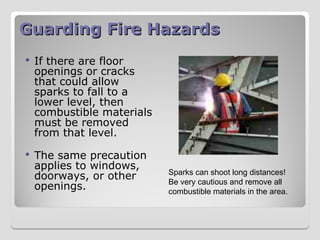
If there are floor
openings or cracks
that could allow
sparks to fall to a
lower level, then
combustible materials
must be removed
from that level.
The same precaution
applies to windows,
doorways, or other
openings.
Sparks can shoot long distances!
Be very cautious and remove all
combustible materials in the area.
7.
Fire Extinguishers
Fire Extinguishers
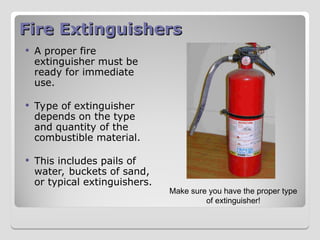
A proper fire
extinguisher must be
ready for immediate
use.
Type of extinguisher
depends on the type
and quantity of the
combustible material.
This includes pails of
water, buckets of sand,
or typical extinguishers.
Make sure you have the proper type
of extinguisher!
8.
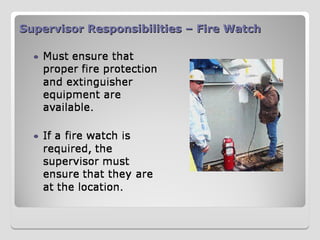
Fire Watch
Fire Watch
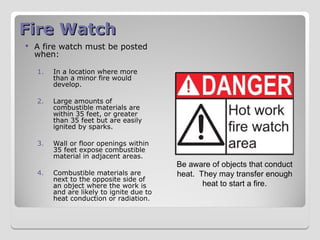
A fire watch must be posted
when:
1. In a location where more
than a minor fire would
develop.
2. Large amounts of
combustible materials are
within 35 feet, or greater
than 35 feet but are easily
ignited by sparks.
3. Wall or floor openings within
35 feet expose combustible
material in adjacent areas.
4. Combustible materials are
next to the opposite side of
an object where the work is
and are likely to ignite due to
heat conduction or radiation.
Be aware of objects that conduct
heat. They may transfer enough
heat to start a fire.
9.
Requirements for FireWatch
Requirements for Fire Watch
Must have fire
extinguisher ready
and be trained in its
use.
Must know how to
sound the alarm in
the case of a fire.
Must be maintained
for at least ½ hour
after welding or
cutting is completed.
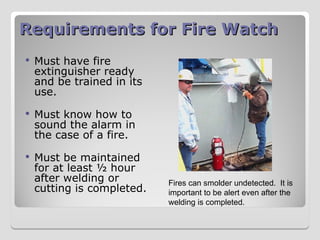
Fires can smolder undetected. It is
important to be alert even after the
welding is completed.
10.
Fire Watch Responsibilities
FireWatch Responsibilities
Fire watch must be the
sole responsibility.
Cannot perform work or
be distracted.
Should only put out a
fire if it is within the
capacity of the
equipment available.
If the fire cannot be
extinguished
immediately, sound the
alarm.
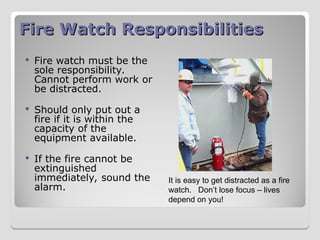
It is easy to get distracted as a fire
watch. Don’t lose focus – lives
depend on you!
11.
Authorizing Work
Authorizing Work
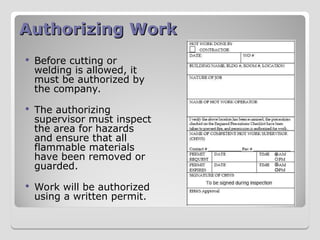
Before cutting or
welding is allowed, it
must be authorized by
the company.
The authorizing
supervisor must inspect
the area for hazards
and ensure that all
flammable materials
have been removed or
guarded.
Work will be authorized
using a written permit.
12.
Preparing An Areafor Welding
Preparing An Area for Welding
Move all combustibles
at least 35 feet from
the work site.
If the materials
cannot be relocated,
protect them with
flameproof covers, or
shield them with
metal or asbestos
guards or curtains.
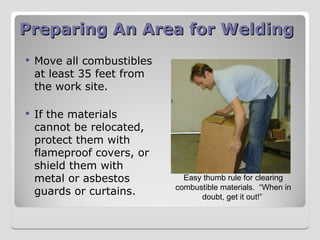
Easy thumb rule for clearing
combustible materials. “When in
doubt, get it out!”
13.
Preparing An Areafor Welding
Preparing An Area for Welding
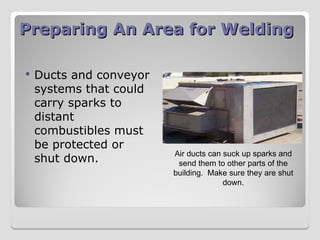
Ducts and conveyor
systems that could
carry sparks to
distant
combustibles must
be protected or
shut down.
Air ducts can suck up sparks and
send them to other parts of the
building. Make sure they are shut
down.
14.
Preparing an Areafor Welding
Preparing an Area for Welding
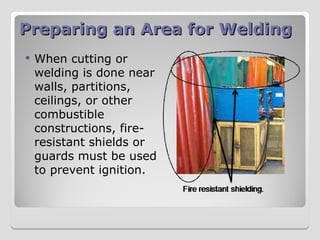
When cutting or
welding is done near
walls, partitions,
ceilings, or other
combustible
constructions, fire-
resistant shields or
guards must be used
to prevent ignition.
Preparing an Areafor Welding
Preparing an Area for Welding
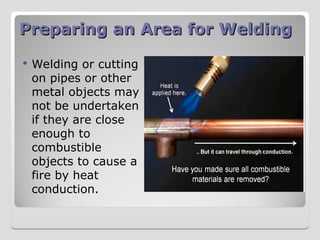
Welding or cutting
on pipes or other
metal objects may
not be undertaken
if they are close
enough to
combustible
objects to cause a
fire by heat
conduction.
17.
Management Responsibilities
Management Responsibilities
Management is responsible for the safe usage of cutting
and welding equipment on its property.
Designate an individual who is responsible for authorizing
welding and cutting that occurs outside of areas
designated for that process.
Designate areas for welding and cutting, and procedures
for welding and cutting outside of those areas.
Ensure all operators are trained on their equipment.
Advise all contractors of flammable materials or hazardous
conditions that they are not aware of.
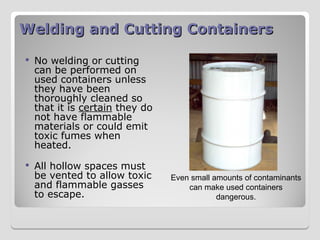
Welding and CuttingContainers
Welding and Cutting Containers
No welding or cutting
can be performed on
used containers unless
they have been
thoroughly cleaned so
that it is certain they do
not have flammable
materials or could emit
toxic fumes when
heated.
All hollow spaces must
be vented to allow toxic
and flammable gasses
to escape.
Even small amounts of contaminants
can make used containers
dangerous.
Welding at Heights
Weldingat Heights
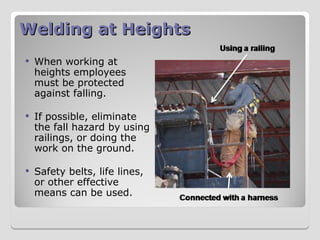
When working at
heights employees
must be protected
against falling.
If possible, eliminate
the fall hazard by using
railings, or doing the
work on the ground.
Safety belts, life lines,
or other effective
means can be used.
Eye Protection Requirements
EyeProtection Requirements
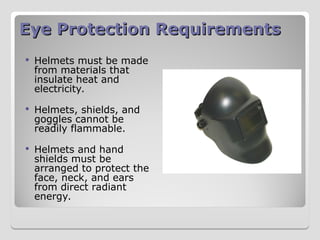
Helmets must be made
from materials that
insulate heat and
electricity.
Helmets, shields, and
goggles cannot be
readily flammable.
Helmets and hand
shields must be
arranged to protect the
face, neck, and ears
from direct radiant
energy.
28.
Eye Protection Requirements
EyeProtection Requirements
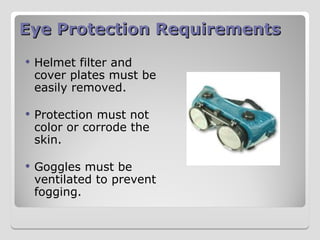
Helmet filter and
cover plates must be
easily removed.
Protection must not
color or corrode the
skin.
Goggles must be
ventilated to prevent
fogging.
29.
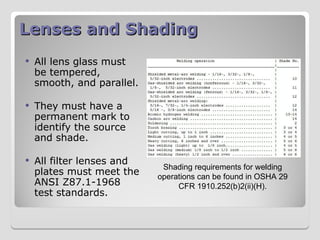
Lenses and Shading
Lensesand Shading
All lens glass must
be tempered,
smooth, and parallel.
They must have a
permanent mark to
identify the source
and shade.
All filter lenses and
plates must meet the
ANSI Z87.1-1968
test standards.
Shading requirements for welding
operations can be found in OSHA 29
CFR 1910.252(b)2(ii)(H).
30.
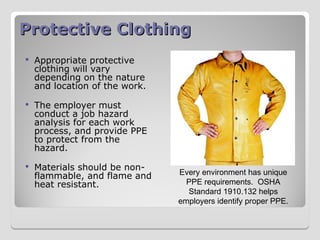
Protective Clothing
Protective Clothing
Appropriate protective
clothing will vary
depending on the nature
and location of the work.
The employer must
conduct a job hazard
analysis for each work
process, and provide PPE
to protect from the
hazard.
Materials should be non-
flammable, and flame and
heat resistant.
Every environment has unique
PPE requirements. OSHA
Standard 1910.132 helps
employers identify proper PPE.
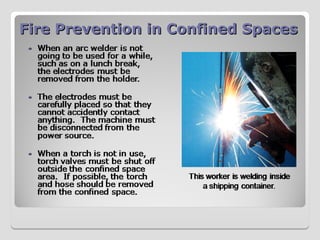
31.
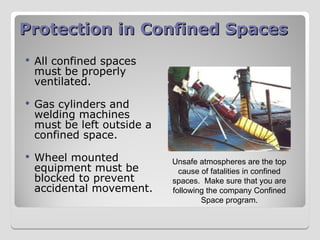
Protection in ConfinedSpaces
Protection in Confined Spaces
All confined spaces
must be properly
ventilated.
Gas cylinders and
welding machines
must be left outside a
confined space.
Wheel mounted
equipment must be
blocked to prevent
accidental movement.
Unsafe atmospheres are the top
cause of fatalities in confined
spaces. Make sure that you are
following the company Confined
Space program.
32.
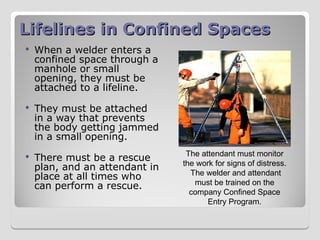
Lifelines in ConfinedSpaces
Lifelines in Confined Spaces
When a welder enters a
confined space through a
manhole or small
opening, they must be
attached to a lifeline.
They must be attached
in a way that prevents
the body getting jammed
in a small opening.
There must be a rescue
plan, and an attendant in
place at all times who
can perform a rescue.
The attendant must monitor
the work for signs of distress.
The welder and attendant
must be trained on the
company Confined Space
Entry Program.
Welding Screens
Welding Screens
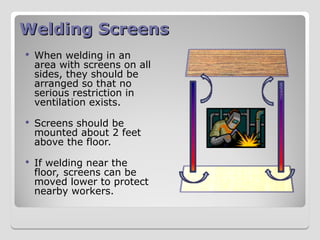
When welding in an
area with screens on all
sides, they should be
arranged so that no
serious restriction in
ventilation exists.
Screens should be
mounted about 2 feet
above the floor.
If welding near the
floor, screens can be
moved lower to protect
nearby workers.
35.
Maximum Allowable Concentrations
MaximumAllowable Concentrations
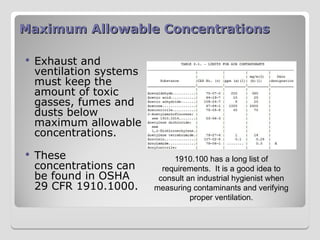
Exhaust and
ventilation systems
must keep the
amount of toxic
gasses, fumes and
dusts below
maximum allowable
concentrations.
These
concentrations can
be found in OSHA
29 CFR 1910.1000.
1910.100 has a long list of
requirements. It is a good idea to
consult an industrial hygienist when
measuring contaminants and verifying
proper ventilation.
36.
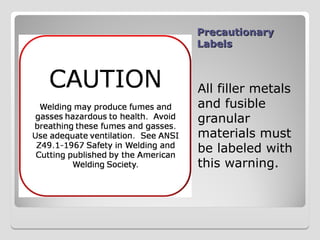
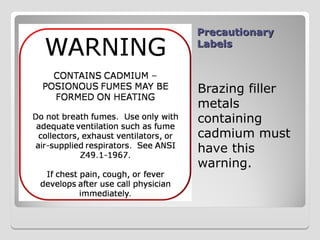
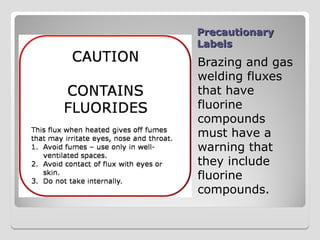
Precautionary Labels
Precautionary Labels
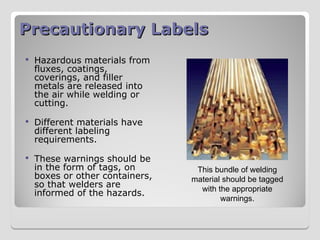
Hazardous materials from
fluxes, coatings,
coverings, and filler
metals are released into
the air while welding or
cutting.
Different materials have
different labeling
requirements.
These warnings should be
in the form of tags, on
boxes or other containers,
so that welders are
informed of the hazards.
This bundle of welding
material should be tagged
with the appropriate
warnings.
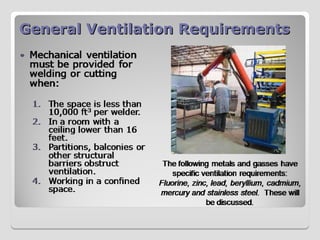
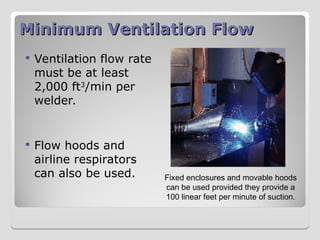
Minimum Ventilation Flow
MinimumVentilation Flow
Ventilation flow rate
must be at least
2,000 ft3
/min per
welder.
Flow hoods and
airline respirators
can also be used. Fixed enclosures and movable hoods
can be used provided they provide a
100 linear feet per minute of suction.
42.
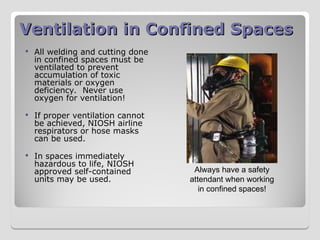
Ventilation in ConfinedSpaces
Ventilation in Confined Spaces
All welding and cutting done
in confined spaces must be
ventilated to prevent
accumulation of toxic
materials or oxygen
deficiency. Never use
oxygen for ventilation!
If proper ventilation cannot
be achieved, NIOSH airline
respirators or hose masks
can be used.
In spaces immediately
hazardous to life, NIOSH
approved self-contained
units may be used.
Always have a safety
attendant when working
in confined spaces!
43.
Special Requirements
Special Requirements
FluorineZinc
Requires local
exhaust or airline
respirators if the
fluorides exceed their
maximum allowable
concentration.
When working with
zinc indoors, local
exhaust hoods or
booths must be used.
44.
Special Requirements
Special Requirements
LeadBeryllium
Welding indoors must
be done with local
exhaust hoods or
booths.
When welding
outdoors, employees
must use a respirator
designed for lead
protection.
When welding with
beryllium, local
exhaust and airline
respirators must be
used.
45.
Special Requirements
Special Requirements
CadmiumMercury
In confined spaces or
indoors, must be
ventilated using
exhaust ventilation or
airline respirators.
Outdoors, welders
should use a NIOSH
approved respirator.
In confined spaces or
indoors, must be
ventilated using
exhaust ventilation or
airline respirators.
Outdoors welders
should use a NIOSH
approved respirator.
46.
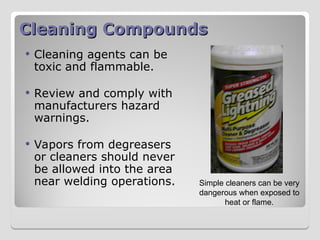
Cleaning Compounds
Cleaning Compounds
Cleaning agents can be
toxic and flammable.
Review and comply with
manufacturers hazard
warnings.
Vapors from degreasers
or cleaners should never
be allowed into the area
near welding operations. Simple cleaners can be very
dangerous when exposed to
heat or flame.
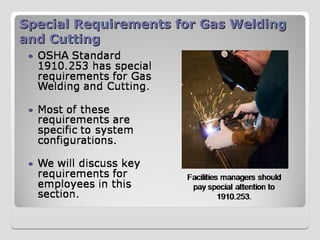
Special Requirements forGas Welding
Special Requirements for Gas Welding
and Cutting
and Cutting
49.
Equipment Responsibility
Equipment Responsibility
Employees in charge
of oxygen or fuel gas
supply equipment
must be trained and
judged competent by
the employer before
being placed in
charge of it.
The employer must
make rules for
operation and
maintenance of this
equipment available.
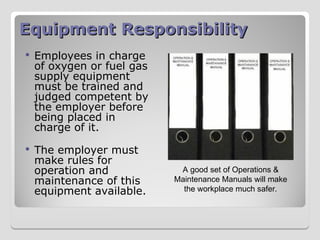
A good set of Operations &
Maintenance Manuals will make
the workplace much safer.
50.
Cylinder Markings
Cylinder Markings
Compressed gas
cylinders must be
labeled with the
chemical name.
The marking must
not be easily
removable.
If possible, the
marking should be
located on the
shoulder of the
cylinder.
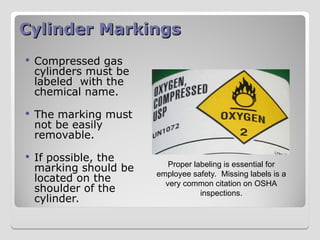
Proper labeling is essential for
employee safety. Missing labels is a
very common citation on OSHA
inspections.
Oxygen Cylinders
Oxygen Cylinders
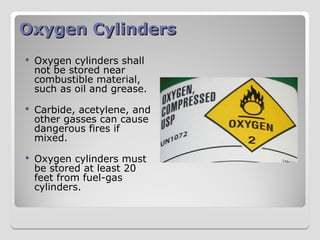
Oxygen cylinders shall
not be stored near
combustible material,
such as oil and grease.
Carbide, acetylene, and
other gasses can cause
dangerous fires if
mixed.
Oxygen cylinders must
be stored at least 20
feet from fuel-gas
cylinders.
53.
General Safe WorkPractices
General Safe Work Practices
Keep cylinders and associated equipment free
from dirt, grease, and oil.
Do not handle with oily hands or gloves.
Never mix fuels or gasses.
Don’t use tools to open stuck cylinder valves. If
it cannot be opened by hand, contact the
supplier.
Close cylinder valves when work is finished.
54.
General Safe WorkPractices
General Safe Work Practices
Safety devices should never be tampered with or
disabled.
Keep cylinders away from hot work.
Close valves before moving cylinders.
Cylinders must be transported in suitable containers
or devices.
Never drop a cylinder or allow it to be struck.
Do not place cylinders where they may become part
of an electric circuit or circuit grounding.
Equipment Requirements
Equipment Requirements
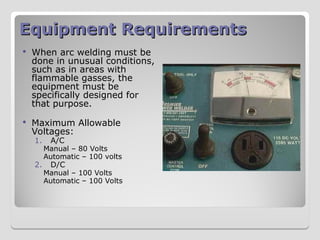
When arc welding must be
done in unusual conditions,
such as in areas with
flammable gasses, the
equipment must be
specifically designed for
that purpose.
Maximum Allowable
Voltages:
1. A/C
Manual – 80 Volts
Automatic – 100 volts
2. D/C
Manual – 100 Volts
Automatic – 100 Volts
Special Requirements forResistance
Special Requirements for Resistance
Welding
Welding
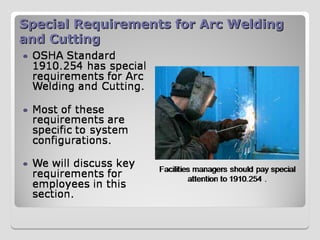
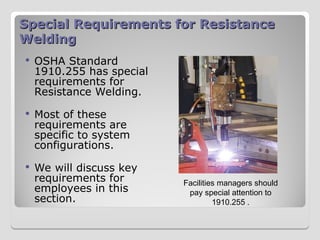
OSHA Standard
1910.255 has special
requirements for
Resistance Welding.
Most of these
requirements are
specific to system
configurations.
We will discuss key
requirements for
employees in this
section.
Facilities managers should
pay special attention to
1910.255 .
62.
Worker Requirements
Worker Requirements
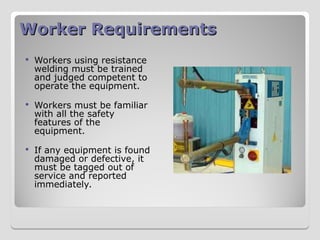
Workers using resistance
welding must be trained
and judged competent to
operate the equipment.
Workers must be familiar
with all the safety
features of the
equipment.
If any equipment is found
damaged or defective, it
must be tagged out of
service and reported
immediately.
63.
Resistance Welding Equipment
ResistanceWelding Equipment
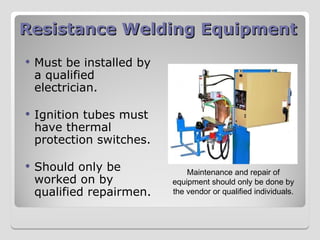
Must be installed by
a qualified
electrician.
Ignition tubes must
have thermal
protection switches.
Should only be
worked on by
qualified repairmen.
Maintenance and repair of
equipment should only be done by
the vendor or qualified individuals.
64.
Required Safety Devices
RequiredSafety Devices
Guards to prevent accidental
startup of equipment.
Interlocks to prevent access to
live parts of the equipment by
unauthorized persons.
Shielding to prevent sparks from
contacting flammable materials
and injuring employees.
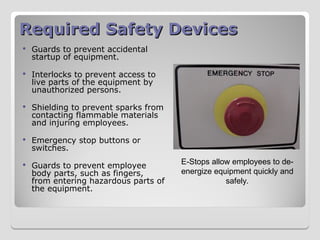
Emergency stop buttons or
switches.
Guards to prevent employee
body parts, such as fingers,
from entering hazardous parts of
the equipment.
E-Stops allow employees to de-
energize equipment quickly and
safely.
65.
Welding and CuttingSummary
Welding and Cutting Summary
Welding should be performed in designated welding
areas.
If not possible, welding may be performed at the
location provided all hazards are managed and the
supervisor approves.
Fire watches should be posted when there is a
potential for a large fire.
Adequate space or ventilation must be verified before
welding can commence.
PPE must be made available by the company to
protect employees from hazards.
#1 Note: Some slides contain copyright images. These slides have been “flattened” for that reason. Feel free to alter these slides by adding images over them, or copying the information on a new slide and adding your own images or text to replace them.
#4 Discussion Point: What areas in your company are not safe for welding and cutting?
#7 Note: There are different types of extinguishers for different types of hazards.
Discussion Points:
What fire extinguishers are used at your company?
Where are they located?
Who is in charge of inspecting and maintaining them?
Are they the correct type for the hazards presented?
#8 Discussion Point: What areas in your facility would require a fire watch when work is performed?
#10 Note: Companies have a tendency to assign fire watch to new and inexperienced employees. While the job may be tedious, it is important to have an experienced individual on fire watch, in case something goes wrong.
Discussion Points:
Who would make a good fire watch?
Should brand new employees be assigned fire watch duties? Why or why not?
#11
Discussion Point: Distribute a copy of your permits. Discuss how they are used.
#12 Discussion Point: What items at your company should be removed from a welding area?
#13 Discussion Point: What ventilation systems does this apply to?
#14 Discussion Points:
What shielding or guards are available for use?
Where should they be used?
#17 Discussion Point: What are some other key management responsibilities?
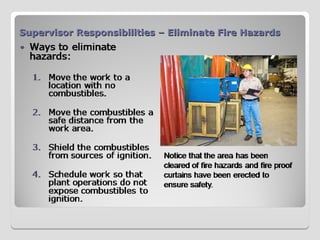
#19 Discussion Point: What other things can supervisors do to eliminate fire hazards?
#22 Note: Welding and cutting used containers should be avoided if possible.
Discussion Point: What are the hazards of welding and cutting on used containers?
#23 Note: Welding in confined spaces should only be performed in accordance with the company Confined Space plan.
#25 Discussion Point: What techniques and equipment does the company have to protect workers at heights?
Note: Work should always be performed on the ground if it is possible to do so.
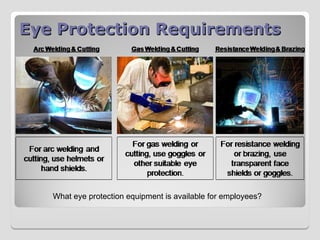
#26 Discussion Point: What eye protection is available for employees to use?
#30 Discussion Points:
What protective clothing is used at your company?
What applications are they used for?
#34 Note: When setting up screens and barriers, be mindful of how they affect ventilation.
#37 Discussion Points:
Do you have any of these materials?
Are they properly tagged?
#38 Discussion Points:
Do you have any of these materials?
Are they properly tagged?
#39 Discussion Points:
Do you have any of these materials?
Are they properly tagged?
#40 Discussion Points:
What areas do you have that would require ventilation while welding?
What ventilation do you have available?
#43 Discussion Points:
Do your employees work with these materials?
What equipment is available to mitigate the hazard?
#44 Discussion Points:
Do your employees work with these materials?
What equipment is available to mitigate the hazard?
#45 Discussion Points:
Do your employees work with these materials?
What equipment is available to mitigate the hazard?
#46 Discussion Points:
What cleaning compounds are commonly used at your facility?
Should they be allowed in welding areas?
#49 Discussion Points:
Who is in charge of your equipment?
Where are the rules and procedures for this equipment?
#54 Discussion Point:
What other safe work practices should be used at your facility?
#64 Discussion Point:
What safety devices are installed on your equipment?