Aim

To create overall
 awareness about
  Grinder safety
Description

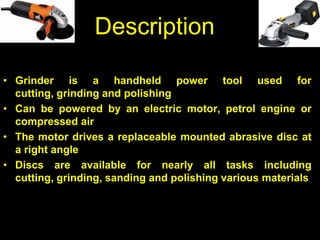
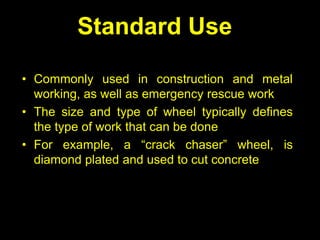
• Grinder is a handheld power tool used for
  cutting, grinding and polishing
• Can be powered by an electric motor, petrol engine or
  compressed air
• The motor drives a replaceable mounted abrasive disc at
  a right angle
• Discs are available for nearly all tasks including
  cutting, grinding, sanding and polishing various materials
Standard Use

• Commonly used in construction and metal
  working, as well as emergency rescue work
• The size and type of wheel typically defines
  the type of work that can be done
• For example, a “crack chaser” wheel, is
  diamond plated and used to cut concrete
Work Hazards
When operating, the cutting or grinding disc may come into
contact with a body part, or shatter and throw off pieces at
extremely high speed

 • Typical hazards include
    – Sparks and excess material projectiles that result
      from normal use
    – Bad discs shredding and flying off at extremely
      high speeds
    – Discs binding and causing the tool to jerk
      violently, which may result in broken bones
      and/or dislocations
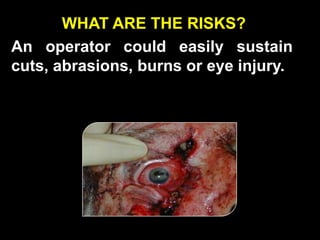
WHAT ARE THE RISKS?
An operator could easily sustain
cuts, abrasions, burns or eye injury.
Fatality Statistics USA
• There were 7 total angle grinder related
  deaths that were investigated by OSHA
  for last three year
• 3 were a result of electric shock
• 2 were a result of kick back
• 2 were a result of disintegrating discs


Extracted from OSHA Accident Investigation Data
Case Study
The worker was trying to open a man hole steel cover that is located at
the accident site, As they did not have the right tool to open the steel
cover, they tried opening it with other tools but failed to open it and also
damaged the slot used to insert the actual tool to open it, the worker
finally decided to cut the manhole steel cover using a hand grinder.
They initially tried cutting it with the normal 6 inch disc but it did not
work, so finally the worker decided to try and use a 12 inch disc . Which
could not fit into the hand grinder as the protective guard only allows
the right size disc to be fitted on it, he decided to remove the guard to
allow a 12 inch disc to be fitted onto the hand grinder and started
cutting the manhole steel cover which approximately has a thickness of
0.5 to 1cm. He managed to cut through to a length 3/4 of the cover's
diameter, all of a sudden most probably, due to long duration and
extreme force applied or the quality and durability of the disc that was
being used cracked and struck his face and threw him to the ground.
A portion of the broken disc was lodged on his right temple till his right
chin killing him 15 minutes after its occurrence
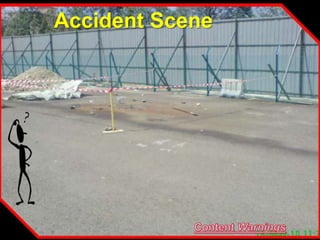
Accident Scene
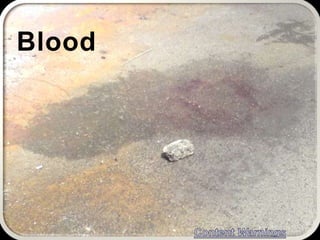
Blood
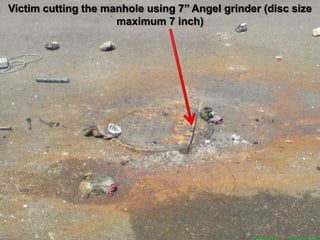
Victim cutting the manhole using 7’’ Angel grinder (disc size
                     maximum 7 inch)
A portion
               lodged on
the victim right temple
   till his right chin
ACCIDENTS
 don’t just happen…

“THEY ARE CAUSED!!!”
Safety Best Practices
• Before use, consult manufactures guidelines
• Inspect the guard before each use
• Never use the grinder above chest height
• Only use wheels that meet the size and rpm rating of the
  grinder (Revolutions per minute use to measure the
  frequency of a rotation)
• Replace disc when wear is obvious or if there is a chip
• Stop use immediately if vibration is apparent
• Stand perpendicular to the plane of the cutting wheel
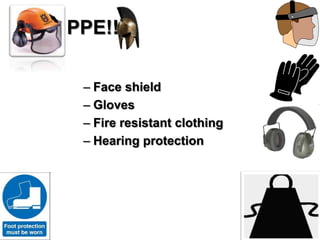
PPE!!

 – Face shield
 – Gloves
 – Fire resistant clothing
 – Hearing protection
Precautions:

• Grinders must only be used by workers who are competent in
the use of the power tool.
• Grinder operators must always wear goggles, face shield and
hearing protection (noise levels from grinders can be as high
as 110 db)
• Ensure the grinding/cutting tool has the correct guard in
place.
• Ensure the work piece is secure so that it can’t move during
the task.
• Be gentle – let the tool do the job – don’t apply excessive
pressure
Inspect the equipment:
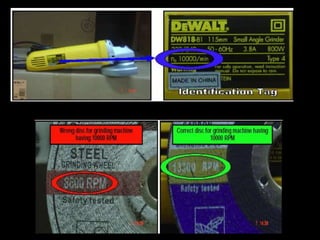
• The RPM of the machine must not exceed the RPM of the
wheel/disc (there are hundreds of different types of wheels and
discs – make sure the correct one is used for the task)
• Never use a cutting-off wheel for grinding – the sideways
force will break the disc.
• Don’t use a damaged disk or wheel – watch for cracks or
chips.
• Prevent discs and wheels from being damaged during
transporting
• Store wheels and discs in dry, cool conditions.
• Clear others from the work area to prevent injury from
projectiles from the work or from a failed wheel or disc .
• Check electrical cord for fraying or damage, keep the cords
away from the rotating disc or wheel
A grinder safety checklist!
Before starting
1. Is the grinder outer body free of visible defects, missing parts or
    damage?
2. Is the power cord/plug or air hose free of visible damage?
3. Is the power supply (electric or pneumatic) compatible with the
    requirements of the grinder?
4. Are guards and handles in place and secure?
5. Does the guard cover a minimum of 50 percent of the abrasive
    wheel circumference between the wheel and the user?
6. Is the grinder equipped with a functioning automatic cut off or "dead
    man" switch?
7. Is the abrasive wheel rated for the maximum possible speed (RPM)
    of the grinder?
8. Is the abrasive wheel free of visible damage?
9. Does the abrasive wheel fit snuggly around the grinder spindle?
10. Is the abrasive wheel attached to the grinder spindle with the correct
    flanges, backing plate and locking nut?
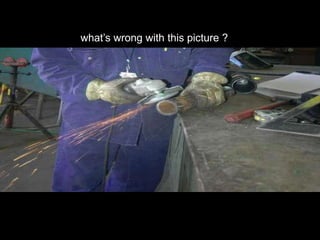
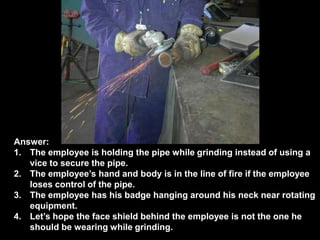
what’s wrong with this picture ?
Answer:
1. The employee is holding the pipe while grinding instead of using a
   vice to secure the pipe.
2. The employee’s hand and body is in the line of fire if the employee
   loses control of the pipe.
3. The employee has his badge hanging around his neck near rotating
   equipment.
4. Let’s hope the face shield behind the employee is not the one he
   should be wearing while grinding.
Worker must know
how to work safely in order to
    protect themselves.
Think Safety

               Work Safely

Develop by:
Ammar Hassan

Work safe with grinder

  • 2.
    Aim To create overall awareness about Grinder safety
  • 3.
    Description • Grinder isa handheld power tool used for cutting, grinding and polishing • Can be powered by an electric motor, petrol engine or compressed air • The motor drives a replaceable mounted abrasive disc at a right angle • Discs are available for nearly all tasks including cutting, grinding, sanding and polishing various materials
  • 4.
    Standard Use • Commonlyused in construction and metal working, as well as emergency rescue work • The size and type of wheel typically defines the type of work that can be done • For example, a “crack chaser” wheel, is diamond plated and used to cut concrete
  • 5.
    Work Hazards When operating,the cutting or grinding disc may come into contact with a body part, or shatter and throw off pieces at extremely high speed • Typical hazards include – Sparks and excess material projectiles that result from normal use – Bad discs shredding and flying off at extremely high speeds – Discs binding and causing the tool to jerk violently, which may result in broken bones and/or dislocations
  • 6.
    WHAT ARE THERISKS? An operator could easily sustain cuts, abrasions, burns or eye injury.
  • 7.
    Fatality Statistics USA •There were 7 total angle grinder related deaths that were investigated by OSHA for last three year • 3 were a result of electric shock • 2 were a result of kick back • 2 were a result of disintegrating discs Extracted from OSHA Accident Investigation Data
  • 8.
    Case Study The workerwas trying to open a man hole steel cover that is located at the accident site, As they did not have the right tool to open the steel cover, they tried opening it with other tools but failed to open it and also damaged the slot used to insert the actual tool to open it, the worker finally decided to cut the manhole steel cover using a hand grinder. They initially tried cutting it with the normal 6 inch disc but it did not work, so finally the worker decided to try and use a 12 inch disc . Which could not fit into the hand grinder as the protective guard only allows the right size disc to be fitted on it, he decided to remove the guard to allow a 12 inch disc to be fitted onto the hand grinder and started cutting the manhole steel cover which approximately has a thickness of 0.5 to 1cm. He managed to cut through to a length 3/4 of the cover's diameter, all of a sudden most probably, due to long duration and extreme force applied or the quality and durability of the disc that was being used cracked and struck his face and threw him to the ground. A portion of the broken disc was lodged on his right temple till his right chin killing him 15 minutes after its occurrence
  • 9.
  • 10.
  • 12.
    Victim cutting themanhole using 7’’ Angel grinder (disc size maximum 7 inch)
  • 13.
    A portion lodged on the victim right temple till his right chin
  • 15.
    ACCIDENTS don’t justhappen… “THEY ARE CAUSED!!!”
  • 16.
    Safety Best Practices •Before use, consult manufactures guidelines • Inspect the guard before each use • Never use the grinder above chest height • Only use wheels that meet the size and rpm rating of the grinder (Revolutions per minute use to measure the frequency of a rotation) • Replace disc when wear is obvious or if there is a chip • Stop use immediately if vibration is apparent • Stand perpendicular to the plane of the cutting wheel
  • 17.
    PPE!! – Faceshield – Gloves – Fire resistant clothing – Hearing protection
  • 18.
    Precautions: • Grinders mustonly be used by workers who are competent in the use of the power tool. • Grinder operators must always wear goggles, face shield and hearing protection (noise levels from grinders can be as high as 110 db) • Ensure the grinding/cutting tool has the correct guard in place. • Ensure the work piece is secure so that it can’t move during the task. • Be gentle – let the tool do the job – don’t apply excessive pressure
  • 19.
    Inspect the equipment: •The RPM of the machine must not exceed the RPM of the wheel/disc (there are hundreds of different types of wheels and discs – make sure the correct one is used for the task) • Never use a cutting-off wheel for grinding – the sideways force will break the disc. • Don’t use a damaged disk or wheel – watch for cracks or chips. • Prevent discs and wheels from being damaged during transporting • Store wheels and discs in dry, cool conditions. • Clear others from the work area to prevent injury from projectiles from the work or from a failed wheel or disc . • Check electrical cord for fraying or damage, keep the cords away from the rotating disc or wheel
  • 21.
    A grinder safetychecklist! Before starting 1. Is the grinder outer body free of visible defects, missing parts or damage? 2. Is the power cord/plug or air hose free of visible damage? 3. Is the power supply (electric or pneumatic) compatible with the requirements of the grinder? 4. Are guards and handles in place and secure? 5. Does the guard cover a minimum of 50 percent of the abrasive wheel circumference between the wheel and the user? 6. Is the grinder equipped with a functioning automatic cut off or "dead man" switch? 7. Is the abrasive wheel rated for the maximum possible speed (RPM) of the grinder? 8. Is the abrasive wheel free of visible damage? 9. Does the abrasive wheel fit snuggly around the grinder spindle? 10. Is the abrasive wheel attached to the grinder spindle with the correct flanges, backing plate and locking nut?
  • 23.
    what’s wrong withthis picture ?
  • 24.
    Answer: 1. The employeeis holding the pipe while grinding instead of using a vice to secure the pipe. 2. The employee’s hand and body is in the line of fire if the employee loses control of the pipe. 3. The employee has his badge hanging around his neck near rotating equipment. 4. Let’s hope the face shield behind the employee is not the one he should be wearing while grinding.
  • 25.
    Worker must know howto work safely in order to protect themselves.
  • 26.
    Think Safety Work Safely Develop by: Ammar Hassan