Repetitive Stress Injuries
Prevention & Management
Dr. Debadutta Mishra
Rehabilitation Consultant
Jindal Steel & Power Ltd.
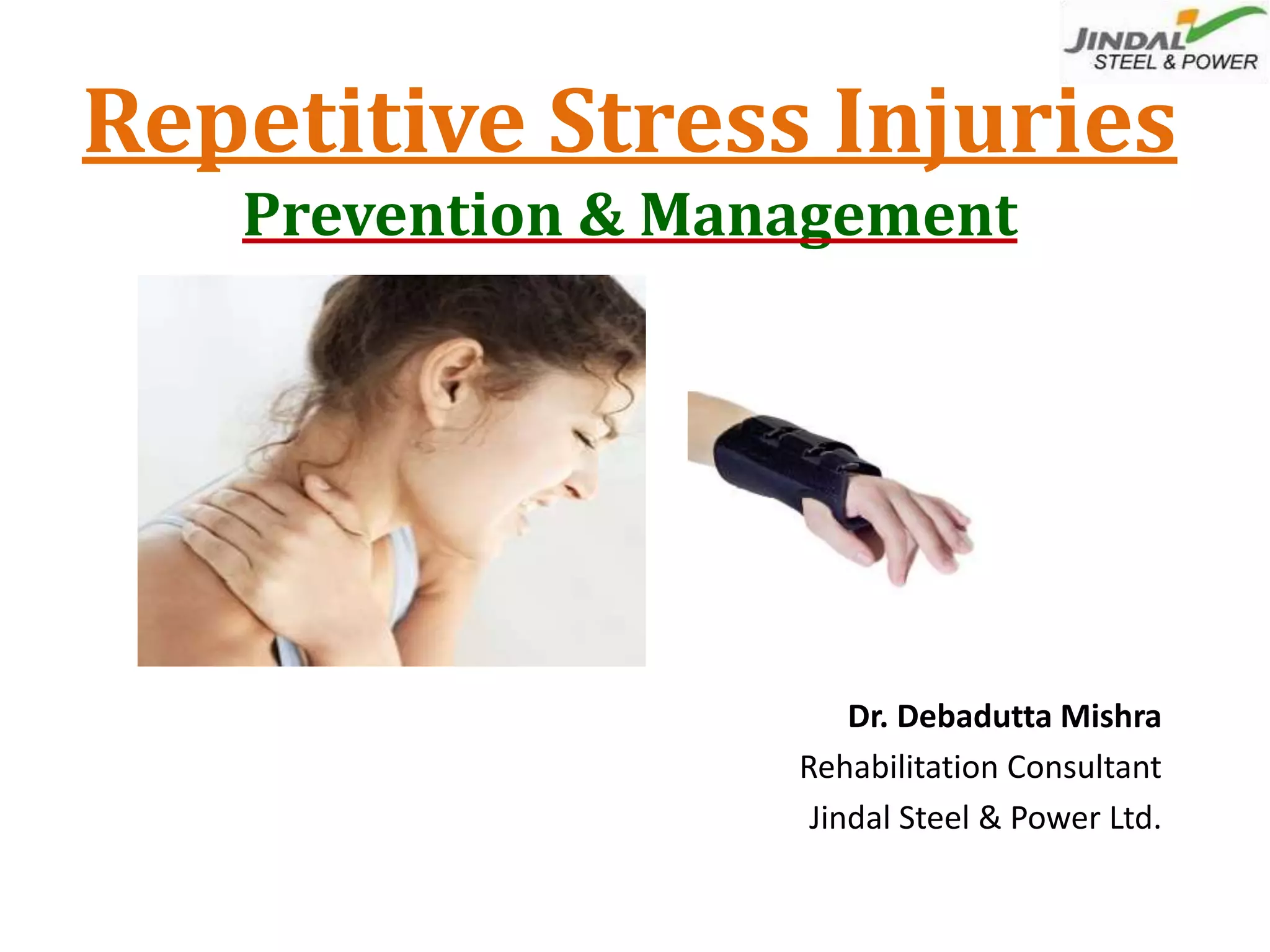
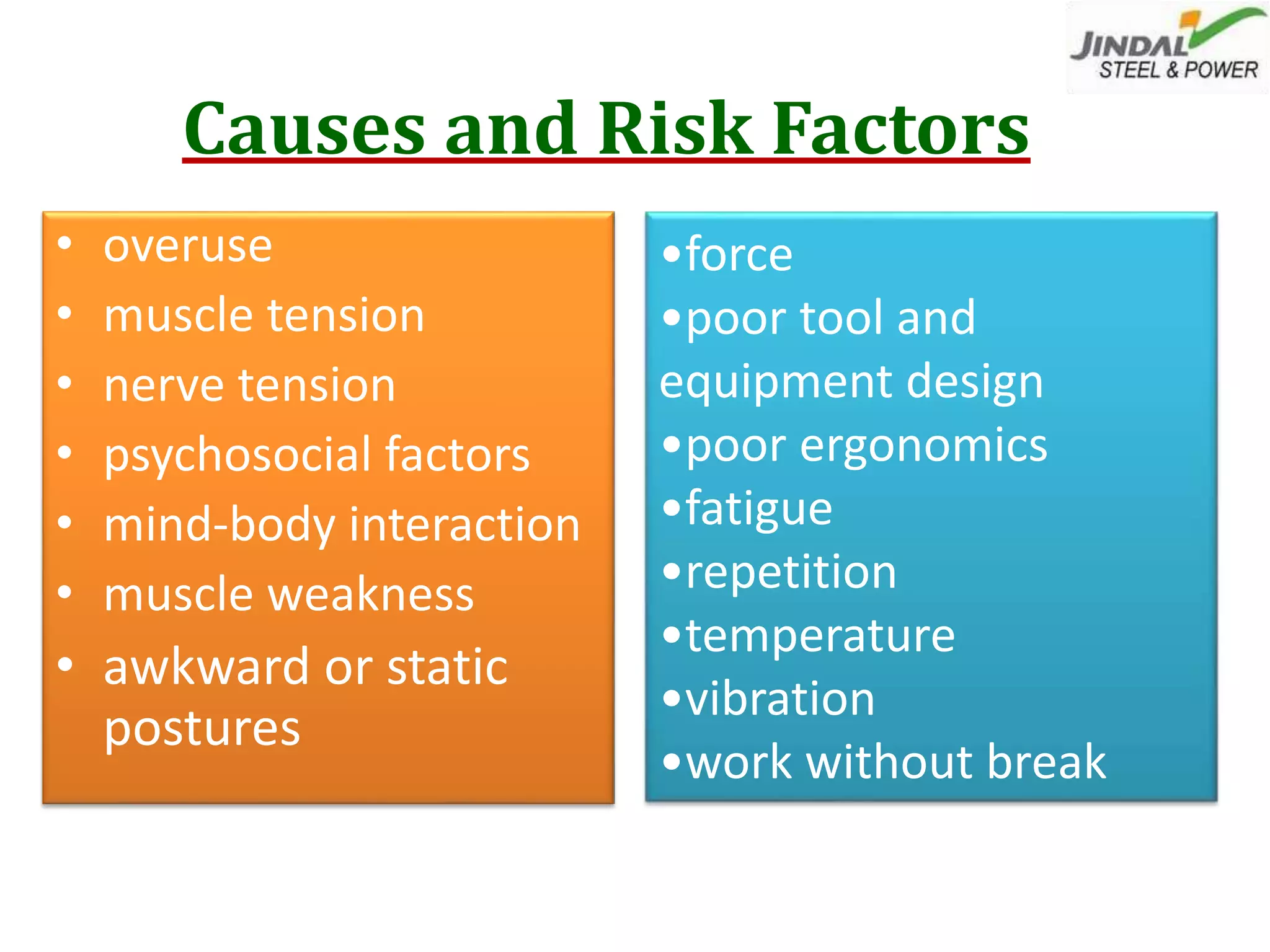
• Repetitive stress injuries (RSI) or Cumulative Trauma Disorder
(CTD) is a catch-all terms used to refer to many painful
conditions, such as trigger finger, nerve spasms, and carpal
tunnel syndrome. They can cause stiffness, swelling, tingling,
weakness, numbness and, in some cases, irreversible nerve
damage, resulting in a disabling condition or a limitation in
working capacity.
Definition
• overuse
• muscle tension
• nerve tension
• psychosocial factors
• mind-body interaction
• muscle weakness
• awkward or static
postures
•force
•poor tool and
equipment design
•poor ergonomics
•fatigue
•repetition
•temperature
•vibration
•work without break
Causes and Risk Factors
Workers in many jobs are at risk for repetitive strain injuries (RSI).
An RSI is an injury or disorder that occurs over time as a result of
repetitive, forceful or awkward body movements. This results in –
• Early fatigue
•Loss of concentration
•Lowering of efficiency and endurance
•Medical complication
•Increased medical bills and medical leaves
•Loss of work hours everyday during rehabilitation phase
And ultimately loss of Productivity
Effects on Human Occupation
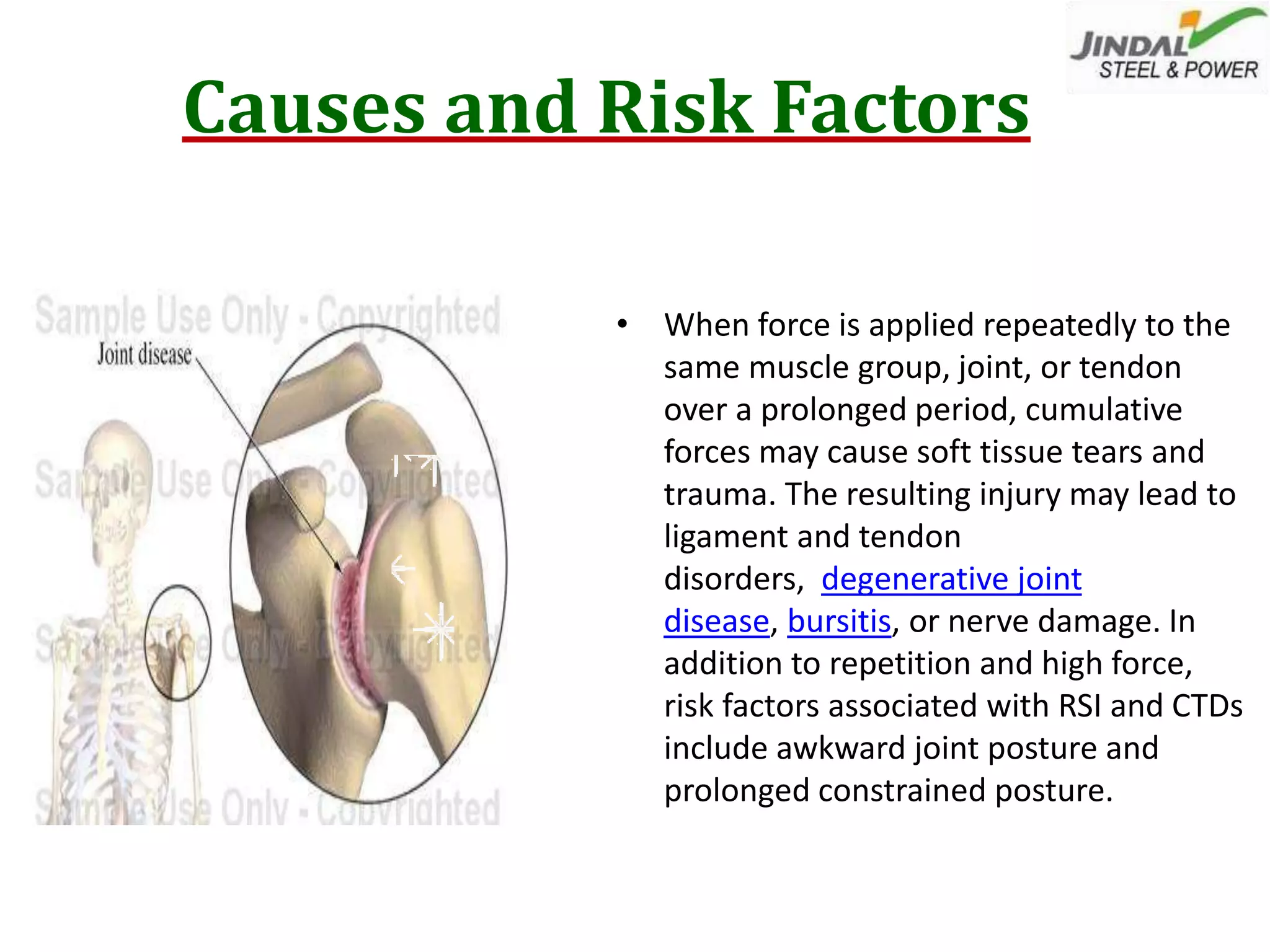
• When force is applied repeatedly to the
same muscle group, joint, or tendon
over a prolonged period, cumulative
forces may cause soft tissue tears and
trauma. The resulting injury may lead to
ligament and tendon
disorders, degenerative joint
disease, bursitis, or nerve damage. In
addition to repetition and high force,
risk factors associated with RSI and CTDs
include awkward joint posture and
prolonged constrained posture.
Causes and Risk Factors
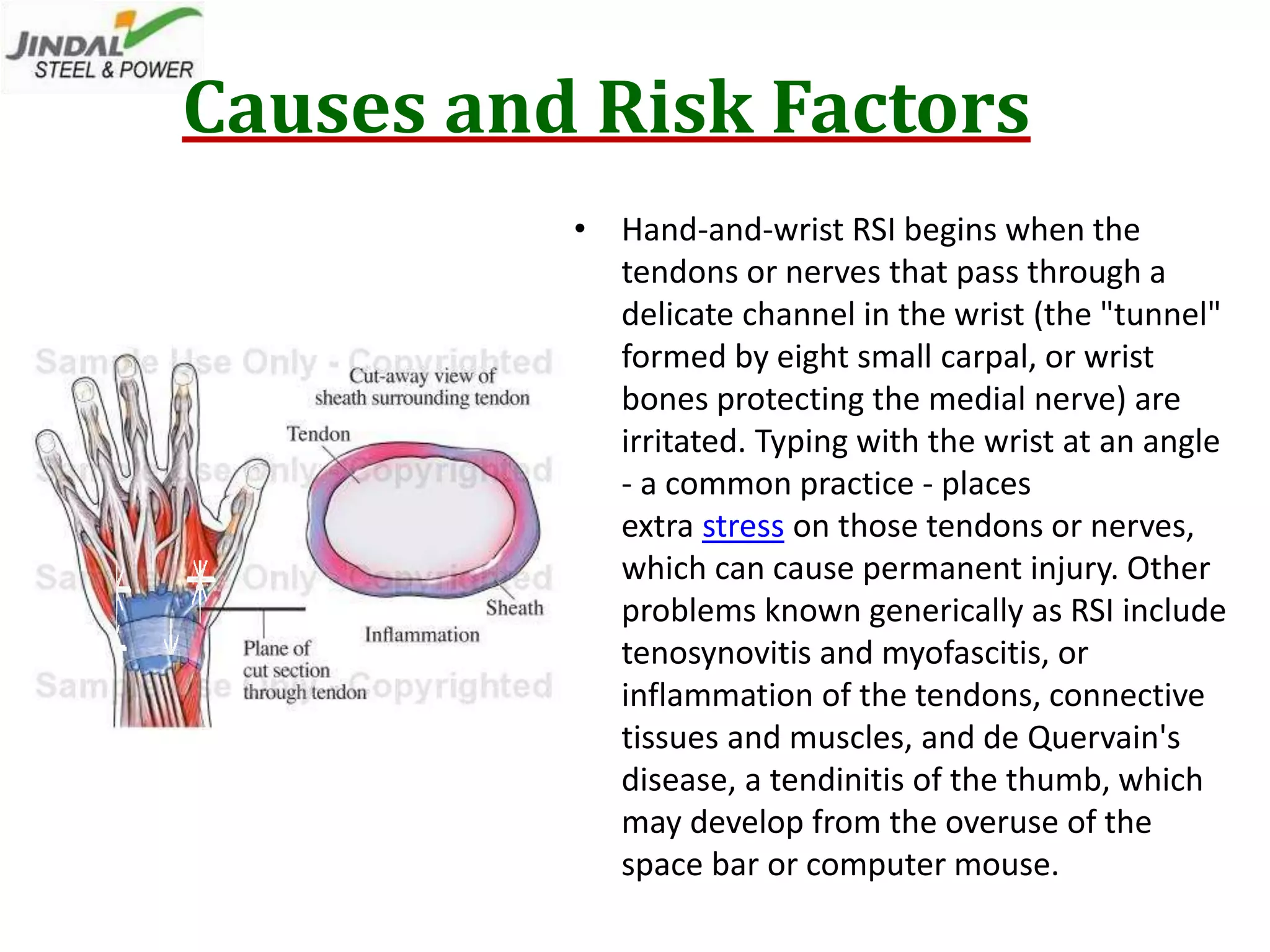
• Hand-and-wrist RSI begins when the
tendons or nerves that pass through a
delicate channel in the wrist (the "tunnel"
formed by eight small carpal, or wrist
bones protecting the medial nerve) are
irritated. Typing with the wrist at an angle
- a common practice - places
extra stress on those tendons or nerves,
which can cause permanent injury. Other
problems known generically as RSI include
tenosynovitis and myofascitis, or
inflammation of the tendons, connective
tissues and muscles, and de Quervain's
disease, a tendinitis of the thumb, which
may develop from the overuse of the
space bar or computer mouse.
Causes and Risk Factors
• Typical early symptoms include
numbness, or tingling or burning
sensations, in the fingers, hands or
forearms which can become crippling.
Victims of full-blown RSI cannot wash
their hair or even hold a sheet of paper
without agonizing pain. Some of the
very severely afflicted never recover.
Symptoms of RSI
• Pains in the wrists and hands as well as
numbness in the fingers are the
symptoms of Carpal Tunnel Syndrome.
They are also the symptoms for a
number of other repetitive stress
injuries. The numbness in Carpal
Tunnel Syndrome is localized to the
thumb and first two fingers.
• Carpal Tunnel Syndrome often
weakens your thumb and therefore
your grip.
• Pain and numbness are also more
prevalent during the night.
Carpal Tunnel Syndrome
• Tendonitis, also spelled Tendinitis, is an
inflammation or irritation of a tendon.
Chronic strain, overuse or misuse of a
tendon leading to a repetitive stress
injury, or a serious acute injury can lead
to a weakness, tear or swelling of the
tendon tissue resulting in pain and
stiffness near the tendon.
Tendonitis
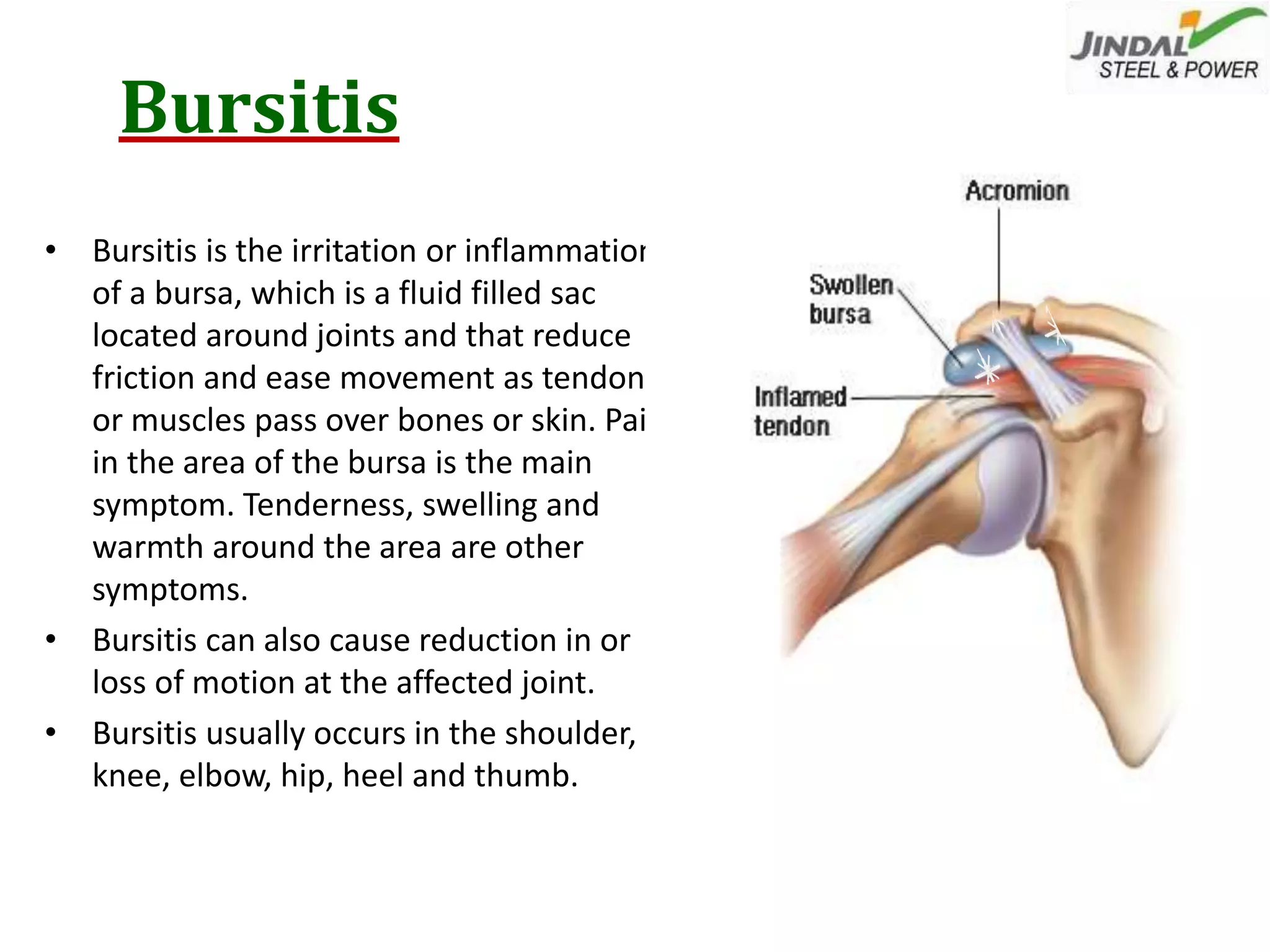
• Bursitis is the irritation or inflammation
of a bursa, which is a fluid filled sac
located around joints and that reduce
friction and ease movement as tendons
or muscles pass over bones or skin. Pain
in the area of the bursa is the main
symptom. Tenderness, swelling and
warmth around the area are other
symptoms.
• Bursitis can also cause reduction in or
loss of motion at the affected joint.
• Bursitis usually occurs in the shoulder,
knee, elbow, hip, heel and thumb.
Bursitis
• Tennis elbow occurs when there is a problem
with the tendons that attach to the outside of
the elbow. These tendons are the attachment
of the muscles that function to cock the wrist
back. Patients with tennis elbow experience
pain on the outside of the elbow that is
worsened by grasping objects and cocking
back the wrist. Also called epicondylitis…
• The most common symptoms of tennis elbow
are:
– Pain over the outside of the elbow
– Pain when lifting objects
– Pain radiating down the forearm
Tennis Elbow
• A common complaint that causes pain and locking of the fingers. The tendons
are like ropes that attach to the ends of your fingers. When your muscle
contracts, the flexor tendons pull the fingers into a fist. The tendons run part
of their course through a sheath called the flexor tendon sheath. When a
patient has the trigger finger condition, this mechanism of movement is
inhibited.
Trigger Finger
BlackBerry Thumb generated quite a media
buzz over the last few years. Dr. Greaney
explained that the human body can withstand
a finite amount of use. Overuse injuries, such
as RSI, occur because of insufficient recovery
time between demands, such as frequent use
of the thumb on a PDA or BlackBerry. “These
types of injuries occur when mechanical
fatigue in tendons and ligaments cause small
tears in the connective tissue “This condition
is worsened by the fact that the connective
tissue has not repaired itself, yet continues to
be placed under stress. The cumulative effect
of stress on the region causes the mechanical
or chemical activation of pain receptors,
resulting in pain and dysfunction.”
Black Berry Thumb
First there was Blackberry thumb, the
repetitive strain injury resulting from too
much typing on mobile devices. Now
bloggers and media outlets are buzzing
over the latest new epidemic to start
worrying about: text neck.
The average human head weighs 4.5kg to
5.5kg, and the neck and shoulders are not
made to support its weight for long
stretches, say experts. Children are
especially at risk because their heads are
larger in relation to their body size than
adults. "The condition, which can result in
headaches and shoulder, arm, and wrist
pain, most often afflicts tall, young women
with slender necks," noted blogger The
Frisky.
Black Berry Thumb/ Text Neck
• Vibration White Finger is a repetitive stress
injury where the small blood vessels in the
fingers periodically spasm. The spams cause
constriction of the blood supply to the fingertips
turning the fingers white. Soon after, the
available oxygen in the blood is used up and the
fingers turn blue. Once the spasms subside the
fingers turn red as oxygenated blood returns to
the finger tips.
Vibration White Finger
• Produces widespread pain, disturbed sleep, and
exhaustion from head to toe.
• Regional muscle pain also occurs in the majority
of people with fibromyalgia.
• Patients experience firm knots in their muscles,
often causing restricted movement and
radiating pain.
Key Symptoms
Pain all over
Fatigue
Brain fog
Trouble sleeping
Exercise difficulties
Irritable bowel
Headaches
Jaw pain
Multiple sensitivities
Fibromyalgia
• pain, tingling, sensory deficits or loss of function
• loss of strength or loss of mobility in the arms, legs or trunk
• loss of balance or other problems with walking and general mobility
skills
• speech or memory difficulties following a stroke or other medical
problem
• difficulty with dressing, bathing, cooking or other activities of daily
living
• problem returning back to work after a work-related injury
• recovery from an accident or sports related injury
Fibromyalgia… Contd..
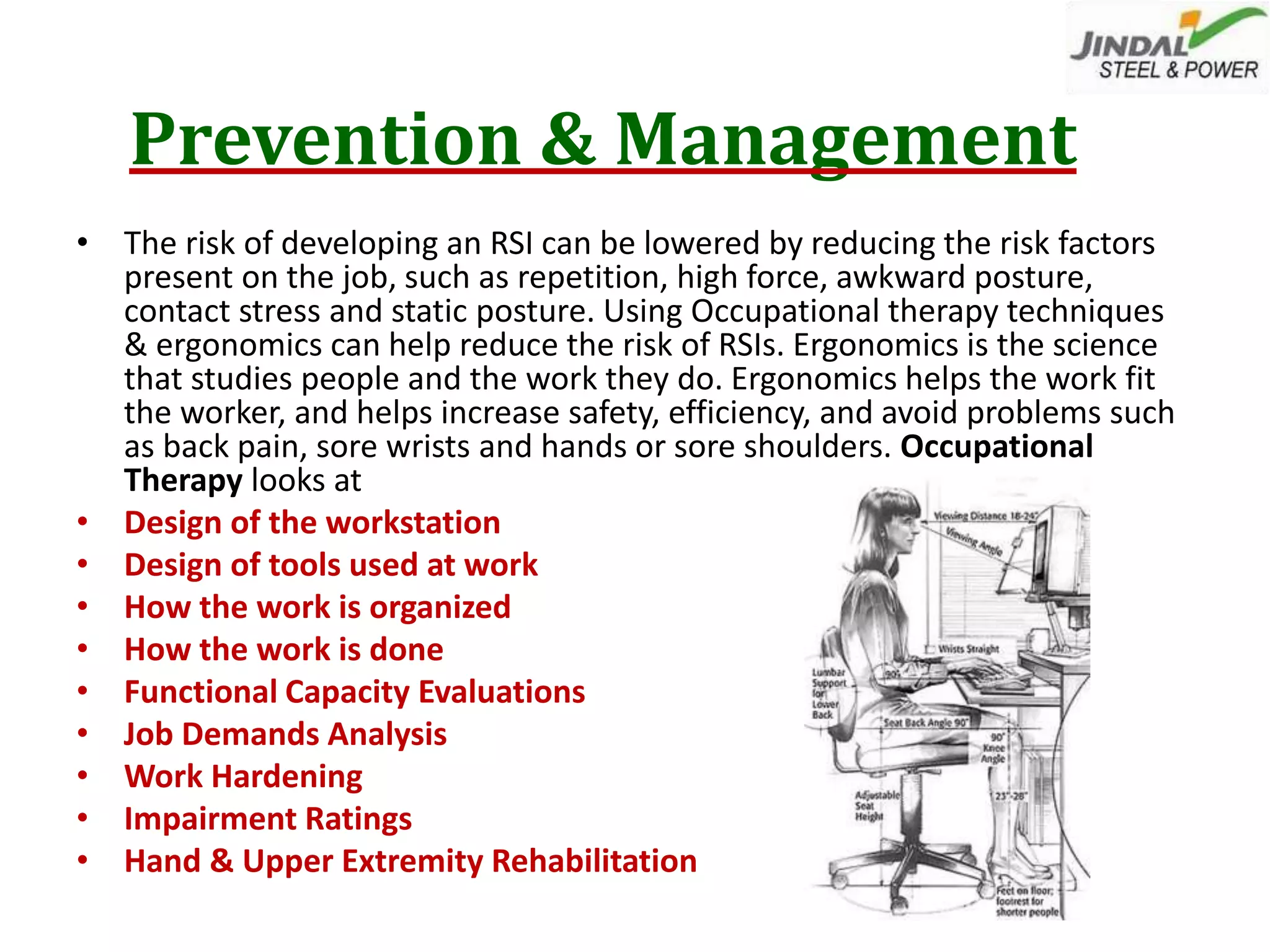
• The risk of developing an RSI can be lowered by reducing the risk factors
present on the job, such as repetition, high force, awkward posture,
contact stress and static posture. Using Occupational therapy techniques
& ergonomics can help reduce the risk of RSIs. Ergonomics is the science
that studies people and the work they do. Ergonomics helps the work fit
the worker, and helps increase safety, efficiency, and avoid problems such
as back pain, sore wrists and hands or sore shoulders. Occupational
Therapy looks at
• Design of the workstation
• Design of tools used at work
• How the work is organized
• How the work is done
• Functional Capacity Evaluations
• Job Demands Analysis
• Work Hardening
• Impairment Ratings
• Hand & Upper Extremity Rehabilitation
Prevention & Management
• Functional Capacity Evaluations
Valid, Reliable, Safe
Whole Body, Upper Extremity Specific, Job Specific, Focused
Test Approach
One or two day evaluations.
Work Hardening—Highly structured program designed to
maximize the client’s ability to return to work. Injury
prevention education is integrated into this program.
• Job Analysis - We can provide on-site, in-depth, Job Analysis
that can help you eliminate uncertainty . Our assessments
can be used to match the worker to a job that he can
perform safely when making return to work decisions, or to
determine critical job demand limits for use with Pre-Work
Screening of potential employees.
• Impairment Ratings are based on the AMA Guides for
Evaluating Permanent Impairment, 5th Edition. An FCE can
also be done for additional Information in making
impairment decisions.
Contd..
• Occupational therapists can
help patients with these
disorders practice "joint
protection." Patients can learn
to use their hands in non-
deforming positions.
• RSI may be avoidable through
proper work habits - including
posture, wrist position and
regular work breaks - as well as
ergonomically designed
workstations and keyboards.
Contd..
Thank You…

Repetitive stress injuries, prevention & management

  • 1.
    Repetitive Stress Injuries Prevention& Management Dr. Debadutta Mishra Rehabilitation Consultant Jindal Steel & Power Ltd.
  • 2.
    • Repetitive stressinjuries (RSI) or Cumulative Trauma Disorder (CTD) is a catch-all terms used to refer to many painful conditions, such as trigger finger, nerve spasms, and carpal tunnel syndrome. They can cause stiffness, swelling, tingling, weakness, numbness and, in some cases, irreversible nerve damage, resulting in a disabling condition or a limitation in working capacity. Definition
  • 3.
    • overuse • muscletension • nerve tension • psychosocial factors • mind-body interaction • muscle weakness • awkward or static postures •force •poor tool and equipment design •poor ergonomics •fatigue •repetition •temperature •vibration •work without break Causes and Risk Factors
  • 4.
    Workers in manyjobs are at risk for repetitive strain injuries (RSI). An RSI is an injury or disorder that occurs over time as a result of repetitive, forceful or awkward body movements. This results in – • Early fatigue •Loss of concentration •Lowering of efficiency and endurance •Medical complication •Increased medical bills and medical leaves •Loss of work hours everyday during rehabilitation phase And ultimately loss of Productivity Effects on Human Occupation
  • 5.
    • When forceis applied repeatedly to the same muscle group, joint, or tendon over a prolonged period, cumulative forces may cause soft tissue tears and trauma. The resulting injury may lead to ligament and tendon disorders, degenerative joint disease, bursitis, or nerve damage. In addition to repetition and high force, risk factors associated with RSI and CTDs include awkward joint posture and prolonged constrained posture. Causes and Risk Factors
  • 6.
    • Hand-and-wrist RSIbegins when the tendons or nerves that pass through a delicate channel in the wrist (the "tunnel" formed by eight small carpal, or wrist bones protecting the medial nerve) are irritated. Typing with the wrist at an angle - a common practice - places extra stress on those tendons or nerves, which can cause permanent injury. Other problems known generically as RSI include tenosynovitis and myofascitis, or inflammation of the tendons, connective tissues and muscles, and de Quervain's disease, a tendinitis of the thumb, which may develop from the overuse of the space bar or computer mouse. Causes and Risk Factors
  • 7.
    • Typical earlysymptoms include numbness, or tingling or burning sensations, in the fingers, hands or forearms which can become crippling. Victims of full-blown RSI cannot wash their hair or even hold a sheet of paper without agonizing pain. Some of the very severely afflicted never recover. Symptoms of RSI
  • 8.
    • Pains inthe wrists and hands as well as numbness in the fingers are the symptoms of Carpal Tunnel Syndrome. They are also the symptoms for a number of other repetitive stress injuries. The numbness in Carpal Tunnel Syndrome is localized to the thumb and first two fingers. • Carpal Tunnel Syndrome often weakens your thumb and therefore your grip. • Pain and numbness are also more prevalent during the night. Carpal Tunnel Syndrome
  • 9.
    • Tendonitis, alsospelled Tendinitis, is an inflammation or irritation of a tendon. Chronic strain, overuse or misuse of a tendon leading to a repetitive stress injury, or a serious acute injury can lead to a weakness, tear or swelling of the tendon tissue resulting in pain and stiffness near the tendon. Tendonitis
  • 10.
    • Bursitis isthe irritation or inflammation of a bursa, which is a fluid filled sac located around joints and that reduce friction and ease movement as tendons or muscles pass over bones or skin. Pain in the area of the bursa is the main symptom. Tenderness, swelling and warmth around the area are other symptoms. • Bursitis can also cause reduction in or loss of motion at the affected joint. • Bursitis usually occurs in the shoulder, knee, elbow, hip, heel and thumb. Bursitis
  • 11.
    • Tennis elbowoccurs when there is a problem with the tendons that attach to the outside of the elbow. These tendons are the attachment of the muscles that function to cock the wrist back. Patients with tennis elbow experience pain on the outside of the elbow that is worsened by grasping objects and cocking back the wrist. Also called epicondylitis… • The most common symptoms of tennis elbow are: – Pain over the outside of the elbow – Pain when lifting objects – Pain radiating down the forearm Tennis Elbow
  • 12.
    • A commoncomplaint that causes pain and locking of the fingers. The tendons are like ropes that attach to the ends of your fingers. When your muscle contracts, the flexor tendons pull the fingers into a fist. The tendons run part of their course through a sheath called the flexor tendon sheath. When a patient has the trigger finger condition, this mechanism of movement is inhibited. Trigger Finger
  • 13.
    BlackBerry Thumb generatedquite a media buzz over the last few years. Dr. Greaney explained that the human body can withstand a finite amount of use. Overuse injuries, such as RSI, occur because of insufficient recovery time between demands, such as frequent use of the thumb on a PDA or BlackBerry. “These types of injuries occur when mechanical fatigue in tendons and ligaments cause small tears in the connective tissue “This condition is worsened by the fact that the connective tissue has not repaired itself, yet continues to be placed under stress. The cumulative effect of stress on the region causes the mechanical or chemical activation of pain receptors, resulting in pain and dysfunction.” Black Berry Thumb
  • 14.
    First there wasBlackberry thumb, the repetitive strain injury resulting from too much typing on mobile devices. Now bloggers and media outlets are buzzing over the latest new epidemic to start worrying about: text neck. The average human head weighs 4.5kg to 5.5kg, and the neck and shoulders are not made to support its weight for long stretches, say experts. Children are especially at risk because their heads are larger in relation to their body size than adults. "The condition, which can result in headaches and shoulder, arm, and wrist pain, most often afflicts tall, young women with slender necks," noted blogger The Frisky. Black Berry Thumb/ Text Neck
  • 15.
    • Vibration WhiteFinger is a repetitive stress injury where the small blood vessels in the fingers periodically spasm. The spams cause constriction of the blood supply to the fingertips turning the fingers white. Soon after, the available oxygen in the blood is used up and the fingers turn blue. Once the spasms subside the fingers turn red as oxygenated blood returns to the finger tips. Vibration White Finger
  • 16.
    • Produces widespreadpain, disturbed sleep, and exhaustion from head to toe. • Regional muscle pain also occurs in the majority of people with fibromyalgia. • Patients experience firm knots in their muscles, often causing restricted movement and radiating pain. Key Symptoms Pain all over Fatigue Brain fog Trouble sleeping Exercise difficulties Irritable bowel Headaches Jaw pain Multiple sensitivities Fibromyalgia
  • 17.
    • pain, tingling,sensory deficits or loss of function • loss of strength or loss of mobility in the arms, legs or trunk • loss of balance or other problems with walking and general mobility skills • speech or memory difficulties following a stroke or other medical problem • difficulty with dressing, bathing, cooking or other activities of daily living • problem returning back to work after a work-related injury • recovery from an accident or sports related injury Fibromyalgia… Contd..
  • 18.
    • The riskof developing an RSI can be lowered by reducing the risk factors present on the job, such as repetition, high force, awkward posture, contact stress and static posture. Using Occupational therapy techniques & ergonomics can help reduce the risk of RSIs. Ergonomics is the science that studies people and the work they do. Ergonomics helps the work fit the worker, and helps increase safety, efficiency, and avoid problems such as back pain, sore wrists and hands or sore shoulders. Occupational Therapy looks at • Design of the workstation • Design of tools used at work • How the work is organized • How the work is done • Functional Capacity Evaluations • Job Demands Analysis • Work Hardening • Impairment Ratings • Hand & Upper Extremity Rehabilitation Prevention & Management
  • 19.
    • Functional CapacityEvaluations Valid, Reliable, Safe Whole Body, Upper Extremity Specific, Job Specific, Focused Test Approach One or two day evaluations. Work Hardening—Highly structured program designed to maximize the client’s ability to return to work. Injury prevention education is integrated into this program. • Job Analysis - We can provide on-site, in-depth, Job Analysis that can help you eliminate uncertainty . Our assessments can be used to match the worker to a job that he can perform safely when making return to work decisions, or to determine critical job demand limits for use with Pre-Work Screening of potential employees. • Impairment Ratings are based on the AMA Guides for Evaluating Permanent Impairment, 5th Edition. An FCE can also be done for additional Information in making impairment decisions. Contd..
  • 20.
    • Occupational therapistscan help patients with these disorders practice "joint protection." Patients can learn to use their hands in non- deforming positions. • RSI may be avoidable through proper work habits - including posture, wrist position and regular work breaks - as well as ergonomically designed workstations and keyboards. Contd..
  • 21.