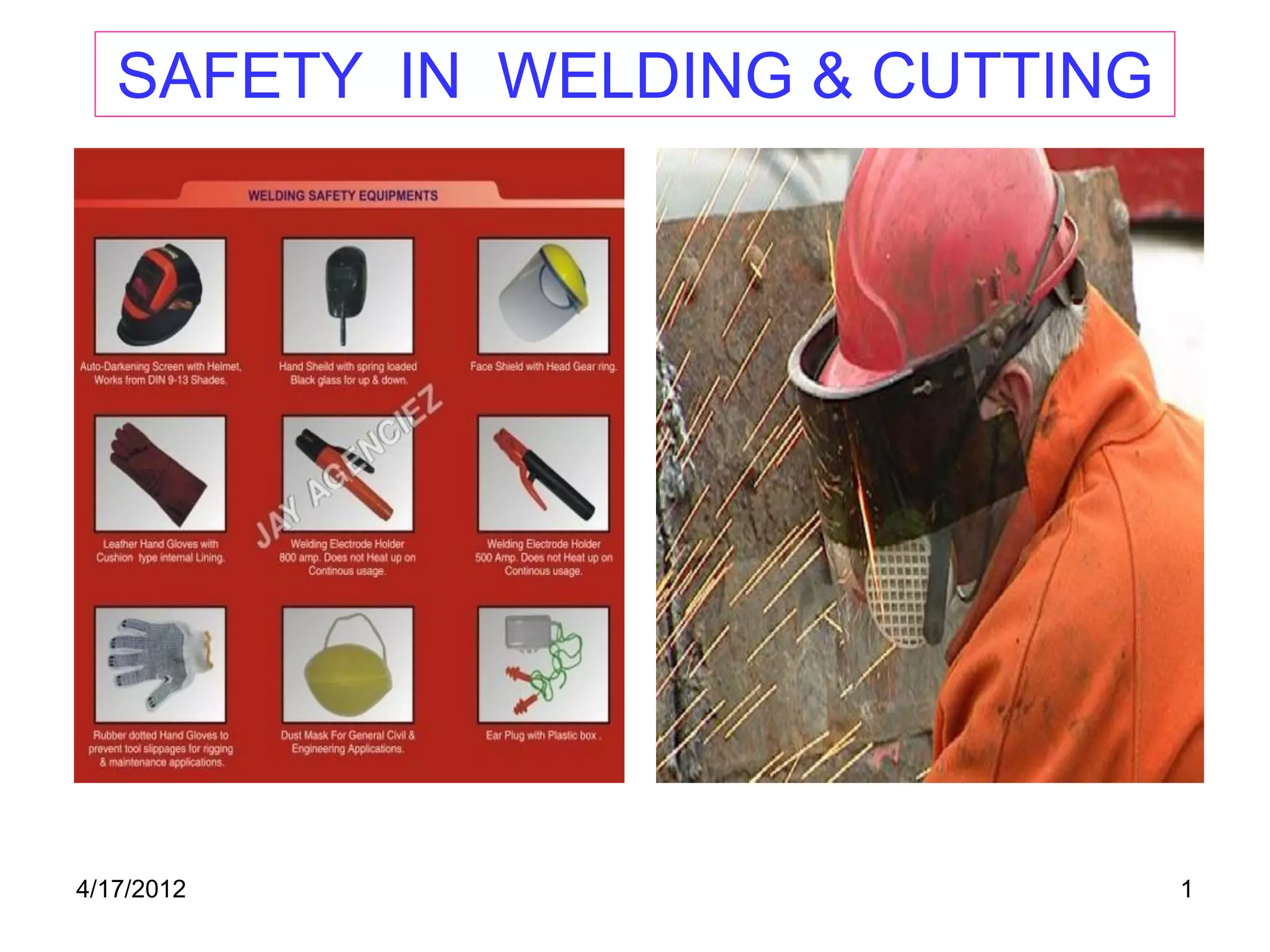
4/17/2012 1
SAFETY IN WELDING & CUTTING
2
INTRODUCTION
• Intense heat is generated during welding
and cutting of metals
– Heat obtained from inflammable gases (C2H2)
or electricity to the objects being welded or cut
• Employees exposed to the hazards created
by welding and cutting operations shall be
protected
• The main hazards are:
– Electric shock
– Arc radiation
– Fumes, Gases & dust
– Compressed gases
– Fire & explosion
– Noise
ELECTRIC SHOCK
• Results due to:-
– Damaged insulation of cables
– Lack of adequate earthing
– current passing through welder’s body (The heart
may cease to function, if current level exceeds
25mA)
– High RH, Ambient temp ›30°C & presence of
chemically active substances in atm damaging
electric insulation
• Cause severe burns & loss of life
16/06/2015 3
ARC RADIATION
• The welding arc emits UV & IR rays
• UV rays can damage both the eyes & the skin.
Even an accidental exposure to the UV light from
an arc can cause a condition known as “Arc Eye”
(watering of eyes & inability to tolerate light)
• Exposure of skin to UV radiation is also harmful.
Prolonged exposure causes severe burning &
skin peels off.
• Exposure to IR rays may cause cataract of the
eyes. Proper glass filter to be used
16/06/2015 4
GASES, FUMES & DUST
• Fumes & CO are produced during pre heating of
work using gas, charcoal, oil or coal fired furnace
• Effects of fumes include irritation of the respiratory
resulting in dryness of throat, coughing, chest
tightness & breathing difficulties.
• Weld fumes :
– injurious to health if the electrode coating contains
fluorides
– with high Cr
– galvanised or any coating
– much more dangerous when done in confined spaces
16/06/2015 5
GASES,FUMES & DUST
• Gases:
–Results due to-
• decomposition of fluxes & by the effects of UV
& IR radiations on the atmospheric gases
(3O2 2O3), which when inhaled regularly
over long periods may result in serious effects
on the welder’s health.
• Absorption of O2 during combustion (CO)
• Oxidation of N2 in the air (nitrous fumes)
• Escape of gases used for combustion in
welding / cutting
16/06/2015 6
GASES,FUMES & DUST
• Dusts:
–Produces harmful fumes if the electrode
contains Pb
16/06/2015 7
COMPRESSED GASES
• Gases used in welding & cutting are the fuel gases
(acetylene, LPG), oxygen & shielding gases
(argon, helium, nitrogen & CO2)
• Escaping fuel gases may cause fire or an
explosion
• Compressed gas cylinders should not be exposed
to sun light or heat as this may lead to increase of
pressure leading to explosion
• The temp of gas cylinders should not exceed 54°C
16/06/2015 8
FIRE & EXPLOSION
• Results due to:
– Inadequate connections
– Damaged insulation cables
– ignition of combustible or inflammable material
lying in the vicinity of weld zone Burns from
freshly welded metal.
– Sparks, molten metal globules & hot slag
– Hot electrode stubs
– gas cylinder valves leaking
– misuse of oxygen
– rubber hoses leaking
• Involves loss of life & damage property
16/06/2015 9
Contd-------
Explosion can take place when:-
• Oil /grease comes in contact with any
pipe, valve, etc. carrying O2.
• welding or cutting of a closed vessel with
inflammable liquids or gases
• Fuel gas cylinders exposed to high temp.
16/06/2015 10
NOISE
• Normal welding operations do not cause
much noise but gouging & plasma arc
cutting with high currents can create
excessive noise
• Noise due to welding, cutting, grinding,
chipping & other machining operation might
be going on simultaneously in the welding
shop
• Noise above 80 db is considered harmful &
above 120 outright dangerous
16/06/2015 11
PERSONAL PROTECTIVE EQUIPMENT
• The risks associated with welding/cutting
can be reduced by proper use of Personal
Protective Equipment (PPE)
• A set of PPE have been published by ISI
and many other similar International
Organisations.
• Appropriate protective clothing required for
any welding operation will vary with the
size, nature & location of the work to be
performed.
16/06/2015 12
16/06/2015 13
WHAT IS SAFETY ?
Definition: “Safety is the measure of
relative freedom from risks or dangers in
any environment”.
Nothing is 100% safe in any condition.
-by Gloss and Wardle
Safety means:
• Free from Hazards
• Free from Risk
• Free from accident
• Free from illness
• Free from harmful effects, etc.
16/06/2015 14
WHY WELDING SAFETY IS REQUIRED ?
• To avoid occupational diseases
–Occupational disease means:
• A disease which affects the human body due
to routine work.
• Substances such as silica, asbestos, Be, Cd,
metals, organic chemicals cause disease of
the respiratory system
• To protect property from fire/explosion
• To prevent human loss due to fire/explosion
16/06/2015 15
VARIOUS ASPECTS OF WELDING &
CUTTING SAFETY
• Safety recommended for operation of:-
–gas welding & cutting equipments.
–arc welding & cutting equipments.
• Explosion, fire & other hazards.
• Ventilation & health protection.
• Protection of welders.
16/06/2015 16
SAFETY RECOMMENDATIONS IN GAS
WELDING & CUTTING
Cylinders to be:
• kept upright in such a way so that they do
not fall.
• fitted with cap, when not in use.
• stored in a well protected place
• Stored cylinders of acetylene & oxygen
separately
• moved by tilting & rolling on their bottom
edge with valves closed
16/06/2015 17
SAFETY RECOMMENDATIONS IN GAS
WELDING & CUTTING
• Cylinders not to be:
– exposed to welding flame, direct sunlight, etc.
– used as rollers for moving materials.
• Welding not be done in confined areas.
• Fire extinguishers / sand to be available at hand.
• Cylinder valves to be closed when work is
finished.
• The nos. & markings on the cylinder & its safety
devices not to be tampered
• Frozen valves or regulators to be thawed with
hot water, never by flame.
16/06/2015 18
SAFETY RECOMMENDATIONS IN GAS
WELDING & CUTTING
• Gas torches & tips to be stored in clean boxes
• blow pipes & other apparatus to be cleaned
internally at a regular interval.
• The slag accumulated at the blow pipe tip to be
frequently removed
• Gas flame not to be played on the cylinder or
their attachments.
• Hot jobs not to be picked up.
• Painted or galvanised surfaces to be welded in
well ventilated space.
OTHER PRECAUTIONS
• Keep hoses away from sharp edges and abrasive
surfaces or where vehicles can run over them
• Do not allow hot metal or spatter to fall on hoses
• Regular checking of all connections and
equipments for faults and leaks.
• Immediate repair or replace leaking components.
• Leaking hoses should not be repaired, but they can
be shortened to remove a damaged section
• Dirt, grease and other contamination increases the
amount of fumes generated which is very toxic.
Avoid all these as far as possible.
16/06/2015 19
OTHER PRECAUTIONS
• Oxygen leaks also increase the fire risk. Clothing
contaminated with oxygen, even fire-retardant
clothing, will catch fire easily and burn very fiercely
• oxygen reacts explosively with oil and grease
• never use oxygen to blow dust off clothing
• never allow oil or grease to come into contact with
oxygen valves or cylinder fittings
• shut off the torch when not in use. Do not leave a
lighted torch on a bench or the floor
• clamp the work piece, avoid holding it by hand.
• Oxy/fuel equipment is relatively easy to use but
users may still need some instruction or training in.
• always provide adequate ventilation
16/06/2015 20
TWO CYLINDERS
16/06/2015 21
16/06/2015 22
GAS CYLINDERS & THEIR
ATTACHMENTS
16/06/2015 23
SAFETY RECOMMENDED IN ARC
WELDING & CUTTING
• All equipments to be inspected periodically &
maintained in safe working order at all times.
• A disconnecting switch to be provided at or near
each welding machine
• Working area & floor to be kept clean & clear of
electrode stubs & metal scrap.
• Be ensure that welding equipment is adequately
earthed.
• not to look at electric arc with the naked eye
• Welding cables:
– should have complete insulation
– be capable of handling the max current required for
the work.
– should be free from repair
– to be kept dry (free from grease & oil).
FIRE HAZARD PROTECTION
Following precautions can help in preventing
fire:
• move work piece to a safe location for
carrying out hot work
• remove nearby combustible materials (wood,
paper, textiles plastics, flammable liquids)
• protect nearby combustible materials that
cannot be moved. Use suitable guards or
covers such as metal sheeting or fire-
retardant blankets
16/06/2015 24
FIRE HAZARD PROTECTION
• use flame-resistant sheets or covers
to prevent hot particles passing
through openings in floors and walls
(doorways, windows, cable runs, etc)
• prevent flame, heat, sparks or hot
spatter from landing on the hoses
• keep fire extinguishers nearby.
16/06/2015 25
16/06/2015 26
SHOCK HAZARDS PROTECTION
• Necessary precautions to minimise electric
risk can best be done by ensuring proper
insulation of cables & reliable earthing of
welding equipments
PERSONAL PROTECTIVE
EQUIPMENT (PPE)
16/06/2015 27
16/06/2015 28
PPE: FOR WELDING & CUTTING
Welders must wear suitable protective
equipments.
They:
• protect against hazards (burns, sparks,
spatters,electric shock, radiation (UV, IR),
Slag, heat, hot metals, heat, fumes, gases,
etc).
• may be procured from regular agencies &
as per the specification
PPE: FOR WELDING & CUTTING
Regular agencies:
• ANSI: American National Standards
Institute
• OSHA: Occupational Safety & Health
Administration
• NFPA: National Fire Protection
Association
• AWS: American Welding Society
16/06/2015 29
16/06/2015 30
SPEC FOR PPE FOR WELDING &
CUTTING
1. Eye protection: ANSI Z 49.1 & OSHA 29 CFR
1910.252
2. Head protection: ANSI Z 49.1&OSHA 29
CFR1910.252
3. Ear protection: ANSI Z 49.1 & OSHA 29 CFR
1910.252
4. Foot protection: ASTM F 2412 & 2413
5. Hand protection: ANSI Z 49.1
6. Body protection: ANSI Z 49.1
7. Respiratory Protection Equipment :ANSI Z 49.1
16/06/2015 31
HAND PROTECTION (GLOVES)
• Protects the hand from:
–Electric shock
–Flame
–Hot parts
–Sharp or flying metals &
–Arc rays
16/06/2015 32
HAND PROTECTION (GLOVES)
Gloves should be:-
• Dry and moisture resistant
• Free from holes
• Flame resistant
• Electrically and thermally
insulated
• Flexible--allow easy movement &
full range of motion
• Comfortable--proper fit and size
• Durable, tough, and long lasting
• Cut, scrape, tear and puncture
resistant
Hand gloves
EAR PROTECTION (EAR
PLUG/MUFF)
• Protects from:
– Flying sparks
– Spatter
– Burns
– Hearing
– hearing loss
• Ear plug/ muff should be:
–fire-resistant
16/06/2015 33
EAR PLUG WITH CAP
EAR PLUG
16/06/2015 34
HEAD PROTECTION (HELMET)
Safety helmets
Safety helmets should be:
• uv-resistant
• facilated with International
design for ventilation of air to
keep head cool
• made of high density poly
ethylene (HDPE)
should have:
• adjustable head band
• Protects from:-
• Flying sparks
• Spatters
• Available in a wide range high quaility
in different beautiful colours
EYE PROTECTION(GOGGLES)
• Eye protective equipments
available in various designs
• They protect eyes from:-
– getting damaged (retinal
burns or permanent
blindness) due to:-
» Infra red rays (can cause
painful injury to the eye) &
ultra violet rays (can burn
the skin)
» Filter lens removes
approx 99.5% IR & 99.75
% UV
– Flying sparks
– Spatter
16/06/2015 Welding goggles
Chipping goggles
16/06/2015 36
FOOT PROTECTION (SAFETY
SHOES & BOOTS)
• They protect legs & feet from:
• Slag
• Falling off cuts
• Spatters.
• Available in various sizes to suit different
persons made from different raw materials like:
– Asbestos
– Leather steel toed
– Rubber
– Vinyl (PVC)
– Canvas
SAFETY SHOES
FOOT GUARD WITH
RUBBER TOED
16/06/2015 37
FOOT PROTECTION (LEG GUARD)
Leg guard
• It protects from:
• Slag
• Falling off cuts
• Spatters available in a wide
range of well designed
• Manufactured from high
quality leather.
• High quality raw materials
makes leg guards flame
resistant.
• Also come in asbestos and
aluminized finish.
16/06/2015 38
BODY PROTECTION (APRON)
Protect complete body from:-
• Flying sparks
• Hot spatter particles
• It should be:-
– In good condition (no holes & tears).
– Dry, clean (free of oil, grease, or solvents)
– Flexible--allow easy movement & full range of
motion
– Comfortable--proper fit and size
– Durable
*Available in a wide range made from different quality
raw materials like:-
– leather, rubber, vinyl (PVC).
*also available in asbestos / aluminized finish.
16/06/2015 39
BODY PROTECTION (APRON)
SAFETY APRON SAFETY APRON
16/06/2015 40
BODY PROTECTION (WELDING SUIT &
SAFETY BELT)
WELDING SUITS:
• Available in a wide range made
from high quality raw materials:
– rubber, vinyl (PVC).
• Also available in asbestos &
aluminized finish
SAFETY BELTS:
• used in jobs that involve a high
risk of falling like construction
sites, etc
• Available in a wide variety made
of Nylon
• Durable in quality
WELDING SUITS
SAFETY BELTS
16/06/2015 41
WELDING RESPIRATOR
Welding Respirators:
• Welding produces fumes and gases
hazardous to health
• Avoid breathing these fumes & gases
• Use adequate ventilation.
• Protect from:
– Welding fumes
– Welding fumes can affect :
• Lungs
• heart
• kidneys
• nervous system, etc
• Available in different types & sizes
Welding Respirators
16/06/2015 42
THANK U
THANK YOU

1434529085754-safety in welding.pdf

  • 1.
    4/17/2012 1 SAFETY INWELDING & CUTTING
  • 2.
    2 INTRODUCTION • Intense heatis generated during welding and cutting of metals – Heat obtained from inflammable gases (C2H2) or electricity to the objects being welded or cut • Employees exposed to the hazards created by welding and cutting operations shall be protected • The main hazards are: – Electric shock – Arc radiation – Fumes, Gases & dust – Compressed gases – Fire & explosion – Noise
  • 3.
    ELECTRIC SHOCK • Resultsdue to:- – Damaged insulation of cables – Lack of adequate earthing – current passing through welder’s body (The heart may cease to function, if current level exceeds 25mA) – High RH, Ambient temp ›30°C & presence of chemically active substances in atm damaging electric insulation • Cause severe burns & loss of life 16/06/2015 3
  • 4.
    ARC RADIATION • Thewelding arc emits UV & IR rays • UV rays can damage both the eyes & the skin. Even an accidental exposure to the UV light from an arc can cause a condition known as “Arc Eye” (watering of eyes & inability to tolerate light) • Exposure of skin to UV radiation is also harmful. Prolonged exposure causes severe burning & skin peels off. • Exposure to IR rays may cause cataract of the eyes. Proper glass filter to be used 16/06/2015 4
  • 5.
    GASES, FUMES &DUST • Fumes & CO are produced during pre heating of work using gas, charcoal, oil or coal fired furnace • Effects of fumes include irritation of the respiratory resulting in dryness of throat, coughing, chest tightness & breathing difficulties. • Weld fumes : – injurious to health if the electrode coating contains fluorides – with high Cr – galvanised or any coating – much more dangerous when done in confined spaces 16/06/2015 5
  • 6.
    GASES,FUMES & DUST •Gases: –Results due to- • decomposition of fluxes & by the effects of UV & IR radiations on the atmospheric gases (3O2 2O3), which when inhaled regularly over long periods may result in serious effects on the welder’s health. • Absorption of O2 during combustion (CO) • Oxidation of N2 in the air (nitrous fumes) • Escape of gases used for combustion in welding / cutting 16/06/2015 6
  • 7.
    GASES,FUMES & DUST •Dusts: –Produces harmful fumes if the electrode contains Pb 16/06/2015 7
  • 8.
    COMPRESSED GASES • Gasesused in welding & cutting are the fuel gases (acetylene, LPG), oxygen & shielding gases (argon, helium, nitrogen & CO2) • Escaping fuel gases may cause fire or an explosion • Compressed gas cylinders should not be exposed to sun light or heat as this may lead to increase of pressure leading to explosion • The temp of gas cylinders should not exceed 54°C 16/06/2015 8
  • 9.
    FIRE & EXPLOSION •Results due to: – Inadequate connections – Damaged insulation cables – ignition of combustible or inflammable material lying in the vicinity of weld zone Burns from freshly welded metal. – Sparks, molten metal globules & hot slag – Hot electrode stubs – gas cylinder valves leaking – misuse of oxygen – rubber hoses leaking • Involves loss of life & damage property 16/06/2015 9
  • 10.
    Contd------- Explosion can takeplace when:- • Oil /grease comes in contact with any pipe, valve, etc. carrying O2. • welding or cutting of a closed vessel with inflammable liquids or gases • Fuel gas cylinders exposed to high temp. 16/06/2015 10
  • 11.
    NOISE • Normal weldingoperations do not cause much noise but gouging & plasma arc cutting with high currents can create excessive noise • Noise due to welding, cutting, grinding, chipping & other machining operation might be going on simultaneously in the welding shop • Noise above 80 db is considered harmful & above 120 outright dangerous 16/06/2015 11
  • 12.
    PERSONAL PROTECTIVE EQUIPMENT •The risks associated with welding/cutting can be reduced by proper use of Personal Protective Equipment (PPE) • A set of PPE have been published by ISI and many other similar International Organisations. • Appropriate protective clothing required for any welding operation will vary with the size, nature & location of the work to be performed. 16/06/2015 12
  • 13.
    16/06/2015 13 WHAT ISSAFETY ? Definition: “Safety is the measure of relative freedom from risks or dangers in any environment”. Nothing is 100% safe in any condition. -by Gloss and Wardle Safety means: • Free from Hazards • Free from Risk • Free from accident • Free from illness • Free from harmful effects, etc.
  • 14.
    16/06/2015 14 WHY WELDINGSAFETY IS REQUIRED ? • To avoid occupational diseases –Occupational disease means: • A disease which affects the human body due to routine work. • Substances such as silica, asbestos, Be, Cd, metals, organic chemicals cause disease of the respiratory system • To protect property from fire/explosion • To prevent human loss due to fire/explosion
  • 15.
    16/06/2015 15 VARIOUS ASPECTSOF WELDING & CUTTING SAFETY • Safety recommended for operation of:- –gas welding & cutting equipments. –arc welding & cutting equipments. • Explosion, fire & other hazards. • Ventilation & health protection. • Protection of welders.
  • 16.
    16/06/2015 16 SAFETY RECOMMENDATIONSIN GAS WELDING & CUTTING Cylinders to be: • kept upright in such a way so that they do not fall. • fitted with cap, when not in use. • stored in a well protected place • Stored cylinders of acetylene & oxygen separately • moved by tilting & rolling on their bottom edge with valves closed
  • 17.
    16/06/2015 17 SAFETY RECOMMENDATIONSIN GAS WELDING & CUTTING • Cylinders not to be: – exposed to welding flame, direct sunlight, etc. – used as rollers for moving materials. • Welding not be done in confined areas. • Fire extinguishers / sand to be available at hand. • Cylinder valves to be closed when work is finished. • The nos. & markings on the cylinder & its safety devices not to be tampered • Frozen valves or regulators to be thawed with hot water, never by flame.
  • 18.
    16/06/2015 18 SAFETY RECOMMENDATIONSIN GAS WELDING & CUTTING • Gas torches & tips to be stored in clean boxes • blow pipes & other apparatus to be cleaned internally at a regular interval. • The slag accumulated at the blow pipe tip to be frequently removed • Gas flame not to be played on the cylinder or their attachments. • Hot jobs not to be picked up. • Painted or galvanised surfaces to be welded in well ventilated space.
  • 19.
    OTHER PRECAUTIONS • Keephoses away from sharp edges and abrasive surfaces or where vehicles can run over them • Do not allow hot metal or spatter to fall on hoses • Regular checking of all connections and equipments for faults and leaks. • Immediate repair or replace leaking components. • Leaking hoses should not be repaired, but they can be shortened to remove a damaged section • Dirt, grease and other contamination increases the amount of fumes generated which is very toxic. Avoid all these as far as possible. 16/06/2015 19
  • 20.
    OTHER PRECAUTIONS • Oxygenleaks also increase the fire risk. Clothing contaminated with oxygen, even fire-retardant clothing, will catch fire easily and burn very fiercely • oxygen reacts explosively with oil and grease • never use oxygen to blow dust off clothing • never allow oil or grease to come into contact with oxygen valves or cylinder fittings • shut off the torch when not in use. Do not leave a lighted torch on a bench or the floor • clamp the work piece, avoid holding it by hand. • Oxy/fuel equipment is relatively easy to use but users may still need some instruction or training in. • always provide adequate ventilation 16/06/2015 20
  • 21.
  • 22.
    16/06/2015 22 GAS CYLINDERS& THEIR ATTACHMENTS
  • 23.
    16/06/2015 23 SAFETY RECOMMENDEDIN ARC WELDING & CUTTING • All equipments to be inspected periodically & maintained in safe working order at all times. • A disconnecting switch to be provided at or near each welding machine • Working area & floor to be kept clean & clear of electrode stubs & metal scrap. • Be ensure that welding equipment is adequately earthed. • not to look at electric arc with the naked eye • Welding cables: – should have complete insulation – be capable of handling the max current required for the work. – should be free from repair – to be kept dry (free from grease & oil).
  • 24.
    FIRE HAZARD PROTECTION Followingprecautions can help in preventing fire: • move work piece to a safe location for carrying out hot work • remove nearby combustible materials (wood, paper, textiles plastics, flammable liquids) • protect nearby combustible materials that cannot be moved. Use suitable guards or covers such as metal sheeting or fire- retardant blankets 16/06/2015 24
  • 25.
    FIRE HAZARD PROTECTION •use flame-resistant sheets or covers to prevent hot particles passing through openings in floors and walls (doorways, windows, cable runs, etc) • prevent flame, heat, sparks or hot spatter from landing on the hoses • keep fire extinguishers nearby. 16/06/2015 25
  • 26.
    16/06/2015 26 SHOCK HAZARDSPROTECTION • Necessary precautions to minimise electric risk can best be done by ensuring proper insulation of cables & reliable earthing of welding equipments
  • 27.
  • 28.
    16/06/2015 28 PPE: FORWELDING & CUTTING Welders must wear suitable protective equipments. They: • protect against hazards (burns, sparks, spatters,electric shock, radiation (UV, IR), Slag, heat, hot metals, heat, fumes, gases, etc). • may be procured from regular agencies & as per the specification
  • 29.
    PPE: FOR WELDING& CUTTING Regular agencies: • ANSI: American National Standards Institute • OSHA: Occupational Safety & Health Administration • NFPA: National Fire Protection Association • AWS: American Welding Society 16/06/2015 29
  • 30.
    16/06/2015 30 SPEC FORPPE FOR WELDING & CUTTING 1. Eye protection: ANSI Z 49.1 & OSHA 29 CFR 1910.252 2. Head protection: ANSI Z 49.1&OSHA 29 CFR1910.252 3. Ear protection: ANSI Z 49.1 & OSHA 29 CFR 1910.252 4. Foot protection: ASTM F 2412 & 2413 5. Hand protection: ANSI Z 49.1 6. Body protection: ANSI Z 49.1 7. Respiratory Protection Equipment :ANSI Z 49.1
  • 31.
    16/06/2015 31 HAND PROTECTION(GLOVES) • Protects the hand from: –Electric shock –Flame –Hot parts –Sharp or flying metals & –Arc rays
  • 32.
    16/06/2015 32 HAND PROTECTION(GLOVES) Gloves should be:- • Dry and moisture resistant • Free from holes • Flame resistant • Electrically and thermally insulated • Flexible--allow easy movement & full range of motion • Comfortable--proper fit and size • Durable, tough, and long lasting • Cut, scrape, tear and puncture resistant Hand gloves
  • 33.
    EAR PROTECTION (EAR PLUG/MUFF) •Protects from: – Flying sparks – Spatter – Burns – Hearing – hearing loss • Ear plug/ muff should be: –fire-resistant 16/06/2015 33 EAR PLUG WITH CAP EAR PLUG
  • 34.
    16/06/2015 34 HEAD PROTECTION(HELMET) Safety helmets Safety helmets should be: • uv-resistant • facilated with International design for ventilation of air to keep head cool • made of high density poly ethylene (HDPE) should have: • adjustable head band • Protects from:- • Flying sparks • Spatters • Available in a wide range high quaility in different beautiful colours
  • 35.
    EYE PROTECTION(GOGGLES) • Eyeprotective equipments available in various designs • They protect eyes from:- – getting damaged (retinal burns or permanent blindness) due to:- » Infra red rays (can cause painful injury to the eye) & ultra violet rays (can burn the skin) » Filter lens removes approx 99.5% IR & 99.75 % UV – Flying sparks – Spatter 16/06/2015 Welding goggles Chipping goggles
  • 36.
    16/06/2015 36 FOOT PROTECTION(SAFETY SHOES & BOOTS) • They protect legs & feet from: • Slag • Falling off cuts • Spatters. • Available in various sizes to suit different persons made from different raw materials like: – Asbestos – Leather steel toed – Rubber – Vinyl (PVC) – Canvas SAFETY SHOES FOOT GUARD WITH RUBBER TOED
  • 37.
    16/06/2015 37 FOOT PROTECTION(LEG GUARD) Leg guard • It protects from: • Slag • Falling off cuts • Spatters available in a wide range of well designed • Manufactured from high quality leather. • High quality raw materials makes leg guards flame resistant. • Also come in asbestos and aluminized finish.
  • 38.
    16/06/2015 38 BODY PROTECTION(APRON) Protect complete body from:- • Flying sparks • Hot spatter particles • It should be:- – In good condition (no holes & tears). – Dry, clean (free of oil, grease, or solvents) – Flexible--allow easy movement & full range of motion – Comfortable--proper fit and size – Durable *Available in a wide range made from different quality raw materials like:- – leather, rubber, vinyl (PVC). *also available in asbestos / aluminized finish.
  • 39.
    16/06/2015 39 BODY PROTECTION(APRON) SAFETY APRON SAFETY APRON
  • 40.
    16/06/2015 40 BODY PROTECTION(WELDING SUIT & SAFETY BELT) WELDING SUITS: • Available in a wide range made from high quality raw materials: – rubber, vinyl (PVC). • Also available in asbestos & aluminized finish SAFETY BELTS: • used in jobs that involve a high risk of falling like construction sites, etc • Available in a wide variety made of Nylon • Durable in quality WELDING SUITS SAFETY BELTS
  • 41.
    16/06/2015 41 WELDING RESPIRATOR WeldingRespirators: • Welding produces fumes and gases hazardous to health • Avoid breathing these fumes & gases • Use adequate ventilation. • Protect from: – Welding fumes – Welding fumes can affect : • Lungs • heart • kidneys • nervous system, etc • Available in different types & sizes Welding Respirators
  • 42.