2
Gas fumes, radiationand electric shock are hazards that face welders.
A welding arc is hot enough to melt steel and the light it emits can
blind you. It generates toxic fumes that are composed of particles of
molten metal. Sparks and molten slag thrown by the arc can fly up to
35 feet and cause fire and explosions.
Still want to weld?
3.
3
Test forflammable gases in the work area before staring any work
Potentially hazardous areas include:
Well heads
Fuel tanks
Mud tanks
Tank batteries
Gas separators
Oil treaters
Confined spaces
WHAT YOU NEED TO KNOW
4.
4
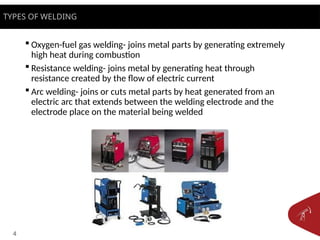
Oxygen-fuel gaswelding- joins metal parts by generating extremely
high heat during combustion
Resistance welding- joins metal by generating heat through
resistance created by the flow of electric current
Arc welding- joins or cuts metal parts by heat generated from an
electric arc that extends between the welding electrode and the
electrode place on the material being welded
TYPES OF WELDING
5.
5
Eyes andskin can be damaged from exposure to ultraviolet and
infrared rays produced
Closed containers that once held flammables or combustibles can
explode under high heat
Toxic gases, fumes and dust may be released during operations
Welding or cutting near materials can cause a fire hazard
Metal splatter
Electric shock
Burns
HAZARDS
6.
6
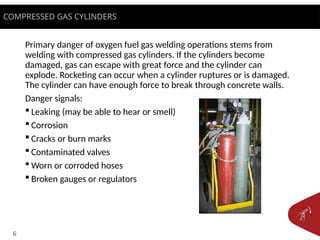
Primary danger ofoxygen fuel gas welding operations stems from
welding with compressed gas cylinders. If the cylinders become
damaged, gas can escape with great force and the cylinder can
explode. Rocketing can occur when a cylinder ruptures or is damaged.
The cylinder can have enough force to break through concrete walls.
Danger signals:
Leaking (may be able to hear or smell)
Corrosion
Cracks or burn marks
Contaminated valves
Worn or corroded hoses
Broken gauges or regulators
COMPRESSED GAS CYLINDERS
7.
7
Non-flammable compressed gases-do not catch fire easily or burn
quickly. However, they possess other hazards. The cylinder label and
SDS will inform you of the toxic properties and physical hazards.
These gases may:
Cause dizziness
Unconsciousness
Suffocation
Explode or accelerate fires
Be harmful or toxic if inhaled
Irritate eyes, nose, throat and lungs
COMPRESSED GAS CYLINDERS
8.
8
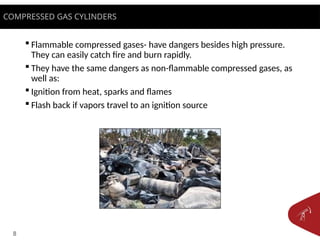
Flammable compressedgases- have dangers besides high pressure.
They can easily catch fire and burn rapidly.
They have the same dangers as non-flammable compressed gases, as
well as:
Ignition from heat, sparks and flames
Flash back if vapors travel to an ignition source
COMPRESSED GAS CYLINDERS
9.
9
When workingat heights use a platform with toeboards and standard
railing or a safety harness and lifeline. Protect workers below from stray
sparks or slag.
Aid the welding torch away from cement or stone surfaces. Moisture within
these surfaces could cause them to explode once raised to a certain
temperature.
When finished welding or cutting, warn other workers of hot metal. Keep
floors clean by putting electrodes and rod stubs in an appropriate container
Never use bare conductors, damaged regulators, torches, electrode holders
or other defective equipment
Do not arc or resistance weld while standing on damp surfaces
Do not wrap cutting torch hoses or welding cords around your body
If welding in a shop, designate a welding area. Use welding shields around
the area to protect other workers
Always turn welding machine off when not in use
SAFE WELDING PRACTICES
10.
10
Identify agas and its dangers before using. Use the information on labels, SDS
and cylinder markings. If you don’t know what it is do not use it.
When accepting an acetylene delivery, make sure it arrives upright. They
contain a stabilizing liquid that may leak out if horizontal
Make sure all valves, hoses, connectors and regulators are in good condition
Keep oil and grease away from oxygen cylinders, valves and hoses. Do not
handle if hands, gloves or clothing is oily. Oxygen increase flammability.
Oxygen and compressed air are not the same.
One type of regulator, hose and gauges cannot be used on every type of gas.
Make sure yours will work with the gas you are using.
Never open valves until regulators are drained of gas and pressure-adjusting
devices are released. When opening cylinder point away from people sources
of ignition.
When empty, close and return the cylinders to your supplier. Empty cylinders
must be marked “MT” or “Empty”.
When finished using a cylinder for a job task, close the valve until next use.
HANDLING COMPRESSED GAS CYLINDERS
11.
11
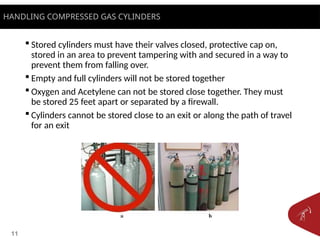
Stored cylindersmust have their valves closed, protective cap on,
stored in an area to prevent tampering with and secured in a way to
prevent them from falling over.
Empty and full cylinders will not be stored together
Oxygen and Acetylene can not be stored close together. They must
be stored 25 feet apart or separated by a firewall.
Cylinders cannot be stored close to an exit or along the path of travel
for an exit
HANDLING COMPRESSED GAS CYLINDERS
12.
12
Welding and cuttingequipment should be used and inspected
according to manufacturer’s instructions. You must be familiar with all
the equipment you use. Routinely inspect and maintain your
equipment, including cylinders. Inspect cylinders regularly, including
manifolds, piping, portable outlet headers, regulators, hose and hose
connections.
If you find defects during the inspection remove the equipment and
place it out of service.
Some examples:
Extreme rust or dents in cylinders
Any leaks
Cut or deep scrapes in electrode cables or hoses
Broke gauges
INSPECTION
13.
13
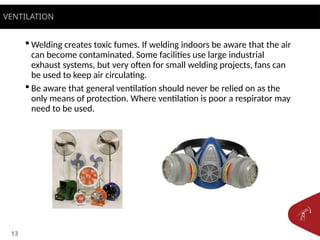
Welding createstoxic fumes. If welding indoors be aware that the air
can become contaminated. Some facilities use large industrial
exhaust systems, but very often for small welding projects, fans can
be used to keep air circulating.
Be aware that general ventilation should never be relied on as the
only means of protection. Where ventilation is poor a respirator may
need to be used.
VENTILATION
14.
14
You mustmake the area your welding/cutting in as safe as possible from
fire hazards. If possible remove all fire hazards from the area before
beginning. When these hazards cannot be removed, guards must be put in
place to confine heat, sparks and slag. A Hot Work permit be used for
these circumstances.
A Fire Watch must be used when welding/cutting is performed in
locations where other than a minor fire may develop such as the
following:
Combustible material is closer than 35 feet to the point of operation
(wellhead, seperaters and tanks in use, etc.)
Combustibles are more than 35 feet away, but easily ignited
Wall or floor openings within a 35 foot radius expose combustible
materials below
Combustible materials are adjacent to the opposite side of metal
partitions, walls, ceilings or roofs and are likely to be ignited by
conduction or radiation
FIRE PREVENTION
15.
15
should haveno other job duties at the time of the watch
Have fire extinguishing equipment readily available and be trained to
use it
Be familiar with the site or facilities for sounding the alarm in the
event of a fire
Watch for fires in all exposed areas
Try to extinguish fires only when obviously within the capacity of the
equipment available, or otherwise sound the alarm
Be maintained for at least 30 minutes after completion of the
welding/cutting operations to detect and extinguish possible
smoldering fires
The fire watch can use “Stop Work Authority” anytime they feel the
job task is unsafe
FIRE WATCH
16.
16
Welding or cuttingin confined spaces presents a new set of challenges. Confined
space entry, hot work and possibly LOTO procedures must be followed in addition
to:
Evaluate the space for its limited area, any hazardous atmosphere or slippery
floor surface
Evaluate for space for flammability or combustible hazards and toxic fumes that
could be caused by welding process
Perform atmospheric testing before and during entry. If flammable or
combustible gases are present, ventilation must be performed until clear. If the
atmosphere is toxic and cannot be cleared respiratory protection must be used.
You must wear a safety harness attached to a lifeline while working
If hot work inside the space is interrupted precautions must be taken.
Disconnect power to the welding or cutting units and remove electrode from
the holder. Turn off torch valves and shut off the gas supply at a point outside of
the space. Remove all equipment from inside the space if possible. Cylinders or
body of the equipment should never be placed inside the confined space.
CONFINED SPACE
17.
17
Necessary protective gearmay include the following, depending on the job:
Flame-retardant clothing
Aprons- flame resistant
Leggings- leather or similar
Safety shoes- ankle length (low cut shoes may catch slag)
Protection during overhead work- shoulder cape or cover, skull cap made of
leather or other protective material, other flame resistant cap worn under
helmet
Hearing protection- ear plugs or ear muffs
Head protection- safety helmet or other head gear to protect against falling
objects
Eye and face protection- operators, welders or helpers should wear goggles,
helmet and face shield for maximum protection. All filter lenses and plates must
meet the test for transmission of radiant energy (ANSI Z87.1)
Respiratory protection- if gases, dust and fumes cannot be maintained below
acceptable limits
PPE
18.
18
Welders shouldcover all parts of their body. Dark clothing works best
to reduce reflection under the face shield.
Wool, leather or cotton clothing treated to reduce flammability are
preferred. Clothing should be thick enough to prevent flash burns, be
clean and free of oil or grease. Clothes should have sleeves and
collars buttoned and no front pockets that could catch sparks. Pants
should not have cuffs. Pant legs should cover the tops of shoes or
boots.
If worn, thermal-insulated underwear should be covered by other
clothing and not exposed. It should be down-filled or waffle weave
cotton or wool. Quilted nylon-shell/polyester-filled underwear and
synthetic outer wear will not necessarily ignite quicker, but melts as it
burns, which can result in serious burns that are hard to treat and
slow to heal.
PPE
19.
19
Keeping areasfree of combustibles is extremely important. Collect
used electrodes or rod stubs for safe disposal. Proper storage of
compressed gas cylinders is also important. As always, store tools in
the appropriate place.
In all operations, take time to evaluate the job and implement
appropriate safety precautions. This will not only prevent damage to
equipment and machine damage, but will reduce the risk of an
incident that could injure you or a co-worker.
SUMMARY