HAZARD IDENTIFICATION, RISK ASSESSMENT & RISK CONTROL By Hera Singh Scientific Officer Pusat  Pengajian Sains Kesihatan
OBJECTIVE To identify types of Hazard in work area To make Risk Assessments To suggest Risk Controls to Organization To implementing Risk Controls To review Risk Controls
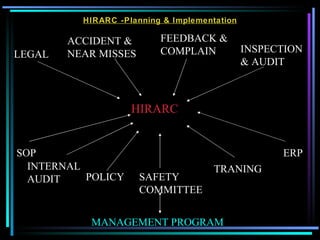
HIRARC -Planning & Implementation HIRARC LEGAL ACCIDENT & NEAR MISSES FEEDBACK & COMPLAIN INSPECTION& AUDIT SOP INTERNAL AUDIT POLICY SAFETY COMMITTEE TRANING ERP MANAGEMENT PROGRAM
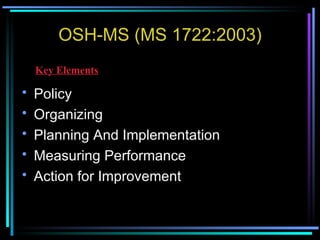
OSH-MS (MS 1722:2003) Policy Organizing Planning And Implementation Measuring Performance Action for Improvement Key Elements
Why We Need OSH-MS Our Organization to be  No. 1 Increase “Return of Investment” - employees, money , time….. Safe work place
How To Start Organization should have vision Commitment from management - right people - resource  - time
Should have internal audit Management committee to review reports External audit Specific organization policy- hazard specific Employee’s participation - meeting, training Safety as basic training How To Start
Introduction to HIRARC Principles used in workplace to manage safety and health. Section 15 (2)(a) of OSHA 1994: which reads “ the provision and maintenance of plants and  systems of work   that are,so far as is practicable, safe and without risks to health”
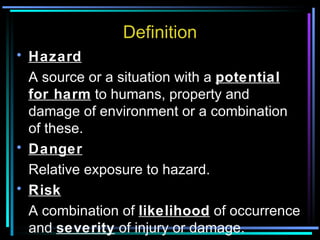
Definition Hazard A source or a situation with a  potential for harm  to humans, property and damage of environment or a combination of these. Danger Relative exposure to hazard. Risk A combination of  likelihood  of occurrence and  severity  of injury or damage.
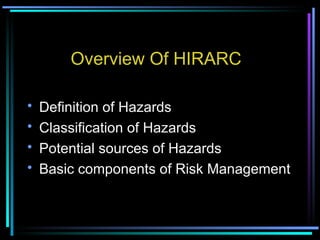
Overview Of HIRARC Definition of Hazards Classification of Hazards Potential sources of Hazards Basic components of Risk Management
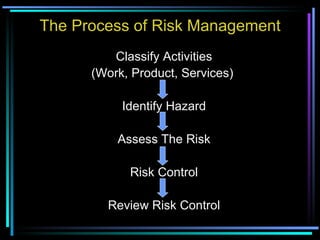
The Process of Risk Management Classify Activities (Work, Product, Services)  Identify Hazard Assess The Risk Risk Control Review Risk Control
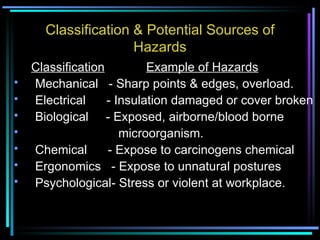
Classification & Potential Sources of Hazards Classification   Example of Hazards Mechanical  - Sharp points & edges, overload. Electrical  - Insulation damaged or cover broken Biological  - Exposed, airborne/blood borne  microorganism.  Chemical  - Expose to carcinogens chemical Ergonomics  - Expose to unnatural postures Psychological- Stress or violent at workplace.
Hazard Identification To keep workplace  safe  and  healthy. -employers should make sure there are no hazards to which employees could be exposed. Employers should look for hazards in advance as part of their risk management plan to prevent potential hazards.
Actions & Recommendations All related statements should be made With no cost restrains Should be reviewed every 4 months Need management support
Risk Assessment Is the process of evaluating the risk to safety &  health from hazards at work Types Qualitative Semi-quantitative Quantitative
How To Assess Risk 1) Look for the Hazards 2) Decide who might be harmed & how 3) Evaluate the risk and check what is  done to prevent it from happening 4) Record finding 5) Review assessment and revise it if necessary
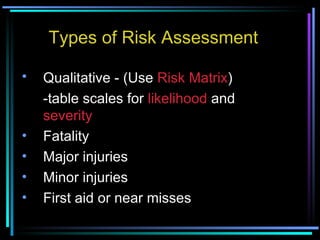
Types of Risk Assessment Qualitative - (Use  Risk Matrix ) -table scales for  likelihood  and  severity Fatality Major injuries Minor injuries First aid or near misses
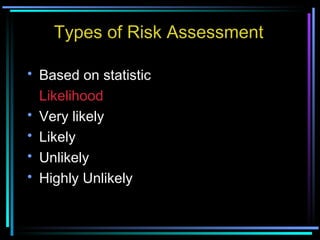
Types of Risk Assessment Based on statistic Likelihood Very likely Likely Unlikely Highly Unlikely
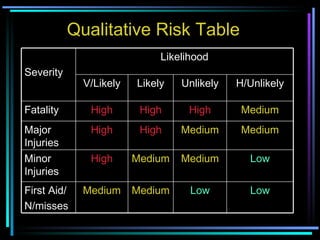
Qualitative Risk Table Low Low Medium Medium First Aid/ N/misses Low Medium Medium High Minor Injuries Medium Medium High High Major Injuries Medium High High High Fatality H/Unlikely Unlikely Likely V/Likely Likelihood Severity
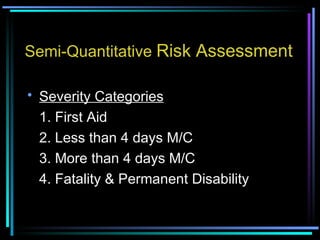
Semi-Quantitative  Risk Assessment Severity Categories 1. First Aid 2. Less than 4 days M/C 3. More than 4 days M/C 4. Fatality & Permanent Disability
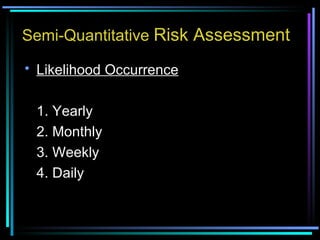
Semi-Quantitative  Risk Assessment Likelihood Occurrence 1. Yearly 2. Monthly 3. Weekly 4. Daily
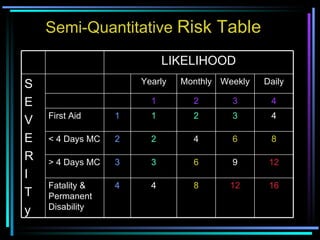
Semi-Quantitative  Risk Table 16 12 8 4 4 Fatality & Permanent Disability 12 9 6 3 3 > 4 Days MC 8 6 4 2 2 < 4 Days MC 4 3 2 1 1 First Aid 4 3 2 1 Daily Weekly Monthly Yearly S E V E R I T y LIKELIHOOD
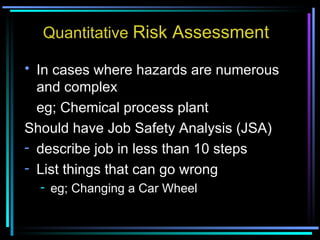
Quantitative  Risk Assessment In cases where hazards are numerous and complex  eg; Chemical process plant Should have Job Safety Analysis (JSA) describe job in less than 10 steps List things that can go wrong eg; Changing a Car Wheel
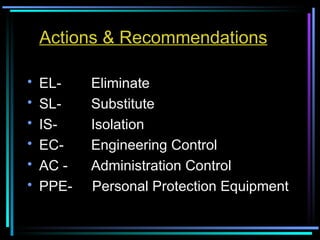
Actions & Recommendations EL- Eliminate SL- Substitute IS- Isolation EC- Engineering Control AC - Administration Control PPE-  Personal Protection Equipment
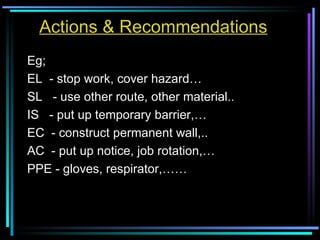
Actions & Recommendations Eg; EL  - stop work, cover hazard… SL  - use other route, other material.. IS  - put up temporary barrier,… EC  - construct permanent wall,.. AC  - put up notice, job rotation,… PPE - gloves, respirator,……
Thank You Hera Singh Scientific Officer Pusat  Pengajian Sains Kesihatan

Hirarc

  • 1.
    HAZARD IDENTIFICATION, RISKASSESSMENT & RISK CONTROL By Hera Singh Scientific Officer Pusat Pengajian Sains Kesihatan
  • 2.
    OBJECTIVE To identifytypes of Hazard in work area To make Risk Assessments To suggest Risk Controls to Organization To implementing Risk Controls To review Risk Controls
  • 3.
    HIRARC -Planning &Implementation HIRARC LEGAL ACCIDENT & NEAR MISSES FEEDBACK & COMPLAIN INSPECTION& AUDIT SOP INTERNAL AUDIT POLICY SAFETY COMMITTEE TRANING ERP MANAGEMENT PROGRAM
  • 4.
    OSH-MS (MS 1722:2003)Policy Organizing Planning And Implementation Measuring Performance Action for Improvement Key Elements
  • 5.
    Why We NeedOSH-MS Our Organization to be No. 1 Increase “Return of Investment” - employees, money , time….. Safe work place
  • 6.
    How To StartOrganization should have vision Commitment from management - right people - resource - time
  • 7.
    Should have internalaudit Management committee to review reports External audit Specific organization policy- hazard specific Employee’s participation - meeting, training Safety as basic training How To Start
  • 8.
    Introduction to HIRARCPrinciples used in workplace to manage safety and health. Section 15 (2)(a) of OSHA 1994: which reads “ the provision and maintenance of plants and systems of work that are,so far as is practicable, safe and without risks to health”
  • 9.
    Definition Hazard Asource or a situation with a potential for harm to humans, property and damage of environment or a combination of these. Danger Relative exposure to hazard. Risk A combination of likelihood of occurrence and severity of injury or damage.
  • 10.
    Overview Of HIRARCDefinition of Hazards Classification of Hazards Potential sources of Hazards Basic components of Risk Management
  • 11.
    The Process ofRisk Management Classify Activities (Work, Product, Services) Identify Hazard Assess The Risk Risk Control Review Risk Control
  • 12.
    Classification & PotentialSources of Hazards Classification Example of Hazards Mechanical - Sharp points & edges, overload. Electrical - Insulation damaged or cover broken Biological - Exposed, airborne/blood borne microorganism. Chemical - Expose to carcinogens chemical Ergonomics - Expose to unnatural postures Psychological- Stress or violent at workplace.
  • 13.
    Hazard Identification Tokeep workplace safe and healthy. -employers should make sure there are no hazards to which employees could be exposed. Employers should look for hazards in advance as part of their risk management plan to prevent potential hazards.
  • 14.
    Actions & RecommendationsAll related statements should be made With no cost restrains Should be reviewed every 4 months Need management support
  • 15.
    Risk Assessment Isthe process of evaluating the risk to safety & health from hazards at work Types Qualitative Semi-quantitative Quantitative
  • 16.
    How To AssessRisk 1) Look for the Hazards 2) Decide who might be harmed & how 3) Evaluate the risk and check what is done to prevent it from happening 4) Record finding 5) Review assessment and revise it if necessary
  • 17.
    Types of RiskAssessment Qualitative - (Use Risk Matrix ) -table scales for likelihood and severity Fatality Major injuries Minor injuries First aid or near misses
  • 18.
    Types of RiskAssessment Based on statistic Likelihood Very likely Likely Unlikely Highly Unlikely
  • 19.
    Qualitative Risk TableLow Low Medium Medium First Aid/ N/misses Low Medium Medium High Minor Injuries Medium Medium High High Major Injuries Medium High High High Fatality H/Unlikely Unlikely Likely V/Likely Likelihood Severity
  • 20.
    Semi-Quantitative RiskAssessment Severity Categories 1. First Aid 2. Less than 4 days M/C 3. More than 4 days M/C 4. Fatality & Permanent Disability
  • 21.
    Semi-Quantitative RiskAssessment Likelihood Occurrence 1. Yearly 2. Monthly 3. Weekly 4. Daily
  • 22.
    Semi-Quantitative RiskTable 16 12 8 4 4 Fatality & Permanent Disability 12 9 6 3 3 > 4 Days MC 8 6 4 2 2 < 4 Days MC 4 3 2 1 1 First Aid 4 3 2 1 Daily Weekly Monthly Yearly S E V E R I T y LIKELIHOOD
  • 23.
    Quantitative RiskAssessment In cases where hazards are numerous and complex eg; Chemical process plant Should have Job Safety Analysis (JSA) describe job in less than 10 steps List things that can go wrong eg; Changing a Car Wheel
  • 24.
    Actions & RecommendationsEL- Eliminate SL- Substitute IS- Isolation EC- Engineering Control AC - Administration Control PPE- Personal Protection Equipment
  • 25.
    Actions & RecommendationsEg; EL - stop work, cover hazard… SL - use other route, other material.. IS - put up temporary barrier,… EC - construct permanent wall,.. AC - put up notice, job rotation,… PPE - gloves, respirator,……
  • 26.
    Thank You HeraSingh Scientific Officer Pusat Pengajian Sains Kesihatan