1© Geigle Communications - Hazard Identification and Control
Hazard Identification and Control
Welcome!
Trainer note: You have permission to make changes to this
workbook file for your own personal use. You may make
copies for personal use. You may not use this file for resale
or other commercial purposes. (Remove this notice before
you use the file ;-)
2© Geigle Communications - Hazard Identification and Control
Your Intro Page Here
(Please change this image at
the...it's me! ;-)
3© Geigle Communications - Hazard Identification and Control
Workshop goals
• Explore the elements of an effective hazard
identification and control program.
• Discuss the steps in the hazard identification and
control process.
• Complete the hazard identification and control
worksheet.
4© Geigle Communications - Hazard Identification and Control
Form Teams
5© Geigle Communications - Hazard Identification and Control
IDENTIFYING HAZARDS
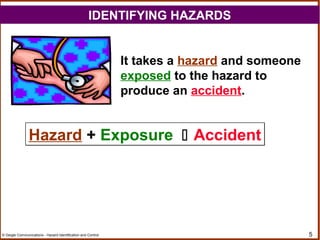
It takes a hazard and someone
exposed to the hazard to
produce an accident.
Hazard + Exposure  AccidentHazard + Exposure  Accident
6© Geigle Communications - Hazard Identification and Control
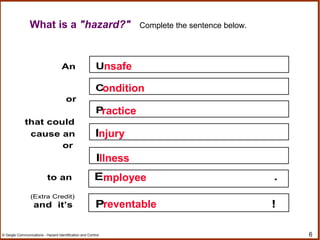
An U
C
and it’s P !
that could
cause an I
to an E .
P
I
(Extra Credit)
or
or
What is a "hazard?" Complete the sentence below.
nsafe
ondition
ractice
njury
llness
mployee
reventable
7© Geigle Communications - Hazard Identification and Control
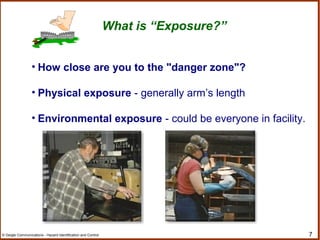
What is “Exposure?”
• How close are you to the "danger zone"?
• Physical exposure - generally arm’s length
• Environmental exposure - could be everyone in facility.
8© Geigle Communications - Hazard Identification and Control
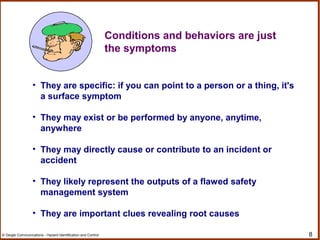
• They are specific: if you can point to a person or a thing, it's
a surface symptom
• They may exist or be performed by anyone, anytime,
anywhere
• They may directly cause or contribute to an incident or
accident
• They likely represent the outputs of a flawed safety
management system
• They are important clues revealing root causes
Conditions and behaviors are just
the symptoms
9© Geigle Communications - Hazard Identification and Control
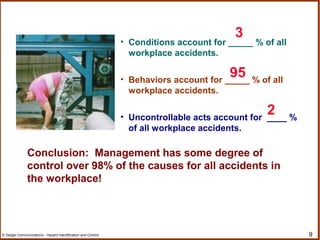
• Conditions account for _____ % of all
workplace accidents.
• Behaviors account for _____ % of all
workplace accidents.
• Uncontrollable acts account for ____ %
of all workplace accidents.
3
95
2
Conclusion: Management has some degree of
control over 98% of the causes for all accidents in
the workplace!
10© Geigle Communications - Hazard Identification and Control
The underlying root causes must be
diagnosed and treated!
System Design Defects - Missing or inadequate program
development
• One or more inadequate policies, plans, programs, processes,
procedures, practices
• Inadequate resources - money, time, people, materials, etc.
• Assures inadequate implementation of the safety management
system
• Have the greatest positive or negative impact on the safety
management system
11© Geigle Communications - Hazard Identification and Control
System Performance Defects - Failure to accomplish
action plans
• Managers, supervisors, or employees fail to effectively carry
out safety policies, plans, processes, procedures or
management practices
• They produce common hazardous conditions and/or unsafe
behaviors, or
• They produce repeated unique hazardous conditions and/or
unsafe behaviors
12© Geigle Communications - Hazard Identification and Control
How to develop an effective safety and health
checklist.
• Determine applicable state safety & health rules for the
workplace.
• Review rules and use those you feel apply to your
workplace.
• Develop applicable checklist questions that are not
addressed in the rules.
Inspections1
Four Important Processes to
Identify and Analyze Hazards
13© Geigle Communications - Hazard Identification and Control
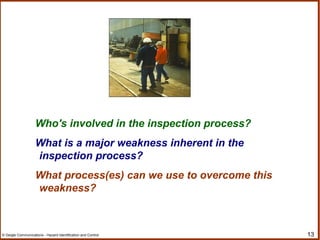
Who's involved in the inspection process?
What is a major weakness inherent in the
inspection process?
What process(es) can we use to overcome this
weakness?
14© Geigle Communications - Hazard Identification and Control
Observations, informal and formal, are quite
important in daily workplace safety.
• Employees and managers can spot
hazardous conditions and unsafe or
inappropriate behaviors while they conduct
their other tasks.
Observation2
15© Geigle Communications - Hazard Identification and Control
1. The Background/Introduction
2. The Findings
3. The Recommendations
4. The Conclusion/Summary
Writing Effective Inspection Reports
16© Geigle Communications - Hazard Identification and Control
• Watch your language. Examples?
• Keep it simple. How?
• Reward appropriate performance.
Which?
How can we most effectively recognize
employees for reporting hazards?
Report Identified Hazards
17© Geigle Communications - Hazard Identification and Control
The Job Hazard Analysis
The process...
• Break a job or task into specific steps.
• Analyze each step for specific hazardous
conditions and unsafe practices.
• Develop preventive measures in each step to
eliminate or reduce the hazards.
• Integrate preventive measures into training
and standard operating procedures (SOP’s).
3 SAM
PL
E JO
B HAZA
RD ANALY
SIS WORKSHEET
Job Description: ____________________________________________________________
Step
1 Descriptio
n: _________________________________________________________
Hazards
Preventive Measure(s) Required
1. ___________________________
__________________________________________
2. ___________________________
__________________________________________
3. ___________________________
__________________________________________
Step
2 Description: _________________________________________________________
Hazards
Preventive Measure(s) Required
1. ___________________________
__________________________________________
2. ___________________________
__________________________________________
3. ___________________________
__________________________________________
Step
3 Description: _________________________________________________________
Hazards
Preventive Measure(s) Required
1. ___________________________
__________________________________________
2. ___________________________
__________________________________________
3. ___________________________
__________________________________________
Safe Job Procedure
__________________________________________________________________________
__________________________________________________________________________
__________________________________________________________________________
________________________________________________________________
__________
________________________________________________________________
__________
SA
MPL
E JO
B HAZA
RD ANALY
SIS WORKSHEET
Job Description: ____________________________________________________________
Step
1 Description: _________________________________________________________
Hazards
Preventive Measure(s) Required
1. ___________________________
__________________________________________
2. ___________________________
__________________________________________
3. ___________________________
__________________________________________
Step
2 Description: _________________________________________________________
Hazards
Preventive Measure(s) Required
1. ___________________________
__________________________________________
2. ___________________________
__________________________________________
3. ___________________________
__________________________________________
Step
3 Description: _________________________________________________________
Hazards
Preventive Measure(s) Required
1. ___________________________
__________________________________________
2. ___________________________
__________________________________________
3. ___________________________
__________________________________________
Safe Job Procedure
__________________________________________________________________________
__________________________________________________________________________
__________________________________________________________________________
__________________________________________________________________________
__________________________________________________________________________
18© Geigle Communications - Hazard Identification and Control
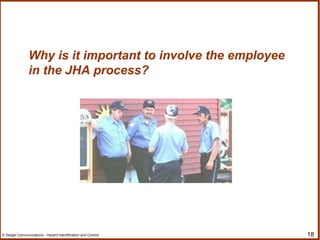
Why is it important to involve the employee
in the JHA process?
19© Geigle Communications - Hazard Identification and Control
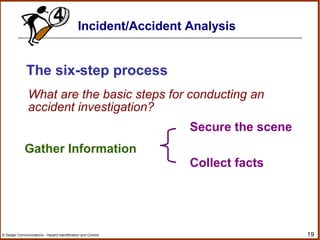
Incident/Accident Analysis
4
What are the basic steps for conducting an
accident investigation?
The six-step process
Gather Information
Secure the scene
Collect facts
20© Geigle Communications - Hazard Identification and Control
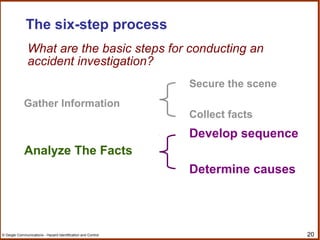
What are the basic steps for conducting an
accident investigation?
The six-step process
Gather Information
Analyze The Facts
Secure the scene
Collect facts
Develop sequence
Determine causes
21© Geigle Communications - Hazard Identification and Control
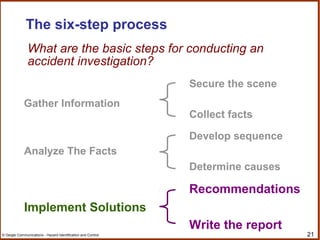
What are the basic steps for conducting an
accident investigation?
The six-step process
Gather Information
Analyze The Facts
Implement Solutions
Secure the scene
Collect facts
Develop sequence
Determine causes
Recommendations
Write the report
22© Geigle Communications - Hazard Identification and Control
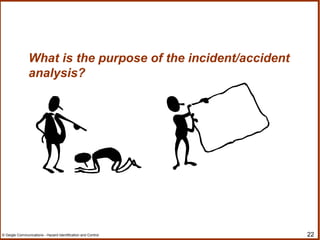
What is the purpose of the incident/accident
analysis?
23© Geigle Communications - Hazard Identification and Control
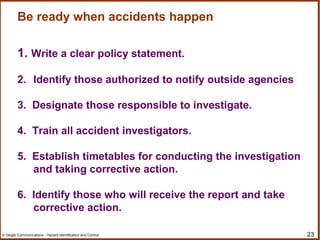
Be ready when accidents happen
1. Write a clear policy statement.
2. Identify those authorized to notify outside agencies
3. Designate those responsible to investigate.
4. Train all accident investigators.
5. Establish timetables for conducting the investigation
and taking corrective action.
6. Identify those who will receive the report and take
corrective action.
24© Geigle Communications - Hazard Identification and Control
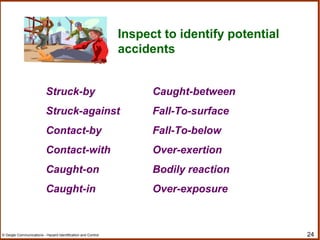
Inspect to identify potential
accidents
Struck-by
Struck-against
Contact-by
Contact-with
Caught-on
Caught-in
Caught-between
Fall-To-surface
Fall-To-below
Over-exertion
Bodily reaction
Over-exposure
25© Geigle Communications - Hazard Identification and Control
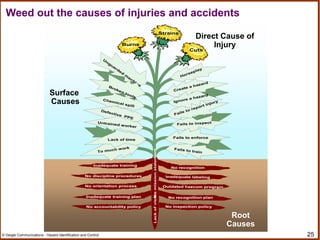
Fails to inspect
No recognition planInadequate training plan
No accountability policy No inspection policy
No discipline procedures
Outdated hazcom programNo orientation process
U
nguarded
m
achine
Horseplay
Fails to trainTo much work
Defective PPE
Fails to report injury
Inadequate training
Create a hazard
Fails to enforce
Untrained worker
Broken tools
Ignore a hazard
Lack of time
Inadequate labeling
No recognition
Cuts
Burns
Lackofvision
Strains
Nomissionstatement
Chemical spill
Direct Cause of
Injury
Surface
Causes
Root
Causes
Weed out the causes of injuries and accidents
26© Geigle Communications - Hazard Identification and Control
Direct Cause of injury- A harmful transfer of energy
that produces injury or illness.
Surface Causes of accident - Specific hazardous
conditions or unsafe behaviors that result in an accident.
Root Causes of the accident - Common behaviors
and conditions that ultimately result in an accident.
27© Geigle Communications - Hazard Identification and Control
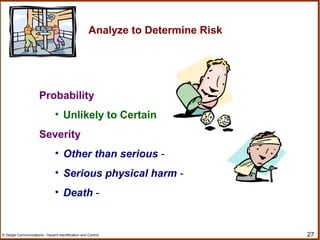
Probability
• Unlikely to Certain
Severity
• Other than serious -
• Serious physical harm -
• Death -
Analyze to Determine Risk
28© Geigle Communications - Hazard Identification and Control
Factors that increase risk
• The number of employees exposed;
• The frequency and duration of exposure;
• The proximity of employees to the point of danger;
• Potential severity of the injury or illness
• Factors that require work under stress;
• Factors that increase severity;
• Lack of proper training and supervision or improper
workplace design; or
• Other factors which may significantly affect the degree of
probability of an accident occurring.
29© Geigle Communications - Hazard Identification and Control
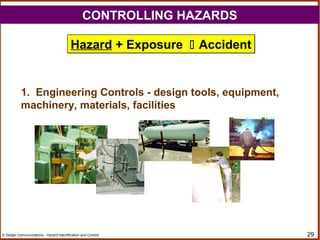
1. Engineering Controls - design tools, equipment,
machinery, materials, facilities
Hazard + Exposure  AccidentHazard + Exposure  Accident
CONTROLLING HAZARDS
30© Geigle Communications - Hazard Identification and Control
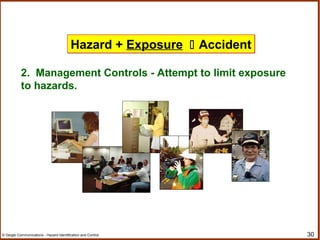
2. Management Controls - Attempt to limit exposure
to hazards.
Hazard + Exposure  AccidentHazard + Exposure  Accident
31© Geigle Communications - Hazard Identification and Control
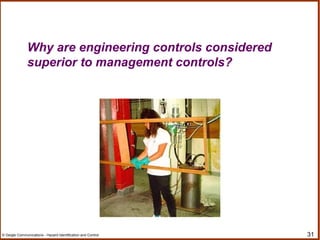
Why are engineering controls considered
superior to management controls?
32© Geigle Communications - Hazard Identification and Control
Control hazards with effective
education and training
When is it important to train employees?
How do we know safety education and
training has been effective?
33© Geigle Communications - Hazard Identification and Control
DOCUMENT SAFETY TRAINING!
Sample training certification for specific tasks
• Trainee certification
• Trainer certification
• Supervisor validation
If it isn’t in writing…it didn’t get done…
34© Geigle Communications - Hazard Identification and Control
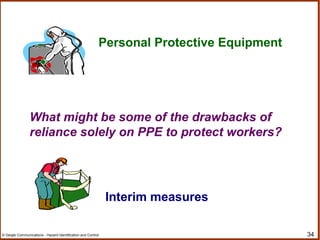
Personal Protective Equipment
What might be some of the drawbacks of
reliance solely on PPE to protect workers?
Interim measures
35© Geigle Communications - Hazard Identification and Control
Effective Maintenance Processes
Two equipment maintenance programs
1. Preventive Maintenance to make sure equipment
and machinery runs safely and smoothly.
2. Corrective Maintenance to make sure equipment
gets back into safe service quickly.
How can we make sure corrective maintenance is
completed quickly?
36© Geigle Communications - Hazard Identification and Control
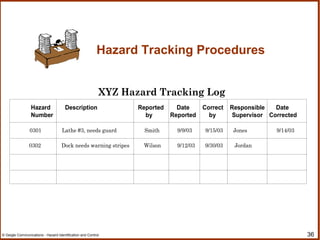
Hazard Tracking Procedures
Hazard Description Reported Date Correct Responsible Date
Number by Reported by Supervisor Corrected
XYZ Hazard Tracking Log
0301 Lathe #3, needs guard Smith 9/9/03 9/15/03 Jones 9/14/03
0302 Dock needs warning stripes Wilson 9/12/03 9/30/03 Jordan
37© Geigle Communications - Hazard Identification and Control
Plan evaluation
Team Exercise: Discuss the processes your
organization uses to evaluate the safety
management system.
38© Geigle Communications - Hazard Identification and Control
Continual improvement
Consider how the change you propose will impact
elements of the safety management system.
39© Geigle Communications - Hazard Identification and Control
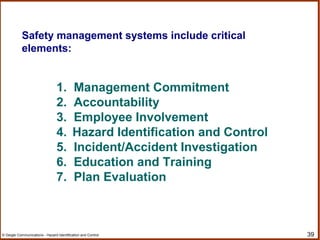
Safety management systems include critical
elements:
1. Management Commitment
2. Accountability
3. Employee Involvement
4. Hazard Identification and Control
5. Incident/Accident Investigation
6. Education and Training
7. Plan Evaluation
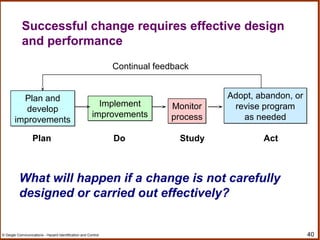
40© Geigle Communications - Hazard Identification and Control
Successful change requires effective design
and performance
Implement
improvements
Implement
improvements
Monitor
process
Monitor
process
Adopt, abandon, or
revise program
as needed
Adopt, abandon, or
revise program
as needed
Continual feedback
Plan and
develop
improvements
Plan and
develop
improvements
What will happen if a change is not carefully
designed or carried out effectively?
Plan Do Study Act
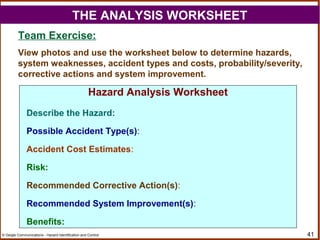
41© Geigle Communications - Hazard Identification and Control
THE ANALYSIS WORKSHEET
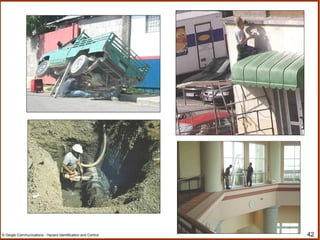
Team Exercise:
View photos and use the worksheet below to determine hazards,
system weaknesses, accident types and costs, probability/severity,
corrective actions and system improvement.
Hazard Analysis Worksheet
Describe the Hazard:
Possible Accident Type(s):
Accident Cost Estimates:
Risk:
Recommended Corrective Action(s):
Recommended System Improvement(s):
Benefits:
42© Geigle Communications - Hazard Identification and Control
43© Geigle Communications - Hazard Identification and Control
FINAL EXAM!
You must pass this test to receive credit
for this class. Just follow these
instructions, and answer the questions
one at a time and as quickly as you can!
44© Geigle Communications - Hazard Identification and Control
Think of a number from 1 to 10
Multiply that number by 9
45© Geigle Communications - Hazard Identification and Control
If the number is a 2-digit number.
Add the digits together.
Subtract 5 from that number.
46© Geigle Communications - Hazard Identification and Control
Determine which letter in the alphabet
corresponds to the number you ended
up with.
(example: 1=a, 2=b, 3=c, etc.)
47© Geigle Communications - Hazard Identification and Control
Think of a country that starts with that
letter.
Remember the last letter of the name of
that country.
48© Geigle Communications - Hazard Identification and Control
Think of the name of an animal that
starts with that letter.
Remember the last letter in the name of
that animal.
49© Geigle Communications - Hazard Identification and Control
Think of the name of a fruit that
starts with that letter.
50© Geigle Communications - Hazard Identification and Control
Are you thinking of a Kangaroo
in Denmark eating an Orange?
51© Geigle Communications - Hazard Identification and Control
If not, you're among the 2% of the population
whose minds are different enough to think of
something else.
52© Geigle Communications - Hazard Identification and Control
Let’s
Review!

Hazard identification and control

  • 1.
    1© Geigle Communications- Hazard Identification and Control Hazard Identification and Control Welcome! Trainer note: You have permission to make changes to this workbook file for your own personal use. You may make copies for personal use. You may not use this file for resale or other commercial purposes. (Remove this notice before you use the file ;-)
  • 2.
    2© Geigle Communications- Hazard Identification and Control Your Intro Page Here (Please change this image at the...it's me! ;-)
  • 3.
    3© Geigle Communications- Hazard Identification and Control Workshop goals • Explore the elements of an effective hazard identification and control program. • Discuss the steps in the hazard identification and control process. • Complete the hazard identification and control worksheet.
  • 4.
    4© Geigle Communications- Hazard Identification and Control Form Teams
  • 5.
    5© Geigle Communications- Hazard Identification and Control IDENTIFYING HAZARDS It takes a hazard and someone exposed to the hazard to produce an accident. Hazard + Exposure  AccidentHazard + Exposure  Accident
  • 6.
    6© Geigle Communications- Hazard Identification and Control An U C and it’s P ! that could cause an I to an E . P I (Extra Credit) or or What is a "hazard?" Complete the sentence below. nsafe ondition ractice njury llness mployee reventable
  • 7.
    7© Geigle Communications- Hazard Identification and Control What is “Exposure?” • How close are you to the "danger zone"? • Physical exposure - generally arm’s length • Environmental exposure - could be everyone in facility.
  • 8.
    8© Geigle Communications- Hazard Identification and Control • They are specific: if you can point to a person or a thing, it's a surface symptom • They may exist or be performed by anyone, anytime, anywhere • They may directly cause or contribute to an incident or accident • They likely represent the outputs of a flawed safety management system • They are important clues revealing root causes Conditions and behaviors are just the symptoms
  • 9.
    9© Geigle Communications- Hazard Identification and Control • Conditions account for _____ % of all workplace accidents. • Behaviors account for _____ % of all workplace accidents. • Uncontrollable acts account for ____ % of all workplace accidents. 3 95 2 Conclusion: Management has some degree of control over 98% of the causes for all accidents in the workplace!
  • 10.
    10© Geigle Communications- Hazard Identification and Control The underlying root causes must be diagnosed and treated! System Design Defects - Missing or inadequate program development • One or more inadequate policies, plans, programs, processes, procedures, practices • Inadequate resources - money, time, people, materials, etc. • Assures inadequate implementation of the safety management system • Have the greatest positive or negative impact on the safety management system
  • 11.
    11© Geigle Communications- Hazard Identification and Control System Performance Defects - Failure to accomplish action plans • Managers, supervisors, or employees fail to effectively carry out safety policies, plans, processes, procedures or management practices • They produce common hazardous conditions and/or unsafe behaviors, or • They produce repeated unique hazardous conditions and/or unsafe behaviors
  • 12.
    12© Geigle Communications- Hazard Identification and Control How to develop an effective safety and health checklist. • Determine applicable state safety & health rules for the workplace. • Review rules and use those you feel apply to your workplace. • Develop applicable checklist questions that are not addressed in the rules. Inspections1 Four Important Processes to Identify and Analyze Hazards
  • 13.
    13© Geigle Communications- Hazard Identification and Control Who's involved in the inspection process? What is a major weakness inherent in the inspection process? What process(es) can we use to overcome this weakness?
  • 14.
    14© Geigle Communications- Hazard Identification and Control Observations, informal and formal, are quite important in daily workplace safety. • Employees and managers can spot hazardous conditions and unsafe or inappropriate behaviors while they conduct their other tasks. Observation2
  • 15.
    15© Geigle Communications- Hazard Identification and Control 1. The Background/Introduction 2. The Findings 3. The Recommendations 4. The Conclusion/Summary Writing Effective Inspection Reports
  • 16.
    16© Geigle Communications- Hazard Identification and Control • Watch your language. Examples? • Keep it simple. How? • Reward appropriate performance. Which? How can we most effectively recognize employees for reporting hazards? Report Identified Hazards
  • 17.
    17© Geigle Communications- Hazard Identification and Control The Job Hazard Analysis The process... • Break a job or task into specific steps. • Analyze each step for specific hazardous conditions and unsafe practices. • Develop preventive measures in each step to eliminate or reduce the hazards. • Integrate preventive measures into training and standard operating procedures (SOP’s). 3 SAM PL E JO B HAZA RD ANALY SIS WORKSHEET Job Description: ____________________________________________________________ Step 1 Descriptio n: _________________________________________________________ Hazards Preventive Measure(s) Required 1. ___________________________ __________________________________________ 2. ___________________________ __________________________________________ 3. ___________________________ __________________________________________ Step 2 Description: _________________________________________________________ Hazards Preventive Measure(s) Required 1. ___________________________ __________________________________________ 2. ___________________________ __________________________________________ 3. ___________________________ __________________________________________ Step 3 Description: _________________________________________________________ Hazards Preventive Measure(s) Required 1. ___________________________ __________________________________________ 2. ___________________________ __________________________________________ 3. ___________________________ __________________________________________ Safe Job Procedure __________________________________________________________________________ __________________________________________________________________________ __________________________________________________________________________ ________________________________________________________________ __________ ________________________________________________________________ __________ SA MPL E JO B HAZA RD ANALY SIS WORKSHEET Job Description: ____________________________________________________________ Step 1 Description: _________________________________________________________ Hazards Preventive Measure(s) Required 1. ___________________________ __________________________________________ 2. ___________________________ __________________________________________ 3. ___________________________ __________________________________________ Step 2 Description: _________________________________________________________ Hazards Preventive Measure(s) Required 1. ___________________________ __________________________________________ 2. ___________________________ __________________________________________ 3. ___________________________ __________________________________________ Step 3 Description: _________________________________________________________ Hazards Preventive Measure(s) Required 1. ___________________________ __________________________________________ 2. ___________________________ __________________________________________ 3. ___________________________ __________________________________________ Safe Job Procedure __________________________________________________________________________ __________________________________________________________________________ __________________________________________________________________________ __________________________________________________________________________ __________________________________________________________________________
  • 18.
    18© Geigle Communications- Hazard Identification and Control Why is it important to involve the employee in the JHA process?
  • 19.
    19© Geigle Communications- Hazard Identification and Control Incident/Accident Analysis 4 What are the basic steps for conducting an accident investigation? The six-step process Gather Information Secure the scene Collect facts
  • 20.
    20© Geigle Communications- Hazard Identification and Control What are the basic steps for conducting an accident investigation? The six-step process Gather Information Analyze The Facts Secure the scene Collect facts Develop sequence Determine causes
  • 21.
    21© Geigle Communications- Hazard Identification and Control What are the basic steps for conducting an accident investigation? The six-step process Gather Information Analyze The Facts Implement Solutions Secure the scene Collect facts Develop sequence Determine causes Recommendations Write the report
  • 22.
    22© Geigle Communications- Hazard Identification and Control What is the purpose of the incident/accident analysis?
  • 23.
    23© Geigle Communications- Hazard Identification and Control Be ready when accidents happen 1. Write a clear policy statement. 2. Identify those authorized to notify outside agencies 3. Designate those responsible to investigate. 4. Train all accident investigators. 5. Establish timetables for conducting the investigation and taking corrective action. 6. Identify those who will receive the report and take corrective action.
  • 24.
    24© Geigle Communications- Hazard Identification and Control Inspect to identify potential accidents Struck-by Struck-against Contact-by Contact-with Caught-on Caught-in Caught-between Fall-To-surface Fall-To-below Over-exertion Bodily reaction Over-exposure
  • 25.
    25© Geigle Communications- Hazard Identification and Control Fails to inspect No recognition planInadequate training plan No accountability policy No inspection policy No discipline procedures Outdated hazcom programNo orientation process U nguarded m achine Horseplay Fails to trainTo much work Defective PPE Fails to report injury Inadequate training Create a hazard Fails to enforce Untrained worker Broken tools Ignore a hazard Lack of time Inadequate labeling No recognition Cuts Burns Lackofvision Strains Nomissionstatement Chemical spill Direct Cause of Injury Surface Causes Root Causes Weed out the causes of injuries and accidents
  • 26.
    26© Geigle Communications- Hazard Identification and Control Direct Cause of injury- A harmful transfer of energy that produces injury or illness. Surface Causes of accident - Specific hazardous conditions or unsafe behaviors that result in an accident. Root Causes of the accident - Common behaviors and conditions that ultimately result in an accident.
  • 27.
    27© Geigle Communications- Hazard Identification and Control Probability • Unlikely to Certain Severity • Other than serious - • Serious physical harm - • Death - Analyze to Determine Risk
  • 28.
    28© Geigle Communications- Hazard Identification and Control Factors that increase risk • The number of employees exposed; • The frequency and duration of exposure; • The proximity of employees to the point of danger; • Potential severity of the injury or illness • Factors that require work under stress; • Factors that increase severity; • Lack of proper training and supervision or improper workplace design; or • Other factors which may significantly affect the degree of probability of an accident occurring.
  • 29.
    29© Geigle Communications- Hazard Identification and Control 1. Engineering Controls - design tools, equipment, machinery, materials, facilities Hazard + Exposure  AccidentHazard + Exposure  Accident CONTROLLING HAZARDS
  • 30.
    30© Geigle Communications- Hazard Identification and Control 2. Management Controls - Attempt to limit exposure to hazards. Hazard + Exposure  AccidentHazard + Exposure  Accident
  • 31.
    31© Geigle Communications- Hazard Identification and Control Why are engineering controls considered superior to management controls?
  • 32.
    32© Geigle Communications- Hazard Identification and Control Control hazards with effective education and training When is it important to train employees? How do we know safety education and training has been effective?
  • 33.
    33© Geigle Communications- Hazard Identification and Control DOCUMENT SAFETY TRAINING! Sample training certification for specific tasks • Trainee certification • Trainer certification • Supervisor validation If it isn’t in writing…it didn’t get done…
  • 34.
    34© Geigle Communications- Hazard Identification and Control Personal Protective Equipment What might be some of the drawbacks of reliance solely on PPE to protect workers? Interim measures
  • 35.
    35© Geigle Communications- Hazard Identification and Control Effective Maintenance Processes Two equipment maintenance programs 1. Preventive Maintenance to make sure equipment and machinery runs safely and smoothly. 2. Corrective Maintenance to make sure equipment gets back into safe service quickly. How can we make sure corrective maintenance is completed quickly?
  • 36.
    36© Geigle Communications- Hazard Identification and Control Hazard Tracking Procedures Hazard Description Reported Date Correct Responsible Date Number by Reported by Supervisor Corrected XYZ Hazard Tracking Log 0301 Lathe #3, needs guard Smith 9/9/03 9/15/03 Jones 9/14/03 0302 Dock needs warning stripes Wilson 9/12/03 9/30/03 Jordan
  • 37.
    37© Geigle Communications- Hazard Identification and Control Plan evaluation Team Exercise: Discuss the processes your organization uses to evaluate the safety management system.
  • 38.
    38© Geigle Communications- Hazard Identification and Control Continual improvement Consider how the change you propose will impact elements of the safety management system.
  • 39.
    39© Geigle Communications- Hazard Identification and Control Safety management systems include critical elements: 1. Management Commitment 2. Accountability 3. Employee Involvement 4. Hazard Identification and Control 5. Incident/Accident Investigation 6. Education and Training 7. Plan Evaluation
  • 40.
    40© Geigle Communications- Hazard Identification and Control Successful change requires effective design and performance Implement improvements Implement improvements Monitor process Monitor process Adopt, abandon, or revise program as needed Adopt, abandon, or revise program as needed Continual feedback Plan and develop improvements Plan and develop improvements What will happen if a change is not carefully designed or carried out effectively? Plan Do Study Act
  • 41.
    41© Geigle Communications- Hazard Identification and Control THE ANALYSIS WORKSHEET Team Exercise: View photos and use the worksheet below to determine hazards, system weaknesses, accident types and costs, probability/severity, corrective actions and system improvement. Hazard Analysis Worksheet Describe the Hazard: Possible Accident Type(s): Accident Cost Estimates: Risk: Recommended Corrective Action(s): Recommended System Improvement(s): Benefits:
  • 42.
    42© Geigle Communications- Hazard Identification and Control
  • 43.
    43© Geigle Communications- Hazard Identification and Control FINAL EXAM! You must pass this test to receive credit for this class. Just follow these instructions, and answer the questions one at a time and as quickly as you can!
  • 44.
    44© Geigle Communications- Hazard Identification and Control Think of a number from 1 to 10 Multiply that number by 9
  • 45.
    45© Geigle Communications- Hazard Identification and Control If the number is a 2-digit number. Add the digits together. Subtract 5 from that number.
  • 46.
    46© Geigle Communications- Hazard Identification and Control Determine which letter in the alphabet corresponds to the number you ended up with. (example: 1=a, 2=b, 3=c, etc.)
  • 47.
    47© Geigle Communications- Hazard Identification and Control Think of a country that starts with that letter. Remember the last letter of the name of that country.
  • 48.
    48© Geigle Communications- Hazard Identification and Control Think of the name of an animal that starts with that letter. Remember the last letter in the name of that animal.
  • 49.
    49© Geigle Communications- Hazard Identification and Control Think of the name of a fruit that starts with that letter.
  • 50.
    50© Geigle Communications- Hazard Identification and Control Are you thinking of a Kangaroo in Denmark eating an Orange?
  • 51.
    51© Geigle Communications- Hazard Identification and Control If not, you're among the 2% of the population whose minds are different enough to think of something else.
  • 52.
    52© Geigle Communications- Hazard Identification and Control Let’s Review!

Editor's Notes

  • #16 It’s important to write an inspection report that effectively “sells” management on corrective actions. The following inspection report format is designed to give management useful information describing hazards and “bottom line” costs/benefits needed to justify corrective actions. 1. The Background/Introduction section briefly outlines the contents of the rest of the report and tells the reader: a. What the report is, b. Who conducted the inspection, c. Where was it was conducted, d. Why it was conducted. 2. The Findings section tells the reader the results of the inspection. It details: a. Specific hazards found, b. Underlying root causes or contributing factors that allow those hazards to exist, c. Possible accidents that may result, d. Estimated probability and severity of potential accidents, and
  • #19 It’s important to write an inspection report that effectively “sells” management on corrective actions. The following inspection report format is designed to give management useful information describing hazards and “bottom line” costs/benefits needed to justify corrective actions. 1. The Background/Introduction section briefly outlines the contents of the rest of the report and tells the reader: a. What the report is, b. Who conducted the inspection, c. Where was it was conducted, d. Why it was conducted. 2. The Findings section tells the reader the results of the inspection. It details: a. Specific hazards found, b. Underlying root causes or contributing factors that allow those hazards to exist, c. Possible accidents that may result, d. Estimated probability and severity of potential accidents, and
  • #26 <number>