
INSTITUTE OF CHEMICAL TECHNOLOGY MUMBAI
SAFETY AND PROTECTIVE TEXTILES
BY-KANHAYA LAL KUMAWAT
INTRODUCTION
 SAFETY TECHNICAL TEXTILE
 Keeps you safe
 Protects from various hazards
 Protection against
 Extreme heat and fire
 Extreme cold weather
 Hazardous chemicals and gases
 Bacterial, viral environment
 High voltage electric current
 Electromagnetic induction (EMI)
 Radiations
 Mechanical injury
 Vacuum, pressure
 Modern nuclear and bio weapons
 Safety and protective textiles are not restricted
only to human beings
PROTECTION FROM EXTREME HEAT AND FIRE
 Fibres
Asbestos- evolves toxic gases, carcinogenic
FR viscose
Glass
Nomex
PPS
PBI
Carbon
Ceramic
 Properties
1. LOI (limiting oxygen index)
2. Strength retention
PBI and PPS show high strength retention even at high temperatures
3. Mass reduction
Depends upon temperature, exposure time
FIBRE PBI PTFE NOMEX KEVLAR PVC PHENOL
IC
LOI (%) 61 58 36 29 29 18
FIBRE PBI PTFE NOME
X
KEVLA
R
PANO
X
PPS
LOI
(%)
41 95 30 29 55 34
Continued…
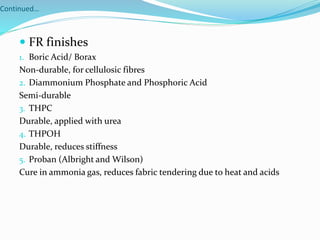
 DESIGNING FR CLOTHING
Mostly 10-80 oz/sq yd
 Nature of application- insulation, welding, gaskets etc.
 Environmental conditions- chemicals, abrasions etc.
 Exposure time
 Temperature range
 Primary FR fabrics
 Secondary FR fabrics
 Design of fire fighter suit
1. Outer layer
Heat and flame resistant, abrasion resistant, 60/40 Kevlar/PBI or Polyimide
2. Moisture layer
Keeps fire fighter dry, PTFE coated or laminated
3. Thermal layer
Inner thermal barrier can be needle punched into batting and face may be
quilted
GSM of fabric- 1150
Continued…
 FR finishes
1. Boric Acid/ Borax
Non-durable, for cellulosic fibres
2. Diammonium Phosphate and Phosphoric Acid
Semi-durable
3. THPC
Durable, applied with urea
4. THPOH
Durable, reduces stiffness
5. Proban (Albright and Wilson)
Cure in ammonia gas, reduces fabric tendering due to heat and acids
PROTECTION FROM HAZARDOUS CHEMICALS, GASES
 SCOPES
 Chemical industries
 farmers handling insecticides
 Forensic
 fire brigades
 Environmental Protection Agency (EPA) has defined four
levels of protection
1. Level ‘A’-
Highest protection, gas and vapour tight
2. Level ‘B’-
Protects from liquids but may not prevent the penetration of gases and
vapors
3. Level ‘C’-
Same as level ‘B’, but provides limited protection
4. Level ‘D’-
Dirt free clothing
Levels of Chemical Protection
A
Vapour
Protective Suit
Liquid Splash
Protective Suit
Support Function
Protective Garment
Coveralls,
Safety boots/shoes,
etc.
B
C
D
Continued…
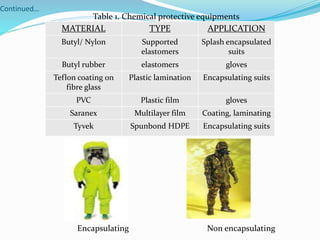
Table 1. Chemical protective equipments
Encapsulating Non encapsulating
MATERIAL TYPE APPLICATION
Butyl/ Nylon Supported
elastomers
Splash encapsulated
suits
Butyl rubber elastomers gloves
Teflon coating on
fibre glass
Plastic lamination Encapsulating suits
PVC Plastic film gloves
Saranex Multilayer film Coating, laminating
Tyvek Spunbond HDPE Encapsulating suits
MECHANICAL PROTECTIVE CLOTHING
 Protection from cut, tear, puncture, abrasion, impact etc.
 High tensile strength fibres used like p-aramides (Kevlar), HDPE (Dyneema)
 Composites -
1. Wrapping of cut resistant fibres around steel/ fibre glass
2. High strength textile fibres with metal fibres
3. Kevlar and HDPE
 Equipments are gloves, aprons, sleeves, pads etc., should not hinder the performance of the wearer
 Applications in flood protection, forestry works, tree cutting, construction sites, metal works,
automobiles etc., reduces injuries during accidents
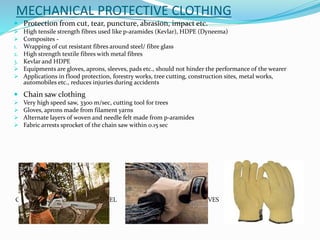
 Chain saw clothing
 Very high speed saw, 3300 m/sec, cutting tool for trees
 Gloves, aprons made from filament yarns
 Alternate layers of woven and needle felt made from p-aramides
 Fabric arrests sprocket of the chain saw within 0.15 sec
CHAIN SAW PROTECTIVE APPAREL PUNCTURE RESISTANT GLOVES CUT RESISTANT
GLOVES
ENVIRONMENTAL PROTECTION
Includes odour management, protecting environment from contaminants,
foreign matter etc.
 THE CONCEPT OF CLEAN ROOM GARMENT
 Protects environment from being contaminated by humans
 Clean rooms are necessary for food processing, pharmaceuticals,
aerospace micro chips manufacturing, optics of many automobiles etc.
 Human body sheds 1 billion cells everyday, except, carries considerable
amounts of lints, foreign matters, perfumes along with the dress
materials
 Disturbs the clean room environment particularly in hi-tech areas
 C-R textiles should be lint free, antistatic and resistant to human
contaminants like dead skin, hairs etc.
 Requirements
Pore size should be < 0.2 micron, continuous filament yarns used,
Sterilization
CLEAN ROOM GARMENTS
EMI SHIELDING
 Electromagnetic pollution
 Serious problem due to use of electrical and electronic devices in military, industries etc.
 Unwanted signals affect badly the sensitive equipments used in-
1. Traffic control
2. Marine radar
3. Space exploration
4. Medical (brain scanning, endoscopic surgeries etc.)
 EMI requires-
A source of conductive EM waves, a propagating medium, a receptor which suffers
adverse effects from the received signals
 EMI SHIELDING
 Barrier of conductive material attenuates energy of EM waves through
reflection and absorption
 Metals can provide adequate shielding but will increase weight of garment
 Conductive polymers are light weight, low cost, flexible, versatile, shielding
effectiveness depends upon concentration and the conductivity of the filler
particles
 Carbon acts as filling material for the polymers
 Short carbon fibre, rubber composites
 Polypyrrole impregnated conductive polymer composites, inclusion of
polypyrrole in a porous cross linked polystyrene host polymer
EMF PROTECTIVE CLOTHING
 Utility workers working very close to high voltage may affect from
induced current of high amperage
 Very harmful, body may catch fire, electric arc occurs as a result of
extreme discharges of voltage, generates a very high level of energy for a
very short period of time (<1 sec), intense heat energy of an electric arc
can generate temperatures of as high as 19,000°C and it also produces
electric shock
 Surface resistivity fibres
 Core conductive fibres
 It is strongly recommended that clothing to protect
against static charges should also be fire resisting
Equipments-
Rubber hat, shoes, Rubber blanket, Live insulating jacket
Faraday’s cloth consists of 25% metal fibre and 75%
wool or with Kevlar, it is also a fire resistant
BALLISTIC PROTECTION
 Due to the development of new biological, nuclear and small superfast
weapons, ballistic protection clothing needs to be more sophisticated
Requirements-
1. Resistant to prolonged exposure to rough weather and abrasion
2. Water repellant, wind proof
3. Light weight
4. Water vapor transmission
5. Ballistic protection
6. Flame resistant
7. Resistant to chemicals, gases
8. Good aesthetic properties for uniforms etc.
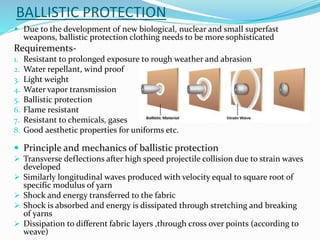
 Principle and mechanics of ballistic protection
 Transverse deflections after high speed projectile collision due to strain waves
developed
 Similarly longitudinal waves produced with velocity equal to square root of
specific modulus of yarn
 Shock and energy transferred to the fabric
 Shock is absorbed and energy is dissipated through stretching and breaking
of yarns
 Dissipation to different fabric layers ,through cross over points (according to
weave)
Continued…
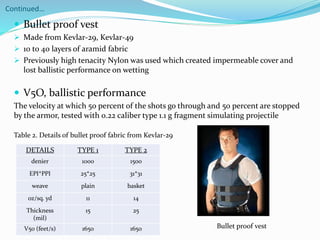
 Bullet proof vest
 Made from Kevlar-29, Kevlar-49
 10 to 40 layers of aramid fabric
 Previously high tenacity Nylon was used which created impermeable cover and
lost ballistic performance on wetting
 V5O, ballistic performance
The velocity at which 50 percent of the shots go through and 50 percent are stopped
by the armor, tested with 0.22 caliber type 1.1 g fragment simulating projectile
Table 2. Details of bullet proof fabric from Kevlar-29
Bullet proof vest
DETAILS TYPE 1 TYPE 2
denier 1000 1500
EPI*PPI 25*25 31*31
weave plain basket
oz/sq. yd 11 14
Thickness
(mil)
15 25
V50 (feet/s) 1650 1650
Continued…
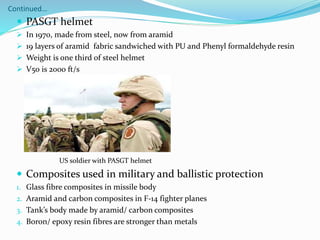
 PASGT helmet
 In 1970, made from steel, now from aramid
 19 layers of aramid fabric sandwiched with PU and Phenyl formaldehyde resin
 Weight is one third of steel helmet
 V50 is 2000 ft/s
US soldier with PASGT helmet
 Composites used in military and ballistic protection
1. Glass fibre composites in missile body
2. Aramid and carbon composites in F-14 fighter planes
3. Tank’s body made by aramid/ carbon composites
4. Boron/ epoxy resin fibres are stronger than metals
Market TrendsThe technical textile consumption under protech is estimated at
around Rs 1,387 crore which is expected to increase to around
Rs 2,386 crore by 2013-14.
The key Protech products are high altitude clothing, bullet-
proof jackets and fire retardant fabrics.
In the medium term (next 5 years), the protective textiles
industry is expected to achieve growth at the rate of 11-12%.
The demand for the protech products is dependent on the
improvements in worker safety practices, fire protective
standards for construction and the defense sector.
Conclusion
Continuous innovations & better understanding of the consumer
requirements is the need of the hour.
The technological trends and challenges ahead will be
determined by market pull demands, increasing environmental
awareness, personal safety and comfort, and performance
requirements.
Due to the increasing health and safety issues at work, protective
textiles are the most essential and attractive segment of textile
market and will continue to do so.
THANK YOU

Safety and protective technical textiles

  • 1.
    INSTITUTE OF CHEMICALTECHNOLOGY MUMBAI SAFETY AND PROTECTIVE TEXTILES BY-KANHAYA LAL KUMAWAT
  • 2.
    INTRODUCTION  SAFETY TECHNICALTEXTILE  Keeps you safe  Protects from various hazards  Protection against  Extreme heat and fire  Extreme cold weather  Hazardous chemicals and gases  Bacterial, viral environment  High voltage electric current  Electromagnetic induction (EMI)  Radiations  Mechanical injury  Vacuum, pressure  Modern nuclear and bio weapons  Safety and protective textiles are not restricted only to human beings
  • 3.
    PROTECTION FROM EXTREMEHEAT AND FIRE  Fibres Asbestos- evolves toxic gases, carcinogenic FR viscose Glass Nomex PPS PBI Carbon Ceramic  Properties 1. LOI (limiting oxygen index) 2. Strength retention PBI and PPS show high strength retention even at high temperatures 3. Mass reduction Depends upon temperature, exposure time FIBRE PBI PTFE NOMEX KEVLAR PVC PHENOL IC LOI (%) 61 58 36 29 29 18 FIBRE PBI PTFE NOME X KEVLA R PANO X PPS LOI (%) 41 95 30 29 55 34
  • 4.
    Continued…  DESIGNING FRCLOTHING Mostly 10-80 oz/sq yd  Nature of application- insulation, welding, gaskets etc.  Environmental conditions- chemicals, abrasions etc.  Exposure time  Temperature range  Primary FR fabrics  Secondary FR fabrics  Design of fire fighter suit 1. Outer layer Heat and flame resistant, abrasion resistant, 60/40 Kevlar/PBI or Polyimide 2. Moisture layer Keeps fire fighter dry, PTFE coated or laminated 3. Thermal layer Inner thermal barrier can be needle punched into batting and face may be quilted GSM of fabric- 1150
  • 5.
    Continued…  FR finishes 1.Boric Acid/ Borax Non-durable, for cellulosic fibres 2. Diammonium Phosphate and Phosphoric Acid Semi-durable 3. THPC Durable, applied with urea 4. THPOH Durable, reduces stiffness 5. Proban (Albright and Wilson) Cure in ammonia gas, reduces fabric tendering due to heat and acids
  • 6.
    PROTECTION FROM HAZARDOUSCHEMICALS, GASES  SCOPES  Chemical industries  farmers handling insecticides  Forensic  fire brigades  Environmental Protection Agency (EPA) has defined four levels of protection 1. Level ‘A’- Highest protection, gas and vapour tight 2. Level ‘B’- Protects from liquids but may not prevent the penetration of gases and vapors 3. Level ‘C’- Same as level ‘B’, but provides limited protection 4. Level ‘D’- Dirt free clothing
  • 7.
    Levels of ChemicalProtection A Vapour Protective Suit Liquid Splash Protective Suit Support Function Protective Garment Coveralls, Safety boots/shoes, etc. B C D
  • 8.
    Continued… Table 1. Chemicalprotective equipments Encapsulating Non encapsulating MATERIAL TYPE APPLICATION Butyl/ Nylon Supported elastomers Splash encapsulated suits Butyl rubber elastomers gloves Teflon coating on fibre glass Plastic lamination Encapsulating suits PVC Plastic film gloves Saranex Multilayer film Coating, laminating Tyvek Spunbond HDPE Encapsulating suits
  • 9.
    MECHANICAL PROTECTIVE CLOTHING Protection from cut, tear, puncture, abrasion, impact etc.  High tensile strength fibres used like p-aramides (Kevlar), HDPE (Dyneema)  Composites - 1. Wrapping of cut resistant fibres around steel/ fibre glass 2. High strength textile fibres with metal fibres 3. Kevlar and HDPE  Equipments are gloves, aprons, sleeves, pads etc., should not hinder the performance of the wearer  Applications in flood protection, forestry works, tree cutting, construction sites, metal works, automobiles etc., reduces injuries during accidents  Chain saw clothing  Very high speed saw, 3300 m/sec, cutting tool for trees  Gloves, aprons made from filament yarns  Alternate layers of woven and needle felt made from p-aramides  Fabric arrests sprocket of the chain saw within 0.15 sec CHAIN SAW PROTECTIVE APPAREL PUNCTURE RESISTANT GLOVES CUT RESISTANT GLOVES
  • 10.
    ENVIRONMENTAL PROTECTION Includes odourmanagement, protecting environment from contaminants, foreign matter etc.  THE CONCEPT OF CLEAN ROOM GARMENT  Protects environment from being contaminated by humans  Clean rooms are necessary for food processing, pharmaceuticals, aerospace micro chips manufacturing, optics of many automobiles etc.  Human body sheds 1 billion cells everyday, except, carries considerable amounts of lints, foreign matters, perfumes along with the dress materials  Disturbs the clean room environment particularly in hi-tech areas  C-R textiles should be lint free, antistatic and resistant to human contaminants like dead skin, hairs etc.  Requirements Pore size should be < 0.2 micron, continuous filament yarns used, Sterilization
  • 11.
  • 12.
    EMI SHIELDING  Electromagneticpollution  Serious problem due to use of electrical and electronic devices in military, industries etc.  Unwanted signals affect badly the sensitive equipments used in- 1. Traffic control 2. Marine radar 3. Space exploration 4. Medical (brain scanning, endoscopic surgeries etc.)  EMI requires- A source of conductive EM waves, a propagating medium, a receptor which suffers adverse effects from the received signals  EMI SHIELDING  Barrier of conductive material attenuates energy of EM waves through reflection and absorption  Metals can provide adequate shielding but will increase weight of garment  Conductive polymers are light weight, low cost, flexible, versatile, shielding effectiveness depends upon concentration and the conductivity of the filler particles  Carbon acts as filling material for the polymers  Short carbon fibre, rubber composites  Polypyrrole impregnated conductive polymer composites, inclusion of polypyrrole in a porous cross linked polystyrene host polymer
  • 13.
    EMF PROTECTIVE CLOTHING Utility workers working very close to high voltage may affect from induced current of high amperage  Very harmful, body may catch fire, electric arc occurs as a result of extreme discharges of voltage, generates a very high level of energy for a very short period of time (<1 sec), intense heat energy of an electric arc can generate temperatures of as high as 19,000°C and it also produces electric shock  Surface resistivity fibres  Core conductive fibres  It is strongly recommended that clothing to protect against static charges should also be fire resisting Equipments- Rubber hat, shoes, Rubber blanket, Live insulating jacket Faraday’s cloth consists of 25% metal fibre and 75% wool or with Kevlar, it is also a fire resistant
  • 14.
    BALLISTIC PROTECTION  Dueto the development of new biological, nuclear and small superfast weapons, ballistic protection clothing needs to be more sophisticated Requirements- 1. Resistant to prolonged exposure to rough weather and abrasion 2. Water repellant, wind proof 3. Light weight 4. Water vapor transmission 5. Ballistic protection 6. Flame resistant 7. Resistant to chemicals, gases 8. Good aesthetic properties for uniforms etc.  Principle and mechanics of ballistic protection  Transverse deflections after high speed projectile collision due to strain waves developed  Similarly longitudinal waves produced with velocity equal to square root of specific modulus of yarn  Shock and energy transferred to the fabric  Shock is absorbed and energy is dissipated through stretching and breaking of yarns  Dissipation to different fabric layers ,through cross over points (according to weave)
  • 15.
    Continued…  Bullet proofvest  Made from Kevlar-29, Kevlar-49  10 to 40 layers of aramid fabric  Previously high tenacity Nylon was used which created impermeable cover and lost ballistic performance on wetting  V5O, ballistic performance The velocity at which 50 percent of the shots go through and 50 percent are stopped by the armor, tested with 0.22 caliber type 1.1 g fragment simulating projectile Table 2. Details of bullet proof fabric from Kevlar-29 Bullet proof vest DETAILS TYPE 1 TYPE 2 denier 1000 1500 EPI*PPI 25*25 31*31 weave plain basket oz/sq. yd 11 14 Thickness (mil) 15 25 V50 (feet/s) 1650 1650
  • 16.
    Continued…  PASGT helmet In 1970, made from steel, now from aramid  19 layers of aramid fabric sandwiched with PU and Phenyl formaldehyde resin  Weight is one third of steel helmet  V50 is 2000 ft/s US soldier with PASGT helmet  Composites used in military and ballistic protection 1. Glass fibre composites in missile body 2. Aramid and carbon composites in F-14 fighter planes 3. Tank’s body made by aramid/ carbon composites 4. Boron/ epoxy resin fibres are stronger than metals
  • 17.
    Market TrendsThe technicaltextile consumption under protech is estimated at around Rs 1,387 crore which is expected to increase to around Rs 2,386 crore by 2013-14. The key Protech products are high altitude clothing, bullet- proof jackets and fire retardant fabrics. In the medium term (next 5 years), the protective textiles industry is expected to achieve growth at the rate of 11-12%. The demand for the protech products is dependent on the improvements in worker safety practices, fire protective standards for construction and the defense sector.
  • 18.
    Conclusion Continuous innovations &better understanding of the consumer requirements is the need of the hour. The technological trends and challenges ahead will be determined by market pull demands, increasing environmental awareness, personal safety and comfort, and performance requirements. Due to the increasing health and safety issues at work, protective textiles are the most essential and attractive segment of textile market and will continue to do so.
  • 19.