Welcome to my presentation
on
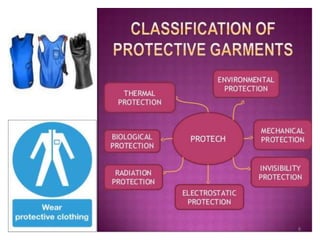
Protech/Protective clothing
Presented by
Md Rakib Hosain
1
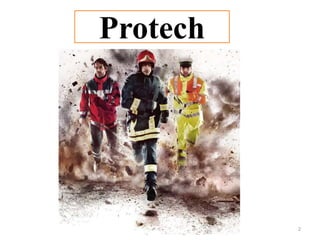
Protech
2
3
Protech or Protex/ Protective textiles
• Used in the manufacturing of protective clothing of
different types.
• Protection against heat & radiation for fire
fighter clothing,
• Against molten metals for welders,
• For bullet proof jackets, or
• For chemical protective clothing.
4
Protech or Protex/ Protective textiles
• Protective textiles are made with the help of
specialty fibers such as aramid fiber used in
making of bullet proof jackets, glass fibers used on
fire proof jackets etc.
• Sometimes the protective textiles is also coated with
special chemicals, for e.g., when used in
manufacturing astronauts suits.
• The main target of the technical protective fabric is
to improve people safety in their workplaces.
• Most of them are mainly used to manufacture PPE
(Personal Protective Equipment).
5
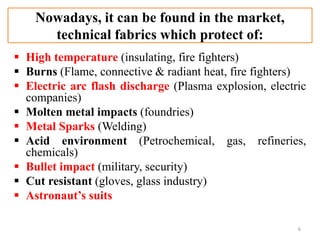
Nowadays, it can be found in the market,
technical fabrics which protect of:
 High temperature (insulating, fire fighters)
 Burns (Flame, connective & radiant heat, fire fighters)
 Electric arc flash discharge (Plasma explosion, electric
companies)
 Molten metal impacts (foundries)
 Metal Sparks (Welding)
 Acid environment (Petrochemical, gas, refineries,
chemicals)
 Bullet impact (military, security)
 Cut resistant (gloves, glass industry)
 Astronaut’s suits
6
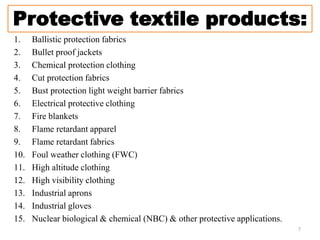
Protective textile products:
1. Ballistic protection fabrics
2. Bullet proof jackets
3. Chemical protection clothing
4. Cut protection fabrics
5. Bust protection light weight barrier fabrics
6. Electrical protective clothing
7. Fire blankets
8. Flame retardant apparel
9. Flame retardant fabrics
10. Foul weather clothing (FWC)
11. High altitude clothing
12. High visibility clothing
13. Industrial aprons
14. Industrial gloves
15. Nuclear biological & chemical (NBC) & other protective applications.
7
8
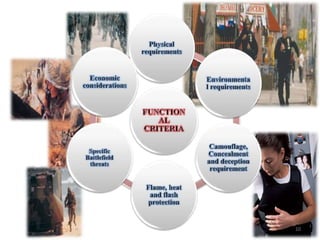
Functional criteria for Protective Textiles/
Modern Military Textiles
1. Physical requirements
2. Environment requirements
3. Camouflage, concealment & deception
requirements
4. Requirements for flame, heat & flash
protection
5. Specific battlefield hazards
6. Economic considerations
9
10
1. Physical requirements:
i. Light weight & low bulk
ii. High durability & dimensional stability
iii. Cleanable
iv. Good handle & drape
v. Low noise emission
vi. Antistatic
11
2. Environment requirements:
i. Water-repellent, waterproof, windproof & snow-
shedding
ii. Thermally insulating
iii. Water vapour permeable
iv. Rot-resistant
v. UV light resistant
vi. Air permeable
vii.Biodegradable
12
3. Camouflage, concealment &
deception requirements:
i. Visual spectrum
ii. Ultraviolet
iii. Near infrared
iv. Acoustic emissions
v. Radar spectrum
13
4. Requirements for flame, heat &
flash protection:
i. Flame retardance
ii. Heat resistance
iii. Melt resistance
iv. Low smoke emission
v. Low toxicity
14
5. Specific Battlefield Hazards:
 Ballistic fragments (from bombs, grenades, shells,
warheads)
 Low velocity bullets (from hand guns, pistols, etc.)
 High velocity bullets (from small-arms rifled weapons
from 5.56mm up to 12.7mm calibre)
 Flechettes (small, sharp, needle shaped projectiles)
 Chemical warfare agents (including blood agents,
nerve agents, vessicants)
 Biological agents (bacteria, toxins, viruses)
 Nuclear radiation (alpha, beta & gamma radiation)
 Directed energy weapons (DEW) (includes laser
rangefinders & target designators)
15
6. Economic considerations
i. Easy-care
ii. Minimal maintenance
iii. Long storage life
iv. Repairable
v. Decontaminable or disposable
vi. Readily available
vii.Minimal cost
16
Chemical Protection
• Protective clothing cannot be made generic for all
chemical applications, since chemicals vary in most
cases.
• Important considerations in designing chemical
protective clothing are:
– The amount of chemical permeation.
– Breakthrough time for penetration.
– Liquid repellency.
– Physical properties of the CPC in specific chemical conditions.
17
Requirements
• Chemical Protective Clothing Should Resist :
Permeation , Degradation, Penetration.
• Durability
• Flexibility
• Temperature Resistance
• Service Life
• Clean Ability
18
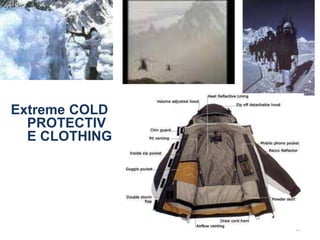
Extreme COLD
PROTECTIV
E CLOTHING
19
Development of Chemical Protective Clothing
Polyester fabric
Cotton Nonwoven
Activated carbon
Cotton Nonwoven
Cotton fabric
• Formed by five layers
• Outer shell made of polyester as it has low absorption of 2% &
provides good strength to the fabric and polyester has a good
resistance to lab grade chemicals
• Inner layer is made up of cotton fabric as it gives good absorbency
and comfort.
• Middle layer comprises of activated carbon sandwiched in cotton
nonwoven 20
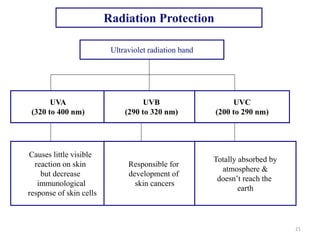
Radiation Protection
Ultraviolet radiation band
UVA
(320 to 400 nm)
UVB
(290 to 320 nm)
UVC
(200 to 290 nm)
Causes little visible
reaction on skin
but decrease
immunological
response of skin cells
Responsible for
development of
skin cancers
Totally absorbed by
atmosphere &
doesn’t reach the
earth
Radiation Protection
21
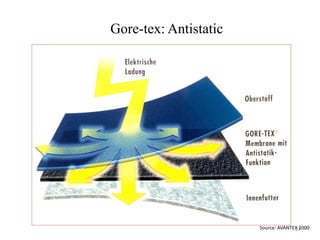
Gore-tex: Antistatic
22Source: AVANTEX 2000
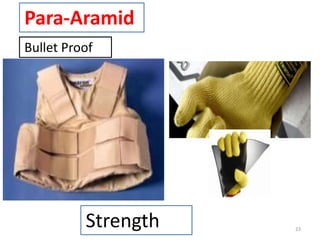
Strength
Para-Aramid
Bullet Proof
23
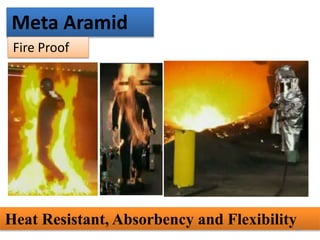
Meta Aramid
Heat Resistant, Absorbency and Flexibility
Fire Proof
24
Optimum properties required of fabric intended for protection
against heat & flame::
1. High level of flame retardance: must not contribute to wearers injury.
2. Fabric integrity: maintains a barrier to prevent direct exposure
to the hazard.
3. Low shrinkage: maintains insulating air layer
4. Good thermal insulation: reduces heat transfer to give
adequate time for escape before burn damage occurs.
5. Easy cleanability & fastness of flame resistance: elimination
of flammable contamination (e.g. oily soil) without adverse
effect on flame retardance & garment properties.
6. Wearer acceptance: lightweight & comfortable.
7. Oil repellecy: protection from flammable contamination, such
as oils & solvents.
25
26
Use Of Textile In Several Military
Application
1. THERMAL INSULATION
2. WATER VAPOUR PERMEABLE/WATERPROOF MATERIALS
3. FLAME-RETARDANT, HEAT PROTECTIVE TEXTILES
4. BALLISTIC PROTECTIVE MATERIALS
5. BIOLOGICALAND CHEMICAL WARFARE PROTECTION
6. MILITARY CAMOUFLAGE
27
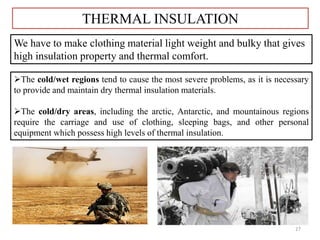
THERMAL INSULATION
We have to make clothing material light weight and bulky that gives
high insulation property and thermal comfort.
The cold/wet regions tend to cause the most severe problems, as it is necessary
to provide and maintain dry thermal insulation materials.
The cold/dry areas, including the arctic, Antarctic, and mountainous regions
require the carriage and use of clothing, sleeping bags, and other personal
equipment which possess high levels of thermal insulation.
28
COLD ENVIRONMENTS
 Insulation is important.
 A ideal fabric should be low weight, low volume and highly insulative.
 An efficient insulator will be composed of about 10–20% of fibre and 80–
90% of air.
 US Army’s new Generation III Extended Cold Weather Clothing System
(ECWCS) seven-layer,
 A Polartec® Thermal Pro® fleece jacket; a nylon/spandex wind jacket; a
soft shell jacket and trousers using Nextec® fabric; an extended
polytetra-fluoroethylene (e-PTFE) membrane, Gore-Tex® wet weather
jacket and trousers; and a Primaloft® insulated loft parka and trousers
Water Vapour Permeable/Waterproof Materials
• One of the basic incompatibilities in technical textiles is that
associated with providing waterproof materials which allow free
passage of water vapor (PERSPIRATION).
• Without this facility, physiological problems can occur when
impermeable clothing is worn by highly active soldiers, marines, &
special forces.
• In the most extreme war operations individuals cannot choose either
the climatic conditions or the intensity of their activities. This can
result in injury or death due to hypothermia or hyperthermia.
• The use of polymer & textiles such as woven, coated or laminated
fabrics which are waterproof & water vapor permeable can solve
the problems.
29
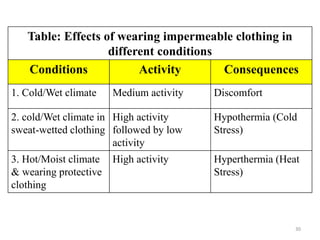
Table: Effects of wearing impermeable clothing in
different conditions
Conditions Activity Consequences
1. Cold/Wet climate Medium activity Discomfort
2. cold/Wet climate in
sweat-wetted clothing
High activity
followed by low
activity
Hypothermia (Cold
Stress)
3. Hot/Moist climate
& wearing protective
clothing
High activity Hyperthermia (Heat
Stress)
30
Types of water vapour permeable barrier fabrics:
There are 3 main categories of materials of this type:
1. High density woven fabrics: Are typified by Ventile cotton fabric.
2. Microporous coatings & films:
→ membranes having microporous voids of pore sizes from
0.1–5mm.
→ Example, Gore-Tex®, utilises a microporous
polytetrafluoroethylene (PTFE) membrane.
3. Hydrophilic solid coatings & films:
→ the hydrophilic products are continuous pore/free solid films.
→ Diffusion of water vapour is achieved by the incorporation of
hydrophilic functional groups into the polymer such as -O-, CO-,
-OH, or -NH₂ in a block copolymer.
31
Ballistic protection
32
33
BALLISTIC PROTECTION
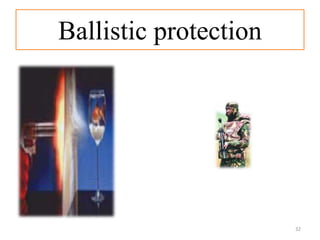
Ballistic-resistant materials for military purposes presently fall into
three general categories:
1. garments, such as vests.
2. helmets.
3. vehicle and structural reinforcement.
Requires high modulus textile fibers i.e. very high strength & low
elasticity.
Woven textiles are most commonly used, but non woven felts are
also available.
Fibers used:
Spiders silk (genetically engineered)
Aliphatic nylon 6.6 (ballistic nylon)
Para aramids (Kevlar, Twaron)
UHMPE (ultra high modulus PE)
GSPE (Gel Spun PE) (Dyneema, Spectra) etc.
34
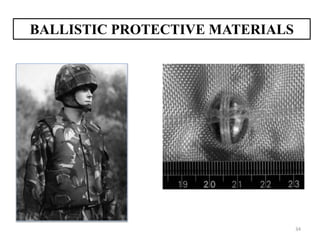
BALLISTIC PROTECTIVE MATERIALS
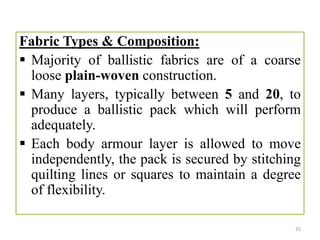
Fabric Types & Composition:
 Majority of ballistic fabrics are of a coarse
loose plain-woven construction.
 Many layers, typically between 5 and 20, to
produce a ballistic pack which will perform
adequately.
 Each body armour layer is allowed to move
independently, the pack is secured by stitching
quilting lines or squares to maintain a degree
of flexibility.
35
36
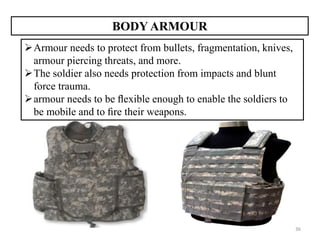
BODY ARMOUR
Armour needs to protect from bullets, fragmentation, knives,
armour piercing threats, and more.
The soldier also needs protection from impacts and blunt
force trauma.
armour needs to be flexible enough to enable the soldiers to
be mobile and to fire their weapons.
37
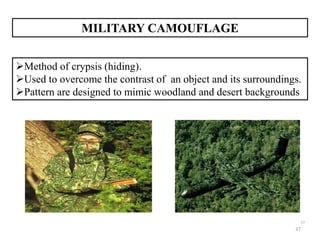
3737
Method of crypsis (hiding).
Used to overcome the contrast of an object and its surroundings.
Pattern are designed to mimic woodland and desert backgrounds
MILITARY CAMOUFLAGE
38
38
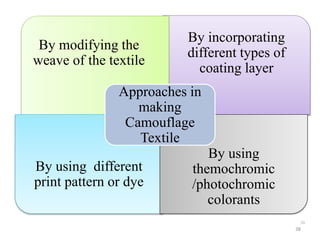
By incorporating
different types of
coating layer
By modifying the
weave of the textile
By using different
print pattern or dye
By using
themochromic
/photochromic
colorants
Approaches in
making
Camouflage
Textile
39
NIR Camouflage:
Objects are seen by their reflections
various metal oxides together with a mixture of N,N`-bis(2-aminoethyl )perylene
tetracarboxylic acid diimide and/or (5,5`-dichloro)indigo to obtain NIR camouflage
patterns.
Many vat dyes based on an anthraquinone-benzanthrone-acridine polycyclic ring
system.
IR Camouflage:
The IR reflectance is increased by titanium white, decreased by carbon black, and
affected in various ways by dyes, pigments, finishing, and after-treatments.
White and yellow pigments and organic reds have excellent Infrared Reflecting Power
(IRP) while most blue and black pigments have very poor IRP due to traces of iron.
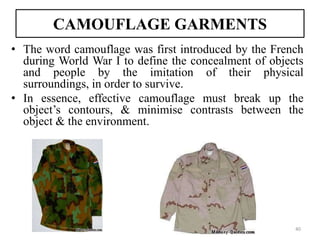
CAMOUFLAGE GARMENTS
• The word camouflage was first introduced by the French
during World War I to define the concealment of objects
and people by the imitation of their physical
surroundings, in order to survive.
• In essence, effective camouflage must break up the
object’s contours, & minimise contrasts between the
object & the environment.
40
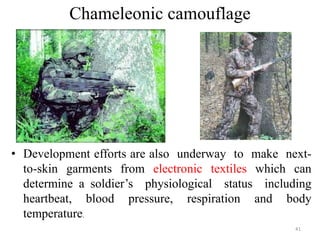
Chameleonic camouflage
41
• Development efforts are also underway to make next-
to-skin garments from electronic textiles which can
determine a soldier’s physiological status including
heartbeat, blood pressure, respiration and body
temperature.
TEXTILES FOR CAMOUFLAGE,CONCEALMENT &
DECEPTION
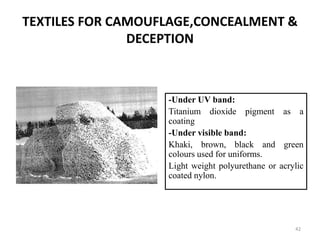
-Under UV band:
Titanium dioxide pigment as a
coating
-Under visible band:
Khaki, brown, black and green
colours used for uniforms.
Light weight polyurethane or acrylic
coated nylon.
42
43
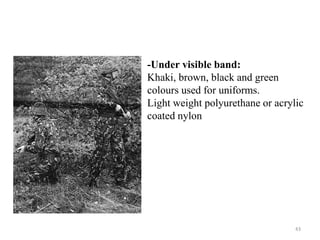
-Under visible band:
Khaki, brown, black and green
colours used for uniforms.
Light weight polyurethane or acrylic
coated nylon
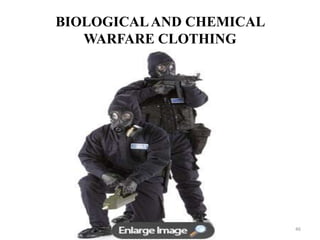
BIOLOGICALAND CHEMICAL WARFARE
PROTECTION
• Biological and chemical warfare is a constant world
threat.
• The toxic agents used are relatively easy to produce
and their effects are emotionally and lethally horrific
to the general population.
• They are weapons of mass destruction e.g syria.
• The fact that they have not been used in recent
conflicts may be due, in part, to the difficulty of
delivering and disseminating such weapons onto
specific chosen targets
• It has been suggested that such weapons have been
used in Syria in the recent crisis
44
BIOLOGICALAND CHEMICAL WARFARE
PROTECTION
• Most current clothing systems use activated carbon on a
textile substrate to absorb the agent vapour.
• Activated carbon can be used in the form of a finely
divided powder coating, small beads, or in carbon fiber
fabric form.
• This form of carbon has a highly developed pore
structure and a high surface area, enabling the adsorption
of a wide spectrum of toxic gases.
• Those with boiling points greater than 60oC are readily
physically adsorbed on the charcoal, but vapours boiling
at lower temperatures must be chemically removed by
impregnants supported on the carbon.
45
BIOLOGICALAND CHEMICAL
WARFARE CLOTHING
46
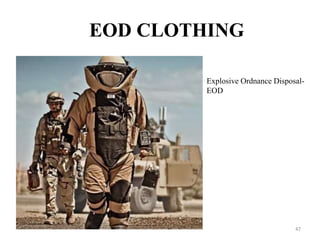
EOD CLOTHING
47
Explosive Ordnance Disposal-
EOD
Thank You
48

11. protective textile by rakib hosain

  • 1.
    Welcome to mypresentation on Protech/Protective clothing Presented by Md Rakib Hosain 1
  • 2.
  • 3.
  • 4.
    Protech or Protex/Protective textiles • Used in the manufacturing of protective clothing of different types. • Protection against heat & radiation for fire fighter clothing, • Against molten metals for welders, • For bullet proof jackets, or • For chemical protective clothing. 4
  • 5.
    Protech or Protex/Protective textiles • Protective textiles are made with the help of specialty fibers such as aramid fiber used in making of bullet proof jackets, glass fibers used on fire proof jackets etc. • Sometimes the protective textiles is also coated with special chemicals, for e.g., when used in manufacturing astronauts suits. • The main target of the technical protective fabric is to improve people safety in their workplaces. • Most of them are mainly used to manufacture PPE (Personal Protective Equipment). 5
  • 6.
    Nowadays, it canbe found in the market, technical fabrics which protect of:  High temperature (insulating, fire fighters)  Burns (Flame, connective & radiant heat, fire fighters)  Electric arc flash discharge (Plasma explosion, electric companies)  Molten metal impacts (foundries)  Metal Sparks (Welding)  Acid environment (Petrochemical, gas, refineries, chemicals)  Bullet impact (military, security)  Cut resistant (gloves, glass industry)  Astronaut’s suits 6
  • 7.
    Protective textile products: 1.Ballistic protection fabrics 2. Bullet proof jackets 3. Chemical protection clothing 4. Cut protection fabrics 5. Bust protection light weight barrier fabrics 6. Electrical protective clothing 7. Fire blankets 8. Flame retardant apparel 9. Flame retardant fabrics 10. Foul weather clothing (FWC) 11. High altitude clothing 12. High visibility clothing 13. Industrial aprons 14. Industrial gloves 15. Nuclear biological & chemical (NBC) & other protective applications. 7
  • 8.
  • 9.
    Functional criteria forProtective Textiles/ Modern Military Textiles 1. Physical requirements 2. Environment requirements 3. Camouflage, concealment & deception requirements 4. Requirements for flame, heat & flash protection 5. Specific battlefield hazards 6. Economic considerations 9
  • 10.
  • 11.
    1. Physical requirements: i.Light weight & low bulk ii. High durability & dimensional stability iii. Cleanable iv. Good handle & drape v. Low noise emission vi. Antistatic 11
  • 12.
    2. Environment requirements: i.Water-repellent, waterproof, windproof & snow- shedding ii. Thermally insulating iii. Water vapour permeable iv. Rot-resistant v. UV light resistant vi. Air permeable vii.Biodegradable 12
  • 13.
    3. Camouflage, concealment& deception requirements: i. Visual spectrum ii. Ultraviolet iii. Near infrared iv. Acoustic emissions v. Radar spectrum 13
  • 14.
    4. Requirements forflame, heat & flash protection: i. Flame retardance ii. Heat resistance iii. Melt resistance iv. Low smoke emission v. Low toxicity 14
  • 15.
    5. Specific BattlefieldHazards:  Ballistic fragments (from bombs, grenades, shells, warheads)  Low velocity bullets (from hand guns, pistols, etc.)  High velocity bullets (from small-arms rifled weapons from 5.56mm up to 12.7mm calibre)  Flechettes (small, sharp, needle shaped projectiles)  Chemical warfare agents (including blood agents, nerve agents, vessicants)  Biological agents (bacteria, toxins, viruses)  Nuclear radiation (alpha, beta & gamma radiation)  Directed energy weapons (DEW) (includes laser rangefinders & target designators) 15
  • 16.
    6. Economic considerations i.Easy-care ii. Minimal maintenance iii. Long storage life iv. Repairable v. Decontaminable or disposable vi. Readily available vii.Minimal cost 16
  • 17.
    Chemical Protection • Protectiveclothing cannot be made generic for all chemical applications, since chemicals vary in most cases. • Important considerations in designing chemical protective clothing are: – The amount of chemical permeation. – Breakthrough time for penetration. – Liquid repellency. – Physical properties of the CPC in specific chemical conditions. 17
  • 18.
    Requirements • Chemical ProtectiveClothing Should Resist : Permeation , Degradation, Penetration. • Durability • Flexibility • Temperature Resistance • Service Life • Clean Ability 18
  • 19.
  • 20.
    Development of ChemicalProtective Clothing Polyester fabric Cotton Nonwoven Activated carbon Cotton Nonwoven Cotton fabric • Formed by five layers • Outer shell made of polyester as it has low absorption of 2% & provides good strength to the fabric and polyester has a good resistance to lab grade chemicals • Inner layer is made up of cotton fabric as it gives good absorbency and comfort. • Middle layer comprises of activated carbon sandwiched in cotton nonwoven 20
  • 21.
    Radiation Protection Ultraviolet radiationband UVA (320 to 400 nm) UVB (290 to 320 nm) UVC (200 to 290 nm) Causes little visible reaction on skin but decrease immunological response of skin cells Responsible for development of skin cancers Totally absorbed by atmosphere & doesn’t reach the earth Radiation Protection 21
  • 22.
  • 23.
  • 24.
    Meta Aramid Heat Resistant,Absorbency and Flexibility Fire Proof 24
  • 25.
    Optimum properties requiredof fabric intended for protection against heat & flame:: 1. High level of flame retardance: must not contribute to wearers injury. 2. Fabric integrity: maintains a barrier to prevent direct exposure to the hazard. 3. Low shrinkage: maintains insulating air layer 4. Good thermal insulation: reduces heat transfer to give adequate time for escape before burn damage occurs. 5. Easy cleanability & fastness of flame resistance: elimination of flammable contamination (e.g. oily soil) without adverse effect on flame retardance & garment properties. 6. Wearer acceptance: lightweight & comfortable. 7. Oil repellecy: protection from flammable contamination, such as oils & solvents. 25
  • 26.
    26 Use Of TextileIn Several Military Application 1. THERMAL INSULATION 2. WATER VAPOUR PERMEABLE/WATERPROOF MATERIALS 3. FLAME-RETARDANT, HEAT PROTECTIVE TEXTILES 4. BALLISTIC PROTECTIVE MATERIALS 5. BIOLOGICALAND CHEMICAL WARFARE PROTECTION 6. MILITARY CAMOUFLAGE
  • 27.
    27 THERMAL INSULATION We haveto make clothing material light weight and bulky that gives high insulation property and thermal comfort. The cold/wet regions tend to cause the most severe problems, as it is necessary to provide and maintain dry thermal insulation materials. The cold/dry areas, including the arctic, Antarctic, and mountainous regions require the carriage and use of clothing, sleeping bags, and other personal equipment which possess high levels of thermal insulation.
  • 28.
    28 COLD ENVIRONMENTS  Insulationis important.  A ideal fabric should be low weight, low volume and highly insulative.  An efficient insulator will be composed of about 10–20% of fibre and 80– 90% of air.  US Army’s new Generation III Extended Cold Weather Clothing System (ECWCS) seven-layer,  A Polartec® Thermal Pro® fleece jacket; a nylon/spandex wind jacket; a soft shell jacket and trousers using Nextec® fabric; an extended polytetra-fluoroethylene (e-PTFE) membrane, Gore-Tex® wet weather jacket and trousers; and a Primaloft® insulated loft parka and trousers
  • 29.
    Water Vapour Permeable/WaterproofMaterials • One of the basic incompatibilities in technical textiles is that associated with providing waterproof materials which allow free passage of water vapor (PERSPIRATION). • Without this facility, physiological problems can occur when impermeable clothing is worn by highly active soldiers, marines, & special forces. • In the most extreme war operations individuals cannot choose either the climatic conditions or the intensity of their activities. This can result in injury or death due to hypothermia or hyperthermia. • The use of polymer & textiles such as woven, coated or laminated fabrics which are waterproof & water vapor permeable can solve the problems. 29
  • 30.
    Table: Effects ofwearing impermeable clothing in different conditions Conditions Activity Consequences 1. Cold/Wet climate Medium activity Discomfort 2. cold/Wet climate in sweat-wetted clothing High activity followed by low activity Hypothermia (Cold Stress) 3. Hot/Moist climate & wearing protective clothing High activity Hyperthermia (Heat Stress) 30
  • 31.
    Types of watervapour permeable barrier fabrics: There are 3 main categories of materials of this type: 1. High density woven fabrics: Are typified by Ventile cotton fabric. 2. Microporous coatings & films: → membranes having microporous voids of pore sizes from 0.1–5mm. → Example, Gore-Tex®, utilises a microporous polytetrafluoroethylene (PTFE) membrane. 3. Hydrophilic solid coatings & films: → the hydrophilic products are continuous pore/free solid films. → Diffusion of water vapour is achieved by the incorporation of hydrophilic functional groups into the polymer such as -O-, CO-, -OH, or -NH₂ in a block copolymer. 31
  • 32.
  • 33.
    33 BALLISTIC PROTECTION Ballistic-resistant materialsfor military purposes presently fall into three general categories: 1. garments, such as vests. 2. helmets. 3. vehicle and structural reinforcement. Requires high modulus textile fibers i.e. very high strength & low elasticity. Woven textiles are most commonly used, but non woven felts are also available. Fibers used: Spiders silk (genetically engineered) Aliphatic nylon 6.6 (ballistic nylon) Para aramids (Kevlar, Twaron) UHMPE (ultra high modulus PE) GSPE (Gel Spun PE) (Dyneema, Spectra) etc.
  • 34.
  • 35.
    Fabric Types &Composition:  Majority of ballistic fabrics are of a coarse loose plain-woven construction.  Many layers, typically between 5 and 20, to produce a ballistic pack which will perform adequately.  Each body armour layer is allowed to move independently, the pack is secured by stitching quilting lines or squares to maintain a degree of flexibility. 35
  • 36.
    36 BODY ARMOUR Armour needsto protect from bullets, fragmentation, knives, armour piercing threats, and more. The soldier also needs protection from impacts and blunt force trauma. armour needs to be flexible enough to enable the soldiers to be mobile and to fire their weapons.
  • 37.
    37 3737 Method of crypsis(hiding). Used to overcome the contrast of an object and its surroundings. Pattern are designed to mimic woodland and desert backgrounds MILITARY CAMOUFLAGE
  • 38.
    38 38 By incorporating different typesof coating layer By modifying the weave of the textile By using different print pattern or dye By using themochromic /photochromic colorants Approaches in making Camouflage Textile
  • 39.
    39 NIR Camouflage: Objects areseen by their reflections various metal oxides together with a mixture of N,N`-bis(2-aminoethyl )perylene tetracarboxylic acid diimide and/or (5,5`-dichloro)indigo to obtain NIR camouflage patterns. Many vat dyes based on an anthraquinone-benzanthrone-acridine polycyclic ring system. IR Camouflage: The IR reflectance is increased by titanium white, decreased by carbon black, and affected in various ways by dyes, pigments, finishing, and after-treatments. White and yellow pigments and organic reds have excellent Infrared Reflecting Power (IRP) while most blue and black pigments have very poor IRP due to traces of iron.
  • 40.
    CAMOUFLAGE GARMENTS • Theword camouflage was first introduced by the French during World War I to define the concealment of objects and people by the imitation of their physical surroundings, in order to survive. • In essence, effective camouflage must break up the object’s contours, & minimise contrasts between the object & the environment. 40
  • 41.
    Chameleonic camouflage 41 • Developmentefforts are also underway to make next- to-skin garments from electronic textiles which can determine a soldier’s physiological status including heartbeat, blood pressure, respiration and body temperature.
  • 42.
    TEXTILES FOR CAMOUFLAGE,CONCEALMENT& DECEPTION -Under UV band: Titanium dioxide pigment as a coating -Under visible band: Khaki, brown, black and green colours used for uniforms. Light weight polyurethane or acrylic coated nylon. 42
  • 43.
    43 -Under visible band: Khaki,brown, black and green colours used for uniforms. Light weight polyurethane or acrylic coated nylon
  • 44.
    BIOLOGICALAND CHEMICAL WARFARE PROTECTION •Biological and chemical warfare is a constant world threat. • The toxic agents used are relatively easy to produce and their effects are emotionally and lethally horrific to the general population. • They are weapons of mass destruction e.g syria. • The fact that they have not been used in recent conflicts may be due, in part, to the difficulty of delivering and disseminating such weapons onto specific chosen targets • It has been suggested that such weapons have been used in Syria in the recent crisis 44
  • 45.
    BIOLOGICALAND CHEMICAL WARFARE PROTECTION •Most current clothing systems use activated carbon on a textile substrate to absorb the agent vapour. • Activated carbon can be used in the form of a finely divided powder coating, small beads, or in carbon fiber fabric form. • This form of carbon has a highly developed pore structure and a high surface area, enabling the adsorption of a wide spectrum of toxic gases. • Those with boiling points greater than 60oC are readily physically adsorbed on the charcoal, but vapours boiling at lower temperatures must be chemically removed by impregnants supported on the carbon. 45
  • 46.
  • 47.
  • 48.

Editor's Notes

  • #29 for a protective clothing system in a cold environment. The objective is to trap warm air around the body. The efficiency of the fibrous insulator depends up on the ratio of fibre to air, and the way in which the fibres are arranged in the system. multi-layering system