Presented By:
Moiz Hussain 16TE20
Ghulamullah Khaskheli 16TE48
Waseem Shafique 16TE83
Zain Jamali 16TE82
Department Of Textile Engineering
contents:
 What is Quality Control & Testing?
 Q.C and Testing in pretreatment process.
 Q.C and Testing in Dyeing and printing process.
 Q.C and Testing in finishing Process.
What is Quality control and testing?
Quality Control:
A system of maintaining standards in manufactured products by
testing a sample of the output against the specification.
Testing:
Testing is the term for a whole series of tests that examine the
physical, mechanical and chemical properties etc…
Quality Control in Textile:
It is a set of steps or guidelines designed to guarantee that a product or
service meets certain performance standards. The goal of quality control is to ensure
that an item meets the needs and specifications of the consumer population.
In the textile industry, quality control is not much different than the standard
definition provided here. starting from the sourcing of raw fibers to the final stages
of garment production.
 Selection of raw materials
 Fiber manufacturing
 Yarn manufacturing
 Fabric construction
 Dye and coloration
 Printing and designs
 Finishing
Testing in Textile:
Textile companies and consumer agencies conduct many kinds of
analyses to make sure our clothes and the fabrics we use in our homes won't
harm us, will be comfortable and will stay colorful for a long time. These
processes are called textile testing.
On-line:
 inspection the chemical, machine, methods, standard procedure during
production
Off-line:
 Physical Testing.
 Chemical Testing.
Quality control and testing in Pretreatment Process.
Pretreatment :
 Singing
 Desizing
 Bleaching
 Mercerization
Q.C of Singing:
Flame position (Tangential (90°), on the roll (60°), of the roll (30°).
Machine speed (80 to 100 m/min)
Flame intensity (14 to 16)
Gas (l.P.G)
Fabric Quality (Heavy, Light, Medium)
Q.C of Desizing:
Chemicals (Enzymes, Wetting agent, Acetic acid etc..)
Temperature ( For Enzymes particular temperature)
Machine Speed (85 to 95 m/min)
PH ( 6.5 to 7)
Testing of Desizing:
Now the after washing the sample of fabric is send to the QC office to check
whether any size is remaining on fabric or it have been remove fully completely from the
fabric.
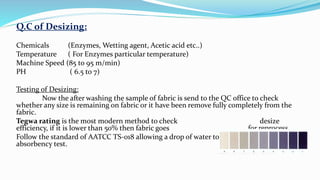
Tegwa rating is the most modern method to check desize
efficiency, if it is lower than 50% then fabric goes for reprocess
Follow the standard of AATCC TS-018 allowing a drop of water to 2.5 cm of fabric, drop
absorbency test.
Q.C in Bleaching (Solomatic Bleaching):
Alkali (48 to 50% concentration)
Other Chemicals (wetting agent, bleaching agent etc..)
Temperature (90 to 95c)
Steam pressure (4.5 to 5.0 bar)
Machine Speed (110 to 130 m/min)
Testing of Bleaching
Absorbency test by Turquoise K2BL2%: To test the absorbencies of different fabrics, I took
10cm (4″) square pieces of the (prewashed) fabric’s pickup check after bleach. if polyester it is 38-40
while for PC-> 30-35
If whiteness low: Then bleaching agents are checked. It is checked through comparison or by
software is present to check out the rating of whiteness of fabric.
PH: Check the Ph of fabric by droping PH solution on to the fabric and then
check by Ph strip.
Q.C of Mercerization
Strong lye (28 to 32 bume)
Weak lye (6 to 8 bume)
Machine Speed (80 to 110 m/min)
Washing tank ( 3 Tanks depend on the machine)
PH (printing 5-6 and dyeing 6-7)
Testing of Mercerization
Baume meter/ twaddle: Checking the Baume or twaddle degree of strong lye
chamber.
Determination of degree of mercerization: By barium number activity (BAN).
Followed by AATCC
Tension: If tension is less or the fabric is allowed to shrink then the luster is
impaired.
PH: Check the Ph of fabric by dropping PH solution on to the fabric and then check
by Ph strip.
Quality control and testing of after treatment process
After Treatment
 Dyeing
 Printing
Q.C and testing
On-line:
 inspection the chemical, machine, methods, standard procedure during
production
Off-line:
 Physical testing.
 chemical testing.
Physical testing
 Abrasion and pilling test
 Washing fastness
 Rubbing test
 Dry Cleaning
 Water fastness
 Perspiration
 PH abstract
 Appearance Shrinkage
 Construction, count, GSM
 Blender ratio
 Grey test
 Tearing test
Shrinkage appearance:
ISO European recommended the template to note out the size according to thata template
and then marked it with permanent maker than do the washing and drying and see the
result by measure it how much it shrink. Both warp and weft shrinkage is tested.
And normally the formula is use:
Followed by standard AATCC.
Shrinkage%= (before wash-after wash)/before wash x 100.
AATCC DRYER:
AATCC dryer is used for drying samples.
Whirl pool front load recommended by European customer.
Whirl pool top load recommended by US customer.
Perspiring test:
PRL/07 incubator PF-60 use to check the perspiration. Perspiration test is performed for
both acidic and alkaline medium. After perspiration test stains on the fabric is matched with
the grey scale.
Crock meter:
Crock meter is used for testing the rubbing fastness of sample.
The sample is clipped in the sample stand and a staining fabric is
clipped in the nose. Then the nose is rubbed against the sample
for 10 times. At first rubbing is done in wet condition, and then
again rubbing is done in dry condition with another piece of
staining fabric. Then the staining fabrics are assessed with
standards and grade is assigned to the sample.
Pilling & Abrasion Machine:
Matending Machine,
It is used to determine the pilling and fuzzing characteristics of
textile fabrics. There are some ISO standards which have to
perform for the test such as for pilling 1000 rubs will their and for
to check abrasion 5000 rubs will their
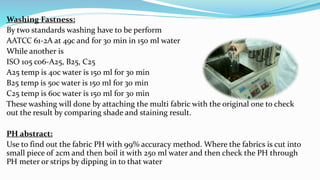
Washing Fastness:
By two standards washing have to be perform
AATCC 61-2A at 49c and for 30 min in 150 ml water
While another is
ISO 105 co6-A25, B25, C25
A25 temp is 40c water is 150 ml for 30 min
B25 temp is 50c water is 150 ml for 30 min
C25 temp is 60c water is 150 ml for 30 min
These washing will done by attaching the multi fabric with the original one to check
out the result by comparing shade and staining result.
PH abstract:
Use to find out the fabric PH with 99% accuracy method. Where the fabrics is cut into
small piece of 2cm and then boil it with 250 ml water and then check the PH through
PH meter or strips by dipping in to that water
Tensile tearing testing
The test is performing in machine to check out the tensile strength force of fabric. In
gram force tear force will be measured or also find in any unit of force . that how much
force is required to break the fabric the test is perform on the basis of costumer
requirement.
Blender Ratio:
This is the ratio which is used during manufacturing of fabric such as CVC, PC, etc.
So for that take the water and chemical dip the fabric in that chemical for 50 min and
then check the result which is remaining fabric than dry and weight and compare the
results before and after and we will get the final result
Construction, GSM:
This is the tests which have to perform for to check the type and
construction of fabric, it will find by knowing the presence of Warp and
Weft yarn through pig glass 2nd one is to find the GSM for that standard GSM
cutter is present which is use for cut the piece of fabric and then weight.
R&D laboratory or Chemical testing
The main objective of R&D department is to check all the incoming and
running chemicals used in the industry also different kinds of tests are
performed in this section. The task of R&D section start from fabrication and
ends at final inspection of finished fabric and new chemicals are developed
which are less costly and produce less environment hazards
Each of the chemical is to check by applying on piece of fabric.
Water testing also perform:
PH: how much water is acidic and how much alkaline
Hardness: Through TDS and TSS it will find and also through titration
method.
Conductivity: as water is full of mineral this is hazards for dyeing and
printing so need to check the conductivity
Quality Control and testing in finishing
In order to impart the required functional properties to the fiber or fabric, it is
customary to subject the material to different types of physical and chemical
treatments.
For example, wash and wear finish for a cotton fabric is necessary to make it
crease-free or wrinkle-free. In a similar way, mercerizing, singeing, flame
retardant, water repellent, waterproof, anti-static and peach finishing achieve
various fabric properties desired by consumers.
The use of 100% synthetic textiles has increased considerably since the
development of textured yarns made of filaments, and the growing production of
knit goods. The use of open weave has enabled production of lighter, breathable,
fabrics to ensure better wearing comfort.
Mechanical finishing
 Raising
Another finishing process is raising. During raising, the fabric surface is treated
with sharp teeth to lift the surface fibers, thereby imparting hairiness, softness and
warmth, as in flannelette.
 Calendaring
Calendaring is the third important mechanical process, in which the fabric is
passed between heated rollers to generate smooth, polished or embossed effects
depending on roller surface properties and relative speeds.
Chemical finishing
 Many other chemical treatments may be applied to cotton fabrics to produce low
flammability, crease resist and other special effects.
Shrinking (Sanforizing)
Mechanical shrinking (sometimes referred to as sanforizing), whereby the fabric is
forced to shrink width and/or lengthwise, creates a fabric in which any residual
tendency to shrink after subsequent laundering is minimal.
Testing of Finishes
 Performance: abrasion or piling
 Dimensional stability: torque, shrinkage, elongation, stretch and recovery
 Weather testing: waterproof, windproof, thermal
 Thermal and water vapor resistance
 Burn test (for 100% cotton textiles)
 Stiffness and bending
 Seam strength (for sewn articles)
 Tearing strength, penetration resistance
 Thickness, compression, and recovery (for floor coverings)
 Tensile properties.
Quality control and testing in wet Processing

Quality control and testing in wet Processing

  • 1.
    Presented By: Moiz Hussain16TE20 Ghulamullah Khaskheli 16TE48 Waseem Shafique 16TE83 Zain Jamali 16TE82 Department Of Textile Engineering
  • 2.
    contents:  What isQuality Control & Testing?  Q.C and Testing in pretreatment process.  Q.C and Testing in Dyeing and printing process.  Q.C and Testing in finishing Process.
  • 3.
    What is Qualitycontrol and testing? Quality Control: A system of maintaining standards in manufactured products by testing a sample of the output against the specification. Testing: Testing is the term for a whole series of tests that examine the physical, mechanical and chemical properties etc…
  • 4.
    Quality Control inTextile: It is a set of steps or guidelines designed to guarantee that a product or service meets certain performance standards. The goal of quality control is to ensure that an item meets the needs and specifications of the consumer population. In the textile industry, quality control is not much different than the standard definition provided here. starting from the sourcing of raw fibers to the final stages of garment production.  Selection of raw materials  Fiber manufacturing  Yarn manufacturing  Fabric construction  Dye and coloration  Printing and designs  Finishing
  • 5.
    Testing in Textile: Textilecompanies and consumer agencies conduct many kinds of analyses to make sure our clothes and the fabrics we use in our homes won't harm us, will be comfortable and will stay colorful for a long time. These processes are called textile testing. On-line:  inspection the chemical, machine, methods, standard procedure during production Off-line:  Physical Testing.  Chemical Testing.
  • 6.
    Quality control andtesting in Pretreatment Process. Pretreatment :  Singing  Desizing  Bleaching  Mercerization Q.C of Singing: Flame position (Tangential (90°), on the roll (60°), of the roll (30°). Machine speed (80 to 100 m/min) Flame intensity (14 to 16) Gas (l.P.G) Fabric Quality (Heavy, Light, Medium)
  • 7.
    Q.C of Desizing: Chemicals(Enzymes, Wetting agent, Acetic acid etc..) Temperature ( For Enzymes particular temperature) Machine Speed (85 to 95 m/min) PH ( 6.5 to 7) Testing of Desizing: Now the after washing the sample of fabric is send to the QC office to check whether any size is remaining on fabric or it have been remove fully completely from the fabric. Tegwa rating is the most modern method to check desize efficiency, if it is lower than 50% then fabric goes for reprocess Follow the standard of AATCC TS-018 allowing a drop of water to 2.5 cm of fabric, drop absorbency test.
  • 8.
    Q.C in Bleaching(Solomatic Bleaching): Alkali (48 to 50% concentration) Other Chemicals (wetting agent, bleaching agent etc..) Temperature (90 to 95c) Steam pressure (4.5 to 5.0 bar) Machine Speed (110 to 130 m/min) Testing of Bleaching Absorbency test by Turquoise K2BL2%: To test the absorbencies of different fabrics, I took 10cm (4″) square pieces of the (prewashed) fabric’s pickup check after bleach. if polyester it is 38-40 while for PC-> 30-35 If whiteness low: Then bleaching agents are checked. It is checked through comparison or by software is present to check out the rating of whiteness of fabric. PH: Check the Ph of fabric by droping PH solution on to the fabric and then check by Ph strip.
  • 9.
    Q.C of Mercerization Stronglye (28 to 32 bume) Weak lye (6 to 8 bume) Machine Speed (80 to 110 m/min) Washing tank ( 3 Tanks depend on the machine) PH (printing 5-6 and dyeing 6-7) Testing of Mercerization Baume meter/ twaddle: Checking the Baume or twaddle degree of strong lye chamber. Determination of degree of mercerization: By barium number activity (BAN). Followed by AATCC Tension: If tension is less or the fabric is allowed to shrink then the luster is impaired. PH: Check the Ph of fabric by dropping PH solution on to the fabric and then check by Ph strip.
  • 10.
    Quality control andtesting of after treatment process After Treatment  Dyeing  Printing Q.C and testing On-line:  inspection the chemical, machine, methods, standard procedure during production Off-line:  Physical testing.  chemical testing.
  • 11.
    Physical testing  Abrasionand pilling test  Washing fastness  Rubbing test  Dry Cleaning  Water fastness  Perspiration  PH abstract  Appearance Shrinkage  Construction, count, GSM  Blender ratio  Grey test  Tearing test
  • 12.
    Shrinkage appearance: ISO Europeanrecommended the template to note out the size according to thata template and then marked it with permanent maker than do the washing and drying and see the result by measure it how much it shrink. Both warp and weft shrinkage is tested. And normally the formula is use: Followed by standard AATCC. Shrinkage%= (before wash-after wash)/before wash x 100. AATCC DRYER: AATCC dryer is used for drying samples. Whirl pool front load recommended by European customer. Whirl pool top load recommended by US customer. Perspiring test: PRL/07 incubator PF-60 use to check the perspiration. Perspiration test is performed for both acidic and alkaline medium. After perspiration test stains on the fabric is matched with the grey scale.
  • 13.
    Crock meter: Crock meteris used for testing the rubbing fastness of sample. The sample is clipped in the sample stand and a staining fabric is clipped in the nose. Then the nose is rubbed against the sample for 10 times. At first rubbing is done in wet condition, and then again rubbing is done in dry condition with another piece of staining fabric. Then the staining fabrics are assessed with standards and grade is assigned to the sample. Pilling & Abrasion Machine: Matending Machine, It is used to determine the pilling and fuzzing characteristics of textile fabrics. There are some ISO standards which have to perform for the test such as for pilling 1000 rubs will their and for to check abrasion 5000 rubs will their
  • 14.
    Washing Fastness: By twostandards washing have to be perform AATCC 61-2A at 49c and for 30 min in 150 ml water While another is ISO 105 co6-A25, B25, C25 A25 temp is 40c water is 150 ml for 30 min B25 temp is 50c water is 150 ml for 30 min C25 temp is 60c water is 150 ml for 30 min These washing will done by attaching the multi fabric with the original one to check out the result by comparing shade and staining result. PH abstract: Use to find out the fabric PH with 99% accuracy method. Where the fabrics is cut into small piece of 2cm and then boil it with 250 ml water and then check the PH through PH meter or strips by dipping in to that water
  • 15.
    Tensile tearing testing Thetest is performing in machine to check out the tensile strength force of fabric. In gram force tear force will be measured or also find in any unit of force . that how much force is required to break the fabric the test is perform on the basis of costumer requirement. Blender Ratio: This is the ratio which is used during manufacturing of fabric such as CVC, PC, etc. So for that take the water and chemical dip the fabric in that chemical for 50 min and then check the result which is remaining fabric than dry and weight and compare the results before and after and we will get the final result Construction, GSM: This is the tests which have to perform for to check the type and construction of fabric, it will find by knowing the presence of Warp and Weft yarn through pig glass 2nd one is to find the GSM for that standard GSM cutter is present which is use for cut the piece of fabric and then weight.
  • 16.
    R&D laboratory orChemical testing The main objective of R&D department is to check all the incoming and running chemicals used in the industry also different kinds of tests are performed in this section. The task of R&D section start from fabrication and ends at final inspection of finished fabric and new chemicals are developed which are less costly and produce less environment hazards Each of the chemical is to check by applying on piece of fabric. Water testing also perform: PH: how much water is acidic and how much alkaline Hardness: Through TDS and TSS it will find and also through titration method. Conductivity: as water is full of mineral this is hazards for dyeing and printing so need to check the conductivity
  • 17.
    Quality Control andtesting in finishing In order to impart the required functional properties to the fiber or fabric, it is customary to subject the material to different types of physical and chemical treatments. For example, wash and wear finish for a cotton fabric is necessary to make it crease-free or wrinkle-free. In a similar way, mercerizing, singeing, flame retardant, water repellent, waterproof, anti-static and peach finishing achieve various fabric properties desired by consumers. The use of 100% synthetic textiles has increased considerably since the development of textured yarns made of filaments, and the growing production of knit goods. The use of open weave has enabled production of lighter, breathable, fabrics to ensure better wearing comfort.
  • 18.
    Mechanical finishing  Raising Anotherfinishing process is raising. During raising, the fabric surface is treated with sharp teeth to lift the surface fibers, thereby imparting hairiness, softness and warmth, as in flannelette.  Calendaring Calendaring is the third important mechanical process, in which the fabric is passed between heated rollers to generate smooth, polished or embossed effects depending on roller surface properties and relative speeds. Chemical finishing  Many other chemical treatments may be applied to cotton fabrics to produce low flammability, crease resist and other special effects. Shrinking (Sanforizing) Mechanical shrinking (sometimes referred to as sanforizing), whereby the fabric is forced to shrink width and/or lengthwise, creates a fabric in which any residual tendency to shrink after subsequent laundering is minimal.
  • 19.
    Testing of Finishes Performance: abrasion or piling  Dimensional stability: torque, shrinkage, elongation, stretch and recovery  Weather testing: waterproof, windproof, thermal  Thermal and water vapor resistance  Burn test (for 100% cotton textiles)  Stiffness and bending  Seam strength (for sewn articles)  Tearing strength, penetration resistance  Thickness, compression, and recovery (for floor coverings)  Tensile properties.

Editor's Notes