Classroom Management Strategies
for Effective Instruction
1
Goals and Objectives…
1. To identify the characteristics of effective
teachers
2. To understand why children misbehave and
identify effective strategies for dealing with
student misbehavior
3. To identify techniques for organizing and
managing effective learning environments
2
Classroom management
Two major goals…
1. To foster student involvement and
cooperation in all classroom activities
2. To establish a productive working
environment.
3
Describe a
well-managed
classroom
4
Characteristics of a Well-
Managed Classroom…
Students are deeply involved with their work
Students know what is expected of them and
are generally successful
The climate of the classroom is work-
oriented, but relaxed and pleasant.
5
Brainstorming Activity…
Think of as many responses to the following
statement as you can…
An effective
teacher is…..
6
A Dangerous Educator…
Believes that this is just a job, and when the
school day is over, the work’s all done.
Believes that he/she can handle any situation,
alone.
7
A Dangerous Educator…
Never makes time to just sit and listen
Believes that he/she can’t make a difference
Believes that punishment is more effective
than discipline
8
A Dangerous Educator…
Believes that morality and values should
only be taught at home
Forgets he/she is modeling.
9
The Effective Teacher…
Establishes good control of the
classroom
Does things right, consistently
Affects and touches lives
Exhibits positive expectations for ALL
students
Establishes good classroom
management techniques
10
The Effective Teacher…
Designs lessons for student mastery
Works cooperatively and learns from
colleagues
Seeks out a mentor who serves as a
role model
Goes to professional meetings to learn
Has a goal of striving for excellence
11
The Effective Teacher…
Can explain the district’s, school’s, and
department or grade level’s curriculum
Is flexible and adaptable
Listens, listens, listens
Knows the difference between an
effective teacher and an ineffective one
12
In summary…
An effective teacher…
Has positive expectations for student success
Is an extremely good classroom manager
Knows how to design lessons for student
mastery
13
Understanding Our
Students
Dealing With Student Behavior in
Today’s Classrooms
14
This is not an easy time to work
with children and youth…
15
We can trace out-of-control
behaviors to a variety of factors…
The physical and emotional climate of the
child's home and neighborhood
The parenting styles of the child’s parents
The power and influence of peers in a child’s
life*
16
the positive and negative role models
available to the child
The child’s exposure to violent media
The child’s emotional and physical health
The child’s own attitude toward his/her
anger*
17
Proactive Intervention Strategies
Classroom Rules
Classroom Schedule
Physical Space
Attention Signal
Beginning and Ending Routines
Student Work
Classroom Management Plan
 adapted from the Tough Kid series, and CHAMPs
18
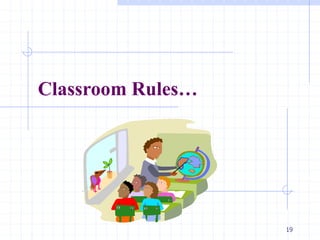
Classroom Rules…
19
The Rules for Rules:
Keep the wording simple.
Keep the wording positive, if possible.
Make your rules specific.
Make your rules describe behavior that
is observable.
20
Classroom Rules, cont.
Keep the rules posted.
Consider having rules recited daily for
first two weeks then periodically..
21
Classroom Schedules…
22
Classroom Schedules
Begin each activity on-time.
Budget your academic time
 Example: 1 hr. allotment
5 min. Teacher-directed review
10 min. Introduction of new concept
23
Physical Space…
24
Physical Space
Arrange desks to optimize the most
common types of instructional tasks you
will have students engaged in.
 Desks in Rows, Front to Back
 Desks in Row, Side to Side
 Desks in Clusters
 Desks in U-Shape
25
Physical Space, cont.
Make sure you have access to all parts of the
room.
Feel free to assign seats, and change at will.
26
Physical Space, cont.
Desks do not have to be in traditional
rows, but all chairs should face forward so
that all eyes are focused on the teacher
27
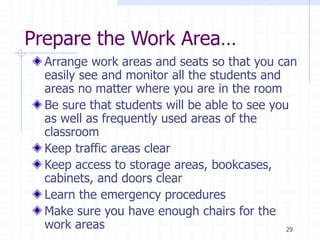
Student's Work
28
Prepare the Work Area…
Arrange work areas and seats so that you can
easily see and monitor all the students and
areas no matter where you are in the room
Be sure that students will be able to see you
as well as frequently used areas of the
classroom
Keep traffic areas clear
Keep access to storage areas, bookcases,
cabinets, and doors clear
Learn the emergency procedures
Make sure you have enough chairs for the
work areas 29
Prepare the Work Area…
Be sure to have all necessary materials in
easily accessible areas
Use materials such as tote bags, boxes,
coffee cans, dishpans, etc. to store materials
that students will need.
30
Prepare the Student Area…
Plan areas for student belongings
 Coats
 Binders
 Backpacks
 Books
 Lunchboxes
 Lost and found items
 others
31
Prepare the Wall Space…
Cover one or more bulletin boards with
colored paper and trim, and leave it bare for
the purpose of displaying student work and
artifacts.
Display your discipline plan in a prominent
place.
Post procedures, assigned duties, calendar,
clock, emergency information, schedules,
menus, charts, maps, decorations, birthdays,
and student work.
Have a consistent place for listing the day’s or
week’s assignments
32
Prepare Yourself and Your Area…
Do not create a barrier between
yourself and the students.
Place your desk away from the door so
that no one can take things from your
desk and quickly walk out.
Communicate to your students that
everything in and on you desk is to be
treated as personal property and off
limits to them
Keep your personal belongings in a safe
location
33
Teachers who are
ready maximize
student learning and
minimize student
misbehavior.
34
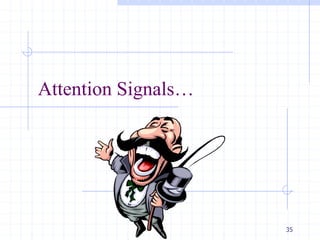
Attention Signals…
35
Attention Signal
Decide upon a signal you can use to get
students’ attention.
Teach students to respond to the signal
by focusing on you and maintaining
complete silence.
36
Discipline, Routines and
Procedures…
37
Important Aspects of a Well-
Disciplined Classroom…
Discipline
Procedures
Routines
Effective teachers introduce rules,
procedures, and routines on the very
first day of school and continue to teach
and reinforce them throughout the
school year.
38
The number one problem in
the classroom is not
discipline; it is the lack of
procedures and routines.
39
Students must know from the very
beginning how they are expected to
behave and work in a classroom
environment.
DISCIPLINE dictates how students are
to behave
PROCEDURES and ROUTINES dictate
how students are to work
40
A PROCEDURE is
how you want
something done
It is the
responsibility of the
the teacher to
communicate
effectively
A ROUTINE is what
the student does
automatically
without prompting
or supervision
Becomes a habit,
practice, or custom
for the student
41
Procedures answer questions
such as…
What to do when the bell rings
What to do when you hear an emergency
alert signal
What to do when you finish your work early
What to do when you have a question
What to do when you need to go to the
restroom
How to enter the classroom
Where to put completed work
42
Beginning and Ending
Routines…
Entering Class
 Goal: Students will feel welcome and will
immediately go to their seats and start on
a productive task.
 Greet the students at the door.
 Have a task prepared for students to work on
as they sit down.
 Do your “housekeeping”.
 Keep tasks short (3-5 min.)
 When you’ve finished, address the task.
43
Beginning and Ending Routine,
cont.
Ending Routine
 Goal: Your procedures for ending the
day/class will:
 Ensure that students will not leave the
classroom before they have organized their
own materials and completed any necessary
clean-up tasks.
 Ensure the you have enough time to give
students both positive and corrective feedback,
and to set a positive tone for ending the class.
44
Beginning and Ending
Routines, cont.
Dismissal
 Goal: Students will not leave the classroom until
they are dismissed by you (not the bell).
 Explain that the bell is a signal for you.
 Excuse the class when things are reasonably quiet and
all “wrap up” activities are completed.
 General Rule:
 Dismiss primary students by rows
45
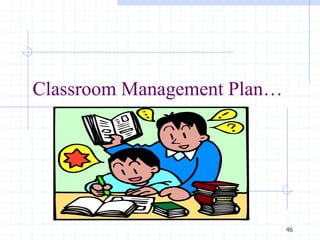
Classroom Management Plan…
46
Classroom Management Plan…
8 Components:
1) Level of Classroom Structure – based on
risk factors of your students.
2) Guidelines for Success – attitudes, traits,
or behaviors to help achieve success.
3) Rules – specific, observable, and
measurable behavioral objectives
4) Teaching Expectations – What, how, and
when expectations will be taught
47
Classroom Management Plan…
5) Monitoring – How you will monitor the
progress of the expectations.
6) Encouragement Procedures – How you
will encourage students to demonstrate
motivated and responsible behavior.
7) Correction Procedures – How you will
respond to irresponsible behavior.
8) Managing Student Work – What
procedures and systems you will use to
manage student work.
48
“No improvement will occur in
instruction until the classroom
climate improves.”
“Classrooms have personalities
just like people.”
-63 Ways of Improving Classroom Instruction
(Gary Phillips and Maurice Gibbons)
49
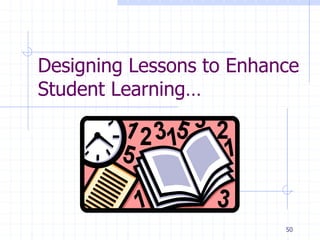
Designing Lessons to Enhance
Student Learning…
50
Why Plan?
Plan
Ahea
d 51
The Correct Question…
DON’T ASK: “What am I going to cover
tomorrow?”
DO ASK: “What are my students going to
learn, achieve, and accomplish tomorrow?”
The role of the teacher is not to cover.
The role of the teacher is to UNCOVER.
52
Learning has nothing to do with what
the teacher COVERS.
Learning ahs to do with what the
student ACCOMPLISHES.
53
Thinking About Lesson
Planning
Who Am I Planning For?
What Am I Supposed To Do?
54
What is a lesson plan?
Teacher’s guide
Design for the learning of the student
Series of student centered learning
Focused on what the student needs to
know and be able to do
Covers one day or several days
To teach for learning, use words,
especially verbs, that show learning has
taken place. 55
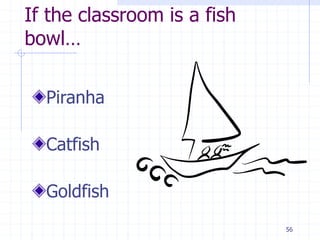
If the classroom is a fish
bowl…
Piranha
Catfish
Goldfish
56
Piranha…..
Are usually the “trouble-makers”
Can be passive aggressive or overtly
aggressive
Have negative attitude
Have attendance problems
Are “at risk”
Etc., etc., etc……
57
Catfish…..
Go with the flow
Are usually good-natured, but have
limited motivation
Are social beings
Tend to cooperate; follow MOST rules
Perform to the average or just enough
to stay out of trouble with mom/dad
Etc., etc., etc……
58
Goldfish…..
Are in the top 10-15% of their class
Are “teacher pleasers”
Are highly motivated to perform well
Show enthusiasm for learning
May be “over achievers” and /or high
achievers
Etc., etc., etc…….
59
''Effective teachers have a classroom
managrement plan with all the
procedures necesarry for a classroom to
run consistently and for learning to take
place.''
Harry Rosemary Wong
THANK YOU !

classroom management INSET.ppt

  • 1.
    Classroom Management Strategies forEffective Instruction 1
  • 2.
    Goals and Objectives… 1.To identify the characteristics of effective teachers 2. To understand why children misbehave and identify effective strategies for dealing with student misbehavior 3. To identify techniques for organizing and managing effective learning environments 2
  • 3.
    Classroom management Two majorgoals… 1. To foster student involvement and cooperation in all classroom activities 2. To establish a productive working environment. 3
  • 4.
  • 5.
    Characteristics of aWell- Managed Classroom… Students are deeply involved with their work Students know what is expected of them and are generally successful The climate of the classroom is work- oriented, but relaxed and pleasant. 5
  • 6.
    Brainstorming Activity… Think ofas many responses to the following statement as you can… An effective teacher is….. 6
  • 7.
    A Dangerous Educator… Believesthat this is just a job, and when the school day is over, the work’s all done. Believes that he/she can handle any situation, alone. 7
  • 8.
    A Dangerous Educator… Nevermakes time to just sit and listen Believes that he/she can’t make a difference Believes that punishment is more effective than discipline 8
  • 9.
    A Dangerous Educator… Believesthat morality and values should only be taught at home Forgets he/she is modeling. 9
  • 10.
    The Effective Teacher… Establishesgood control of the classroom Does things right, consistently Affects and touches lives Exhibits positive expectations for ALL students Establishes good classroom management techniques 10
  • 11.
    The Effective Teacher… Designslessons for student mastery Works cooperatively and learns from colleagues Seeks out a mentor who serves as a role model Goes to professional meetings to learn Has a goal of striving for excellence 11
  • 12.
    The Effective Teacher… Canexplain the district’s, school’s, and department or grade level’s curriculum Is flexible and adaptable Listens, listens, listens Knows the difference between an effective teacher and an ineffective one 12
  • 13.
    In summary… An effectiveteacher… Has positive expectations for student success Is an extremely good classroom manager Knows how to design lessons for student mastery 13
  • 14.
    Understanding Our Students Dealing WithStudent Behavior in Today’s Classrooms 14
  • 15.
    This is notan easy time to work with children and youth… 15
  • 16.
    We can traceout-of-control behaviors to a variety of factors… The physical and emotional climate of the child's home and neighborhood The parenting styles of the child’s parents The power and influence of peers in a child’s life* 16
  • 17.
    the positive andnegative role models available to the child The child’s exposure to violent media The child’s emotional and physical health The child’s own attitude toward his/her anger* 17
  • 18.
    Proactive Intervention Strategies ClassroomRules Classroom Schedule Physical Space Attention Signal Beginning and Ending Routines Student Work Classroom Management Plan  adapted from the Tough Kid series, and CHAMPs 18
  • 19.
  • 20.
    The Rules forRules: Keep the wording simple. Keep the wording positive, if possible. Make your rules specific. Make your rules describe behavior that is observable. 20
  • 21.
    Classroom Rules, cont. Keepthe rules posted. Consider having rules recited daily for first two weeks then periodically.. 21
  • 22.
  • 23.
    Classroom Schedules Begin eachactivity on-time. Budget your academic time  Example: 1 hr. allotment 5 min. Teacher-directed review 10 min. Introduction of new concept 23
  • 24.
  • 25.
    Physical Space Arrange desksto optimize the most common types of instructional tasks you will have students engaged in.  Desks in Rows, Front to Back  Desks in Row, Side to Side  Desks in Clusters  Desks in U-Shape 25
  • 26.
    Physical Space, cont. Makesure you have access to all parts of the room. Feel free to assign seats, and change at will. 26
  • 27.
    Physical Space, cont. Desksdo not have to be in traditional rows, but all chairs should face forward so that all eyes are focused on the teacher 27
  • 28.
  • 29.
    Prepare the WorkArea… Arrange work areas and seats so that you can easily see and monitor all the students and areas no matter where you are in the room Be sure that students will be able to see you as well as frequently used areas of the classroom Keep traffic areas clear Keep access to storage areas, bookcases, cabinets, and doors clear Learn the emergency procedures Make sure you have enough chairs for the work areas 29
  • 30.
    Prepare the WorkArea… Be sure to have all necessary materials in easily accessible areas Use materials such as tote bags, boxes, coffee cans, dishpans, etc. to store materials that students will need. 30
  • 31.
    Prepare the StudentArea… Plan areas for student belongings  Coats  Binders  Backpacks  Books  Lunchboxes  Lost and found items  others 31
  • 32.
    Prepare the WallSpace… Cover one or more bulletin boards with colored paper and trim, and leave it bare for the purpose of displaying student work and artifacts. Display your discipline plan in a prominent place. Post procedures, assigned duties, calendar, clock, emergency information, schedules, menus, charts, maps, decorations, birthdays, and student work. Have a consistent place for listing the day’s or week’s assignments 32
  • 33.
    Prepare Yourself andYour Area… Do not create a barrier between yourself and the students. Place your desk away from the door so that no one can take things from your desk and quickly walk out. Communicate to your students that everything in and on you desk is to be treated as personal property and off limits to them Keep your personal belongings in a safe location 33
  • 34.
    Teachers who are readymaximize student learning and minimize student misbehavior. 34
  • 35.
  • 36.
    Attention Signal Decide upona signal you can use to get students’ attention. Teach students to respond to the signal by focusing on you and maintaining complete silence. 36
  • 37.
  • 38.
    Important Aspects ofa Well- Disciplined Classroom… Discipline Procedures Routines Effective teachers introduce rules, procedures, and routines on the very first day of school and continue to teach and reinforce them throughout the school year. 38
  • 39.
    The number oneproblem in the classroom is not discipline; it is the lack of procedures and routines. 39
  • 40.
    Students must knowfrom the very beginning how they are expected to behave and work in a classroom environment. DISCIPLINE dictates how students are to behave PROCEDURES and ROUTINES dictate how students are to work 40
  • 41.
    A PROCEDURE is howyou want something done It is the responsibility of the the teacher to communicate effectively A ROUTINE is what the student does automatically without prompting or supervision Becomes a habit, practice, or custom for the student 41
  • 42.
    Procedures answer questions suchas… What to do when the bell rings What to do when you hear an emergency alert signal What to do when you finish your work early What to do when you have a question What to do when you need to go to the restroom How to enter the classroom Where to put completed work 42
  • 43.
    Beginning and Ending Routines… EnteringClass  Goal: Students will feel welcome and will immediately go to their seats and start on a productive task.  Greet the students at the door.  Have a task prepared for students to work on as they sit down.  Do your “housekeeping”.  Keep tasks short (3-5 min.)  When you’ve finished, address the task. 43
  • 44.
    Beginning and EndingRoutine, cont. Ending Routine  Goal: Your procedures for ending the day/class will:  Ensure that students will not leave the classroom before they have organized their own materials and completed any necessary clean-up tasks.  Ensure the you have enough time to give students both positive and corrective feedback, and to set a positive tone for ending the class. 44
  • 45.
    Beginning and Ending Routines,cont. Dismissal  Goal: Students will not leave the classroom until they are dismissed by you (not the bell).  Explain that the bell is a signal for you.  Excuse the class when things are reasonably quiet and all “wrap up” activities are completed.  General Rule:  Dismiss primary students by rows 45
  • 46.
  • 47.
    Classroom Management Plan… 8Components: 1) Level of Classroom Structure – based on risk factors of your students. 2) Guidelines for Success – attitudes, traits, or behaviors to help achieve success. 3) Rules – specific, observable, and measurable behavioral objectives 4) Teaching Expectations – What, how, and when expectations will be taught 47
  • 48.
    Classroom Management Plan… 5)Monitoring – How you will monitor the progress of the expectations. 6) Encouragement Procedures – How you will encourage students to demonstrate motivated and responsible behavior. 7) Correction Procedures – How you will respond to irresponsible behavior. 8) Managing Student Work – What procedures and systems you will use to manage student work. 48
  • 49.
    “No improvement willoccur in instruction until the classroom climate improves.” “Classrooms have personalities just like people.” -63 Ways of Improving Classroom Instruction (Gary Phillips and Maurice Gibbons) 49
  • 50.
    Designing Lessons toEnhance Student Learning… 50
  • 51.
  • 52.
    The Correct Question… DON’TASK: “What am I going to cover tomorrow?” DO ASK: “What are my students going to learn, achieve, and accomplish tomorrow?” The role of the teacher is not to cover. The role of the teacher is to UNCOVER. 52
  • 53.
    Learning has nothingto do with what the teacher COVERS. Learning ahs to do with what the student ACCOMPLISHES. 53
  • 54.
    Thinking About Lesson Planning WhoAm I Planning For? What Am I Supposed To Do? 54
  • 55.
    What is alesson plan? Teacher’s guide Design for the learning of the student Series of student centered learning Focused on what the student needs to know and be able to do Covers one day or several days To teach for learning, use words, especially verbs, that show learning has taken place. 55
  • 56.
    If the classroomis a fish bowl… Piranha Catfish Goldfish 56
  • 57.
    Piranha….. Are usually the“trouble-makers” Can be passive aggressive or overtly aggressive Have negative attitude Have attendance problems Are “at risk” Etc., etc., etc…… 57
  • 58.
    Catfish….. Go with theflow Are usually good-natured, but have limited motivation Are social beings Tend to cooperate; follow MOST rules Perform to the average or just enough to stay out of trouble with mom/dad Etc., etc., etc…… 58
  • 59.
    Goldfish….. Are in thetop 10-15% of their class Are “teacher pleasers” Are highly motivated to perform well Show enthusiasm for learning May be “over achievers” and /or high achievers Etc., etc., etc……. 59
  • 60.
    ''Effective teachers havea classroom managrement plan with all the procedures necesarry for a classroom to run consistently and for learning to take place.'' Harry Rosemary Wong
  • 61.

Editor's Notes

  • #6 See page 87 of First Days of School…
  • #21 Distribute “Classroom Rules” handout
  • #26 Even if you plan to change your room arrangement during the school year, it’s a good idea to begin the year with the desks in rows facing the teacher.
  • #33 The most effective classes are those where the students are self-disciplined, self-motivated, and self-responsible learners.
  • #34 Maximize your proximity to students to minimize your problems.
  • #43 Many more…. See handout # _____
  • #48 (CHAMPs Task 7 p.93
  • #50 Discuss the two quotes….what are your thoughts…………..