Causes of
Disciplining
Problems
Prevention
Common Ways of Establishing
Discipline/ Classroom Control
Tips to be a Good
Disciplinarian
Common Ways of
Dealing Discipline
Problems
Causes of Disciplining Problems
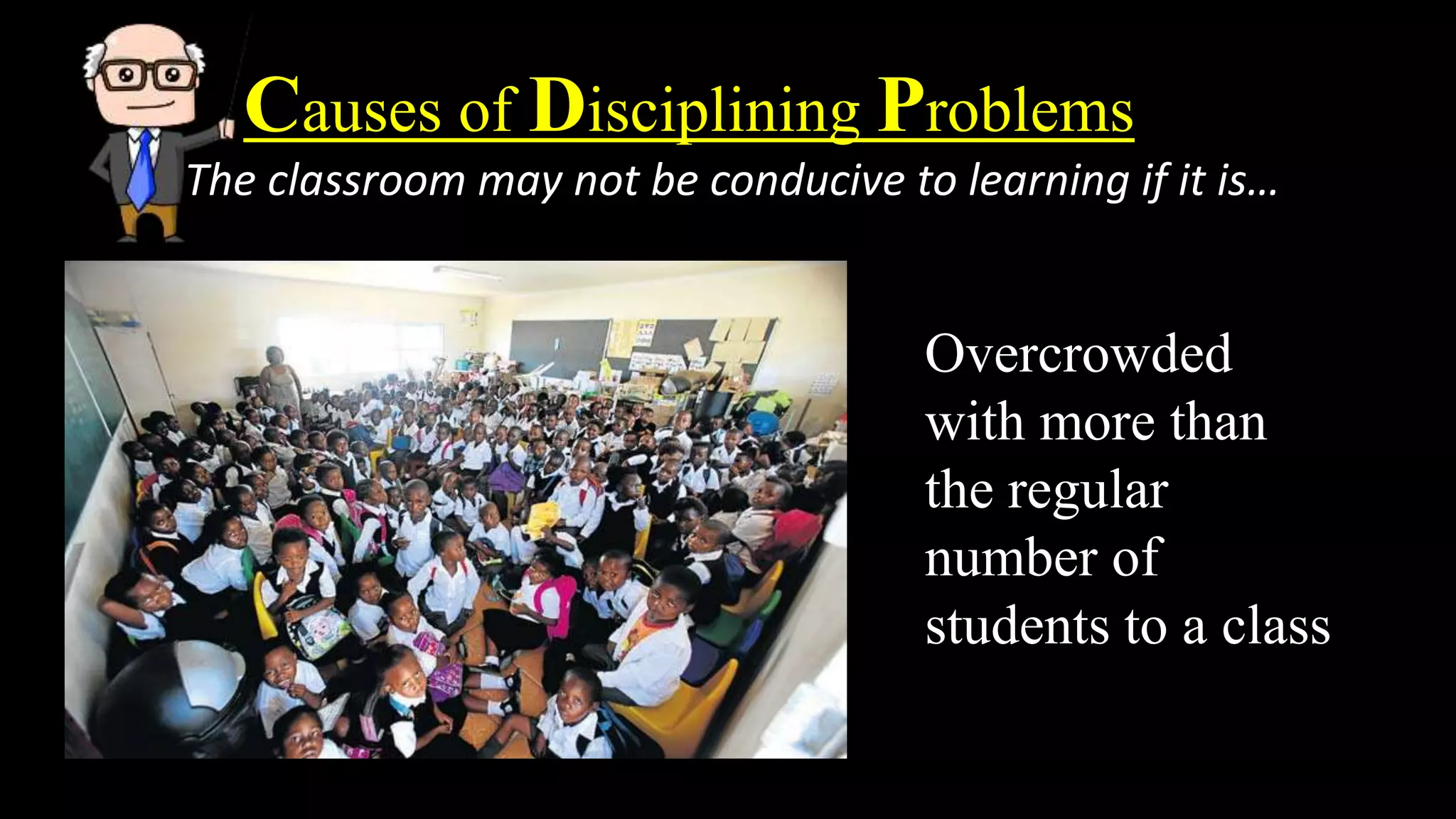
Overcrowded
with more than
the regular
number of
students to a class
The classroom may not be conducive to learning if it is…
Causes of Disciplining Problems
The classroom may not be conducive to learning if it is…
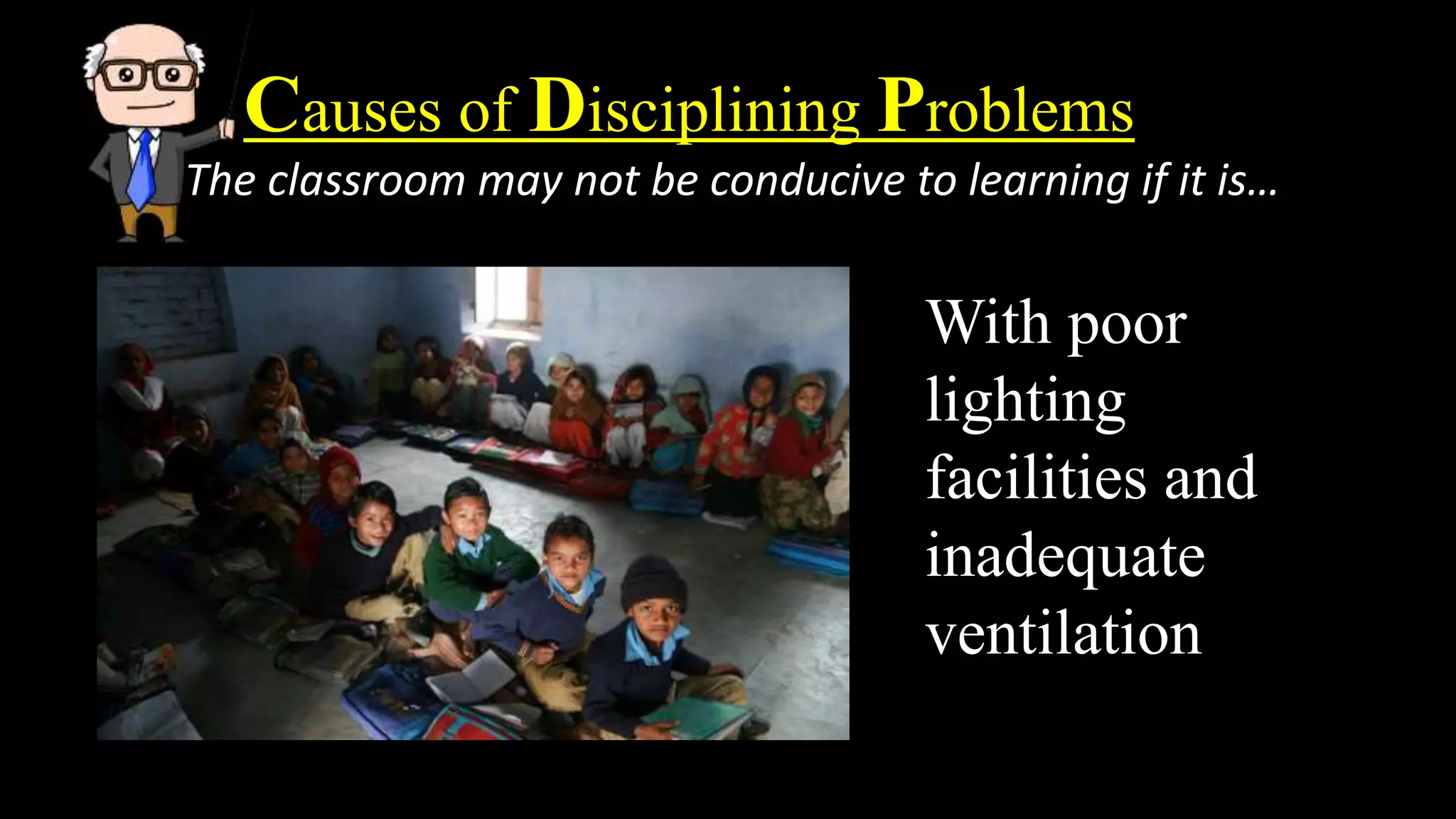
With poor
lighting
facilities and
inadequate
ventilation
Causes of Disciplining Problems
The classroom may not be conducive to learning if it is…
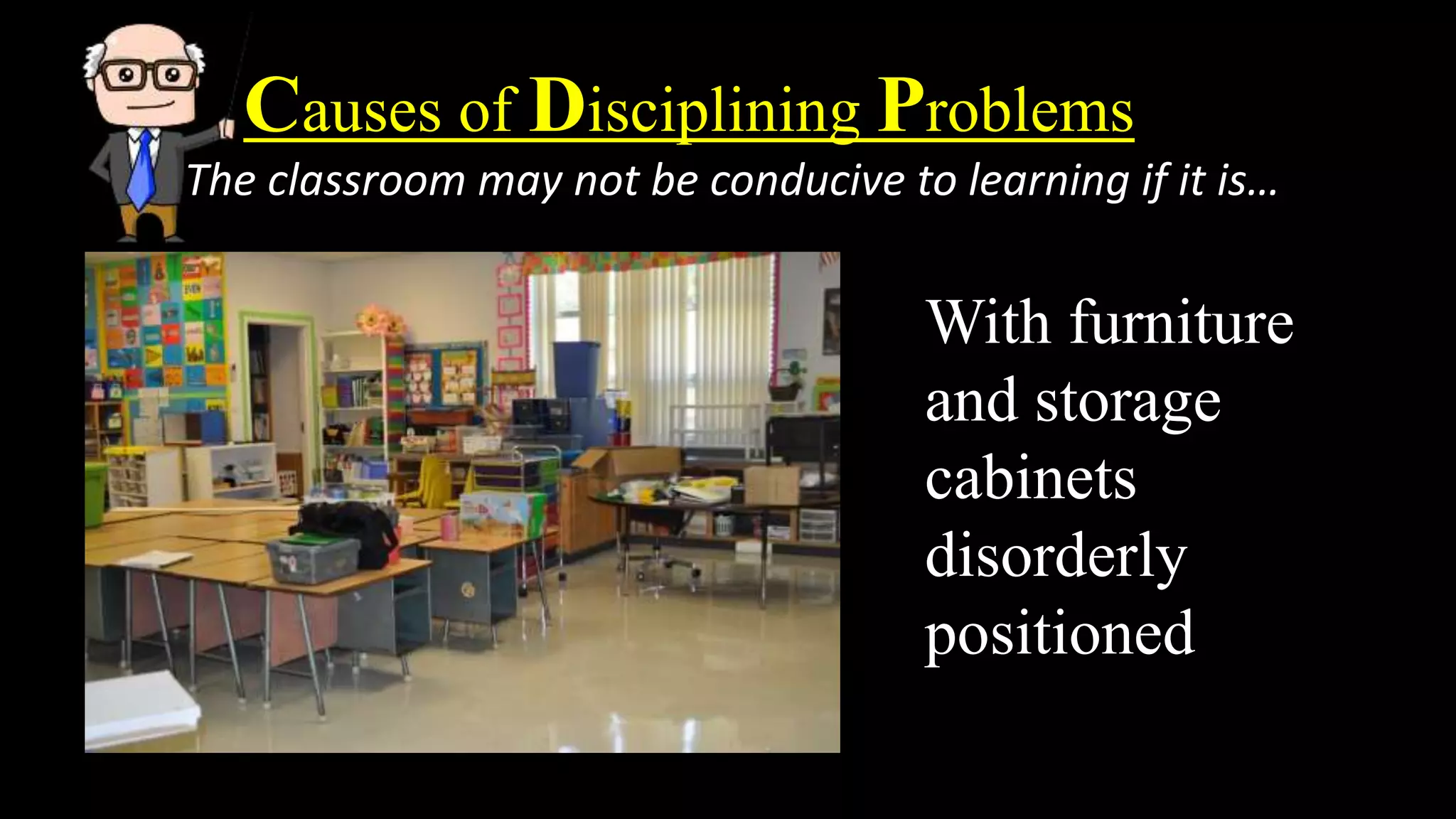
With furniture
and storage
cabinets
disorderly
positioned
Causes of Disciplining Problems
The classroom may not be conducive to learning if it is…
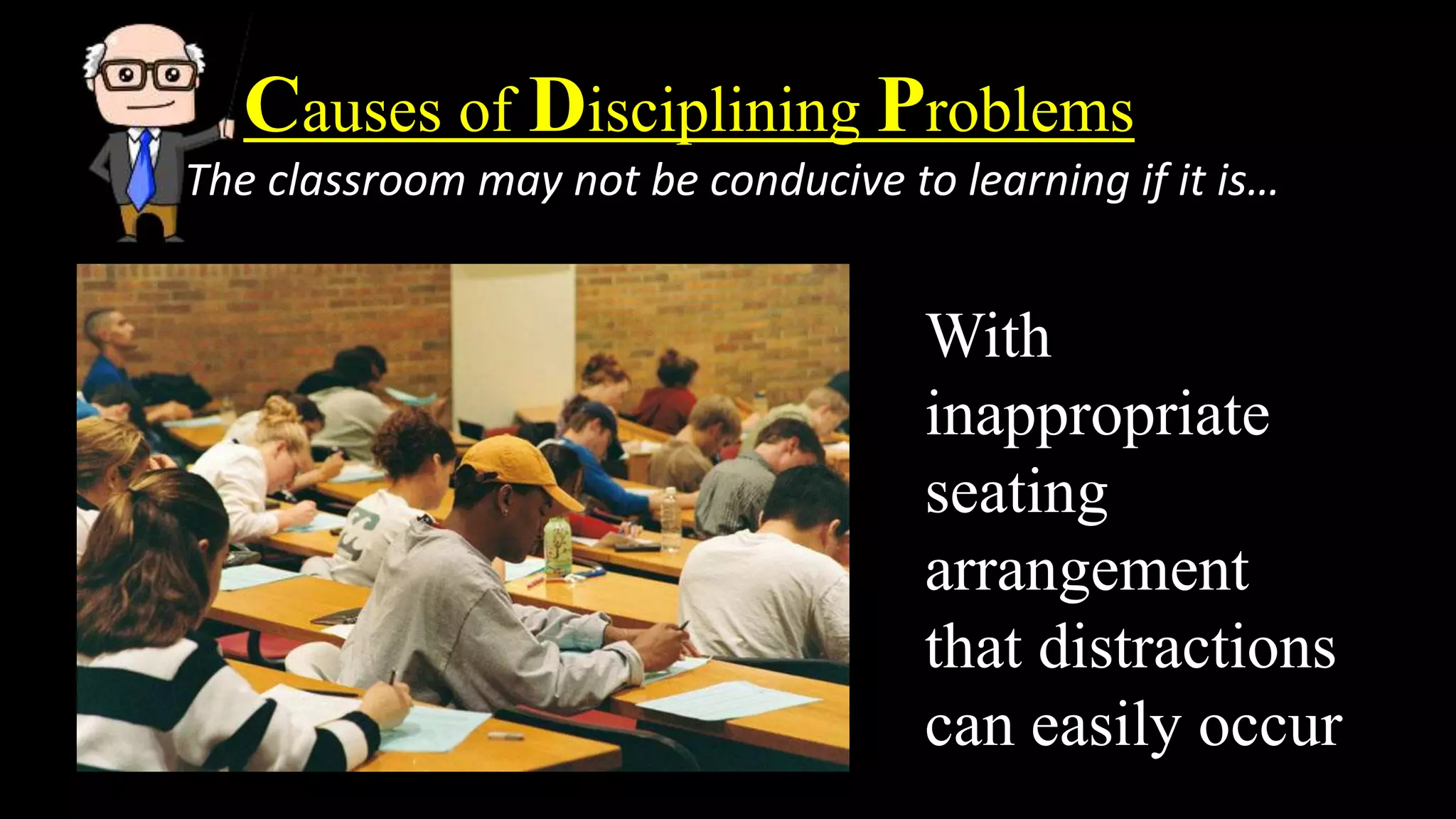
With
inappropriate
seating
arrangement
that distractions
can easily occur
Causes of Disciplining Problems
The classroom may not be conducive to learning if it is…
Near sources of
noise which
obstructs
understanding
of the lesson
Students differ in:
 Family background
 Physical and mental
capacities
 Emotional traits
 Students bred in
families with different
socio-economic
backgrounds may
exhibit characteristics
that are different from
the rest.
Students differ in:
 Family background
 Physical and mental
capacities
 Emotional traits
 Disciplinary measures
practiced in different
homes may cause
unfavorable
consequences as
they relate with one
another.
Students differ in:
 Family background
 Physical and mental
capacities
 Emotional traits
 With varied abilities,
they may greatly differ
in expressing self-
control, patience and
temper when
challenged.
Students differ in:
 Family background
 Physical and mental
capacities
 Emotional traits
 Some may have
special interests that
must be attended to.
Students differ in:
 Family background
 Physical and mental
capacities
 Emotional traits
 Others may have
problems that would
need immediate
solution.
Students differ in:
 Family background
 Physical and mental
capacities
 Emotional traits
 Relationships with
one another can bring
about either positive
or negative
interactions as they
study and work
together.
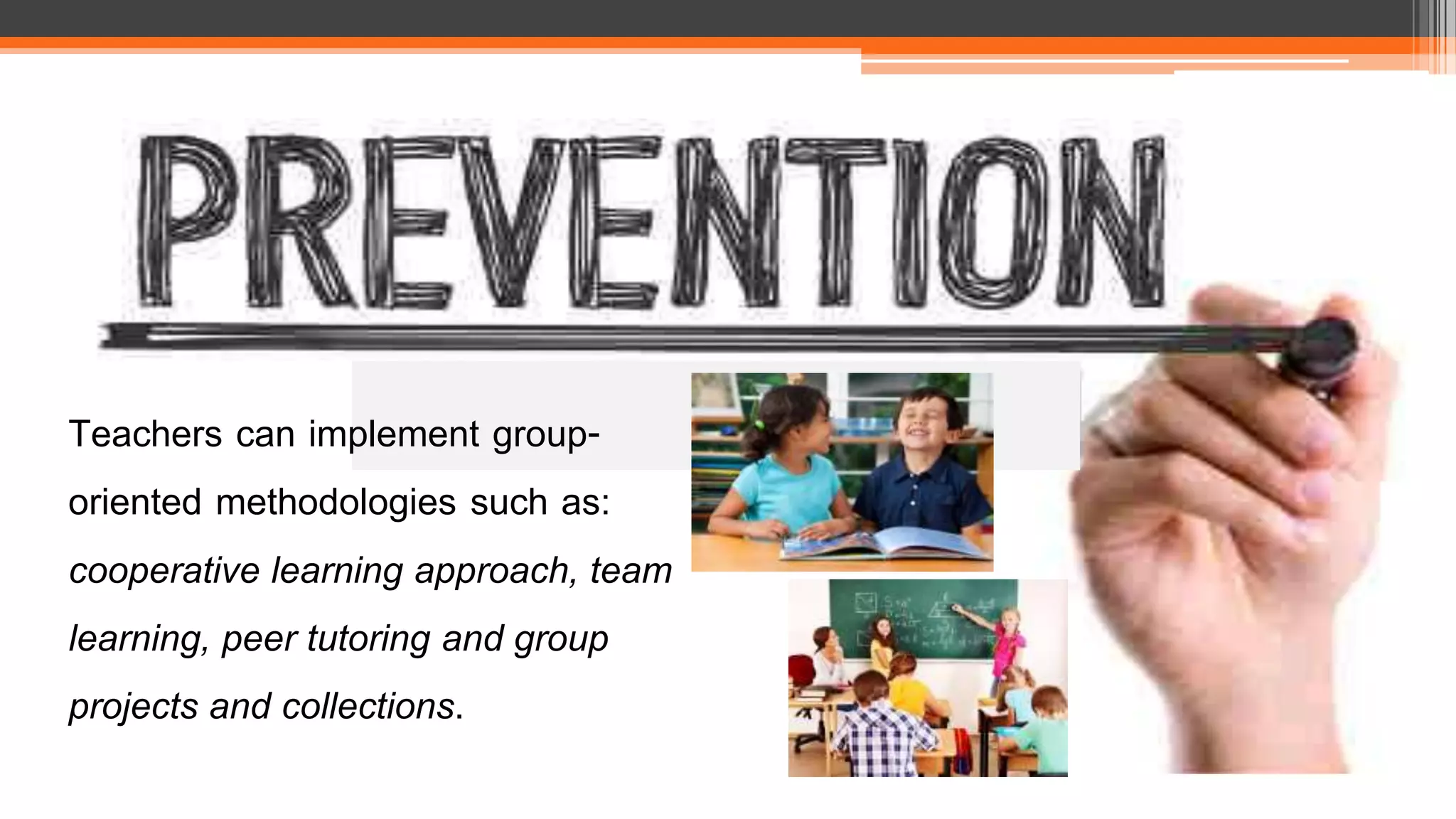
Teachers can implement group-
oriented methodologies such as:
cooperative learning approach, team
learning, peer tutoring and group
projects and collections.
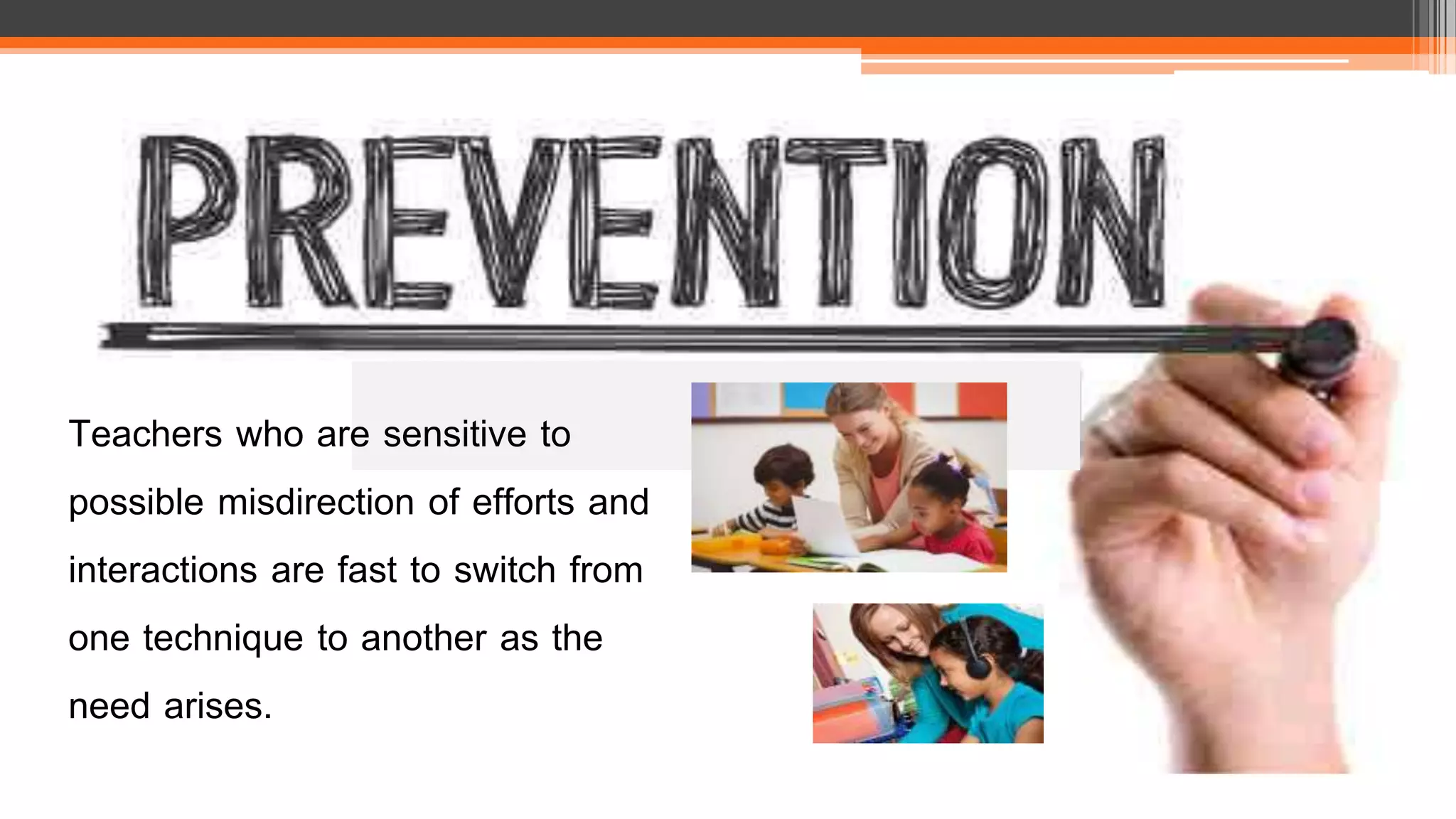
Teachers who are sensitive to
possible misdirection of efforts and
interactions are fast to switch from
one technique to another as the
need arises.
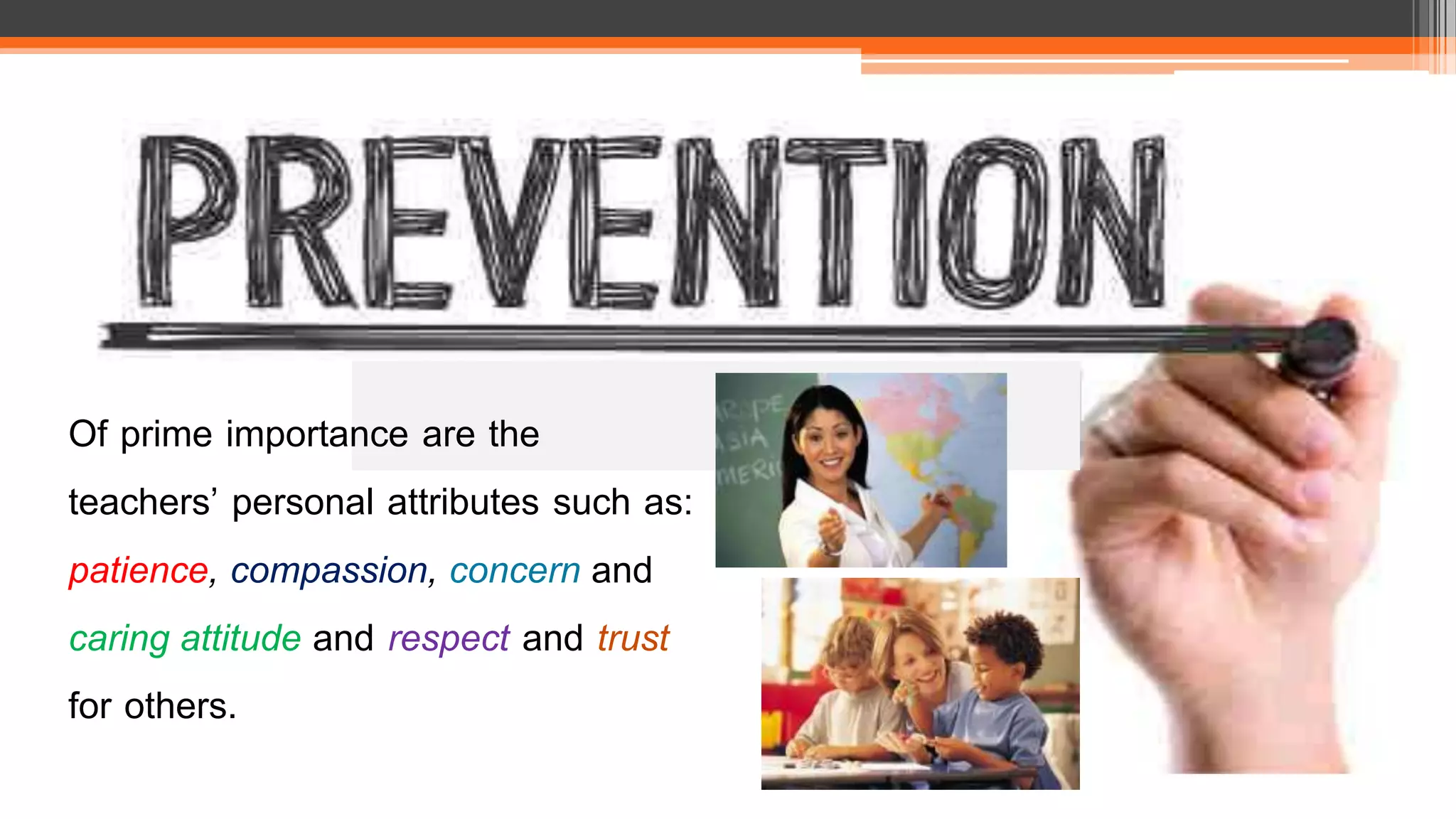
Of prime importance are the
teachers’ personal attributes such as:
patience, compassion, concern and
caring attitude and respect and trust
for others.
The teachers’ personalities are their
surest “arms” that can either win or
fail amidst a controllable learning
situation.
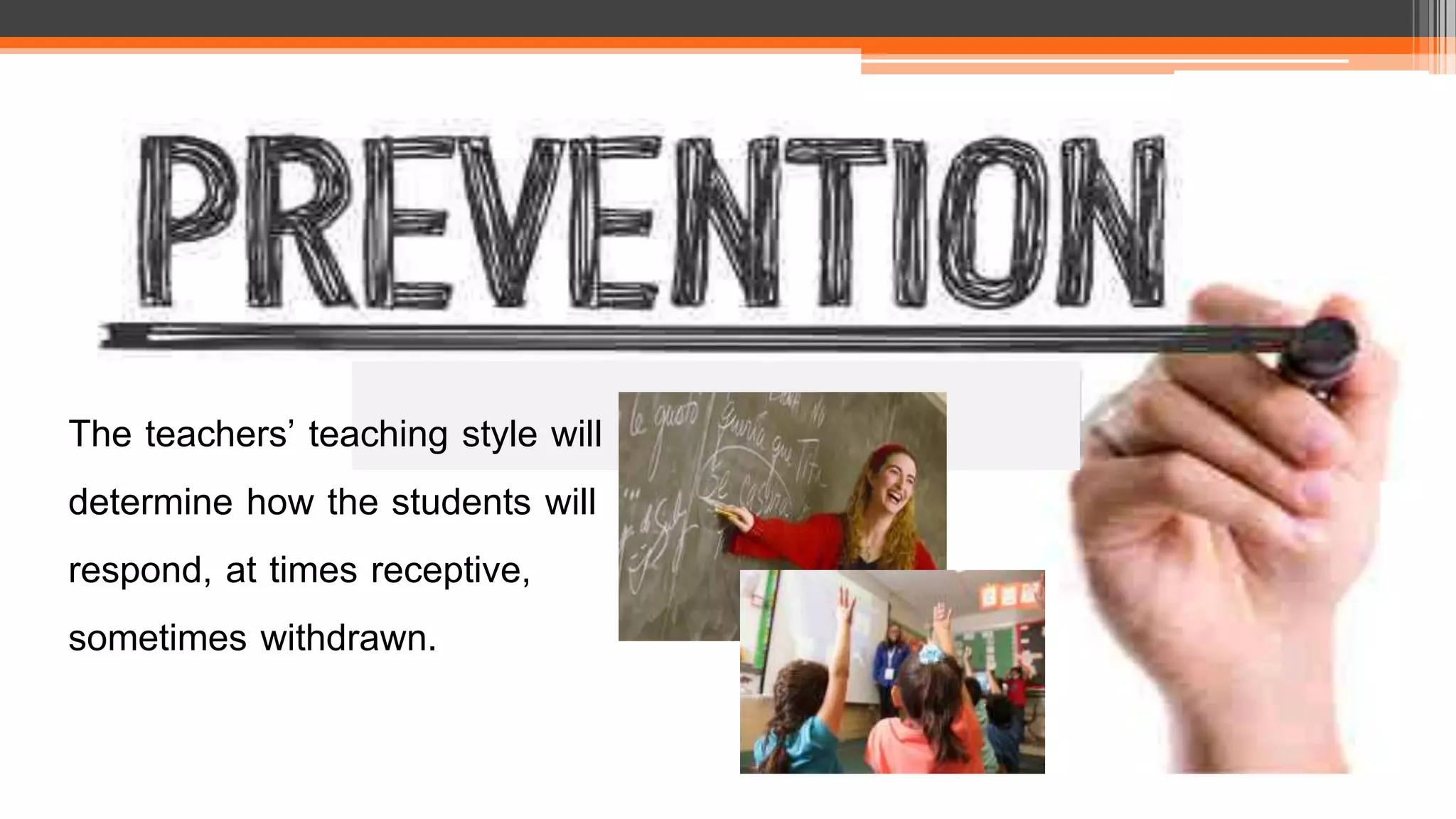
The teachers’ teaching style will
determine how the students will
respond, at times receptive,
sometimes withdrawn.
Common Ways of Establishing Discipline/Classroom Control
 Discipline is the students’ responsibility.
 Discipline is the teachers’ way of establishing a desirable
student-oriented environment for learning.
 Discipline is coupled with effective teaching strategies and
techniques.
 Discipline is achieved through the effects of group
dynamics on behavior.
 Discipline is believed to be the exclusive responsibility of
the teachers.
Tips to be a
Good
Disciplinarian
Be prepared to
face a class with
multi-behavior
tendencies.
Tips to be a
Good
Disciplinarian
Know your
students well.
Tips to be a
Good
Disciplinarian
Commendable
behavior is
reciprocal.
Tips to be a
Good
Disciplinarian
Show your
sincere concern
for their welfare.
Tips to be a
Good
Disciplinarian
Be calm, poised
and tactful in
solving discipline
problems.
Tips to be a
Good
Disciplinarian
Be
enthusiastic.
Tips to be a
Good
Disciplinarian
At all times be firm

and consistent in
following classroom
“do’s” and “don’t’s.”
Tips to be a
Good
Disciplinarian
Let out your
good sense of
humor.
Tips to be a
Good
Disciplinarian
Speak with a
good voice
volume.
Tips to be a
Good
Disciplinarian
Be humble in
words and
actions.
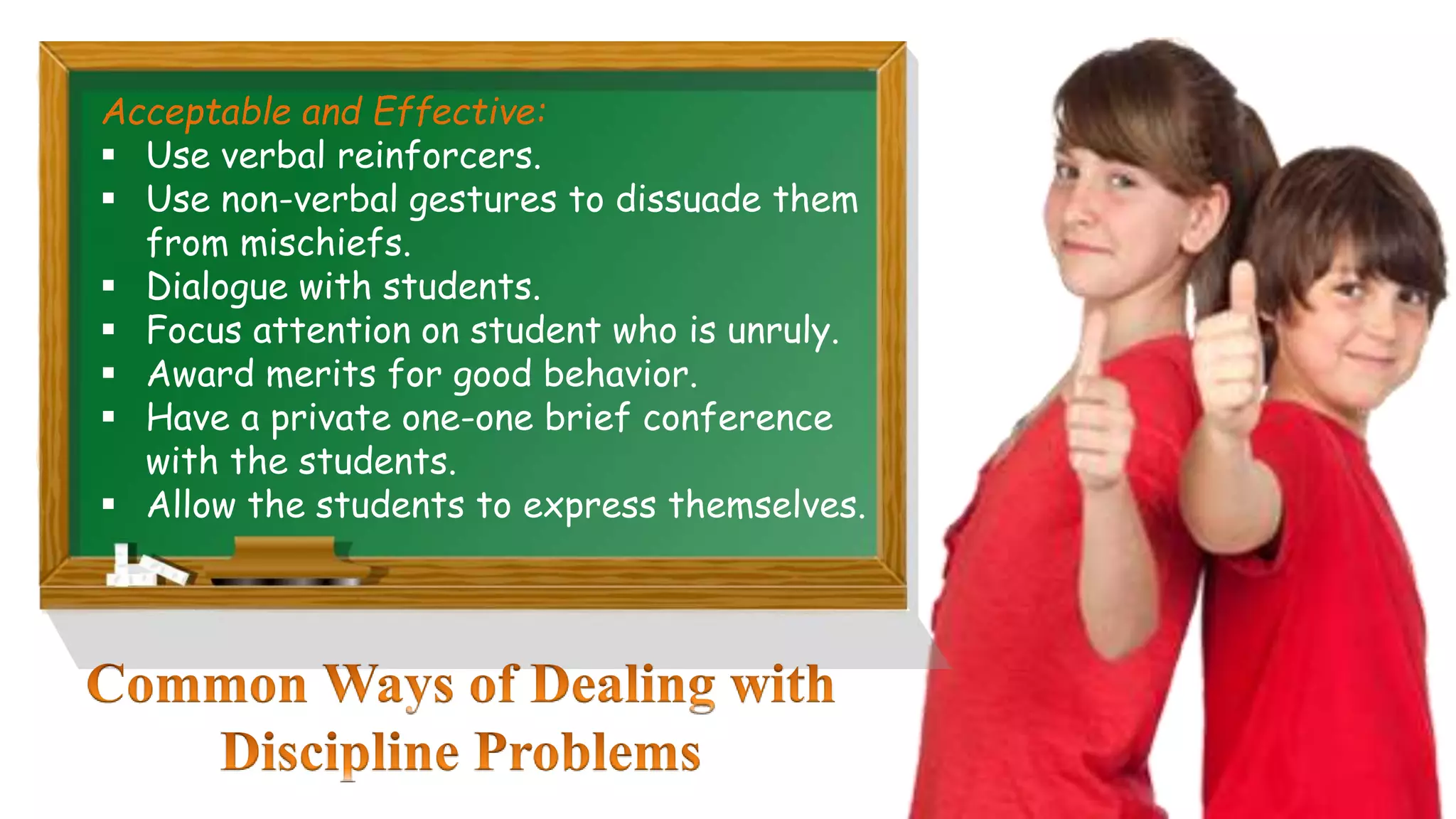
Acceptable and Effective:
 Use verbal reinforcers.
 Use non-verbal gestures to dissuade them
from mischiefs.
 Dialogue with students.
 Focus attention on student who is unruly.
 Award merits for good behavior.
 Have a private one-one brief conference
with the students.
 Allow the students to express themselves.
Common Ways of Dealing with
Discipline Problems
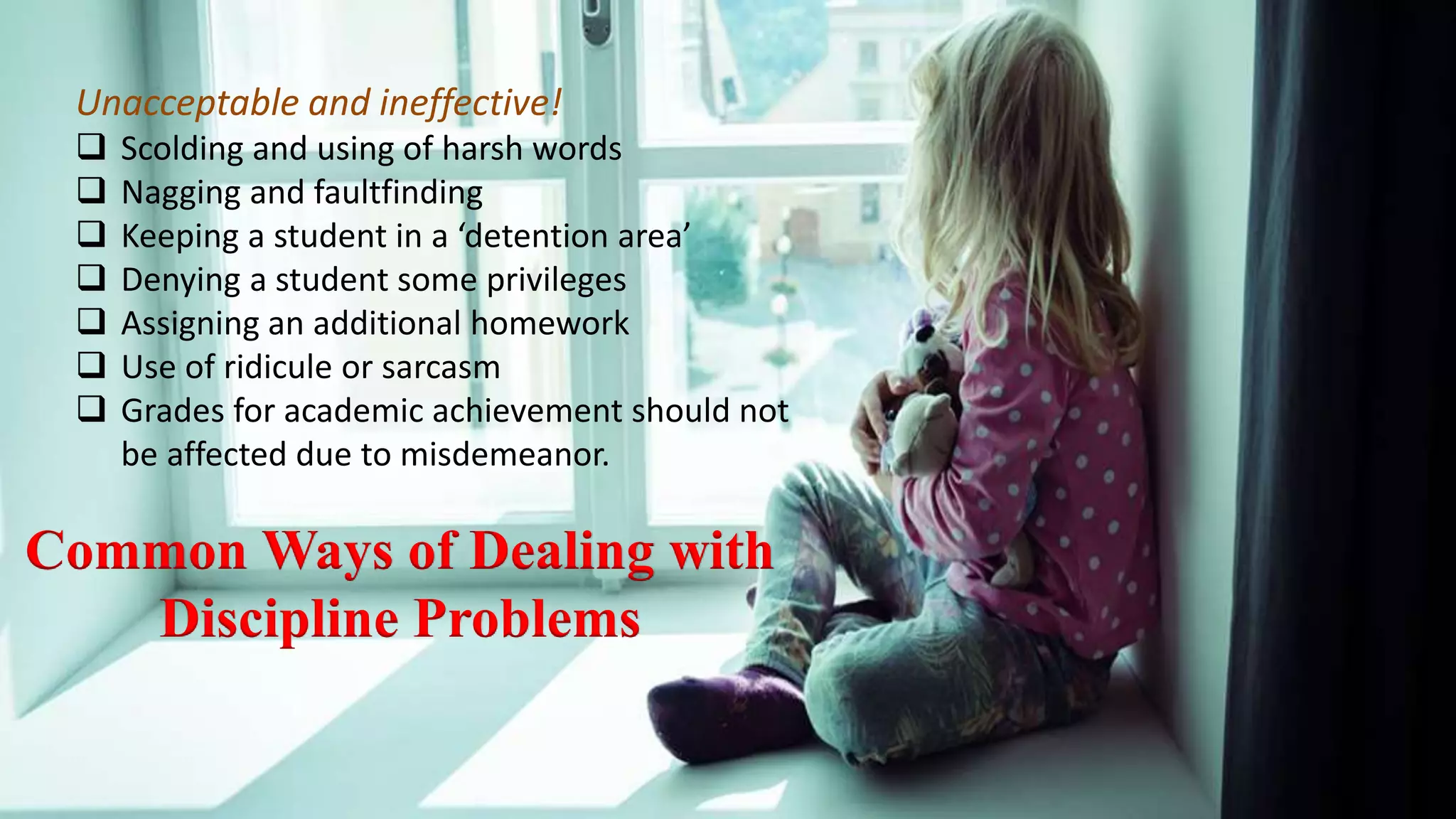
Unacceptable and ineffective!
 Scolding and using of harsh words
 Nagging and faultfinding
 Keeping a student in a ‘detention area’
 Denying a student some privileges
 Assigning an additional homework
 Use of ridicule or sarcasm
 Grades for academic achievement should not
be affected due to misdemeanor.
Establis
hingROUTINE
Advantages
Ways of Establishing Routine
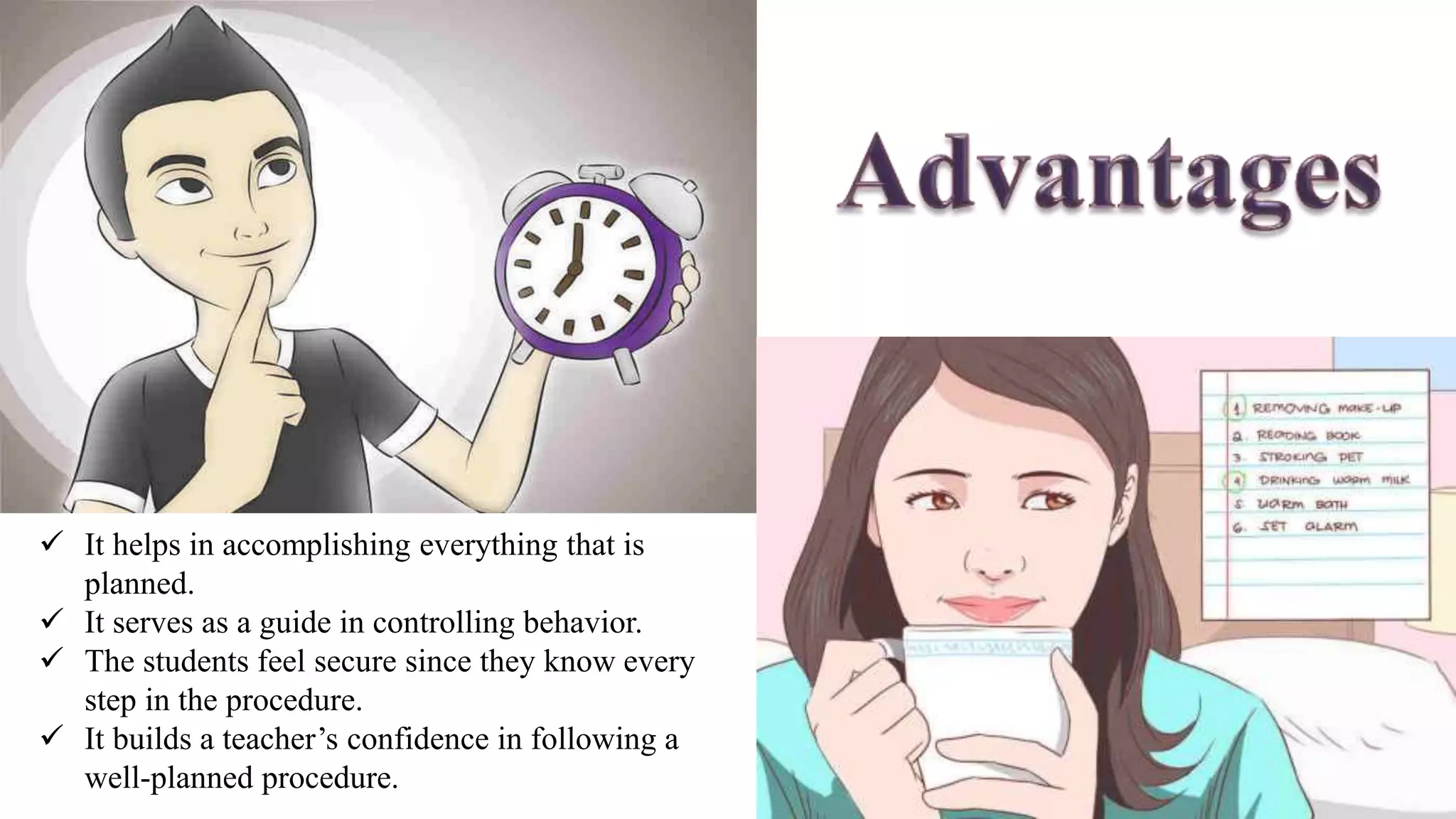
 It helps in accomplishing everything that is
planned.
 It serves as a guide in controlling behavior.
 The students feel secure since they know every
step in the procedure.
 It builds a teacher’s confidence in following a
well-planned procedure.
Ways of
Establishing
Routine  Schedule a routine on a weekly or monthly basis
instead of a daily basis.
 Plan a routine for an entire class rather than for
an individual or group.
 Plan a procedure for the whole unit with a
corresponding time-allotment for each topic.
 Though beyond the time limit, you may continue
discussing for the sake of additional learning.
 Give clear and direct instructions.
 Practice some signals.
 Model time consciousness.
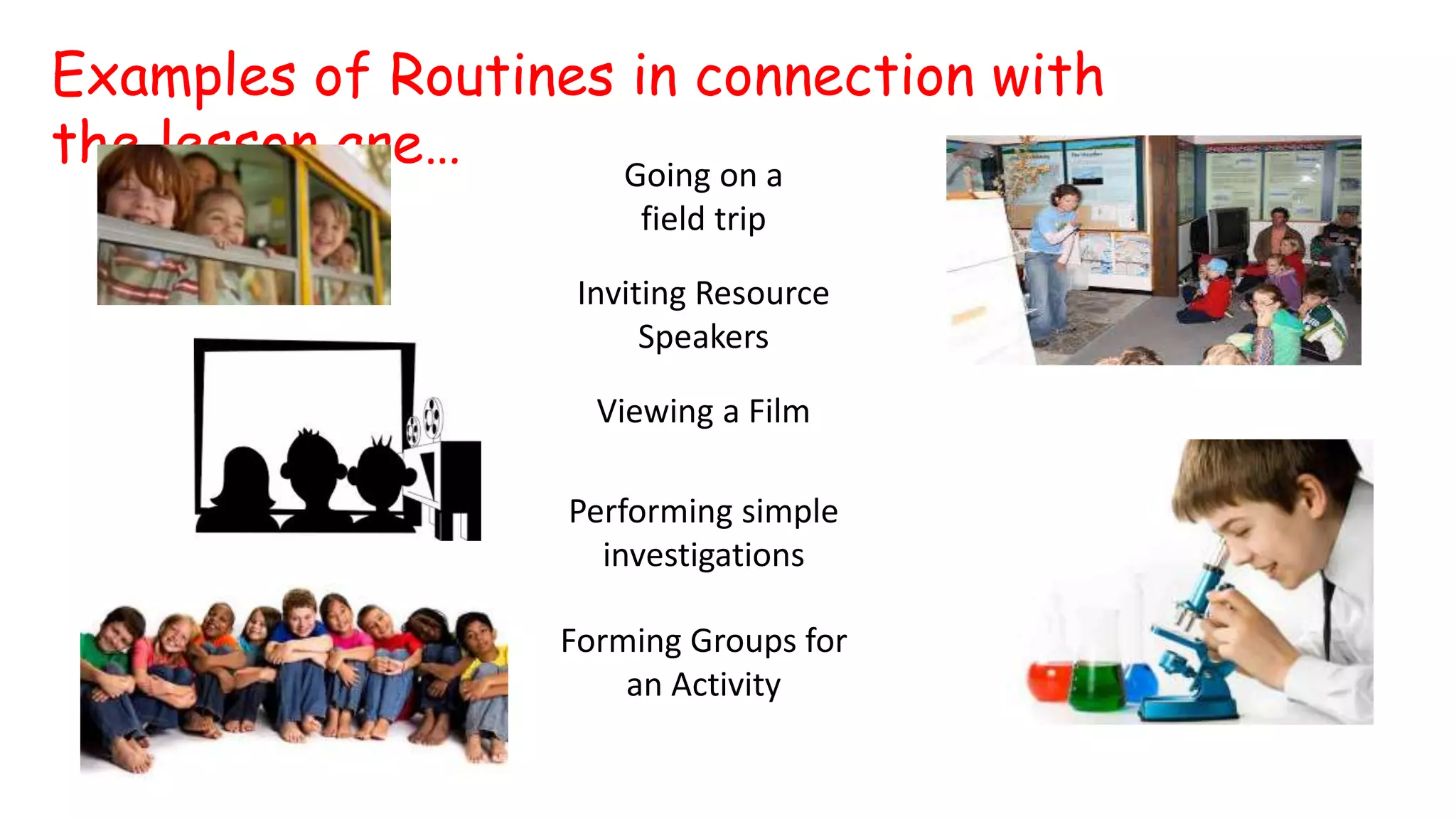
Examples of Routines in connection with
the lesson are… Going on a
field trip
Inviting Resource
Speakers
Viewing a Film
Performing simple
investigations
Forming Groups for
an Activity
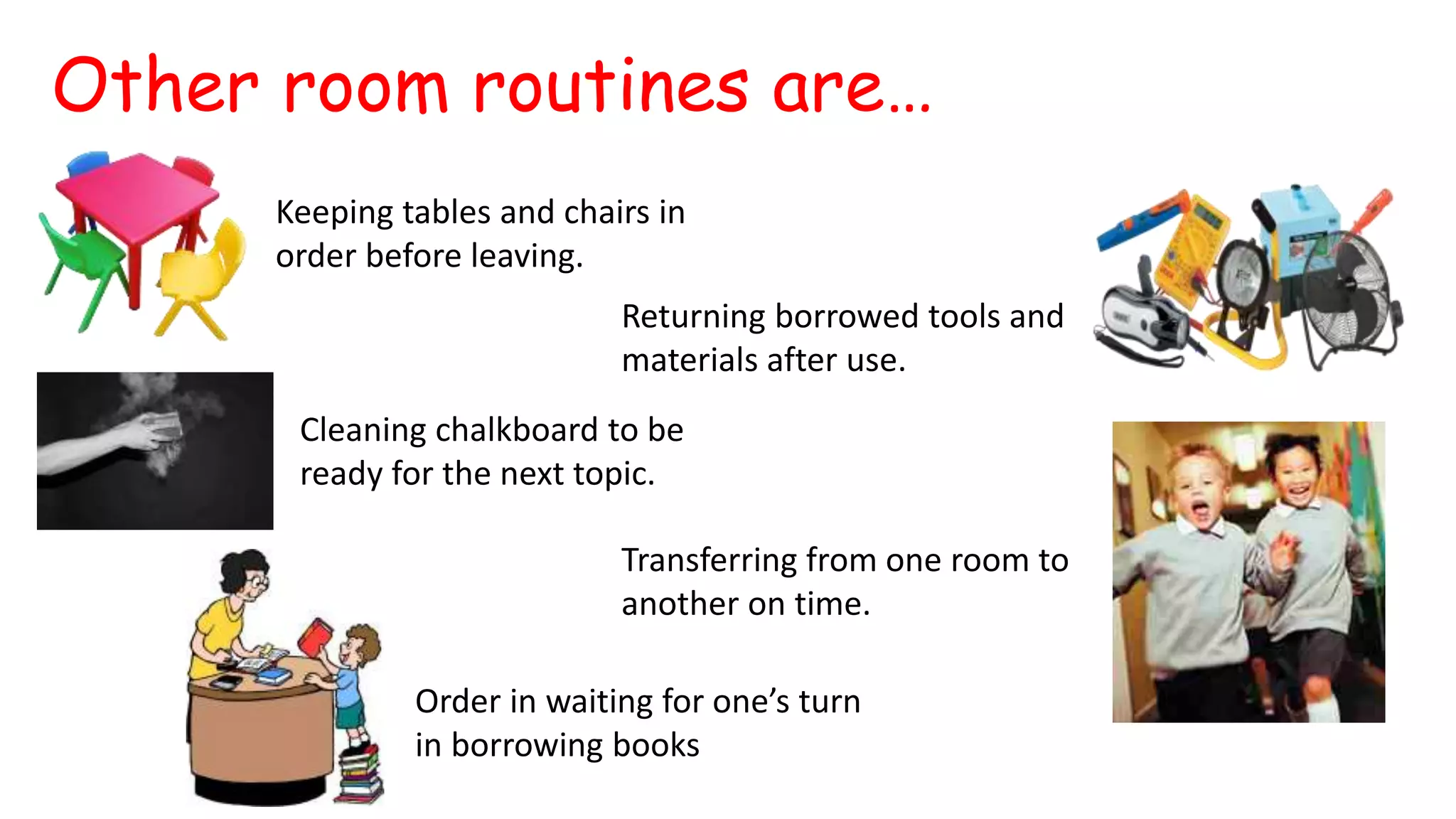
Other room routines are…
Keeping tables and chairs in
order before leaving.
Returning borrowed tools and
materials after use.
Cleaning chalkboard to be
ready for the next topic.
Transferring from one room to
another on time.
Order in waiting for one’s turn
in borrowing books
Discipline and Establishing Routine Inside the Classroom

Discipline and Establishing Routine Inside the Classroom

  • 1.
    Causes of Disciplining Problems Prevention Common Waysof Establishing Discipline/ Classroom Control Tips to be a Good Disciplinarian Common Ways of Dealing Discipline Problems
  • 2.
    Causes of DiscipliningProblems Overcrowded with more than the regular number of students to a class The classroom may not be conducive to learning if it is…
  • 3.
    Causes of DiscipliningProblems The classroom may not be conducive to learning if it is… With poor lighting facilities and inadequate ventilation
  • 4.
    Causes of DiscipliningProblems The classroom may not be conducive to learning if it is… With furniture and storage cabinets disorderly positioned
  • 5.
    Causes of DiscipliningProblems The classroom may not be conducive to learning if it is… With inappropriate seating arrangement that distractions can easily occur
  • 6.
    Causes of DiscipliningProblems The classroom may not be conducive to learning if it is… Near sources of noise which obstructs understanding of the lesson
  • 7.
    Students differ in: Family background  Physical and mental capacities  Emotional traits  Students bred in families with different socio-economic backgrounds may exhibit characteristics that are different from the rest.
  • 8.
    Students differ in: Family background  Physical and mental capacities  Emotional traits  Disciplinary measures practiced in different homes may cause unfavorable consequences as they relate with one another.
  • 9.
    Students differ in: Family background  Physical and mental capacities  Emotional traits  With varied abilities, they may greatly differ in expressing self- control, patience and temper when challenged.
  • 10.
    Students differ in: Family background  Physical and mental capacities  Emotional traits  Some may have special interests that must be attended to.
  • 11.
    Students differ in: Family background  Physical and mental capacities  Emotional traits  Others may have problems that would need immediate solution.
  • 12.
    Students differ in: Family background  Physical and mental capacities  Emotional traits  Relationships with one another can bring about either positive or negative interactions as they study and work together.
  • 13.
    Teachers can implementgroup- oriented methodologies such as: cooperative learning approach, team learning, peer tutoring and group projects and collections.
  • 14.
    Teachers who aresensitive to possible misdirection of efforts and interactions are fast to switch from one technique to another as the need arises.
  • 15.
    Of prime importanceare the teachers’ personal attributes such as: patience, compassion, concern and caring attitude and respect and trust for others.
  • 16.
    The teachers’ personalitiesare their surest “arms” that can either win or fail amidst a controllable learning situation.
  • 17.
    The teachers’ teachingstyle will determine how the students will respond, at times receptive, sometimes withdrawn.
  • 18.
    Common Ways ofEstablishing Discipline/Classroom Control  Discipline is the students’ responsibility.  Discipline is the teachers’ way of establishing a desirable student-oriented environment for learning.  Discipline is coupled with effective teaching strategies and techniques.  Discipline is achieved through the effects of group dynamics on behavior.  Discipline is believed to be the exclusive responsibility of the teachers.
  • 19.
    Tips to bea Good Disciplinarian Be prepared to face a class with multi-behavior tendencies.
  • 20.
    Tips to bea Good Disciplinarian Know your students well.
  • 21.
    Tips to bea Good Disciplinarian Commendable behavior is reciprocal.
  • 22.
    Tips to bea Good Disciplinarian Show your sincere concern for their welfare.
  • 23.
    Tips to bea Good Disciplinarian Be calm, poised and tactful in solving discipline problems.
  • 24.
    Tips to bea Good Disciplinarian Be enthusiastic.
  • 25.
    Tips to bea Good Disciplinarian At all times be firm and consistent in following classroom “do’s” and “don’t’s.”
  • 26.
    Tips to bea Good Disciplinarian Let out your good sense of humor.
  • 27.
    Tips to bea Good Disciplinarian Speak with a good voice volume.
  • 28.
    Tips to bea Good Disciplinarian Be humble in words and actions.
  • 29.
    Acceptable and Effective: Use verbal reinforcers.  Use non-verbal gestures to dissuade them from mischiefs.  Dialogue with students.  Focus attention on student who is unruly.  Award merits for good behavior.  Have a private one-one brief conference with the students.  Allow the students to express themselves.
  • 30.
    Common Ways ofDealing with Discipline Problems Unacceptable and ineffective!  Scolding and using of harsh words  Nagging and faultfinding  Keeping a student in a ‘detention area’  Denying a student some privileges  Assigning an additional homework  Use of ridicule or sarcasm  Grades for academic achievement should not be affected due to misdemeanor.
  • 31.
  • 32.
     It helpsin accomplishing everything that is planned.  It serves as a guide in controlling behavior.  The students feel secure since they know every step in the procedure.  It builds a teacher’s confidence in following a well-planned procedure.
  • 33.
    Ways of Establishing Routine Schedule a routine on a weekly or monthly basis instead of a daily basis.  Plan a routine for an entire class rather than for an individual or group.  Plan a procedure for the whole unit with a corresponding time-allotment for each topic.  Though beyond the time limit, you may continue discussing for the sake of additional learning.  Give clear and direct instructions.  Practice some signals.  Model time consciousness.
  • 34.
    Examples of Routinesin connection with the lesson are… Going on a field trip Inviting Resource Speakers Viewing a Film Performing simple investigations Forming Groups for an Activity
  • 35.
    Other room routinesare… Keeping tables and chairs in order before leaving. Returning borrowed tools and materials after use. Cleaning chalkboard to be ready for the next topic. Transferring from one room to another on time. Order in waiting for one’s turn in borrowing books