Classroom Management
Prepared by:
Orlando A. Pistan, MAEd
Psychology Instructor
Classroom Management
 One of the most
challenging and difficult
functions of a teacher is
classroom management.
 In the past, classroom
management had often
been an issue dealing with
individual student
behaviour; also the ability
of the teacher to control or
manage his class as
reflected in the quietness of
the students.
Classroom Management
 Management of the class
means establishing a routine
that enables learning to move
smoothly and prevent
unnecessary discipline
problems.
 From a pedagogical standpoint,
only in an orderly classroom
can learning occur.
 Orderly does not mean quiet
and rigid. An orderly classroom
is one in which everyone-
teacher and students, know
exactly what is going on.
Classroom Management
 Classroom management
is the use of rules and
procedures to maintain
order, so that learning
may result.
Functions of Classroom
Management:
 Planning
 Communication
 Control
Functions of Classroom
Management:
Planning – where
objectives and procedures
are selected. This also
concerns ongoing
activities and how they
can be best organized.
Functions of Classroom
Management:
Communication – by
which information is
transferred. This
underscores the
necessity to tell
students what is
expected of them.
Functions of Classroom
Management:
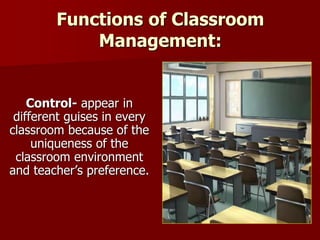
Control- appear in
different guises in every
classroom because of the
uniqueness of the
classroom environment
and teacher’s preference.
Disruptive Behaviours in the
Classroom
Let us examine what is
actually going on in the
classroom. It would be useful
to know something about the
kinds of disruptive
behaviours exhibited by
students during classes. Any
student may have one or
more particular kinds of
problem behaviour.
Disruptive Behaviours in the
Classroom
 Odd noises
 Over-talkativeness
 Shouting one’s answer
 Answering at the same time
 Moving around
 Standing
 Short attention span
 Fighting, hitting
 Temper tantrums
 Destructiveness
 Uncooperativeness
 Lack of perseverance
 Does not follow instructions
 Staring blankly
 Failing to finish
 Eating inside the classroom
 Habitual absences & Tardiness
Responding to Disruptions
 Looking on
 Non-directive
statements
 Questions
 Directing
 Modelling
 Physical
interventions
Looking on.
Sometimes teacher
simply looks hard at
the student. This
look is a way of
showing
disapproval.
Non-directive statements.
At times, teachers
simply state words
what they see. The
statement is a
verbal way of
showing awareness
of what is
happening.
Questions.
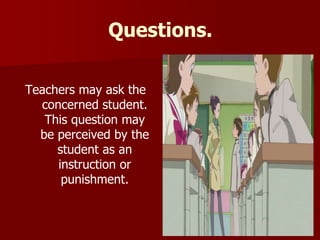
Teachers may ask the
concerned student.
This question may
be perceived by the
student as an
instruction or
punishment.
Directing.
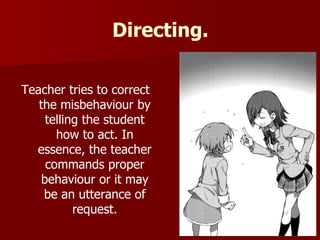
Teacher tries to correct
the misbehaviour by
telling the student
how to act. In
essence, the teacher
commands proper
behaviour or it may
be an utterance of
request.
Modelling.
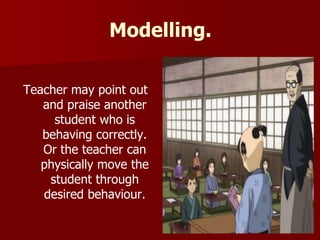
Teacher may point out
and praise another
student who is
behaving correctly.
Or the teacher can
physically move the
student through
desired behaviour.
Physical interventions.
Sending the student out
of the classroom,
isolate the student,
the teacher may grab,
shake, or even paddle
a student.
Thank you for paying attention.
 Prepared by:
 Orlando A. Pistan, MAEd
 Psychology Instructor

Classroom Management

  • 1.
    Classroom Management Prepared by: OrlandoA. Pistan, MAEd Psychology Instructor
  • 2.
    Classroom Management  Oneof the most challenging and difficult functions of a teacher is classroom management.  In the past, classroom management had often been an issue dealing with individual student behaviour; also the ability of the teacher to control or manage his class as reflected in the quietness of the students.
  • 3.
    Classroom Management  Managementof the class means establishing a routine that enables learning to move smoothly and prevent unnecessary discipline problems.  From a pedagogical standpoint, only in an orderly classroom can learning occur.  Orderly does not mean quiet and rigid. An orderly classroom is one in which everyone- teacher and students, know exactly what is going on.
  • 4.
    Classroom Management  Classroommanagement is the use of rules and procedures to maintain order, so that learning may result.
  • 5.
    Functions of Classroom Management: Planning  Communication  Control
  • 6.
    Functions of Classroom Management: Planning– where objectives and procedures are selected. This also concerns ongoing activities and how they can be best organized.
  • 7.
    Functions of Classroom Management: Communication– by which information is transferred. This underscores the necessity to tell students what is expected of them.
  • 8.
    Functions of Classroom Management: Control-appear in different guises in every classroom because of the uniqueness of the classroom environment and teacher’s preference.
  • 9.
    Disruptive Behaviours inthe Classroom Let us examine what is actually going on in the classroom. It would be useful to know something about the kinds of disruptive behaviours exhibited by students during classes. Any student may have one or more particular kinds of problem behaviour.
  • 10.
    Disruptive Behaviours inthe Classroom  Odd noises  Over-talkativeness  Shouting one’s answer  Answering at the same time  Moving around  Standing  Short attention span  Fighting, hitting  Temper tantrums  Destructiveness  Uncooperativeness  Lack of perseverance  Does not follow instructions  Staring blankly  Failing to finish  Eating inside the classroom  Habitual absences & Tardiness
  • 11.
    Responding to Disruptions Looking on  Non-directive statements  Questions  Directing  Modelling  Physical interventions
  • 12.
    Looking on. Sometimes teacher simplylooks hard at the student. This look is a way of showing disapproval.
  • 13.
    Non-directive statements. At times,teachers simply state words what they see. The statement is a verbal way of showing awareness of what is happening.
  • 14.
    Questions. Teachers may askthe concerned student. This question may be perceived by the student as an instruction or punishment.
  • 15.
    Directing. Teacher tries tocorrect the misbehaviour by telling the student how to act. In essence, the teacher commands proper behaviour or it may be an utterance of request.
  • 16.
    Modelling. Teacher may pointout and praise another student who is behaving correctly. Or the teacher can physically move the student through desired behaviour.
  • 17.
    Physical interventions. Sending thestudent out of the classroom, isolate the student, the teacher may grab, shake, or even paddle a student.
  • 18.
    Thank you forpaying attention.  Prepared by:  Orlando A. Pistan, MAEd  Psychology Instructor