




Developing Standarts for
Classroom Behaviour and
Methods for Maximizing
On-Task Student Behaviour
Table of Contents
• Content
• Behaved Teachers
• Gantt Card
• Chapter Reviews
• Fishbone
• Matrix Diagram
• Survey
• Problem
• References & Thanks
• Behaved Teachers
Ozan O. YILMAZ Selahattin ÖZTÜRK Merve DİNÇ
Halil AKBAŞSelen ESENSamet KARAMAN
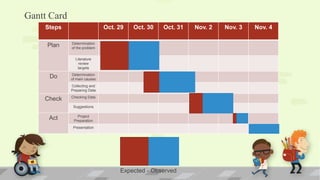
Gantt Card
Steps Oct. 29 Oct. 30 Oct. 31 Nov. 2 Nov. 3 Nov. 4
Plan Determination
of the problem
Literature
review
targets
Do Determination
of main causes
Collecting and
Preparing Data
Check Checking Data
Suggestions
Act Project
Preparation
Presentation
Expected - Observed
Learning Goals
Learning goals
• For example:
• After this presentation:
• You will understand the importance of having goals
• You will know how to teach and monitor procedures
• You will be equipped with the tools to manage desired behaviour in classroom
Why are these goals important?
• 1) They provide the clasroom with a smooth flow.
• 2) They help reduce behavioral problems.
• 3) They help us be more organized, thus more productive.
Literature Review of
«Creating Behavioral Standards within the Classroom»
• (Emmer et al., 1980; Evertson & Emmer, 1982a): Effective teachers
teach students classroom rules and procedures.
• According to Emmer and colleagues (1981),
• Rules mean any written rules given that students must obey.
• Procedures mean expectations for a specific behavior. They are
directed to accomplishing, rather than forbiddin some behaviour.
Literature Review
• According to initial research, there is a correlation between
establishing rules and classroom success
• Which means establishing more rules results in more
classroom achievement.
Literature Review
• (Evertson & Harris, 1999; Evertson & Smithey, 2000): Teachers should be given
more training in classroom management. They further developed this idea into what
is known as Classroom Organization and Management Program.
• Jerome Freiberg (1999), Ron Nelson (Nelson et al, 1998), Positive Behavioral
Support work (Lewis & Newcomer, 2005; Lewis et al., 2006): It is important to
teach desired behaviour and to establish agreed-on behaviour standards.
Practical Implication
• To become an effective teacher, we need more training programs like COMP.
• Rules are good but procedures are more effective because they are more specific and
they are positive rather than negative. But we shouldn’t forget that they are
complement of each other.
• We shouldn’t start setting rules and procedures on the first day, it can wait several
lessons.
Developing General
Behaviours Standarts or Rules
Developing General Behaviours Standarts or Rules
• Rules vs. Norms, Behavior Expectations or Behavior Standards.
Steps in Developing Classroom Behaviour Standarts
1. Discussing the value of Rules and Behavior Standards.
 Ask students why adults have rules in society.
Steps in Developing Classroom Behaviour Standarts
2. Developing a list.
 State the standards in a positive manner.
 It is important to evaluate the behavior by examining time, place and
manner.
Steps in Developing Classroom Behaviour Standarts
3. Getting a commitment.
 Ask students if the rule is appropriate.
 Have students sign this commitment.
Steps in Developing Classroom Behaviour Standarts
4. Monitoring and Reviewing the Standards
 Students can be asked to role-play both appropriate and inappropriate
behavior standards.
 It is important to review the rules when the problem increases.
Steps in Developing Classroom Behaviour Standarts
5. Reinforcing Behavior that Supports the Classroom Behavior Norms
 Praise and Feedback.
 Assign students to observe the class.
Creative Examples of Teaching
and Reviewing Rules and
Procedures
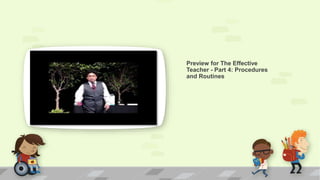
Preview for The Effective
Teacher - Part 4: Procedures
and Routines
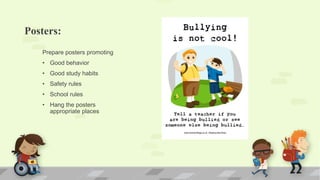
Posters:
Prepare posters promoting
• Good behavior
• Good study habits
• Safety rules
• School rules
• Hang the posters
appropriate places
School in Relation to Community Rules:
• Let students work on school rules.
• Let them know how school rules works and what their reasons are.
• How they are related to community rules
• What is the importance of these rules on community life
• This let students to know their responsibilities.
Picture Posters
• Make students bring their picture of themselves to school
• Use student pictures highlighting school rules
• The following students believe it is important to respect everyone.
• Show pictures listing students’ names and grades
• Post posters through school
• Uses peer pressure
DO NOT FORGET!
• Your students are individuals.
• Your students deserves the treatment that you think you deserve.
• Act accordingly.
Procedures
Procedures
• Procedures mean expectations for a specific behavior. They are directed to
accomplishing, rather than forbiddin some behaviour.
Several Examples of Procedures: Class Attention Grabbers
Caption
One spot tactic
Example: Practice of Procedure
Example: Addressing learner differences
Can we control non-class behaviour?
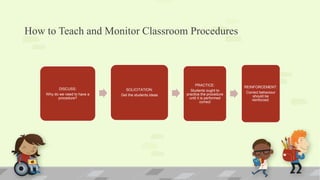
How to Teach and Monitor Classroom Procedures
DISCUSS:
Why do we need to have a
procedure?
SOLICITATION:
Get the students ideas
PRACTICE:
Students ought to
practice the procedure
until it is performed
correct
REINFORCEMENT:
Correct behaviour
should be
reinforced.
Classroom Management Skills that
Help Maximize On-Task Student
Behaviour
An Outline for Beginning the School Year
• Arranging classroom
• Beginning the lesson
• Giving clear instructions
• Maintainin attention
• Using seatwork effectively
• Summarizing
• Providing useful feedback and evaluation
• Making smooth transition
An Outline for Beginning the School Year
• If a teacher corrects misbehavior of one individual student, the other students in the
classroom normally will correct their misbehaviors as well.
• Teacher needs to be aware of what is going on in all parts of the classroom at all
times by continually being alert. Students need to know that the teacher is aware of
what is going on in the classroom.
• Teacher should maintain the direction in the lesson without being diverted by
irrelevant incidents.
• Teacher should have the ability to move smoothly from one activity to next and to
maintain momentum.
(Kounin, Jacob S. (1970) Discipline and Group Management in Classrooms. Holt,
Rinehart and Winston, Inc. )
Creating a Safe and Supportive
Learning Community
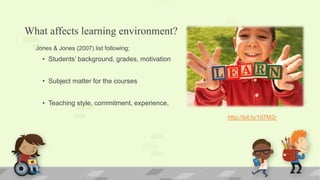
What affects learning environment?
• Students’ background, grades, motivation
• Subject matter for the courses
• Teaching style, commitment, experience,
Jones & Jones (2007) list following;
http://bit.ly/1it7M2r
Primary School
• Get the classroom and materials ready.
• Decide on rules, procedures and attitudes
that you want your students to obey.
• Think about what consequences there should be for students’ behaviors.
• Inform your students on what they are going to go through during the semester.
Guidelines prepared by Evertson, Emmer, Sanford, &
Clement (1983)
http://bit.ly/1M7bNFH
Primary School
• Use different activities as icebreakers and let them socialize.
• Anticipate problems and plan strategies to evade them.
• Monitor your students and get to know their differences.
• Be specific, clear and facilitator while giving the instructions.
http://bit.ly/1HioJ63
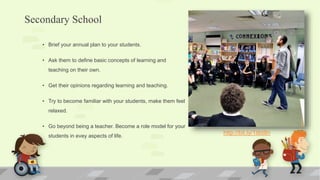
Secondary School
• Brief your annual plan to your students.
• Ask them to define basic concepts of learning and
teaching on their own.
• Get their opinions regarding learning and teaching.
• Try to become familiar with your students, make them feel
relaxed.
• Go beyond being a teacher. Become a role model for your
students in evey aspects of life.
http://bit.ly/1itbt8n
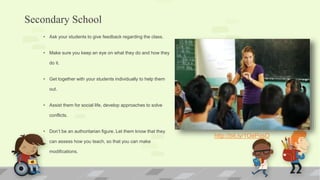
Secondary School
• Ask your students to give feedback regarding the class.
• Make sure you keep an eye on what they do and how they
do it.
• Get together with your students individually to help them
out.
• Assist them for social life, develop approaches to solve
conflicts.
• Don’t be an authoritarian figure. Let them know that they
can assess how you teach, so that you can make
modifications.
http://bit.ly/1OePgsO
What to Do Beginning the School Year?
• Start by introducing yourself. Be kind, welcoming and friendly.
• Use nametags or class name word search to get to know your students.
• Take attendance by using name chain.
• Ask them to talk or write about theirselves, their expectations.
• Mention procudures clearly i.e. Lunch, recess, discussing, entrance and close
of lessons, quarrel,
Literature Review
• McLeod, Fisher, and Hoover (2003) suggest that teachers should become
instructional leaders in the class. Consequently, they have to take
organization of the classroom settings and intellectual and social levels of
students into the consideration to maximize their efficiency.
• Popescu (2014) also states that teachers should design their strategies and
curriculum for intended or unintended student behaviors, try to develop
themselves in terms of resources and time management and become a role
model to their students.
Reference
• McLeod, J., Fisher, J., & Hoover, G. (2003). The key elements of classroom
management: Managing time and space, student behavior, and instructional
strategies. Alexandria, Virginia USA: Association for Supervision and
Curriculum Development (ASCD).
• Popescu, T. (2014). CLASSROOM MANAGEMENT STRATEGIES AND
TECHNIQUES: A PERSPECTIVE OF ENGLISH TEACHER TRAINEES. The
Journal of Linguistic and Intercultural Education, 7, 143-160,204-205.
Retrieved from
http://search.proquest.com/docview/1712314309?accountid=9645
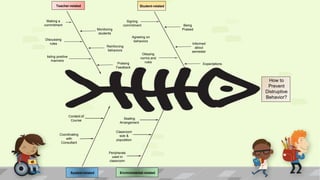
Environmental-relatedSystem-related
Seating
Arrangement
Classroom
size &
population
Content of
Course
Coordinating
with
Consultant
Peripherals
used in
classroom
How to
Prevent
Distruptive
Behavior?
Teacher-related Student-related
Discussing
rules
Signing
commitment
Agreeing on
behaviors
Obeying
norms and
rules
listing positive
manners
Making a
commitment
Monitoring
students
Reinforcing
behaviors
Praising
Feedback
Being
Praised
Informed
about
semester
Expectations
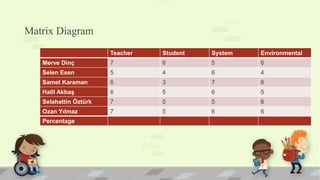
Matrix Diagram
Teacher Student System Environmental
Merve Dinç 7 6 5 6
Selen Esen 5 4 6 4
Samet Karaman 6 3 7 6
Halil Akbaş 6 5 6 5
Selahattin Öztürk 7 5 5 6
Ozan Yılmaz 7 5 6 6
Percentage
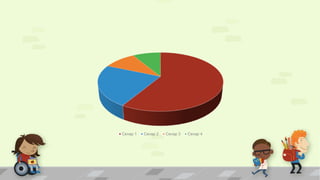
Cevap 1 Cevap 2 Cevap 3 Cevap 4
Survey
• We have conducted a survey among 20 university
students. We expected them to reflect their opinions
about distruptive behaviors in the classroom in
accordance with given questions.
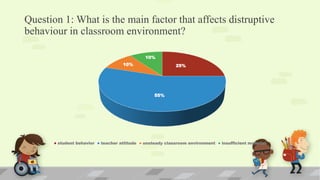
Question 1: What is the main factor that affects distruptive
behaviour in classroom environment?
25%
55%
10%
10%
student behavior teacher attitude unsteady classroom environment insufficient material
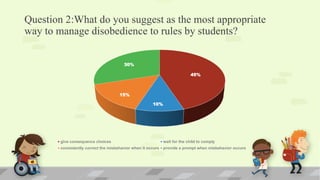
Question 2:What do you suggest as the most appropriate
way to manage disobedience to rules by students?
45%
10%
15%
30%
give consequence choices wait for the child to comply
consistently correct the misbehavior when it occurs provide a prompt when misbehavior occurs
Question 3: What is the best way to promote good
behaviour in the classroom?
35%
25%
15%
25%
exploring with students how people should treat each other
clear boundries and rules for students
as adults, modeling the behaviour that is expected from students
recognizing and giving positive feedback about behaviour
Question 4: What is the key factor for successful group
activities?
sitting arrangement classroom population tedious activity unmotivated students
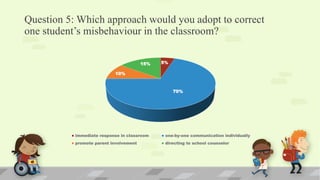
Question 5: Which approach would you adopt to correct
one student’s misbehaviour in the classroom?
5%
70%
10%
15%
immediate response in classroom one-by-one communication individually
promote parent involvement directing to school counselor
Kind Regards to Dr. Köksal

2016 leading seagulls 6 behaved teachers

  • 1.
    Developing Standarts for ClassroomBehaviour and Methods for Maximizing On-Task Student Behaviour
  • 2.
    Table of Contents •Content • Behaved Teachers • Gantt Card • Chapter Reviews • Fishbone • Matrix Diagram • Survey • Problem • References & Thanks
  • 3.
    • Behaved Teachers OzanO. YILMAZ Selahattin ÖZTÜRK Merve DİNÇ Halil AKBAŞSelen ESENSamet KARAMAN
  • 4.
    Gantt Card Steps Oct.29 Oct. 30 Oct. 31 Nov. 2 Nov. 3 Nov. 4 Plan Determination of the problem Literature review targets Do Determination of main causes Collecting and Preparing Data Check Checking Data Suggestions Act Project Preparation Presentation Expected - Observed
  • 5.
  • 6.
    Learning goals • Forexample: • After this presentation: • You will understand the importance of having goals • You will know how to teach and monitor procedures • You will be equipped with the tools to manage desired behaviour in classroom
  • 7.
    Why are thesegoals important? • 1) They provide the clasroom with a smooth flow. • 2) They help reduce behavioral problems. • 3) They help us be more organized, thus more productive.
  • 8.
    Literature Review of «CreatingBehavioral Standards within the Classroom» • (Emmer et al., 1980; Evertson & Emmer, 1982a): Effective teachers teach students classroom rules and procedures. • According to Emmer and colleagues (1981), • Rules mean any written rules given that students must obey. • Procedures mean expectations for a specific behavior. They are directed to accomplishing, rather than forbiddin some behaviour.
  • 9.
    Literature Review • Accordingto initial research, there is a correlation between establishing rules and classroom success • Which means establishing more rules results in more classroom achievement.
  • 10.
    Literature Review • (Evertson& Harris, 1999; Evertson & Smithey, 2000): Teachers should be given more training in classroom management. They further developed this idea into what is known as Classroom Organization and Management Program. • Jerome Freiberg (1999), Ron Nelson (Nelson et al, 1998), Positive Behavioral Support work (Lewis & Newcomer, 2005; Lewis et al., 2006): It is important to teach desired behaviour and to establish agreed-on behaviour standards.
  • 11.
    Practical Implication • Tobecome an effective teacher, we need more training programs like COMP. • Rules are good but procedures are more effective because they are more specific and they are positive rather than negative. But we shouldn’t forget that they are complement of each other. • We shouldn’t start setting rules and procedures on the first day, it can wait several lessons.
  • 12.
  • 13.
    Developing General BehavioursStandarts or Rules • Rules vs. Norms, Behavior Expectations or Behavior Standards.
  • 14.
    Steps in DevelopingClassroom Behaviour Standarts 1. Discussing the value of Rules and Behavior Standards.  Ask students why adults have rules in society.
  • 15.
    Steps in DevelopingClassroom Behaviour Standarts 2. Developing a list.  State the standards in a positive manner.  It is important to evaluate the behavior by examining time, place and manner.
  • 16.
    Steps in DevelopingClassroom Behaviour Standarts 3. Getting a commitment.  Ask students if the rule is appropriate.  Have students sign this commitment.
  • 17.
    Steps in DevelopingClassroom Behaviour Standarts 4. Monitoring and Reviewing the Standards  Students can be asked to role-play both appropriate and inappropriate behavior standards.  It is important to review the rules when the problem increases.
  • 18.
    Steps in DevelopingClassroom Behaviour Standarts 5. Reinforcing Behavior that Supports the Classroom Behavior Norms  Praise and Feedback.  Assign students to observe the class.
  • 19.
    Creative Examples ofTeaching and Reviewing Rules and Procedures
  • 20.
    Preview for TheEffective Teacher - Part 4: Procedures and Routines
  • 21.
    Posters: Prepare posters promoting •Good behavior • Good study habits • Safety rules • School rules • Hang the posters appropriate places
  • 22.
    School in Relationto Community Rules: • Let students work on school rules. • Let them know how school rules works and what their reasons are. • How they are related to community rules • What is the importance of these rules on community life • This let students to know their responsibilities.
  • 23.
    Picture Posters • Makestudents bring their picture of themselves to school • Use student pictures highlighting school rules • The following students believe it is important to respect everyone. • Show pictures listing students’ names and grades • Post posters through school • Uses peer pressure
  • 24.
    DO NOT FORGET! •Your students are individuals. • Your students deserves the treatment that you think you deserve. • Act accordingly.
  • 25.
  • 26.
    Procedures • Procedures meanexpectations for a specific behavior. They are directed to accomplishing, rather than forbiddin some behaviour.
  • 27.
    Several Examples ofProcedures: Class Attention Grabbers Caption
  • 28.
  • 29.
  • 30.
  • 31.
    Can we controlnon-class behaviour?
  • 32.
    How to Teachand Monitor Classroom Procedures DISCUSS: Why do we need to have a procedure? SOLICITATION: Get the students ideas PRACTICE: Students ought to practice the procedure until it is performed correct REINFORCEMENT: Correct behaviour should be reinforced.
  • 34.
    Classroom Management Skillsthat Help Maximize On-Task Student Behaviour
  • 35.
    An Outline forBeginning the School Year • Arranging classroom • Beginning the lesson • Giving clear instructions • Maintainin attention • Using seatwork effectively • Summarizing • Providing useful feedback and evaluation • Making smooth transition
  • 37.
    An Outline forBeginning the School Year • If a teacher corrects misbehavior of one individual student, the other students in the classroom normally will correct their misbehaviors as well. • Teacher needs to be aware of what is going on in all parts of the classroom at all times by continually being alert. Students need to know that the teacher is aware of what is going on in the classroom. • Teacher should maintain the direction in the lesson without being diverted by irrelevant incidents. • Teacher should have the ability to move smoothly from one activity to next and to maintain momentum. (Kounin, Jacob S. (1970) Discipline and Group Management in Classrooms. Holt, Rinehart and Winston, Inc. )
  • 38.
    Creating a Safeand Supportive Learning Community
  • 39.
    What affects learningenvironment? • Students’ background, grades, motivation • Subject matter for the courses • Teaching style, commitment, experience, Jones & Jones (2007) list following; http://bit.ly/1it7M2r
  • 40.
    Primary School • Getthe classroom and materials ready. • Decide on rules, procedures and attitudes that you want your students to obey. • Think about what consequences there should be for students’ behaviors. • Inform your students on what they are going to go through during the semester. Guidelines prepared by Evertson, Emmer, Sanford, & Clement (1983) http://bit.ly/1M7bNFH
  • 41.
    Primary School • Usedifferent activities as icebreakers and let them socialize. • Anticipate problems and plan strategies to evade them. • Monitor your students and get to know their differences. • Be specific, clear and facilitator while giving the instructions. http://bit.ly/1HioJ63
  • 42.
    Secondary School • Briefyour annual plan to your students. • Ask them to define basic concepts of learning and teaching on their own. • Get their opinions regarding learning and teaching. • Try to become familiar with your students, make them feel relaxed. • Go beyond being a teacher. Become a role model for your students in evey aspects of life. http://bit.ly/1itbt8n
  • 43.
    Secondary School • Askyour students to give feedback regarding the class. • Make sure you keep an eye on what they do and how they do it. • Get together with your students individually to help them out. • Assist them for social life, develop approaches to solve conflicts. • Don’t be an authoritarian figure. Let them know that they can assess how you teach, so that you can make modifications. http://bit.ly/1OePgsO
  • 44.
    What to DoBeginning the School Year? • Start by introducing yourself. Be kind, welcoming and friendly. • Use nametags or class name word search to get to know your students. • Take attendance by using name chain. • Ask them to talk or write about theirselves, their expectations. • Mention procudures clearly i.e. Lunch, recess, discussing, entrance and close of lessons, quarrel,
  • 45.
    Literature Review • McLeod,Fisher, and Hoover (2003) suggest that teachers should become instructional leaders in the class. Consequently, they have to take organization of the classroom settings and intellectual and social levels of students into the consideration to maximize their efficiency. • Popescu (2014) also states that teachers should design their strategies and curriculum for intended or unintended student behaviors, try to develop themselves in terms of resources and time management and become a role model to their students.
  • 46.
    Reference • McLeod, J.,Fisher, J., & Hoover, G. (2003). The key elements of classroom management: Managing time and space, student behavior, and instructional strategies. Alexandria, Virginia USA: Association for Supervision and Curriculum Development (ASCD). • Popescu, T. (2014). CLASSROOM MANAGEMENT STRATEGIES AND TECHNIQUES: A PERSPECTIVE OF ENGLISH TEACHER TRAINEES. The Journal of Linguistic and Intercultural Education, 7, 143-160,204-205. Retrieved from http://search.proquest.com/docview/1712314309?accountid=9645
  • 47.
    Environmental-relatedSystem-related Seating Arrangement Classroom size & population Content of Course Coordinating with Consultant Peripherals usedin classroom How to Prevent Distruptive Behavior? Teacher-related Student-related Discussing rules Signing commitment Agreeing on behaviors Obeying norms and rules listing positive manners Making a commitment Monitoring students Reinforcing behaviors Praising Feedback Being Praised Informed about semester Expectations
  • 48.
    Matrix Diagram Teacher StudentSystem Environmental Merve Dinç 7 6 5 6 Selen Esen 5 4 6 4 Samet Karaman 6 3 7 6 Halil Akbaş 6 5 6 5 Selahattin Öztürk 7 5 5 6 Ozan Yılmaz 7 5 6 6 Percentage
  • 49.
    Cevap 1 Cevap2 Cevap 3 Cevap 4
  • 50.
    Survey • We haveconducted a survey among 20 university students. We expected them to reflect their opinions about distruptive behaviors in the classroom in accordance with given questions.
  • 51.
    Question 1: Whatis the main factor that affects distruptive behaviour in classroom environment? 25% 55% 10% 10% student behavior teacher attitude unsteady classroom environment insufficient material
  • 52.
    Question 2:What doyou suggest as the most appropriate way to manage disobedience to rules by students? 45% 10% 15% 30% give consequence choices wait for the child to comply consistently correct the misbehavior when it occurs provide a prompt when misbehavior occurs
  • 53.
    Question 3: Whatis the best way to promote good behaviour in the classroom? 35% 25% 15% 25% exploring with students how people should treat each other clear boundries and rules for students as adults, modeling the behaviour that is expected from students recognizing and giving positive feedback about behaviour
  • 54.
    Question 4: Whatis the key factor for successful group activities? sitting arrangement classroom population tedious activity unmotivated students
  • 55.
    Question 5: Whichapproach would you adopt to correct one student’s misbehaviour in the classroom? 5% 70% 10% 15% immediate response in classroom one-by-one communication individually promote parent involvement directing to school counselor
  • 56.
    Kind Regards toDr. Köksal